

- Article

Protective Effects of Curcumin and Sulforaphane Against Ionising Radiation–Induced Oxidative Stress and Inflammatory Responses in Rat Lung Tissue
- Katarina Baralić,
- Jovana Živanović and
- Danijela Đukić-Ćosić
- + 4 authors
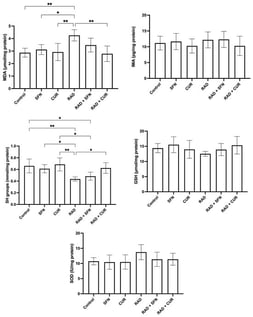
Ionising radiation-induced lung injury is a major complication of thoracic radiotherapy, primarily driven by oxidative stress and inflammation. The current study evaluates and compares the protective effects of sulforaphane (SFN) and curcumin (CUR) pretreatment against radiation-induced oxidative damage and inflammation in rat lung tissue. Female Wistar rats were pretreated in vivo with SFN (2 mg/kg b.w./day) or CUR (4.13 mg/kg b.w./day) for 28 days per os. Isolated lung tissues were exposed ex vivo to γ-radiation (absorbed dose: 2 Gy). Oxidative stress markers—malondialdehyde (MDA), ischemia-modified albumin (IMA), total sulfhydryl (SH) groups, reduced glutathione (GSH), and superoxide dismutase (SOD)—and inflammatory markers—tumour necrosis factor alpha (TNF-α), prostaglandin-endoperoxide synthase 2 (PTGS2/COX-2), interleukin-6 (IL-6), and interleukin-1 beta (IL-1β)—were measured to evaluate irradiation and protective effects. Radiation significantly increased MDA, TNF-α, PTGS2/COX-2, and IL-6 levels while decreasing SH groups. Pretreatment with SFN or CUR attenuated these changes. CUR showed a more pronounced effect on oxidative stress-related parameters, whereas SFN more strongly influenced inflammatory markers. These findings suggest that SFN and CUR differentially modulate radiation-induced oxidative and inflammatory responses in lung tissue under the applied experimental conditions and warrant further investigation of their potential as protective agents in radiotherapy.
15 February 2026