
Skip Content
You are currently on the new version of our website. Access the old version .

Animals

Animals is an international, peer-reviewed, open access journal devoted entirely to animals, including zoology and veterinary sciences, and is published semimonthly online by MDPI.
Indexed in PubMed | Quartile Ranking JCR - Q1 (Veterinary Sciences | Agriculture, Dairy and Animal Science)

All Articles (23,344)

Intensive sheep and goat farming in hot-arid regions faces unique welfare challenges that differ substantially from those encountered in cooler climates; however, few practical and validated assessment tools are specifically designed to assess welfare under such extreme conditions. In this study, the term practical refers to field feasibility under routine farm conditions, limited assessment time, and suitability for reliability-based application, rather than comprehensive validation of welfare outcomes. This study aimed to develop and pilot-test a simplified welfare assessment protocol, based on a reduced set of clearly defined, field-applicable indicators supported by explicit operational definitions and standardized scoring criteria, tailored for the United Arab Emirates, with a specific focus on extreme heat and intensive husbandry conditions. Candidate indicators were identified from validated international sources and screened for applicability to arid climates, meat-oriented production, and intensive systems. The refined indicator set was converted into operational scoring sheets and applied by trained undergraduate animal science students as assessors to 100 animals at an intensive research farm. Inter-observer reliability was calculated using Fleiss’ Kappa to evaluate consistency across assessors. Most behavioural and health indicators demonstrated substantial to almost perfect inter-observer agreement (κ-based), while environmental and some tactile indicators, such as body condition and hydration tests, showed moderate reliability. Based on the most reliable indicators, a climate-sensitive Arid-Hot Small Ruminant Welfare Index (ASR-WI) was developed by weighting four welfare domains—Behaviour and Mental State, Environment, Nutrition, and Health. The findings confirm that a simplified welfare assessment protocol can be reliably implemented under intensive hot-arid conditions when clear scoring criteria and structured assessor training are provided. The resulting protocol and index offer a practical foundation for routine welfare monitoring under intensive hot-arid conditions, as well as for policymaking and future longitudinal research.

11 February 2026
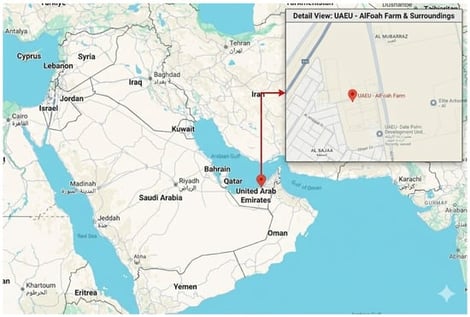
Location of the study site and study farm within the United Arab Emirates.

Socialisation with humans and willingness to interact with them are essential traits for animals involved in animal-assisted services (AAS). This study examined whether goats without prior intensive socialisation with humans may show predispositions to AAS in terms of sociability towards people. Ten goats underwent four tests: (1) acceptance of human approach and touch, voluntary approach to (2) a passive and (3) an active human, and (4) a novel sound fear test. Tests 1–3 were conducted with the caretaker and a familiar neutral person, and 4 with the neutral person. The goats generally accepted being approached and touched but showed little interest in interacting voluntarily with humans. Goats’ responses did not differ between the caretaker and the neutral person (p > 0.05). In the fear test, goats escaped less often and returned more quickly after the sound playback when a human was present (p < 0.01). Female goats exhibited higher sociability towards humans. Overall, the goats demonstrated some predispositions to AAS, such as tolerance of human contact and a tendency to perceive humans as a source of support during stress. However, these traits alone are insufficient for participation in AAS. Additional training is needed to increase the goats’ willingness to initiate interactions with people.

11 February 2026

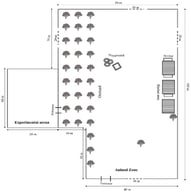
Scheme of the pasture where the goats are kept. Specifically, the Animal Zone with its elements (orchard, playground, shelter area, and drinkers) and the Experimental Zone where the tests were conducted are shown. The dashed lines indicate sections of the diagram that have been abbreviated for visual purposes.

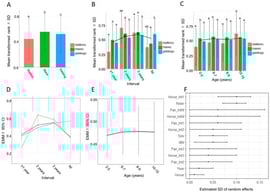
To investigate the factors affecting the utilization of retired Thoroughbred racehorses in equestrian disciplines, Bayesian linear mixed models were separately fitted using rank, round time, and obstacle faults from show-jumping competitions restricted to retired Thoroughbred racehorses as dependent variables, with the interaction between horse sex and the interval from race retirement to competition (as a proxy for transition training to show-jumping) as a fixed effect. When the interval was short (≤1 year), the estimated marginal mean of rank was statistically significantly lower in stallions (0.26) than in mares (0.41) and geldings (0.39). However, ranking improved with longer intervals in all sexes, with the greatest improvement observed in stallions, and the significant sex-related differences disappeared at the 3-year interval, suggesting an effect of transition training on ranking. Round time improved significantly with longer intervals in all sexes, consistent with the ranking pattern; significant improvement in obstacle faults was observed only in stallions and geldings. The explanatory power of the models, including major random effects, rider, horse ability, sire and affiliation after retirement, was moderate (conditional R2: 0.40–0.65), whereas that of the fixed effects was small (marginal R2: 0.02–0.07), indicating the multifactorial nature of success in competition.

11 February 2026

Rank-related results of descriptive analyses and Bayesian linear mixed-model analyses. (A) Mean transformed rank ± SD of stallions, mares, and geldings. (B) Mean transformed rank ± SD of stallions, mares, and geldings by interval between retirement from racing and participation in jumping competition (≤1 year, 2 years, 3 years, and the NI group, representing horses with no information regarding the interval). (C) Mean transformed rank ± SD of stallions, mares, and geldings by age group (2–5 years, 6–7 years, 8–9 years, and 10–15 years). (D) Estimated marginal means (EMMs) ± 95% credible intervals (CIs) for the interaction between sex and interval for transformed rank. (E) EMMs ± 95% CIs for transformed rank by age group. (F) Estimated SDs of random effects in the rank model. Each point represents the posterior mean, and horizontal lines indicate the 95% CIs. Abbreviations: Rider, rider; Pair_Int1y, random slope for rider–horse pair at the ≤1-year interval; Pair_Int2y, random slope for rider–horse pair at the 2-year interval; Pair_Int3y, random slope for rider–horse pair at the 3-year interval; Pair_IntNI, random slope for rider–horse pair in the NI group; Horse_Int1y, random slope for horse at the ≤1-year interval; Horse_Int2y, random slope for horse at the 2-year interval; Horse_Int3y, random slope for horse at the 3-year interval; Horse_IntNI, random slope for horse in the NI group; Sire, sire; Affil, affiliation after retirement; Year, competition year; Venue, competition venue. In panels (A–D), red, green, and blue bars or lines represent stallions, mares, and geldings, respectively. In panels (A–C), bars with different letters (a–c) indicate significant differences (p &lt; 0.05). In panels (B,C), asterisks on the solid line indicate significant differences between specific interval or age groups (p &lt; 0.05).

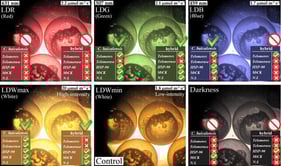
The light spectrum is a key factor in aquaculture, but its effects on molecular stress responses during early fish development are unclear. This study examined how light of different wavelengths (spectra) affects embryos of Baikal whitefish Coregonus baicalensis and its hybrid with Yenisei hump-snout whitefish C. fluviatilis. Eggs were incubated from 35 days post-fertilization under white light (1.8 and 20 µmol m−2 s−1), darkness, red (peak at 631 nm), green (peak at 507 nm) and blue (peak at 459 nm) light. We analyzed relative telomere length, telomerase activity, blood profiles, and expression of stress-related genes (HSP-90, MtCK) at key developmental stages. Notably, a significant increase in telomere length was observed throughout early development (from embryo to larva to fry), independent of the light spectrum. Red light and darkness acted as potent stressors, indicating proteotoxic stress and energy imbalance. In Baikal whitefish, this was accompanied by notable telomere shortening at the earliest stage and elongation at later stages under certain conditions, potentially mediated by increased telomerase activity, a response that may be metabolically costly. Conversely, green light was the most neutral. The effect of blue light differed between Baikal whitefish and its hybrid, with the hybrid proving more sensitive. Furthermore, high-intensity white light (20 µmol m−2 s−1) also induced negative effects in the hybrid, such as increased telomere length, suggesting that excessive irradiance itself can be a stressor, independent of spectral composition. We conclude that darkness or a predominance of red light is suboptimal for incubating these whitefish, while green light provides a more favorable environment, offering a basis for optimizing aquaculture light conditions.

11 February 2026

A system of boxes with individual lighting: (a) an aluminum lid with mounted RGBW LED strips, (b) separate 12-well plates containing incubating whitefish eggs, (c) general view of a foam box with individual thermometers, (d) a system of boxes with holes for aeration inside a refrigerated unit at a temperature of 1–6 °C.

News & Conferences

Issues

Open for Submission

Editor's Choice

Reprints of Collections

Sustainable Feed Ingredients in Freshwater Aquaculture
Reprint

Sustainable Feed Ingredients in Freshwater Aquaculture

Editors: Zsuzsanna Sandor, Csaba Hancz
Feed Additives in Pig Feeding
Reprint

Feed Additives in Pig Feeding

2nd Edition
Editors: Małgorzata Kasprowicz-Potocka

Get Alerted

Add your email address to receive forthcoming issues of this journal.

XFacebookLinkedIn
Animals - ISSN 2076-2615