Skip to Content

Analytica

Analytica is an international, peer-reviewed, open access journal on analytical chemistry and chemical analysis published quarterly online by MDPI.

Quartile Ranking JCR - Q2 (Chemistry, Analytical)

All Articles (211)

High-resolution mass spectrometry (HRMS) enables non-targeted detection of drugs and metabolites in complex matrices. Phase II metabolites—especially glucuronides—are often the only detectable biomarkers in late or postmortem samples but are underrepresented in commercial libraries. This work pursued the prediction of phase II-glucuronide conjugates in diluted urine samples by non-targeted/targeted LC-HRMS workflows. A simply “dilute-and-shoot” qualitative UHPLC-HRMS/MS method (Q Exactive HF, ddMS2) was integrated with Compound Discoverer® software for data processing. The workflow incorporated predictive strategies such as exact mass suspect lists, Structured Query Language (SQL)-based filters, compound-class and diagnostic neutral-loss rules (including the characteristic loss of 176.0321 Da for glucuronides) and MS/MS confirmation using both in-house and public spectral libraries. An additional part of the application’s performance assessment involved its validation for diluted urine sample. A qualitative validated method for more than two hundred drugs in urine samples was performed, including the method’s selectivity/specificity, limit of identification, matrix effects, and potential carryover. Most analytes fulfilled the qualitative acceptance criteria, with more than 60% successfully identified at a concentration of at least 2.5 ng/mL. Matrix effects were within acceptable limits for most compounds, and no severe ion suppression was observed. A non-targeted workflow was applied to real forensic samples (n = 16), allowing a reduction of approximately 66,800 detected features to 225 glucuronide candidates, while a targeted workflow based on exact mass lists yielded 31 high-confidence identifications. Characteristic neutral losses and diagnostic fragment ions led to the tentative identification of some glucuronide phase II metabolites such as mirtazapine–glucuronide, morphine-6–glucuronide, and glucuronide conjugates of benzodiazepines and synthetic opioids. In conclusion, the integration of biotransformation knowledge with HRMS-based predictive filtering allows for the efficient and hydrolysis-free detection of glucuronide metabolites, thereby extending detection windows and enhancing toxicological interpretation in complex forensic scenarios. This adaptable and library-independent workflow also facilitates retrospective data mining, making it suitable for the identification of emerging substances and newly characterized metabolites.

26 February 2026
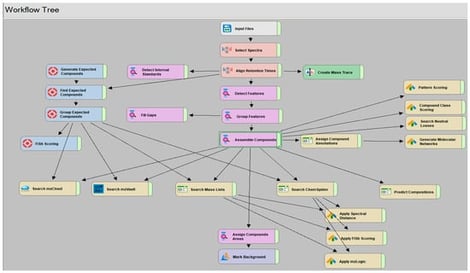
Example of workflow tree, with different nodes applied for results in the study, without SQL filters, through Compound Discoverer software (version 3.3 SP3, ThermoScientific). The node colors represent different functional categories within the workflow: purple indicates feature processing steps such as detection, grouping, and compound assembly; yellow and orange correspond to scoring and annotation processes used for compound identification and confidence evaluation; blue represents data input and database searching nodes; green denotes generation or creation steps such as mass trace or molecular network generation; and red identifies nodes related to expected compounds handling.

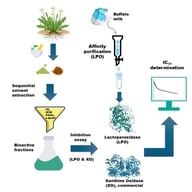
Taraxacum mirabile Wagenitz, one of the endemic riches of Anatolia, is a species that has remained largely unexplored regarding its enzyme inhibition profile despite its pharmacological potential. The effects of T. mirabile aerial and root extracts, obtained at different polarities, were scrutinized in this study against two important enzymes: lactoperoxidase (LPO), which plays a vital role in the innate immune system, and xanthine oxidase (XO), which is prominently associated with hyperuricemia and oxidative stress. The aerial and root portions of the plant were extracted into fractions of varying polarities using petroleum ether, dichloromethane, ethyl acetate, and butanol. LPO was isolated from buffalo milk (881.6-fold purification, 22.5% yield, and 1249.9 EU/mg specific activity) via affinity chromatography and used in in vitro inhibition assays alongside commercial bovine XO enzyme. The results showed that the ethyl acetate fraction of the aerial part of the plant exhibited the strongest LPO inhibition (IC50: 15.60 ± 0.77 µg/mL) among the fractions. The petroleum ether fraction of both the aerial part (IC50: 11.17 ± 0.94 µg/mL) and the root part (IC50: 11.61 ± 0.59 µg/mL) had the highest inhibitory effect for the XO enzyme. These distinct inhibition profiles allow for significant insights into how plant extracts with varying polarities modulate XO and LPO enzymes. In conclusion, the significant inhibitory activity of T. mirabile extracts toward LPO and XO enzymes highlights their potential as a natural source for developing effective enzyme inhibitors, which could be useful for therapeutic applications.

17 February 2026

Purification of buffalo milk LPO by elution from the Sepharose 4B–ethylenediamine–4–thioureidobenzenesulfonamide affinity column. The green curve (left y-axis) represents LPO activity (EU), and the blue curve (right y-axis) depicts the change in absorbance at 280 nm. The orange dots on the x-axis denote fractions of the purified enzyme.

A simple mechanical polishing treatment of commercial solid-gold electrodes (SGEs) can renew the active gold surface, reduce manufacturing-related grooves, and markedly improve the repeatability of geometric-area estimation and the analytical performance in stripping voltammetry. The work focuses on the accurate determination of the geometric area of a SGE by two voltammetric techniques. Cyclic voltammetry (CV) at different scan rates, referred to as the Randles–Ševčik equation, and voltage scans at different electrode rotation rates, based on the Levich equation, were performed. The geometric area of the SGE was also evaluated by scanning electron microscopy (SEM). Commercial SGEs show grooves on their surface, derived from the fabrication processes. The effects of these grooves on the voltammetric response were investigated. The measurements were carried out on the SGE both as received from the manufacturer and after a reduction in the grooves height by a drastic mechanical treatment. After the treatment, the estimated area values were lower and more precise (3.05 ± 0.02 mm2). Moreover, the reduction in the grooves’ height affected the area estimations in contrast with the meaning of the geometric area, as intended by the Randles–Ševčik and Levich equations. Furthermore, the gold exposed surface was measured by CV in sulphuric acid. Finally, the SGE was tested for the detection of Hg in a NaCl solution by anodic stripping voltammetry: the repeatability of the response improved after the mechanical treatment, confirming the usefulness of this step before electrode usage.

13 February 2026

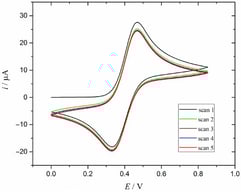
CV scans obtained at the scan rate of 500 mV/s.

The all-d-enantiomeric-peptide RD2 was developed for the treatment of Alzheimer’s disease. This study aimed to develop a specific and highly sensitive liquid chromatography-mass-spectrometric (UHPLC-ESI-QTOF) method for quantifying RD2 in the mouse brain and to validate it according to the ICH M10 guideline to investigate the pharmacokinetic profile of RD2 in its target organ. Sample preparation, chromatographic separation and quantification were very challenging due to RD2’s highly hydrophilic properties, the complex matrix and the required lower limit of quantification (LLOQ). Chromatographic separation was performed on an Acquity UPLC BEH C18 column (2.1 × 100 mm, 1.7 μm particle size) within 5 min at 50 °C with a flow rate of 0.5 mL·min−1. Mobile phases consisted of water and acetonitrile with 0.2% formic acid and 0.015% heptafluorobutyric acid. Ions were generated by electrospray ionization in the positive mode, and RD2 was quantified by QTOF-MS. The developed extraction method revealed complete recovery. The linearity of the calibration curve was in the range of 2 ng·mL−1 to 500 ng·mL−1 (R2 > 0.99) with a LLOQ of 5 ng·mL−1. The intraday and interday accuracy and precision ranged from 0.4% to 12.2% and from 1.0% to 12.0%. RD2 remained stable in the freshly homogenized brain even after several freeze–thaw cycles, but stability decreased over time during long-term storage at −80 °C. Using this validated method, RD2-spiked brain homogenate samples and samples of a pharmacokinetic study with RD2 in mice were analyzed.

7 February 2026

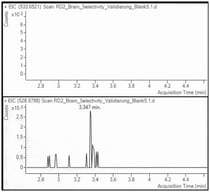
EICs of blank brain homogenate samples. No significant peak appears at the expected retention time for both peptides at ca. 3.4 min (for RD2 (m/z 533.650) and ISTD (528.983)).

News & Conferences

Issues

Open for Submission

Editor's Choice

Get Alerted

Add your email address to receive forthcoming issues of this journal.

XFacebookLinkedIn
Analytica - ISSN 2673-4532