Skip to Content

Administrative Sciences

Administrative Sciences is an international, peer-reviewed, scholarly, open access journal on organization studies published monthly online by MDPI.

Quartile Ranking JCR - Q2 (Management)

All Articles (1,978)

Although Generative Artificial Intelligence (GenAI) has the potential to transform Human Resource Management (HRM), empirical research on its actual use is still rare. This study aims to investigate how HR professionals use GenAI in HRM, the benefits and challenges they associate with it, and how these patterns vary with organizational context. An exploratory cross-sectional survey of 150 HR professionals in the UK (n = 70) and the US (n = 80) was conducted to investigate usage patterns. Results show that GenAI is mainly applied in job analysis and design, training and development, and recruitment and selection, but concerns persist around operational and technical difficulties, privacy and ethics, output accuracy, and employee resistance. Cluster analysis revealed four user profiles that represent different ways of reconciling efficiency gains and risks. Viewed through the lens of Diffusion of Innovation, Technology–Organization–Environment, and Task–Technology Fit, the results highlight ethical and legal compatibility as a relevant condition for sustained use, point to the potential importance of the organization’s GenAI governance environment, and reveal a boundary condition when tasks involve consequential decisions. This study provides insights into early patterns of GenAI use in HRM and advances theory with propositions that can guide future confirmatory research on responsible and effective use.

27 February 2026
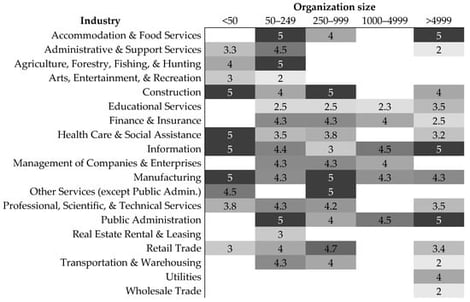
Average frequency of use by industry and organization size.

Development and Validation of a Brief Inventory of Psychosocial Factors Related to Organizational Changes and Occupational Stress

  • Beatriz Acosta-Uribe,
  • Ariadna Crisantema Martínez-Hernández and
  • Nancy Guzmán-Raya
  • + 1 author

In recent decades, profound transformations in work organization, employment conditions, and organizational change processes have intensified workers’ exposure to psychosocial risks, with significant consequences for occupational health and well-being. Despite the growing relevance of these risks, organizations often lack psychometrically robust instruments capable of capturing psychosocial stressors associated with change, Conflicts, and working conditions in an integrated manner. The purpose of this study was to develop and psychometrically evaluate a questionnaire designed to measure psychosocial factors related to organizational changes, interpersonal Conflicts, and occupational well-being. An instrumental study design was employed, following international standards for the construction and validation of psychological instruments. The sample consisted of 350 workers with a mean age of 33.19 years (SD = 9.18; range: 18–66) and an average organizational tenure of 6.71 years (SD = 8.61). The initial 48-item questionnaire was refined to a final version comprising 24 items distributed across 7 scales: Organizational Changes, Work Program, Job Security, Promotion, Training, Interpersonal Conflicts, and Lack of Participation. Preliminary analyses indicated that the data adequately met the assumptions for factor analysis (KMO = 0.81; Bartlett’s test χ2 = 4376.98, p < 0.001). The results supported a seven-factor structure explaining 72% of the total variance, with clear and interpretable factor loadings consistent with the theoretical model. Internal consistency was acceptable to excellent across scales (α = 0.72–0.91; ω = 0.84–0.95), including short scales with three items. Inter-scale correlations were low to moderate, supporting discriminant validity and indicating that the dimensions, while related, represent distinct constructs. Overall, the findings provide strong evidence for the instrument’s reliability and validity based on its internal structure, supporting its use for psychosocial risk assessment and research on organizational changes, interpersonal Conflicts, and occupational well-being.

27 February 2026

  • Systematic Review
  • Open Access

Marketing Agility in Family-Owned Breweries: A Systematic Literature Review and Research Agenda

  • Harry Ph. Sophocleous,
  • Christos Papademetriou and
  • Sotiris Apostolopoulos
  • + 2 authors

The global economy is significantly influenced by family firms, which play a crucial role in shaping and sustaining the so-called real economy. Many flourish in the brewing sector, particularly in the area of craft and microbrewery. Such family firms often have strong community ties, multi-generational leadership and deeply rooted cultural values that influence how they conduct business, both within and outside the organisation. Furthermore, they operate in an industry characterised by a unique blend of cultural identity, emotional branding and a focus on niche markets. Few previous studies have comprehensively approached the topic of marketing agility in family-run brewing businesses. This study provides decision-makers in the brewing industry, particularly those in family-owned businesses, with a research framework for applying agile marketing strategies to improve responsiveness, drive innovation and maintain competitiveness.

27 February 2026

The tire industry, as a long-established and mature sector, is undergoing a profound transformation driven by electrification, smart manufacturing, and sustainability. In this context, efficiency-oriented strategies and incremental improvements can no longer ensure long-term competitiveness. Using Michelin as a case study, this paper examines how open innovation operates as an organizational mechanism for fostering ambidexterity by balancing exploitation with the development of exploration capabilities. The findings reveal that Michelin integrates external knowledge through inbound, outbound, and coupled open innovation, while employing structural and domain separation to absorb, recombine, and institutionalize exploratory initiatives within core operations. This dual approach enables the firm to preserve efficiency advantages while cultivating adaptive capacity under technological and regulatory uncertainty. The study extends theories of open innovation and organizational ambidexterity to a mature manufacturing context and highlights the organizational conditions under which openness supports, rather than undermines, strategic renewal. It also offers practical implications for incumbent firms pursuing strategic transformation under uncertain technological and policy environments.

27 February 2026

News & Conferences

Issues

Open for Submission

Editor's Choice

Reprints of Collections

Advancing Nonprofit Management
Reprint

Advancing Nonprofit Management

Innovations, Challenges and Best Practices
Editors: Mary Tschirhart, Khaldoun AbouAssi
Emerging Trends in Innovative Learning Environments and Entrepreneurial Learning
Reprint

Emerging Trends in Innovative Learning Environments and Entrepreneurial Learning

Editors: Muhammad Zaheer Asghar, Samma Faiz Rasool

Get Alerted

Add your email address to receive forthcoming issues of this journal.

XFacebookLinkedIn
Adm. Sci. - ISSN 2076-3387