Skip Content
You are currently on the new version of our website. Access the old version .

Acoustics

Acoustics is an international, peer-reviewed, open access journal on acoustics science and engineering, published quarterly online by MDPI.

All Articles (434)

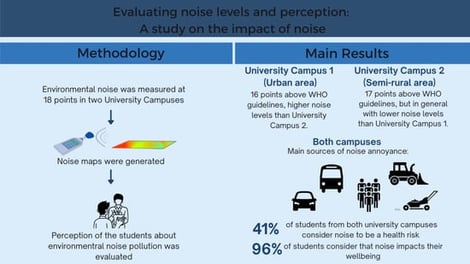
Noise pollution poses a serious threat to human health and well-being, especially in educational environments where concentration and learning are essential. While urban noise has been widely studied, its effects within university settings remain underexplored. This study investigates environmental noise and student perceptions on two campuses of the University of Guadalajara, Mexico—one located in an urban area and the other in a semi-rural setting. Noise levels were measured using the CESVA-SC260 integrating instrument (CESVA Instruments, SLU, Barcelona, Spain), and student perceptions were gathered through a survey. A total of 731 students participated, with 357 from the urban campus and 374 from the semi-rural one. Results showed that noise levels on both campuses frequently exceeded the WHO’s recommended limit of 55 dB(A) for educational facilities, with readings between 40.9 and 85.0 dB(A); 89% of measurements surpassed the threshold. Major sources of noise included vehicular traffic, student gatherings, and construction-related machinery. Survey responses indicated that 41% of students perceived noise as a health risk, and 96% reported adverse effects on well-being and identified it as a disruptor of academic tasks. These findings underscore the pressing need for targeted noise management strategies in university environments and call for further research into effective, context-specific interventions that enhances learning conditions.

9 February 2026
UC1 located in the urban complex of Guadalajara, Mexico.

Dual-Band Acoustic Metasurface: Bimodal Resonance for Anomalous Reflections

  • Xiaole Yan,
  • Qingning Yang and
  • Zhi Chen
  • + 4 authors

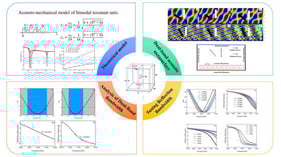
In fields such as noise control, medical ultrasound, and acoustic communication, the flexible regulation of reflected sound waves has significant application value. In this work, a dual-band acoustic metasurface was designed using a split hollow cuboid with an open-hole plate (OPSHC) structure, which simultaneously achieves the direction control of reflected sound waves in both frequency bands. An OPSHC is a series structural unit, and the two center frequencies are mainly controlled by the diameters of the two openings in the structure and the position of the open-hole plate. Through finite element simulation, the influence of the center frequency of the metasurface and the position of the open-hole plate on the bandwidth of the anomalous reflection was studied. The results show that when the low-frequency center frequency is fixed, the low-frequency bandwidth of the metasurface increases with the increase in the high-frequency center frequency. When the position of the plate is moved, the low-frequency bandwidth increases and the high-frequency bandwidth decreases. This type of metasurface provides a new technical approach for broadband acoustic metasurface applications in noise control and underwater detection systems.

8 February 2026

(a) Schematic diagram of the OPSHC structure; (b) a schematic diagram of the equivalent series double mass–spring oscillator model.

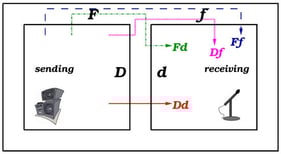
This review provides a comprehensive assessment of modelling techniques for flanking transmission, with a primary focus on building acoustics. The discussion is organised into three main parts. First, methods that address the full vibro-acoustic problem are examined, distinguishing between deterministic approaches—such as the Finite Element Method, spectral formulations, and modal techniques—and statistical approaches, in particular, Statistical Energy Analysis. Second, simplified characterisation methods for flanking transmission paths are reviewed, with emphasis on the EN 12354 framework for heavy structures and subsequent adaptations for lightweight constructions. Third, the parameters commonly used to characterise vibration transmission at structural junctions are introduced, followed by an extensive review of junction-level models. These include wave-based formulations, finite-dimension models suitable for low and mid frequencies, and simplified regression-based expressions intended for practical design workflows. The review concludes with a curated compilation of experimental data available in the literature.

3 February 2026

Sketch of two rooms and the sound transmission via direct and flanking paths.

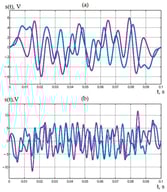
The high peak-to-average power ratio (PAPR) in classical high-speed digital data transmission systems with orthogonal frequency division multiplexing (OFDM) limits energy efficiency and communication range. This paper proposes a method for randomizing OFDM signals via frequency coding using synthesized pseudorandom sequences with improved autocorrelation properties, obtained through machine learning, to minimize PAPR in complex, non-stationary hydroacoustic channels for communicating with underwater robotic systems. A neural network architecture was developed and trained to generate codes of up to 150 elements long based on an analysis of patterns in previously found best short sequences. The obtained class of OFDM signals does not require regular and accurate estimation of channel parameters while remaining resistant to various types of impulse noise, Doppler shifts, and significant multipath interference typical of the underwater environment. The attained spectral efficiency values (up to 0.5 bits/s/Hz) are relatively high for existing hydroacoustic communication systems. It has been shown that the peak power of such multi-frequency information transmission systems can be effectively reduced by an average of 5–10 dB, which allows for an increase in the communication range compared to classical OFDM methods in non-stationary hydrological conditions at acceptable bit error rates (from 10−2 to 10−3 and less). The effectiveness of the proposed methods of randomization with synthesized codes and frequency coding for OFDM signals was confirmed by field experiments at sea on the shelf, over distances of up to 4.2 km, with sea waves of up to 2–3 Beaufort units and mutual movement of the transmitter and receiver.

2 February 2026

(a) randomizing M-sequence 
  
    U
  
 of length 15: 0×35C6 (in hexadecimal), OFDM signal with PAPR = 
  
    6.8
     
    d
    B
  
 (purple). New code of length 15: 0×39A, OFDM signal with PAPR = 
  
    4.56
     
    d
    B
  
 (blue). (b) randomizing M-sequence 
  
    U
  
 of length 31: 0×65EF153, OFDM signal with PAPR = 
  
    9.3
     
    d
    B
  
 (purple). New code of length 31: 0×3FC4C52C, OFDM signal with PAPR = 
  
    4.76
     
    d
    B
  
 (blue).

News & Conferences

Issues

Open for Submission

Editor's Choice

Reprints of Collections

Acoustics, Soundscapes and Sounds as Intangible Heritage
Reprint

Acoustics, Soundscapes and Sounds as Intangible Heritage

Editors: Lidia Alvarez-Morales, Margarita Díaz-Andreu
Historical Acoustics
Reprint

Historical Acoustics

Relationships between People and Sound over Time
Editors: Francesco Aletta, Jian Kang

Get Alerted

Add your email address to receive forthcoming issues of this journal.

XFacebookLinkedIn
Acoustics - ISSN 2624-599X