Skip to Content

International Journal of Neonatal Screening

International Journal of Neonatal Screening (IJNS) is an international, peer-reviewed, open access journal on neonatal screening and neonatal medicine, published quarterly online.
It is the official journal of the International Society for Neonatal Screening (ISNS). The German Society for Neonatal Screening (DGNS), French Society for Neonatal Screening (SFDN), Japanese Society for Neonatal Screening (JSNS), UK Newborn Screening Laboratory Network (UKNSLN) and more societies are affiliated with IJNS. Societies members receive discounts on the article processing charges.
Indexed in PubMed | Quartile Ranking JCR - Q1 (Pediatrics | Genetics and Heredity)

All Articles (664)

Optimal Timing for Neonatal Hearing Screening in Well-Babies

  • Lisanne Vonk,
  • Paula van Dommelen and
  • Catharina (Kitty) P. B. van der Ploeg
  • + 3 authors

In The Netherlands, preventive child healthcare (PCHC) has been carrying out neonatal hearing screening in well-babies since 2006. The aim of this study was to examine the relationship between the age of newborns and the false positive referral rate of the first hearing screening using a transient evoked otoacoustic emission (OAE) test, to identify the most efficient timing for OAE screening. Additionally, we investigated the relationship between the type of OAE screening device (Echoscreen (ES)I/II versus ESIII) and the referral rate during the first screening. We used data from the Dutch universal well-baby neonatal hearing screening programme by PCHC between 2013 and 2023. Multilevel logistic regression analyses were performed to estimate the probability of a referral in 2023 for newborns screened in 2022 and 2023. We included a total of 1,650,506 newborns for 2013–2022 and 323,194 newborns for 2022–2023. The lowest false positive referral rates were found between days five and thirteen, ranging from 3.3 to 3.9%. ESIII significantly increased the probability of a referral compared to ESI/II (odds ratio = 1.84, 95% confidence interval = 1.65–2.06). In conclusion, the timing of neonatal hearing screening significantly impacts the false positive referral rate. Furthermore, the likelihood of a referral is significantly higher when using the ESIII compared to the ESI/II.

15 February 2026
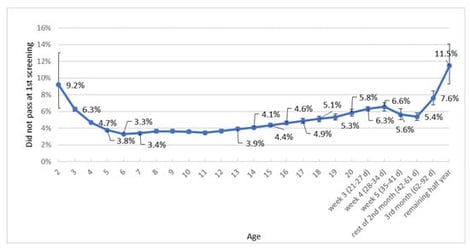
Relationship between age at first OAE hearing session and false positive referral rate (N = 1,650,506). Note: Bars: 95% confidence intervals.

Screening for spinal muscular atrophy (SMA) was adopted by all US state newborn screening programs between 2018 and 2024; by the end of 2022, 48 states were screening for SMA. We assessed trends in health insurance records of SMA diagnoses to quantify improvements in the timeliness of SMA identification following the adoption of screening. We used nationally representative Medicaid claims data for approximately half of US births covered by public insurance and a convenience sample of employer-sponsored health plans. We analyzed records for birth cohorts with at least 1 full year of follow-up (i.e., through the end of the following calendar year). For 2017 births, 1.3 per 100,000 infants had SMA codes first recorded by 1 month of age; this increased to 6.6 per 100,000 among publicly insured newborns born in 2022. The rollout of SMA newborn screening across US states was also followed by improvements in the timely detection of SMA. The proportion of infants with SMA detected by 1 month increased from 18% in 2017 to 61% in 2021 and is projected to reach 75% in 2022. Growth in timely detection was even greater in the employer-insured sample. Timely diagnosis of SMA can enable the initiation of treatment prior to the irreversible loss of motor function.

18 February 2026

Newborn bloodspot screening (NBS) began in Guthrie’s laboratory in 1961 for phenylketonuria. A federal study the following year formed the basis for expanding NBS as a public health function. Diseases detectable through NBS gradually expanded, eventually including sickle cell anemia, which was included in the screening panel in New York in 1975. Universal inclusion of full population screening for sickle cell anemia was included in all US NBS programs by 2006. Through the years, NBS for sickle cell anemia has expanded to include other clinically significant hemoglobin disorders (both hemoglobinopathies and thalassemias). While NBS programs exist in most high-income countries, their implementation in low- and middle-income settings has been slow, with the inclusion of hemoglobin disorders occurring even more slowly. It is particularly noteworthy that the low-resource settings with the highest incidences of sickle cell diseases (Sub-Saharan Africa, the Caribbean Islands, and India) and therefore the greatest potential for benefitting from NBS, continue to struggle with its implementation. Recent advances in curative treatments further emphasize the importance of NBS in early disease identification. This report reviews some of the history of newborn screening for hemoglobinopathies and thalassemias and provides an update of related activities currently ongoing globally.

17 February 2026

  • Conference Report
  • Open Access

Integrated Newborn Screening in Nigeria: The Way Forward, A Workshop Report

  • Olumuyiwa S. Folayan,
  • Bose E. Orimadegun and
  • John I. Anetor
  • + 3 authors

Newborn screening (NBS) is a cost-effective public health strategy for the early detection of congenital disorders that cause neonatal/infant morbidity and mortality. It is standard care in many high-income and emerging economies. Nigeria, despite its high birth number, has no newborn screening (NBS) programme for any disorder, causing missed opportunities for early therapy. This manuscript is a workshop report and expert consensus of a three-day national workshop organised by the Newborn Screening Consortium–Nigeria (NSC-N) in conjunction with The Federal Ministry of Health Nigeria, Revvity, and international partners. The first meeting comprised experts in different fields of newborn screening and newborn care who reviewed priority congenital disorders, implementation barriers, and national NBS needs in Nigeria. Experts presented pilot data, opinions, and global best practice evidence. Contributions were examined and debated and conclusions were reached by guided discussions and consensus agreement for a pragmatic nationwide NBS plan. The key outcomes were the urgency for Nigeria to begin an integrated, comprehensive NBS programme. Based on standard prioritisation criteria, sickle cell disease and congenital hypothyroidism were selected. Key implementation strategies included integration into routine maternal and child health services, establishing a national screening database, and developing a robust legislative and policy framework. The NBS workshop developed a framework to commence and incorporate integrated NBS into the Nigerian healthcare system. Two conditions were selected to kickstart the programme and establish a foundation for future expansion. This would improve neonatal health outcomes and reduce the long-term burden of congenital disorders.

29 January 2026

News & Conferences

Issues

Open for Submission

Editor's Choice

Reprints of Collections

Newborn Screening for Congenital Hypothyroidism
Reprint

Newborn Screening for Congenital Hypothyroidism

Editors: Ernest M. Post, Natasha Heather
Newborn Screening in Japan
Reprint

Newborn Screening in Japan

Editors: Toshihiro Tajima, Seiji Yamaguchi

Get Alerted

Add your email address to receive forthcoming issues of this journal.

XFacebookLinkedIn
Int. J. Neonatal Screen. - ISSN 2409-515X