


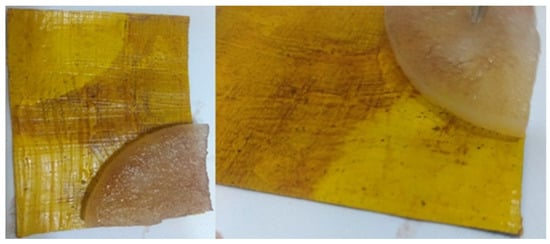
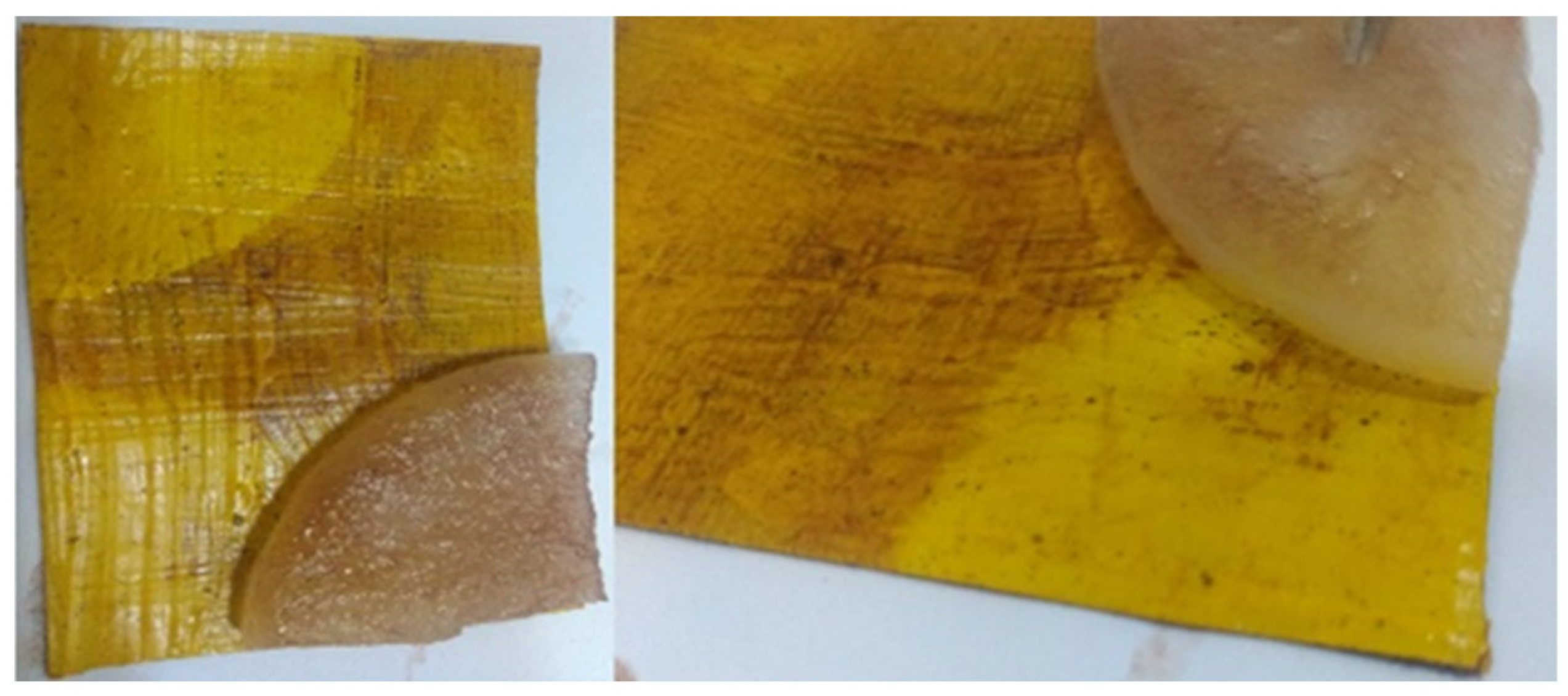
Introduction: History can be defined as the study of people who have lived in the past. From one generation to another, people transmit values and knowledge through art. The more efficient the processes of evaluation, cleaning, and restoration of cultural heritage, the more efficient the communication between generations. Over time, the painting undergoes numerous oxidation processes by exposure to light or various contaminants from the environment which causes loss of visibility through the formation of unwanted layers [1,2]. Today’s study aims to evaluate some recipes for cryogels in the process of cleaning acrylic paints. Materials and methods: Sample preparation consisted of application of pigments in two steps on a black paper with thickness 0.2 mm, using ordinary brushes. Aging process was simulated when the paintings samples was introduced at climate chamber KK150 for 3 days at T = 50 °C and RH = 15% with 4 h/day. An artificial soil with the composition described in [3] was applied on the paintings in order to partially simulate the natural soiling of the paintings exposed to pollutants, dust, or smoke. For cryogel synthesis, we used 10 g polyvinyl alcohol (PVA) dissolved in 100 mL H2O through magnetic stirring for 2 h at 800 rpm and 85 °C. After this step, the content was transferred in a Petri dish and kept at room temperature to cool. The subsequent freezing–thawing cycles consisted in placing the samples on the freezer for 20 h at a temperature of −20 °C then thaw for 4 h at room temperature [4]. For the removal of the hydrophobic layer, a microemulsion O/W based on toluene, water, Triton X-100, and n-butanol was used. The microemulsion can be uploaded in cryogel in two ways; before starting the first FT cycle or through immersion in microemulsion for 24 h after the last FT cycle. Results: To remove the excess of microemulsion, the gel is placed for a few minutes in a sheet of filter paper. The gel was applied to the substrate with tweezers, every 2 min, when the position of gel was changed. Color analysis was made with a chromameter Konica Minolta CR-410 and with a hyperspectral camera GreenEye Vis-NIR in the initial state, after the soiling process, after the application of the first stage of treatment, and, respectively after the second treatment. The differences of the values between the chromatic parameters of the initial and the final state must be as small as possible. Conclusions: The layer of dirt was removed and the acrylic pigment was not absorbed by cryogel (Figure 1). The evaluation of cleaning capacity was quantified through optical microscopy, colorimetry, and imaging spectral data.
Figure 1.
The application of first treatment.
Author Contributions
Conceptualization, R.-M.I. and D.A.V.; methodology, D.A.V., C.E.R. and I.O.Z.; validation, C.E.R., D.A.V., I.O.Z. and R.-M.I.; formal analysis, L.M.; investigation, C.E.R., D.A.V., I.O.Z. and I.V.; resources, R.-M.I.; data curation, R.-M.I.; writing—original draft preparation, D.A.V.; writing—review and editing, D.A.V. and R.-M.I.; visualization, C.E.R.; supervision, R.-M.I.; project administration, R.-M.I.; funding acquisition, R.-M.I. All authors have read and agreed to the published version of the manuscript.
Funding
This research was funded by the Romanian Ministry of Research and Innovation, Project 51PCCDI/2018 within PNIII and PN 19.23.03.01.11 within the NUCLEU program.
Institutional Review Board Statement
Not applicable.
Informed Consent Statement
Not applicable.
Data Availability Statement
Not applicable.
Conflicts of Interest
The authors declare no conflict of interest.
References
- Linhares, J.; Cardeira, L.Q.; Bailão, A.; Pastilha, R.; Nascimento, S. Chromatic changes in paintings of Adriano de Sousa Lopes after the removal of aged varnish. Conserv. Patrim. 2020, 34, 50–64. [Google Scholar] [CrossRef] [Scilit]
- Mecklenburg, M.; Koestler, R.J.; Charola, A.E. New Insights into the Cleaning of Paintings, Proceedings from the Cleaning 2010 International Conference, Universidad Politécnica de Valencia and Museum Conservation Institute; Smithsonian Institution Scholarly Press: Washington, DC, USA, 2013; pp. 1–243. [Google Scholar] [CrossRef]
- Bronwyn, A.; Soldano, O.A.; Keefe, M.H.; Phenix, A.; Learner, T. An Empirical Evaluation of a Range of Cleaning Agents for Removing Dirt from Artists’ Acrylic Emulsion Paints. AIC Paintings Specialty Group Postprints 23. Presented at the 38th Annual Meeting of the American Institute for Conservation and Historic Works, Milwaukee, WI, USA, 11–14 May 2010; pp. 77–87. [Google Scholar]
- Chelazzi, D.; Bordes, R.; Giorgi, R.; Holmberg, K.; Baglioni, P. The use of surfactants in the cleaning of works of art. Curr. Opin. Colloid Interface Sci. 2020, 45, 108–123. [Google Scholar] [CrossRef] [Scilit]
Publisher’s Note: MDPI stays neutral with regard to jurisdictional claims in published maps and institutional affiliations. |
© 2022 by the authors. Licensee MDPI, Basel, Switzerland. This article is an open access article distributed under the terms and conditions of the Creative Commons Attribution (CC BY) license (https://creativecommons.org/licenses/by/4.0/).