

The Vertex Gutman Index and Gutman Index of the Union of Two Cycles

School of Mathematics, North University of China, Taiyuan 030051, China
*
Author to whom correspondence should be addressed.
Axioms 2024, 13(4), 269; https://doi.org/10.3390/axioms13040269
Submission received: 14 March 2024
/
Revised: 15 April 2024
/
Accepted: 16 April 2024
/
Published: 18 April 2024
(This article belongs to the Special Issue Advances in Convex Geometry and Analysis)
Abstract
:The Wiener index is one of the most classic and widely used indicators in topology. It reflects the average distance of any node pair in the graph. It not only makes the boundaries of given graphs clearer but also continuously generates topological indices that are more suitable for new fields, such as the Gutman index. The Wiener index and Gutman index are two important topological indices, which are commonly used to describe the characteristics of molecular structure. They are closely related to the physical and chemical properties of molecular compounds. And they are widely used to predict the physical and chemical properties and biological activity of molecular compounds. In this paper, we study the vertex Gutman index and Gutman index and describe the structural characteristics of all cases of two simple cycles intersecting. We comprehensively analyze the Gutman index and vertex Gutman index in these cases in detail by means of classification discussion and analogical reasoning and characterize their maximum and minimum accordingly.
1. Introduction
Let be an undirected simple graph with vertex set and edge set E. The degree is the number of edges connecting to the vertex u in the G. The distance between vertices u and v in G is the length of the shortest path connecting u and v.
The Gutman index of the graph G is the sum of the products of the distance of pairs of unordered vertices and their vertex degrees, i.e.,
where is called the degree distance of the vertex u, denoted as . is called the vertex Gutman index of u, denoted as . The Gutman index of the graph G can also be expressed as , i.e.,
Path is a non-null graph whose vertex set and edge set are, respectively,
Here, all the are different from each other. Vertices and are connected by path P and called endpoints or ends of the path, and is called the internal vertex of P. The path of length k is designated as . If a path is closed, that is, it has a positive length and the same beginning as the end, then it is a cycle. A cycle with length n is referred to as .
The topological index of a graph is an invariant derived from the molecular structure graph of a compound. It is often used to study the structural properties or characteristics of molecules, allowing for numerical calculation of molecular structure information. The topological index of the distance between vertices plays a vital role in describing the molecular graph and establishing the relationship between molecular structure and features. In [1], Dobrynin and Kochetova introduced a variant of the Wiener index, the degree distance (later known as the Schultz index) of the graph based on vertex degree and distance. In [2], Klavzar and Gutman changed the sum of any two degrees in the Schultz index to the product of degrees, defining the improved Schultz index and later the Gutman index. In [3], Gutman et al. formally introduced the Gutman index based on graph invariants of degree and distance, expanding the field of graph parameters related to vertex degree and distance. Subsequently, it has been studied by numerous experts and scholars. In [4], Feng et al. studied the Gutman index of unicyclic graphs with given pendant edges. The (vertex) degree distance and Gutman index of one vertex union of two cycles were given in [5,6], and new methods for calculating them were explored in [7]. In [8], Das et al. generalized the well-known Gutman index by introducing the general Gutman index of a graph. The recent literature has discussed the association and comparison between the degree distance and Gutman index [9,10,11], respectively. The extremal generalized Gutman index of trees was studied in [12]. In [13], Liu et al. focused on minimizing the Gutman index among unicyclic graphs with a given matching number. In [14,15], the scholars studied an even cycle and low-stretch trees. And the latest relevant studies are available in [16,17]. They studied the Sombor index of cycle graphs and the Gutman index of spiro and polyphenyl hexagonal chains. However, there are few papers that link cycle graphs with the Gutman index, so this article begins to explore this.
The in-depth study of the path union and double intersection union of two cycles presented in this article represents a significant deepening and refinement of previous research areas, delving into a more intricate and sophisticated analysis of topological structures. This paper aims to further elucidate the inherent connections between the profound characteristics and properties of molecular structures by exploring the vertex Gutman index, Gutman index, and their extremum within these complex structures.
Based on an understanding of the , this paper studies the vertex Gutman index and Gutman index on the and , comparing the maximum and minimum of their (vertex) Gutman index, which improves the results of the Gutman index of the union of double circles.
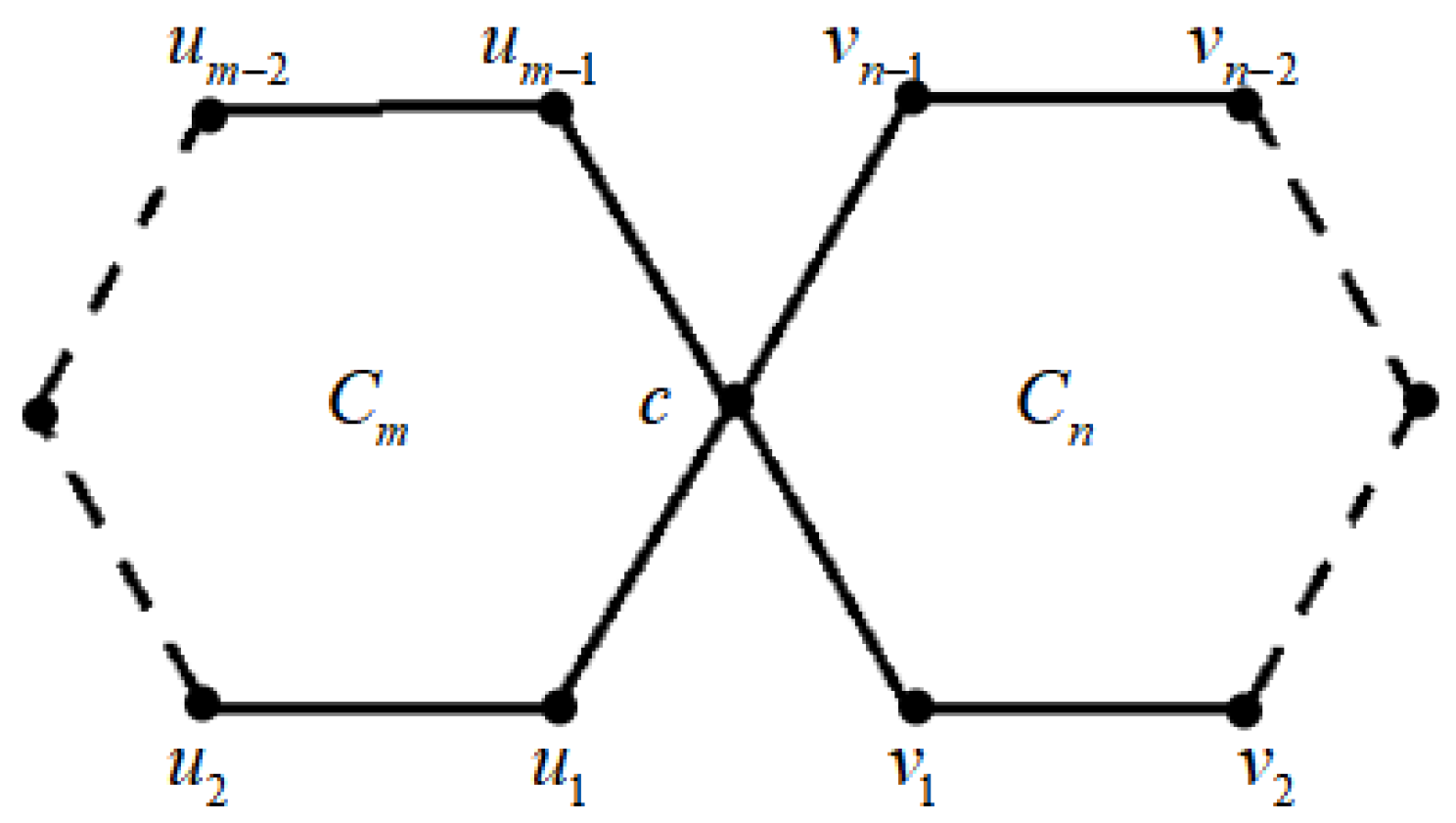
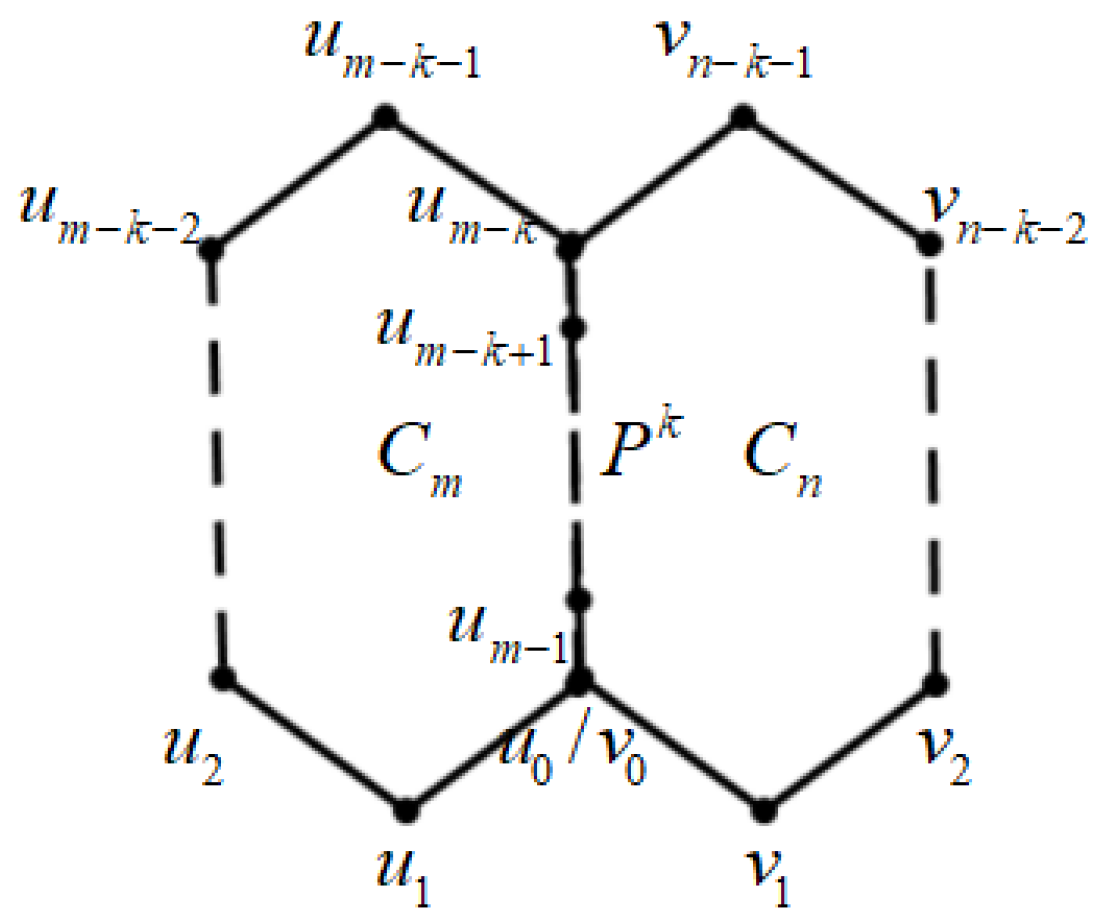
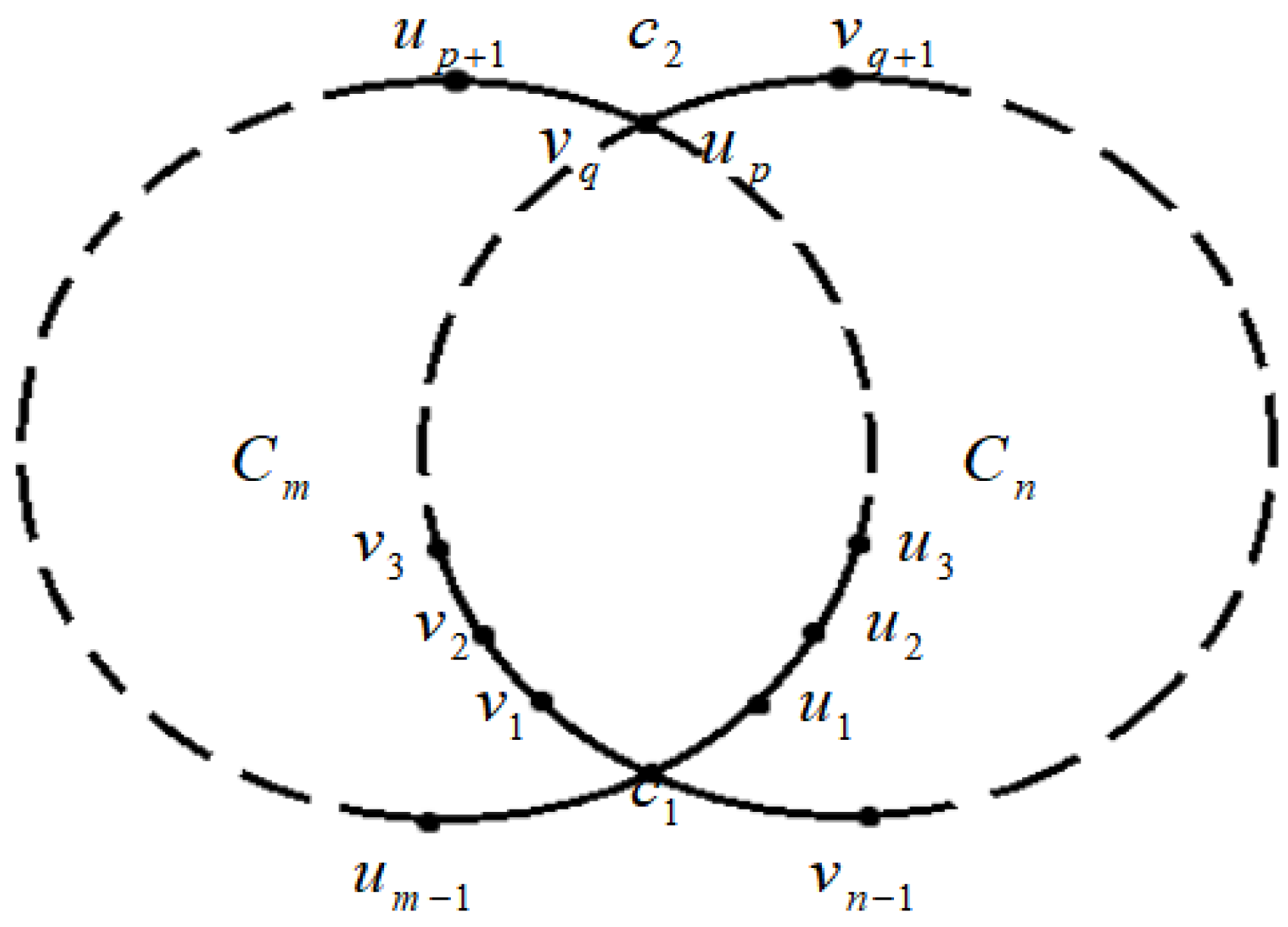
In the following, and and indicate roads with length k and circles of length m and n, respectively. The s indicates the number of odd numbers in . , , and represent the single intersection union, path union, and double intersection union of and , respectively (see Figure 1, Figure 2 and Figure 3 for details). Where , .
Due to the symmetry of the graph structure [18], for convenience, let ,
2. The Gutman Index of
Theorem 2 ([6]).
The extreme value of the vertex Gutman index in is as follows:
Theorem 3 ([6]).
The Gutman index of
From the above, the vertex Gutman index of had the maximum at the center and the minimum at some vertices nearest to the center.
3. The Gutman Index of
3.1. The First Situation:
Lemma 1.
The Gutman index of the endpoint v of is
Proof.
Due to the symmetry of the graph, we only consider the vertex of . By the definition of the Gutman index of the vertex
(1) If m and n are both odd or even, then
(2) If m is odd, n is even, then
(3) Similarly, m is even, n is odd,
□
Lemma 2.
The Gutman index of the internal vertex of is:
Proof.
By the definition of the Gutman index of the vertex
(1) If m and n are both odd or even, then
(2) If m is odd, n is even, then
(3) Similarly, m is even, n is odd,
□
Lemma 3.
The Gutman index of the vertex in the cycle is
Proof.
By the definition of the Gutman index of the vertex
Due to the symmetry of the vertex, we only consider and .
Case 1: m and n are both odd or even.
(1) If , then
(2) If , then
Case 2: m is odd, n is even.
(1) If , then
(2) If , then
Case 3: Similarly, the conclusion holds when m is an even number and n is an odd number.
From the symmetry of the graph structure, we obtain Lemma 4 by contrast. □
Lemma 4.
The Gutman index of the vertex in the cycle is
It is easy to obtain the following two Lemmas from Lemma 2 to Lemma 4.
Lemma 5.
Lemma 6.
Theorem 4.
where .
Proof.
(1) When ,
It is easy to obtain that, when , ; and when ,
(2) When ,
It is easy to obtain that, when , , where the equation holds if and only if k is even and meets the conditions ; when , ; when and , .
In summary, the conclusion is valid. □
Theorem 5.
Proof.
By Lemma 1 to 4, it is easy to calculate that
Thus,
Specifically, when , □
Theorem 6.
The Gutman index of is
where
Proof.
By the definition of the Gutman index of graph
(1) If m and n are both odd or even, then
(2) If m is odd, n is even, then
(3) Similarly, if m is even, n is odd,
□
3.2. The Second Situation:
Lemma 7.
The Gutman index of the endpoint v of is
Proof.
Due to the symmetry of the graph, we only consider the vertex of . By the definition of the Gutman index of the vertex
(1) If m and n are both odd or even, then
(2) If m is odd, n is even, then
(3) Similarly, if m is even, n is odd, □
Lemma 8.
The Gutman index of the internal vertex of is
Proof.
By the definition of the Gutman index of the vertex
Due to the symmetry of the vertex, we only consider and
Case 1: m and n are both odd or even.
(1) If , then
(2) If , then
Case 2: m is odd, n is even.
(1) If , then
(2) If , then
Case 3: Similarly, the conclusion holds when m is an even number and n is an odd number. □
Lemma 9.
The Gutman index of the vertex in the cycle is:
Proof.
By the definition of the Gutman index of the vertex
Due to the symmetry of the vertex, we only consider and .
Case 1: m and n are both odd or even.
(1) If , then
(2) If , then
Case 2: m is odd, n is even.
(1) If , then
(2) If , then
Case 3: Similarly, the conclusion holds when m is an even number and n is an odd number. □
Lemma 10.
The Gutman index of the vertex in the cycle is:
The proof method is like Lemma 9.
It is easy to obtain the following two Lemmas from Lemma 8 to Lemma 10.
Lemma 11.
Lemma 12.
Theorem 7.
where , .
Proof.
Case 1: When , then
Thus,
Case 2: When , then
(1) If , then
The proof method is similar to Theroem 4, which is discussed in different cases below.
(a) When and , ;
(b) When and or , ;
(c) When , .
(2) If , then
Similar to (1), the following cases are discussed below:
(a) If and ,
(b) If and or ,
(c) If ,
In summary, this theorem holds. □
Theorem 8.
Proof.
By Lemma 7 to 10, we have
Thus, . □
Theorem 9.
The Gutman index of the is
where
Proof.
By the definition of the Gutman index of graph
(1) If m and n are both odd or even, then
(2) If m is odd, n is even, then
(3) If m is even, n is odd, and it is a similar proof that the conclusion holds. □
From the above, by comprehensively summarizing the two situations, it can be concluded that the vertex Gutman index of is the maximum at the end of the public path or the farthest point from the end of the public path and the minimum at some vertices closest to the end of the public path.
Comparing the vertex Gutman index, Gutman index, and the extremum of under different parameters can help us gain insight into the influence of this particular structure on the overall properties of the compound, thus revealing the relationship between the molecular structure and its properties.
4. The Gutman Index of the
4.1. The First Situation:
Lemma 13.
The Gutman index of the intersection c of and is:
Proof.
Due to the symmetry of the graph, we only consider the vertex of . By the definition of the vertex Gutman index
Case 1: m and n are both odd or even.
(1) If is even, then
(2) If is odd, similarly,
Case 2: m is odd, n is even.
(1) If is even, then
(2) If is odd, similarly,
Case 3: Similarly, the conclusion holds when m is an even number and n is an odd number. □
Lemma 14.
The Gutman index for the vertices in the cycle is:
Proof.
Let , . Defined by the Gutman index of the vertex
Due to the symmetry of the vertex, we only consider , and .
Case 1: m and n are both odd or even.
(1) If is even, , then
(2) If is even, , then
(3) If is even, , then
(4) Similarly, when is odd, the conclusion holds.
Case 2: m is odd, n is even.
(1) If is even, , then
(2) If is even, , then
(3) If is even, , then
(4) Similarly, when is odd, the conclusion holds.
Case 3: Similarly, the conclusion holds when m is an even number and n is an odd number. □
From the symmetry of the graph structure, we obtain Lemma 15 by contrast.
Lemma 15.
The Gutman index for the vertices in the cycle is:
It is easy to obtain the following two Lemmas from Lemma 14 to 15.
Lemma 16.
Lemma 17.
Theorem 10.
Proof.
According to Lemma 13 to 15, then ,
Thus,. □
Theorem 11.
The Gutman index of the is
where
Proof.
By the definition of the Gutman index of graph
Case 1: are both odd or even.
(1) If is even, then
(2) If is odd, similarly, then
Case 2: m is odd, n is even.
(1) If is even, then
(2) If is odd, similarly, then
Case 3: Similarly, the conclusion holds when m is an even number and n is an odd number. □
Considering that the second and third situation proof methods are similar to the first situation, in the following proofs, we only consider that m and n are both odd numbers.
4.2. The Second Situation: ,
Lemma 18.
The Gutman index of the intersection of and is
Proof.
Due to the symmetry of the graph, we only consider the vertex of . By the definition of the vertex Gutman index
Let m and n be odd. We discuss different cases.
Case 1: .
(1) If is even, then
(2) If is odd, similarly, the conclusion holds.
Case 2: .
(1) If is even, then
(2) If is odd, similarly, the conclusion holds. □
Lemma 19.
The Gutman index for the vertices in the cycle is
(1) When , then
(2) When , then
Proof.
Let , . Defined by the Gutman index of the vertex
Let m and n be odd. We discuss different cases.
Case 1: . Due to the symmetry of the vertex, we only consider , and .
(1) If is even, , then
(2) If is even, , then
(3) If is even, , then
(4) Similarly, when is odd, the conclusion holds.
Case 2: . Due to the symmetry of the vertex, we only consider , , and .
(1) If is even, , then
(2) If is even, , then
(3) If is even, , then
(4) If is even, , then
(5) Similarly, when is odd, the conclusion holds. □
From the symmetry of the graph structure, we obtain Lemma 20 by contrast.
Lemma 20.
The Gutman index for the vertices in the cycle is
(1) When , then
(2) When , then
It is easy to obtain the following two Lemmas from Lemma 19 to 20.
Lemma 21.
Lemma 22.
- (1)
- When , then
- (2)
- When , then
Theorem 12.
Proof.
We discuss different cases according to Lemma 18 to 20. we discuss in different cases
(1) If , then
Thus,.
(2) If , then
Thus,.
In summary, the conclusion holds. □
Theorem 13.
The Gutman index of the is
(1) When , then
(2) When , then
where
Proof.
By the definition of the Gutman index of graph
Let m and n be odd. We discuss different cases.
Case 1: .
(1) If is even, then
(2) If is odd, similarly, then
Case 2: . □
From the symmetry of the graph structure, the conclusion clearly holds.
4.3. The Third Situation: ,
Lemma 23.
The Gutman index of the intersection of and is:
Proof.
Due to the symmetry of the graph, we only consider the vertex of . By the definition of the vertex Gutman index
Let m and n be odd. We discuss different cases.
Case 1: .
(1) If is even, then
(2) If is odd, similarly, the conclusion holds.
Case 2: .
(1) If is even, then
(2) If is odd, similarly, the conclusion holds.
□
Lemma 24.
The Gutman index for the vertices in the cycle is
(1) When , then
(2) When , then
Proof.
Let , . Defined by the Gutman index of the vertex
Let m and n be odd. We discuss different cases.
Case 1: . Due to the symmetry of the vertex, we only consider , and .
(1) If is even, , then
(2) If is even, , then
(3) If is even, , then
(4) Similarly, when is odd, the conclusion holds.
Case 2: . Due to the symmetry of the vertex, we only consider , , and .
(1) If is even, , then
(2) If is even, , then
(3) If is even, , then
(4) If is even, , then
(5) Similarly, when is odd, the conclusion holds. □
From the symmetry of the graph structure, we obtain Lemma 25 by contrast.
Lemma 25.
The Gutman index for the vertices in the cycle is
(1) When , then
(2) When , then
It is easy to obtain the following two Lemmas from Lemma 24 to 25.
Lemma 26.
Lemma 27.
(1) When , then
(2) When , then
Theorem 14.
Proof.
Thus,. □
We discuss different cases from Lemma 23 to 25.
(1) If , then
Thus,.
(2) If , then
In summary, the conclusion holds.
Since when , the case is the same as in Section 3.1, when , the case is the same as for in Section 3.2. Therefore, the following theorem can be drawn directly.
Theorem 15.
The Gutman index of the is
(1) When , then
(2) When , then
From the above three situations, the vertex Gutman index of is the maximum at the intersection or the farthest distance from the intersection, and the minimum at some vertices closest to the intersection.
By comparing the vertex Gutman index, Gutman index, and the extremum of under different parameters, we can gain insights into how the arrangement and nature of the bonds affect the overall properties of the molecule and can predict and explain the behavior of molecules with similar graph structures.
5. Conclusions
Based on the Gutman index of degree and distance, we have made full use of algebraic theory, classification discussion, and calculation skills of logical reasoning to describe the intersection of all double-circle graphs, and summarized that the (vertex) Gutman index of , , and is the maximum at the intersection (endpoint) or the farthest distance from the intersection (endpoint) and the minimum at some vertices closest to the intersection (endpoint).
Our future research directions may delve deeper into the vertex Gutman index, Gutman index, and their extremal properties related to pairwise intersecting cycles in tricyclic or even higher-order cyclic graphs. We expect to draw consistent conclusions from the structure of such graphs to obtain extremum at the same position. And we make similar considerations for paths. Such graphs share similarities with the resonance structures of benzene and its derivatives in chemistry. Therefore, studying them can assist us in understanding and analyzing the distribution and flow of electrons within chemical molecules, ultimately leading to a deeper understanding of their chemical properties and reaction mechanisms.
Author Contributions
Conceptualization, Y.M. and H.M.; Methodology, Y.M.; Software, H.M.; Formal analysis, Y.M. and H.M.; Writing—original draft, H.M.; Writing—review & editing, Y.M. All authors have read and agreed to the published version of the manuscript.
Funding
This research was funded by Shanxi Scholarship Council of China (No. 2022-149).
Data Availability Statement
Data are contained within the article.
Acknowledgments
The authors express their sincere thanks to the anonymous referee for many valuable comments and suggestions.
Conflicts of Interest
The authors declare that they have no conflicts of interest in this paper.
References
- Dobrynin, A.A.; Kochetova, A.A. Degree distance of a graph: A degree analogue of the Wiener. J. Chem. Inf. Comput. Sci. 1994, 34, 1082–1086. [Google Scholar] [CrossRef]
- Klavžar, S.; Gutman, I. Wiener number of vertex-weighted graphs and a chemical application. Discret. Appl. Math. 1997, 80, 73–81. [Google Scholar] [CrossRef]
- Gutman, I.; Furtula, B.; Das, K. On some degree-and-distance-based graph invariants of trees. Appl. Math. Comput. 2016, 289, 1–6. [Google Scholar] [CrossRef]
- Feng, M.; Yu, X.; Zhang, J.; Duan, W. The Gutman Index of the Unicyclic Graphs with pendent edges. J. Phys. Conf. Ser. 2021, 2012, 012053. [Google Scholar] [CrossRef]
- Guo, H. The Vertex Degree Distance of One Vertex Union of Two Cycles. J. Phys. Conf. Ser. 2019, 1302, 042041. [Google Scholar] [CrossRef]
- Wang, K.; Guo, H. The (Vertex) Gutman Index of One Vertex Union of Two Cycles. J. Phys. Conf. Ser. 2022, 2173, 012017. [Google Scholar] [CrossRef]
- Brezovnik, S.; Tratnik, N. New methods for calculating the degree distance and the Gutman index. MATCH Commun. Math. Comput. Chem. 2019, 82, 111–132. [Google Scholar]
- Das, K.C.; Vetrík, T. General Gutman index of a graph. MATCH Commun. Math. Comput. Chem. 2023, 89, 583–603. [Google Scholar] [CrossRef]
- Das, K.C.; Su, G.; Xiong, L. Relation between degree distance and Gutman index of graphs. MATCH Commun. Math. Comput. Chem. 2016, 76, 221–232. [Google Scholar]
- Guo, H.; Zhou, B. Properties of degree distance and Gutman index of uniform hypergraphs. MATCH Commun. Math. Comput. Chem. 2017, 78, 213–220. [Google Scholar]
- Ashraf, S.; Imran, M.; Bokhary, S.; Akhter, S. The Wiener index, degree distance index and Gutman index of composite hypergraphs and sunflower hypergraphs. Heliyon 2022, 8, e12382. [Google Scholar] [CrossRef]
- Cheng, X.; Li, X. Extremal General Gutman Index of Trees. MATCH Commun. Math. Comput. Chem. 2023, 89, 567–582. [Google Scholar] [CrossRef]
- Liu, W.; Wang, J. Minimizing the Gutman Index among Unicyclic Graphs with Given Matching Number. Symmetry 2023, 15, 556. [Google Scholar] [CrossRef]
- Harcos, G.; Soltész, D. New bounds on even cycle creating hamiltonian paths using expander graphs. Combinatorica 2020, 40, 435–454. [Google Scholar] [CrossRef]
- Becker, R.; Emek, Y.; Ghaffari, M.; Lenzen, C. Decentralized low-stretch trees via low diameter graph decompositions. SIAM J. Comput. 2024, 53, 247–286. [Google Scholar] [CrossRef]
- Das, K.C. Open problems on Sombor index of unicyclic and bicyclic graphs. Appl. Math. Comput. 2024, 473, 128647. [Google Scholar] [CrossRef]
- Chen, D.; Ma, X.L.; Hong, B. Degree-Kirchhoff indices and Gutman indices of spiro and polyphenyl hexagonal chains. Polycycl. Aromat. Compd. 2023, 43, 7700–7718. [Google Scholar] [CrossRef]
- Akitsu, T. Symmetry (Group Theory) and Mathematical Treatment in Chemistry; IntechOpen: London, UK, 2018. [Google Scholar]
Figure 1.
Single intersection union of two cycles .

Figure 2.
Path union of two cycles .

Figure 3.
Double intersection union of two cycles .

Disclaimer/Publisher’s Note: The statements, opinions and data contained in all publications are solely those of the individual author(s) and contributor(s) and not of MDPI and/or the editor(s). MDPI and/or the editor(s) disclaim responsibility for any injury to people or property resulting from any ideas, methods, instructions or products referred to in the content. |
© 2024 by the authors. Licensee MDPI, Basel, Switzerland. This article is an open access article distributed under the terms and conditions of the Creative Commons Attribution (CC BY) license (https://creativecommons.org/licenses/by/4.0/).
Share and Cite
MDPI and ACS Style
Mei, Y.; Miao, H. The Vertex Gutman Index and Gutman Index of the Union of Two Cycles. Axioms 2024, 13, 269. https://doi.org/10.3390/axioms13040269
AMA Style
Mei Y, Miao H. The Vertex Gutman Index and Gutman Index of the Union of Two Cycles. Axioms. 2024; 13(4):269. https://doi.org/10.3390/axioms13040269
Chicago/Turabian StyleMei, Yinzhen, and Hongli Miao. 2024. "The Vertex Gutman Index and Gutman Index of the Union of Two Cycles" Axioms 13, no. 4: 269. https://doi.org/10.3390/axioms13040269
Note that from the first issue of 2016, this journal uses article numbers instead of page numbers. See further details here.