


Abstract
Starlike and convex functions have gained increased prominence in both academic literature and practical applications over the past decade. Concurrently, logarithmic coefficients play a pivotal role in estimating diverse properties within the realm of analytic functions, whether they are univalent or nonunivalent. In this paper, we rigorously derive bounds for specific Toeplitz determinants involving logarithmic coefficients pertaining to classes of convex and starlike functions concerning symmetric points. Furthermore, we present illustrative examples showcasing the sharpness of these established bounds. Our findings represent a substantial contribution to the advancement of our understanding of logarithmic coefficients and their profound implications across diverse mathematical contexts.
Keywords:
univalent functions; starlike and convex functions; symmetric points; logarithmic coefficients; Schwarz functions; Toeplitz determinants MSC:
30A10; 30H05; 30C35; 30C45; 30C50; 30C55
1. Introduction, Definitions and Motivation
Within the open unit disk in the complex plane, the class is defined by functions g expressed as power series , where and the functions are analytic. Let be the collection of functions satisfying , . Additionally, is defined as a sub-collection of consisting of schlicht functions, where a function is represented by
In the domain of geometric function theory, considerable attention has been directed towards subclasses associated with convex and starlike functions. A function g within the class is classified as convex if its image takes on a convex shape, while it is characterized as starlike when the image exhibits starlikeness with respect to the origin. We denote these sets of functions by and , respectively.
Undoubtedly, the primary focus of study within univalent functions revolves around the subclasses and . Throughout this manuscript, it will become evident that both and fall within the purview of , thereby exemplifying natural subsets of . These subclasses boast a longstanding historical legacy, originating in the early decades of the twentieth century. Starlike functions hold a particular allure, especially considering the inclusion of the Koebe function within . This implies that starlike functions have the potential to exhibit growth rates equivalent to those in . Consequently, the geometric constraints imposed on the image domain of starlike functions contribute to a rich array of properties within , many of which extend to the broader class . However, some properties either prove false or present open conjectures within . We begin by presenting the established analytic characterization of starlike functions, as outlined by Duren [1], in which these functions are defined in terms of having a positive real part. Let . Then if, and only if, , where
A similar analytic expression applies to convex functions, and a again follows that given by Duren [1]. Let . Then if, and only if, , where
We note that . In the research by Sakaguchi [2], a category of functions, denoted by , was introduced, where a function was defined as starlike concerning symmetric points if, for any near 1 and for any located on , the angular velocity of around is positive at as z moves along the circle in the positive direction. These functions, often referred to as Sakaguchi functions, are noteworthy for their amalgamation of symmetry and starlike properties, establishing them as a unique subclass within the realm of univalent functions. The well-known analytic description of functions that are starlike with respect to symmetric points has an excellent exposition, expressed by , where
Das and Singh [3] introduced the class of convex functions concerning symmetric points. A similar analytic expression holds for functions that are convex with respect to symmetric points, expressed as , where
The functions within the class are recognized as close to convex, thus ensuring their univalence. This class encompasses not only starlike functions concerning symmetric points but also extends to convex functions and odd starlike functions with respect to the origin. Addressing the geometric properties of analytic functions, Sakaguchi functions find applications in various facets of complex analysis, including the theory of univalent functions, quasiconformal mappings, and the exploration of conformal maps between diverse regions in the complex plane. The practical utility of conformal mappings and geometric transformations tied to the properties of starlike functions extends to computer graphics and image processing, facilitating the visually pleasing and efficient mapping of shapes, textures, and images.
Consider as the collection of functions satisfying and for . Functions are said to be Schwarz functions and have the following series form:
An analytic function is considered subordinate to (symbolically ), if we have , such that for . Ma and Minda [4] unified various subclasses of starlike and convex functions. They defined
and
where and are given by (2) and (3), respectively. Moreover,
is univalent in with a positive real part, and all s are real numbers, where . In [5], Ravichandran introduced unified classes and of Sakaguchi functions, which are defined as follows:
and
where , and are defined by (4), (5) and (9), respectively. The classes and include various subclasses associated with the exponential function, the cosine hyperbolic function, the lemniscate of Bernoulli, and others. Authors [6] focused on subclasses, such as and , within the realm of Sakaguchi functions, investigating bounded constraints on the initial Taylor–Maclaurin coefficients of functions within these subclasses. Subsequently, Ganesh et al. [7] delved into the class and estimated certain coefficient functionals, although most of the results lack sharpness. In a distinct approach introduced in [8], the author established connections between the coefficients of Schwarz functions and the coefficients of corresponding functions in a specified class. In this study, we examine the classes and , where is the bilinear transformation . Therefore, we can represent these classes as
and
where and are given by (4) and (5), respectively. It is well established that these classes are subclasses of close-to-convex functions with bounded Taylor–Maclaurin coefficients, where the bound is set to 1. However, no bounds are known for coefficients of functions g satisfying (10) and (11), excluding cases where . It is worth noting that the functions and belong to the classes and , respectively. Consequently, it becomes evident that these classes are not empty.
The logarithmic coefficients of the function , denoted as for , are defined as follows:
The significance of these coefficients becomes evident in various estimates during the analysis of univalent functions (see Milin [9], Chapter 2). The heightened interest in logarithmic coefficients is driven by the fact that, for the class , exact bounds are established solely for () and (). The logarithmic coefficients for any adhere to the following inequality
and the equality is established for the Koebe function. It is noteworthy that the function does not belong to , preventing it from being an extremal function for .
Toeplitz and Hankel matrices share a close relationship. Toeplitz matrices display identical elements along their main diagonals, whereas Hankel matrices exhibit constant values along the converse diagonals. In a seminal work in 2016, Ye and Lim [10] established that matrices of size across the set of complex values can generally be considered to derive from the product of specific Toeplitz matrices. The importance of Toeplitz determinants and matrices spans different mathematical concepts, presenting a diverse scope of applications [10]. Furthermore, across both the theoretical and applied mathematical realm, Toeplitz determinants take on vital roles, finding applications in fields such as integral equations and analysis, quantum mechanics, signal and image processing, etc. [11].
The research presented by Thomas and Halim [12] introduces the symmetric Toeplitz determinant associated with defined by (1). This Toeplitz determinant, denoted as , is expressed as follows:
where . Numerous recent papers have focused on determining upper and lower bounds for Toeplitz determinants associated with functions in . Ali et al. [13] examined the bounds of , and within the classes and . Cudna et al. [14] investigated sharp upper and lower estimates for and concerning the classes and , where . Obradovi and Tuneski [15] delved into the same determinants within the class and some of its subclasses. Recently, Sun and Wang [16] derived sharp bounds for second- and third-order Hermitian Toeplitz determinants for the class of convex functions. Recently, Mandal et al. [17] determined the best possible bounds for second Hankel and Hermitian Toeplitz matrices, involving logarithmic coefficients of inverse functions, which are applied to starlike and convex functions concerning symmetric points. In recent studies, considerable attention has been devoted to exploring interesting properties associated with Teoplitz and Hankel determinants within the realm of analytic functions of certain classes of convex and starlike functions (see, for example, [18,19,20,21,22,23,24,25,26,27] and references therein).
The Toeplitz determinant, characterized by entries corresponding to the logarithmic coefficients of in the form (14), is expressed as
Consequently, specific expressions are obtained, such as
Inspired by the aforementioned works and recognizing the importance of Toeplitz determinants and logarithmic coefficients, the structure of the rest of this paper is as follows: in Section 2, we establish sharp bounds for the Toeplitz determinants and . These determinants are characterized by entries representing the logarithmic coefficients of analytic univalent functions, and we delve into the analysis of the well-known class of Sakaguchi functions within . To achieve this, we employ the Schwarz function, in accordance with the principle of subordination between analytic functions with respect to symmetric points. Significant advancements have been achieved in this regard, particularly in the context of Toeplitz determinants for univalent functions concerning symmetric points. The findings contribute to a broader understanding of logarithmic coefficients. Finally, Section 3 includes the most relevant concluding remarks from the present work and addresses future research directions.
2. Main Results
To establish our findings, the pivotal role will be played by the subsequent lemma applied to Schwarz functions.
Lemma 1
Theorem 1.
Proof.
Assuming , it follows that we have in the form (6), such that
Next, using Lemma 1 along with the triangle inequality, we obtain
Now, setting in (22) and simplifying, we arrive at
The equality case in (17) is realized by the function , which is given as
It is clear that , and for this function, we find
which demonstrates the sharpness of the bound in (17). □
Theorem 2.
Proof.
Using (15), we obtain
Applying Lemma 1 and the triangle inequality yields
Setting in (28) and simplifying, we obtain
To establish the sharpness of the bound in (23), we consider the function , which is defined by
Clearly, and for this function, we have
demonstrating the sharpness of the bound. □
Theorem 3.
Proof.
Given that , we can derive the following expression from (15):
Applying the triangle inequality and Lemma 1 to Equation (31), we obtain the following inequality
where
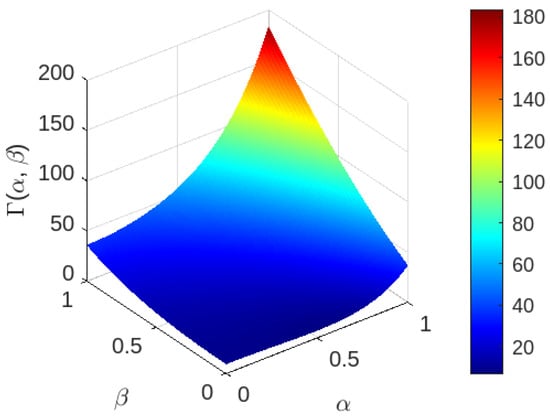
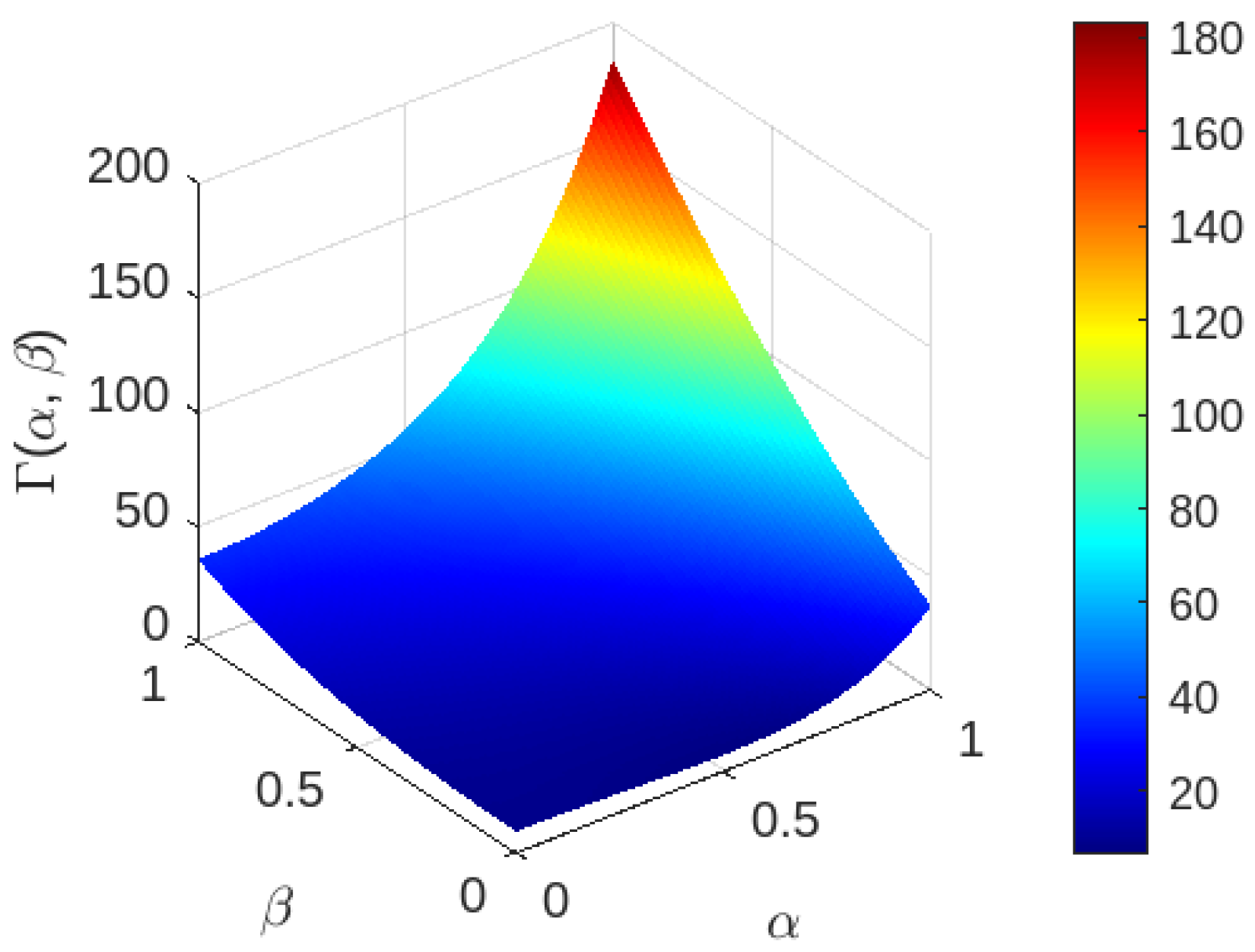
Considering Lemma 1, the admissible values for a pair are consistent with the compact set defined by (see Figure 1)
Figure 1.
Graph of the region and the function over .
Since is differentiable, the only places where can assume these values are points inside where and points on the boundary. Therefore, we show that for and . All the critical points of within satisfy
where
by a numerical computation are the following:
Thus, there are no solutions within the interior of . Utilizing basic calculus techniques, we can establish that the maximum value of exists on the boundary of . In particular, at the boundary defined by and , the function is
Likewise, at the boundary where and , the function is
Lastly, on the boundary curve defined by and , the function becomes
with a maximum of 37. The amalgamation of these cases leads to
and therefore, from (33), we obtain the desired result.
The sharpness of the bound specified in (29) is illustrated through the function , which is defined by
It is evident that , and for this function, we observe that
demonstrating the sharpness of the bound in (29). □
Theorem 4.
If g is expressed in according to (1), then the inequality
remains valid, and it has been established that this estimate is sharp.
Proof.
Therefore, using Lemma 1, we obtain
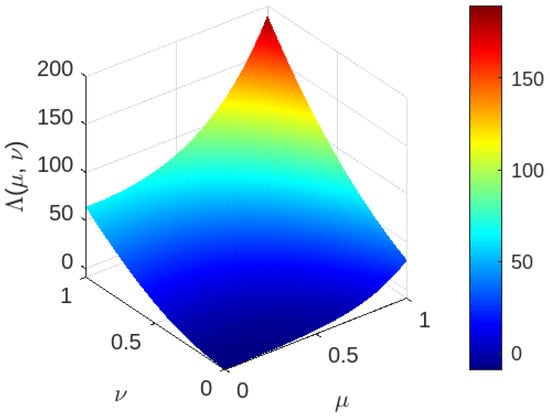
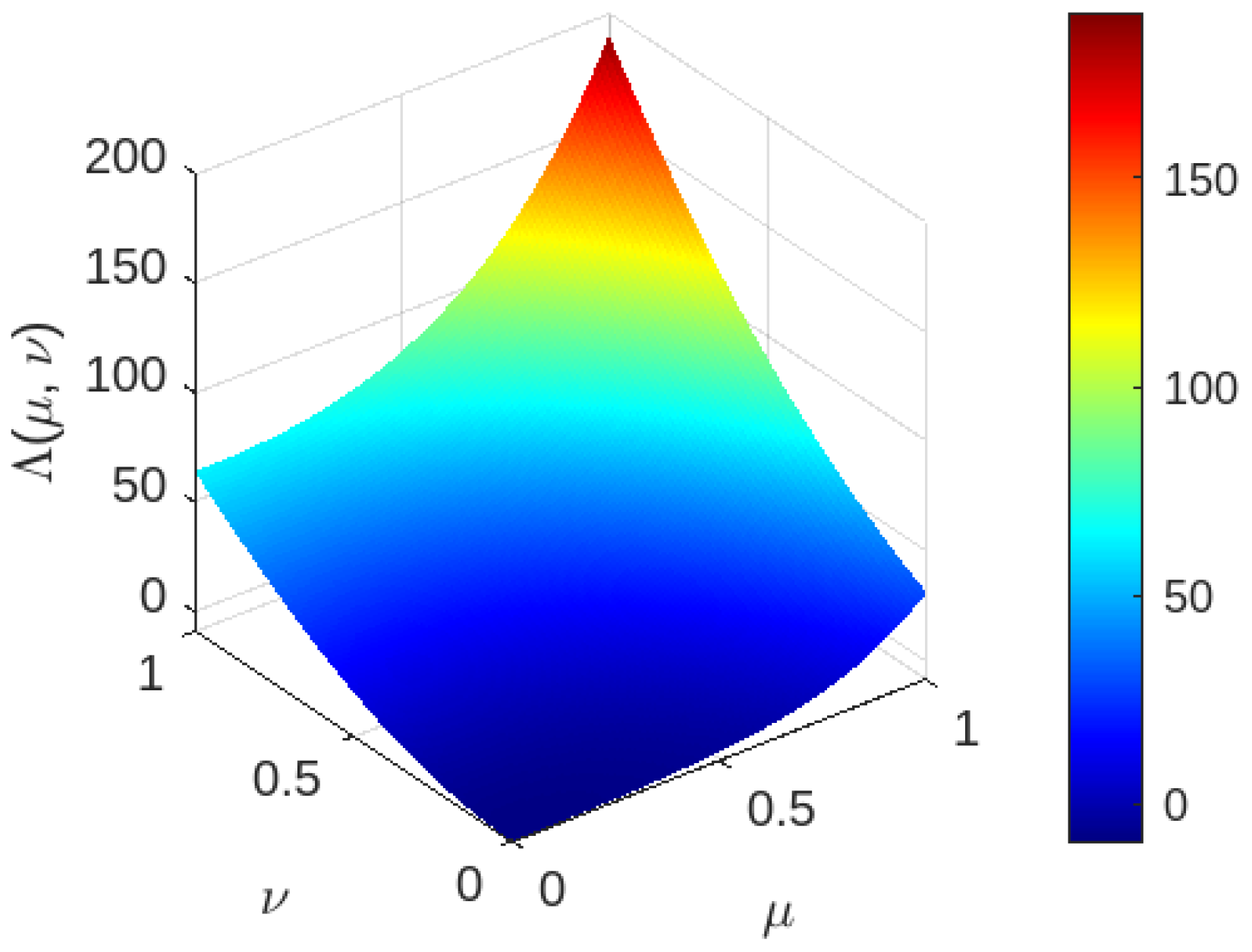
In accordance with Lemma 1, the feasible region for the pair aligns with , which is defined by (34). Given the differentiability of , its values are restricted to points inside , where , as well as points on the boundary. Hence, it is necessary to determine the maximum value of within (see Figure 2). The critical points of adhere to the following conditions
where
Figure 2.
Graph of within the region and .
The system of two equations described above does not possess a solution within the interior of . Consequently, the function cannot attain a maximum within the interior of . Due to the continuity of on , its maximum value is realized on the boundary of . As a result, we obtain
Combining the considerations from the above-discussed cases yields
Consequently, from (38), the desired result is obtained.
To demonstrate the sharpness of the bound in (35), we examine the function , which is defined as
Evidently, , and for this function, we find
indicating the sharpness of the bound. □
3. Concluding Remarks and Observations
The primary focus of exploring coefficient problems in various categories of analytic functions, whether multivalent or univalent, revolves around expressing the coefficients of functions within a particular class using the coefficients of related functions that exhibit a positive real part. This approach allows coefficient functionals to be analyzed by applying established inequalities for the class . The investigation in this paper has extensively delved into Toeplitz determinants featuring logarithmic coefficients for symmetric points in convex and starlike functions’ associated bilinear transformation, resulting in the establishment of sharp bounds.
The importance of logarithmic coefficients enhances the appeal of the proposed problem, making it a topic worthy of consideration and interest. Nevertheless, there has been insufficient work conducted to establish sharp bounds for Toeplitz determinants with logarithmic coefficients for convex, starlike, and their associated subclasses. So, it becomes possible to investigate the bounds of and for a given class and its associate subclasses, defined as
where and are given by (15) and
Funding
This research received no external funding
Data Availability Statement
Data sharing is not applicable to this article as no datasets were generated or analyzed during the current study.
Conflicts of Interest
The author declares no conflicts of interest.
References
- Duren, P.L. Univalent Functions; Grundlehren der mathematischen wissenchaffen, Band 259; Springer: New York, NY, USA; Berlin/Heidelberg, Germany; Tokyo, Japan, 1983. [Google Scholar]
- Sakaguchi, K. On a certain univalent mapping. J. Math. Soc. Jpn. 1959, 11, 72–75. [Google Scholar] [CrossRef] [Scilit]
- Das, R.N.; Singh, P. On subclasses of schlicht mapping. Indian J. Pure Appl. Math. 1977, 8, 864–872. [Google Scholar]
- Ma, W.C.; Minda, D. A unified treatment of some special classes of univalent functions. In Proceedings of the Conference on Complex Analysis, Petersburg Beach, FL, USA, 4–7 June 1992; International Press: Cambridge, MA, USA, 1992; pp. 157–169. [Google Scholar]
- Ravichandran, V. Starlike and convex functions with respect to conjugate points. Acta Math. Acad. Paedagog. Nyí Regyháziensis New Ser. 2004, 20, 31–37. [Google Scholar]
- Khatter, K.; Ravichandran, V.; Kumar, S.S. Estimates for initial coefficients of certain starlike functions with respect to symmetric points. In Applied Analysis in Biological and Physical Sciences; Springer: Aligarh, India, 2016. [Google Scholar]
- Ganesh, K.; Bharavi, S.R.; Rajya, L.K. Third Hankel determinant for a class of functions with respect to symmetric points associated with exponential function. WSEAS Trans. Math. 2020, 19, 13. [Google Scholar] [CrossRef] [Scilit]
- Zaprawa, P. On coefficient problems for functions starlike with respect to symmetric points. Boletín Soc. Matemática Mex. 2022, 28, 17. [Google Scholar] [CrossRef] [Scilit]
- Milin, I.M. Univalent Functions and Orthonormal Systems; AMS Translations of Mathematical Monographs: Proovidence, RI, USA, 1977; Volume 49. [Google Scholar]
- Ye, K.; Lim, L.H. Every matrix is a product of Toeplitz matrices. Found. Comput. Math. 2016, 16, 577–598. [Google Scholar] [CrossRef] [Scilit]
- Grenander, U.; Szegö, G. Toeplitz Forms and Their Applications; University of California Press: Berkcley, CA, USA, 1958. [Google Scholar]
- Thomas, D.K.; Halim, S.A. Toeplitz matrices whose elements are the coefficients of starlike and close-to-convex functions. Bull. Malays. Math. Sci. Soc. 2017, 40, 1781–1790. [Google Scholar] [CrossRef] [Scilit]
- Ali, M.F.; Thomas, D.K.; Vasudevarao, A. Toeplitz determinants whose elements are the coefficients of analytic and univalent functions. Bull. Aust. Math. Soc. 2018, 97, 253–264. [Google Scholar] [CrossRef] [Scilit]
- Cudna, K.; Kwon, O.S.; Lecko, A.; Sim, Y.J.; Smiarowska, B. The second and third-order Hermitian Toeplitz determinants for starlike and convex functions of order α. Boletín Soc. Matemática Mex. 2020, 26, 361–375. [Google Scholar] [CrossRef] [Scilit]
- Obradović, M.; Tuneski, N. Hermitian Toeplitz determinants for the class of univalent functions. Armen. J. Math. 2021, 13, 1–10. [Google Scholar]
- Sun, Y.; Wang, Z.G. Sharp bounds on Hermitian Toeplitz determinants for Sakaguchi Classes. Bull. Malays. Math. Sci. Soc. 2023, 46, 59. [Google Scholar] [CrossRef] [Scilit]
- Mandal, S.; Roy, P.P.; Ahamed, M.B. Hankel and Toeplitz determinants of logarithmic coefficients of Inverse functions for certain classes of univalent functions. arXiv 2023, arXiv:2308.01548. [Google Scholar]
- Wanas, A.K.; Sakar, F.M.; Oros, G.I.; Cotîrlă, L.I. Toeplitz determinants for a certain family of analytic functions endowed with Borel distribution. Symmetry 2023, 15, 262. [Google Scholar] [CrossRef] [Scilit]
- Mandal, S.; Ahamed, M.B. Second Hankel determinant of logarithmic coefficients of inverse functions in certain classes of univalent functions. Lith. Math. J. 2024, 64, 67–79. [Google Scholar] [CrossRef] [Scilit]
- Kumar, D.; Kumar, V.; Das, L. Hermitian-Toeplitz determinants and some coefficient functionals for the starlike functions. Appl. Math. 2023, 68, 289–304. [Google Scholar] [CrossRef] [Scilit]
- Srivastava, H.M.; Shaba, T.G.; Ibrahim, M.; Tchier, F.; Khan, B. Coefficient bounds and second Hankel determinant for a subclass of symmetric bi-starlike functions involving Euler polynomials. Bull. Sci. Math. 2024, 192, 103405. [Google Scholar] [CrossRef] [Scilit]
- Buyankara, M.; Çağlar, M. Hankel and Toeplitz determinants for a subclass of analytic functions. Mat. Stud. 2023, 60, 132–137. [Google Scholar] [CrossRef] [Scilit]
- Ali, R.M.; Kumar, S.; Ravichandran, V. The third Hermitian-Toeplitz and Hankel determinants for parabolic starlike functions. Bull. Korean Math. Soc. 2023, 60, 281–291. [Google Scholar]
- Sabir, P.O.; Agarwal, R.P.; Mohammedfaeq, S.J.; Mohammed, P.O.; Chorfi, N.; Abdeljawad, T. Hankel determinant for a general subclass of m-fold symmetric biunivalent functions defined by Ruscheweyh operators. J. Inequalities Appl. 2024, 2024, 14. [Google Scholar] [CrossRef] [Scilit]
- Dobosz, A. The third-order Hermitian Toeplitz determinant for alpha-convex functions. Symmetry 2021, 13, 1274. [Google Scholar] [CrossRef] [Scilit]
- Tang, H.; Gul, I.; Hussain, S.; Noor, S. Bounds for Toeplitz determinants and related inequalities for a new subclass of analytic functions. Mathematics 2023, 11, 3966. [Google Scholar] [CrossRef] [Scilit]
- Shakir, Q.A.; Atshan, W.G. On third Hankel determinant for certain subclass of bi-univalent functions. Symmetry 2024, 16, 239. [Google Scholar] [CrossRef] [Scilit]
- Efraimidis, I. A generalization of Livingston’s coefficient inequalities for functions with positive real part. J. Math. Anal. Appl. 2016, 435, 369–379. [Google Scholar] [CrossRef] [Scilit]
Disclaimer/Publisher’s Note: The statements, opinions and data contained in all publications are solely those of the individual author(s) and contributor(s) and not of MDPI and/or the editor(s). MDPI and/or the editor(s) disclaim responsibility for any injury to people or property resulting from any ideas, methods, instructions or products referred to in the content. |
© 2024 by the author. Licensee MDPI, Basel, Switzerland. This article is an open access article distributed under the terms and conditions of the Creative Commons Attribution (CC BY) license (https://creativecommons.org/licenses/by/4.0/).