Article

The Complete Mitochondrial Genome of Portunion sinensis (Crustacea: Isopoda) and Its Phylogenies

1
College of Animal Science and Technology, Guangxi University, Nanning 530200, China
2
Key Laboratory of Tropical Marine Ecosystem and Bioresource, Fourth Institute of Oceanography, Ministry of Natural Resources, Beihai 536000, China
3
Institute of Marine Drugs, Guangxi University of Chinese Medicine, Nanning 530200, China
4
Key Laboratory of Healthy Mariculture for the East China Sea, Ministry of Agriculture, Fisheries College, Jimei University, Xiamen 361000, China
5
Health and Environmental Research Center, Faculty of Environmental Management, Prince of Songkla University, Hat Yai 90110, Songkhla, Thailand
*
Authors to whom correspondence should be addressed.
Biology 2026, 15(3), 282; https://doi.org/10.3390/biology15030282
Submission received: 29 December 2025 / Revised: 26 January 2026 / Accepted: 1 February 2026 / Published: 4 February 2026
(This article belongs to the Section Marine and Freshwater Biology)

Simple Summary

The mud crab (Scylla paramamosain) is an economically important crustacean species. This study reports the first complete mitochondrial genome of the parasitic isopod Portunion sinensis (family Entoniscidae) infecting this crab. We conducted a detailed analysis of its genomic architecture, revealing a compact genome and unique structural characteristics. As the first representative mitochondrial genome for the family Entoniscidae, this work fills a critical gap in molecular data for the superfamily Bopyroidea. These findings not only provide essential genetic resources for species identification but also serve as a key reference for elucidating the mitochondrial structure and phylogenetic relationships of parasitic crustaceans.

Abstract

In this study, we conducted molecular identification and complete mitochondrial genome annotation of isopod parasites isolated from mud crabs (Scylla paramamosain) in the China Sea. The specimen was identified as Portunion sinensis, a recently described species of the family Entoniscidae. P. sinensis is characterized by an anterior thorax positioned vertically and posterior ventral processes directed backwards; the female’s marsupium is formed by the close adhesion of oostegites to the host membrane; the first oostegite is differentiated into three parts; the pleopoda have well-developed lamellar and pleural lamellae; and two ventral ovarian processes are present along with a pair of dorsal processes. The complete mitochondrial genome of the parasite is 14,603 bp in length, containing 35 genes (13 protein-coding genes, 20 transfer RNAs, and 2 ribosomal RNAs) as well as a putative control region (CR) located between the cob and nad1 genes. This study represents the initial characterization of the mitochondrial genome of P. sinensis. These findings provide molecular validation of its status as an independent species and lay the groundwork for the future identification of parasites within the genus Portunion. These data provide a necessary molecular reference for future research into the systematics and evolutionary history of decapod-infesting parasites.

1. Introduction

The mud crab, Scylla paramamosain (Portunoidea, Brachyura), is an economically important crustacean species widely distributed along the coast of southern China. However, its wild and cultivated populations are frequently infested by parasitic diseases. Portunion sinensis is a parasitic isopod that specifically infects S. paramamosain and was formally described in recent taxonomic studies [1]. Taxonomically, this parasite belongs to the subfamily Entioninae within the family Entoniscidae (Superfamily Bopyroidea). Members of the superfamily Bopyroidea exhibit extreme sexual dimorphism and a holoparasitic lifestyle that has a profound effect on their host [2]. They predominantly inhabit the gill cavity, abdomen, or hemocoel of crustaceans, leading to diapause, failure of ecdysis, gonadal development inhibition, and parasitic castration [3]. Specifically, P. sinensis inhabits the hemocoel of S. paramamosain, posing a potential threat to the mud crab aquaculture industry.
Accurate species identification of the genus Portunion, and indeed the family Entoniscidae, is highly challenging due to their extreme morphological specialization. To adapt to a reproductive lifestyle within the host, the female Portunion sp. has completely lost the typical morphological characteristics of an isopod [4]. The female is enveloped by a sheath formed by the host [5], which connects to the exterior via an exit pore in the host’s gill cavity. In contrast, the male individuals are dwarfed and segmented; they attach to the female and remain morphologically recognizable as typical isopods. The epicaridium larvae leave the host through the gill pores, utilizing copepods as intermediate hosts before eventually metamorphosing into infective larvae [2]. Currently, the World Register of Marine Species (WoRMS) recognizes eight valid Portunion species. Researchers typically rely on complex morphological characteristics for classification, such as the host species, the orientation of the female’s thoracic protrusions, the fusion of the male’s cephalothorax, the second antenna, abdominal spines, and the characteristics of the sixth pereopod of the epicaridium larvae [6,7]. However, relying solely on these reduced morphological traits can be problematic, necessitating the urgent use of molecular markers for precise identification and phylogenetic analysis.
Despite the taxonomic diversity of the genus, molecular data for the family Entoniscidae are scarce. While mitochondrial genomes have been widely sequenced for other isopod lineages (e.g., the suborders Cymothoida and Oniscidea), genomic resources for the family Entoniscidae are currently restricted to partial sequences of specific markers (e.g., cox1 and 18S rRNA), leaving the complete mitogenomic architecture of this family unknown. Currently, molecular records for the genus Portunion are limited to a single cox1 DNA fragment from P. conformis. Even within the broader superfamily Bopyroidea, species with complete mitochondrial gene sequences are rare (e.g., Gyge ovalis) [8]. The complete mitochondrial genome serves as a distinct and accessible molecular marker that facilitates not only parasite species identification [9] and phylogenetic analyses [10], but also investigations into population genetic structure [11].
To bridge this research gap, we sequenced and assembled the complete mitochondrial genome of P. sinensis and explored its phylogenetic position at the mitogenomic level. This study contributes the first complete mitogenome for the genus Portunion, enriching the limited molecular data available for the family Entoniscidae, and providing key evidence for an in-depth understanding of the genomic variation characteristics and phylogenetic relationships of isopod species. These data offer a necessary molecular reference for future research into the taxonomy and evolutionary history of parasitic crustaceans.

2. Materials and Methods

2.1. Source of Materials

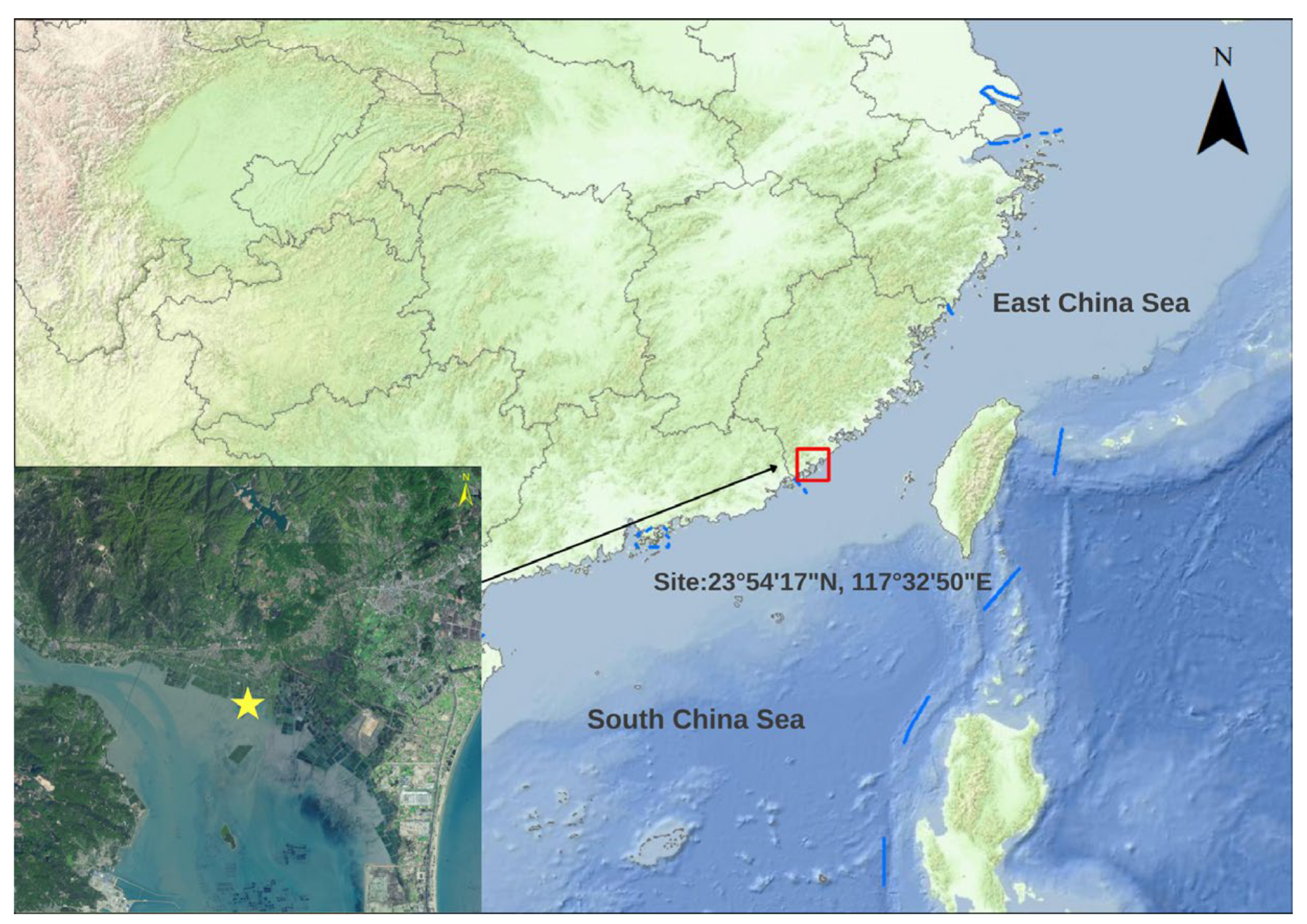
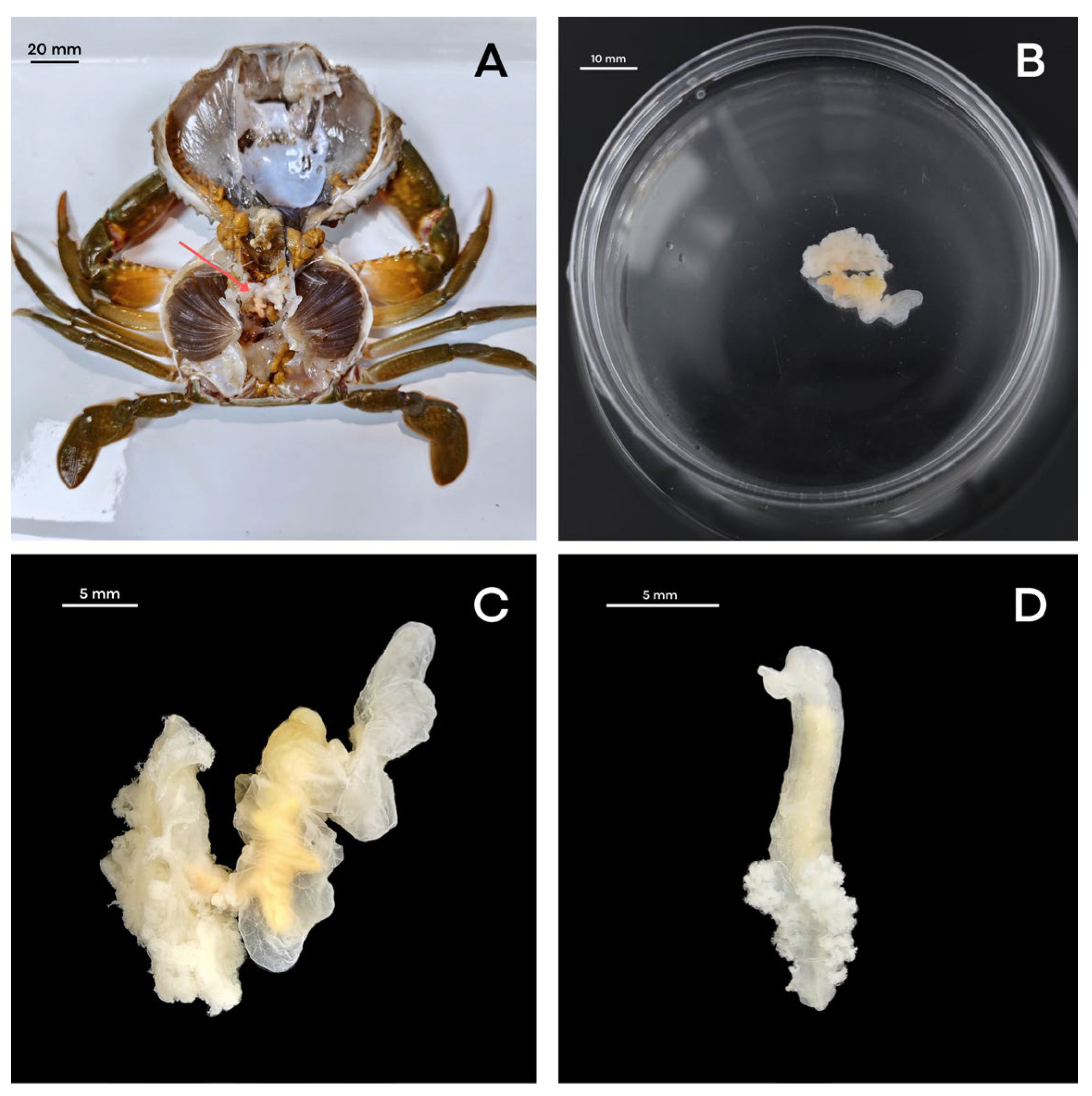
For this study, we collected parasite-infected crabs from the natural waters of Zhangpu, Fujian, China (23°54′17″ N, 117°32′50″ E) (Figure 1), the type locality of the parasite, and then transported the crabs to the laboratory. To obtain live parasite samples, crabs were dissected while alive. Humane euthanasia was achieved by immersing the crab in a mixture of ice and water at 0 °C before proceeding with the dissection. The carapace was carefully detached to expose the internal organs, and female parasites were searched for within the host’s visceral mass (Figure 2A). The parasite was then separated from the mud crab’s hemocoel using sterile forceps, rinsed briefly with saline solution to remove residual host tissue from its surface, and placed in a clean Petri dish for subsequent observation (Figure 2B).

2.2. Morphological Observation

Specimens were preserved using two methods depending on downstream analysis: individuals for morphological identification were fixed in 75% ethanol, while ovigerous females intended for genomic DNA extraction were preserved in 100% ethanol at −20 °C [12]. Mature female parasites, characterized by a marsupium filled with eggs and embryos, appeared as distinct yellow masses easily distinguishable from host organs. In contrast, juvenile parasites with transparent, empty marsupia required meticulous examination to distinguish them from the host’s gonads. Morphological characteristics were observed under a stereoscopic microscope (SteREO Discovery.V12, Zeiss, Oberkochen, Germany) (Figure 2C,D). Body dimensions were measured as follows: abdominal length (AT), defined as the distance from the thorax–abdomen junction to the posterior extremity; and head–thorax length (HT), defined as the distance from the anterior head margin to the thorax–abdomen junction along the dorsal midline.

2.3. Whole Mitochondrial Genome Sequencing

To eliminate genomic contamination from the host, eggs or epicaridium larvae were specifically collected from the female marsupium for DNA extraction [12]. Total genomic DNA was extracted using the MolPure® Marine Animals DNA Kit (Yeasen Biotech, Shanghai, China) following the manufacturer’s protocol. The concentration and purity of the extracted DNA were measured using a Nano 500 micro spectrophotometer (Allsheng, Hangzhou, China). The integrity of the genomic DNA was assessed by 1% agarose gel electrophoresis [13]. A total of approximately 1.5 µg of genomic DNA was used for library construction. Before whole-genome sequencing, the species identity was verified by amplifying the cytochrome c oxidase subunit I (cox1) gene [14]. PCR primers were designed targeting conserved motifs identified through an alignment of available cox1 sequences from related isopod species. The PCR reaction (50 μL) contained 0.05 μg of DNA, 0.4 μM of each primer (Forward: Portunion-cox1-F 5′-ATGCAACGTTGAATATACTCTACTA-3′; Reverse: Portunion-cox1-R 5′-AGAGCACTCCCACAAACATCA-3′), 25 μL of 2× EasyTaq® PCR SuperMix (TransGen Biotech, Beijing, China), and 22 μL of ddH2O. The thermal cycling conditions were as follows: 95 °C for 7 min; 30 cycles of 95 °C for 30 s, 55 °C for 30 s, and 72 °C for 1 min; and a final extension at 72 °C for 10 min. PCR products were purified and sequenced using Sanger sequencing at BGI (Beijing, China) to confirm the taxonomic identity.

2.4. Mitochondrial Genome Structure Annotation and Analysis

Following molecular verification, the genomic DNA was subjected to high-throughput sequencing. DNA libraries with an insert size of 350 bp were constructed using the TruSeq Nano™ Kit (Illumina, San Diego, CA, USA) following the manufacturer’s instructions. Sequencing was performed on the Illumina HiSeq platform at BGI (Beijing, China) (2 × 150 bp paired-end reads). Prior to assembly, raw reads were filtered using fastp to remove adapters [15], poly-N sequences, and low-quality reads (Q-value < 20).
The mitochondrial genome assembly was performed using MITObim (v1.9.1) [16] with the previously amplified cox1 fragment serving as the reference seed for the iterative mapping process (default parameters, maximum iterations = 100). The resulting contigs were screened using BLASTn (v2.9.0) against the NCBI nucleotide database to identify the complete mitochondrial genome. The assembled circular mitogenome was then annotated using the MITOS2 web server and manually corrected for start/stop codons [17]. Transfer RNA (tRNA) genes were independently validated using tRNAscan-SE (v2.0) [18]. The circular genome map was generated using the Proksee online platform [19].
Nucleotide composition bias was assessed by calculating skew values using the following formulas [20]: AT-skew = (A − T)/(A + T) and GC-skew = (G − C)/(G + C). The GC-skew value measures the relative abundance of guanine (G) versus cytosine (C) on the coding strand, serving as an indicator of strand asymmetry resulting from replication and transcription pressures. To evaluate codon usage bias, Relative Synonymous Codon Usage (RSCU) was calculated according to the formula [21] RSCUij = (Xij × ni)/ΣXij, where Xij is the frequency of the j-th codon for the i-th amino acid, and ni represents the number of synonymous codons (degeneracy) for that amino acid. These analyses were performed using a custom Python 3 script, and the results were visualized using the ggplot2 package in Rstudio [22].

2.5. Phylogenetic Analysis

Phylogenetic analysis was performed using the newly sequenced mitogenome of P. sinensis and representative species selected from major isopod suborders, with a specific focus on available sequences within the suborder Epicaridea to ensure taxonomic coverage. Specifically, the dataset incorporated all currently available sequences from the genus Portunion, comprising a total of 14 complete mitochondrial genomes and 3 partial sequences, with Ligia oceanica serving as the outgroup (Table 1).
Gene extraction and matrix compilation were performed using the integrated platform PhyloSuite v1.2.3 [23]. Thirteen protein-coding genes (PCGs) and two ribosomal RNA genes (rRNAs) were retrieved from each dataset. PCG nucleotide sequences were aligned in batches using the “Codon” mode of MAFFT [24] implemented in PhyloSuite. Ambiguously aligned regions and excessive gaps were removed using Gblocks [25]. Ribosomal RNA sequences were aligned with the Q-INS-i algorithm, which incorporates secondary-structure information, and were subsequently trimmed using trimAl [26]. All individual gene alignments were concatenated in PhyloSuite to generate the final supermatrix.
Model selection and partitioning schemes were determined using PartitionFinder 2 [27] under the corrected Akaike Information Criterion (AICc). Maximum Likelihood (ML) phylogenetic analyses were conducted in IQ-TREE [28], with node support evaluated using 1000 ultrafast bootstrap replicates. The resulting phylogenetic trees were visualized and annotated using the ChiPlot online platform (https://www.chiplot.online/ (accessed on 25 January 2026)) [29].
To assess genetic differentiation, aligned cox1 sequences were imported into MEGA X [30]. Average intra-specific and inter-specific genetic distances were calculated under the Kimura 2-parameter (K2P) model [31], and standard errors (SEs) were estimated using 1000 bootstrap replicates.

3. Results

3.1. Observation of Morphology and Parasitism

Specimens were identified as Portunion sinensis Huang et al., 2025 [1] based on morphological vouchers (75% ethanol) from the same collection batch as the genomic samples. The females exhibited diagnostic characters consistent with the species description: the anterior thorax is vertical, while the posterior ventral processes are directed backwards. The marsupium is formed by the close adhesion of oostegites to the host membrane. The pleopods possess well-developed lamellar and pleural lamellae. Two ventral ovarian processes and a pair of dorsal processes are present (Figure 2C) [1]. Males were not observed in the examined specimens. A voucher specimen was deposited at the Fourth institute of Oceanography, Ministry of Natural Resources, China (Accession No.: Ps-ZP05). Genomic samples were morphologically verified as conspecific with vouchers prior to DNA extraction.

3.2. Mitochondrial Genome Analyses

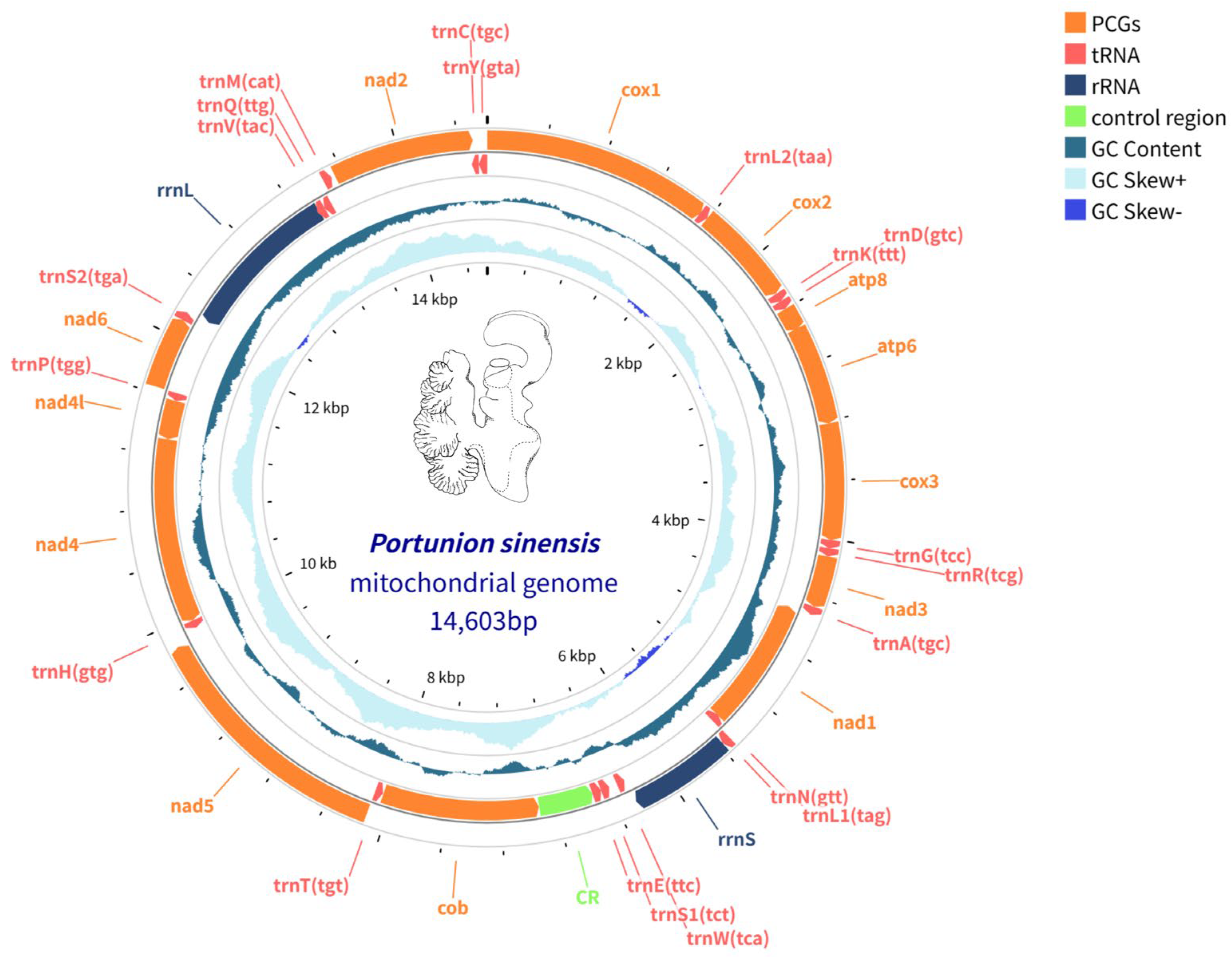
The genome of the parasite was 14,603 bp in length. As illustrated in the genome circle map (Figure 3), the structure of the genome comprises 2 rRNA genes, 13 protein-coding genes, 20 tRNA genes, and a putative control region (CR). The overall base composition is 26.7% A, 31.2% T, 17.8% C and 24.2% G, resulting in a positive GC skew value of 0.15 and an AT skew value of −0.07 (Table 2).
The protein-coding genes of the P. sinensis mitochondrial genome have a total length of 10,971 bp, accounting for 75.13% of the total genome, with an AT skew of −0.197 and a GC skew of 0.084. Of the 13 PCGs, 3 genes began with ATA, 2 began with ATT 3 began with ATG and 3 began with GTG or TTG, while only cox1 began with ACG. It is evident that 6 genes (nad4l, cob, cox1, nad2, atp6 and atp8) share a stop codon TAA. In addition, 3 genes (nad6, cox2 and cox3) have a TAG stop codon, while 4 genes (nad1, nad3, nad5 and nad4) have incomplete stop codons T (Table 3). The putative control region (322 bp) is located between nad1 and cob.
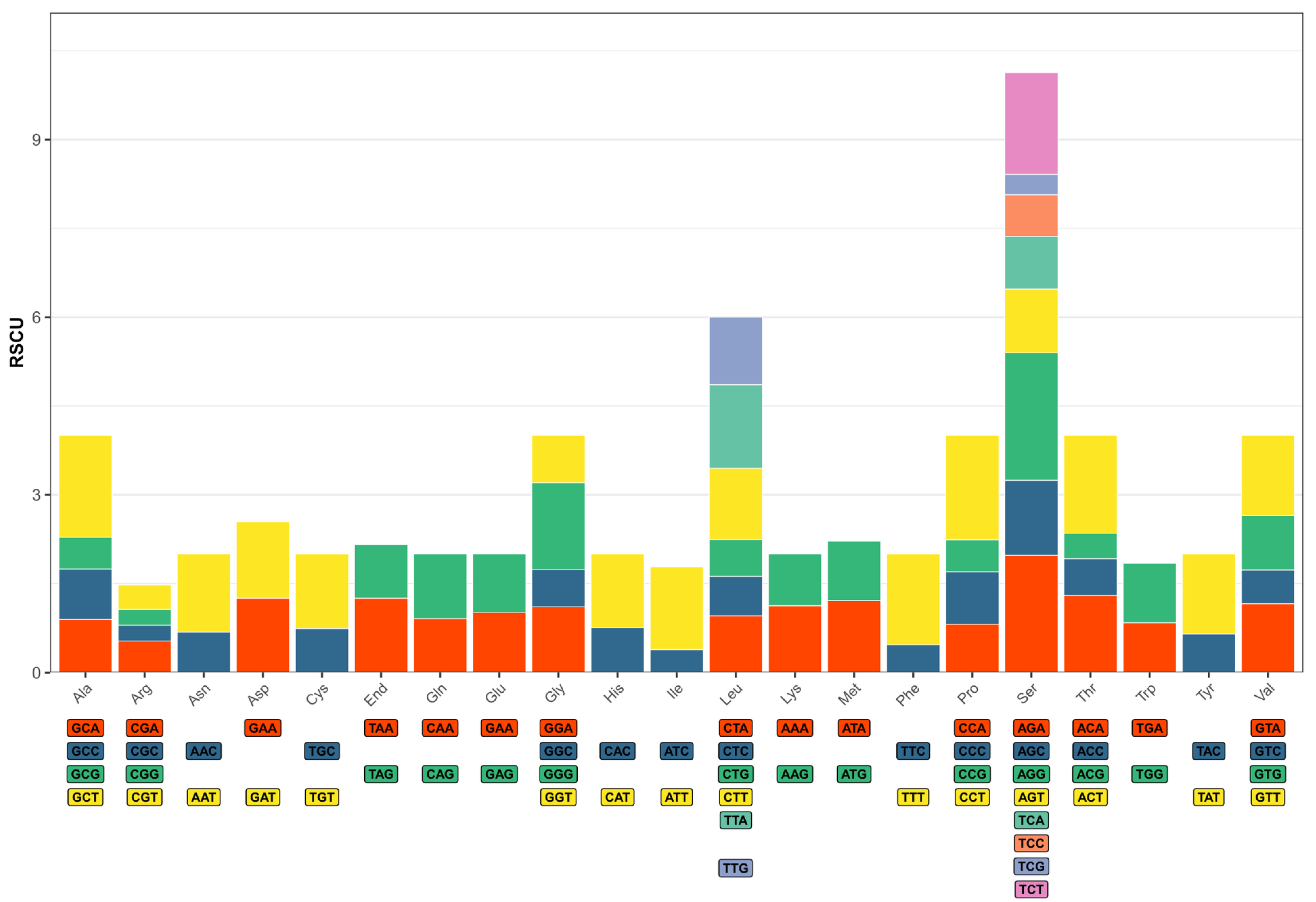
The RSCU and codon numbers of PCGs are listed in Table S1 and illustrated in Figure 4. Of these codons, TTT is the most frequently used, appearing 237 times in total, while CGC is the least frequently used, appearing only 17 times. Of the 31 codons in mitochondrial DNA with RSCU values exceeding 1, 10 end with A, 14 end with T, one ends with C and six end with G. This indicates a preference for codons ending with A and T.
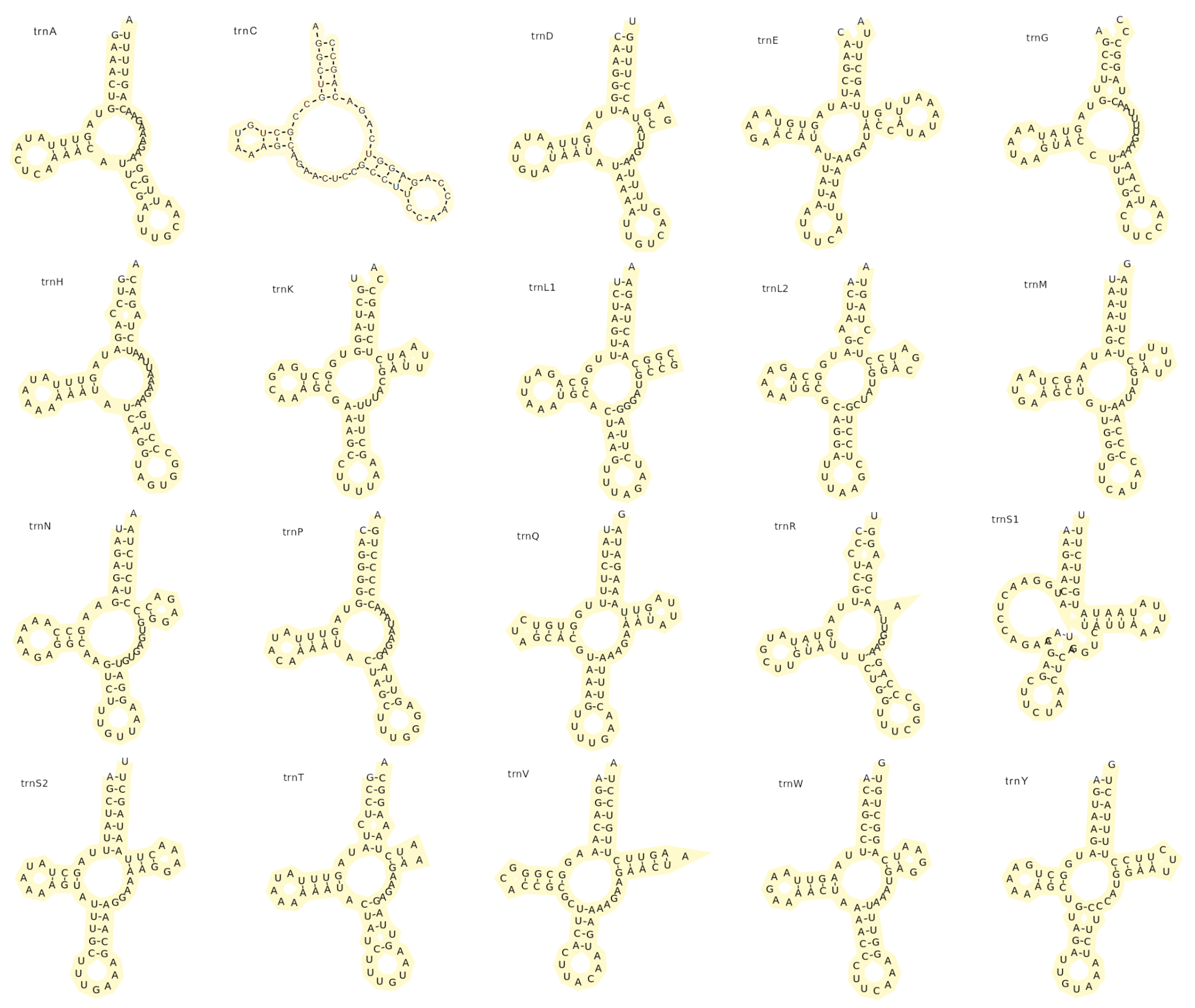
The total length of rRNA in the P. sinensis mitochondrial DNA sample is 1841 base pairs, with AT and GC skew values of 0.071 and −0.027, respectively. The mitochondrial genome contains 20 tRNAs in total, with the absence of trnF and trnI, resulting in a total length of 1189 base pairs. The AT skew value for these tRNAs is 0.060, while the GC skew value is notably high at 0.130. Figure 5 shows the secondary structures of the tRNAs encoded by the mitochondrion. Notably, trnA, trnC, trnG, trnH, trnP and trnR lack the T-arm structure and trnS1 lacks the D-arm structure; all exhibit atypical cloverleaf secondary structural features.

3.3. Phylogenetic Relationships

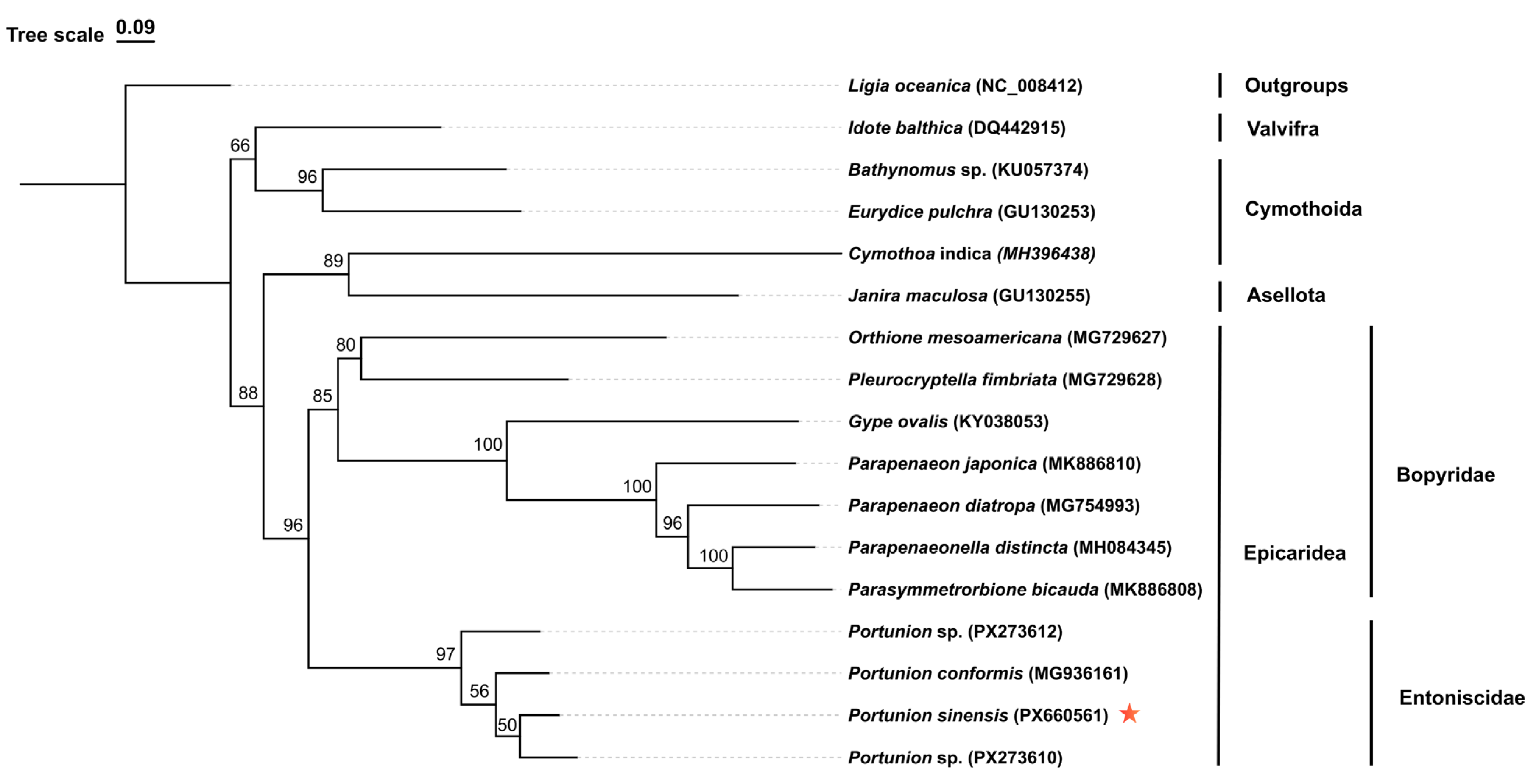
The phylogenetic reconstruction of the family Bopyridae using ML methods was based on the concatenated dataset of 13 protein-coding genes and 2 ribosomal RNAs (PCGs + rRNAs) (Figure 6). The analyses recovered the genus Portunion as a coherent lineage within Entoniscidae. Entoniscidae and Bopyridae together formed a strongly supported monophyletic group corresponding to the suborder Epicaridea. In contrast, resolution within the genus Portunion was limited. The internal nodes connecting the sampled species received low bootstrap support (BS < 60). This lack of resolution is likely attributable to the limited informative sites provided by the partial sequences included in the alignment (Table 1). Despite the low support for interspecific relationships, P. sinensis formed a distinct lineage genetically differentiated from other congeners.
The genetic distances calculated based on the Kimura 2-parameter (K2P) model are presented [31]. The average genetic distances among P. sinensis individuals collected from the coastal waters of China ranged from 0.0% to 0.1%. In contrast, the average genetic distance between P. sinensis and the known congeneric species P. conformis was 14.0%, while the distances to the Vietnam samples (PX273610 and PX273612) were 11.7% and 18.2%, respectively. Consequently, P. sinensis meets the “standard sequence threshold” proposed by Hebert et al. [14], supporting its recognition as a distinct species at the molecular level and corroborating its taxonomic status established based on morphology [32].

4. Discussion

4.1. Phylogenetic Relationships and Molecular Validation of Species Status

Based on the phylogenetic tree, the family Entoniscidae formed a well-supported monophyletic clade, which corresponds with the classification results based on parasitic habits that separate the unique endoparasitic Entoniscidae from other ectoparasitic groups [33]. As to whether Entoniscidae is an early independently diverged branch or a monophyletic branch sister to Bopyridae, support from molecular sequences of additional families is required.
Regarding the genus Portunion, the phylogenetic analysis revealed a polytomous structure with low bootstrap support for internal nodes. This lack of resolution is likely primarily attributable to the limited length of the available reference sequences used in the alignment. Most public data for Portunion species are restricted to partial cox1 barcoding fragments, which provide insufficient phylogenetically informative sites to resolve deep interspecific branching orders. However, a contribution from rapid evolutionary radiation cannot be ruled out [34]. Theoretically, if speciation events occur in rapid succession, the synapomorphies accumulated by ancestral populations during short internodes may be insufficient to be captured by standard molecular markers, leading to poor phylogenetic resolution [35]. As current molecular data are insufficient to distinguish between methodological limitations and true biological radiation, future studies incorporating more genetic loci or complete genomes from closely related species are required.

4.2. Occurrence and Distribution of the Non-Canonical Start Codon in cox1

It is noteworthy that in the mitochondrial protein-coding genes of P. sinensis, the start codon of cox1 is ACG rather than the standard ATG. The use of ACG does not exhibit phylogenetic continuity within Isopoda. It is found in some free-living suborders, such as Valvifera (e.g., Idotea balthica) and Oniscidea (e.g., Ligia oceanica) [36,37]; however, in the parasitic family Bopyridae, the closely related Gyge ovalis does not use this codon but retains the standard ATG [38], and ACG was observed as the cox1 start codon only in Pleurocryptella skinkai of the same family [39].
This mosaic distribution pattern indicates that the non-canonical start codon ACG is not a stable synapomorphy of the parasitic clade [40], but is more likely a homoplastic trait resulting from independent parallel evolution or high mutational plasticity within Isopoda [41]. This implies that different groups more likely independently underwent T-to-C transition mutations rather than inheriting them from a common ancestor.
Although ACG is a non-canonical start codon, this does not imply a loss of translational function. Wolstenholme pointed out in a review of mitochondrial genomics that the use of various non-canonical start codons is a widespread phenomenon in metazoan mitochondria; this diversity is not a random error but a stable evolutionary strategy formed under the context of high A + T selection pressure, genome compaction, and tRNA co-evolution [42]. Regarding specific translation mechanisms, classic experimental studies by Peabody showed that ACG can efficiently initiate translation within a strong Kozak sequence context and exhibits the highest initiation efficiency among all single-base non-AUG variants [43]. Crucially, the polypeptide chain initiated at this site still starts with Methionine [44]. Therefore, future studies need to incorporate transcriptome sequencing (RNA-seq) alignment or protein N-terminal sequencing to definitively confirm the true start site of cox1 and its translational initiation mechanism at the transcriptomic or proteomic level.

4.3. Structural Reduction and Putative Loss of Mitochondrial tRNAs

In the predicted mitochondrial tRNA secondary structures of this study, trnA, trnC, trnG, trnH, trnP, and trnR lack the typical TψC loop of the cloverleaf model, with the anticodon loop directly connected to the acceptor arm or variable loop; trnS1 lacks the D-arm structure. All these tRNAs exhibit atypical cloverleaf secondary structural characteristics. Such structural simplification is not rare in animal mitochondrial genomes and has been frequently reported in invertebrates [45,46]. Although these truncated tRNAs deviate from the canonical secondary structure, this does not imply a loss of function. Research by Ohtsuki et al. indicates that such structural aberrations can be compensated by alternative mechanisms. Specifically, tRNAs lacking the D-arm can maintain the necessary spatial distance between the acceptor stem and the anticodon loop through unique intramolecular interactions, despite lacking the classical L-shape [47]. Furthermore, the functional loss of the T-arm may be compensated by specific post-transcriptional modifications (e.g., 1-methyladenosine) [48] or the co-evolution of mitochondrial elongation factors (EF-Tu) [49], which ensure efficient recognition and binding.
Compared with the isopod mitochondrial genome ground pattern [49], we found a putative loss of certain tRNA genes (trnF and trnI) in P. sinensis. This is consistent with the widespread tRNA gene loss observed by Kilpert across different isopod lineages. For instance, trnI is missing in the mitochondrial genome of Gyge ovalis, trnF is missing in Eurydice pulchra [50], and a more extensive loss of 9 tRNA genes occurs in the mitochondrial genome of Armadillidium vulgare [51]. Notably, this retention rate is significantly higher than that reported in the free-living Armadillidium vulgare (13 tRNAs) or the predatory Eurydice pulchra (16 tRNAs) [49]. This observation suggests that parasitic specialization is not linearly correlated with extensive gene loss in mitochondria [52].
On the contrary, the low gene counts reported in isopod lineages may partly stem from annotation artifacts rather than genuine biological loss. The high nucleotide substitution rates and structural aberrations in isopods may cause standard search algorithms (e.g., tRNAscan-SE) to fail in detecting tRNA genes [53]. Doublet systematically verified the expression of 13 tRNA genes in the A. vulgare mtDNA using RT-PCR and circularized RT-PCR (cRT-PCR) combined with cloning and sequencing [53]. This revealed that a truncated trnH undergoes extensive 3′-end repair and 5′-end addition of a G-1 residue post-transcriptionally. This also indicates that even under conditions of high mitochondrial genome compaction and extensive gene overlap [54], isopods can still maintain normal gene expression functions through complex RNA processing mechanisms, despite showing a prevalent loss of D-loops or T-loops, or even entire arms. Whether the trnF and trnI that were undetected by algorithm software in the P. sinensis mitochondrial genome also exist cryptically through similar mechanisms remains to be deeply analyzed in the future by combining transcriptome data.

5. Conclusions

Through morphological observation, the parasites collected and isolated in this study were identified as Portunion sinensis, a recently described species characterized by a unique body architecture where the anterior thorax is vertical and the female’s ventral processes are directed posteriorly. The complete mitochondrial genome was determined to be 14,603 bp in length, containing 35 genes: 13 protein-coding genes, 2 rRNA genes, 20 tRNA genes, and a putative control region (CR). The mitochondrial genome of P. sinensis exhibits a high degree of evolutionary streamlining and adaptation, characterized by several non-standard features. These include the use of an atypical ACG start codon for cox1, the presence of incomplete stop codons (T--) for several PCGs (e.g., nad1, nad3, nad5 and nad4), and significant structural reductions (such as the absence of the TψC-loop) in multiple tRNAs. Furthermore, P. sinensis shows putative tRNA gene losses (trnF and trnI), aligning with the broader pattern of tRNA gene attrition observed across diverse isopod lineages. Collectively, these genomic modifications underscore a pervasive evolutionary trend towards compactness and efficiency, likely driven by the intense selective pressures associated with a parasitic lifestyle. This study represents the first report on the mitochondrial genome of Portunion sinensis, filling a gap in the genomic data for the superfamily Bopyroidea. The results provide fundamental molecular data for the identification of parasites within the genus Portunion and offer valuable insights for the phylogenetic and taxonomic studies of the family Entoniscidae and the suborder Epicaridea.

Supplementary Materials

The following supporting information can be downloaded at: https://www.mdpi.com/article/10.3390/biology15030282/s1, Table S1: Relative synonymous codon usage and codon number of Portunion sinensis mitochondrial PCGs.

Author Contributions

Conceptualization, W.L. and Y.Q.; Formal analysis, T.H., X.M., S.Z., W.L. and J.C.; Investigation, T.H., J.C., D.Y., T.P. and L.H.; Methodology, X.M., X.C., D.Y., L.H., T.P. and Y.Q.; Resources, T.H., S.Z., D.C., W.L. and X.C.; Software, T.H., D.C. and Y.Q.; Writing—original draft, T.H. and Y.Q. All authors have read and agreed to the published version of the manuscript.

Funding

This work was funded by National Parasitic Resource Center (Grant No. 2019-194-30); Guangxi Science and Technology Major Program (Grant Number: Guike AA24206044); China Postdoctoral Scientific Foundation (Grant No. 2021M701798); Ministry of Science and Technology of the People’s Republic of China (Grant Number: 2023YFD2402600); Science & Technology Fundamental Resources Investigation Program (Grant Number: 2023FY100800); The Fund of Hainan Provincial Key Laboratory of Tropical Maricultural Technologies (Grant No. TMTOF202104 & TMTOF202205); the Guangxi Key Laboratory of Beibu Gulf Marine Biodiversity Conservation, Beibu Gulf University (Grant No. 2022KA04); Guangxi University of Chinese Medicine “GuiPai Traditional Chinese Medicine inheritance and innovation team” Project (2022A007); Development Program of High-level Talent Team under Qihuang Project of Guangxi University of Chinese Medicine (2021004); Science and Technology Planning Projects of Beihai (No. 202082035 & 2021158007).

Institutional Review Board Statement

This study has been approved by the experimental animal care committee of Fourth Institute of Oceanography, Ministry of Natural Resources, China.

Informed Consent Statement

Not applicable.

Data Availability Statement

All figures and tables used to support the results of this study have been included. The data presented in this study are openly available in GenBank at [https://www.ncbi.nlm.nih.gov/ (accessed on 25 January 2026)], reference number [PX660561].

Conflicts of Interest

The authors declare that they have no conflicts of interest related to this work.

References

  1. Huang, T.; Ma, X.; Zhong, S.; Chen, X.; Yang, D.; Guo, J.; Huang, L.; Li, W.; Pengsakul, T.; Qiao, Y. A new species of endoparasitic isopod, Portunion sinensis sp. nov. (Isopoda: Entoniscidae), found in the mud crab Scylla paramamosain in China. Front. Mar. Sci. 2025, 12, 1565361. [Google Scholar] [CrossRef]
  2. Williams, J.D.; Boyko, C.B. The global diversity of parasitic isopods associated with crustacean hosts (Isopoda: Bopyroidea and Cryptoniscoidea). PLoS ONE 2012, 7, e35350. [Google Scholar] [CrossRef]
  3. An, J. Taxonomy of Parasitic Isopods from China; Science Press: Beijing, China, 2011. [Google Scholar]
  4. Giard, A.; Bonnier, J. Contributions à L’étude des Bopyriens; Biodiversity Heritage Library: Washington, DC, USA, 1887; Volume 5, pp. 1–272. [Google Scholar]
  5. Lester, R.J.G. Isopoda (isopods). In Marine Parasitology; Rohde, K., Ed.; CSIRO Publishing: Victoria, Australia, 2005; pp. 138–144. [Google Scholar]
  6. Shiino, S.M. On the parasitic isopods of the family Entoniscidae, especially those found in the vicinity of Seto. Mem. Coll. Sci. Kyoto Imp. Univ. Ser. B 1942, 18, 37–76. [Google Scholar]
  7. Muscatine, L. A new entoniscid (Crustacea: Isopoda) from the Pacific coast. J. Wash. Acad. Sci. 1956, 46, 122–126. [Google Scholar]
  8. An, J.; Paulay, G.; Zhang, Y.; Yu, H.; Li, H. Disrupted architecture and fast evolution of the mitochondrial genome of Argeia pugettensis (Isopoda): Implications for speciation and fitness. BMC Genom. 2020, 21, 607. [Google Scholar] [CrossRef]
  9. Sana, S.; Hardouin, E.A.; Paley, R.; Zhang, T.; Andreou, D. The complete mitochondrial genome of a parasite at the animal-fungal boundary. Parasites Vectors 2020, 13, 81. [Google Scholar] [CrossRef]
  10. Li, Z.B.; Xiang, M.; Yang, T.; Hu, H.; Shu, M.; Huang, C.Q. The complete mitochondrial genome analysis of Haemaphysalis hystricis Supino, 1897 (Ixodida: Ixodidae) and its phylogenetic implications. Open Life Sci. 2025, 20, 20220875. [Google Scholar] [CrossRef]
  11. Varella, K.; Vilela, R.D.V.; Gentile, R.; Cardoso, T.D.S.; da Costa-Neto, S.F.; Maldonado Júnior, A. Population genetic structure and phenotypic diversity of Aspidodera raillieti (Nematoda: Heterakoidea), a parasite of Didelphini marsupials in Brazil’s South and Southeast Atlantic Forest. Parasites Vectors 2022, 15, 203. [Google Scholar] [CrossRef]
  12. Boyko, C.B.; Williams, J.D. Methods of detection, collection and preservation of parasitic isopods (Isopoda: Epicaridea). Proc. Biol. Soc. Wash. 2016, 129, 76–83. [Google Scholar] [CrossRef]
  13. Sambrook, J.; Russell, D.W. Molecular Cloning: A Laboratory Manual, 3rd ed.; Cold Spring Harbor Laboratory Press: Cold Spring Harbor, NY, USA, 2001. [Google Scholar]
  14. Hebert, P.D.N.; Cywinska, A.; Ball, S.L.; deWaard, J.R. Biological identifications through DNA barcodes. Proc. R. Soc. Lond. Ser. B 2003, 270, 313–321. [Google Scholar] [CrossRef]
  15. Chen, S.; Zhou, Y.; Chen, Y.; Gu, J. fastp: An ultra-fast all-in-one FASTQ preprocessor. Bioinformatics 2018, 34, i884–i890. [Google Scholar] [CrossRef]
  16. Hahn, C.; Bachmann, L.; Chevreux, B. Reconstructing mitochondrial genomes directly from genomic next-generation sequencing reads—A baiting and iterative mapping approach. Nucleic Acids Res. 2013, 41, e129. [Google Scholar] [CrossRef] [PubMed]
  17. Donath, A.; Jühling, F.; Al-Arab, M.; Bernhart, S.H.; Reinhardt, F.; Stadler, P.F.; Middendorf, M.; Bernt, M. Improved annotation of protein-coding genes boundaries in metazoan mitochondrial genomes. Nucleic Acids Res. 2019, 47, 10543–10552. [Google Scholar] [CrossRef] [PubMed]
  18. Chan, P.P.; Lowe, T.M. tRNAscan-SE On-line: Integrating search and context for analysis of transfer RNA genes. Nucleic Acids Res. 2019, 47, W83–W85. [Google Scholar]
  19. Grant, J.R.; Enns, E.; Marinier, E.; Mandal, A.; Herman, E.K.; Chen, C.Y.; Graham, M.; Van Domselaar, G.; Petkau, A. Proksee: In-depth characterization and visualization of bacterial genomes. Nucleic Acids Res. 2023, 51, W484–W492. [Google Scholar] [CrossRef] [PubMed]
  20. Perna, N.T.; Kocher, T.D. Patterns of nucleotide composition at fourfold degenerate sites of animal mitochondrial genomes. J. Mol. Evol. 1995, 41, 353–358. [Google Scholar] [CrossRef]
  21. Sharp, P.M.; Li, W.H. The codon Adaptation Index—A measure of directional synonymous codon usage bias, and its potential applications. Nucleic Acids Res. 1987, 15, 1281–1295. [Google Scholar] [CrossRef]
  22. Wickham, H. ggplot2: Elegant Graphics for Data Analysis; Springer: New York, NY, USA, 2016. [Google Scholar]
  23. Zhang, D.; Gao, F.; Jakovlić, I.; Zou, H.; Zhang, J.; Li, W.X.; Wang, G.T. PhyloSuite: An integrated and scalable desktop platform for streamlined molecular sequence data management and evolutionary phylogenetics studies. Mol. Ecol. Resour. 2020, 20, 348–355. [Google Scholar] [CrossRef]
  24. Katoh, K.; Standley, D.M. MAFFT multiple sequence alignment software version 7: Improvements in performance and usability. Mol. Biol. Evol. 2013, 30, 772–780. [Google Scholar] [CrossRef]
  25. Castresana, J. Selection of conserved blocks from multiple alignments for their use in phylogenetic analysis. Mol. Biol. Evol. 2000, 17, 540–552. [Google Scholar] [CrossRef]
  26. Capella-Gutiérrez, S.; Silla-Mertínez, J.M.; Gabaldón, T. trimAl: A tool for automated alignment trimming in large-scale phylogenetic analyses. Bioinformatics 2009, 25, 1972–1973. [Google Scholar] [CrossRef]
  27. Lanfear, R.; Calcott, B.; Ho, S.Y.W.; Guindon, S. PartitionFinder: Combined selection of partitioning schemes and substitution models for phylogenetic analyses. Mol. Biol. Evol. 2012, 29, 1695–1701. [Google Scholar] [CrossRef] [PubMed]
  28. Nguyen, L.T.; Schmidt, H.A.; von Haeseler, A.; Minh, B.Q. IQ-TREE: A fast and effective stochastic algorithm for estimating maximum-likelihood phylogenies. Mol. Biol. Evol. 2015, 32, 268–274. [Google Scholar] [CrossRef] [PubMed]
  29. Xie, J.; Chen, Y.; Cai, G.; Cai, R.; Hu, Z.; Wang, H. Tree Visualization By One Table (tvBOT): A web application for visualizing, modifying and annotating phylogenetic trees. Nucleic Acids Res. 2023, 51, W587–W592. [Google Scholar] [CrossRef] [PubMed]
  30. Kumar, S.; Stecher, G.; Li, M.; Knyaz, C.; Tamura, K. MEGA X: Molecular evolutionary genetics analysis across computing platforms. Mol. Biol. Evol. 2018, 35, 1547–1549. [Google Scholar] [CrossRef]
  31. Kimura, M. A simple method for estimating evolutionary rates of base substitutions through comparative studies of nucleotide sequences. J. Mol. Evol. 1980, 16, 111–120. [Google Scholar] [CrossRef]
  32. Giard, A.; Bonnier, J. Nouvelles remarques sur les Entoniscus. Comptes Rendus Hebd. Séances L’académie Sci. 1886, 103, 1173–1176. [Google Scholar]
  33. Boyko, C.B.; Moss, J.; Williams, J.D.; Shields, J.D. A molecular phylogeny of Bopyroidea and Cryptoniscoidea (Crustacea: Isopoda). Syst. Biodivers. 2013, 11, 495–506. [Google Scholar] [CrossRef]
  34. Whitfield, J.B.; Lockhart, P.J. Deciphering ancient rapid radiations. Trends Ecol. Evol. 2007, 22, 258–265. [Google Scholar] [CrossRef]
  35. Hoelzer, G.A.; Melnick, D.J. Patterns of speciation and limits to phylogenetic resolution. Trends Ecol. Evol. 1994, 9, 104–107. [Google Scholar] [CrossRef]
  36. Kilpert, F.; Podsiadlowski, L. The complete mitochondrial genome of the common sea slater, Ligia oceanica (Crustacea, Isopoda) bears a novel gene order and unusual control region features. BMC Genom. 2006, 7, 241. [Google Scholar] [CrossRef]
  37. Podsiadlowski, L.; Bartolomaeus, T. Major rearrangements characterize the mitochondrial genome of the isopod Idotea baltica (Crustacea: Peracarida). Mol. Phylogenetics Evol. 2006, 40, 893–899. [Google Scholar] [CrossRef] [PubMed]
  38. Yang, J.; Zhang, Y.; Chen, X. The complete mitochondrial genome of the parasitic isopod Gyge ovalis (Isopoda, Bopyridae). Mitochondrial DNA Part B 2016, 1, 688–689. [Google Scholar]
  39. Wang, A.; Hui, M.; Sha, Z. First Genomic Survey of Pleurocryptella shinkai Provides Preliminary Insights into Genome Characteristics and Evolution of a Deep-Sea Parasitic Isopod. Diversity 2025, 17, 297. [Google Scholar] [CrossRef]
  40. Hennig, W. Phylogenetic Systematics; University of Illinois Press: Urbana, IL, USA, 1966. [Google Scholar]
  41. Sanderson, M.J.; Hufford, L. Homoplasy: The recurrence of similarity in evolution. Annu. Rev. Ecol. Evol. Syst. 1996, 27, 251–271. [Google Scholar]
  42. Wolstenholme, D.R. Animal mitochondrial DNA: Structure and evolution. Int. Rev. Cytol. 1992, 141, 173–216. [Google Scholar]
  43. Kozak, M. Point mutations define a sequence flanking the AUG initiator codon that modulates translation by eukaryotic ribosomes. Cell 1986, 44, 283–292. [Google Scholar] [CrossRef]
  44. Peabody, D.S. Translation initiation at non-AUG triplets in mammalian cells. J. Biol. Chem. 1989, 264, 5031–5035. [Google Scholar] [CrossRef]
  45. Ohtsuki, T.; Watanabe, K. T-armless tRNAs and elongated elongation factor Tu. IUBMB Life 2007, 59, 68–75. [Google Scholar] [CrossRef]
  46. Kilpert, F.; Held, C.; Podsiadlowski, L. Multiple rearrangements in mitochondrial genomes of Isopoda and phylogenetic implications. Mol. Phylogenetics Evol. 2012, 64, 106–117. [Google Scholar] [CrossRef]
  47. Ohtsuki, T.; Kawai, G.; Watanabe, K. The minimal tRNA: Unique structure of Ascaris suum mitochondrial tRNA(Ser)(UCU) having a short T arm and lacking the entire D arm. FEBS Lett. 2002, 514, 37–43. [Google Scholar] [CrossRef] [PubMed]
  48. Sakurai, M.; Ohtsuki, T.; Watanabe, K. Modification at position 9 with 1-methyladenosine is crucial for structure and function of nematode mitochondrial tRNAs lacking the entire T-arm. Nucleic Acids Res. 2005, 33, 1653–1661. [Google Scholar] [CrossRef] [PubMed]
  49. Sakurai, M.; Ohtsuki, T.; Watanabe, Y.; Watanabe, K. Requirement of modified residue m1A9 for EF-Tu binding to nematode mitochondrial tRNA lacking the T arm. Nucleic Acids Symp. Ser. 2001, 1, 237–238. [Google Scholar] [CrossRef] [PubMed]
  50. Yu, J.; Li, S.; Wang, X. The complete mitochondrial genome of Eurydice pulchra (Isopoda: Cirolanidae). Mitochondrial DNA Part B 2018, 3, 794–795. [Google Scholar]
  51. Marcadé, I.; Cordaux, R.; Doublet, V.; Debenest, C.; Bouchon, D.; Raimond, R. Structure and evolution of the atypical mitochondrial genome of Armadillidium vulgare (Isopoda, Oniscidea). BMC Evol. Biol. 2007, 7, 200. [Google Scholar]
  52. Andersson, S.G.; Kurland, C.G. Reductive evolution of resident genomes. Trends Microbiol. 1998, 6, 263–268. [Google Scholar] [CrossRef]
  53. Doublet, V.; Helleu, Q.; Raimond, R.; Souty-Grosset, C.; Marcadé, I. Large gene overlaps and tRNA processing in the compact mitochondrial genome of the crustacean Armadillidium vulgare. RNA Biol. 2015, 12, 1159–1168. [Google Scholar] [CrossRef]
  54. Chandler, E.A.; McDowell, J.R.; Graves, J.E. The mitochondrial genome of the freshwater isopod Proasellus slavus (Isopoda: Asellidae) contains a heteroplasmic control region and the smallest arthropod mitochondrial genome. Mitochondrial DNA 2015, 26, 599–600. [Google Scholar]
Figure 1. Collecting sites of the Portunion sinensis in Zhangpu, Fujian, China. The yellow star indicates the specific collection locality.
Biology 15 00282 g001
Figure 2. Dissection and observation of morphology of Portunion sinensis. (A) Dissection of the mud crab; (B) Long shot of the female P. sinensis. (C) V shape of the female P. sinensis; (D) juvenile of the female P. sinensis. Scale bars: (A) = 20 mm; (B) = 10 mm; (C,D) = 5 mm.
Biology 15 00282 g002
Figure 3. Gene map of the complete mitochondrial genome of Portunion sinensis. The complete mitochondrial genome of Portunion sinensis contains a total of 35 genes including 13 protein-coding genes, 2 ribosomal RNA genes and 20 transfer RNA genes.
Biology 15 00282 g003
Figure 4. Relative synonymous codon usage (RSCU) of the mitochondrial genome of Portunion sinensis. The bottom graphic shows all the sense codons used for each amino acid, with the height of each column representing the sum of the RSCU values of all the codons.
Biology 15 00282 g004
Figure 5. Secondary structures of the 20 mitochondrial tRNAs encoded by Portunion sinensis.
Biology 15 00282 g005
Figure 6. Phylogenetic tree of Portunion sinensis and related species constructed from the concatenated sequences of 13 PCGs and 2rRNAs (by maximum likelihood, ML). The ML bootstrap support values are denoted at each node. The asterisk (*) indicates the species sequenced in this study.
Biology 15 00282 g006
Table 1. Taxonomic information and GenBank entry numbers for all species used in the phylogenetic analysis.
SuborderFamilyGenusSpeciesAccession Number
EpicarideaEntoniscidaePortunionPortunion sp.PX273610
PortunionPortunion sp.PX273612
PortunionPortunion sinensisPX660561
PortunionPortunion conformisMG936161
BopyridaeGygeGyge ovalisKY038053
PleurpcrytellaPleurocryptella fimbriataMG729628
OrthioneOrthione mesoamericanaMG729627
ParapenaeonParapenaeon japonicaMK886810
Parapenaeon diatropaMG754993
ParapenaeonellaParapenaeonella distinctaMH084345
ParasymmetrorbioneParasymmetrorbione bicaudaMK886808
CymothoidaCymothoidaeCymothoaCymothoa indicaMH396438
CirolanidaeBathynomusBathynomus sp.KU057374
EurydiceEurydice pulchraGU130253
ValvifraIdoteidaeIdoteaIdotea balthicaDQ442915
AsellotaJanirdaeJaniraJanira maculosaGU130255
OniscideaLigiidaeLigiaLigia oceanicaNC_008412
Table 2. Nucleotide composition and skewness of the whole mitochondrial genome and distinct gene categories (PCGs, tRNAs, and rRNAs) of Portunion sinensis.
Portunion sinensisSize (bp)A%T%G%C%A + T%G + C%AT-SkewGC-Skew
Mitogenome14,60326.7531.2224.2517.7857.9742.03−0.0770.154
PCGs10,97123.0834.4223.0419.4657.542.5−0.1970.084
tRNAs118934.7630.8119.4414.9865.7734.430.0600.130
rRNAs184131.527.3220.0421.1358.8241.170.071−0.027
Table 3. Overview of the complete mitochondrial genome of Portunion sinensis.
GenePositionLengthStrandCodonIntergenic Length
FromToStartStop
cox1115391539HACGTAA0
trnL2-TAA1535159359H −5
cox215942277684HATTTAG0
trnK-TTT2280233960H 2
trnD-GTC2338239760H −2
atp823982556159HTTGTAA0
atp625503221672HGTGTAA−7
cox332214006786HATGTAG−1
trnG-TCC4005406258H −2
trnR-TCG4061411656H −2
nad341174465349HATTT--0
trnA-TGC4466452358H 0
nad145375476940LATGT--13
trnL1-TAG5459551860L −18
trnN-GTT5515557561H −4
rrnS55756273699H −1
trnW-TCA6287634660L 13
trnS1-TCT6405646864L 58
trnE-TTC6468653467L −1
D-loop65356856322 0
cob686079901131LATATAA220
trnT-TGT8066812358L 75
nad5812598471723HATAT--1
trnH-GTG9910996758L 62
nad4996811,3001333LATGT--0
nad4l11,30111,582282LATATAA0
trnP-TGG11,58311,63856L 0
nad611,64012,122483HGTGTAG1
trnS2-TGA12,12112,18060H −2
rrnL12,19213,3321141L 11
trnV-TAC13,31813,37861L −15
trnQ-TTG13,37713,43660L −2
trnM-CAT13,46313,52260H 26
nad213,57414,506933HTTGTAA24
trnC-TGC14,49214,54352L −15
trnY-GTA14,54314,60361L −1
Disclaimer/Publisher’s Note: The statements, opinions and data contained in all publications are solely those of the individual author(s) and contributor(s) and not of MDPI and/or the editor(s). MDPI and/or the editor(s) disclaim responsibility for any injury to people or property resulting from any ideas, methods, instructions or products referred to in the content.