
Skip to Content
You are currently on the new version of our website. Access the old version .
  • 1.6
    Impact Factor
  • 21 days
    Submission to First Decision
  • 7 days
    Acceptance to Publication

Women

Women is an international, peer-reviewed, open access journal on women's medicine and healthcare published quarterly online by MDPI. 

Get Alerted

Add your email address to receive forthcoming issues of this journal.

All Articles (267)

  • Article
  • Open Access

Sex Hormone–Frailty Axis in Women with Cirrhosis

  • Luana Alexandrescu,
  • Daria Maria Alexandrescu and
  • Lucian Serbanescu
  • + 11 authors

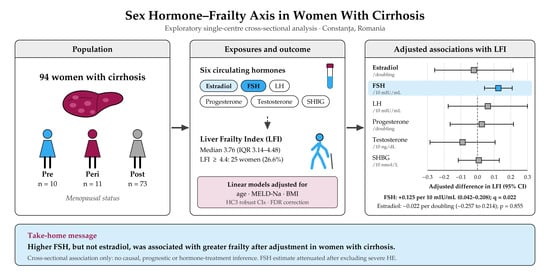
Endocrine disturbance and impaired physical reserve coexist in cirrhosis, but female-specific associations between circulating sex hormones and frailty remain insufficiently characterized. We examined hormone–frailty associations across menopausal categories in a clinical database of women with cirrhosis. This exploratory, single-centre, record-based cross-sectional analysis used retrospectively reviewed clinical records of 94 women with cirrhosis treated at “Sf. Apostol Andrei” Emergency County Hospital, Constanța, Romania, during January 2021–March 2025. The continuous Liver Frailty Index (LFI) was the principal outcome; handgrip strength and L3 skeletal muscle index were complementary phenotypes. Six separate linear models evaluated estradiol, follicle-stimulating hormone (FSH), luteinizing hormone, progesterone, total testosterone, and sex hormone-binding globulin, adjusting for age, recorded MELD-Na, and body mass index. HC3 heteroscedasticity-robust confidence intervals and Benjamini–Hochberg false-discovery-rate correction were used. Sensitivity analyses addressed menopausal status, exogenous hormones, inflammation, disease severity, sampling context, and severe hepatic encephalopathy (HE). There were 10 premenopausal, 11 perimenopausal, and 73 postmenopausal women. Median LFI was 3.76 (interquartile range, 3.14–4.48); 25 women (26.6%) had LFI ≥ 4.4. Estradiol was not clearly associated with LFI after adjustment: coefficient −0.022 per doubling (95% confidence interval, −0.257 to 0.214; p = 0.855). FSH was associated with higher LFI: 0.125 per 10 mIU/mL (0.042–0.208; p = 0.004; adjusted q = 0.022). The FSH estimate remained positive in postmenopausal women, but its interval crossed zero after excluding records labelled with severe HE. No hormone–muscle correlation survived correction across 18 exploratory comparisons. FSH, but not estradiol, showed an adjusted cross-sectional association with frailty. These findings do not establish causality, prognostic utility, or an indication for hormone treatment. Unresolved sampling-context and physical-assessment timing require source-record verification before clinical interpretation.

Women

9 November 2026

Sex hormone–frailty axis in women with cirrhosis. Created in BioRender. Nelson Twakor, A. (2026) https://BioRender.com/q4qs4v4.
  • Article
  • Open Access

Although educational interventions for pregnancy-related low back pain (PLBP) have previously been investigated, little is known about physically active women’s postpartum perceptions of written information or whether these perceptions align with physical activity (PA), PLBP, and healthcare-seeking. This prospective cohort study assessed postpartum perceptions of information provided during the first trimester and their associations with PA, PLBP, and primary care consultation. The cohort included 147 pregnant women who met a prespecified operational PA criterion of ≥600 MET·min/week both before and during pregnancy, with PA assessed using the short form of the International Physical Activity Questionnaire (IPAQ). This threshold was operationally derived from World Health Organization recommendations on PA during pregnancy. At first-trimester recruitment, all participants received comprehensive written information on PA during pregnancy and strategies to prevent or alleviate PLBP. Perceptions were assessed within the first month postpartum. Overall, 97.3% perceived the information as useful, and 90.5% reported a positive influence on their motivation to remain active. PLBP developed in 64.6% of participants, with no significant differences in perceived usefulness or motivational influence between women with and without PLBP. Motivational influence was not associated with PA levels or changes during pregnancy. Among participants who developed PLBP, 44.2% consulted primary care; consultation was not associated with perceived usefulness, motivational influence, or PA. Maximum pain intensity was not associated with motivational influence, whereas PLBP affecting more than one trimester was associated with the absence of a perceived positive motivational influence after adjustment (adjusted OR 6.02; 95% CI 1.66–24.99). Thus, favorable perceptions of the information coexisted with a high incidence of PLBP and a low primary care consultation rate, indicating that perceived usefulness and motivation were not necessarily reflected in PA levels or changes, pain experience, or healthcare-seeking.

Women

8 November 2026

  • Article
  • Open Access

Cesarean delivery is associated with maternal and infant outcomes, but population-average estimates may obscure variation across individuals. This study examined associations between delivery mode and four maternal and infant outcomes and explored heterogeneity in estimated treatment effects. We analyzed Pregnancy Risk Assessment Monitoring System (PRAMS) data from 2016–2020, including 197,942 women with classifiable delivery modes. Least absolute shrinkage and selection operator regression was used for covariate screening, followed by extreme gradient boosting for propensity score estimation. Stabilized inverse-probability-of-treatment weights were combined with PRAMS analytic weights for population-average logistic regression. An X-learner framework was applied to explore heterogeneity in estimated treatment effects across baseline maternal and pregnancy characteristics. Compared with vaginal delivery, cesarean delivery was associated with higher odds of infant transfer (OR, 2.27; 95% CI, 1.99–2.60; p < 0.001) and postpartum depressive symptoms (OR, 1.11; 95% CI, 1.06–1.16; p < 0.001), and lower odds of breastfeeding initiation (OR, 0.85; 95% CI, 0.81–0.88; p < 0.001). The estimated odds of infant death were lower but not statistically significant (OR, 0.77; 95% CI, 0.57–1.03; p = 0.082). Exploratory X-learner analyses indicated greater heterogeneity for infant transfer and breastfeeding initiation, whereas postpartum depressive symptoms and infant death exhibited comparatively limited variability in estimated conditional effects. Cesarean delivery was associated with differential maternal and infant outcomes, with estimated heterogeneity varying across outcomes. Combining population-average regression with exploratory machine learning approaches may provide additional insight into these associations. However, residual confounding, particularly by clinical indication, and the lack of external validation limit causal interpretation and immediate clinical application.

Women

6 November 2026

  • Article
  • Open Access

Monitoring training load in professional soccer should account for sex-specific physiological rhythms, including menstrual cycle fluctuations. Although app-based tracking tools provide a non-invasive solution for estimating cycle phases, their relationship with performance metrics remains unclear. This study investigates whether external training load varies across menstrual cycle phases estimated via app-based tracking in professional female soccer players during pre-season and early competition. Thirty-one professional female soccer players (age: 23.29 ± 4.27 years) from two Spanish teams participated in this prospective, longitudinal, and observational study. Global Positioning System (GPS)-derived external load was recorded daily during all training sessions over five weeks of pre-season and early competition. Menstrual cycle phases were estimated using the FitrWoman app and classified into four physiological phases. Phase-based differences were analyzed using one-way ANOVA with post hoc tests. The follicular to ovulation phase consistently showed the highest values in total distance (TD), maximum velocity (Vmax), and walking distance compared to the other phases (all p ≤ 0.002). No significant effects were observed in the remaining GPS-derived variables. Overall, menstrual cycle phase may influence specific aspects of training load, and app-based monitoring may offer a feasible strategy to contextualize performance data in elite environments.

Women

5 November 2026

Highly Accessed Articles

News & Conferences

Latest Issues

Open for Submission

Journal Sections

XFacebookLinkedIn
Women - ISSN 2673-4184