Skip to Content
  • 3.5
    Impact Factor
  • 7.7
    CiteScore
  • 18 days
    Submission to First Decision
  • 3 days
    Acceptance to Publication

Vaccines

Vaccines is an international, peer-reviewed, open access journal on laboratory and clinical vaccine research, utilization and immunization, published monthly online by MDPI. The Polish Society of Vaccinology (PTW) is affiliated with Vaccines and its members receive discounts on the article processing charges.

Get Alerted

Add your email address to receive forthcoming issues of this journal.

All Articles (10,571)

  • Review
  • Open Access

Messenger RNA (mRNA) vaccines offer a flexible approach to colorectal cancer (CRC) immunotherapy, with applications ranging from postoperative residual disease to metastatic cancer. This narrative review examines antigen selection, RNA engineering, nanodelivery, and clinical development, drawing on literature available through 21 October 2026. Tumor-associated antigens, shared driver mutations, and personalized neoantigens offer different advantages in population coverage, specificity, and manufacturing. Their activity also depends on RNA chemistry and carrier design, including lipid composition, endosomal release, APC targeting, tissue distribution, stability, and repeated dosing. Early clinical studies have demonstrated antigen-specific T-cell responses in selected patients, while randomized melanoma data provide a benchmark for combining vaccination with checkpoint blockade. The termination of the CRC adjuvant autogene cevumeran monotherapy trial highlights the difficulty of translating immune priming into recurrence prevention. Antigen heterogeneity, impaired HLA presentation, stromal exclusion, and liver-associated immune suppression remain important barriers in CRC. Advances in neoantigen prediction, self-amplifying RNA, and mechanism-based combinations may improve vaccine design, but their clinical value will depend on disease-specific trials that account for manufacturing feasibility and established oncological endpoints. The available evidence remains heterogeneous, with small CRC cohorts and limited randomized outcomes; the non-systematic search also introduces potential selection bias.

Vaccines

18 November 2026

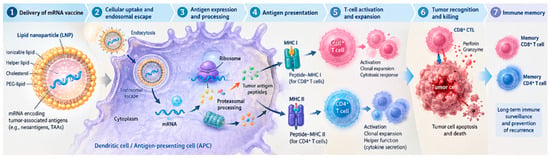
Antitumor immune responses induced by nanodelivered mRNA vaccines. Following cellular uptake and endosomal escape, mRNA is translated in APCs and processed for peptide presentation to CD8+ and CD4+ T cells. MHC class II presentation involves endosomal trafficking, secretion and reuptake, or autophagy. Effector T cells subsequently recognize matching peptide–HLA complexes on tumor cells, while memory populations may support longer-term surveillance. Neoantigens and tumor-associated self-antigens are distinct target classes. Recurrence prevention represents a therapeutic objective. APC, antigen-presenting cell; CTL, cytotoxic T lymphocyte; PEG, polyethylene glycol [4,6,8,12]. Prepared using chatGPT.
  • Article
  • Open Access

Background/Objectives: Chronic Chagas cardiomyopathy (CCC), caused by Trypanosoma cruzi (T. cruzi), remains a major public health challenge and a leading cause of heart failure, with this chronic stage representing the period when most patients are diagnosed and require clinical intervention. However, the efficacy of the available parasiticidal drugs, benznidazole (BZL) and nifurtimox during chronic infection is limited and new therapeutic approaches are needed. In this study, we evaluated a novel sequential chemo-immunotherapeutic strategy (BZL → Vac → BZL) designed to shorten benznidazole treatment duration to minimize drug-related adverse effects by leveraging the synergistic potential of both treatments. Methods: BALB/c mice chronically infected with T. cruzi were used as model. A long-term sequential regimen was evaluated and compared 190 days post-infection with uninfected, untreated infected (Tc), monotherapy (BZL or TSNt-ISPA vaccine), and combined (Vac → BZL) controls. The sequential treatment consisted of an initial short cycle of oral BZL, three subcutaneous immunizations with the TSNt-ISPA vaccine, and a final BZL booster. Cardiac parasite load and cytokine expression (qPCR), inflammation and fibrosis (histopathology), electrocardiograms (ECG), specific antibodies (ELISA), and splenic cellular response (flow cytometry) were analyzed. Results: The BZL-Vac → BZL scheme significantly reduced cardiac parasite load, achieving undetectability in some animals. Combined therapies (Vac → BZL and BZL → Vac → BZL) significantly attenuated myocardial inflammation and fibrosis, improving P-wave duration and the QTc interval. The sequential treatment induced a robust Th1-associated humoral response (IgG2a) and a balanced cellular profile, uniquely increasing splenic IL-10-producing CD4+ T cells, TNF-α-producing CD8+ T cells, and cardiac IL-10 and Foxp3 expression. Conclusions: The temporal integration of fractionated benznidazole and TSNt-ISPA immunotherapy protects myocardial integrity and function through an effector immune response under strict regulatory control.

Vaccines

17 November 2026

  • Article
  • Open Access

HPV Vaccine Communication Needs and Preferences Among Cape Verdean Immigrant Parents in the United States

  • Oriana Barros,
  • Celestina V. Antunes and
  • Ana Cristina Lindsay
  • + 3 authors

Background: Limited research has examined HPV vaccine communication among Cape Verdean immigrant families living in the United States (U.S.). This study explored how Cape Verdean immigrant parents of adolescents living in the U.S. receive and seek HPV vaccine information, focusing on information sources, trusted messengers, healthcare provider (HCP) communication, and preferences for HPV education. Methods: We conducted a cross-sectional formative study among Cape Verdean immigrant parents of adolescents aged 11–17 years. Participants completed a survey in their preferred language (English, Portuguese, or Cape Verdean Creole). Descriptive statistics characterized HPV vaccine communication experiences, interest in HPV education, and intervention preferences. Among parents whose adolescents had not initiated HPV vaccination (n = 115), sociodemographic and HPV-related characteristics were compared by interest in participating in an HPV education program. Preferred intervention delivery formats and language were also summarized among interested parents (n = 52). Results: As previously reported, fewer than half of the 166 participating parents had heard of HPV (42.8%) or the HPV vaccine (40.4%). Healthcare providers (HCPs) were the most common source of HPV vaccine information (69.3%) and the most trusted (99.4%), yet only 39.8% reported receiving an HPV vaccine recommendation. However, among parents who received HPV vaccine information from HCPs, fewer than half (48.8%) considered the information reliable or trustworthy, and 35.5% reported insufficient information to make a vaccination decision. Among parents whose adolescents had not initiated HPV vaccination, 45.2% expressed interest in HPV education, which varied by U.S. residence duration and selected vaccine beliefs and family and social influences. Text messaging (55.8%) and Facebook (38.5%) were the most frequently selected delivery formats, and Cape Verdean Creole (68.6%) was the preferred language. Conclusions: Findings highlight gaps in HPV vaccine communication despite high healthcare provider (HCP) access and parental trust in HCPs. Future interventions should strengthen HCP–family communication and use culturally and linguistically responsive approaches through preferred communication channels.

Vaccines

17 November 2026

  • Review
  • Open Access

Cervical cancer is a major cause of morbidity and mortality among women in sub-Saharan Africa, where vaccination coverage remains below the World Health Organization target of 90% of girls fully vaccinated by 15 years of age. This narrative review synthesizes evidence on human papillomavirus (HPV) genotype distribution, single-dose versus two-dose vaccination, and the implications of human immunodeficiency virus (HIV) co-infection. Although HPV 16 and HPV 18 remain the predominant oncogenic types, HPV 35, HPV 52, HPV 45, HPV 33, and HPV 58 are reported frequently in sub-Saharan African populations. Consequently, some high-risk infections fall outside bivalent and quadrivalent vaccine coverage, and some detected types remain outside nonavalent vaccine coverage. Randomized trials in Tanzania and Kenya demonstrate durable single-dose immunogenicity through 60 months and vaccine efficacy above 98% against persistent vaccine-type infection through 54 months, respectively. A trial in Costa Rica provides a direct five-year randomized comparison showing non-inferiority of one dose to two doses. Equivalent single-dose efficacy and durability evidence for people living with HIV remains unavailable. These findings support expanded single-dose vaccination in immunocompetent populations alongside multidose pathways for people living with HIV, genotype-specific surveillance, and continued cervical screening.

Vaccines

17 November 2026

Featured Articles of Last Quarter

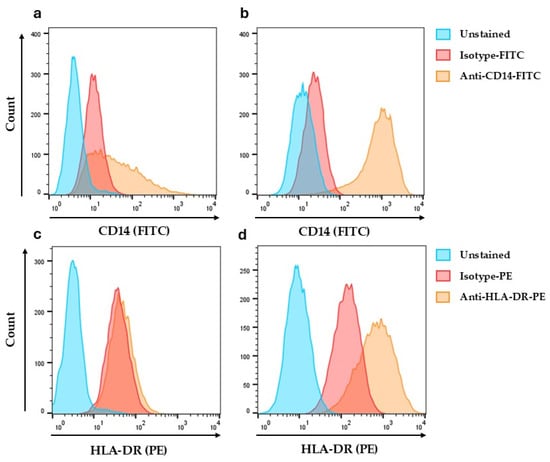
Surface expression of CD14 and HLA-DR in naïve monocytic THP-1 cells and on THP-1-derived macrophage-like cells after PMA plus IFN-γ. Overlays include the corresponding isotype-control antibody. (a) CD14 on monocytic cells; (b) CD14 on macrophage-like cells; (c) HLA-DR on monocytic cells; (d) HLA-DR on macrophage-like cells.
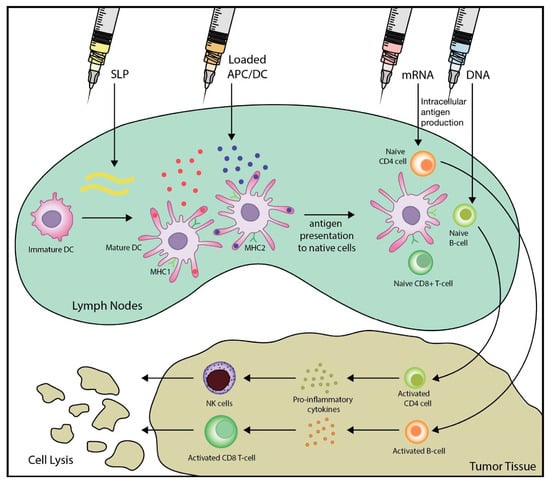
Mechanism of adaptive immune response to a vaccine. Illustration of immune system activation by major vaccine platforms. Arrows show cascade of immune activation and where vaccine platforms exert effects. In lymph nodes and other secondary lymphoid organs, antigens from SLPs or antigens (from loaded DCs) are ingested by immature dendritic cells and presented via MHC I and II to naive CD8 T cells, CD4 T cells, and B cells. Mature immune cells migrate to the tumor site, where CD4+ T cells and B cells secrete pro-inflammatory cytokines, while CD8+ T cells and NK cells promote tumor cell lysis.

Highly Accessed Articles

News & Conferences

Latest Issues

Open for Submission

Journal Sections

XFacebookLinkedIn
Vaccines - ISSN 2076-393X