
Skip to Content
You are currently on the new version of our website. Access the old version .
  • 3.1
    Impact Factor
  • 6.0
    CiteScore
  • 26 days
    Submission to First Decision
  • 4 days
    Acceptance to Publication

Tropical Medicine and Infectious Disease

Tropical Medicine and Infectious Disease (TropicalMed) is an international, peer-reviewed, open access journal of tropical medicine and infectious disease, and is published monthly online. The Australasian College of Tropical Medicine (ACTM) and its joint Faculties of Travel Medicine and Expedition and Wilderness Medicine are affiliated with the journal, serving as their official journal. College members receive discounts on the article processing charges.
  • Open Access— free for readers, with article processing charges (APC) paid by authors or their institutions.
  • High Visibility: indexed within Scopus, SCIE (Web of Science), PubMed, PMC, Embase, Informit, and other databases.
  • Journal Rank: JCR - Q1 (Tropical Medicine) / CiteScore - Q1 (Public Health, Environmental and Occupational Health)
  • Rapid Publication: manuscripts are peer-reviewed and a first decision is provided to authors approximately 25.9 days after submission; acceptance to publication is undertaken in 3.8 days (median values for papers published in this journal in the first half of 2026).
  • Recognition of Reviewers: Reviewers whose reports are timely and of high quality receive an APC discount voucher for a future publication in an MDPI journal. Become a reviewer.

Get Alerted

Add your email address to receive forthcoming issues of this journal.

All Articles (2,708)

  • Article
  • Open Access

Background/Objectives: Liver test abnormalities are common in anaplasmosis, but their pattern has not been characterized. We aimed to describe the frequency, pattern, and severity of liver injury and acute hepatitis in hospitalized patients. Methods: We performed a secondary analysis of a previously described cohort of adults hospitalized with polymerase chain reaction (PCR)-confirmed anaplasmosis in Minnesota and Wisconsin, USA, between 2014 and 2024. After excluding patients with alcohol use disorder, tick-borne coinfection, or other causes of liver injury, we classified the pattern of injury by R factor in patients with elevated alanine aminotransferase (ALT) or alkaline phosphatase (ALP). We compared patients with acute hepatitis and those with isolated abnormalities. Results: Of 78 eligible patients with liver tests, 64 (82.1%) had at least one abnormality, most often of aspartate aminotransferase (AST; 92.2%). Among 50 patients with elevated ALT or ALP, the pattern was cholestatic in 56.0%, mixed in 36.0%, and hepatocellular in 8.0%; 14 patients had isolated AST elevation. Most elevations were mild, and no patient developed acute liver failure. Patients with acute hepatitis (n = 14, 21.9%) more often had elevated ALP than those with isolated abnormalities (85.7% vs. 50.0%, p = 0.030), whereas the pattern of injury did not differ. Conclusions: Liver involvement in hospitalized patients with anaplasmosis is common and may present as acute hepatitis or as isolated liver test abnormalities. It is usually mild, predominantly cholestatic or mixed, and does not progress to liver failure. Isolated AST elevation is frequent and may partly reflect muscle injury.

Trop. Med. Infect. Dis.

14 November 2026

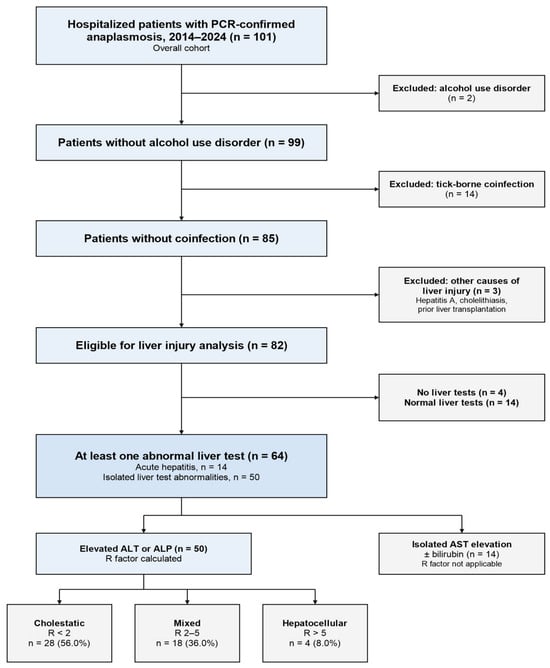
Flow diagram of patient selection for the liver injury analysis. Of the 101 patients in the overall cohort [13], 2 with alcohol use disorder, 14 with tick-borne coinfection, and 3 with other causes of liver injury (hepatitis A, cholelithiasis, prior liver transplantation) were excluded, leaving 82 eligible patients. Of these, 4 had no liver tests, 14 had normal liver tests, and 64 had at least one abnormal liver test. The R factor was calculated for the 50 patients with elevated ALT or ALP; the remaining 14 had isolated AST elevation with or without hyperbilirubinemia. Patients with abnormal liver tests were classified as having acute hepatitis (n = 14) or isolated liver test abnormalities (n = 50). ALP, alkaline phosphatase; ALT, alanine aminotransferase; AST, aspartate aminotransferase; PCR, polymerase chain reaction; R, R factor.
  • Article
  • Open Access

Background: In recent years, the incidence of enteric infectious diseases in China has declined significantly. However, hepatitis E incidence remains relatively high in eastern coastal provinces. This study aimed to characterize the epidemiological features of hepatitis E in Zhejiang Province; to decompose county-level incidence into endemic, autoregressive, and spatiotemporal components; and to assess the heterogeneity across counties. Methods: Hepatitis E case data, population data, socioeconomic data, and meteorological data were obtained. Seasonality was described using the seasonal index, the concentration method and a harmonic Poisson regression. A spatiotemporal multicomponent model was fitted to monthly county-level case counts to decompose incidence into endemic, autoregressive and spatiotemporal components. Results: Over the study period, hepatitis E incidence in Zhejiang Province showed an upward trend. Seasonality was weak (concentration index M = 0.10; sin term: p < 0.001; amplitude A = 0.21, 95% CI: 0.16–0.27), with a minor peak in early-to-mid April. Incidence was relatively higher in the northwestern region. The estimated parameters for the autoregressive, spatiotemporal, and endemic components were 0.366, 0.037, and 45.325, respectively, with substantial heterogeneity across counties. The endemic component accounted for the largest mean county-specific proportion. The autoregressive component accounted for the largest proportion in high-incidence areas, whereas the endemic component dominated in low-incidence areas. The relative risk for per capita Gross Domestic Product and daily total precipitation was 1.018 (95% CI: 1.010–1.025) and 0.976 (95% CI: 0.960–0.992), respectively. Conclusions: The components accounting for the largest proportion of hepatitis E incidence in Zhejiang Province differed between high- and low-incidence areas, underscoring the need for tailored prevention strategies based on local epidemiological patterns.

Trop. Med. Infect. Dis.

13 November 2026

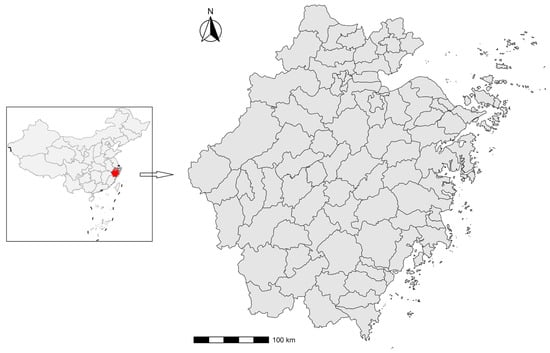
The geographical location of Zhejiang Province in China. Zhejiang Province is highlighted in red. The 88 spatial units used in the analysis are shown; Longgang City (separated from Cangnan County in 2020) and Linping District (separated from Yuhang District in 2021) are merged into their parent units to maintain spatial comparability over the study period.
  • Review
  • Open Access

Travelers and Human–Animal Pathogen Transmission: A One Health Review of Zoonotic and Reverse Zoonotic Diseases

  • Sakarn Charoensakulchai,
  • Nicha Nuntanajaroenkul and
  • Manasvin Onwan
  • + 1 author

Background: International travel can accelerate the geographic spread of zoonotic pathogens and, under certain circumstances, contribute to epidemic or pandemic dissemination. Travelers may also transmit human pathogens to wildlife at tourism interfaces, acting as intermediaries in zoonotic and reverse zoonotic transmission. Methods: Archived WHO and ECDC reports were screened for major zoonotic outbreaks in which international travel contributed to cross-border spread. PubMed and Scopus were searched for studies of human-to-wildlife transmission involving tourists, visitors, or travelers and traveler behaviors that could facilitate transmission. Results: Among 14 major zoonotic outbreaks, travelers commonly acted as spreaders following initial animal-to-human spillover by importing infections into new regions, sometimes resulting in onward transmission. This pattern was prominent with respiratory infections such as SARS, MERS, influenza, and COVID-19 and vector-borne infections such as Oropouche and Zika. Twenty-one studies reported possible or confirmed reverse zoonotic transmission at human–wildlife tourism interfaces. Pathogens included respiratory viruses, Mycobacterium tuberculosis, enteric pathogens, and antimicrobial-resistant pathogens. Affected wildlife included great apes, primates, elephants, felines, carnivorans, ungulates, avians, reptiles, and urban-adapted wildlife in national parks, zoological parks, rehabilitation centers, and semi-urban parks. Five additional studies documented risky tourist behaviors, including close approach to, physical contact with, and feeding and visiting wildlife while having respiratory symptoms, and inadequate vaccination against measles, influenza, and polio. Conclusions: Travelers can influence transmission bidirectionally by disseminating zoonotic pathogens and exposing wildlife to human pathogens. Travel medicine should incorporate wildlife-protective counseling on distancing, hygiene, waste disposal, and immunization alongside conventional traveler protection.

Trop. Med. Infect. Dis.

12 November 2026

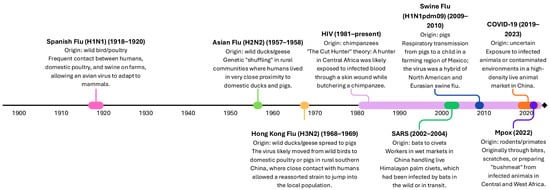
Timeline of selected major global pandemics with zoonotic origins.
  • Article
  • Open Access

Toxoplasma gondii (T. gondii) is an important pathogen in terms of veterinary and human public health and is responsible for Toxoplasmosis. Ticks are the leading vectors of veterinary and medically important pathogens, and T. gondii has also been detected in ticks in some studies. Information on the molecular occurrence of T. gondii in ticks from Pakistan is lacking. The current study aims to detect the existence of T. gondii DNA in ticks in Pakistan. A total of 1075 ticks were collected from 270 different animals. Each sample was identified morphologically using a stereomicroscope. DNA from pooled samples was screened for T. gondii detection by PCR assay targeting a 529 bp repetitive element. The overall PCR-positive pool proportion of T. gondii was found to be 13% in 100 pooled samples of ticks. PCR-positive pool proportion of T. gondii was observed in ticks collected from district Pakpattan (16.7%), district Sahiwal (12.5%), and district Okara (10%). PCR-positive pool proportion of T. gondii DNA was higher in ticks of the Hyalomma genus collected from buffalo (20%) and goats (13.6%) and the genus Rhipicephalus collected from cattle (27.7%) and sheep (10%). This study is the first molecular evidence of T. gondii DNA in ticks from the Sahiwal division of Punjab province, Pakistan.

Trop. Med. Infect. Dis.

11 November 2026

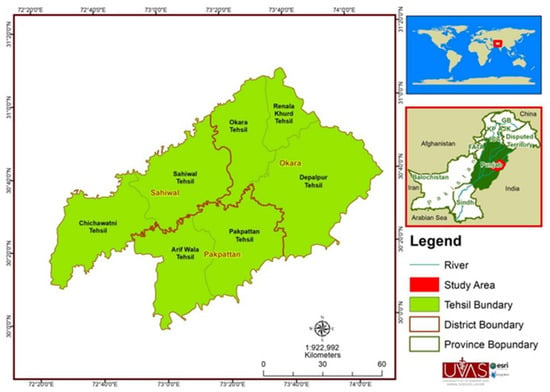
Map of the tick sampling sites showing 3 districts of Sahiwal division, Punjab province, Pakistan.

Highly Accessed Articles

News & Conferences

Latest Issues

Open for Submission

Journal Sections

XFacebookLinkedIn
Trop. Med. Infect. Dis. - ISSN 2414-6366