
Skip to Content
You are currently on the new version of our website. Access the old version .
  • 4.1
    Impact Factor
  • 8.9
    CiteScore
  • 17 days
    Submission to First Decision
  • 4 days
    Acceptance to Publication

Sustainability

Sustainability is an international, peer-reviewed, open-access journal on environmental, cultural, economic, and social sustainability of human beings, published semimonthly online by MDPI. The Canadian Urban Transit Research & Innovation Consortium (CUTRIC), International Council for Research and Innovation in Building and Construction (CIB) and Urban Land Institute (ULI) are affiliated with Sustainability and their members receive discounts on the article processing charges.

Get Alerted

Add your email address to receive forthcoming issues of this journal.

All Articles (111,012)

  • Article
  • Open Access

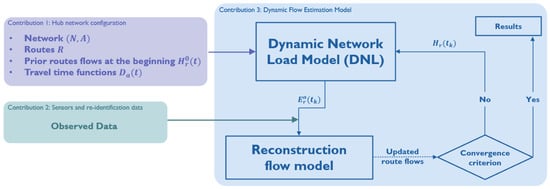
Dynamic estimation of pedestrian route flows in intermodal stations is essential to understand how passengers are distributed within complex infrastructures and to support operational management, planning and sustainable mobility. However, estimating these flows is challenging because direct observations are usually partial: sensors can only be installed at selected locations, and the same detection may be compatible with several routes. To address this limitation, this paper proposes a dynamic model to estimate pedestrian route flows from re-identification sensor data. The method combines a dynamic network loading model, which propagates route demand through the network, with a flow reconstruction model that adjusts the estimates using cumulative observations and travel times recorded between sensors. To assess its performance, the model is evaluated under different sensor layouts in a representative intermodal-station network simulated in Vissim–Viswalk, where reference route and link flows are available for validation. This comparison examines how the amount and location of the available information affects the quality of the estimation. The evaluation is further extended to a larger case study based on Getafe-Central station as a real-size case study. In both experiments, the results show that the model can accurately reconstruct route flows when all routes are identifiable and can still provide acceptable estimates with fewer sensors in the analysed scenarios. The reconstructed flows therefore provide useful information for managing pedestrian movements, detecting critical areas and supporting a more efficient and sustainable use of intermodal transport facilities.

Sustainability

10 November 2026

General scheme of the dynamic estimation algorithm for pedestrian flows.
  • Article
  • Open Access

Institutional opening-up may influence the cross-border supply of technologies used in the energy transition. Using a panel of 31 Chinese provincial-level administrative units from 2008 to 2024, this study examines renewable energy-related product exports following the staggered establishment of pilot free trade zones (PFTZs). The two-way fixed-effects estimate with five controls is 0.394 in units of CNY 10 billion, equivalent to approximately CNY 3.94 billion at current prices, and is significant at the 1% level. A Callaway–Sant'Anna specification with the same five covariates also yields a positive overall estimate. Results differ by outcome scale: the corresponding log-export estimates are not statistically significant. Sensitivity intervals include zero when larger departures from parallel trends are allowed. The restricted wind/PV-related basket yields a positive coefficient significant only at the 10% level and retains multipurpose products. Regressions for green invention patent applications and the business-environment index provide suggestive evidence consistent with the proposed channels, but do not identify indirect causal effects on exports. The business-environment evidence warrants particular caution because 70.59% of its annual observations are interpolated or extrapolated. Formal comparisons indicate overall differences across products and regions, but do not justify a general ranking of all subgroup effects. Destination analysis is restricted to a fixed end-2024 Belt and Road partner list and its complement. The findings provide provincial evidence on institutional opening-up and energy technology-related trade. Their sustainability implications depend on product uses and overseas deployment, which are not directly observed.

Sustainability

10 November 2026

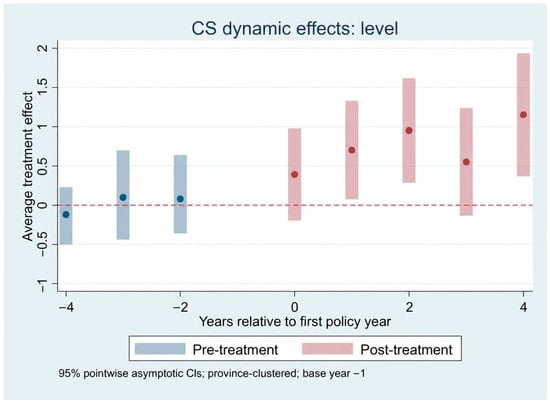
CS dynamic estimates for export levels. Event-time zero is the first treatment year and −1 is the reference. Shaded intervals are 95% pointwise asymptotic confidence intervals clustered by province. Counts of contributing treated provinces and cohorts appear in Supplementary Table S7. Pointwise intervals do not constitute a simultaneous confidence band. The event window is displayed without endpoint pooling.
  • Systematic Review
  • Open Access

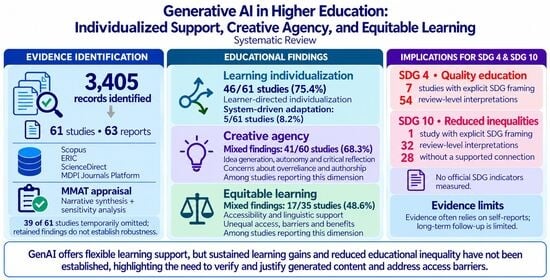
Generative AI (GenAI) promises individualized support in higher education, yet sustained learning and equity benefits remain uncertain. This systematic review examined learning individualization, student support, creative agency, equitable learning, and implications for Sustainable Development Goals (SDGs) 4 and 10. Prospectively registered (INPLASY202660012) and reported following PRISMA 2020, it searched Scopus, ERIC, ScienceDirect, and the MDPI Journals Platform. Sixty-one studies represented by 63 reports underwent independent dual appraisal using the Mixed Methods Appraisal Tool (criterion-level Cohen’s κ = 0.664) and narrative synthesis. Learner-directed individualization appeared in 46 studies; five documented system-driven adaptation. Creative-agency findings were mixed in 41 of 60 studies, combining ideation and autonomy with overreliance concerns. Equitable-learning findings were mixed in 17 of 35 studies, with accessibility and linguistic support alongside unequal access and benefit. Evidence frequently relied on self-reports, with limited long-term follow-up. Seven studies explicitly framed findings around SDG 4, one around SDG 10, and none measured official SDG indicators. Core themes remained represented after 39 studies were temporarily omitted in sensitivity analysis, without establishing robustness. GenAI offers flexible support, but sustained learning gains and reduced educational inequality remain unestablished. Future research should assess learning, compare groups longitudinally, and specify SDG targets.

Sustainability

10 November 2026

Study identification, screening, eligibility assessment, and final inclusion, including additional studies identified through citation searching. Note: For citation searching, only additional inclusions are shown because intermediate identification and selection counts were not recorded.
  • Article
  • Open Access

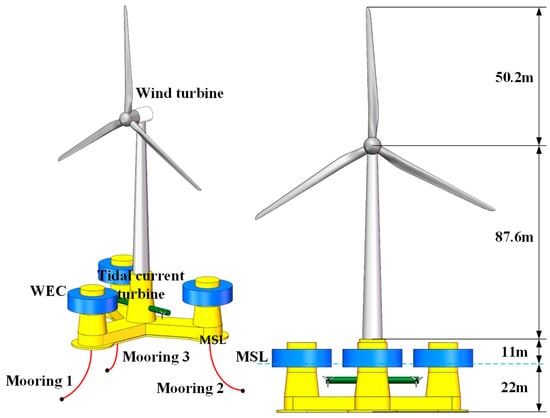
As the development of marine renewable energy gradually moves towards the deep sea, the positioning capability and motion performance of the mooring system for floating marine platforms have become more demanding. This work takes the wave–wind–tidal (WWT) hybrid energy system as the research object and constructs three mooring schemes, namely, spread mooring, central single-point mooring (SPM) and forward SPM. Using a coupling calculation framework that combines FAST and AQWA, the motion responses and mooring load characteristics of the platform under different mooring systems are compared and studied. The results show that different mooring systems have a significant impact on the motion response of the platform. Spread mooring provides a strong horizontal restoring effect through multiple mooring cables. In contrast, single-point mooring (SPM) has a lower capacity to constrain the motion of the platform, resulting in an increased motion response. A directional distribution of mooring-line tension is observed in all three configurations, with the front mooring line carrying a substantially larger mean tension than the two rear mooring lines. Compared with central SPM, forward SPM can increase the arm of the mooring force and enhance the restoring moment, thereby effectively suppressing the low-frequency motion response of the platform. The research results can provide a reference for the layout optimization and motion performance control of the WWT hybrid energy system.

Sustainability

10 November 2026

Configuration of WWT energy system.

Highly Accessed Articles

News & Conferences

Latest Issues

Open for Submission

Journal Sections

XFacebookLinkedIn
Sustainability - ISSN 2071-1050