
- Article

31 Pages
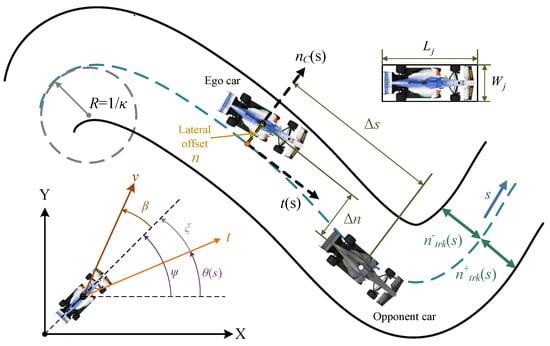
Overtaking planning and decision-making are central to performance in autonomous racing. Limited maneuvering space on narrow closed circuits makes high-speed overtaking difficult and increases the risk of failed overtaking attempts and collisions. To address this problem, we formulate overtaking as robust tactical feasible-set selection and develop a Stackelberg-supervised policy that translates response-set reasoning into persistent tactical corridors for constrained planning and closed-loop control. First, a robust Stackelberg response-set teacher provides action-prior and action-conditioned robust-value supervision to a Truncated Quantile Critics (TQC) policy that takes sensor-derived opponent-state estimates as input and learns passing-side intention, corridor parameters, and speed demand. Second, a hysteretic finite-state machine (FSM) preserves the selected passing side, while a deterministic corridor carver combines the learned corridor parameters with the evolving track and interaction geometry to construct a time-varying Frenet corridor. Finally, a corridor-constrained sequential second-order cone programming (SOCP) planner and a speed profiler generate a continuous path–speed reference, which is tracked using reference-conditioned contouring-error nonlinear model predictive control (RC-NMPC) to produce closed-loop vehicle commands. Hardware-in-the-loop experiments were conducted using an Emirates Autonomous Vehicle (EAV24) formula race-car simulator with Gaussian noise and packet drops applied to localization and perception outputs. Across 1000 laps, the method achieved a lead-acquisition rate of 94.7% and a mean time to lead acquisition of 4.82 s. Compared with three baselines using the same execution stack, the lead-acquisition rate was 31.2–66.2 percentage points higher and the mean time to lead acquisition was 3.01–6.41 s shorter; no collisions or track-boundary violations were observed.
Sensors
6 November 2026