
Skip to Content
  • 3.6
    Impact Factor
  • 7.4
    CiteScore
  • 21 days
    Submission to First Decision
  • 4 days
    Acceptance to Publication

Robotics

Robotics is an international, peer-reviewed, open access journal on robotic systems in theory, design, and applications, published monthly online by MDPI. The International Federation for the Promotion of Mechanism and Machine Science (IFToMM) and Robotic Global Surgical Society (TROGSS) are affiliated with Robotics and its members receive a discount on the article processing charges.

Get Alerted

Add your email address to receive forthcoming issues of this journal.

All Articles (1,479)

  • Article
  • Open Access

Construction and demolition waste (CDW) sorting on conveyors requires robots to intercept irregular targets while maintaining alignment under motion constraints. However, CDW research has emphasised perception, grasp generation, and planned trajectory execution, with limited evidence linking reactive velocity control to sorting productivity. This study formulates a control-oriented evaluation framework to characterise target tracking and examine whether conveyor motion compensation improves acquisition and recovery as conveyor speed increases. A Unity–ROS 2 digital twin using data-derived CDW objects and a UR10e manipulator compared feedback (FB) and combined feedforward and feedback (FF+FB) velocity control across three independently seeded 600 s simulation runs per operating condition. FF+FB maintained progressive tracking convergence across conveyor speeds of 0.4–0.6 m/s. At 0.5 m/s, FF+FB increased the mean pick completion rate from 40.8% to 78.1% and recovery throughput from 4.43 to 6.77 objects/min relative to FB. At 0.6 m/s, pick completion increased from 23.0% to 91.7%, while throughput increased from 2.37 to 6.63 objects/min. Despite lower Approach completion rates, FF+FB consistently achieved stronger downstream acquisition and recovery performance. Comparable cycle durations at 0.5 m/s showed that productivity gains arose from successful acquisition and transfer rather than faster cycles. Repeated seed evaluation demonstrated substantial performance differences between the controllers, although the limited number of independent runs constrains formal statistical inference. By linking motion demand and stage outcomes to throughput, the framework shows how reactive moving target control influences CDW sorting productivity across conveyor speeds.

Robotics

5 November 2026
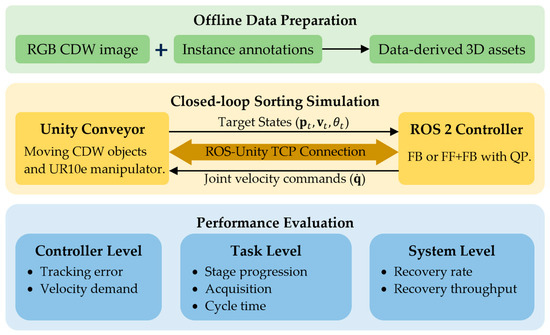
Control-oriented evaluation workflow for conveyor-based CDW sorting.
  • Article
  • Open Access

Flow-matching vision–language–action (VLA) models generate robot actions through iterative denoising, making inference latency a deployment constraint. The acceleration methods reviewed here rarely assess task-success retention against a margin fixed before evaluation. We study three weight-preserving runtime levers on SmolVLA and π0.5: denoising-step count, masked camera prefix elimination, and execution horizon. In simulated closed-loop LIBERO evaluations, three prespecified settings each met a five-percentage-point aggregate task-success margin on 800 paired episodes in the original primary analysis. Because the first confirmation block partly overlapped selection, secondary checks used states the selection grid never reached; they met the margin when pooled, though not in every single block. At settings closer to each checkpoint’s reference evaluation, all three also met it on two blocks. Prediction latency fell by 56–58%; the measured amortized cost per control step for the joint SmolVLA setting was about 94% lower under the stated timing boundaries, with similar reductions on an embedded Jetson AGX Thor. A curvature–tolerance screen agreed with one tested Meta-World rejection but failed to distinguish LIBERO suites, supporting only preliminary screening. Runtime budget changes yielded larger latency reductions than the tested pruning configurations. The contribution is a scoped empirical evaluation and a reusable margin-based procedure, rather than a universal budget or screening guarantee.

Robotics

4 November 2026

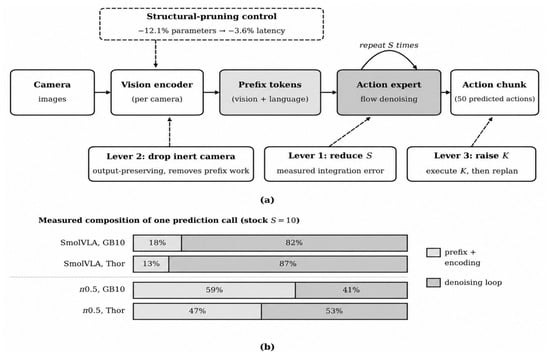
The inference pipeline and measured cost composition. (a) Lever 1 reduces denoising steps S. Lever 2 removes a fully masked camera encoder pass and its prefix tokens without changing outputs in exact arithmetic under the stated assumptions (in the 16-bit brain floating-point format (bf16), closed-loop trajectories can differ; Section 3.3). Lever 3 raises the execution horizon K to amortize one prediction call over K control steps. The dashed branch is the tested structural-pruning control (−12.1% parameters, −3.6% latency). (b) At stock S = 10, denoising accounts for approximately 82%/87% of SmolVLA latency on GB10/Thor, whereas π0.5 carries a larger prefix share (approximately 59%/47%). The split is implementation- and accelerator-dependent [19,20].
  • Article
  • Open Access

A Hybrid Autonomous Underwater Vehicle for Acoustic Monitoring of Low-Noise Sources in Shallow Water

  • Aleksei A. Boreiko,
  • Vladimir V. Kostenko and
  • Sergey A. Pereselkov
  • + 4 authors

Acoustic monitoring of low-noise underwater sources is challenging for autonomous underwater vehicles (AUVs) in shallow water, where waveguide variability and platform self-noise reduce source detectability. This paper presents the design concept of a hybrid autonomous underwater vehicle (HAUV) for passive acoustic monitoring of such sources. The platform combines conventional AUV propulsion for deployment and transit, buoyancy-driven glider motion, and a low-noise receiving mode in which propulsion is switched off, the vehicle is anchored near the seabed, and a vector–scalar receiver (VSR) acquires the acoustic field. Functional and structural models specify the vehicle architecture, mode transitions, buoyancy and stability control, anchoring, navigation and communication, and onboard hydroacoustic processing. Holographic signal processing (HSP) transforms the frequency–time interferogram of the received field into a hologram in which the source energy is concentrated in a small region, whereas incoherent noise is spread over the hologram plane. This enables estimation of source kinematic parameters and reduces the data transmitted to a remote control center. The present work is limited to a conceptual system specification. The next steps toward implementation are hydrodynamic modeling and validation, measurement of platform self-noise, experimental validation of the hydroacoustic subsystem, embedded real-time benchmarking, and full-scale testing of the integrated platform.

Robotics

30 October 2026

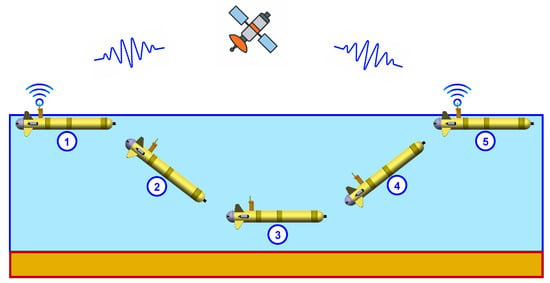
Conceptual deployment of the HAUV in VSR transport mode. Positions: 1—initial surface transit and geographic position determination; 2—dive to the transit depth; 3—underwater travel toward the monitoring area with position estimated by navigation/dead reckoning; 4—ascent after arrival; 5—surface position refinement and correction of accumulated navigation error.
  • Article
  • Open Access

Evaluation of a Rapid-Response Mechanism in Embedded Child Restraint Seat for Cars

  • Luis Angel Guerrero-Hernández,
  • Marco Ceccarelli and
  • Christopher Rene Torres-SanMiguel
  • + 1 author

This paper presents a numerical and energy-based assessment of a rapid-response linkage mechanism intended for an embedded child restraint seat. It is modeled as a rapid-repositioning device that modifies the child–seat system’s kinematic configuration. A single-degree-of-freedom model under base excitation represents the child–seat interaction during a frontal impact. We compare the reference case without the mechanism with a mechanism-enabled case using equivalent impact pulses with the same velocity change. The rapid-response input is limited to a 15 mm displacement in 0.1 s, corresponding to the maximum mechanical travel of the guided-slider region. The comparison is based on relative displacement, transmitted force, and positive accumulated transmitted energy. We evaluate mechanical performance indices to quantify the mechanism’s effect. A sensitivity study examines pulse shape, equivalent stiffness, damping ratio, child mass, activation delay, and partial mechanism displacement. Under the nominal half-sine pulse, the mechanism-enabled case reduces the maximum relative displacement by 0.99%, the maximum transmitted force by 0.99%, and the positive accumulated transmitted energy by 1.59%. The results are preliminary mechanical indicators, not injury criteria or regulatory validation. The proposed framework provides a design tool for evaluating rapid-response mechanisms before experimental and biomechanical testing.

Robotics

24 October 2026

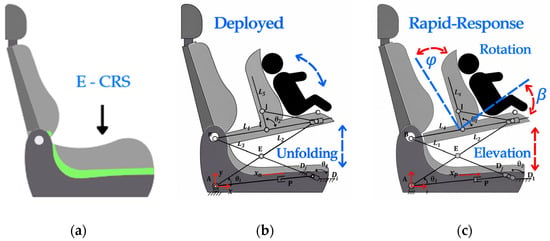
Design concept of the embedded child restraint seat: (a) stored configuration inside the rear seat; (b) deployed child-seat configuration; and (c) rapid-response configuration with lifting and backrest angular repositioning.

Featured Articles of Last Quarter

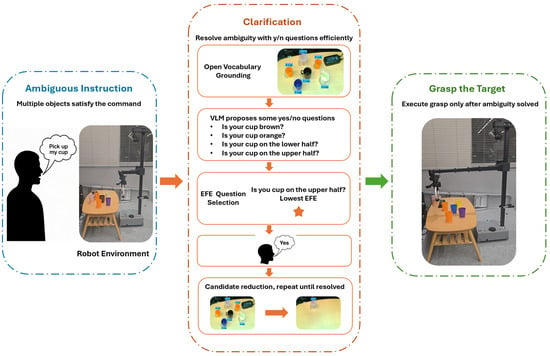
Conceptual overview of ActivAsk. An ambiguous instruction can match several objects in the robot workspace. ActivAsk constructs plausible candidates, asks candidate-grounded yes/no clarification questions, selects an informative question using an expected free energy (EFE) rule, updates the candidate state from the user answer, and executes the grasp only after the intended target is resolved.

Highly Accessed Articles

News & Conferences

Latest Issues

Open for Submission

Journal Sections

XFacebookLinkedIn
Robotics - ISSN 2218-6581