


Reproductive Medicine in Europe

Editor


E-Mail Website
Collection Editor
1. Department of Neurosciences, Rehabilitation, Ophthalmology, Genetics, Maternal and Child Health (DiNOGMI), University of Genoa, 16132 Genoa, Italy
2. Academic Unit of Obstetrics and Gynecology, IRCCS Ospedale Policlinico San Martino, 16132 Genoa, Italy
Interests: gynecology; endometriosis; fibroids; laparoscopy; hormonal therapy; hysteroscopy; ultrasonography; gynecological surgery; minimally invasive surgery; infertility
Special Issues, Collections and Topics in MDPI journals

Topical Collection Information

Dear Colleagues, 

The contribution of European countries to reproductive medicine research is enormous. It seems interesting to know and share the research of European scholars in reproductive medicine so that one can understand the progress of the field in this region, compare it with other countries, and predict future directions. This topical collection aims to bring together scholars, professors, researchers, and administrators from Europe to use state-of-the-art technologies and concepts to significantly improve the field of reproductive medicine.

Prof. Dr. Simone Ferrero
Collection Editor

Manuscript Submission Information

Manuscripts should be submitted online at www.mdpi.com by registering and logging in to this website. Once you are registered, click here to go to the submission form. Manuscripts can be submitted until the deadline. All submissions that pass pre-check are peer-reviewed. Accepted papers will be published continuously in the journal (as soon as accepted) and will be listed together on the collection website. Research articles, review articles as well as short communications are invited. For planned papers, a title and short abstract (about 250 words) can be sent to the Editorial Office for assessment.

Submitted manuscripts should not have been published previously, nor be under consideration for publication elsewhere (except conference proceedings papers). All manuscripts are thoroughly refereed through a single-blind peer-review process. A guide for authors and other relevant information for submission of manuscripts is available on the Instructions for Authors page. Reproductive Medicine is an international peer-reviewed open access quarterly journal published by MDPI.

Please visit the Instructions for Authors page before submitting a manuscript. The Article Processing Charge (APC) for publication in this open access journal is 1200 CHF (Swiss Francs). Submitted papers should be well formatted and use good English. Authors may use MDPI's English editing service prior to publication or during author revisions.

Keywords

  • reproductive medicine
  • gynecology
  • endometriosis
  • fibroids
  • laparoscopy
  • hormonal therapy
  • hysteroscopy
  • ultrasonography
  • gynecological surgery
  • minimally invasive surgery
  • infertility

Published Papers (1 paper)

2025

23 pages, 602 KB  
Review
Environmental Pollution, Endocrine Disruptors, and Metabolic Status: Impact on Female Fertility—A Narrative Review
by Cristina-Diana Popescu, Romina Marina Sima, Mircea-Octavian Poenaru, Ancuta-Alina Constantin, Gabriel-Petre Gorecki, Andrei-Sebastian Diaconescu, Mara Mihai, Cristian-Valentin Toma and Liana Pleș
Reprod. Med. 2025, 6(4), 37; https://doi.org/10.3390/reprodmed6040037 - 18 Nov 2025
Viewed by 766
Abstract
Objectives: Female fertility is increasingly threatened by environmental pollutants such as fine particulate matter (PM2.5 and NO2), endocrine-disrupting chemicals (BPA, phthalates, PFAS, and PCBs), and microplastics. These exposures are associated with impaired ovarian reserve, reduced implantation rates, and lower [...] Read more.
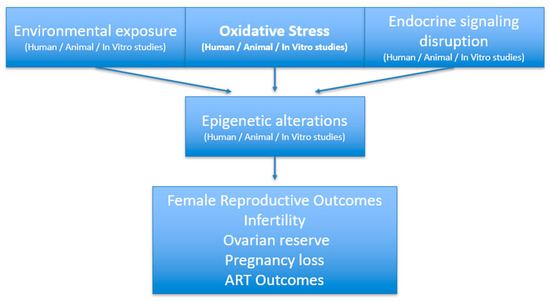
Objectives: Female fertility is increasingly threatened by environmental pollutants such as fine particulate matter (PM2.5 and NO2), endocrine-disrupting chemicals (BPA, phthalates, PFAS, and PCBs), and microplastics. These exposures are associated with impaired ovarian reserve, reduced implantation rates, and lower assisted reproductive technology (ART) success. Given the rising prevalence of obesity and weight-loss interventions, particularly bariatric surgery, understanding the combined influence of metabolic and environmental factors on reproductive outcomes is of critical importance. This review aimed to synthesize recent evidence on how these exposures interact to affect female fertility. Methods: A narrative review was conducted of studies published between 2019 and 2025 using PubMed, Google Scholar, Web of Science, and Wiley Online Library. The PubMed Boolean search string was “female fertility”, “ovarian function”, “IVF” and “pollution”, “endocrine disruptors”, “air pollutants”, and “microplastics”. Searches were limited to English language publications, with the last search performed on 30 March 2025. Human, animal, and in vitro data were screened separately. Human evidence was prioritized, and confounding factors (age, BMI, and smoking) were considered during interpretation. Results: Environmental pollutants were consistently associated with diminished ovarian reserve, poor oocyte quality, and reduced live birth rates in ART. PFAS exposure correlated with lower fecundability, while PM2.5 and NO2 were linked to decreased AMH and AFC levels. Mechanistic animal and in vitro studies support these findings through pathways involving oxidative stress, endocrine disruption, and epigenetic alterations. Rapid metabolic changes, particularly post-bariatric surgery, may transiently increase circulating lipophilic toxicants and reduce antioxidant defenses, amplifying reproductive vulnerability. Conclusions: Environmental exposures, especially PM2.5, NO2, PFAS, and microplastics, adversely influence ovarian and embryonic competence. Rapid metabolic transitions may further modulate this susceptibility through pollutant mobilization and micronutrient imbalances. Future interdisciplinary prospective studies integrating exposure monitoring, metabolic profiling, and reproductive endpoints are essential to guide clinical recommendations and precision fertility counseling. Full article
Show Figures

Figure 1

Back to TopTop
