Skip to Content
  • 3.2
    Impact Factor
  • 3.3
    CiteScore
  • 20 days
    Submission to First Decision
  • 7 days
    Acceptance to Publication

Organics

Organics is an international, peer-reviewed, open access journal on organic chemistry published quarterly online by MDPI.

Get Alerted

Add your email address to receive forthcoming issues of this journal.

All Articles (241)

  • Article
  • Open Access

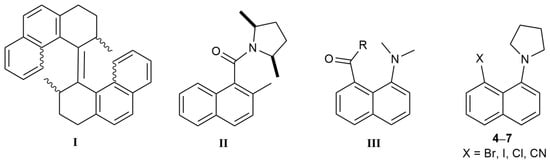
Three 1-pyrrolidinyl 8-halo and one 1-pyrrolidinyl 8-cyano-substituted naphthalenes are prepared. The rate of the rotation of the pyrrolidinyl group is determined through variable temperature proton NMR using line-shape analysis and EXSY. The potential energy of the rotation is modeled through DFT calculations using the aug-cc-pVDZ-PP basis set. The activation energies are compared with the experimental values. The strain components of the transition states are obtained from molecular mechanics analysis using MM3. The activation energies follow the steric footprint of the halogen/nitrile: I > Br > Cl > CN. Rotation requires significant twisting and splaying of the naphthalene framework and inversion of the pyrrolidine nitrogen atom. The twisted naphthalene snaps backwards as the barrier is traversed, giving the opposite helicity.

Organics

6 November 2026

Examples of molecular rotors (I–III) [5,8,11] and the rotors studied in this paper (4–7).
  • Article
  • Open Access

Divergent Chiral-Pool Synthesis of the C1–C8 and C9–C13 Fragments of Pladienolide B from L-Malic Acid

  • Sai Krishna Chilaka,
  • Nerella Ashok and
  • Ramachandra Reddy Putta
  • + 1 author

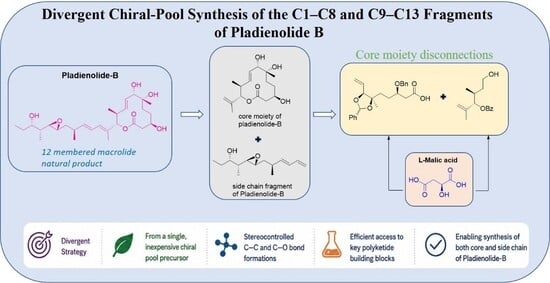
Pladienolide B (1), a macrocyclic polyketide isolated from Streptomyces platensis Mer-11107, displays potent antiproliferative and antitumor activities through its interaction with the SF3b subunit of the spliceosome. Herein, we report a divergent, stereoselective synthetic route to access both the C1–C8 and C9–C13 fragments of the core moiety of Pladienolide B (1) starting from a common, inexpensive chiral-pool precursor, L-Malic acid. Key stereocenters and structural motifs were established using Sharpless asymmetric epoxidation, regioselective nucleophilic epoxide opening, Mannich reaction for exo-methylene introduction, and a tandem iodination–zinc elimination cascade. This unified precursor approach offers a streamlined tactical route toward the core macrolide framework.

Organics

4 November 2026

Pladienolide B: Mechanistic Insights and Clinical Applications.
  • Article
  • Open Access

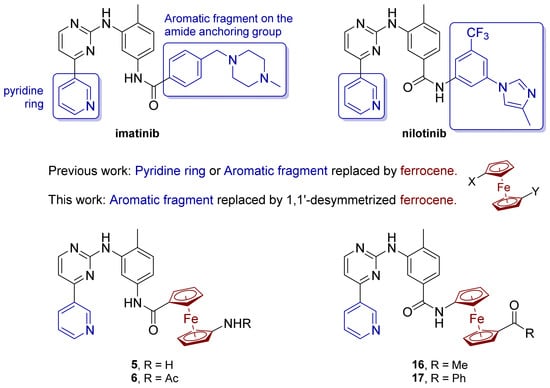
The incorporation of ferrocene into established pharmacophores represents a promising strategy for combining targeted activity with the properties of the organometallic scaffold. Building on our previous work on ferrocene-modified tyrosine kinase inhibitors (TKIs), this study presents the synthesis, biological evaluation and molecular docking analysis of four novel 1,1′-desymmetrized ferrocenyl derivatives of imatinib and nilotinib, designed to investigate how subtle structural modifications of the ferrocenyl moiety influence their cytotoxic activity and predicted interactions with the ABL1 kinase domain. The imatinib-derived compounds 5 and 6 contain amino and acetamido substituents, respectively, whereas the nilotinib-derived compounds 16 and 17 incorporate acetyl and benzoyl functionalities. Their cytotoxic activity was evaluated against four BCR::ABL1-positive leukemia cell lines with distinct molecular characteristics (BV-173, K-562, AR-230, and LAMA-84), with non-malignant CCL-1 fibroblasts included for assessment of selectivity and imatinib used as a reference drug. All four derivatives exhibited cytotoxic activity, with pronounced structure- and cell line-dependent differences. Compound 5 showed the most favorable activity profile, with pronounced cytotoxicity against AR-230 cells and activity comparable to or greater than imatinib in BV-173 and K-562 cells. In contrast, compound 17 was the most active derivative in LAMA-84 cells and exhibited the highest selectivity among all analogues in the series across the entire leukemia panel. Molecular docking indicated that ferrocenyl incorporation altered the binding orientation within the ABL1 kinase domain, while compound 5 showed the smallest positional deviation, consistent with its favorable cytotoxic profile. The results demonstrate that additional functionalization of the ferrocenyl moiety produces cell-line-dependent changes in cytotoxic activity without consistently improving potency or selectivity compared with previously reported monosubstituted analogues. Nevertheless, the successful synthesis of 1,1′-desymmetrized ferrocene conjugates provides new opportunities for structural diversification and further optimization of this class of compounds.


Organics

3 November 2026

Chemical structures of imatinib, nilotinib and the reported ferrocene conjugates.
  • Article
  • Open Access

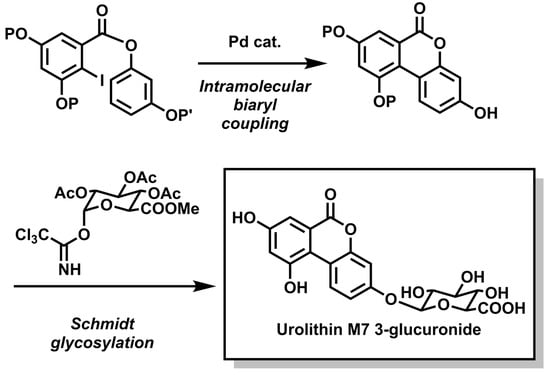
Urolithin M7 is a gut microbial metabolite of ellagic acid, but its glucuronide conjugate has not been well characterized. We report the first total synthesis of urolithin M7 3-glucuronide through a convergent route that combines Pd-mediated intramolecular biaryl coupling with Schmidt glycosylation. Cyclization of phenyl benzoate 9 gave regioisomers 10a and 10b in 87% combined yield, with the desired 3-benzyloxy isomer formed preferentially in a 2:1 ratio. Selective protecting-group manipulation of 10a gave the glycosylation precursor, which underwent Schmidt glycosylation with a glucuronyl trichloroacetimidate donor to afford the protected β-glucuronide in 90% yield. Deprotection then furnished urolithin M7 3-glucuronide. The synthesis provides structurally defined urolithin M7 3-glucuronide for future analytical, metabolic, pharmacokinetic and biological studies.

Organics

2 November 2026

Representative ellagitannins, tellimagrandin I and punicalagin.

Highly Accessed Articles

News & Conferences

Latest Issues

Open for Submission

Journal Sections

XFacebookLinkedIn
Organics - ISSN 2673-401X