
Skip to Content
  • 5.8
    Impact Factor
  • 10.2
    CiteScore
  • 16 days
    Submission to First Decision
  • 3 days
    Acceptance to Publication

Nutrients

Nutrients is an international, peer-reviewed, open access journal of human nutrition published semimonthly online by MDPI. The Asia Pacific Nutrigenomics Nutrigenetics Organisation (APNNO), Italian Society for Pediatric Gastroenterology, Hepatology and Nutrition (SIGENP), Nutrition Society of New Zealand (NSNZ), Ocular Wellness & Nutrition Society (OWNS) and others are affiliated with Nutrients and their members receive discounts on article processing charges.

Get Alerted

Add your email address to receive forthcoming issues of this journal.

All Articles (39,987)

  • Article
  • Open Access

Background: Obesity promotes ectopic lipid deposition and hepatic steatosis, a central feature of metabolic dysfunction-associated steatotic liver disease. Because microbial effects are strain- and model-specific, whether Bacillus megaterium 1259 (BM1259) affects established diet-induced obesity remains unclear. We evaluated BM1259 during continued high-fat diet (HFD) exposure and examined accompanying hepatic changes. Methods: Male C57BL/6J mice received an HFD for 12 weeks before assignment to HFD + PBS or HFD + BM1259 groups; normal-diet mice served as controls. BM1259 (1 × 10¹⁰ CFU/mouse/day) was administered by intragastric gavage for 8 weeks during continued HFD feeding. Phenotypic, biochemical, and histopathological assessments were combined with hepatic RNA sequencing, untargeted metabolomics, and paired multi-omics analysis. Results: Body weight was significantly lower in the HFD + BM1259 group at the intervention endpoint. BM1259 administration was also associated with lower body-weight-normalized iWAT and liver weights, a smaller mean iWAT adipocyte area, and lower hepatic triglyceride content and Oil Red O-positive area. Serum LDL-C, ALT, and fasting blood glucose were lower, whereas the reduction in ipGTT AUC did not reach statistical significance. Hepatic transcriptomic differences involved genes related to lipid uptake, synthesis, lipoprotein handling, and fatty-acyl processing. Metabolomic differences included features related to choline–glycerophospholipid, sphingolipid, steroid-related, and acylcarnitine metabolism. Exploratory paired analysis suggested possible associations between gene expression and metabolite abundance. Conclusions: BM1259 was associated with lower obesity-related and hepatic lipid burden during continued HFD exposure and warrants further investigation as a candidate microbial intervention.

Nutrients

6 November 2026
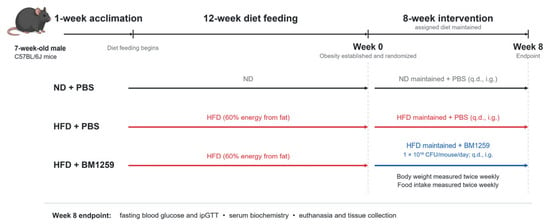
Experimental design. Male C57BL/6J mice were fed a normal diet (ND) or high-fat diet (HFD) for 12 weeks. After diet-induced obesity had been established, eligible HFD-fed mice were assigned to the HFD + PBS or HFD + BM1259 group. The mice remained on their assigned diets for a further 8 weeks, during which BM1259 was administered once daily by intragastric gavage at 1 × 10¹⁰ CFU/mouse/day. The ND and HFD control groups received PBS.
  • Systematic Review
  • Open Access

Background/Objectives: Silymarin is a widely used hepatoprotective agent; however, its effects on hepatic steatosis and fibrosis remain unclear. We systematically reviewed the effects of silymarin on liver biochemical parameters, fibrosis, steatosis, and cardiometabolic outcomes, as well as its safety, in chronic liver disease. Methods: PubMed, Embase, and the Cochrane Library were searched from inception to June 11, 2026. Randomized controlled trials (RCTs) and eligible comparative clinical studies that evaluated the use of oral silymarin were included. Risk of bias was evaluated using RoB 2 for randomized trials and ROBINS-I for non-randomized studies. Random-effects meta-analyses were performed for alanine aminotransferase (ALT) and aspartate aminotransferase (AST) in placebo-controlled RCTs of silymarin monotherapy and for liver stiffness measurement (LSM) in placebo-controlled RCTs, and the certainty of evidence was assessed using GRADE. Results: Forty-seven studies (37 RCTs and 10 non-randomized studies) met the inclusion criteria. Compared with placebo, silymarin monotherapy significantly reduced ALT (six trials; mean difference [MD], −7.25 IU/L; 95% confidence interval [CI], −11.60 to −2.89) and AST (four trials; MD, −5.36 IU/L; 95% CI, −8.45 to −2.27). In addition, an exploratory meta-analysis of three placebo-controlled RCTs showed a greater reduction in LSM with silymarin-based interventions than with placebo (MD, −0.60 kPa; 95% CI, −1.04 to −0.16). Conclusions: In placebo-controlled trials, silymarin monotherapy significantly reduced serum aminotransferase levels, and an exploratory meta-analysis of three trials also showed a reduction in liver stiffness with silymarin-based interventions. Silymarin was generally well tolerated. Well-designed long-term randomized controlled trials using validated noninvasive or histological fibrosis endpoints are warranted to determine whether these improvements translate into antifibrotic and clinically meaningful benefits.

Nutrients

6 November 2026

  • Review
  • Open Access

Heart failure (HF) and obesity commonly occur together and can worsen symptoms, physical function, and quality of life. Although weight loss may benefit selected patients with HF and obesity, body weight alone does not show whether patients are losing fat, muscle, fluid, or a combination of these. This narrative review summarizes selected evidence on nutrition therapy, weight loss, body composition, and functional outcomes in adults with HF, including studies of high-protein diets, nutritional supplements, calorie restriction, Mediterranean-style diets, and obesity pharmacotherapy. Across studies, body composition and functional outcomes have not been measured consistently, making it difficult to determine whether weight loss is associated with meaningful functional improvement. Building on this evidence and findings from the Pro-HEART trial, we propose a body composition-guided nutrition framework that considers changes in fat and lean mass alongside physical function and quality of life. The framework is conceptual and has not yet been validated. Future studies should examine whether nutrition and weight loss interventions can reduce excess fat, preserve muscle, and improve functional and patient-centered outcomes in patients with HF and obesity.

Nutrients

6 November 2026

  • Review
  • Open Access

The Circadian Diet in Age-Related Neurodegeneration: Nutrient Timing, Sleep, and Mitochondrial Mechanisms

  • Cristina Manuela Drăgoi,
  • Alina-Crenguţa Nicolae and
  • Ion-Bogdan Dumitrescu

Circadian rhythms coordinate sleep–wake regulation, endocrine secretion, nutrient handling and cellular energy metabolism. Circadian and sleep disturbances are associated with metabolic and cardiovascular morbidity and with neurodegenerative disorders, particularly Alzheimer’s disease (AD) and Parkinson’s disease (PD), although whether restoring circadian alignment modifies neurodegeneration remains uncertain. This narrative review examines chrononutrition within the broader context of sleep regulation, physical activity and circadian care, distinguishing evidence from cellular and animal models, observational studies and clinical trials. Meal timing and dietary composition act as signals to peripheral clocks, while NAD+, sirtuins and AMP-activated protein kinase link nutrient availability with clock regulation and mitochondrial metabolism. We appraise time-restricted eating, protein distribution, NAD+ precursors, tryptophan- and melatonin-containing foods, magnesium, omega-3 fatty acids, polyphenols and fermentable fiber. Experimental findings provide mechanistic plausibility, but metabolic improvements and target engagement have not translated into demonstrated neuroprotection. Clinical application must account for levodopa–protein interactions, undernutrition, frailty and sarcopenia. Adequately powered trials with circadian-phase assessment, controlled energy intake and clinically meaningful neurological outcomes are required before a “circadian diet” can be established as a disease-modifying intervention.

Nutrients

6 November 2026
Highly Accessed Articles

News & Conferences

Latest Issues

Open for Submission

Journal Sections

XFacebookLinkedIn
Nutrients - ISSN 2072-6643