
Skip to Content
You are currently on the new version of our website. Access the old version .
  • 5.8
    Impact Factor
  • 10.2
    CiteScore
  • 16 days
    Submission to First Decision
  • 3 days
    Acceptance to Publication

Nutrients

Nutrients is an international, peer-reviewed, open access journal of human nutrition published semimonthly online by MDPI. The Asia Pacific Nutrigenomics Nutrigenetics Organisation (APNNO), Italian Society for Pediatric Gastroenterology, Hepatology and Nutrition (SIGENP), Nutrition Society of New Zealand (NSNZ), Ocular Wellness & Nutrition Society (OWNS) and others are affiliated with Nutrients and their members receive discounts on article processing charges.

Get Alerted

Add your email address to receive forthcoming issues of this journal.

All Articles (40,091)

  • Review
  • Open Access

The C-reactive protein-to-albumin ratio (CAR) is a readily available composite biomarker reflecting systemic inflammatory activity and changes in circulating albumin, but its nutritional interpretation and clinical utility remain incompletely defined. This narrative review critically examines the biological basis, nutritional and functional relevance, clinical evidence, comparative performance, methodological limitations, and potential precision-nutrition role of CAR. PubMed/MEDLINE, Embase, Scopus, and Web of Science Core Collection were searched from database inception through 20 August 2026, supplemented by citation tracking and relevant consensus and methodological literature. Across diverse clinical populations, higher CAR has generally been associated with adverse outcomes, while nutrition- and function-focused studies link elevated CAR with nutritional risk, frailty, sarcopenia, and impaired physical performance. Reported discrimination for nutrition- and function-related outcomes has been context dependent, with selected area under curve (AUCs) ranging from 0.619 to 0.814. Current evidence does not establish CAR as consistently superior to CRP, albumin, or established inflammatory and nutrition-related indices. Interpretation is further limited by heterogeneity in assay and calculation conventions, sampling time, organ dysfunction, fluid status, study-derived cut-offs, and limited external validation. CAR should therefore be regarded as an inflammation-associated marker of nutritional and physiological vulnerability rather than a diagnostic marker of malnutrition. Future research should prioritize standardized measurement, prospective construct validation, longitudinal and multicentre validation, incremental and clinical-utility evaluation, and randomized assessment of CAR-by-intervention effects before precision-nutrition treatment selection is considered.

Nutrients

14 November 2026

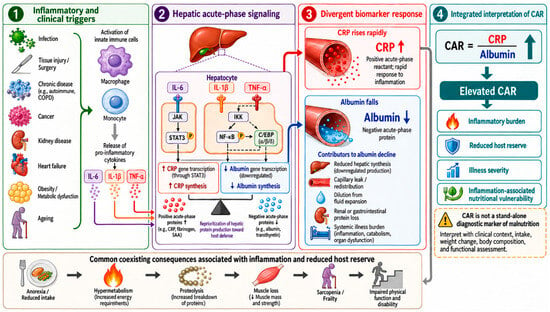
Biological basis and interpretative framework of the C-reactive protein-to-albumin ratio. Inflammatory and disease-related stimuli increase CRP production while influencing circulating albumin through acute-phase regulation, altered synthesis, vascular permeability, redistribution, protein loss, and fluid balance. CAR therefore integrates an inflammatory numerator with an albumin denominator influenced by broader host physiology. Elevated CAR may indicate increased inflammatory burden and reduced host reserve but does not independently establish malnutrition; nutritional interpretation requires assessment of dietary intake, weight trajectory, body composition, and muscle or functional status. The illustrated downstream relationships represent a conceptual framework rather than a proven causal sequence.
  • Review
  • Open Access

Exogenous dietary microRNAs, commonly referred to as xenomiRs, have been proposed to survive digestion, enter animal tissues, and regulate host gene expression, with plant-derived miRNAs representing one of the most debated sources. This review critically evaluates evidence for plant-derived xenomiR stability, uptake, and tissue accumulation in mammals, with particular emphasis on differential detection patterns between gastrointestinal and systemic compartments. This review also examines proposed mechanisms of gastrointestinal uptake and retention and considers their potential relevance to local gastrointestinal physiology. Current evidence indicates that some plant miRNAs can persist through digestion, although survival varies substantially by miRNA species, food matrix, and experimental protocol. Detection in gastrointestinal contents or feces supports persistence but does not establish cellular internalization, cytosolic delivery, or sequence-specific gene regulation. Studies provide the strongest in vivo support for SIDT1-mediated gastric uptake under acidic conditions, while intestinal uptake remains less well defined and may involve endocytic routes, vesicle-associated delivery, and cell-type-specific interactions. Overall, these findings motivate a gut-local hypothesis, but gastrointestinal detection does not establish cellular uptake or local gene regulation. Direct evidence linking ordinary dietary exposure to functionally available intracellular miRNAs and sequence-specific target regulation remains limited in both gastrointestinal and systemic tissues.

Nutrients

14 November 2026

  • Article
  • Open Access

Background: Fashion models are widely assumed to eat very little, yet their own dietary intake has rarely been measured. Most research regarding this occupational group has examined the effects of images of thin models on the body image of the wider public rather than on the nutritional health of the models themselves. Objective: This exploratory study measured the anthropometric status, energy intake and macronutrient and micronutrient intake of professional female and male fashion models working through agencies in the four principal fashion capitals (New York, London, Milan and Paris) and used the findings to design a preliminary tailored nutrition intervention framework. Methods: Eleven models (8 female, mean age 25.8 years; 3 male, mean age 32.7 years) completed a three-day self-reported food diary and had height and weight measured and basal metabolic rate estimated by bioelectrical impedance. Diaries were analysed in Nutritics, with energy requirements estimated from basal metabolic rate and a low physical activity level (1.49). Results: Female models had a mean body mass index (BMI) of 18.34 kg/m2 and male models 22.29 kg/m2. Both groups consumed fewer calories than their estimated requirement (female mean intake 1616 kcal/day compared with an estimated requirement of 2047 kcal/day; male mean intake 2222 kcal/day against 3172 kcal/day), yet both consumed more than the reported national average and met most micronutrient reference values. Mean intakes of calcium, iron, selenium and vitamin D fell below UK reference nutrient intakes in one or both groups, and female vitamin E intake was below the European adequate intake; without biochemical measures, these indicate a risk of inadequate intake rather than confirmed deficiency. Based on these apparent shortfalls and the occupational constraints described by the cohort, a Tailored Nutritional Care (TNC) cookbook and educational guideline were developed, offering 53 recipes across four dietary patterns (vegan, vegetarian, omnivore, and low-FODMAP) and the four fashion capitals. Conclusions: These findings come from 11 models, rely on three days of self-reported intake and on estimated requirements, and cannot be generalised to fashion models as a whole. The intervention is preliminary: its feasibility, acceptability, safety and effectiveness have not yet been tested.

Nutrients

14 November 2026

  • Article
  • Open Access

Background/Objectives: Evidence on subsequent dietary changes associated with leisure-time exercise participation patterns remains limited. We examined these associations among Chinese adults. Methods: We used two China Health and Nutrition Survey sequences (T0–T1–T2): 2004–2006–2009 and 2006–2009–2011. Linear regression examined associations between reported T0–T1 participation patterns and T1-to-T2 changes in energy intake and protein density (co-primary outcomes) and absolute protein intake, adjusting for T0 and T1 dietary levels and covariates and accounting for repeated observations and community clustering. Holm correction was applied within comparison families. Results: The analysis included 6279 adults contributing 10,016 observations. Compared with reporting no leisure-time exercise at either assessment, reporting exercise only at T1 or at both assessments was associated with adjusted between-group differences in protein density change of 1.30 (95% confidence interval [CI], 0.59 to 2.00) and 2.09 (95% CI, 0.70 to 3.48) g/1000 kcal, respectively (Holm-adjusted p = 0.002 and 0.017). Corresponding adjusted differences in absolute protein intake change were 0.66 (95% CI, −1.53 to 2.84) and 4.28 (95% CI, 1.20 to 7.36) g/day (Holm-adjusted p = 1.000 and 0.020); statistical support for the latter varied across sensitivity analyses. The energy omnibus test was significant (Holm-adjusted p = 0.044), but individual energy contrasts were not significant after correction. Direct comparisons between these participation groups were not significant for any of the three outcomes after correction. Conclusions: Compared with nonparticipation at both assessments, reported participation only at T1 or at both assessments was associated with modestly greater subsequent protein density changes. Interpretation should consider both protein density and absolute protein intake.

Nutrients

14 November 2026

Highly Accessed Articles

News & Conferences

Latest Issues

Open for Submission

Journal Sections

XFacebookLinkedIn
Nutrients - ISSN 2072-6643