
Skip to Content
You are currently on the new version of our website. Access the old version .
  • 5.1
    Impact Factor
  • 10.3
    CiteScore
  • 16 days
    Submission to First Decision
  • 4 days
    Acceptance to Publication

Molecules

Molecules is a leading international, peer-reviewed, open access journal of chemistry published semimonthly online by MDPI. The International Society of Nucleosides, Nucleotides & Nucleic Acids (IS3NA), Spanish Society of Medicinal Chemistry (SEQT) and International Society of Heterocyclic Chemistry (ISHC) are affiliated with Molecules and their members receive discounts on the article processing charges.

Get Alerted

Add your email address to receive forthcoming issues of this journal.

All Articles (66,411)

  • Review
  • Open Access

Surfactants are widely used chemicals whose continuous release into aquatic environments may pose environmental risks. Adsorption represents a promising approach for their removal owing to its operational simplicity, process flexibility, and the possibility of using a wide range of conventional and low-cost adsorbents. This review summarises and critically evaluates current knowledge on the adsorption of anionic, cationic, and non-ionic surfactants from aqueous solutions, with particular emphasis on the adsorbent materials employed, factors affecting the adsorption process, and adsorption mechanisms. Conventional carbon-based and mineral adsorbents, biopolymers, biochars, natural and waste-derived materials, as well as advanced and surface-modified adsorbents, are discussed. Analysis of the published literature indicates that adsorption performance is governed by the interplay between the molecular structure and ionic character of the surfactant, the surface properties and porous structure of the adsorbent, and experimental conditions, particularly pH, initial surfactant concentration, contact time and adsorbent dose. Surfactant adsorption generally involves a combination of electrostatic, hydrophobic, and dispersion interactions, hydrogen bonding, ion exchange, and interactions between adsorbed molecules, with the relative contribution of individual mechanisms varying with surfactant concentration and surface coverage. A major challenge remains the limited comparability of published data due to differences in experimental conditions and the metrics used to evaluate adsorption performance. Future research should therefore focus on more standardised evaluation of adsorption systems, adsorbent regeneration and reuse, and, particularly, validation under practically relevant conditions using complex real wastewater matrices.

Molecules

14 November 2026

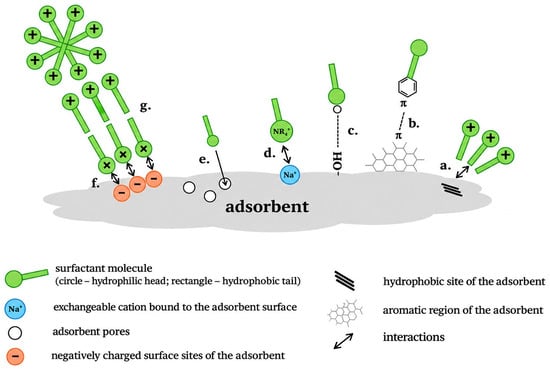
Schematic representation of the principal interactions and transport processes involved in surfactant adsorption: (a) hydrophobic interactions; (b) π–π interactions; (c) hydrogen bonding; (d) ion exchange; (e) pore diffusion; (f) electrostatic interactions; and (g) lateral hydrophobic interactions.
  • Review
  • Open Access

Plant flavonoids and other polyphenols have been investigated for their effects on protein homeostasis, but their role in regulating biomolecular condensates, membraneless compartments formed through liquid–liquid phase separation (LLPS), remains poorly understood. While direct biophysical evidence for polyphenol-mediated LLPS modulation is currently limited to a small number of compounds (notably EGCG, curcumin, and gallic acid) and protein targets (primarily Tau and α-synuclein), indirect evidence suggests that polyphenols may influence condensate biology through oxidative stress modulation, chaperone induction, autophagy activation, and effects on post-translational modifications. This review critically examines the available evidence, applying an explicit classification framework that distinguishes direct biophysical evidence, direct cellular evidence, and indirect mechanistic associations. We provide a comparative structure–activity analysis of representative polyphenols and evaluate the translational gap between in vitro effective concentrations and achievable systemic and brain exposure. Our synthesis indicates that while polyphenols represent promising tool compounds for investigating condensate biology, their therapeutic potential as condensate-modulating agents remains speculative and requires substantially more direct evidence, including validation in disease-relevant models, testing of circulating metabolites, and demonstration of achievable exposure at target sites. Finally, current knowledge gaps and future research directions will be discussed with the aim of clarifying the current stage of preclinical evidence and the substantial work still required before the therapeutic relevance of plant polyphenols as modulators of biomolecular condensate biology can be evaluated.

Molecules

13 November 2026

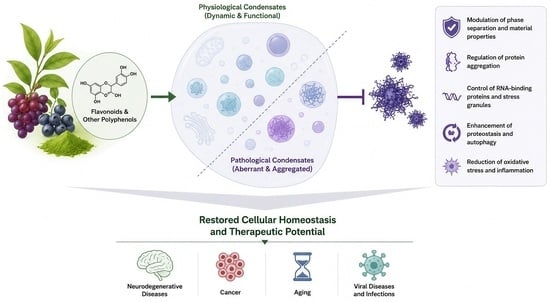
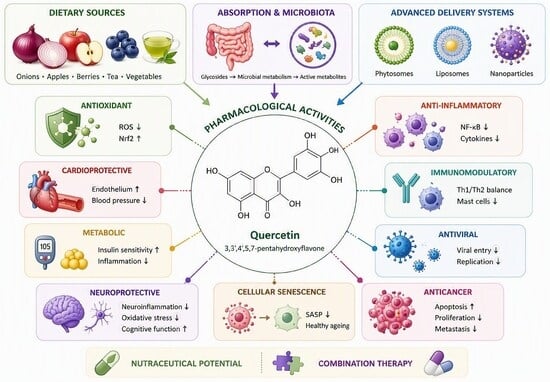
Plant polyphenols as modulators of biomolecular condensate biology: direct and indirect mechanisms. Abbreviations: LLPS, liquid–liquid phase separation; ROS, reactive oxygen species; Nrf2, nuclear factor erythroid 2–related factor 2; Hsp70/90, heat shock proteins 70/90; AMPK, AMP–activated protein kinase; mTOR, mechanistic target of rapamycin; ATG5, autophagy–related gene 5; NF–κB, nuclear factor kappa–light–chain–enhancer of activated B cells; UPS, ubiquitin-proteasome system; PTMs, post-translational modifications.
  • Article
  • Open Access

This study developed a non-destructive analytical approach based on handheld near-infrared (NIR) reflectance spectroscopy coupled with chemometric modeling for predicting major fatty acid classes in bovine milk. A total of 560 individual-cow milk samples from Holstein cows were collected from a single commercial dairy farm during one sampling period and analyzed using gas chromatography–mass spectrometry (GC–MS) as reference measurements. The concentrations of saturated fatty acids (SFA), monounsaturated fatty acids (MUFA), and polyunsaturated fatty acids (PUFA) determined by GC–MS were used as reference values for NIR prediction model development. Reflectance NIR spectra were collected over 900–1700 nm using a portable NIR spectrometer from previously frozen milk samples maintained at approximately 4 °C during measurement, and three replicate scans per sample were averaged. Seven preprocessing methods, multiple wavelength ranges, and different numbers of selected feature wavelengths were compared. Partial least squares regression models were developed using sample-level five-fold cross-validation. The optimal models for SFA, MUFA, and PUFA used raw, first-derivative, and Savitzky–Golay smoothed spectra, respectively, with CV-R2 values of 0.931, 0.887, and 0.910, RMSECV values of 0.2076, 0.1095, and 0.0120 g/100 g milk, respectively, and RPD values of 3.818, 2.988, and 3.342. These results indicate that handheld NIR reflectance spectroscopy combined with optimized chemometric strategies has potential for predicting major fatty acid class concentrations in bovine milk. However, the present models were evaluated only by internal cross-validation using samples from a single farm and breed during a limited sampling period; independent external validation across farms, seasons, breeds, and management conditions is required to further assess model transferability and generalizability.

Molecules

13 November 2026

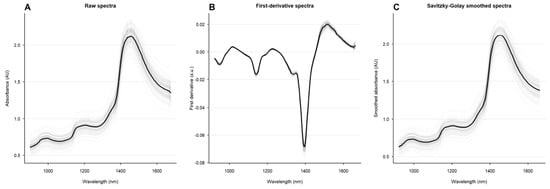
Raw and preprocessed near-infrared reflectance spectra of bovine milk samples. (A) Raw spectra; (B) first–derivative spectra; and (C) Savitzky–Golay smoothed spectra. Spectra were collected from 560 bovine milk samples over the wavelength range of 900–1700 nm. Gray lines represent individual sample spectra, and the black line represents the mean spectrum.
  • Article
  • Open Access

Sequential selective extraction of bioactive compounds from plants can be achieved by using different approaches. Recently, we described the use of supercritical fluid extraction (SFE) to provide two fractions from Calendula flower, one containing the faradiol esters, in a non-polar fraction, and one the isorhamnetin-3-O-rutinoside (narcissin), in a polar fraction. In this paper, we attempted to replace the second step of SFE with NaDES (natural deep eutectic solvent) ultrasonic-assisted extraction (UAE) since NaDES extract could be directly incorporated into cosmetic formulation owing to their safety. The paper reports the method development for the UHPLC analysis of viscous NaDES samples, the screening of the suited NaDES from narcissin extraction and the Box–Behnken experimental design applied to the Calendula flower to select the experimental conditions—ultrasound frequency, water content, and extraction duration—that maximize narcissin recovery. Finally, a sequential selective extraction methodology combining SFE with the NaDES is proposed and discussed.

Molecules

13 November 2026

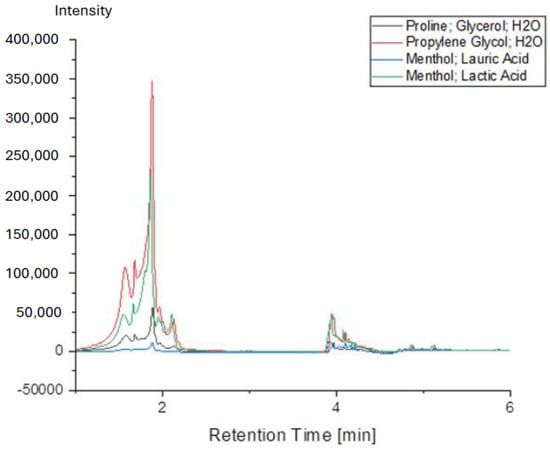
Overlayed chromatograms with the previous UHPLC method [10] for four different NaDES extracts.

Featured Articles of Last Quarter

Highly Accessed Articles

News & Conferences

Latest Issues

Open for Submission

Journal Sections

XFacebookLinkedIn
Molecules - ISSN 1420-3049