
Skip to Content
  • 3.5
    Impact Factor
  • 7.1
    CiteScore
  • 17 days
    Submission to First Decision
  • 3 days
    Acceptance to Publication

Micromachines

Micromachines is a peer-reviewed, open access journal on the science and technology of small structures, devices and systems, published monthly online by MDPI. The Chinese Society of Micro-Nano Technology (CSMNT) and AES Electrophoresis Society are affiliated with Micromachines and their members receive a discount on the article processing charges.

Get Alerted

Add your email address to receive forthcoming issues of this journal.

All Articles (14,007)

  • Article
  • Open Access

High-reinforcement-fraction SiCp/Al metal matrix composites (MMCs) are difficult to machine efficiently because large, electrically nonconductive reinforcement particles can accumulate in the inter-electrode gap and destabilize discharge and debris evacuation. This study proposes a grooved hollow abrasive electrode for grinding-aided electrochemical discharge machining (G-ECDM). Straight axial grooves are introduced on a hollow abrasive electrode to create enlarged debris-removal pathways without increasing the diamond-grit protrusion beyond the critical discharge gap. Multiphysics simulations and machining observations show that the enlarged pathways redirect electrolyte flow outward, reduce debris residence and local accumulation, and promote the evacuation of large debris particles. Under identical comparison conditions, the proposed electrode achieved a material removal rate (MRR) of 2.14 g/min, compared with 1.41 g/min for the hollow abrasive electrode and 0.07 g/min for the hollow round electrode; the corresponding tool-wear ratio (TWR) was 0.13, compared with 0.28 and 1.01, respectively. Single-factor experiments further show that peak current, pulse width, spindle speed, and flushing pressure affect the trade-off between MRR and tool wear. The results demonstrate that deliberately engineering the debris-evacuation path is an effective means of improving discharge stability and machining performance in G-ECDM of high-reinforcement-fraction SiCp/Al composites.

Micromachines

6 November 2026
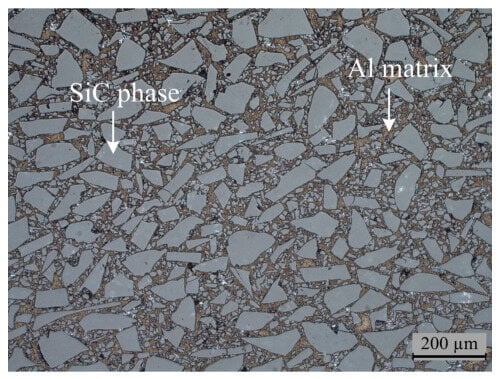
Micrograph of 60 wt% SiCp/Al matrix composite.
  • Article
  • Open Access

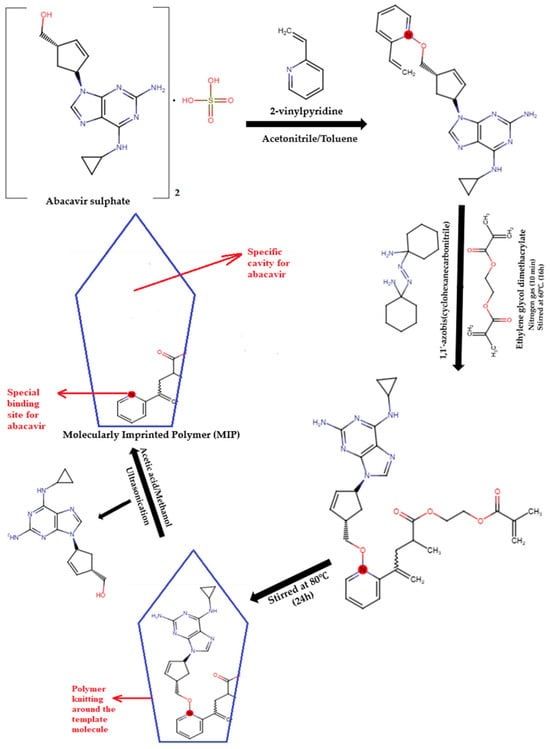
Abacavir sulphate residues reported in South African water resources highlight the need for monitoring pharmaceutical contaminants to assess wastewater treatment efficiency and protect aquatic ecosystems. This study aimed to determine whether combining molecularly imprinted polymers (MIPs) with a carbon paste electrode (CPE) could improve the selectivity and sensitivity of abacavir detection while providing a cost-effective alternative to conventional methods. The optimized MIP-CPE sensor was applied to determine abacavir sulphate in real water matrices. The MIP was attained by bulk polymerization and coupled with CPE. The MIP had thermal stability of greater than 300 °C. Using differential pulse voltammetry (DPV), it was possible to quantify abacavir sulphate using a redox probe; a linear response in a range of 2 to 14 µM with a correlation coefficient (R2) of 0.991 was observed, with lower limits of detection (LOD) and quantification (LOQ) of 1.47 µM and 4.47 µM, respectively. Thus, the developed MIP-CPE sensor can be used to detect analyte residues present at trace levels. The developed sensor demonstrated satisfactory accuracy and precision in real water matrices, achieving recoveries of 82.2–101.2% with RSD values of 1.27–7.34% for spiked abacavir sulphate concentrations of 8 and 12 µM. The presence of abacavir sulphate was only detected in uMhlathuzana wastewater effluent samples, with a concentration of 7.19 µM (RSD 7.40%, n = 3). The MIP-CPE showed high selectivity for abacavir sulphate when tested alongside common interferents (lamivudine, ibuprofen, nevirapine, and trimethoprim). Abacavir sulphate gave the lowest peak current (DPV) of the group (489 µA), due to the ferricyanide peak falling when the target rebinds and blocks the probe. A lower current for abacavir therefore means more rebinding, which is evidence of selectivity. The MIP-CPE sensor demonstrated rapid rebinding and strong affinity for abacavir sulphate, even in complex matrices. This study offers wastewater treatment plants as a cost-effective, sensitive, and selective analytical method for routine monitoring of antiretroviral contaminants before effluent discharge into environmental waters.

Micromachines

6 November 2026

Schematic diagram showing synthesis of molecularly imprinted polymer (MIP).
  • Review
  • Open Access

Spatiotemporal couplings are defined by non-separable spatial and temporal or spectral dependences of the optical field. They must be distinguished from the kinematic conversion between pulse duration and longitudinal spatial extent, s = cτ, which applies to a rigidly translating profile in vacuum under specified observation conditions. This review examines theoretical and experimental frameworks developed to describe such regimes, where diffraction–dispersion analogies coexist with angular dispersion, pulse-front tilt, space-dependent spectra, and structured spatiotemporal wave packets and discusses their influence on peak intensity, nonlinear absorption, energy deposition, ablation, heat-affected zones, processing resolution, surface quality, and reproducibility, while highlighting the emerging role of MEMSs and micromachine-based optical systems in enabling precise control of these processes for advanced laser micromachining. Particular attention is devoted to the fundamental concepts of spatiotemporal analogies, spatiotemporal couplings in ultrashort pulses, and the corresponding spatiotemporal effects relevant to petawatt laser systems. The influence of these effects in ultrashort and ultra-intense laser systems is discussed, where spatiotemporal distortions impact focal intensity and pulse duration. We highlight how spatiotemporal structuring of ultrashort and ultra-intense laser pulses, combined with tailored micro- and nanostructured targets, enables control of field localization, energy deposition, and laser–matter coupling. By proceeding beyond a direct space–time equivalence, spatiotemporal analogies provide essential insight for both fundamental understanding and practical optimization of ultrashort and ultra-intense laser–target interactions.

Micromachines

6 November 2026

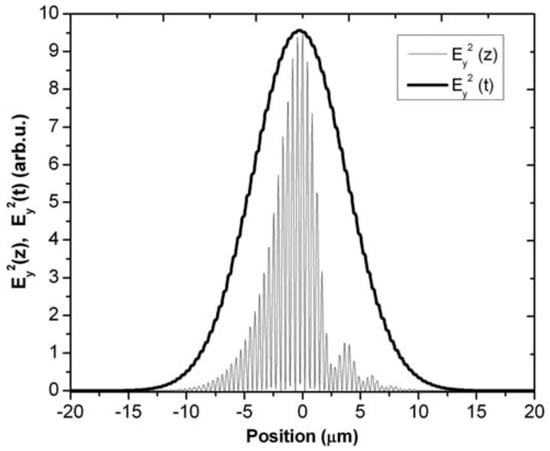
Comparison of the spatial and temporal envelopes of the squared electric field for a tightly focused pulse (TFP) with an f-number of 0.83. The spatial envelope has a full width at half maximum (FWHM) of 3.78 μm, while the temporal envelope has a temporal FWHM of approximately 31.2 fs, corresponding to cτ = 9.35 μm, where c is the speed of light. The axial spatial profile and the temporal trace are different cuts through the evolving focused field; their unequal widths alone do not establish transverse STC. Reprinted with permission from Ref. [15].
  • Article
  • Open Access

Many biochemical reactions performed in microfluidic systems, such as nucleic acid amplification and enzymatic assays, require precise, compact, portable, and programmable temperature control. However, existing platforms are often limited by high cost, bulkiness, and poor integration with real-time visualization. Here, we present a portable microfluidic platform that integrates a high-precision thermal regulation module with a smartphone-based imaging interface, enabling real-time sample monitoring under programmable temperature protocols. An STM32 microcontroller with a positional PID algorithm achieves a steady-state temperature accuracy of ±1.5 °C and adjustable heating and cooling rates of 0.1–5 °C/s, supporting both constant-temperature and thermal-cycling modes. As a representative application, we use this platform to evaluate the thermal stability of water-in-oil single-emulsion droplets under programmable heating. In this system, the oil phase was a mixture of silicone oil and RSN-749, and the mass ratio of the two components was varied to examine its effect on droplet stability. Our results suggest that, under the tested conditions, droplet coalescence tended to be more pronounced during temperature ramping than during isothermal holding. For this oil–surfactant formulation, the coalescence ratio remained below 4% across 20–95 °C. Therefore, this low-cost, user-friendly platform offers a practical analytical tool for temperature-controlled microfluidic reactions and thermal stability assessment, with potential for future point-of-care diagnostic workflows.

Micromachines

5 November 2026

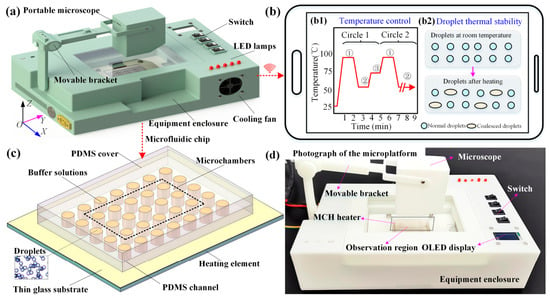
Schematic of the portable microfluidic platform with integrated temperature control and real-time visualization. (a) 3D model of the platform. (b) Schematic illustrating on-site monitoring of temperature and droplet states via a smartphone. (c) Layout of the microfluidic chip for droplet handling. (d) Photograph of the experimental setup.

Highly Accessed Articles

News & Conferences

Latest Issues

Open for Submission

Journal Sections

XFacebookLinkedIn
Micromachines - ISSN 2072-666X