
Skip to Content
  • 3.1
    Impact Factor
  • 5.7
    CiteScore
  • 16 days
    Submission to First Decision
  • 3 days
    Acceptance to Publication

Metals

Metals is an international, peer-reviewed, open access journal published monthly online by MDPI. The Spanish Materials Society (SOCIEMAT) is affiliated with Metals and their members receive discounts on the article processing charges.

Get Alerted

Add your email address to receive forthcoming issues of this journal.

All Articles (15,674)

  • Article
  • Open Access

The effects of preheating temperature on the microstructural evolution and mechanical properties of low-activity martensitic steel welded joints were investigated, with emphasis on the relationship between preheating temperature, δ-ferrite content, and impact energy. Preheating temperature ranged from 150 °C to 300 °C. Optical microscopy and TEM were used for microstructural characterization, and tensile and impact tests were conducted to evaluate mechanical properties. The results showed that preheating temperature influenced the retained δ-ferrite content in the weld metal, whereas its effect on the heat-affected-zone microstructure was comparatively limited. The δ-ferrite fraction exhibited a non-monotonic dependence on preheating temperature, reaching a minimum of 2.76% in the filler weld pass at 250 °C. As the δ-ferrite fraction increased to approximately 13.27% at 150 °C, the average impact energy of the weld metal decreased from 47.37 J at 250 °C to 34.57 J at 150 °C. Impact fracture analysis revealed preferential crack propagation along δ ferrite/martensite interfaces and through δ-ferrite grains. An increase in the δ-ferrite fraction may promote the formation of interconnected ferrite networks, thereby facilitating crack propagation and reducing the impact toughness of the weld metal.

Metals

8 November 2026
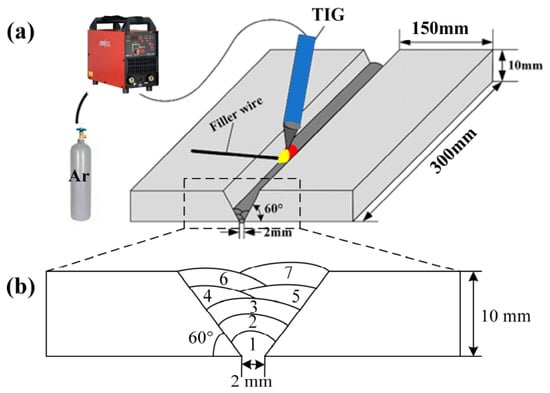
Schematic of welding experiment: (a) welding experiment system; (b) groove and weld passes.
  • Article
  • Open Access

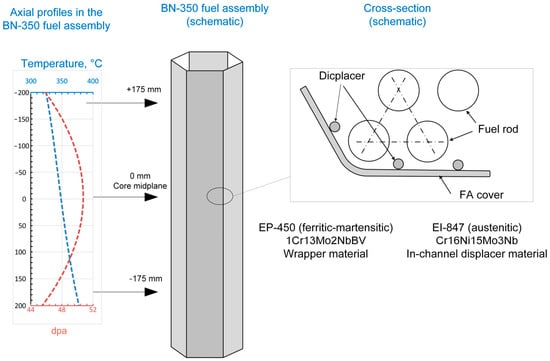
Axial variations in irradiation conditions along elongated fuel assembly components can produce locally different irradiation-induced material states and, consequently, different post-irradiation thermal responses. The present study investigates EI-847 austenitic steel from a BN-350 reactor’s spent fuel assembly displacer irradiated to approximately 50 dpa. Material was sampled at axial positions of −175, 0, and +175 mm relative to the reactor core midplane, corresponding to irradiation temperatures of approximately 326, 351, and 377 °C, respectively. The three axial states were compared in the as-irradiated condition and after identical post-irradiation annealing at 470 °C for 100 h. Density, Vickers microhardness, tensile properties, microstructure, and fracture surfaces were examined to assess axial heterogeneity and subsequent thermal response. In the as-irradiated condition, the lowest microhardness and yield strength (YS) occurred at +175 mm, whereas the minimum density was measured at the core midplane. After annealing, microhardness decreased by 13.5%, 15.1%, and 6.3% at −175, 0, and +175 mm, respectively. The YS decreased by 20–28%, while the ultimate tensile strength (UTS) decreased by 10–15%. Total elongation (TE) increased from 10% to 29% at −175 mm, from 16% to 27% at the core midplane, and only from 19% to 21% at +175 mm. Predominantly ductile dimpled fracture was retained in all conditions. These results show that identical post-irradiation annealing produces different degrees of softening and ductility recovery depending on axial position and the irradiation-induced state established during reactor operation.

Metals

8 November 2026

Schematic representation of the axial temperature and displacement-damage profiles in the BN-350 fuel assembly, the positions of the investigated displacer sections relative to the reactor core midplane, and the location of the displacers in the peripheral region of the fuel-pin bundle.
  • Article
  • Open Access

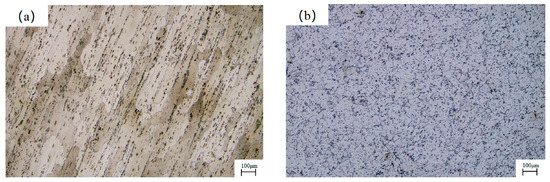
This study investigates the grain size effect on the high-temperature fretting wear–fatigue coupling damage of 2A70 aluminum alloy/42CrMoA steel pairs at 115 °C for bolted connections in steel-crown aluminum-skirt composite pistons. Two grain size grades (3.5 and 5) of 2A70 were tested using a single-clamp-head apparatus under a 3 kN normal load and 4, 5, and 6 kN fatigue loads. SEM characterized contact-zone wear and fracture features. Results show that grain refinement improves initial yield strength and crack-initiation resistance, reduces the high-stress region at the contact edge and the damage accumulation rate, and generally enhances fretting fatigue life; however, this strengthening effect weakens at 6 kN. A grain size-dependent Chaboche nonlinear kinematic hardening damage constitutive model was established. The average grain size d was introduced, and the Hall–Petch relationship modified the initial yield stress. The critical-plane SSR parameter and equivalent strain amplitude replaced the uniaxial maximum damage equivalent stress and equivalent plastic strain increment, forming a wear–fatigue coupled damage evolution equation. Using master–slave contact and a 90% initial-stiffness failure criterion, predicted lives all fall within the factor-of-two scatter band. This study provides experimental evidence and a numerical prediction tool for the anti-fatigue design of 2A70 aluminum alloy with different grain sizes under high-temperature fretting.

Metals

7 November 2026

Metallographic images: (a) grain size grade 3.5; (b) grain size grade 5.
  • Article
  • Open Access

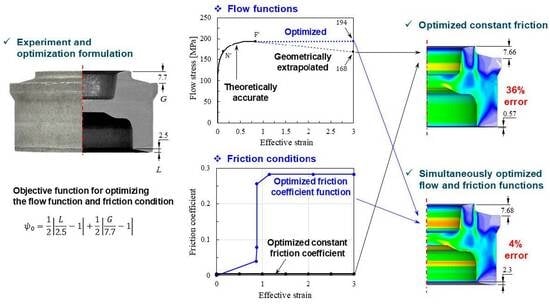
The laws of Coulomb and constant shear friction, with a constant friction coefficient and friction factor, respectively, are criticized by comparing experimental results with finite element (FE) predictions of a cold forward and backward extrusion process (or cold forging) of an A6061 alloy automobile part. It is experimentally and numerically shown that they have a clear limitation in predicting an acceptable deformed shape of the material during the process. It is emphasized that the tribological effect during a cold forward and backward extrusion process of the A6061 alloy is comparable to the effect of the material’s flow behavior since the material has a low strain-hardening capability. A technique for the simultaneous optimization of the friction condition and flow function in terms of the deformed shape is presented. An application to the process shows the strong dependence of the friction coefficient function on the lubrication-harmful effective strain of the material at the material–die interface. It is also shown that the A6061 material with an effective strain greater than the limit effective strain from the tensile test perspective behaves like a perfectly plastic material.

Metals

6 November 2026

Fractured tensile specimens.

Highly Accessed Articles

News & Conferences

Latest Issues

Open for Submission

Journal Sections

XFacebookLinkedIn
Metals - ISSN 2075-4701