
Skip to Content
You are currently on the new version of our website. Access the old version .
  • 3.3
    Impact Factor
  • 5.2
    CiteScore
  • 17 days
    Submission to First Decision
  • 3 days
    Acceptance to Publication

Journal of Clinical Medicine

Journal of Clinical Medicine is an international, peer-reviewed, open access journal of clinical medicine, published semimonthly online by MDPI. The International Bone Research Association (IBRA), Spanish Society of Hematology and Hemotherapy (SEHH), Japan Association for Clinical Engineers (JACE), European Independent Foundation in Angiology/ Vascular Medicine (VAS) and others are all affiliated with JCM, and their members receive a discount on article processing charges.

Get Alerted

Add your email address to receive forthcoming issues of this journal.

All Articles (54,542)

  • Systematic Review
  • Open Access

Background/Objectives: Artificial intelligence (AI) may automate breast arterial calcification (BAC) assessment and extract cardiovascular information from mammograms. In this study, we review technical BAC assessment, computed tomography (CT)-derived coronary artery calcification (CAC) surrogate assessment, and cardiovascular associations and prediction. Methods: MEDLINE and Embase were searched through 29 August 2026, supplemented by citation searching. Reports were synthesized narratively by target task, reference standard, and predictor type. QUADAS-2 and PROBAST informed risk-of-bias assessment. Results: Database screening yielded 17 eligible reports, and citation searching added three, resulting in 20 reports from 19 studies. These included 12 technical BAC reports, two CAC-surrogate reports, and six cardiovascular reports comprising five BAC-specific studies and one whole-mammogram study. BAC-detection areas under the receiver operating characteristic curve (AUCs) reached 0.95–0.96; segmentation Jaccard coefficients were approximately 0.58–0.61, and one small internal validation reported a Dice of 0.89. Mammography-only CAC AUCs ranged from 0.761 to 0.850 across thresholds; an AI-derived BAC score yielded AUC 0.64 for marked CAC. In an external health system cohort, severe versus absent BAC was associated with major adverse cardiovascular events after adjustment for Predicting Risk of cardiovascular disease EVENTs (PREVENT) (hazard ratio 2.80; 95% confidence interval 2.36–3.32). Separately, adding categorical BAC to PREVENT increased the external cohort C-index from 0.62 to 0.64. Conclusions: AI enables automated BAC assessment, and BAC-derived measures show prognostic associations with limited evidence of incremental predictive performance. Whole-mammogram models provide complementary evidence that cannot establish BAC-specific prognostic value. These tasks require separate interpretation. Standardized measurement, external validation, calibration, and prospective evidence of clinical benefit remain necessary.

J. Clin. Med.

17 November 2026

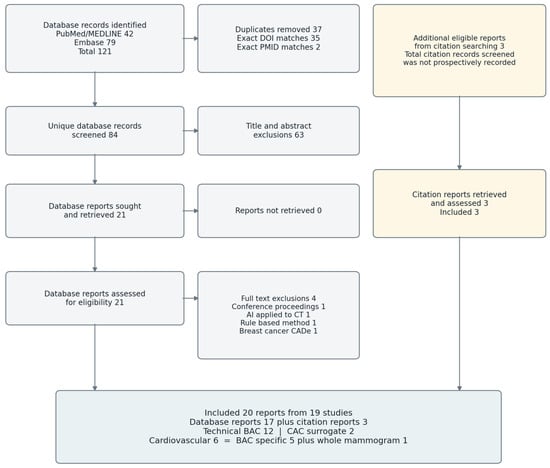
PRISMA 2020 flow diagram. The database counts and three eligible citation reports follow the reported screening audit. The total number of records assessed through citation searching was not prospectively recorded; three is the number of additional eligible reports, not the total citation search yield.
  • Review
  • Open Access

Background/Objectives: Bone fractures, particularly in older adults with osteoporosis, remain a major clinical challenge due to delayed union and nonunion despite advances in surgical techniques. This narrative review aimed to summarize the clinical evidence on unconcentrated bone marrow aspirate (BM) and bone marrow aspirate concentrate (BMAC) for promoting fracture healing and union. Methods: In this narrative review, clinical studies of BM or BMAC used as an adjunct to surgical treatment or as a percutaneous treatment for nonunion and delayed union were identified through a literature search and summarized descriptively. Outcomes included radiological union, clinical union, time to union, and reported complications. Results: In surgical settings (distraction osteogenesis, congenital pseudarthrosis, atypical femoral fractures, and atrophic mandibular fractures), one randomized trial and three non-randomized comparative studies, in all of which BMAC was part of a combined intervention, reported faster healing or a shorter time to union (three studies) and fewer complications or refractures (two studies). In 13 studies of percutaneous injection for nonunion, 11 of which used unconcentrated BM, reported union rates ranging from 50% to 94.4%, and the unweighted median of the study-level summary time to radiological union was 20.7 weeks. In two BMAC studies, union or callus formation was associated with the number or concentration of progenitor cells delivered. One uncontrolled series of infected tibial nonunion without bone defects reported union and resolution of infection after BMAC containing granulocyte precursors, without antibiotics. Conclusions: BM- and BMAC-based interventions have been associated with favorable outcomes in selected clinical settings. However, small samples, uncontrolled designs, heterogeneous products and populations, and concomitant treatments limit certainty about the independent contribution of BMAC and its safety relative to standard treatment. The available evidence is of low certainty. Further large-scale randomized controlled trials are warranted to establish standardized protocols, optimize preparation methods, and evaluate long-term outcomes.

J. Clin. Med.

17 November 2026

  • Review
  • Open Access

Helicobacter pylori eradication has substantially reduced the incidence of gastric cancer and is now a cornerstone of gastric cancer prevention. However, the risk of gastric cancer persists even after successful eradication, and post-eradication gastric cancer has become an increasingly important clinical challenge. Recent epidemiological studies have suggested that long-term use of potent acid suppressants, including proton pump inhibitors (PPIs) and potassium-competitive acid blockers (PCABs), may further increase this residual risk, although findings have been inconsistent across studies. Following eradication, recovery of gastric acid secretion frequently precipitates gastroesophageal reflux symptoms, often leading to prolonged PPI or PCAB therapy, although the overall impact of eradication on the risk of gastroesophageal reflux disease remains uncertain. Some of the large-scale observational studies have demonstrated an association between long-term acid suppressant use and an increased risk of gastric cancer, with evidence of dose- and duration-dependent effects. Although causality has not been established, several biological mechanisms have been proposed. Sustained acid suppression induces hypergastrinemia, which may influence gastric epithelial proliferation and stem/progenitor cell dynamics mainly in the gastric corpus, although its effects appear to vary depending on the gastric region and cellular context. In addition, elevation of gastric pH alters the gastric microbiota, resulting in dysbiosis characterized by enrichment of potentially carcinogenic bacteria, chronic low-grade inflammation, and increased production of genotoxic metabolites. These mechanisms may act synergistically to facilitate gastric carcinogenesis in the post-eradication stomach. Given the accumulating evidence, long-term PPI or PCAB therapy should be prescribed only when clinically indicated, using the lowest effective dose and shortest possible duration. In patients requiring prolonged acid suppression, careful risk assessment and appropriate endoscopic surveillance should be considered. Further prospective studies are needed to clarify the causal relationship between acid suppressants and post-eradication gastric cancer.

J. Clin. Med.

17 November 2026

  • Article
  • Open Access

Background/Objectives: Body mass index (BMI) contributes to estimated heart failure (HF) risk in the Predicting Risk of cardiovascular disease EVENTs (PREVENT) HF equation, whereas cholesterol does not. We examined BMI and low-density lipoprotein cholesterol (LDL-C) associations with calculated risk and measured vascular phenotypes. Methods: This cross-sectional analysis included 158 adults with treated hypertension and no recorded cardiovascular disease or HF. Mutually adjusted models examined seven vascular, renal and inflammatory markers, with robust standard errors and false discovery rate correction across 14 comparisons. Mathematical input-variable substitution scenarios described equation behaviour. Results: Median calculated 10-year HF risk was 4.55% (interquartile range 2.52–8.39%); 44.3% had estimates ≥ 5%. Risk did not differ significantly across BMI categories (p = 0.173). Per 30 mg/dL higher LDL-C, carotid–femoral pulse wave velocity was 0.307 m/s higher, common carotid artery intima–media thickness 0.026 mm higher, flow-mediated dilation 0.277 percentage points lower, reactive hyperaemia index 0.087 lower and capillary density 0.160 loops/mm lower (all q ≤ 0.043). No BMI association passed correction. LDL-C was not significantly correlated with calculated risk after age/sex adjustment (partial ρ = 0.059; p = 0.462). Substituting BMI 25 kg/m2 lowered aggregate calculated risk by 15.0% in obesity, reflecting equation structure. Conclusions: LDL-C was associated with adverse measured vascular phenotypes. These exploratory associations do not demonstrate causality, incremental HF prediction or treatment benefit. Null BMI findings do not exclude adiposity-related vascular effects.

J. Clin. Med.

17 November 2026

Highly Accessed Articles

News & Conferences

Latest Issues

Open for Submission

Journal Sections

XFacebookLinkedIn
J. Clin. Med. - ISSN 2077-0383