Instruments 2026, 10(3), 45; https://doi.org/10.3390/instruments10030045 - 9 Sep 2026
Abstract
Particle accelerators have become indispensable tools in fundamental charged-particle and beam-physics research, medical diagnostics and therapy, security screening, and many other applications. A small number of large, GeV-scale machines, often called “Big Science,” drive scientific discovery, while thousands of small accelerators serve everyday
[...] Read more.
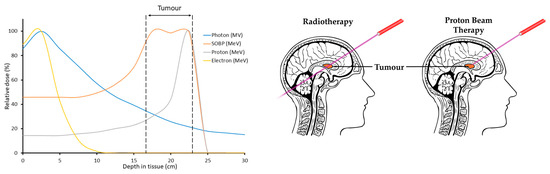
Particle accelerators have become indispensable tools in fundamental charged-particle and beam-physics research, medical diagnostics and therapy, security screening, and many other applications. A small number of large, GeV-scale machines, often called “Big Science,” drive scientific discovery, while thousands of small accelerators serve everyday needs, primarily as X-ray sources when an electron beam is used. When an electron beam in the keV–MeV range strikes a high-Z (high-atomic-number) target material, it produces bremsstrahlung photons, whose interaction with matter is governed by the photoelectric effect, Compton scattering, and pair production, each dominant in a distinct energy regime that also depends on the atomic number of the absorbing material. A small accelerator can generate such significant effects if the energy and material parameters are properly matched, and these interactions can be exploited to generate material-specific signatures. Ion beams, on the other hand, deposit energy in materials and are used for gamma and neutron production, microstructure analysis, and many other applications. Here we review the operating principles of several small accelerators and their potential applications, offering a unified perspective on their role in contemporary science and technology.
Full article
(This article belongs to the Special Issue Compact Accelerators)
►
Show Figures

Figure 1