
Skip to Content
You are currently on the new version of our website. Access the old version .
  • 9.8
    CiteScore
  • 24 days
    Submission to First Decision
  • 4 days
    Acceptance to Publication

International Journal of Environmental Research and Public Health

International Journal of Environmental Research and Public Health (IJERPH) is a transdisciplinary, peer-reviewed, open access journal that covers global health, healthcare sciences, behavioral and mental health, infectious diseases, chronic diseases and disease prevention, exercise and health related quality of life, environmental health and environmental sciences, and is published monthly online by MDPI. The International Society Doctors for the Environment (ISDE), Italian Society of Environmental Medicine (SIMA) and Environmental Health Association of Québec (ASEQ‑EHAQ) are affiliated with IJERPH and their members receive discounts on the article processing charges.

Get Alerted

Add your email address to receive forthcoming issues of this journal.

All Articles (66,814)

  • Article
  • Open Access

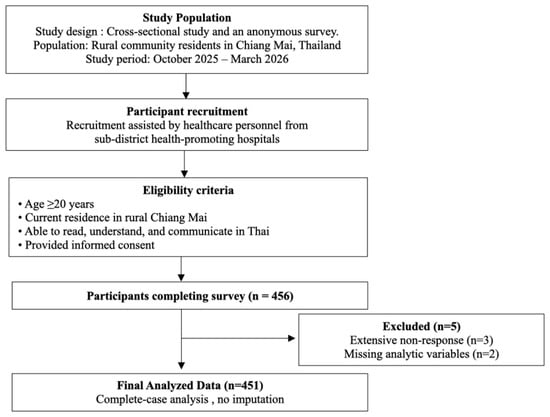
Early bystander intervention is important in rural trauma and out-of-hospital cardiac arrest, where emergency response times are often prolonged. This study assessed first-aid and cardiopulmonary resuscitation (CPR) knowledge and identified predictors of passing knowledge among rural residents in Chiang Mai, Thailand. A cross-sectional anonymous questionnaire was administered to rural adults in Chiang Mai between October 2025 and March 2026. The survey assessed sociodemographic characteristics, emergency experiences, prior training, willingness to help, attitudes, and knowledge using 10 multiple-choice items covering first aid, hemorrhage control, and CPR. Passing required meeting the minimum score in all three knowledge domains. Multivariable logistic regression identified factors associated with passing. Among 451 participants, 29.7% passed the knowledge assessment, despite high willingness to call for help (98.0%) and provide first aid (84.5%). Passing was independently associated with previous first-aid experience (aOR 2.04, 95% CI 1.04–3.99) and witnessing cardiac arrest (aOR 2.56, 95% CI 1.18–5.55), while older age and current smoking were negatively associated with passing; formal training was not independently associated. Key knowledge gaps involved scene safety, tourniquet use, and appropriate chest compression rates. First-aid and CPR knowledge was suboptimal despite high willingness to help. Targeted community training incorporating hands-on practice is needed to address specific skill deficits, particularly among older adults and non-healthcare occupational groups.

Flowchart of the study process, participant selection, and final analyzed data.
  • Article
  • Open Access

Advances in antiretroviral therapy (ART) have dramatically reduced the risk of mother-to-child transmission (MTCT) of HIV, leading to substantial changes in obstetric management. However, data describing the implementation of updated recommendations in routine clinical practice, particularly regarding mode of birth after a previous cesarean section (CS) and delayed cord clamping (DCC), remain limited. We aimed to evaluate temporal changes in intrapartum and postpartum management among women living with HIV (WLWH) over a 17-year period at a tertiary referral center. We conducted a retrospective cohort study including all WLWH who delivered at a university hospital between January 2009 and December 2025. Pregnancies were categorized into three periods according to major changes in national recommendations on mode of birth: 2009–2013, 2014–2018, and 2019–2025. Maternal HIV characteristics, ART, obstetric management, and delivery and neonatal outcomes were compared among study periods. Sixty-three women had 83 pregnancies during the study period. The proportion of women receiving ART at conception increased significantly over time (p < 0.001), paralleled by a shift toward contemporary antiretroviral regimens. At delivery, only three women had a viral load ≥50 copies/mL, all during the earliest study period. Planned pre-labor CS declined significantly (p < 0.001), whereas vaginal delivery increased, reaching 51.8% in 2019–2025, without any case of vertical HIV transmission. Among women with a previous CS managed after 2014, the acceptance rate of a trial of labor after CS (TOLAC) was 53.3%. All women declining TOLAC cited fear of HIV transmission despite viral suppression. DCC was performed in 89.4% of newborns, with no adverse neonatal outcomes attributable to the procedure. Contemporary multidisciplinary management of WLWH enables high rates of viral suppression, increasing use of vaginal birth, and implementation of DCC with no case of vertical transmission observed. Given the sample size and observational design, these findings are reassuring but not conclusive. Nevertheless, previous HIV-related cesarean delivery continues to influence women’s decisions regarding mode of birth in subsequent pregnancies, highlighting the need for individualized counseling to facilitate evidence-based shared decision-making.

  • Article
  • Open Access

People with disability and rehabilitation needs in regional, rural and remote communities rely on formal and informal assets to support health, participation and quality of life. Assets can be difficult to identify and navigate within service environments shaped by geographic, workforce and infrastructure constraints. Structured asset mapping offers a systematic, strength-based approach to identifying, classifying and visualizing these assets. This study aimed to identify and compare publicly documented disability and rehabilitation assets across three local government areas in Far North Queensland, Australia. Structured desktop asset mapping was undertaken across Cairns, the Tablelands and Kowanyama. Publicly available sources were searched for assets relevant to people with disability, people with rehabilitation needs, and their families, carers and support networks. Assets were classified using two complementary approaches: six functional categories describing what the assets provide and two descriptive categories of the disability and rehabilitation ecosystems: System of Care and Enabling Infrastructure. Public visibility was assessed from the availability of key service information, and assets were mapped using interactive visualizations. A total of 476 publicly documented assets were identified: 336 in Cairns, 126 in the Tablelands and 14 in Kowanyama. Allied health was the largest functional category across all three local government areas, although the number and breadth of functional asset categories differed across place. Most ecosystem assets were classified within the System of Care (n = 380), with fewer classified as Enabling Infrastructure (n = 96). Structured asset mapping provides a transparent method for identifying and comparing publicly documented disability and rehabilitation assets. The resulting map provides a starting point for understanding local disability and rehabilitation ecosystems, to be expanded, contextualized and validated through lived experience, community and stakeholder knowledge.

  • Review
  • Open Access

Virtual reality (VR) is increasingly used in healthcare for surgical training, rehabilitation, and psychotherapy, generating high-frequency “immersive telemetry” from user behaviour and, in some cases, physiological sensing. Such data may reveal sensitive clinical and non-clinical attributes. This structured narrative review synthesizes literature published from 2021 through October 2026 on privacy risks in healthcare and therapy-oriented VR, emphasizing data collected in clinical and home deployments, threats across the data lifecycle, and technical, organizational, and governance mitigations. Four recurring risk drivers were identified: sensitivity and identifiability of immersive telemetry; re-identification, profiling, and inference from non-traditional health data; limitations of informed consent and transparency in vendor and third-party analytics pipelines; and heightened exposure in telehealth and home settings. Analysis of GDPR and HIPAA highlights tensions around data minimization, purpose limitation, and accountable data sharing. Proposed safeguards include encryption and access control, privacy-preserving analytics, local or edge processing, and governance controls, but no single measure provides end-to-end protection. Healthcare VR therefore requires lifecycle-based privacy risk assessment, clearer governance of immersive telemetry and third-party processing, and interdisciplinary design integrating clinical, technical, and regulatory perspectives.

Highly Accessed Articles

News & Conferences

Latest Issues

Open for Submission

Journal Sections

XFacebookLinkedIn
Int. J. Environ. Res. Public Health - ISSN 1660-4601