
Skip to Content
You are currently on the new version of our website. Access the old version .
  • 3.4
    Impact Factor
  • 5.5
    CiteScore
  • 22 days
    Submission to First Decision
  • 3 days
    Acceptance to Publication

Healthcare

Healthcare is an international, scientific, peer-reviewed, open access journal on health care systems, industry, technology, policy, and regulation, and is published semimonthly online by MDPI. The European Medical Association (EMA), Ocular Wellness & Nutrition Society (OWNS) and Italian Society of Nephrology Nurses (SIAN) are affiliated with Healthcare and their members receive discounts on the article processing charges.

Get Alerted

Add your email address to receive forthcoming issues of this journal.

All Articles (18,616)

  • Article
  • Open Access

Objectives: Mechanical chronic low back pain (CLBP) associated with multifidus muscle dysfunction is a major cause of disability and increased healthcare resource utilization (HRU). Existing evidence and literature have analyzed and reported the clinical value resulting from restorative neurostimulation for mechanical CLBP (e.g., reductions in pain and improvements in quality of life). This analysis adds to this literature by evaluating the economic value of restorative neurostimulation using two distinct analyses: (1) examining its potential impact on HRU and (2) estimating its cost-effectiveness based on its improvement in quality of life and potential impact on HRU. Materials and Methods: For the HRU analysis, information on HRU was collected from the RESTORE clinical trial, which randomized participants to restorative neurostimulation or optimal medical management (OMM). Back-pain-related HRU measures (e.g., medical visits, medication usage, treatments and procedures) were self-reported for the 1-year period prior to randomization (1-year baseline observations) and at 1- and 2-year follow-up for each randomized arm, and were monetized using Medicare unit costs. HRU outcomes were summarized using descriptive statistics, including total utilization counts, per-participant means, and associated costs. For the cost-effectiveness analysis, we compared the health and economic outcomes of restorative neurostimulation with those of OMM over a 5-year time horizon using a Markov cohort model. Healthcare sector and partial societal perspectives were used. The primary intervention effect associated with restorative neurostimulation was a quality-of-life improvement, but the potential impact on HRU was explored in scenario analyses. Uncertainty and variability in key model inputs were assessed through sensitivity and scenario analyses. Results: For the HRU analysis, a comparison of the year prior to baseline with the one-year randomization phase (1-year visit) showed that participants receiving restorative neurostimulation required fewer healthcare services. Interventional pain procedures decreased from a mean of 1.28 treatments per participant at baseline to 0.14 at the 1-year visit; physical rehabilitation-related treatments decreased from a mean of 17.90 to 5.15 per patient. By comparison, the control group showed smaller reductions, from a mean of 1.60 to 1.33 interventional treatments and 22.93 to 19.47 physical rehabilitation treatments per participant. Across all CPT-coded treatments, restorative neurostimulation was associated with a $1079 per-participant cost saving compared with OMM. For the cost-effectiveness analysis, the incremental cost-effectiveness ratio was around $43,000 per quality-adjusted life year gained from the healthcare sector perspective and was cost-saving from the partial societal perspective. Incorporating the potential impact on HRU resulted in more favorable cost-effectiveness estimates. Conclusions: Restorative neurostimulation may be associated with reduced HRU and is expected to be cost-effective from a healthcare sector perspective and potentially cost-saving to society. These findings support the economic value of restorative neurostimulation in appropriately selected patients with chronic low back pain associated with multifidus dysfunction. (ClinicalTrials.gov NCT04803214).

Healthcare

17 November 2026

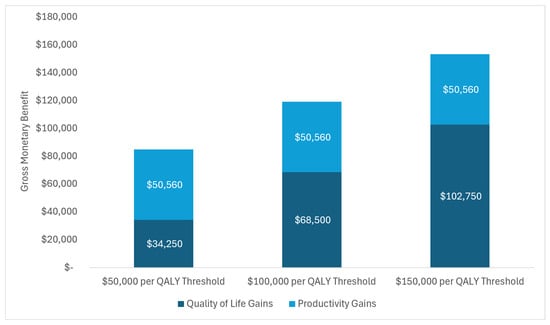
Estimated gross monetary benefit of restorative neurostimulation, showing contributions from Quality-of-Life improvements and model-dependent projections of productivity gains.
  • Article
  • Open Access

Background/Objectives: Vulvodynia is a chronic vulvar pain condition associated with psychological distress and reduced quality of life. While the link between pain severity and depression is well documented, less is known about positive body image. Grounded in Piran’s Developmental Theory of Embodiment, according to which a positive relationship with one’s body can coexist with persistent pain, this cross-sectional study examined whether body appreciation explains depressive symptoms beyond pain severity in women with vulvodynia. Methods: A convenience sample of 133 Italian women with a self-reported diagnosis of vulvodynia, recruited via social media and support groups, completed an online survey comprising the Multidimensional Pain Inventory (MPI) Pain Severity subscale, the Body Appreciation Scale-2 (BAS-2), and the Patient Health Questionnaire-9 (PHQ-9). A hierarchical linear regression tested whether body appreciation explained additional variance in depressive symptoms after controlling for pain severity; regression assumptions and influential observations were examined. Results: Pain severity was positively associated with depressive symptoms (r = 0.433, 95% CI [0.28, 0.57], p < 0.001), whereas body appreciation was negatively associated with them (r = −0.375, 95% CI [−0.55, −0.18], p < 0.001). In the hierarchical regression, body appreciation explained an additional 8.3% of the variance in depressive symptoms beyond pain severity (ΔR2 = 0.083, 95% CI [0.01, 0.20], p < 0.001) and remained negatively associated with them (B = −0.19, 95% CI [−0.29, −0.09]; β = −0.295, p < 0.001). Conclusions: Higher body appreciation was associated with lower depressive symptoms beyond pain severity. Given the cross-sectional design and the small, online-recruited Italian sample, causal inferences or generalization are limited. These findings suggest that body appreciation may be a relevant construct to examine in future studies on psychological adjustment in women with vulvodynia.

Healthcare

17 November 2026

  • Article
  • Open Access

Background/Objectives: Sexual and gender minorities (SGMs) face elevated suicidality risk, yet underlying network structures remain unexamined. This study’s purpose was to examine interrelationships among suicidality and other factors, integrating key constructs from Minority Stress Theory and the Interpersonal Theory of Suicide. Methods: This cross-sectional study analyzed survey data from 411 Thai SGM adults assessing minority stress, interpersonal factors, and suicidality. A mixed graphical model was used to examine conditional associations among variables and estimated centrality indices to identify highly interconnected constructs within the network. Results: Participants reported a 19.0% prevalence of past-year suicidal ideation and a 13.1% prevalence of lifetime suicide attempts. Network analysis identified stress, social isolation, hopelessness, and loneliness as core correlates of suicidality, with stress being the most central. Victimization emerged as an important connection, connecting minority stressors with general stress and suicidality-related constructs. Outness was associated with lower loneliness and social isolation but also with greater victimization. Centrality analyses were stable, supporting the importance of stress, social isolation, and loneliness within the network. Conclusions: Among SGM adults, minority-specific and general stressors, interpersonal disconnection, and suicidality formed an interconnected psychosocial network, with stress, social isolation, and loneliness showing the highest interconnectivity. Integrating both frameworks reveals how SGM minority stressors directly fuel core interpersonal suicide pathways, providing a theoretical bridge between identity-based stress and suicidal ideation. Targeting stress and isolation through interventions is critical to reducing suicidality.

Healthcare

17 November 2026

  • Article
  • Open Access

Introduction: In the antiretroviral therapy (ART) era, inpatient care for people with HIV (PWH) increasingly involves managing chronic conditions alongside HIV-related illness. Yet how accumulating chronic conditions and their patterns of co-occurrence relate to hospitalisation charges and length of stay (LOS) remains poorly understood, particularly in China. We examined these associations and characterised the composition of inpatient charges. Methods: This retrospective study included 19,134 hospitalisations among 10,165 PWH at a tertiary hospital in Beijing during 2009–2025. Chronic-condition burden was categorised as 0, 1, 2, or ≥3 conditions. Patient-clustered generalised estimating equations estimated adjusted differences in charges and LOS, accounting for demographic characteristics, admission year, payment type, and HIV/AIDS-related and other infectious clinical case mix. Additional analyses examined charge components and identified multimorbidity patterns using patient-balanced latent class analysis. Results: Compared with hospitalisations without chronic conditions, adjusted charges were 11.7%, 21.2%, and 38.9% higher for 1, 2, and ≥3 conditions, respectively; corresponding LOS increases were 9.8%, 13.4%, and 26.1%, respectively (all p < 0.001). For ≥3 conditions, adjusted absolute increments were 11,334.7 Chinese yuan (CNY) and 3.5 inpatient days. Drugs, medical materials, and laboratory testing accounted for 73.1% of the sum of component-specific charge increments. Six multimorbidity patterns were identified. The advanced cardiovascular–metabolic pattern had the highest adjusted charges (52,356 CNY), whereas the musculoskeletal–neuropathic–reflux pattern had the longest adjusted LOS (16.92 days). Conclusions: Greater chronic-condition burden was associated with higher hospitalisation charges and longer LOS among PWH, with distinct resource-use profiles across multimorbidity patterns. These findings extend existing evidence on HIV-related multimorbidity to the Chinese inpatient setting and highlight the importance of considering both chronic-condition burden and clinical composition when assessing inpatient resource needs. As HIV care increasingly encompasses the management of chronic conditions alongside HIV-related illness, our findings may inform more integrated care approaches and hospital resource planning in the ART era.

Healthcare

17 November 2026

Highly Accessed Articles

News & Conferences

Latest Issues

Open for Submission

Journal Sections

XFacebookLinkedIn
Healthcare - ISSN 2227-9032