
Skip to Content
You are currently on the new version of our website. Access the old version .
  • 3.7
    Impact Factor
  • 4.2
    CiteScore
  • 22 days
    Submission to First Decision
  • 3 days
    Acceptance to Publication

Diseases

Diseases is an international, peer-reviewed, open access, multidisciplinary journal with focus on research on human diseases and conditions, published monthly online by MDPI. 
  • Open Access— free for readers, with article processing charges (APC) paid by authors or their institutions.
  • High Visibility: indexed within Scopus, ESCI (Web of Science), PubMed, PMC, CAPlus / SciFinder, and other databases.
  • Journal Rank: JCR - Q2 (Medicine, Research and Experimental) / CiteScore - Q1 (General Medicine)
  • Rapid Publication: manuscripts are peer-reviewed and a first decision is provided to authors approximately 21.6 days after submission; acceptance to publication is undertaken in 2.6 days (median values for papers published in this journal in the first half of 2026).
  • Recognition of Reviewers: Reviewers whose reports are timely and of high quality receive an APC discount voucher for a future publication in an MDPI journal. Become a reviewer.
  • Sections: published in 8 topical sections.

Get Alerted

Add your email address to receive forthcoming issues of this journal.

All Articles (1,906)

  • Article
  • Open Access

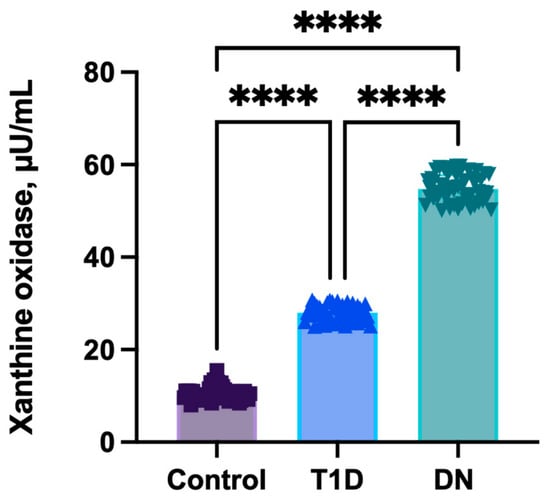
Background: Xanthine oxidase (XO) is an important source of reactive oxygen species (ROS) and may be involved in oxidative stress-related renal injury. However, the relationship between XO activity, oxidative stress and early renal tubular injury in children with type 1 diabetes (T1D) and early diabetic nephropathy (DN) remains insufficiently studied. Methods: This cross-sectional study included 150 participants aged 10–18 years: 50 children with T1D without DN, 50 with with T1D and DN and 50 healthy controls. Plasma XOR and XDH activities were determined spectrophotometrically, and XO activity was calculated as the difference between XOR and XDH activities. Superoxide production was assessed spectrophotometrically by monitoring cytochrome c reduction. The Urinary Kidney Injury Molecule (KIM-1) was assessed as a marker of tubular injury. Associations between oxidative stress markers, KIM-1 and DN were examined using correlation and multivariable regression analyses. Results: Plasma XO activity increased progressively across the study groups, from 10.25 (9.49–11.12) μU/mL in controls to 27.95 (26.31–29.29) μU/mL in children with T1D and 54.79 (52.62–57.73) μU/mL in those with DN (p < 0.0001). Principal component analysis showed clustering of oxidative stress and tubular injury biomarkers distinct from conventional renal function measures. Multivariable regression identified XO and superoxide production as independently associated with urinary KIM-1 levels in the DN group. T1D duration, BMI, KIM-1, XO and superoxide production were independently associated with DN. The combined model demonstrated excellent discrimination (AUC = 0.933). Conclusions: Increased XO activity is associated with oxidative stress and urinary KIM-1 in children with T1D, with the highest levels observed in DN group. The combined associations of XO, superoxide, KIM- and clinical factors with DN suggest a potential link between oxidative stress and early tubular injury in pediatric T1D. These biomarkers may be associated with early involvement and require further investigation as potential indicators of kidney injury in children with T1D.

Diseases

10 November 2026

Plasma XO levels in healthy controls, children with type 1 diabetes T1D and children with diabetic nephropathy DN. ****—p &lt; 0.0001.
  • Review
  • Open Access

The RNA-induced silencing complex (RISC), built around the Argonaute proteins, executes microRNA-mediated gene silencing. AGO2, the only catalytically active human paralogue, stabilises mature microRNAs in neurons and controls local translation in dendrites and axons. AGO2 is now invoked across the whole span of neurological disease, from monogenic neurodevelopmental syndromes to Alzheimer’s and Parkinson’s disease, on evidence of very unequal strength. We therefore ask of each body of work two questions: what was experimentally manipulated, and what was then measured. De novo variants in AGO1 and AGO2 cause the Argonaute syndromes, where the mechanism has been traced from the kinetics of the mutant protein to knock-in mouse phenotypes and indicates delayed strand release rather than loss of function; conditional Ago2 deletion in mice is comparably direct for neurovascular development and adult neurogenesis. In neurodegenerative disease, the position differs. The DISE mechanism shows that AGO2 activity sets the threshold for amyloid-beta toxicity in cultured neurons, and one study identifies AGO2 as an endogenous brake on alpha-synuclein synthesis, but no experiment has yet tested whether altering AGO2 in vivo changes neurodegeneration, even though deleting the upstream enzyme Dicer kills dopaminergic neurons. Benchmarked against TDP-43-dependent mis-splicing, where causality in amyotrophic lateral sclerosis is established, AGO2 remains a convergence point for several pathological processes rather than a demonstrated driver of any of them. The available evidence neither establishes nor excludes a causal role, and we set out the experiments that would decide.

Diseases

9 November 2026

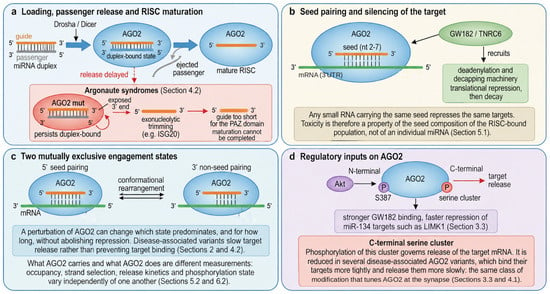
The RISC cycle and the steps at which it is known to fail. (a) A miRNA duplex produced by Drosha and Dicer is loaded into AGO2; the passenger strand is ejected and the guide retained, producing a mature RISC. Delayed passenger release, the defect common to the Argonaute syndromes, leaves the guide 3′ end exposed to exonucleolytic trimming and yields a shortened guide that cannot complete maturation (Section 4.2). (b) The seed, positions 2 to 7 of the guide, pairs with the 3′UTR of the target; GW182/TNRC6 then recruits the deadenylation and decapping machinery. Because any small RNA carrying a given seed represses the same target set, seed composition rather than individual miRNA identity determines the outcome, which is the basis of the DISE mechanism (Section 5.1). (c) Target engagement alternates between mutually exclusive 5′ seed and 3′ non-seed states. (d) Regulatory inputs: Akt phosphorylates S387, strengthening the GW182 interaction, while phosphorylation of the C-terminal serine cluster governs target release and is reduced in several disease-associated variants.
  • Article
  • Open Access

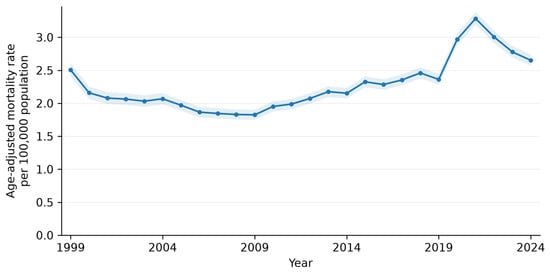
Background/Objectives: Death certificates provide a population-level measure of mortality involving gastrointestinal hemorrhage (GIH) and liver cirrhosis. We examined trends in deaths with unspecified GIH and selected cirrhosis codes recorded among U.S. adults aged 45 years and older from 1999 through 2024. Methods: Centers for Disease Control and Prevention Wide-Ranging Online Data for Epidemiologic Research (CDC WONDER) mortality data were queried for K92.2 AND (K70.3 OR K74.6). Age-adjusted mortality rates (AAMRs) per 100,000 were standardized to the 2000 U.S. population. Joinpoint models evaluated national trends, alternative model restrictions, an expanded bleeding definition and overlapping cirrhosis-code strata. Results: There were 75,309 deaths, averaging 2897 annually. The mean annual AAMR was 2.27, with higher descriptive means among males and in the West. The primary full-period average annual percent change (AAPC) was 0.48% (95% confidence interval, −0.59 to 1.57; p = 0.381). A maximum-two-joinpoint model was also nonsignificant, whereas wider spacing yielded an AAPC of 1.14% (0.20–2.09; p = 0.018). Adding bleeding esophageal varices identified 105,000 deaths, with an AAPC of 0.26% (−0.52 to 1.05; p = 0.508). Cirrhosis-code analyses were exploratory; the K70.3 model included a three-observation initial segment, limiting interpretation. Conclusions: Mortality with unspecified GIH and selected co-recorded cirrhosis codes represents a defined death certificate endpoint, not all cirrhosis-related bleeding mortality. The identified burden depended on the bleeding codes included, and inference about full-period change and late trends depended on model restrictions.

Diseases

9 November 2026

Annual age-adjusted mortality rates for deaths with unspecified gastrointestinal hemorrhage (K92.2) and cirrhosis (K70.3 or K74.6) co-recorded, U.S. adults aged 45 years and older, 1999–2024. Shading indicates annual 95% confidence intervals. Rates are per 100,000 and standardized to the 2000 U.S. population. Source: Centers for Disease Control and Prevention Wide-ranging Online Data for Epidemiologic Research (CDC WONDER). Lines connect observed annual values; they are not fitted regression curves.
  • Article
  • Open Access

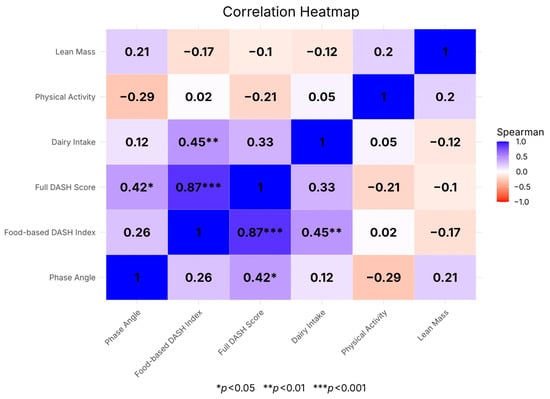
Background/Objectives: Patients with Crohn’s disease (CD) are at increased risk of malnutrition, which may be reflected by reduced phase angle (PhA), a bioelectrical impedance marker of cellular integrity. This exploratory study investigated associations between Mediterranean and DASH diet adherence and PhA in adults with CD. Methods: This cross-sectional study included 39 adults with CD, mostly in clinical remission, from a Greek public hospital. PhA was measured by bioelectrical impedance analysis, and dietary quality was assessed with the MedDietScore and an adapted DASH score; the primary exposure was a food-based DASH index (seven food-group components), and the full 10-component score was exploratory. Associations were examined with multiple linear regression models adjusted for sex and physical activity. Results: After adjustment for sex and physical activity, each one-point higher food-based DASH index was associated with a 0.29° higher PhA, with a 95% CI from −0.003 to 0.588 (n = 35). In exploratory analyses, the full score, which includes qualitatively scored nutrient components, was also positively associated with PhA (B = 0.230, 95% CI 0.042–0.418). No clear association was observed for the total MedDietScore or full-fat dairy consumption. Conclusions: In adults with CD, the adjusted estimate for DASH-type food choices and PhA was positive but imprecise. These hypothesis-generating findings require confirmation in longitudinal and interventional studies.

Diseases

8 November 2026

Spearman correlation heatmap of phase angle with dietary, physical activity, and body composition variables (pairwise complete observations: n = 35 for correlations involving dietary variables and n = 39 for the remaining variables). Colours indicate the direction and magnitude of the correlation coefficients (red, negative; blue, positive), and the values within the cells are Spearman’s ρ. Dairy intake, MedDietScore full-fat dairy item reverse-coded so that higher values indicate more frequent consumption; physical activity, total IPAQ score (MET-min/week); food-based DASH index, sum of the seven food-group components of the adapted Dietary Approaches to Stop Hypertension (DASH) score (primary exposure); full DASH score, adapted 10-component score (exploratory exposure). * p &lt; 0.05, ** p &lt; 0.01, *** p &lt; 0.001.

Highly Accessed Articles

News & Conferences

Latest Issues

Open for Submission

Journal Sections

XFacebookLinkedIn
Diseases - ISSN 2079-9721