




Journal Menu
► ▼ Journal Menu-
- Biology Home
- Aims & Scope
- Editorial Board
- Reviewer Board
- Topical Advisory Panel
- Instructions for Authors
- Special Issues
- Topics
- Sections & Collections
- Article Processing Charge
- Indexing & Archiving
- Editor’s Choice Articles
- Most Cited & Viewed
- Journal Statistics
- Journal History
- Journal Awards
- Society Collaborations
- Editorial Office
Journal Browser
► ▼ Journal BrowserNeed Help?
Announcements
12 May 2026
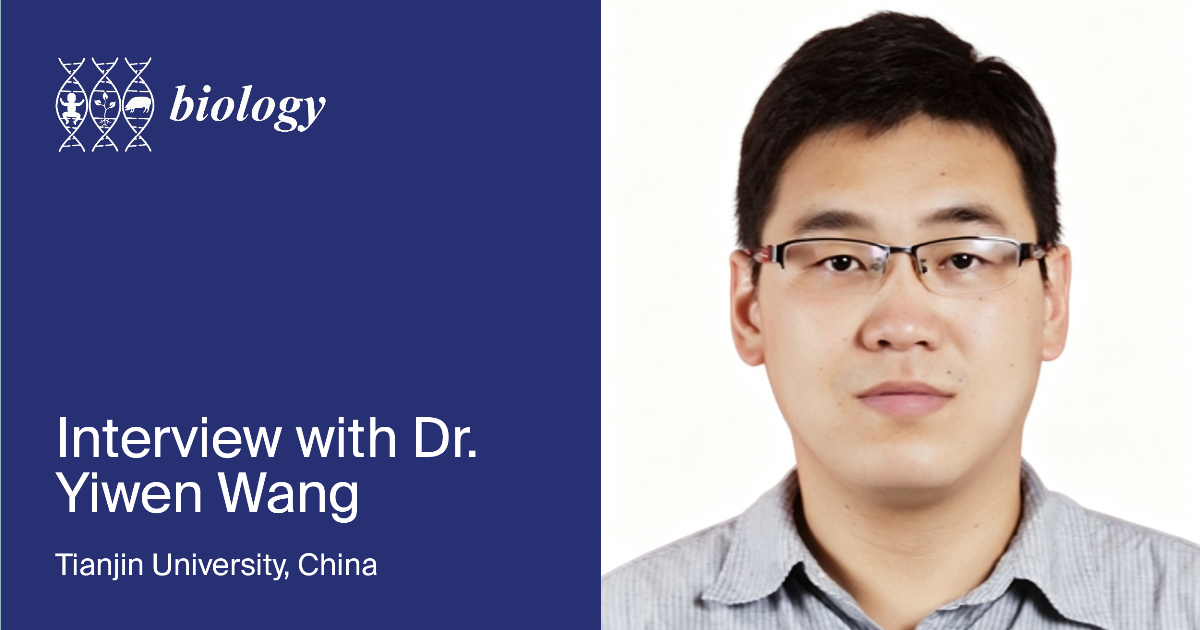
Interview with Dr. Yiwen Wang—Winner of the Biology Young Investigator Award
1. Could you briefly introduce yourself and share your current research focus?
My name is Wang Yiwen. I am an Associate Professor and independent Principal Investigator in the School of Pharmaceutical Science and Technology (SPST), Tianjin University, Faculty of Medicine. I received my doctoral degree from the University of Tübingen in 2018, under the supervision of Professor Bernard Moussian, where I systematically mastered research methodologies in Drosophila genetics. I returned to China in 2019 and established my independent Drosophila research laboratory at SPST, Tianjin University. Currently, my research focuses on two main directions. The first is the construction of diverse disease models using Drosophila to identify the core bioactive compounds from medicinal herbs and uncover their underlying molecular mechanisms in disease treatment. The second direction is environmental entomotoxicology, focusing on the regulatory networks of insect detoxification and metabolic systems, as well as how environmental factors modulate insect pesticide resistance.
2. What inspired you to pursue research in the field of biology?
I am deeply grateful to my undergraduate alma mater, Jilin University in China. I originally majored in software engineering, yet the university’s inclusive academic atmosphere offered me the opportunity to pursue a second degree. Therefore, I chose bioengineering as my secondary major and eventually developed a profound passion for molecular biology. Through reading textbooks and scientific literature, I was profoundly amazed by life itself: it advances through randomness and contingency, breaking through the chaos of nature. Every single cell is exquisitely sophisticated yet inherently contradictory, like intricate puzzles that constantly draw me into deeper exploration. I also owe great thanks to Prof. Bernard Moussian, my supervisor, for both my master’s and doctoral studies. He is not only a rigorous mentor but also a close friend. He provided me with top-tier, rigorous training in biological research while also encouraging me to retain my curiosity and freely conduct interesting, curiosity-driven experiments in his laboratory. All of these experiences have jointly motivated me to devote myself to biological research.
3. Could you please share with us your feelings after winning the Biology Young Investigator Award?
I was truly surprised and honored to receive this award. I would like to express my sincere gratitude to the editorial team of Biology. This recognition affirms my research efforts over the past six years and serves as a great encouragement for me to continue my academic exploration in the years ahead.
4. Do you have any other suggestions on how journals and publishers can further support young researchers and the academic community?
Biology is an excellent journal, and this Young Investigator Award has deeply warmed my heart. In an era where scientific research relies heavily on high-end technology and interdisciplinary collaboration, many early career independent PIs without high-profile academic support are facing growing challenges in carrying out their work. This is a widespread practical difficulty. The gradual decline of small, independent research teams may even become an inevitable trend of modern academia. Nevertheless, the loss of such teams will inevitably reduce the diversity of the overall research ecosystem. As biologists, we all understand clearly that genuine innovation always stems from diversity, rather than goal-oriented high-input research. I sincerely appreciate that Biology has long offered extensive support to young researchers through various initiatives. Looking ahead, I sincerely hope the journal can continue to provide more publishing opportunities and targeted support for small-scale, independent research projects.
5. Based on your experience, which research topics in this field do you think will be of particular interest to the academic community in the next few years?
The human body functions as a sophisticated complex system, in which signaling pathways intertwine to form an intricate regulatory network. For this reason, a single drug intervention may trigger chain reactions across the whole organism. Meanwhile, due to the inherent stability of complex biological systems, therapeutic effects can often be constrained or weakened. In the coming years, refined multi‑omics analysis and artificial intelligence modeling will become core frontier directions. These approaches will enable us to quantitatively simulate physiological regulatory networks at the molecular signaling level. Such predictive models will deepen our understanding of complex metabolic disorders. They will also help us interpret physiological systems and pathogeneses through a reductionist perspective and further guide the development of systematic, optimized therapeutic strategies for complex diseases.
6. What advice would you give to early career researchers or young scientists who are just starting their academic journey?
Science is becoming increasingly collaborative. My own continuous research output would never have been possible without extensive cooperation with numerous collaborators. Therefore, my advice for early-career researchers is to always maintain an open mind, engage in active communication, and embrace academic collaboration.
7. Looking ahead, what are your main goals or projects for the coming years?
I continue to adopt Drosophila as my core model organism because it possesses irreplaceable advantages. Compared with mammalian models, fruit flies feature lower experimental costs, higher research efficiency, and minimal individual variation. Traditional Chinese medicine exerts therapeutic effects through a multi-component and multi-target network, which enables it to manage complex diseases better than single-target synthetic drugs. However, this inherent complexity leads to an exponential increase in research difficulty. Such an ambiguous “black box” mechanism greatly restricts the modernization and standardized development of TCM and other traditional medical resources. In the next few years, I will combine the Drosophila model with cutting-edge multi-omics approaches to systematically decipher the molecular mechanisms of herbal medicines. Relying on the high-throughput and high-efficiency strengths of this model, my long-term goal is to clarify how multiple active ingredients cooperatively regulate physiological functions via synergistic multi-target pathways. Ultimately, I aim to optimize herbal formulas at the molecular and compositional levels and develop individualized, balanced therapeutic strategies for complex human diseases.
