

Uplifting Workspaces: A Brief Review of Sit-to-Stand Workstations Among Different Occupations
 ,
,
Abstract
1. Introduction
2. Health Problems from Sedentary Behavior
3. Health Benefits of Rest Breaks and Standing from Prolonged Sedentary Behavior
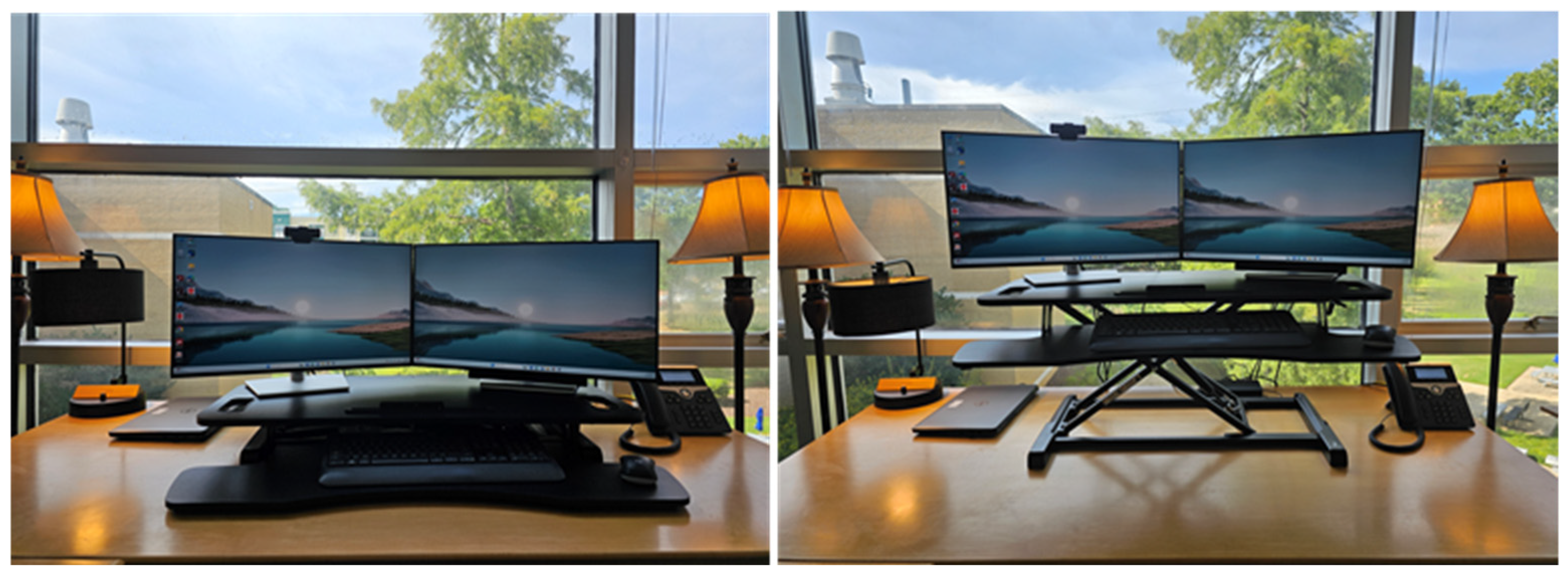
4. Sit-to-Stand Workstations
5. Selected Specific Occupations
5.1. Emergency Dispatchers
5.2. Architects
5.3. Customer Service Representatives
5.4. General Practitioners
5.5. Engineers
5.6. Pharmacists
5.7. Laboratory Research Scientists, Such as Biophysicists
5.8. Generalized Office Workers
6. Occupation-Specific Summary
7. Suggestions and Recommendations
8. Limitations
9. Conclusions
Author Contributions
Funding
Institutional Review Board Statement
Informed Consent Statement
Data Availability Statement
Conflicts of Interest
References
- Karakolis, T.; Callaghan, J.P. The impact of sit–stand office workstations on worker discomfort and productivity: A review. Appl. Ergon. 2014, 45, 799–806. [Google Scholar] [CrossRef]
- Agarwal, S.; Steinmaus, C.; Harris-Adamson, C. Sit-stand workstations and impact on low back discomfort: A systematic review and meta-analysis. Ergonomics 2018, 61, 538–552. [Google Scholar] [CrossRef]
- Chambers, A.J.; Robertson, M.M.; Baker, N.A. The effect of sit-stand desks on office worker behavioral and health outcomes: A scoping review. Appl. Ergon. 2019, 78, 37–53. [Google Scholar] [CrossRef]
- Newton, R.L., Jr.; Han, H.; Zderic, T.; Hamilton, M. Correction: The Energy Expenditure of Sedentary Behavior: A Whole Room Calorimeter Study. PLoS ONE 2013, 8, e63171. [Google Scholar] [CrossRef]
- Bames, J.; Behrens, T.K.; Benden, M.E.; Biddle, S.; Bond, D.; Brassard, P.; Brown, H.; Carr, L.; Carson, V.; Chaput, J.; et al. Letter to the Editor: Standardized use of the terms “sedentary” and “sedentary behaviours”. Appl. Physiol. Nutr. Metab. 2012, 37, 540–542. [Google Scholar] [PubMed]
- Owen, N.; Bauman, A.; Brown, W. Too much sitting: A novel and important predictor of chronic disease risk? Br. J. Sports Med. 2009, 43, 81–83. [Google Scholar] [CrossRef]
- Putsa, B.; Jalayondeja, W.; Mekhora, K.; Bhuanantanondh, P.; Jalayondeja, C. Factors associated with reduced risk of musculoskeletal disorders among office workers: A cross-sectional study 2017 to 2020. BMC Public Health 2022, 22, 1503. [Google Scholar] [CrossRef]
- Hanna, F.; Daas, R.N.; El-Shareif, T.J.; Al-Marridi, H.H.; Al-Rojoub, Z.M.; Adegboye, O.A. The Relationship Between Sedentary Behavior, Back Pain, and Psychosocial Correlates Among University Employees. Front. Public Health 2019, 7, 80. [Google Scholar] [CrossRef]
- Buffey, A.J.; Herring, M.P.; Langley, C.K.; Donnelly, A.E.; Carson, B.P. The Acute Effects of Interrupting Prolonged Sitting Time in Adults with Standing and Light-Intensity Walking on Biomarkers of Cardiometabolic Health in Adults: A Systematic Review and Meta-analysis. Sports Med. 2022, 52, 1765–1787. [Google Scholar] [CrossRef] [PubMed]
- Quittan, M. Aspects of physical medicine and rehabilitation in the treatment of deconditioned patients in the acute care setting: The role of skeletal muscle. Wien. Med. Wochenschr. 2016, 166, 28–38. [Google Scholar] [CrossRef] [PubMed]
- Dzakpasu, F.Q.S.; Carver, A.; Brakenridge, C.J.; Cicuttini, F.; Urquhart, D.M.; Owen, N.; Dunstan, D.W. Musculoskeletal pain and sedentary behaviour in occupational and non-occupational settings: A systematic review with meta-analysis. Int. J. Behav. Nutr. Phys. Act. 2021, 18, 159. [Google Scholar] [CrossRef]
- Kang, K.W.; Son, S.M.; Ko, Y.M. Time-varying Changes in Pulmonary Function with Exposure to Prolonged Sitting. Osong Public Health Res. Perspect. 2016, 7, 382–384. [Google Scholar] [CrossRef] [PubMed]
- Bull, F.C.; Al-Ansari, S.S.; Biddle, S.; Borodulin, K.; Buman, M.P.; Cardon, G.; Carty, C.; Chaput, J.-P.; Chastin, S.; Chou, R.; et al. World Health Organization 2020 guidelines on physical activity and sedentary behaviour. Br. J. Sports Med. 2020, 54, 1451–1462. [Google Scholar] [CrossRef] [PubMed]
- Bonnet, C.T.; Cheval, B. Sitting vs. standing: An urgent need to rebalance our world. Health Psychol. Rev. 2023, 17, 673–694. [Google Scholar] [CrossRef] [PubMed]
- Gupta, A.; Sekher, T.V. Call Centers and Associated Health Hazard for Women Employees: A Review of Health Implications for Women Employees of Transnational Call Centers in India. SAGE Open 2023, 13, 21582440231192152. [Google Scholar] [CrossRef]
- Hadgraft, N.T.; Dunstan, D.W.; Owen, N. Models for Understanding Sedentary Behaviour. In Sedentary Behaviour Epidemiology; Leitzmann, M.F., Jochem, C., Schmid, D., Eds.; Springer International Publishing: Cham, Switzerland, 2018; pp. 381–403. ISBN 978-3-319-61552-3. [Google Scholar]
- Karol, S.; Robertson, M.M. Implications of sit-stand and active workstations to counteract the adverse effects of sedentary work: A comprehensive review. Work 2015, 52, 255–267. [Google Scholar] [CrossRef]
- Haskell, W.; Lee, I.-M.; Pate, R.; Powell, K.; Blair, S.; Franklin, B.; Macera, C.; Heath, G.; Thompson, P.; Bauman, A. Physical Activity and Public Health: Updated Recommendation for Adults From the American College of Sports Medicine and the American Heart Association. Circulation 2007, 116, 1081–1093. [Google Scholar] [CrossRef]
- Löllgen, H.; Böckenhoff, A.; Knapp, G. Physical Activity and All-cause Mortality: An Updated Meta-analysis with Different Intensity Categories. Int. J. Sports Med. 2009, 30, 213–224. [Google Scholar] [CrossRef]
- Sheahan, P.J.; Diesbourg, T.L.; Fischer, S.L. The effect of rest break schedule on acute low back pain development in pain and non-pain developers during seated work. Appl. Ergon. 2016, 53, 64–70. [Google Scholar] [CrossRef]
- Wennberg, P.; Boraxbekk, C.-J.; Wheeler, M.; Howard, B.; Dempsey, P.C.; Lambert, G.; Eikelis, N.; Larsen, R.; Sethi, P.; Occleston, J.; et al. Acute effects of breaking up prolonged sitting on fatigue and cognition: A pilot study. BMJ Open 2016, 6, e009630. [Google Scholar] [CrossRef]
- Peddie, M.C.; Kessell, C.; Bergen, T.; Gibbons, T.D.; Campbell, H.A.; Cotter, J.D.; Rehrer, N.J.; Thomas, K.N. The effects of prolonged sitting, prolonged standing, and activity breaks on vascular function, and postprandial glucose and insulin responses: A randomised crossover trial. PLoS ONE 2021, 16, e0244841. [Google Scholar] [CrossRef] [PubMed]
- Hartman, Y.A.W.; Tillmans, L.C.M.; Benschop, D.L.; Hermans, A.N.L.; Nijssen, K.M.R.; Eijsvogels, T.M.H.; Willems, P.; Tack, C.J.; Hopman, M.T.E.; Claassen, J.; et al. Long-Term and Acute Benefits of Reduced Sitting on Vascular Flow and Function. Med. Sci. Sports Exerc. 2021, 53, 341–350. [Google Scholar] [CrossRef] [PubMed]
- Husemann, B.; Mach, C.Y.V.; Borsotto, D.; Zepf, K.I.; Scharnbacher, J. Comparisons of Musculoskeletal Complaints and Data Entry Between a Sitting and a Sit-Stand Workstation Paradigm. Hum. Factors 2009, 51, 310–320. [Google Scholar] [CrossRef]
- Kowalsky, R.J.; Stoner, L.; Faghy, M.A.; Barone Gibbs, B. A Call to Clarify the Intensity and Classification of Standing Behavior. Int. J. Environ. Res. Public Health 2021, 18, 8460. [Google Scholar] [CrossRef]
- Zhu, W.; Gutierrez, M.; Toledo, M.J.; Mullane, S.; Stella, A.P.; Diemar, R.; Buman, K.F.; Buman, M.P. Long-term effects of sit-stand workstations on workplace sitting: A natural experiment. J. Sci. Med. Sport. 2018, 21, 811–816. [Google Scholar] [CrossRef]
- Chau, J.Y.; Daley, M.; Dunn, S.; Srinivasan, A.; Do, A.; Bauman, A.E.; van der Ploeg, H.P. The effectiveness of sit-stand workstations for changing office workers’ sitting time: Results from the Stand@Work randomized controlled trial pilot. Int. J. Behav. Nutr. Phys. Act. 2014, 11, 127. [Google Scholar] [CrossRef]
- Dutta, N.; Koepp, G.A.; Stovitz, S.D.; Levine, J.A.; Pereira, M.A. Using Sit-Stand Workstations to Decrease Sedentary Time in Office Workers: A Randomized Crossover Trial. Int. J. Environ. Res. Public Health 2014, 11, 6653–6665. [Google Scholar] [CrossRef]
- Straker, L.; Levine, J.; Campbell, A. The Effects of Walking and Cycling Computer Workstations on Keyboard and Mouse Performance. Hum. Factors 2010, 51, 831–844. [Google Scholar] [CrossRef]
- Zhou, L.; Deng, X.; Xu, M.; Wu, Y.; Shang, X.; E, F.; Wang, Y.; Liang, S.; Yang, K.; Li, X. The effects of active workstations on reducing work-specific sedentary time in office workers: A network meta-analysis of 23 randomized controlled trials. Int. J. Behav. Nutr. Phys. Act. 2023, 20, 92. [Google Scholar] [CrossRef]
- Pierce, H.; Lilly, M.M. Duty-related trauma exposure in 911 telecommunicators: Considering the risk for posttraumatic stress. J. Trauma. Stress 2012, 25, 211–215. [Google Scholar] [CrossRef] [PubMed]
- Public Safety Telecommunicators. Available online: https://www.bls.gov/ooh/office-and-administrative-support/police-fire-and-ambulance-dispatchers.htm (accessed on 31 July 2025).
- Straker, L.; Abbott, R.A.; Heiden, M.; Mathiassen, S.E.; Toomingas, A. Sit–stand desks in call centres: Associations of use and ergonomics awareness with sedentary behavior. Appl. Ergon. 2013, 44, 517–522. [Google Scholar] [CrossRef]
- Toomingas, A.; Forsman, M.; Mathiassen, S.E.; Heiden, M.; Nilsson, T. Variation between seated and standing/walking postures among male and female call centre operators. BMC Public Health 2012, 12, 154. [Google Scholar] [CrossRef]
- Black, N.; Fortin, A.-P.; Handrigan, G.A. Postural and Perception Variations When Using Manually Adjustable and Programmable Sit–Stand Workstations in an Emergency Call Center. IIE Trans. Occup. Ergon. Hum. Factors 2015, 3, 127–138. [Google Scholar] [CrossRef]
- Clinchamps, M.; Bouillon-Minois, J.-B.; Trousselard, M.; Schmidt, J.; Pic, D.; Taillandier, T.; Mermillod, M.; Pereira, B.; Dutheil, F. Effects of a sedentary behaviour intervention in emergency dispatch centre phone operators: A study protocol for the SECODIS randomised controlled cross-over trial. BMJ Open 2024, 14, e080177. [Google Scholar] [CrossRef]
- Chau, J.Y.; Engelen, L.; Burks-Young, S.; Daley, M.; Maxwell, J.-K.; Milton, K.; Bauman, A. Perspectives on a ‘Sit Less, Move More’ Intervention in Australian Emergency Call Centres. AIMS Public Health 2016, 3, 288–297. [Google Scholar] [CrossRef]
- Alkhajah, T.A.; Reeves, M.M.; Eakin, E.G.; Winkler, E.A.H.; Owen, N.; Healy, G.N. Sit–Stand Workstations: A Pilot Intervention to Reduce Office Sitting Time. Am. J. Prev. Med. 2012, 43, 298–303. [Google Scholar] [CrossRef] [PubMed]
- Mansoubi, M.; Pearson, N.; Biddle, S.J.H.; Clemes, S. The relationship between sedentary behaviour and physical activity in adults: A systematic review. Prev. Med. 2014, 69, 28–35. [Google Scholar] [CrossRef] [PubMed]
- Clemes, S.A.; O’Connell, S.E.; Edwardson, C.L. Office Workers’ Objectively Measured Sedentary Behavior and Physical Activity During and Outside Working Hours. J. Occup. Environ. Med. 2014, 56, 298–303. [Google Scholar] [CrossRef] [PubMed]
- Kazi, A.; Duncan, M.; Clemes, S.; Haslam, C. A survey of sitting time among UK employees. Occup. Med. 2014, 64, 497–502. [Google Scholar] [CrossRef]
- Finch, L.E.; Tomiyama, A.J.; Ward, A. Taking a Stand: The Effects of Standing Desks on Task Performance and Engagement. Int. J. Environ. Res. Public Health 2017, 14, 939. [Google Scholar] [CrossRef]
- Sharma, P.; Pickens, A.; Mehta, R.; Han, G.; Benden, M.E. Smart Software Can Increase Sit–Stand Desk Transitions During Active Computer Use. Int. J. Environ. Res. Public Health 2019, 16, 2438. [Google Scholar] [CrossRef]
- Surana, S.; Singh, A.K.; Saxena, S. The management of job burnout among call centre customer service agents in India: The role of social support. Int. J. Manag. Dev. 2011, 1, 79. [Google Scholar] [CrossRef]
- Nadeem, S. The uses and abuses of time: Globalization and time arbitrage in India’s outsourcing industries. Glob. Netw. 2009, 9, 20–40. [Google Scholar] [CrossRef]
- Garrett, G.; Benden, M.; Mehta, R.; Pickens, A.; Peres, S.C.; Zhao, H. Call Center Productivity Over 6 Months Following a Standing Desk Intervention. IIE Trans. Occup. Ergon. Hum. Factors 2016, 4, 188–195. [Google Scholar] [CrossRef]
- Pickens, A.W.; Kress, M.M.; Benden, M.E.; Zhao, H.; Wendel, M.; Congleton, J.J. Stand-capable desk use in a call center: A six-month follow-up pilot study. Public Health 2016, 135, 131–134. [Google Scholar] [CrossRef] [PubMed]
- Chau, J.Y.; Sukala, W.; Fedel, K.; Do, A.; Engelen, L.; Kingham, M.; Sainsbury, A.; Bauman, A.E. More standing and just as productive: Effects of a sit-stand desk intervention on call center workers’ sitting, standing, and productivity at work in the Opt to Stand pilot study. Prev. Med. Rep. 2016, 3, 68–74. [Google Scholar] [CrossRef]
- Laestadius, J.G.; Ye, J.; Cai, X.; Ross, S.; Dimberg, L.; Klekner, M. The Proactive Approach—Is It Worthwhile? A Prospective Controlled Ergonomic Intervention Study in Office Workers. J. Occup. Environ. Med. 2009, 51, 1116–1124. [Google Scholar] [CrossRef]
- Ma, J.; Ma, D.; Li, Z.; Kim, H. Effects of a Workplace Sit–Stand Desk Intervention on Health and Productivity. Int. J. Environ. Res. Public Health 2021, 18, 11604. [Google Scholar] [CrossRef]
- Mayne, R.S.; Hart, N.D.; Heron, N. Sedentary behaviour among general practitioners: A systematic review. BMC Fam. Pract. 2021, 22, 6. [Google Scholar] [CrossRef] [PubMed]
- McWhinney, I.R. Being a general practitioner: What it means. Eur. J. Gen. Pract. 2000, 6, 135–139. [Google Scholar] [CrossRef]
- Biddle, G.J.H.; Thomas, N.; Edwardson, C.L.; Clemes, S.A.; Daley, A.J. Feasibility and acceptability of general practitioners using sit–stand desks: A feasibility trial. BMJ Open 2024, 14, e084085. [Google Scholar] [CrossRef] [PubMed]
- McLachlan, M.L.; Schupack, K.M.; Curry, E.N.; Konwinski, B.L.; Younge, T.S.; Gonzalez, C.A. Sit-Stand Desks and Physical Self-care Behaviors in a Family Medicine Residency. PRiMER 2022, 6, 31. [Google Scholar] [CrossRef]
- Architecture and Engineering Occupations. Available online: https://www.bls.gov/ooh/architecture-and-engineering/ (accessed on 31 July 2025).
- Parry, S.; Straker, L. The contribution of office work to sedentary behaviour associated risk. BMC Public Health 2013, 13, 296. [Google Scholar] [CrossRef]
- Wang, H.; Yu, D.; Zeng, Y.; Zhou, T.; Wang, W.; Liu, X.; Pei, Z.; Yu, Y.; Wang, C.; Deng, Y.; et al. Quantifying the impacts of posture changes on office worker productivity: An exploratory study using effective computer interactions as a real-time indicator. BMC Public Health 2023, 23, 2198. [Google Scholar] [CrossRef]
- DiRocco, T.; Hall-Nelson, B.; Carlson, I.; Corrigan, J.; Kutcher, S.; Mertz, P.; Nelson-Wong, E. Task type, preference, and occupation affect standing desk utilization in office workers. Work 2023, 74, 295–308. [Google Scholar] [CrossRef]
- Pharmacists. Available online: https://www.bls.gov/ooh/healthcare/pharmacists.htm (accessed on 31 July 2025).
- Waters, T.R.; Dick, R.B. Evidence of Health Risks Associated with Prolonged Standing at Work and Intervention Effectiveness. Rehabil. Nurs. 2015, 40, 148–165. [Google Scholar] [CrossRef] [PubMed]
- Alwahaibi, N.; Al Sadairi, M.; Al Abri, I.; Al Rawahi, S. Prevalence of laboratory-related musculoskeletal disorders among biomedical scientists. Work 2023, 75, 223–232. [Google Scholar] [CrossRef]
- Aldhabi, R.; Alzahrani, A.; Alsobhi, M.; Albadi, M.; Alfawaz, S.; Alabasi, U.; Almaddah, M.; Gmmash, A.; Neamatallah, Z.; Gaowgzeh, R.A. Prevalence and Risk Factors of Musculoskeletal Disorders Among Clinical Laboratory Technicians. Healthcare 2025, 13, 1406. [Google Scholar] [CrossRef]
- Vos, T.; Lim, S.S.; Abbafati, C.; Abbas, K.M.; Abbasi, M.; Abbasifard, M.; Abbasi-Kangevari, M.; Abbastabar, H.; Abd-Allah, F.; Abdelalim, A.; et al. Global burden of 369 diseases and injuries in 204 countries and territories, 1990–2019: A systematic analysis for the Global Burden of Disease Study 2019. Lancet 2020, 396, 1204–1222. [Google Scholar] [CrossRef]
- McDonald, M.; DiBonaventura, M.d.; Ullman, S. Musculoskeletal Pain in the Workforce: The Effects of Back, Arthritis, and Fibromyalgia Pain on Quality of Life and Work Productivity. J. Occup. Environ. Med. 2011, 53, 765. [Google Scholar] [CrossRef] [PubMed]
- Cancelliere, C.; Cassidy, J.D.; Ammendolia, C.; Côté, P. Are workplace health promotion programs effective at improving presenteeism in workers? a systematic review and best evidence synthesis of the literature. BMC Public Health 2011, 11, 395. [Google Scholar] [CrossRef] [PubMed]
- Cho, C.-Y.; Hwang, Y.-S.; Cherng, R.-J. Musculoskeletal Symptoms and Associated Risk Factors Among Office Workers With High Workload Computer Use. J. Manip. Physiol. Ther. 2012, 35, 534–540. [Google Scholar] [CrossRef]
- Hoy, D.; March, L.; Woolf, A.; Blyth, F.; Brooks, P.; Smith, E.; Vos, T.; Barendregt, J.; Blore, J.; Murray, C.; et al. The global burden of neck pain: Estimates from the Global Burden of Disease 2010 study. Ann. Rheum. Dis. 2014, 73, 1309–1315. [Google Scholar] [CrossRef]
- Van Eerd, D.; Munhall, C.; Irvin, E.; Rempel, D.; Brewer, S.; van der Beek, A.J.; Dennerlein, J.T.; Tullar, J.; Skivington, K.; Pinion, C.; et al. Effectiveness of workplace interventions in the prevention of upper extremity musculoskeletal disorders and symptoms: An update of the evidence. Occup. Env. Med. 2016, 73, 62–70. [Google Scholar] [CrossRef]
- Robertson, M.M.; Ciriello, V.M.; Garabet, A.M. Office ergonomics training and a sit-stand workstation: Effects on musculoskeletal and visual symptoms and performance of office workers. Appl. Ergon. 2013, 44, 73–85. [Google Scholar] [CrossRef] [PubMed]
- Buckley, J.P.; Hedge, A.; Yates, T.; Copeland, R.J.; Loosemore, M.; Hamer, M.; Bradley, G.; Dunstan, D.W. The sedentary office: An expert statement on the growing case for change towards better health and productivity. Br. J. Sports Med. 2015, 49, 1357–6271. [Google Scholar] [CrossRef] [PubMed]


| Occupation | Key Job Characteristics | Interventions/Supporting Strategies | Reported Outcomes | Practical Takeaways |
|---|---|---|---|---|
| Emergency Dispatchers | Assess and manage emergency and non-emergency calls or alerts to coordinate and provide instruction to emergency personnel. Seated for the majority of 8–12 h shifts during high-stress situations. Limited opportunity to move away from the workstation. | Automated programmable sit-to-stand workstations. Ergonomist evaluation with mandatory ergonomic training prior to use. | A programmable moving workstation should be pursued, but with refinements combined with training to reduce the perception of pain and general discomfort. | Automate and program posture shifts and combine with training. Additional stress management and sleep hygiene training to combat musculoskeletal complaints, with the challenging nature of the job. |
| Architects | Plan and design structures, meet with clients, and conduct field visits to review project progress. Long design sessions with a mix of manual drawings and CADD. Field visits create additional stationary time during travel but allow for increased mobility upon arrival. | Manually adjustable workstations with software reminders for position changes. Ergonomic setup training. | Limited research on outcomes specific to this occupation. May use general office workers for reference. | Use reminders Adapt cycles to tasks |
| Customer Service Representatives | Answer questions or requests, resolve complaints, process orders, and provide information about products to the public, typically by phone, email, live chat, or social media. Work in a seated position at a table within a large room at individual workstations. Highly monitored, repetitive work with 80–90% of time spent sitting. Limited opportunity to move away from the workstation. | Either spring or electrical sit-to-stand workstations for quick and convenient adjustments to reduce workflow disruption. Ergonomic assessment and user education. | Stand-capable desk users are ~45% more productive daily. Limited evidence for long-term follow-up use. Usage may decline over time as the novelty of the desk wears off. | Combine height-adjustable desk with ergonomic guidance. |
| General Practitioners | Provide primary care to patients of all ages and manage their various health conditions. Extended periods of sitting during patient interaction and documenting encounters. | Sit-to-stand workstation options within patient rooms and at office stations for documentation. Encourage patient education during use through modeling healthy physical habits. | Significantly increases strategies for increased physical activity. Studies are needed on specific sit–stand ratios. Still allow for face-to-face interaction during patient encounters. | Integrate postural changes during consultations to demonstrate movement behavior. |
| Engineers | Design, develop, and analyze systems, structures, materials, and processes across various disciplines. Certain disciplines spend most of their workday sitting at a computer to utilize specialized software. Others may spend more time in the field or on factory floors, although desk-based analysis remains a common practice. | Sit-to-stand workstation with behavior prompts or mobile reminders. Ergonomic assessment and education. Mobile alternatives (e.g., standing meetings, portable laptop stands). | Installing sit-to-stand workstations reduces occupational sitting time and prolonged sitting when combined with behavioral strategies. ~6.5% more productive while standing. Widespread adoption is inconsistent due to multiple factors. | Reinforce sit–stand variety combined with behavioral strategies. |
| Pharmacists | Distribute and guide the public on the utilization of their prescribed medication, provide information on over-the-counter medication, guide physicians on selection, dosage, interactions, and side effects of medications, and administer immunizations. Long hours, mostly standing at counters or dispensaries. | Sit-to-stand workstation, anti-fatigue mats, compression stockings, and shoe inserts. Dynamic movement breaks. | Limited research on outcomes specific to this occupation regarding sit-to-stand workstations. The data does suggest that the use of sit-to-stand workstations should be considered for workers who must either stand or sit for long periods. | Encourage seated time during tasks that do not require standing position to promote positional changes. |
| Laboratory Research Scientists | Work alongside other scientists to develop products. The work environment includes laboratories and offices to conduct research and interpret results. Tend to work extra hours to adhere to strict deadlines for projects. | Sit-to-stand workstation for alternating posture. Ergonomic training and posture correction during lab work. Modify lab benches as needed for optimal ergonomic positioning. | Limited research on outcomes specific to this occupation. May use general office workers for reference. | Adapt to benches Ergonomic education |
| Generalized Office Workers | Tasks may vary depending on specific job titles, but employees typically spend up to 75% of their workday seated. | Sit-to-stand workstation with software or mobile reminders every 50 min. Walking or light activity may be added during a break from sitting if possible. | Increased light movement. Increased overall sense of well-being, energy, and decreased fatigue. Decreased MSK symptoms. | Attempt to replace half of sitting time with standing. Adjust position 2–4×/shift. |
| Topic | Suggestions |
|---|---|
| Workstation Setup |
|
| Recommended Use Patterns |
|
| Behavior Strategies |
|
| Education |
|
| When to Use Programmable or Automated Desk |
|
Disclaimer/Publisher’s Note: The statements, opinions and data contained in all publications are solely those of the individual author(s) and contributor(s) and not of MDPI and/or the editor(s). MDPI and/or the editor(s) disclaim responsibility for any injury to people or property resulting from any ideas, methods, instructions or products referred to in the content. |
© 2025 by the authors. Licensee MDPI, Basel, Switzerland. This article is an open access article distributed under the terms and conditions of the Creative Commons Attribution (CC BY) license (https://creativecommons.org/licenses/by/4.0/).
Share and Cite
Cialone, S.J.; Abraham, K.C.; Holt, K.L.; Cole, K.D.; Kuebler, J.C.; Wilkins, R.; Chander, H. Uplifting Workspaces: A Brief Review of Sit-to-Stand Workstations Among Different Occupations. Theor. Appl. Ergon. 2025, 1, 12. https://doi.org/10.3390/tae1020012
Cialone SJ, Abraham KC, Holt KL, Cole KD, Kuebler JC, Wilkins R, Chander H. Uplifting Workspaces: A Brief Review of Sit-to-Stand Workstations Among Different Occupations. Theoretical and Applied Ergonomics. 2025; 1(2):12. https://doi.org/10.3390/tae1020012
Chicago/Turabian StyleCialone, Steven J., Kayla C. Abraham, Kimberly L. Holt, Kristy D. Cole, Joy C. Kuebler, Renee Wilkins, and Harish Chander. 2025. "Uplifting Workspaces: A Brief Review of Sit-to-Stand Workstations Among Different Occupations" Theoretical and Applied Ergonomics 1, no. 2: 12. https://doi.org/10.3390/tae1020012
APA StyleCialone, S. J., Abraham, K. C., Holt, K. L., Cole, K. D., Kuebler, J. C., Wilkins, R., & Chander, H. (2025). Uplifting Workspaces: A Brief Review of Sit-to-Stand Workstations Among Different Occupations. Theoretical and Applied Ergonomics, 1(2), 12. https://doi.org/10.3390/tae1020012