


Abstract
Background: Oral collagen supplements are widely used as nutricosmetics for skin ageing; however, the magnitude and reliability of their effects remain uncertain because of methodological heterogeneity and potential bias. Methods: We conducted a systematic review and random-effects meta-analysis in accordance with PRISMA 2020 and was registered in PROSPERO (CRD420261285731). PubMed/MEDLINE, Embase, Scopus, Web of Science, and Cochrane CENTRAL were searched from database inception to 1 January 2026. Randomized controlled trials comparing oral hydrolysed collagen or collagen peptides with placebo or no treatment in adults were eligible. Risk of bias was assessed independently by two reviewers using Cochrane RoB 2. Results: Fifteen randomized controlled trials were included. Quantitative synthesis was possible for five trials reporting skin hydration and four reporting skin elasticity. Oral collagen supplementation improved skin hydration (standardized mean difference [SMD] 0.71; 95% confidence interval [CI] 0.08 to 1.34; p = 0.027; I2 = 90.4%) and elasticity (SMD 0.78; 95% CI 0.12 to 1.45; p = 0.022; I2 = 88.9%). Sensitivity analyses excluding a high-leverage multi-ingredient trial attenuated the estimates, particularly for elasticity. Most trials raised some concerns regarding bias, mainly because allocation concealment, prespecified outcome selection, or complete statistical reporting was insufficiently described. Conclusions: Oral collagen supplementation may improve instrumental measures of skin hydration and elasticity, but the certainty and clinical interpretation of these effects are limited by substantial heterogeneity, short follow-up, incomplete reporting, and frequent industry involvement.
1. Introduction
Skin ageing reflects intrinsic and extrinsic processes that converge on dermal extracellular matrix remodelling and barrier changes, presenting clinically as dryness, reduced elasticity, and wrinkles [1,2].
Nutricosmetics intended to modify skin ageing have grown rapidly, with particular interest in oral hydrolysed collagen, bioactive collagen peptides, and collagen tripeptides. Previous systematic reviews and meta-analyses have generally reported improvements in hydration and elasticity, but they have also identified substantial heterogeneity in collagen source, dose, duration, measurement instruments, study quality, and funding [3,4,5,6].
Biological plausibility is supported by studies showing that orally ingested collagen is digested into amino acids and hydroxyproline-containing peptides that can be detected in the circulation [7,8,9]. Experimental evidence suggests that peptides such as prolyl-hydroxyproline may influence fibroblast chemotaxis and proliferation, collagen synthesis, hyaluronic-acid production, and matrix-metalloproteinase activity [10,11,12]. Nevertheless, biological plausibility does not establish clinical efficacy, and recent evidence has raised concern that favourable estimates may be concentrated in lower-quality or industry-funded trials [6].
The rapid publication of new randomized trials since 2021, together with conflicting conclusions from recent meta-analyses, justifies an updated synthesis focused on recent controlled evidence and on objectively measured skin outcomes. The objective of this systematic review and meta-analysis was to critically evaluate and quantitatively synthesize randomized controlled trials investigating the effects of oral collagen supplementation on instrumental measures of skin hydration and elasticity in adults.
2. Materials and Methods
This systematic review and meta-analysis was conducted and reported according to the PRISMA 2020 statement [13] and was registered prospectively in PROSPERO (CRD420261285731) (Supplementary Materials).
2.1. Inclusion and Exclusion Criteria
The research question was formulated using the PICOS strategy, which helped to define the inclusion and exclusion criteria for the study. P (Population): Adults (≥18 years old) without active inflammatory dermatosis. I (Intervention): Oral collagen supplementation: hydrolysed collagen (any origin: bovine, porcine, marine) at varying doses (usually ~1–10 g/day) for 8–12 weeks (depending on trial). C (Comparator): Indistinguishable placebo (double-blind where appropriate) or no treatment/standard of care control. O (Outcomes): Skin hydration and elasticity. S (Study design): Randomized clinical trials (RCT/clinical trials), preferably double-blind and placebo-controlled, published in PubMed in the last 5 years (1 January 2021 to 1 January 2026).
Animal or experimental studies, commentaries or opinion pieces, publications focusing on other types of supplementation or not aimed at improving the skin, those not published in English and those without the full text available were excluded.
2.2. Information Sources and Search Strategy
PubMed/MEDLINE, Embase, Scopus, Web of Science Core Collection, and Cochrane CENTRAL were searched from database inception to 1 January 2026. The search combined controlled vocabulary and free-text terms for collagen supplementation, skin, hydration, elasticity, and randomized trials. The PubMed strategy was as follows: ((collagen[Title/Abstract] OR “hydrolyzed collagen”[Title/Abstract] OR “hydrolysed collagen”[Title/Abstract] OR “collagen peptide*”[Title/Abstract] OR “collagen tripeptide*”[Title/Abstract]) AND (skin[Title/Abstract] OR hydration[Title/Abstract] OR moisture[Title/Abstract] OR elasticity[Title/Abstract] OR wrinkle*[Title/Abstract]) AND (random*[Title/Abstract] OR placebo[Title/Abstract] OR trial[Title/Abstract])). The syntax was adapted to each database. Reference lists of included studies and relevant systematic reviews were also screened manually. No additional eligible randomized trial was identified by the expanded database search beyond the final set included in the review.
After duplicate removal, two reviewers independently screened titles and abstracts. Potentially eligible reports were retrieved in full text and assessed independently against the predefined criteria. Disagreements were resolved by discussion and consensus. Reasons for full-text exclusion were recorded.
Two reviewers independently extracted author, publication year, country, sample size, participant characteristics, intervention composition and dose, comparator, treatment duration, outcome instrument, endpoint values, adverse events, trial registration, funding, and conflicts of interest. The primary outcomes were end-of-intervention skin hydration and elasticity measured by validated biophysical instruments. Corneometry was prioritized for hydration and Cutometer-derived R2 or the most comparable elasticity parameter was prioritized for elasticity. When standard deviations were not reported directly, they were derived from standard errors, confidence intervals, or other convertible dispersion measures according to Cochrane guidance [14].
2.3. Risk-of-Bias Assessment
Risk of bias was assessed independently by two reviewers using the revised Cochrane Risk of Bias tool for randomized trials (RoB 2) [14,15]. The following domains were evaluated for the hydration and elasticity results: bias arising from the randomization process; bias due to deviations from intended interventions; bias due to missing outcome data; bias in measurement of the outcome; and bias in selection of the reported result. Domain-level and overall judgements were classified as low risk, raising some concerns, or high risk. Disagreements were resolved by consensus.
2.4. Statistical Analysis
For each trial, standardized mean differences were calculated as Hedges g using end-of-intervention group means, standard deviations, and sample sizes [16]. A positive effect favoured collagen. Random-effects models were prespecified because clinical and methodological heterogeneity was expected. Between-study variance was estimated using restricted maximum likelihood, and 95% confidence intervals were calculated with small-sample robust inference where appropriate [17,18]. Statistical heterogeneity was quantified using I2 and τ2. Multi-arm studies were handled by combining eligible intervention groups or appropriately dividing a shared comparator to avoid double counting. Sensitivity analyses excluded high-leverage trials and multi-ingredient formulations. Funnel plots and regression tests for small-study effects were not performed because fewer than 10 studies contributed to each quantitative outcome. Two-sided p values below 0.05 were considered statistically significant.
2.5. Ethics
Ethics approval and informed consent were not required because the study synthesized data from previously published trials.
3. Results
3.1. Study Selection Process
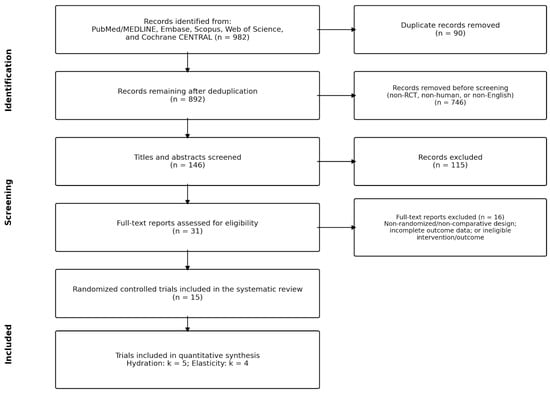
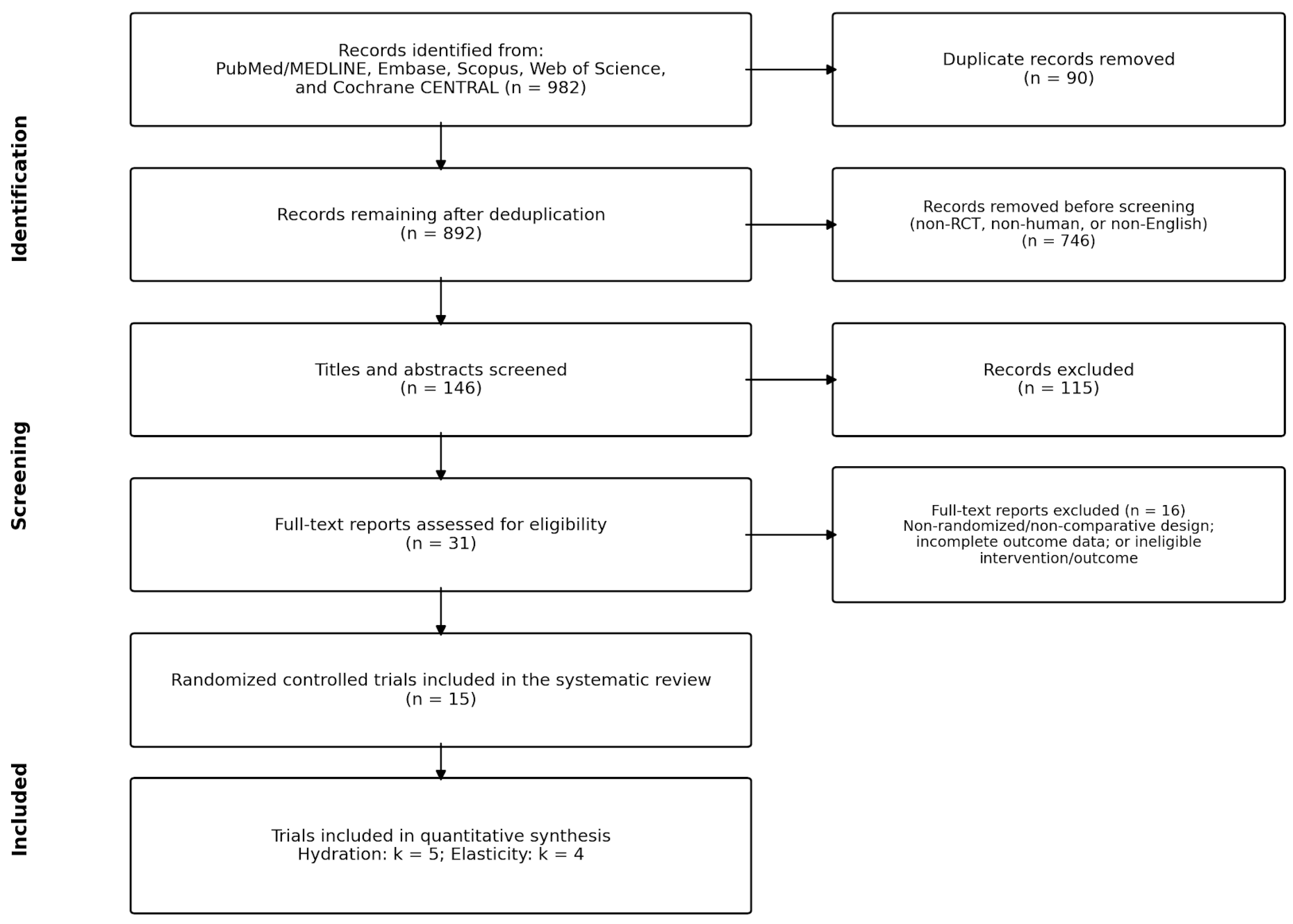
The database searches identified 982 records. After duplicate removal and application of predefined limits, 146 records underwent title and abstract screening. Thirty-one full-text reports were assessed, 16 were excluded, and 15 randomized controlled trials were included in the qualitative synthesis [19,20,21,22,23,24,25,26,27,28,29,30,31,32,33]. Five trials contributed extractable data to the hydration meta-analysis and four to the elasticity meta-analysis (Figure 1).
Figure 1.
PRISMA 2020 flow diagram of study selection.
3.2. Study Characteristics
The 15 trials were published between 2021 and 2025 and enrolled predominantly middle-aged women. Intervention duration ranged from 4 to 16 weeks, most commonly 8 to 12 weeks. Collagen doses ranged from approximately 0.5 to 10 g/day and included marine, bovine, and other hydrolysed collagen formulations. Several products contained additional ingredients, most commonly vitamin C. Hydration was generally assessed by corneometry or related capacitance methods, whereas elasticity was assessed using Cutometer-derived indices or other device-specific mechanical measures. The principal characteristics are summarized in Table 1.
Table 1.
Characteristics of included randomized controlled trials. TEWL, transepidermal water loss; RCT, randomized controlled trial.
3.3. Risk of Bias
Three trials were judged to have a low overall risk of bias, ten raised some concerns, and two were judged to have a high risk of bias. The most frequent limitations were insufficient reporting of allocation concealment, retrospective or absent registration, incomplete specification of prespecified outcomes, incomplete variance reporting, and selective presentation of multiple instrument-derived endpoints. Objective device-based outcome measurement generally reduced concern in the outcome-measurement domain. Industry funding or author affiliation with the product manufacturer was common; although funding source is not itself a RoB 2 domain, it was considered when interpreting the body of evidence. No trial was excluded solely because of risk of bias (Table 2).
Table 2.
RoB 2 assessment for hydration and elasticity outcomes. D1, randomization process; D2, deviations from intended interventions; D3, missing outcome data; D4, measurement of the outcome; D5, selection of the reported result.
3.4. Skin Hydration
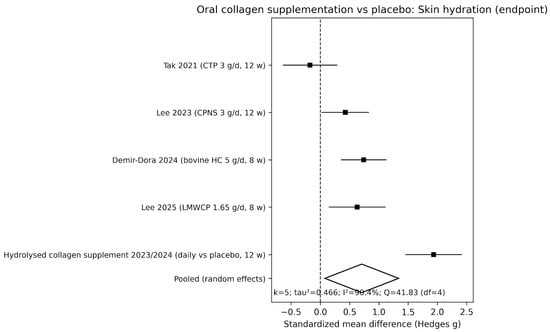
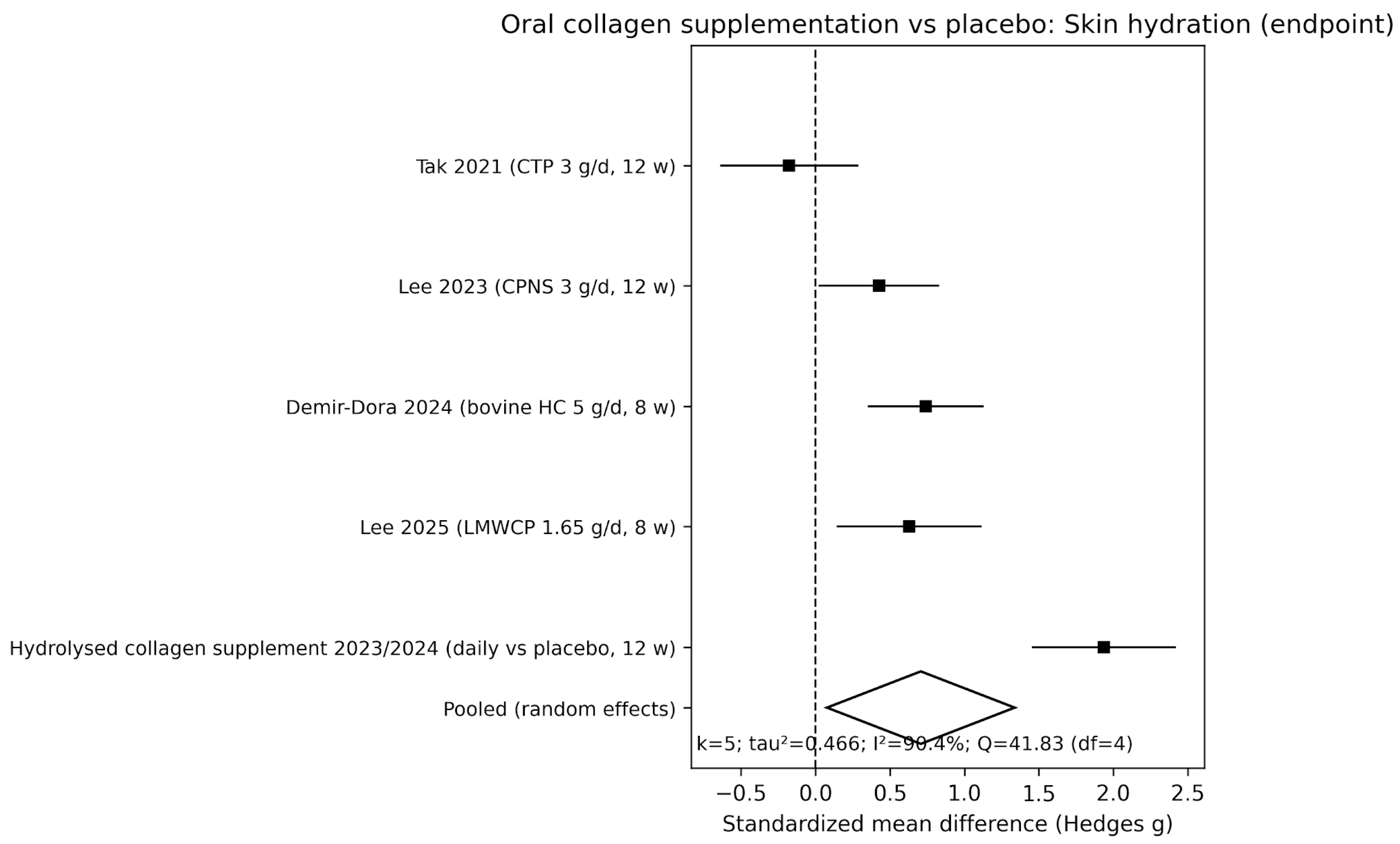
Five randomized trials (456 participants) provided extractable endpoint means and dispersion measures for a comparable hydration outcome. The random-effects model favoured collagen supplementation (SMD 0.71; 95% CI 0.08 to 1.34; p = 0.027), but heterogeneity was considerable (I2 = 90.4%; τ2 = 0.466). Four trials showed an effect in the beneficial direction, whereas one reported a null or slightly unfavourable estimate. Excluding the high-leverage multi-ingredient trial reduced the pooled estimate but retained statistical significance (k = 4; SMD 0.41; 95% CI 0.02 to 0.80; p = 0.039; I2 = 69.8%). These results indicate a probable moisturizing effect, although the magnitude is uncertain (Figure 2).
Figure 2.
Random-effects meta-analysis of oral collagen supplementation versus placebo for skin hydration. Positive values favour collagen [19,26,31,32].
3.5. Skin Elasticity
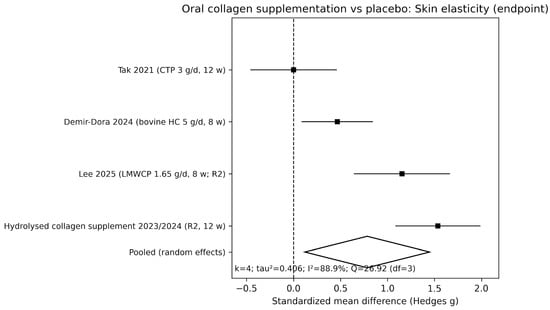
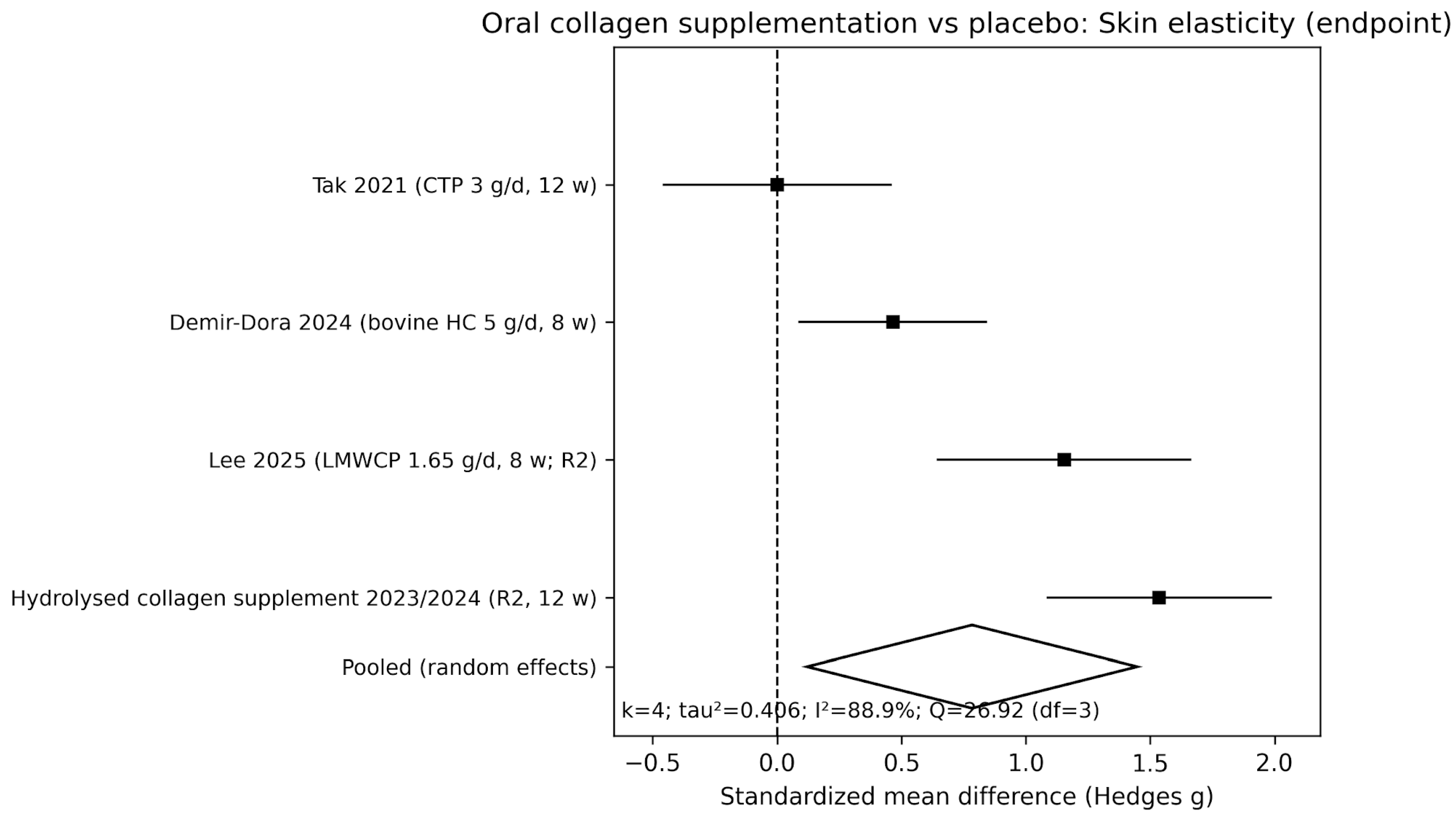
Four randomized trials (356 participants) provided extractable endpoint data for elasticity. The pooled random-effects estimate favoured collagen supplementation (SMD 0.78; 95% CI 0.12 to 1.45; p = 0.022), with substantial heterogeneity (I2 = 88.9%; τ2 = 0.406). Exclusion of the high-leverage multi-ingredient trial attenuated the estimate and widened its confidence interval (k = 3; SMD 0.53; 95% CI −0.07 to 1.13; p = 0.083; I2 = 81.9%) (Figure 3 and Table 3). Thus, the primary synthesis suggested improved elasticity, but the result was not robust to the conservative sensitivity analysis.
Figure 3.
Random-effects meta-analysis of oral collagen supplementation versus placebo for skin elasticity. Positive values favour collagen [19,31,32].
Table 3.
Summary of quantitative findings.
3.6. Safety and Reporting Bias
Adverse events were infrequent and generally mild, and no consistent safety signal was identified. Nevertheless, adverse-event collection and reporting were often insufficiently detailed. Formal funnel-plot asymmetry and regression-based small-study-effect analyses were not performed because fewer than 10 studies were available for each outcome.
4. Discussion
This updated systematic review found that oral collagen supplementation was associated with statistically significant improvements in instrumental measures of skin hydration and elasticity. The pooled effects were moderate, but both outcomes showed substantial between-study heterogeneity. Moreover, the elasticity estimate became statistically non-significant after exclusion of a high-leverage multi-ingredient trial. The findings therefore support a potential benefit rather than a definitive, uniformly applicable treatment effect.
Our primary results are directionally consistent with earlier meta-analyses by de Miranda et al. and Pu et al., which reported favourable effects on hydration and elasticity [3,4]. A later synthesis also reported positive pooled estimates but highlighted moderate heterogeneity and generally unclear risk of bias [5]. In contrast, Myung and Park found that benefits were not evident in analyses restricted to higher-quality or non-industry-funded trials [6]. The present RoB 2 assessment supports that concern: most recent trials did not have a clearly low risk of bias, and incomplete reporting of allocation methods, prespecified analyses, and variance estimates limited confidence in the pooled results.
The observed heterogeneity has several plausible sources. Collagen products differed in source, molecular-weight distribution, peptide profile, dose, formulation, and co-ingredients. Trial populations varied in age, baseline dryness, menopausal status, photodamage, ethnicity, and environmental exposure. Hydration and elasticity were also measured at different anatomical sites under variably controlled temperature and humidity conditions. These factors are particularly important for corneometry and Cutometer measurements. Standardized mean differences enable pooling across instruments but may exaggerate apparent effect size when within-study standard deviations are small. Consequently, statistical significance should not be interpreted automatically as a clinically perceptible improvement.
Biological plausibility remains coherent. Hydroxyproline-containing peptides can appear in plasma after oral ingestion [7,8,9], and experimental work indicates that selected peptides may stimulate fibroblast activity, collagen synthesis, and hyaluronic-acid production while modulating matrix degradation [10,11,12]. However, mechanistic evidence cannot determine the magnitude, durability, or patient relevance of a clinical effect. The contribution of vitamin C, hyaluronic acid, antioxidants, and other co-ingredients also remains difficult to separate from that of collagen in multi-ingredient products.
The review suggested by the Reviewer, Susini et al. [34], provides a useful model for discussing evidence in aesthetic medicine by integrating proposed mechanisms, clinical indications, safety, limitations, and future perspectives. Applying that framework here emphasizes a similar methodological problem: heterogeneous aesthetic interventions and non-uniform outcome measures can produce an apparently favourable evidence base while limiting direct clinical translation. For oral collagen, the most defensible interpretation is that short-term improvements in biophysical skin parameters are possible, but product-specific efficacy and meaningful visible benefit are not yet established with high certainty.
This review has several strengths. The search was expanded beyond PubMed to four additional major databases; screening and extraction were performed independently by two reviewers; the objective was corrected to focus explicitly on randomized controlled trials; RoB 2 was applied systematically; and the meta-analysis distinguished the primary estimate from conservative sensitivity analyses. The review also focused on recent trials and on objective instrumental outcomes.
Several limitations remain. First, only a subset of eligible trials reported means, standard deviations, and sample sizes in a format suitable for quantitative synthesis; selective availability of numerical data may itself introduce bias. Second, the number of studies per outcome was small, precluding reliable assessment of publication bias and limiting the precision of random-effects estimates. Third, heterogeneity remained substantial after sensitivity analyses. Fourth, most participants were women, follow-up rarely exceeded 12 to 16 weeks, and evidence regarding persistence after discontinuation was limited. Fifth, industry involvement was frequent, and clinical importance could not be established because minimally important differences for corneometry and Cutometer outcomes are not well defined.
Future trials should be prospectively registered, adequately powered, independently funded where possible, and reported according to CONSORT. Randomization and allocation concealment should be described in sufficient detail, and complete outcome data should be made available. Core outcome sets should specify standardized anatomical sites, acclimatization conditions, instruments, and time points. Trials should distinguish purified collagen products from multi-ingredient formulations, include longer follow-up after discontinuation, and combine instrumental outcomes with blinded clinical assessment and patient-reported measures of visible or meaningful benefit.
5. Conclusions
Oral collagen supplementation may improve short-term instrumental measures of skin hydration and elasticity compared with placebo. However, the magnitude and clinical relevance of these effects remain uncertain because of substantial heterogeneity, incomplete reporting, risk-of-bias concerns, and frequent industry involvement. The evidence supports cautious consideration of collagen as an adjunctive nutricosmetic rather than a conclusively established anti-ageing treatment.
Supplementary Materials
The following supporting information can be downloaded at: https://www.mdpi.com/article/10.3390/jaestheticmed2030017/s1. Table S1: The PRISMA checklist for the systematic review.
Author Contributions
Conceptualization, P.M.-B. and A.S.-M.; methodology, P.M.-B.; software, P.M.-B.; validation, P.M.-B.; formal analysis, P.M.-B. and A.S.-M.; investigation, P.M.-B.; resources, P.M.-B.; data curation, P.M.-B.; writing—original draft preparation P.M.-B. and A.S.-M.; writing—review and editing, P.M.-B.; visualization, P.M.-B.; supervision, P.M.-B.; project administration, P.M.-B.; funding acquisition, P.M.-B. All authors have read and agreed to the published version of the manuscript.
Funding
This research received no external funding.
Institutional Review Board Statement
Not applicable.
Informed Consent Statement
Not applicable.
Data Availability Statement
All data and materials are included in the manuscript.
Acknowledgments
During the preparation of this manuscript/study, the authors used ChatGPT AI system version 5.3 for reviewing and considering translation options in the English translation of the original language. The authors have reviewed and edited the output and take full responsibility for the content of this publication.
Conflicts of Interest
The authors declare no conflicts of interest.
References
- Ganceviciene, R.; Liakou, A.I.; Theodoridis, A.; Makrantonaki, E.; Zouboulis, C.C. Skin anti-aging strategies. Derm.-Endocrinol. 2012, 4, 308–319. [Google Scholar] [CrossRef] [Scilit] [PubMed]
- Strnadova, K.; Sandera, V.; Dvorankova, B.; Kodet, O.; Duskova, M.; Smetana, K.; Lacina, L. Skin aging: The dermal perspective. Clin. Dermatol. 2019, 37, 326–335. [Google Scholar] [CrossRef] [Scilit] [PubMed]
- Pu, S.Y.; Huang, Y.L.; Pu, C.M.; Kang, Y.N.; Hoang, K.D.; Chen, K.H.; Chen, C. Effects of oral collagen for skin anti-aging: A systematic review and meta-analysis. Nutrients 2023, 15, 2080. [Google Scholar] [CrossRef] [Scilit] [PubMed]
- de Miranda, R.B.; Weimer, P.; Rossi, R.C. Effects of hydrolyzed collagen supplementation on skin aging: A systematic review and meta-analysis. Int. J. Dermatol. 2021, 60, 1449–1461. [Google Scholar] [CrossRef] [Scilit] [PubMed]
- Danessa, G.; Notario, D.; Regina, R. Effects of collagen-based supplements on skin hydration and elasticity: A systematic review and meta-analysis. Indian J. Dermatol. Venereol. Leprol. 2025, 91, 730–740. [Google Scholar] [CrossRef] [Scilit] [PubMed]
- Myung, S.K.; Park, Y. Effects of collagen supplements on skin aging: A systematic review and meta-analysis of randomized controlled trials. Am. J. Med. 2025, 138, 1264–1277. [Google Scholar] [CrossRef] [Scilit] [PubMed]
- Iwai, K.; Hasegawa, T.; Taguchi, Y.; Morimatsu, F.; Sato, K.; Nakamura, Y.; Higashi, A.; Kido, Y.; Nakabo, Y.; Ohtsuki, K. Identification of food-derived collagen peptides in human blood after oral ingestion of gelatin hydrolysates. J. Agric. Food Chem. 2005, 53, 6531–6536. [Google Scholar] [CrossRef] [Scilit] [PubMed]
- Ohara, H.; Matsumoto, H.; Ito, K.; Iwai, K.; Sato, K. Comparison of quantity and structures of hydroxyproline-containing peptides in human blood after oral ingestion of gelatin hydrolysates from different sources. J. Agric. Food Chem. 2007, 55, 1532–1535. [Google Scholar] [CrossRef] [Scilit] [PubMed]
- Watanabe-Kamiyama, M.; Shimizu, M.; Kamiyama, S.; Taguchi, Y.; Sone, H.; Morimatsu, F.; Shirakawa, H.; Furukawa, Y.; Komai, M. Absorption and effectiveness of orally administered low molecular weight collagen hydrolysate in rats and humans. J. Agric. Food Chem. 2010, 58, 835–841. [Google Scholar] [CrossRef] [Scilit] [PubMed]
- Shigemura, Y.; Iwai, K.; Morimatsu, F.; Iwamoto, T.; Mori, T.; Oda, C.; Taira, T.; Park, E.Y.; Nakamura, Y.; Sato, K. Effect of prolyl-hydroxyproline, a food-derived collagen peptide in human blood, on growth of fibroblasts from mouse skin. J. Agric. Food Chem. 2009, 57, 444–449. [Google Scholar] [CrossRef] [Scilit] [PubMed]
- Zague, V.; de Freitas, V.; da Costa Rosa, M.; de Castro, G.A.; Jaeger, R.G.; Machado-Santelli, G.M. Collagen hydrolysate intake increases skin collagen expression and suppresses matrix metalloproteinase 2 activity. J. Med. Food 2011, 14, 618–624. [Google Scholar] [CrossRef] [Scilit] [PubMed]
- Inacio, P.A.Q.; Chaluppe, F.A.; Aguiar, G.F.; Coelho, C.F.; Vieira, R.P. Effects of hydrolyzed collagen as a dietary supplement on fibroblast activation: A systematic review. Nutrients 2024, 16, 1543. [Google Scholar] [CrossRef] [Scilit] [PubMed]
- Page, M.J.; McKenzie, J.E.; Bossuyt, P.M.; Boutron, I.; Hoffmann, T.C.; Mulrow, C.D.; Shamseer, L.; Tetzlaff, J.M.; Akl, E.A.; Brennan, S.E.; et al. The PRISMA 2020 statement: An updated guideline for reporting systematic reviews. Am. J. Med. 2021, 372, n71. [Google Scholar] [CrossRef] [Scilit] [PubMed]
- Higgins, J.P.T.; Thomas, J.; Chandler, J.; Cumpston, M.; Li, T.; Page, M.J.; Welch, V.A. (Eds.) Cochrane Handbook for Systematic Reviews of Interventions; Version 6.5; Cochrane: London, UK, 2024. [Google Scholar]
- Sterne, J.A.C.; Savović, J.; Page, M.J.; Elbers, R.G.; Blencowe, N.S.; Boutron, I.; Cates, C.J.; Cheng, H.Y.; Corbett, M.S.; Eldridge, S.M.; et al. RoB 2: A revised tool for assessing risk of bias in randomised trials. BMJ 2019, 366, l4898. [Google Scholar] [CrossRef] [Scilit] [PubMed]
- Hedges, L.V.; Olkin, I. Statistical Methods for Meta-Analysis; Academic Press: Orlando, FL, USA, 1985. [Google Scholar]
- DerSimonian, R.; Laird, N. Meta-analysis in clinical trials. Control Clin. Trials 1986, 7, 177–188. [Google Scholar] [CrossRef] [Scilit] [PubMed]
- IntHout, J.; Ioannidis, J.P.A.; Borm, G.F. The Hartung-Knapp-Sidik-Jonkman method for random effects meta-analysis is straightforward and considerably outperforms the standard DerSimonian-Laird method. BMC Med. Res. Methodol. 2014, 14, 25. [Google Scholar] [CrossRef] [Scilit] [PubMed]
- Tak, Y.J.; Shin, D.K.; Kim, A.H.; Kim, J.I.; Lee, Y.L.; Ko, H.-C.; Kim, Y.-W.; Lee, S.Y. Effect of collagen tripeptide and adjusting for climate change on skin hydration in middle-aged women: A randomized, double-blind, placebo-controlled trial. Front Med. 2021, 7, 608903. [Google Scholar] [CrossRef] [Scilit] [PubMed]
- Sangsuwan, W.; Asawanonda, P. Four-weeks daily intake of oral collagen hydrolysate results in improved skin elasticity, especially in sun-exposed areas: A randomized, double-blind, placebo-controlled trial. J. Dermatol. Treat. 2021, 32, 991–996. [Google Scholar] [CrossRef] [Scilit] [PubMed]
- Evans, M.; Lewis, E.D.; Zakaria, N.; Pelipyagina, T.; Guthrie, N. A randomized, triple-blind, placebo-controlled, parallel study to evaluate the efficacy of a freshwater marine collagen on skin wrinkles and elasticity. J. Cosmet. Dermatol. 2021, 20, 825–834. [Google Scholar] [CrossRef] [Scilit] [PubMed]
- Miyanaga, M.; Uchiyama, T.; Motoyama, A.; Ochiai, N.; Ueda, O.; Ogo, M. Oral supplementation of collagen peptides improves skin hydration by increasing the natural moisturizing factor content in the stratum corneum: A randomized, double-blind, placebo-controlled clinical trial. Skin. Pharmacol. Physiol. 2021, 34, 115–127. [Google Scholar] [CrossRef] [Scilit] [PubMed]
- Campos, P.M.B.G.; Franco, R.S.B.; Kakuda, L.; Cadioli, G.F.; Costa, G.M.D.; Bouvret, E. Oral supplementation with hydrolyzed fish cartilage improves the morphological and structural characteristics of the skin: A double-blind, placebo-controlled clinical study. Molecules 2021, 26, 4880. [Google Scholar] [CrossRef] [Scilit] [PubMed]
- Bianchi, F.M.; Angelinetta, C.; Rizzi, G.; Praticò, A.; Villa, R. Evaluation of the efficacy of a hydrolyzed collagen supplement for improving skin moisturization, smoothness, and wrinkles. J. Clin. Aesthet. Dermatol. 2022, 15, 48–52. [Google Scholar] [PubMed]
- Kim, J.; Lee, S.G.; Lee, J.; Choi, S.; Suk, J.; Lee, J.H.; Yang, J.H.; Yang, J.S.; Kim, J. Oral supplementation of low-molecular-weight collagen peptides reduces skin wrinkles and improves biophysical properties of skin: A randomized, double-blinded, placebo-controlled study. J. Med. Food 2022, 25, 1146–1154. [Google Scholar] [CrossRef] [Scilit] [PubMed]
- Lee, M.; Kim, E.; Ahn, H.; Son, S.; Lee, H. Oral intake of collagen peptide NS improves hydration, elasticity, desquamation, and wrinkling in human skin: A randomized, double-blinded, placebo-controlled study. Food Funct. 2023, 14, 3196–3207. [Google Scholar] [CrossRef] [Scilit] [PubMed]
- Seong, S.H.; Lee, Y.I.; Lee, J.; Choi, S.; Kim, I.A.; Suk, J.; Jung, I.; Baeg, C.; Kim, J.; Oh, D.; et al. Low-molecular-weight collagen peptides supplement promotes a healthy skin: A randomized, double-blinded, placebo-controlled study. J. Cosmet. Dermatol. 2024, 23, 554–562. [Google Scholar] [CrossRef] [Scilit] [PubMed]
- Lee, J.S.; Yoon, Y.C.; Kim, J.M.; Kim, Y.-H.; Kang, Y.-H.; Shin, Y.C. Anti-aging effects of a liquid collagen drink derived from freshwater fish skin: A randomized, double-blind, placebo-controlled clinical study. Nutr. Res. Pract. 2024, 18, 357–371. [Google Scholar] [CrossRef] [Scilit] [PubMed]
- Reilly, D.M.; Kynaston, L.; Naseem, S.; Proudman, E.; Laceby, D. A clinical trial shows improvement in skin collagen, hydration, elasticity, wrinkles, scalp, and hair condition following 12-week oral intake of a supplement containing hydrolysed collagen. Dermatol. Res. Pract. 2024, 2024, 8752787. [Google Scholar] [CrossRef] [Scilit] [PubMed]
- Vleminckx, S.; Virgilio, N.; Asserin, J.; Prawitt, J.; Silva, C.I.F. Influence of collagen peptide supplementation on visible signs of skin and nail health and ageing in an East Asian population: A double-blind, randomized, placebo-controlled trial. J. Cosmet. Dermatol. 2024, 23, 3645–3653. [Google Scholar] [CrossRef] [Scilit] [PubMed]
- Demir-Dora, D.; Ozsoy, U.; Yildirim, Y.; Yilmaz, O.; Aytac, P.; Yilmaz, B.; Kurtoglu, E.D.; Akman, A.; Tezman, S.; Inaloz, H.S.; et al. The efficacy and safety of CollaSel Pro hydrolyzed collagen peptide supplementation without addons in improving skin health in adult females: A double-blind, randomized, placebo-controlled clinical study using biophysical and skin imaging techniques. J. Clin. Med. 2024, 13, 5370. [Google Scholar] [CrossRef] [Scilit] [PubMed]
- Lee, E.; Ahn, D.K.; Kim, J.H.; Lee, S.; Kim, H.J.; Lee, H.K.; Shin, J.H. Skin anti-aging and moisturizing effects of low-molecular-weight collagen peptide supplementation in healthy adults: A randomized, double-blind, placebo-controlled clinical trial. J. Microbiol. Biotechnol. 2025, 35, e2507008. [Google Scholar] [CrossRef] [Scilit] [PubMed]
- Wang, Y.; Zhu, W.; Luo, W.; Ma, Y.; Zhou, Y. The sustained effects of bioactive collagen peptides on skin health: A randomized, double-blind, placebo-controlled clinical study. J. Cosmet. Dermatol. 2025, 24, e70565. [Google Scholar] [CrossRef] [Scilit] [PubMed]
- Susini, P.; di Seclì, D.; Bacchini, S.; Pozzi, M.; Diluiso, G.; Marcaccini, G.; Brandi, C.; Nisi, G.; Grimaldi, L.; Cuomo, R. Carboxytherapy in dermatologic surgery and aesthetic medicine: Current knowledge and future perspectives—A systematic review. Dermatol. Surg. 2025, 51, 673–678. [Google Scholar] [CrossRef] [Scilit] [PubMed]

Disclaimer/Publisher’s Note: The statements, opinions and data contained in all publications are solely those of the individual author(s) and contributor(s) and not of MDPI and/or the editor(s). MDPI and/or the editor(s) disclaim responsibility for any injury to people or property resulting from any ideas, methods, instructions or products referred to in the content. |
© 2026 by the authors. Licensee MDPI, Basel, Switzerland. This article is an open access article distributed under the terms and conditions of the Creative Commons Attribution (CC BY) license.