


Abstract
Repeated outreach is often necessary in longitudinal research, yet observational analyses of contact timing can be misleading when they reduce a participant’s history to the final recorded contact. We reconstructed 21,402 contact attempts involving 4440 former university students invited to complete a health survey between 2020 and 2025. Contact attempts were ordered relative to exact survey-completion timestamps. We examined completion within 1, 2, 7, and 14 days of eligible contact attempts using logistic models with participant-clustered robust standard errors. Models adjusted for attempt sequence, calendar year, and the interval since the preceding contact attempt; time-of-day models also adjusted for weekday. Recorded time of day was not associated with completion in any response window (global p values = 0.210–0.770). Weekday tests were statistically significant across windows, but Monday through Friday were generally similar. In the primary 7-day model, Saturday contact attempts were positively associated with completion (OR = 1.50, 95% CI [1.03, 2.19]) and Sunday contact attempts negatively associated with completion (OR = 0.19, 95% CI [0.09, 0.40]), relative to Tuesday. These opposing weekend estimates arose from relatively small, selectively scheduled samples and should not be interpreted causally. No consistently optimal weekday or hour emerged. These findings illustrate why contact sequence, response latency, and repeated observations should be incorporated before observational outreach records are translated into scheduling recommendations.
1. Introduction
Online questionnaires have become central to longitudinal health and social research because they permit geographically dispersed data collection at relatively low cost. Their accessibility, however, does not guarantee participation. Researchers frequently rely on reminders delivered by email, telephone, voicemail, text message, or social media to sustain participation across waves. Such repeated outreach can be expensive, can burden potential participants, and can complicate the interpretation of response patterns.
A response rate alone is not a sufficient measure of survey quality. The risk of nonresponse bias depends on how respondents and nonrespondents differ with respect to the variables being estimated, as well as on sampling, measurement, and follow-up procedures (Groves & Peytcheva, 2008). Nevertheless, increasing participation remains practically important. Additional contact attempts require staff time and may increase participant burden, particularly when the same individuals are approached repeatedly (Leeper, 2019). Research teams therefore have a reasonable interest in whether outreach can be scheduled more efficiently.
Weekday and time of day are attractive targets because they appear inexpensive to modify. Prior findings, however, have not produced a stable set of recommendations. Studies have variously favored early-week, midweek, or late-week invitations, while others have found no meaningful weekday differences. In a preregistered experiment with 26,126 members of an ongoing panel, Howard et al. (2024) found that randomizing the invitation day did not affect subsequent questionnaire completion. The inconsistency across studies may reflect differences in populations, contact modes, definitions of response, response windows, and whether timing was randomized.
Contact timing also cannot be separated readily from the broader outreach process. A second or tenth attempt is made only because an earlier attempt did not produce the desired response. Staff may change the contact mode, day, or hour based on prior nonresponse, telephone validity, workload, or perceived participant availability. Mixed-mode and sequential-contact designs can improve participation, but mode and sequence themselves influence the response process (Millar & Dillman, 2011). Consequently, the time assigned to a later attempt is not an isolated exposure. It is embedded in a history of prior attempts and staff decisions.
This creates a particular problem for analyses based on a participant’s final recorded contact. For responders, outreach usually stops after completion; for nonresponders, additional attempts may continue. The identity and timing of the final contact attempt are therefore partly determined by whether and when the participant responds. Comparing final-contact categories can produce large descriptive differences that reflect the stopping process rather than the consequences of choosing a particular day or hour.
A more defensible observational approach begins with each recorded attempt, places it in temporal order, excludes attempts made after completion, and evaluates whether completion follows within a defined interval. Repeated attempts from the same participant must also be treated as dependent. Even this approach cannot establish causal effects when timing and mode were not randomized, but it more faithfully represents the available longitudinal record.
The present study reconstructed the complete outreach histories of former university students invited to complete a health questionnaire. Rather than asking which final-contact category was associated with ultimate response status, we asked whether recorded weekday or time of day was consistently associated with subsequent completion across four response windows after accounting for contact sequence, calendar period, elapsed time since the preceding attempt, and within-participant dependence.
The study was designed to evaluate two questions. First, did recorded time of day consistently predict subsequent completion within 1, 2, 7, or 14 days? Second, did recorded weekday consistently predict completion across these same windows? Because outreach was observational, we did not interpret either question causally or hypothesize that a particular day or hour would be optimal.
2. Materials and Methods
2.1. Participants and Parent Study
Data came from a longitudinal study of myalgic encephalomyelitis/chronic fatigue syndrome and long COVID. The original cohort included 4501 students enrolled at a large Midwestern university from 2014 through 2018 (Jason et al., 2021). The present analysis concerned 4440 individuals who remained eligible for later follow-up and for whom cleaned contact records were available. At the original assessment, participants were university undergraduates. By the follow-up period, they were approximately 22 to 35 years old. The cohort was predominantly female and White, limiting generalizability to other populations and recruitment contexts.
The cleaned contact file merged successfully with questionnaire records for 4429 participants; 11 contact records could not be matched. Exact survey-completion timestamps were available for 1865 participants classified as complete, and 1786 of these participants had at least one recorded contact attempt preceding completion.
2.2. Ethical Approval
The parent study was approved by the DePaul University Institutional Review Committee (Research Protocol # LJ090319PSY) on 25 October 2019. The present study used contact and questionnaire records collected under that approved protocol.
2.3. Outreach Procedures
Between January 2020 and November 2025, research assistants and volunteers invited participants to complete a REDCap questionnaire concerning health symptoms and health-related quality of life. The questionnaire required approximately 30 min, and participants who completed it received a $20 electronic gift card. Participants initially received an email invitation. Those who did not complete the questionnaire were eligible for additional outreach through telephone calls, voicemail, text messages, email, and, when other information was invalid, social-media platforms. A participant could receive as many as 18 recorded attempts.
Contact dates and times were recorded manually in Excel in Central Time. Some records included a date but no meaningful time component. Participant location, participant-local time, message-opening time, and the time at which a participant actually read or heard the communication were unavailable. Contact mode was not consistently recoverable at the attempt level. Participant-local time was unavailable; therefore, the time-of-day categories represent recorded contact time and not necessarily the recipient’s local time at exposure.
2.4. Reconstruction of Contact Histories
The contact file was reshaped from one record per participant to one record per contact attempt. Each attempt was assigned its sequence number, recorded date and time, weekday, hour category, calendar year, and interval since the preceding recorded attempt. The reconstruction produced 21,402 valid dated attempts. Of these, 15,629 contained an exact time and 5773 were date-only records.
Contact attempts were then ordered relative to the recorded completion timestamp. A chronology audit identified 373 contact attempts involving 180 participants that had been recorded after exact completion. These contact attempts were excluded from all analytic risk sets. Date-only contact attempts remained eligible for weekday analyses but were excluded from time-of-day analyses.
2.5. Outcome and Response Windows
The outcome was recorded survey completion following an eligible contact attempt. Separate analyses defined the nominal response window as 1 day, 2 days, 7 days, or 14 days. In the primary analysis, each completion was attributed to the most recent eligible contact attempt preceding it when completion occurred within the specified window. Earlier eligible contact attempts remained in the risk set as non-events. This rule prevented a single completion from being counted as the outcome of several preceding contact attempts and reflected the sequential outreach process, in which an additional contact attempt was generally made because completion had not yet been recorded. It nevertheless represents an attribution rule: when several contact attempts preceded completion within the same nominal window, the observational record could not establish which contact attempt prompted the response.
We therefore examined the robustness of the findings using two alternative rules. Under an inclusive-attribution rule, every eligible contact attempt followed by completion within the specified window was coded as an event. Under a next-contact censoring rule, an attempt’s observation period ended when another contact attempt occurred; completion was attributed to the attempt only when it occurred before the next recorded contact attempt and within the specified response window. Attempts followed by another contact attempt before the window closed were otherwise treated as censored. For participants without a recorded completion, an attempt was included only when the applicable observation period could be observed before the administrative cutoff.
The primary analysis required an exact completion timestamp. A date-inclusive sensitivity analysis added 284 participants classified as incomplete who had a questionnaire date but not an exact completion time. Because exact response time was unavailable, this sensitivity analysis used calendar-day windows and was limited to weekday models.
2.6. Predictors and Covariates
Weekday was represented by Monday through Sunday, with Tuesday as the reference category. Recorded time was represented as 9 a.m. or earlier, 10 a.m., 11 a.m., noon, 1 p.m., 2 p.m., 3 p.m., and 4 p.m. or later, with 1 p.m. as the reference category. Reference categories were selected as well-populated comparisons and were not assigned substantive importance.
All models adjusted for attempt sequence, calendar year, and interval since the preceding contact. Attempt sequence was represented categorically, with attempts 1 through 7 modeled separately and attempts 8 through 18 combined because the later categories became increasingly sparse. The numbers of observations for attempts 8 through 18 were 1008, 733, 453, 174, 111, 79, 59, 24, 17, 9, and 3, respectively. The complete distribution is reported in Supplementary Table S8. Calendar year was also entered categorically. Interval was represented using four categories: the first observed valid attempt or 7 days or less (n = 9058, 42.3%), 8 to 14 days (n = 4175, 19.5%), 15 to 30 days (n = 3252, 15.2%), and more than 30 days (n = 4917, 23.0%). Time-of-day models additionally adjusted for weekday.
2.7. Statistical Analysis
Logistic regression models were fit at the contact-attempt level. Participant-clustered robust standard errors accounted for dependence created by repeated attempts within participants. Global Wald tests evaluated the weekday and time-of-day coefficients jointly. Odds ratios and 95% confidence intervals described associations with completion within each response window. Because timing was not randomized, estimates were interpreted as conditional associations rather than causal effects.
Attempt-level logistic regression was retained as the primary specification because the research questions concerned completion within prespecified operational windows following each recorded contact. Contact timing was defined at the attempt level and could change whenever another contact attempt occurred, making the window-specific models directly relevant to the scheduling question.
Participant clustering does not determine which of several contact attempts within an overlapping response window should receive attribution for a subsequent completion. We therefore repeated the weekday and time-of-day models using the inclusive-attribution and next-contact censoring rules described above. We also calculated the number and percentage of attempts for which another contact attempt occurred before the end of each nominal response window. The next-contact censoring analysis divided each participant’s outreach history into nonoverlapping observation periods ending at completion, the next recorded contact, or the closing of the specified response window. This evaluated whether the findings depended on treating earlier contact attempts within overlapping windows as non-events.
As a time-to-event sensitivity analysis, we also estimated discrete-time logistic hazard models over the 14 days following contact. Each nonoverlapping contact spell was divided into daily person-period records and ended at survey completion, the next recorded contact attempt, 14 days after the initiating contact, or administrative censoring, whichever occurred first. The outcome indicated whether completion occurred during each daily interval. The models included categorical indicators for elapsed day to represent the baseline hazard and adjusted for attempt sequence, calendar year, and interval since the preceding contact; the time-of-day model additionally adjusted for weekday. Participant-clustered robust standard errors accounted for repeated daily intervals and contact spells within participants.
Analyses were conducted in Python (Version 3.12.13) using NumPy (Version 2.3.5), pandas (Version 2.2.3), SciPy (Version 1.17.0), and openpyxl (Version 3.1.5). The complete script, variable definitions, inclusion and exclusion rules, package versions, chronology audit, diagnostics, and unrounded model estimates are supplied as reproducibility materials. To assess potential selection associated with missing contact times, we compared attempts with and without an exact recorded time by weekday, calendar year, attempt sequence, and interval since the preceding contact attempt. We also compared their unadjusted completion proportions within the 1-, 2-, 7-, and 14-day response windows. Global tests and comparisons of completion frequency used participant-clustered robust standard errors to account for repeated attempts within participants.
Global Wald tests were used as the principal inferential tests of weekday and recorded time of day within each response window. Individual category-versus-reference contrasts were considered exploratory and were used to describe the pattern underlying the global tests. No formal multiplicity adjustment was applied because the response windows were nested and highly correlated; interpretation therefore emphasized the consistency of estimates across windows and the magnitude and precision of odds ratios rather than isolated p values.
3. Results
3.1. Chronology and Analytic Samples
Table 1 summarizes reconstruction of the contact histories. Across the four windows, the primary weekday models included 18,124 to 18,158 attempts from 3751 participants. The time-of-day models included 13,203 to 13,237 attempts from 3258 participants because date-only attempts were excluded. The number of completions observed within the window increased from 712 at 1 day to 1278 at 14 days in the weekday analyses and from 523 to 910 in the time analyses.
Table 1.
Reconstruction and chronology of the contact-attempt dataset.
Supplementary Tables S1 and S2 provide descriptive counts by weekday and recorded time of day, including the number of attempts, number of distinct participants, number of completion events, and unadjusted completion proportion for each response window. Weekend outreach represented a small portion of the analytic record. In the primary 7-day risk set, Saturday accounted for 232 attempts involving 185 participants, of which 37 (15.9%) were followed by completion within 7 days. Sunday accounted for 211 attempts involving 160 participants, of which 7 (3.3%) were followed by completion within 7 days. The corresponding event counts were 24 and 2 within 1 day, 29 and 4 within 2 days, and 44 and 8 within 14 days for Saturday and Sunday, respectively.
3.2. Assessment of Missing Contact Times
Of the 21,402 dated contact attempts, 15,629 (73.0%) included an exact recorded time and 5773 (27.0%) were date-only records. Exact-time availability differed by weekday (Wald χ2(6) = 243.43, p < 0.001); calendar year (Wald χ2(6) = 746.00, p < 0.001); attempt sequence (Wald χ2(7) = 4468.61, p < 0.001); and interval since the preceding contact (Wald χ2(3) = 2019.10, p < 0.001). The largest difference involved attempt sequence: 3099 of 4280 first attempts (72.4%) were date-only, compared with approximately 11% of second and third attempts and 165 of 2670 attempts 8 through 18 (6.2%). Missingness also varied across weekdays and years; notably, 118 of 227 Sunday attempts (52.0%) were date-only, compared with 1129 of 5611 Tuesday attempts (20.1%).
Completion frequencies nevertheless did not differ significantly between date-only and exact-time attempts at 1 day (3.8% vs. 4.0%, p = 0.735), 2 days (5.2% vs. 4.7%, p = 0.236), 7 days (6.9% vs. 6.3%, p = 0.107), or 14 days (7.5% vs. 6.9%, p = 0.175). Complete comparisons are reported in Supplementary Table S7. Thus, exact-time availability was systematically related to characteristics of the outreach process, particularly attempt sequence, although it was not significantly associated with completion frequency.
3.3. Global Tests Across Response Windows
Table 2 presents the global weekday and time-of-day tests across the four response windows, and Supplementary Tables S3 and S4 provide the complete coefficient estimates. Recorded time of day was not significantly associated with subsequent completion in any response window. Global p values ranged from 0.210 to 0.770, and no time category differed consistently from 1 p.m.
Table 2.
Global weekday and time-of-day tests across response windows.
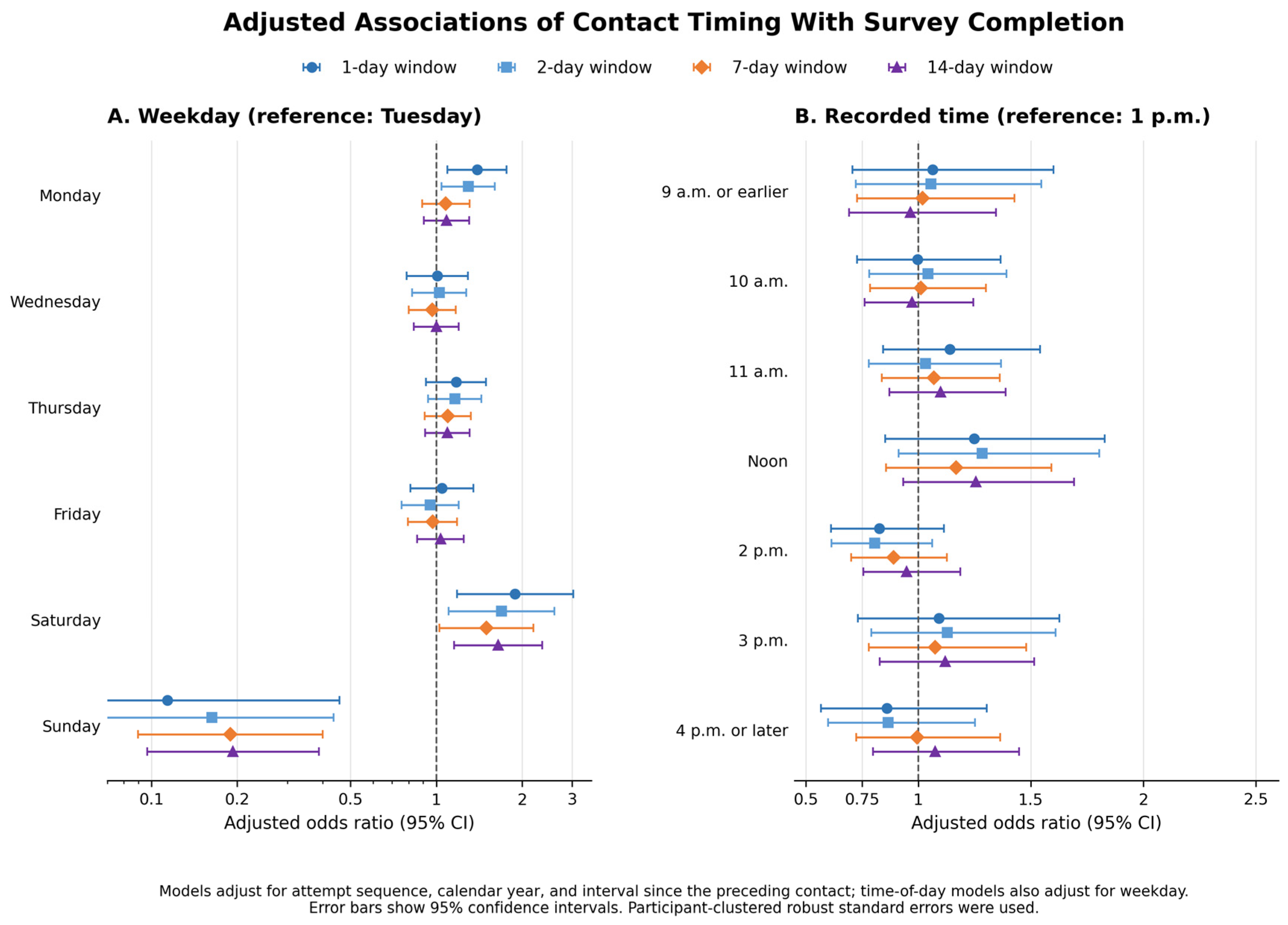
In contrast, the global weekday test was significant at each response window. Examination of the individual estimates did not, however, identify a stable advantage among the ordinary workweek days. Relative to Tuesday, Monday was positively associated with completion within 1 and 2 days but not within 7 or 14 days. Wednesday, Thursday, and Friday did not differ consistently from Tuesday. The global weekday tests were driven principally by the opposing Saturday and Sunday estimates, which arose from substantially smaller and selectively scheduled samples.
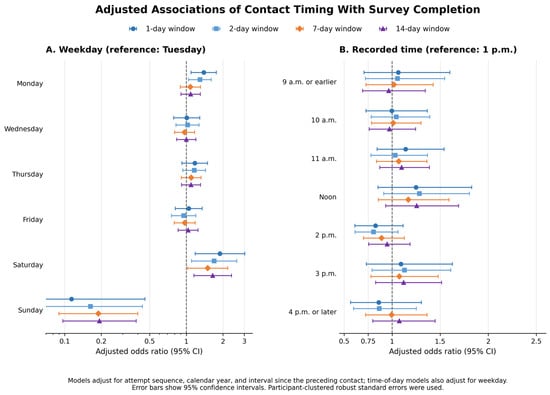
Figure 1 displays the adjusted estimates across all four response windows. The weekday estimates for Monday through Friday generally cluster around an odds ratio of 1, as do the recorded time-of-day estimates. The principal departures from the null occur for Saturday and Sunday, for which estimates are less precise because weekend contact attempts were uncommon.
Figure 1.
Adjusted associations of contact timing with survey completion across response windows.
Panel A presents adjusted odds ratios and 95% confidence intervals for weekday, with Tuesday as the reference category. Panel B presents corresponding estimates for recorded time of day, with 1 p.m. as the reference category. Estimates are shown separately for the 1-, 2-, 7-, and 14-day response windows. All models adjust for attempt sequence, calendar year, and interval since the preceding contact; time-of-day models additionally adjust for weekday. Error bars represent 95% confidence intervals. Standard errors are clustered by participant. Recorded times are in Central Time.
3.4. Primary Seven-Day Models
Table 3 presents the focal contrasts from the primary 7-day models. Monday, Wednesday, Thursday, and Friday did not differ significantly from Tuesday. Saturday contact attempts had higher adjusted odds of completion within 7 days than Tuesday contact attempts (OR = 1.50, 95% CI [1.03, 2.19], p = 0.037), whereas Sunday contact attempts had lower adjusted odds (OR = 0.19, 95% CI [0.09, 0.40], p < 0.001). None of the time-of-day categories differed significantly from 1 p.m.; odds ratios were close to 1, and confidence intervals were comparatively broad for the less frequently used hours.
Table 3.
Associations with completion within seven days.
Complete coefficient estimates for the 1-, 2-, 7-, and 14-day models are reported in the Supplementary Material and displayed graphically in Figure 1. Table S3 presents the weekday models and Table S4 presents the time-of-day models, including odds ratios, 95% confidence intervals, p values, and model sample sizes for each response window. Results from the date-inclusive analysis are reported in Table S5, and results using inclusive attribution, next-contact censoring, and discrete-time modeling are reported in Table S6.
The weekend estimates were based on substantially fewer observations than the Monday-through-Friday estimates. In the 7-day analysis, Saturday included 232 attempts involving 185 participants, with 37 completions (15.9%), whereas Sunday included 211 attempts involving 160 participants, with 7 completions (3.3%). Tuesday, the reference category, included 4791 attempts involving 2131 participants, with 244 completions (5.1%). Counts of attempts, distinct participants, completion events, and unadjusted completion proportions for every weekday across all four response windows are reported in Supplementary Table S1; corresponding descriptive results for time-of-day categories are reported in Supplementary Table S2. Because weekend outreach was infrequent and selectively scheduled, the Saturday and Sunday estimates should be interpreted cautiously and not as causal effects of scheduling outreach on those days.
3.5. Sensitivity Analyses
Across the primary response-window models, Monday was positively associated with completion relative to Tuesday within 1 and 2 days but not within 7 or 14 days. Wednesday, Thursday, and Friday showed no consistent associations, while Saturday estimates were positive and Sunday estimates negative across the primary models. The date-inclusive sensitivity analysis likewise identified no stable advantage among Monday through Friday.
Overlapping observation windows became more common as the nominal window increased. Another contact attempt occurred before the end of the window for 1421 attempts (7.8%) in the 1-day analysis, 1635 (9.0%) in the 2-day analysis, 3844 (21.2%) in the 7-day analysis, and 7557 (41.7%) in the 14-day analysis.
The global weekday test remained significant under both inclusive attribution and next-contact censoring, although individual estimates varied. In the 7-day model, the positive Saturday association found under the primary rule (OR = 1.50, 95% CI [1.03, 2.19]) was reduced and no longer significant under either inclusive attribution (OR = 1.24, 95% CI [0.80, 1.92]) or next-contact censoring (OR = 1.25, 95% CI [0.83, 1.88]). The negative Sunday estimate persisted under inclusive attribution (OR = 0.21, 95% CI [0.09, 0.50]) and next-contact censoring (OR = 0.16, 95% CI [0.08, 0.35]). No consistent pattern emerged among Monday through Friday across response windows or analytic rules.
Finally, a discrete-time event-history analysis modeled the timing of completion directly; its findings are presented in the following subsection.
The absence of a time-of-day association was similarly stable under the alternative specifications. Global time-of-day tests remained nonsignificant at every response window under both inclusive attribution and next-contact censoring, and no time category showed a consistent association with completion. Taken together, the sensitivity analyses did not identify a consistently optimal weekday or time of day. Full primary and date-inclusive estimates are reported in Supplementary Tables S3–S5; alternative-attribution, next-contact censoring, and event-history estimates are reported in Supplementary Table S6.
3.6. Discrete-Time Event-History Analysis
The global weekday test was significant (Wald χ2(6) = 31.93, p < 0 001), although none of the Monday-through-Friday estimates differed significantly from Tuesday. As in the primary analyses, the global effect reflected opposing weekend estimates: Saturday was associated with higher daily odds of completion (OR = 1.55, 95% CI [1.11, 2.17], p = 0.011), whereas Sunday was associated with lower daily odds (OR = 0.20, 95% CI [0.10, 0.41], p < 0.001). The global time-of-day test was nonsignificant (Wald χ2(7) = 7.47, p = 0.382). Noon showed an individual association relative to 1 p.m. (OR = 1.39, 95% CI [1.04, 1.85], p = 0.025), but this isolated contrast occurred in the absence of a significant global time-of-day effect. Thus, modeling the timing of completion directly did not identify an optimal weekday from Monday through Friday or a consistent time-of-day advantage. Complete event-history results are reported in Panel C of Supplementary Table S6.
4. Discussion
When complete contact histories were ordered relative to survey completion and repeated attempts were accounted for, no consistently advantageous recorded contact time emerged. Contact attempts recorded from 9 a.m. through late afternoon had similar adjusted associations with completion within 1, 2, 7, and 14 days. Monday through Friday were also generally similar. The significant overall weekday tests reflected opposite Saturday and Sunday associations rather than a stable ranking of the workweek.
These findings do not support recommending a preferred hour or advising researchers to avoid a particular weekday. They are consistent with experimental evidence showing no day-of-week effect on completion in an established panel (Howard et al., 2024). More broadly, they illustrate the danger of converting observational operational records into scheduling rules without first representing the response process that generated those records.
Repeated outreach creates informative sequences. A person receives a later contact attempt precisely because earlier outreach did not yield completion, and staff may choose the next mode or time based on this accumulating history. For a responder, the sequence ordinarily stops after completion; for a nonresponder, it may continue. The final contact is therefore not simply one exposure selected from a neutral set of times. It is partly an outcome of the contact process itself.
Attempt-level reconstruction does not remove every source of confounding, but it prevents several avoidable distortions. It eliminates contact attempts made after completion, preserves earlier attempts, distinguishes short from longer response windows, and accounts for dependence among attempts from the same participant. In the present data, doing so replaced apparently large timing differences with near-null time-of-day estimates and modest, inconsistent weekday contrasts.
This methodological lesson may be more useful than a single scheduling recommendation. Administrative contact records are increasingly available in longitudinal studies, clinical registries, and panel research. Those records can be informative, but their chronology must be audited before analysis. At minimum, investigators should retain all attempts, record contact mode and local time, distinguish message delivery from message engagement, define the response event precisely, and specify the interval during which a response is attributed to an attempt.
Saturday contact attempts were positively associated with completion in the primary analysis, but the 7-day association was smaller and nonsignificant under both inclusive attribution and next-contact censoring. The negative Sunday association was more stable across outcome definitions. This difference demonstrates that individual weekend estimates were sensitive, to varying degrees, to how completion was attributed among repeated contact attempts and further cautions against translating them into scheduling recommendations. Weekend contact attempts were uncommon and were scheduled at staff discretion. Participants contacted on weekends, reasons for weekend outreach, available staff, contact modes, and stages in the outreach sequence may have differed systematically from weekday contact attempts.
The opposing direction of the two weekend estimates further argues against combining them into a general weekend effect. A randomized design with adequate numbers assigned separately to Saturday and Sunday would be needed before either contrast could inform practice.
The present results suggest that research teams should not devote disproportionate operational attention to selecting a particular business-hour contact time. Resources may be better directed toward features with stronger experimental support, such as clear invitation materials, carefully planned reminder sequences, appropriate incentives, and deliberate integration of response modes (Millar & Dillman, 2011). These strategies still require evaluation within the population and ethical constraints of each study.
A definitive contact-timing study would randomize eligible participants or attempts to prespecified contact windows, standardize or randomize mode, record participant-local time, track message delivery and opening when ethically permissible, and distinguish initial engagement, partial completion, full completion, withdrawal, and complete nonresponse. The analysis plan should specify how overlapping response windows and additional attempts are handled. Registration and independent reproduction of the analysis would further strengthen the evidence.
Several limitations constrain interpretation. First, contact timing was observational and determined by research staff. Adjustment for sequence, year, and interval cannot eliminate confounding by staff decisions or participant circumstances.
Second, contact mode and staff identity could not be reconstructed consistently at the attempt level and represent potential sources of residual confounding. Contact mode may have varied by weekday, hour, attempt sequence, prior participant responsiveness, and the interval between contact and completion. Staff members may likewise have differed in their preferred outreach days, hours, and communication approaches, and these practices may have changed over time. Consequently, the weekday and time-of-day coefficients may partly reflect differences in outreach mode, strategy, or staff practice rather than independent associations with contact timing. These findings should therefore not be interpreted as evidence that changing the day or hour of outreach would necessarily change completion probability. Future studies should record both contact mode and staff identity systematically at each attempt.
Third, timestamps were recorded in Central Time; participant location and local time were unknown. Fourth, recorded outreach does not show whether or when a participant opened, read, or heard the communication.
Fifth, 5773 attempts lacked an exact recorded time and could not contribute to time-of-day models. Although these contact attempts were retained in weekday analyses, missing time information may itself be related to contact mode and staff practice. More than one quarter of dated attempts lacked an exact recorded time. Exact-time availability differed systematically by weekday, calendar year, attempt sequence, and interval since the preceding contact, with missing times especially common for first attempts. Completion frequencies did not differ significantly between attempts with and without exact times in any response window, providing some reassurance that the excluded attempts did not have markedly different response rates. Nevertheless, attempts with recorded times were not a random subset of all dated attempts. The null time-of-day findings therefore apply only to that subset and should not be interpreted as definitive evidence that contact time was unrelated to completion across the entire outreach process.
Sixth, the sample consisted of former students from one Midwestern university and was predominantly female and White. The results should not be generalized broadly to healthcare populations, older adults, or people with different educational and technological experiences. Finally, the available response categories and timestamps did not permit a complete attempt-level separation of initial engagement, partial completion, withdrawal, and completion of all study measures.
5. Conclusions
Across four response windows, recorded time of day did not consistently predict survey completion after accounting for repeated outreach, attempt sequence, calendar period, and spacing between attempts. Monday through Friday were generally similar, while opposing weekend associations arose from small, selectively scheduled samples. The data therefore do not identify an optimal recorded contact day or hour. Their more defensible contribution is methodological: recommendations based on the final recorded contact can be misleading when the full outreach sequence and response chronology are ignored.
Supplementary Materials
The following supporting information can be downloaded at: https://www.mdpi.com/article/10.3390/psycholint8030056/s1, Table S1: Attempts, Participants, Events, and Unadjusted Completion Proportions by Weekday and Response Window; Table S2: Attempts, Participants, Events, and Unadjusted Completion Proportions by Recorded Time of Day and Response Window; Table S3: Adjusted Weekday Associations Across Primary Response Windows; Table S4: Adjusted Recorded Time-of-Day Associations Across Primary Response Windows; Table S5: Adjusted Weekday Associations in the Date-Inclusive Sensitivity Analysis; Table S6: Alternative Attribution, Next-Contact Censoring, and Discrete-Time Sensitivity Analyses; Table S7: Comparison of Contact Attempts With and Without Exact Recorded Times; Table S8: Distribution of Contact Attempts by Attempt Sequence.
Author Contributions
Conceptualization, L.A.J. and H.N.; Methodology, L.A.J. and H.N.; Formal Analysis, L.A.J. and H.N.; Investigation, L.A.J.; Writing—Original Draft, H.N.; Writing—Review and Editing, L.A.J. and H.N.; Supervision, L.A.J. All authors have read and agreed to the published version of the manuscript.
Funding
This work was supported by the National Institute of Neurological Disorders and Stroke (R01NS111105).
Institutional Review Board Statement
This study was approved by the DePaul University Institutional Review Committee, Research Protocol # LJ090319PSY, on 25 October 2019.
Informed Consent Statement
Informed consent was obtained from all subjects involved in the study.
Data Availability Statement
The analysis script, variable definitions, inclusion and exclusion rules, software and package versions, chronology audit, model diagnostics, and unrounded model estimates are provided as Supplementary Materials. Participant-level data are not publicly available because they contain potentially identifiable information. Requests for de-identified data may be directed to the corresponding author and will be considered subject to institutional review, ethical requirements, and applicable data-use and privacy restrictions.
Acknowledgments
During preparation of the analysis and manuscript, the authors used ChatGPT (OpenAI) (Version GPT-5.6) to assist with code development and language editing. The authors reviewed the code, regenerated the results from the reconstructed dataset, revised the manuscript, and take responsibility for the analysis and content.
Conflicts of Interest
The authors declare no conflicts of interest.
References
- Groves, R. M., & Peytcheva, E. (2008). The impact of nonresponse rates on nonresponse bias: A meta-analysis. Public Opinion Quarterly, 72(2), 167–189. [Google Scholar] [CrossRef] [Scilit]
- Howard, C., Greaves, L. M., Osborne, D., & Sibley, C. G. (2024). Is there a day of the week effect on panel response rate to an online questionnaire email invitation? Journal of Survey Statistics and Methodology, 12(1), 94–104. [Google Scholar] [CrossRef] [Scilit]
- Jason, L. A., Cotler, J., Islam, M. F., Sunnquist, M., & Katz, B. Z. (2021). Risks for developing myalgic encephalomyelitis/chronic fatigue syndrome in college students following infectious mononucleosis: A prospective cohort study. Clinical Infectious Diseases, 73(11), e3740–e3746. [Google Scholar] [CrossRef] [Scilit] [PubMed]
- Leeper, T. J. (2019). Where have the respondents gone? Perhaps we ate them all. Public Opinion Quarterly, 83(S1), 280–288. [Google Scholar] [CrossRef] [Scilit]
- Millar, M. M., & Dillman, D. A. (2011). Improving response to web and mixed-mode surveys. Public Opinion Quarterly, 75(2), 249–269. [Google Scholar] [CrossRef] [Scilit]

Disclaimer/Publisher’s Note: The statements, opinions and data contained in all publications are solely those of the individual author(s) and contributor(s) and not of MDPI and/or the editor(s). MDPI and/or the editor(s) disclaim responsibility for any injury to people or property resulting from any ideas, methods, instructions or products referred to in the content. |
© 2026 by the authors. Licensee MDPI, Basel, Switzerland. This article is an open access article distributed under the terms and conditions of the Creative Commons Attribution (CC BY) license.