3.3. Phenomenological Characteristics by Domain
3.3.1. Contact
The Contact domain assessed experiences involving the perceived presence of, and interaction or communication with, deceased loved ones or other non-ordinary entities. Most participants reported a clear and well-defined sense of the deceased’s presence (M = 4.41, SD = 0.97), with 82.81% endorsing high agreement (responses of 4–5). This sense of presence was typically described as phenomenologically distinct from symbolic or memory-based forms of connection and, in many cases, was perceived as temporally bounded and occurring unexpectedly rather than being intentionally evoked.
Communication within the Contact domain was frequently described as reciprocal and relationally attuned. A large proportion of participants reported bidirectional communication (M = 4.33, SD = 1.21; % ≥ 4 = 81.25%) and the direct perception of the deceased’s love (M = 4.63, SD = 0.79; % ≥ 4 = 89.06), affective states (M = 4.25, SD = 1.22; % ≥ 4 = 79.69%), without reliance on spoken language or nonverbal perceptual imagery of the deceased loved one, but rather through experiences described as affective telepathy (i.e., the direct mind-to-mind perception of the deceased’s affection) and emotional-state telepathy (i.e., the direct mind-to-mind perception of the deceased’s specific emotional states). Verbal communication was predominantly experienced as personally directed and grounded in the shared relational history with the deceased (M = 4.61, SD = 0.97; % ≥ 4 = 92.19%), and as motivated by love and reassurance (84.38% and 89.06%, respectively).
Visual perceptions of the deceased—either partial or whole—were also frequently reported (M = 4.30, SD = 1.29; % ≥ 4 = 82.81%), sometimes occurring in the presence of other figures, including relatives, animals, or unfamiliar entities. Embodied aspects of contact were salient for a substantial proportion of participants, with tactile contact endorsed by over half of the sample (M = 3.31, SD = 1.83; % ≥ 4 = 53.13%). Auditory and olfactory perceptions were less frequent but nonetheless present in a subset of experiences, contributing to the multisensory quality of the encounter.
Overall, items within the Contact domain showed consistently high levels of endorsement for experiences reflecting perceived presence, relational reciprocity, and affective attunement. Descriptive statistics for individual items are reported in
Table 2.
3.3.2. Sensoriality
The Sensoriality domain assesses sensory perception during the experience, including changes in the intensity of ordinary sensory modalities, the integration of multiple perceptual perspectives (at times organized in a manner analogous to a cinematic montage), and the emergence of non-ordinary sensory modalities. Perceptual visual imagery, that is, imagery experienced as having perception-like qualities in terms of vividness, externality, and relational presence, emerged as a central component, with most participants reporting highly vivid images. In this context, the distinction between vivid imagery and perception-like experience is best understood in terms of an overall experiential pattern rather than discrete categorical boundaries. Vivid imagery is typically experienced as internally generated, recognized as imagination, and often amenable to voluntary evocation and modulation; it represents the deceased without involving a sense of interaction. In contrast, EPLEs show a constellation of perception-like features when considered in terms of their phenomenological structure—that is, their mode of appearance and experiential configuration rather than their representational content. These features include a felt sense of external source, high experiential realism, experiential immediacy, and a relational quality involving a perceived interaction with the deceased. The term “perceptual visual imagery” is therefore used here in a descriptive phenomenological sense to denote imagery with perception-like qualities, and does not imply a diagnostic or ontological classification. A large proportion endorsed visual clarity levels comparable to ordinary perception (M = 4.11, SD = 1.25), with 81.25% reporting high endorsement (responses of 4–5), indicating that such imagery was experienced as perceptually robust rather than vague or imagined symbolic. Consistent with this pattern and reflecting the intensity of perceptual engagement during EPLE, a substantial proportion of participants reported enhanced sensory vividness (M = 3.66, SD = 1.41; % ≥ 4 = 57.81%).
Visual experience was frequently characterized by flexibility in perspective. First-person visual immersion was commonly reported (M = 3.88, SD = 1.45; % ≥ 4 = 65.63%), alongside external/observer perspectives (% ≥ 4 = 50.00%) and, in a substantial subset of cases, the perceptual standpoint of the deceased (% ≥ 4 = 45.31%). These perspectives were not mutually exclusive but often co-occurred within a single experiential scene, in a manner analogous to a cinematic montage, as reflected by a moderate frequency of reported perspective alternation (35.94%), suggesting a dynamic configuration of perceptual visual imagery.
Alterations in visual qualities were also common. Nearly half of participants reported perceiving non-ordinary colors (46.88%).
Auditory experiences varied in form. While a minority of participants perceived the deceased’s communication as audible sounds or voices (34.38%), telepathic-verbal communication was highly prevalent (M = 4.17, SD = 1.40; % ≥ 4 = 76.56%), often described as thoughts entering consciousness directly. Consistently, most participants indicated that the origin of the communication could not be reduced to their ordinary flow of thoughts (M = 4.00, SD = 1.33; % ≥ 4 = 71.88%).
Somatic and spatial aspects of sensoriality were also prominent. Many participants reported kinesthetic sensations (M = 3.42, SD = 1.82; % ≥ 4 = 57.81%), as well as detachment from the surrounding physical environment (M = 3.53, SD = 1.48; % ≥ 4 = 59.38%), or an experience of partial separation from the physical body itself (M = 3.09, SD = 1.63; % ≥ 4 = 46.88%), without complete loss of bodily awareness. Tactile perceptions extending to animals (≥4 = 14.06) or objects (≥4 = 17.19) were relatively uncommon, and gustatory sensations were rare (≥4 = 6.25%).
Ineffability emerged as a salient feature of sensorial experience. A majority of participants reported difficulty in adequately describing aspects of the experience (M = 3.80, SD = 1.56; (≥4 = 65.63%), particularly its emotional and visual qualities. Descriptive statistics for individual items within the Sensoriality domain are reported in
Table 3.
3.3.3. Space and Time
The Space and Time domain captured the spatial and temporal configuration of the experiential context in which the EPLE unfolded. With respect to spatial features, most participants reported perceiving a surrounding environment in which the deceased was present (M = 3.95, SD = 1.51), with 73.44% endorsing high agreement (responses of 4–5), indicating that the experience was not limited to interpersonal contact but embedded within a structured experiential setting.
The environments described were heterogeneous yet showed recurrent phenomenological patterns. Qualitative reports frequently referred to luminous natural landscapes characterized by elements such as water, open spaces, vegetation, and diffuse light. In other cases, environments were described as familiar or autobiographical places, whereas a smaller subset involved non-specific or suspended spaces not clearly referable to ordinary physical locations.
A substantial proportion of participants reported that the perceived environment differed qualitatively from everyday terrestrial settings. This was reflected in the high prevalence of experiences described as occurring in a supernatural or non-ordinary world (M = 3.86, SD = 1.40; % ≥ 4 = 64.06%). Commonly reported features included non-ordinary light, intensified or emotionally charged colors, and a pervasive sense of peace, lightness, or emotional calm. In some accounts, the environment appeared amplified or altered relative to everyday reality, occasionally incorporating phenomena not compatible with ordinary physical constraints. Environmental dynamics were also reported, with some participants describing the setting as capable of changing abruptly—often in relation to the deceased’s will—whereas others reported continuity of the environment throughout the experience.
Auditory and olfactory elements contributed to the spatial configuration of the experience. Perceptions of sounds originating from an otherworldly environment were reported by approximately one third of participants (M = 2.45, SD = 1.73; % ≥ 4 = 34.38%), whereas olfactory perceptions were less frequent (M = 1.89, SD = 1.53; % ≥ 4 = 20.31%). When present, these sensory elements further reinforced the sense of being situated within a coherent experiential environment rather than an abstract or imaginal space.
With respect to temporal features, the Space and Time domain also captured marked alterations in the subjective experience of time during the EPLE. In this context, “re-experiencing” refers to the vivid reliving of past events with a sense of presentness, such that the experience is felt as occurring again in the present rather than being merely remembered or imagined. A subset of participants reported re-experiencing past events, including personal memories unrelated to the deceased (23.44%), shared autobiographical moments with the deceased (35.94%), and episodes from the deceased’s past in which the participant had not been present (26.56%). These temporal reactivations were less prevalent than other experiential features and were predominantly reported at moderate levels of endorsement.
Changes in the flow of time were more commonly reported. Over half of participants indicated a qualitative alteration in temporal perception (M = 3.36, SD = 1.74; % ≥ 4 = 56.25), most frequently described as a suspension, dissolution, or qualitative transformation of ordinary time. Participants often referred to time as “suspended” or “no longer flowing,” suggesting a departure from linear temporal organization despite substantial interindividual variability.
Experiences involving future-oriented scenes were rare (6.25%), indicating that future-oriented experiential content was not a prominent component of the EPLE. Similarly, a small proportion of participants reported experiences involving scenes or narratives referring to past lives (M = 1.63, SD = 1.32; % ≥ 4 = 12.50). Given their low prevalence, these reports were treated descriptively and were not considered central to the temporal structure of the experience.
Overall, the Space and Time domain was characterized by immersive, non-ordinary spatial environments and by alterations in the subjective flow of time, resulting in non-linear and flexible temporal configurations. In these configurations, past events were often relived as present experiential realities rather than retrieved through autobiographical recall, occasionally from shifting first- and third-person perspectives. Descriptive statistics for individual items within the Space and Time domain are reported in
Table 4.
3.3.4. Impact
The Impact domain captured the perceived emotional, cognitive, and existential consequences of the Emergent Post-Loss Experience.
During preliminary inspection of item-level responses within the Impact domain, a systematic response pattern emerged for items assessing negative emotional states (fear, anxiety, sadness, anger, and frustration). Qualitative examination of open-ended responses indicated that these items were frequently interpreted by participants as referring to the pain of loss elicited during the abreaction phase preceding the EPLE, rather than to the EPLE itself. In other cases, qualitative examination of open-ended responses indicated that negative emotional reactions reflected the perceived absence or incompleteness of the experience itself, or were associated with the necessity of returning to ordinary reality following an otherwise positive experience. Finally, in rare instances, reactions were transient and linked to a specific experiential content rather than to the experience as a whole. Overall, such reactions were not indicative of negative evaluations of the EPLE itself. This decision was made during the analytic phase after examining item responses and qualitative comments provided by participants and was therefore not preregistered.
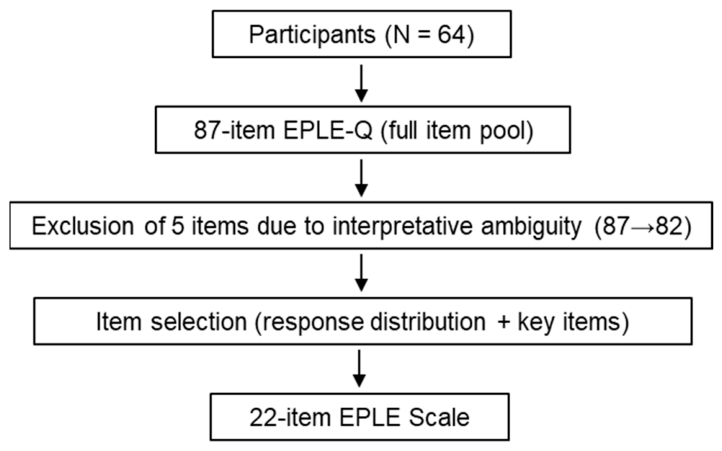
Given this consistent interpretative mismatch, distress-related items were excluded from the present Impact-domain analyses and from all subsequent analyses involving this domain, resulting in a reduced set of 82 items from the original 87-item pool. This decision was guided by phenomenological coherence and aimed to ensure that the Impact domain specifically captured emotional, cognitive, and existential consequences attributed to the EPLE rather than to grief-related distress more generally.
A substantial proportion of participants reported experiencing significant comfort and reassurance during the encounter. Comfort derived from tactile contact was endorsed by over half of the sample (≥4 = 54.69%), while feeling encouraged not to remain stuck in pain was widely reported (M = 4.20, SD = 1.26; ≥4 = 79.69%). Positive emotional states were highly prevalent, with most participants describing the encounter as joyful and comforting (M = 4.39, SD = 0.97; ≥4 = 84.38%) and reporting a strong sense of peace and tranquility (M = 4.36, SD = 1.06; ≥4 = 78.13%).
A sense of safety and familiarity was also prominent. Many participants reported feeling perfectly safe during the experience (M = 4.25, SD = 1.16; ≥4 = 70.31%) and described the setting as “home-like” (M = 4.00, SD = 1.31; ≥4 = 64.06%). For a subset of participants, the encounter was so immersive and coherent that it was perceived as highly realistic and not attributable to autosuggestion (M = 4.20, SD = 1.20; ≥4 = 71.88%).
Beyond immediate emotional effects, participants reported substantial cognitive and existential changes. A majority indicated changes in their views on death or the afterlife (M = 3.92, SD = 1.44; ≥4 = 65.63%), and a strong belief in eventual reunion with the deceased was one of the most consistently endorsed outcomes (M = 4.59, SD = 0.81; ≥4 = 87.50%). Participants also frequently reported that the experience helped them work through their grief (M = 4.42, SD = 0.96; ≥4 = 85.94%).
Broader meaning-making processes were also affected. Many participants endorsed having gained important life lessons (≥4 = 75.00%), reported a significant impact on their spiritual growth (≥4 = 73.44%), and described receiving insights into the meaning of life (≥4 = 73.44%). Deepened awareness of core values was reported by a substantial proportion of the sample (≥4 = 62.50%). Overall, the Impact domain reflects a multidomain influence of the EPLE across emotional responses, cognitive appraisals, and existential purpose, understood as a value-mediated life direction domains. Descriptive statistics for individual items within the Impact domain are reported in
Table 5.
3.4. Development and Preliminary Psychometric Evaluation of the EPLE Scale
3.4.1. Item-Level Properties and Scoring
A total EPLE Scale score was calculated by summing the 22 items, with higher scores indicating greater intensity and experiential richness of the emergent post-loss experience. The theoretical range of the total score was 22–110.
3.4.2. Exploratory Factor Analysis of the EPLE Scale
An exploratory factor analysis (EFA) was conducted on the 22 EPLE Scale items using a Pearson correlation matrix, minimum residual extraction, and oblimin rotation. Sampling adequacy was acceptable, as indicated by the Kaiser–Meyer–Olkin measure (KMO = 0.72). Bartlett’s test of sphericity was significant, χ2(231) = 592.25, p < 0.001, supporting the factorability of the correlation matrix.
Parallel analysis did not support a clear multidimensional structure. Extracted solutions were characterized by limited item saturation, substantial cross-loadings, and low internal consistency at the factor level. The chi-square goodness-of-fit test for the factor model was non-significant, χ2(168) = 177.23, p = 0.298, indicating no evidence of poor overall model fit but failing to support a robust and interpretable factor structure.
Given these results, together with the modest sample size and the conceptual rationale underlying the development of the EPLE Scale, the scale was retained as a unidimensional composite measure. Accordingly, all subsequent analyses were conducted using the total EPLE Scale score.
3.4.3. Internal Consistency of the EPLE Scale
In light of the exploratory factor analysis results, the EPLE Scale was examined as a global measure of emergent post-loss experience. The scale demonstrated satisfactory internal consistency. McDonald’s omega was 0.79 (95% CI: 0.72–0.87) indicating adequate reliability for a newly derived measure.
3.4.4. Network Analysis of the EPLE Scale
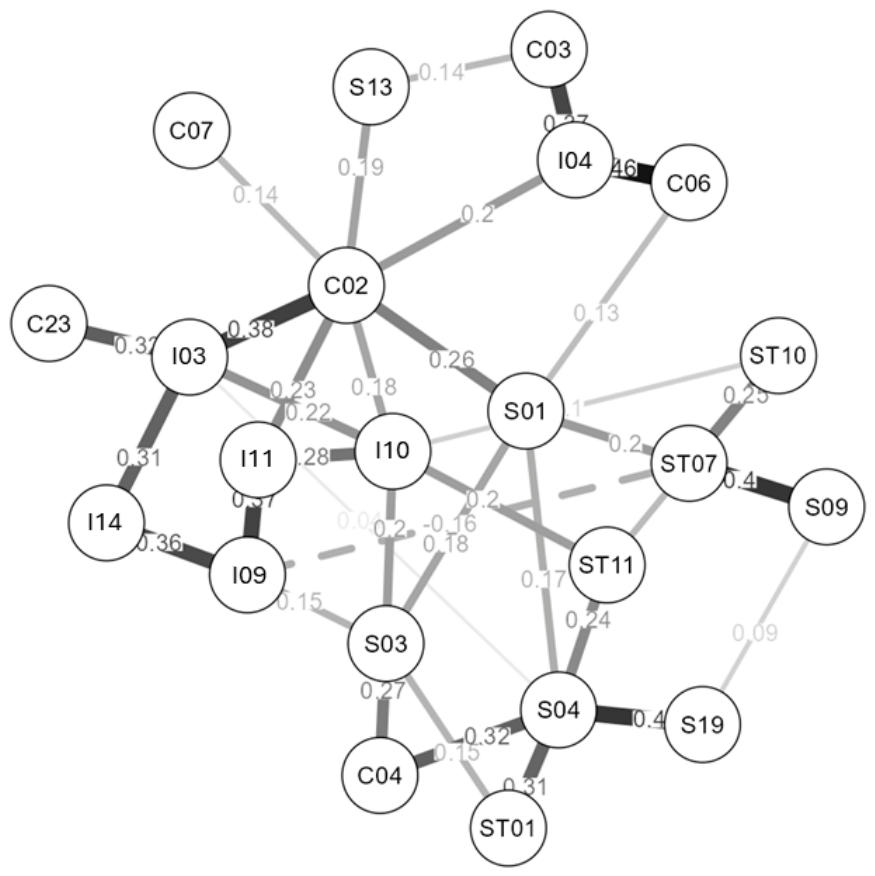
A network analysis was conducted on the 22 items of the EPLE Scale to examine the conditional dependency structure among experiential elements. The estimated network exhibited a relatively sparse configuration, characterized by selective inter-item connections rather than densely interconnected clusters (
Figure 2).
Inspection of the network revealed the presence of two organizing nodes with higher connectivity relative to other items. In this context, “organizing nodes” refer to nodes that appear relatively more connected within the network structure rather than to nodes identified through formal centrality indices. Item C02 (“Love emanating from the deceased’s presence”) emerged as the primary organizing node within the network, displaying the highest number of cross-domain conditional associations. C02 showed direct connections with items spanning multiple experiential domains, including I03 (“Joyful and comforting encounter”), I11 (“Help in working through grief”), I10 (“Belief in a future reunion with the deceased”), I04 (“Sense of peace and tranquility”), S01 (“Presence perceived as distinct from symbolic bereavement feelings”), S13 (“Telepathic-verbal communication”), and C07 (“Clarification of initially unclear messages”). It is noteworthy that the estimated network was relatively sparse, with a limited number of conditional associations among the possible item pairs. This suggests that the observed connections are not simply due to a general overlap among items but instead reflect specific relationships between particular components of the experience. This pattern indicates that C02 occupies a central position within the network, linking contact-related experiences with sensory and impact-related elements.
In addition to C02, item S04 (“Visual clarity comparable to ordinary perception”) also emerged as a highly connected node. S04 displayed direct conditional associations with C04 (“Visual perception of the deceased, partial or full”), ST01 (“Perception of environmental elements surrounding the deceased”), ST11 (“Experience of being in a supernatural world”), S01 (“Presence perceived as distinct from symbolic bereavement feelings”), and S19 (“Kinesthetic perception of movement”). Unlike C02, which showed strong associations with relational and impact-related items, S04 primarily connected sensory features with spatial and temporal aspects of the experience.
Overall, the network structure suggests a policentric organization of emergent post-loss experiences, with multiple organizing nodes contributing to different aspects of experiential coherence. This interpretation should be understood within the exploratory framework of network analysis, which models associations among experiential features rather than latent variables; accordingly, the analysis was not intended as a formal comparison with latent variable models (e.g., CFA or bifactor models), and model fit indices typically used in such approaches were not estimated. C02 functioned as a relational–integrative node, showing multiple cross-domain conditional associations, whereas S04 functioned as a perceptual–contextual node, together supporting the configuration of the experience as an interconnected experiential system rather than as separable latent dimensions.
3.4.5. Convergent Validity with the NDE Scale
Convergent validity of the EPLE Scale was examined by correlating the total EPLE Scale score with the total score of the Near-Death Experience (NDE) Scale using Spearman’s rank-order correlation coefficient. The EPLE Scale total score showed a moderate-to-strong positive association with the NDE total score, ρ = 0.62, p < 0.001, indicating substantial overlap between emergent post-loss experiences and near-death experiential phenomena.