Review

Wide Bandgap Semiconductors for Power Electronics: Comparative Properties, Applications, and Reliability of GaN and SiC Devices


by
Nathaniel Viewegh
,
Harrison Holloway
,
Rainey Biggerstaff
,
Joseph Bruce Herzog
and
Christopher Martin Stanley
*
R.B. Annis School of Engineering, University of Indianapolis, Indianapolis, IN 46227, USA
*
Author to whom correspondence should be addressed.
Hardware 2026, 4(1), 6; https://doi.org/10.3390/hardware4010006
Submission received: 29 September 2025 / Revised: 6 February 2026 / Accepted: 13 February 2026 / Published: 18 March 2026

Abstract

Wide bandgap (WBG) semiconductors such as gallium nitride (GaN) and silicon carbide (SiC) have revolutionized modern power electronics by enabling devices that operate at higher voltages, temperatures, and switching frequencies than their silicon counterparts. This paper reviews the material properties, device architectures, fabrication techniques, and thermal management strategies that underpin the performance of GaN and SiC technologies. We highlight key trade-offs between GaN and SiC in terms of voltage blocking capability, switching efficiency, and thermal robustness and discussed their application in electric vehicles, renewable energy systems, and power converters. Market adoption trends and manufacturing challenges are also analyzed, with attention to cost-performance dynamics and packaging innovations. Finally, we address the critical role of thermal boundary resistance and emerging reliability solutions, providing a perspective on the future trajectory of WBG device research and commercialization.

1. Introduction

Silicon has historically served as the backbone of power electronics, but its physical limitations in bandgap energy, thermal conductivity, and breakdown field are increasingly evident in high-performance applications [1]. Wide bandgap semiconductors such as gallium nitride (GaN) and silicon carbide (SiC) have emerged as leading alternatives because of their superior intrinsic properties, including larger band gaps, higher electron mobility, and higher thermal stability [2,3,4].
GaN devices, most notably high-electron-mobility transistors (HEMTs), operate based on strong polarization effects in wurtzite structures, which enable the formation of high-density, two-dimensional electron gases with low on-resistance and high carrier mobility [5,6]. These attributes make GaN highly suitable for compact, high-frequency converters, consumer electronics, and fast-charging applications [7]. However, GaN suffers from limited substrate availability and reliability challenges when grown on foreign substrates such as silicon due to lattice mismatch and thermal expansion differences [8,9,10].
SiC, by contrast, offers a mature manufacturing base with commercially available 4H-SiC substrates and excellent thermal conductivity [11]. This enables SiC metal-oxide-semiconductor field-effect transistors (MOSFETs) to operate reliably at elevated temperatures, making them attractive for applications such as electric vehicle traction inverters and renewable energy converters [12,13]. Nevertheless, defect structures such as basal plane dislocations and threading screw dislocations remain a concern for long-term reliability [14,15].
Beyond their material and device-level differences, both GaN and SiC face system-level challenges. High-frequency operation can exacerbate electromagnetic interference and parasitic effects, while thermal boundary resistance at material interfaces has become a critical factor in determining device lifetime and performance [16,17,18]. Research into interface engineering, novel heat spreaders, and advanced packaging continues to push the boundaries of what WBG devices can achieve and the environments in which they can achieve it.
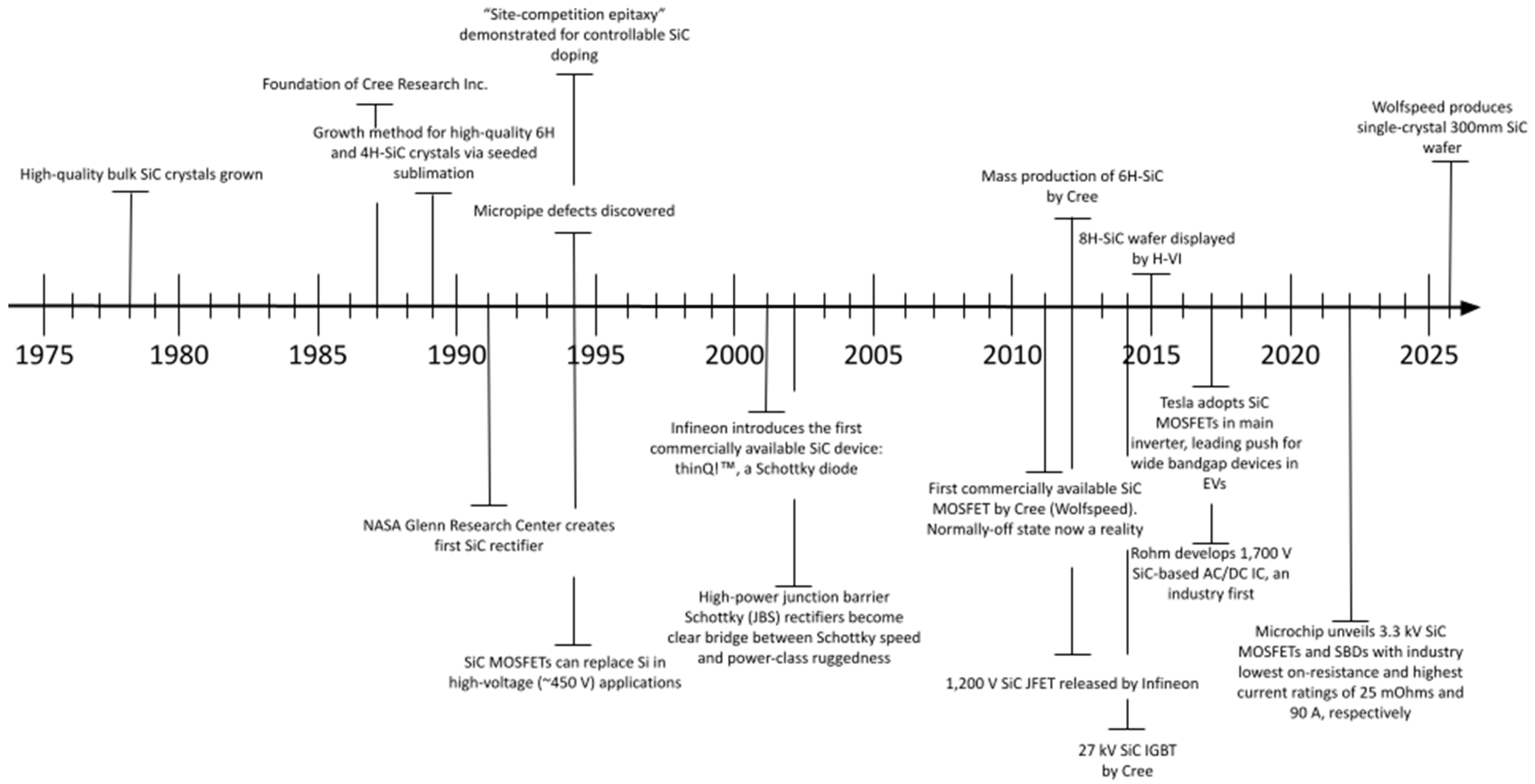
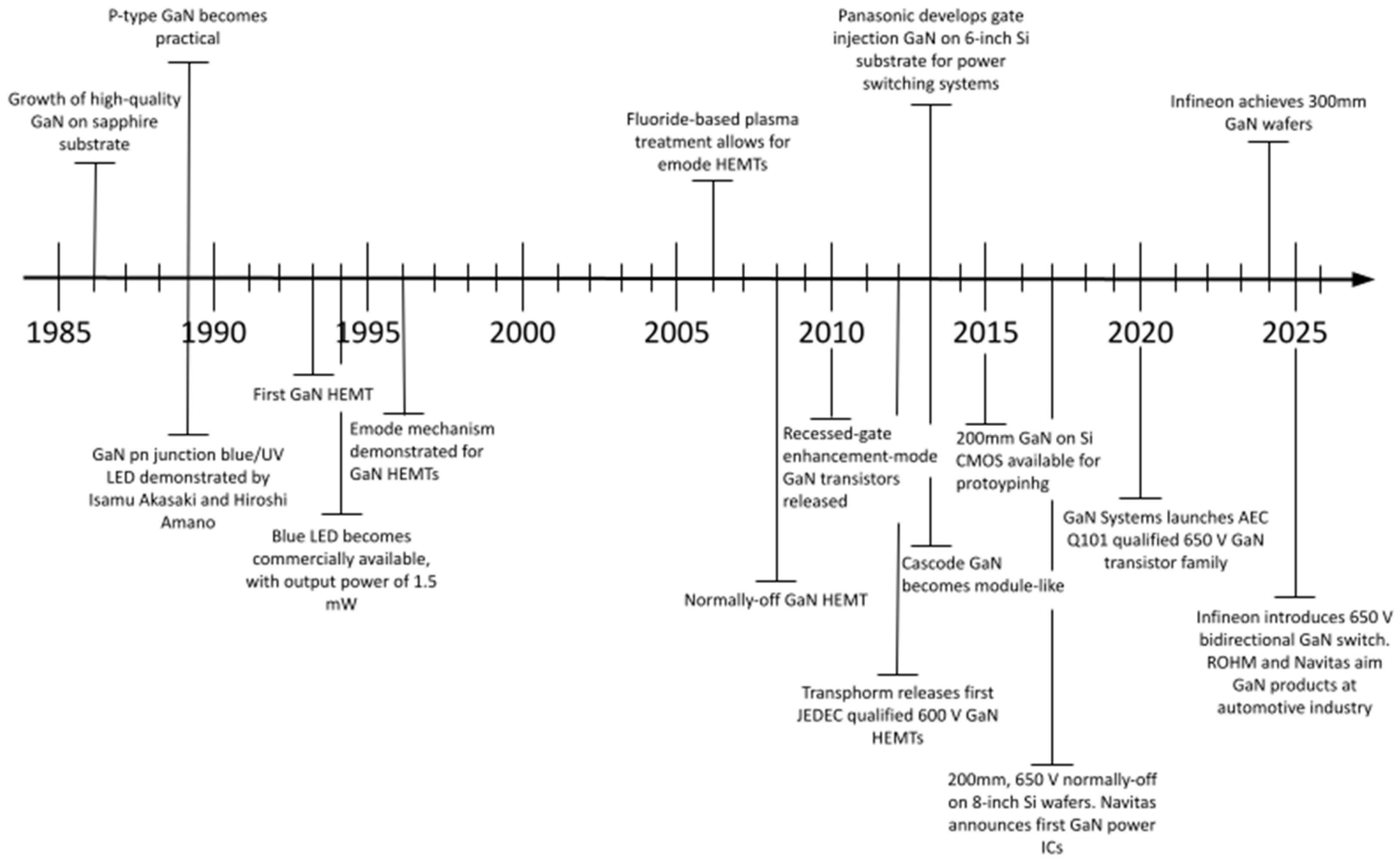
This paper reviews the comparative properties of GaN and SiC, their fabrication and packaging techniques, and their application in key sectors such as electric vehicles, renewable energy, and power conversion. We also address emerging strategies in thermal management and reliability, which remain essential to the next phase of wide bandgap device commercialization. This review integrates the GaN versus SiC landscape for power electronics across material properties, device topologies, fabrication and packaging constraints, and application-driven trade-offs, then connects those fundamentals to adoption and industry roadmaps. A timeline of the history of GaN and SiC devices is provided in Figure 1 and Figure 2.

2. Material Properties of Wide Bandgap (WBG) Semiconductors, GaN and SiC

2.1. Gallium Nitride (GaN)

2.1.1. GaN and Alloys

Gallium nitride (GaN) has gained significant popularity in high-power electronics due to its high bandgap, electron mobility, etc. GaN has formed the basis for high-electron-mobility transistors (HEMTs). Furthermore, the addition of other elements allows for tunable material properties and device structures. This section introduces properties of GaN, including its alloy with Aluminum (AlGaN).
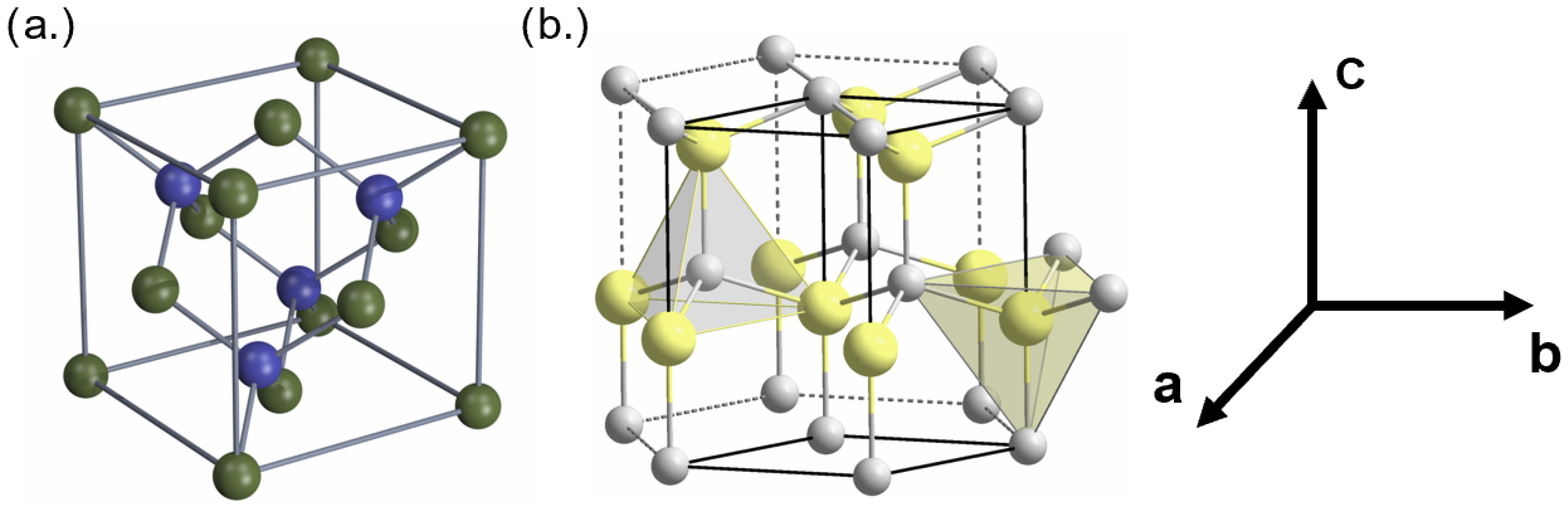
GaN most commonly crystallizes in the wurtzite (hexagonal) structure under typical growing conditions. While GaN can crystallize in the zincblende (cubic) configuration, this requires constrained epitaxial conditions, which make it more difficult to grow. Furthermore, it was shown that GaN wurtzite structures have a larger bandgap than their zincblende counterpart [53,54].
Moreover, wurtzite structures exhibit strong spontaneous and piezoelectric polarization along the c-axis, as shown in Figure 3.
Aluminum gallium nitride (AlGaN) incorporates into the GaN lattice, allowing the alloy to have an improved bandgap and polarization fields across the heterojunction due to the lattice mismatch. Therefore, AlGaN makes a very good barrier layer, creating a high-density 2D electron gas (2DEG) channel at the junction without intentional doping.

2.1.2. Carrier Mobility and 2D Electron Gas (2DEG)

High carrier mobility in GaN high-electron-mobility-transistors (HEMTs) is largely due to the formation of 2DEG at the heterojunction of AlGaN/GaN. Because of strong spontaneous and piezoelectric polarization inherent in wurtzite crystals, charge accumulates at the polarization discontinuity between GaN and AlGaN. This mismatch occurs when AlGaN is grown on GaN, producing a polarization discontinuity and inducing a fixed positive sheet charge on the AlGaN [5]. In turn, this creates a strong internal electric field, attracting electrons to the GaN side. This structure offers high electron mobility with low on-resistance. The confinement of charges within this channel reduces polar optical phonon interactions and ionized impurity scattering. This thereby enhances electron mobility through this channel and increases efficiency [6].

2.1.3. GaN-on-Si

GaN-on-Si is a cost-effective option when producing WBG devices due to the abundance of large-diameter silicon wafers and compatibility with CMOS-capable processes. However, GaN and Si have significant thermal expansion coefficients (TECs) (5.59  ×  10−6 K−1 for GaN and 2.6  ×  10−6 K−1 for Si) and 17% lattice mismatch. These inconsistencies during epitaxy lead to high defect densities, stress, and cracking during cool down, even in films as thin as 4 μm [8]. Despite these challenges, progress has been made in growing up to 20 μm-thick layers with lower-density dislocations [8,57]. Additionally, advanced metal organic chemical vapor deposition (MOCVD) has reduced the thermal and lattice mismatch [9]. By using an AlN/GaN superlattice buffer layer, GaN crystals had improved quality [58]. Furthermore, low-temperature AlN interlayer and AlGaN buffer layers have been shown to reduce dislocation densities [9]. Nevertheless, despite high-quality GaN crystals [8,10,58,59], device reliability still trails GaN-on-SiC devices.

2.1.4. GaN-on-SiC

GaN-on-SiC offers a significantly better lattice and thermal expansion coefficient match compared with GaN-on-Si. This compatibility results in lower defect densities, reduced film stress, and superior thermal performance, making GaN-on-SiC the preferred platform for high-power and high-frequency WBG devices.
However, during epitaxial growth, thermal resistance at the GaN/SiC interface can limit heat dissipation, primarily due to the low thermal conductivity of the GaN buffer layer [60]. To mitigate this issue, several strategies have been explored. These include hot-wall MOCVD pretreatment of the SiC substrate and thinning the AlN nucleation layer, both of which improve interface quality and thermal transport [61]. Another promising approach is surface-activated bonding (SAB), which enables the direct bonding of GaN to SiC without a transition layer, reducing interfacial resistance and simplifying the stack architecture.
Due to its favorable thermal and electrical properties, GaN-on-SiC remains the dominant platform for commercial GaN power devices, particularly in applications demanding high efficiency and thermal robustness.

2.2. Silicon Carbide (SiC)

2.2.1. SiC and Polytypes

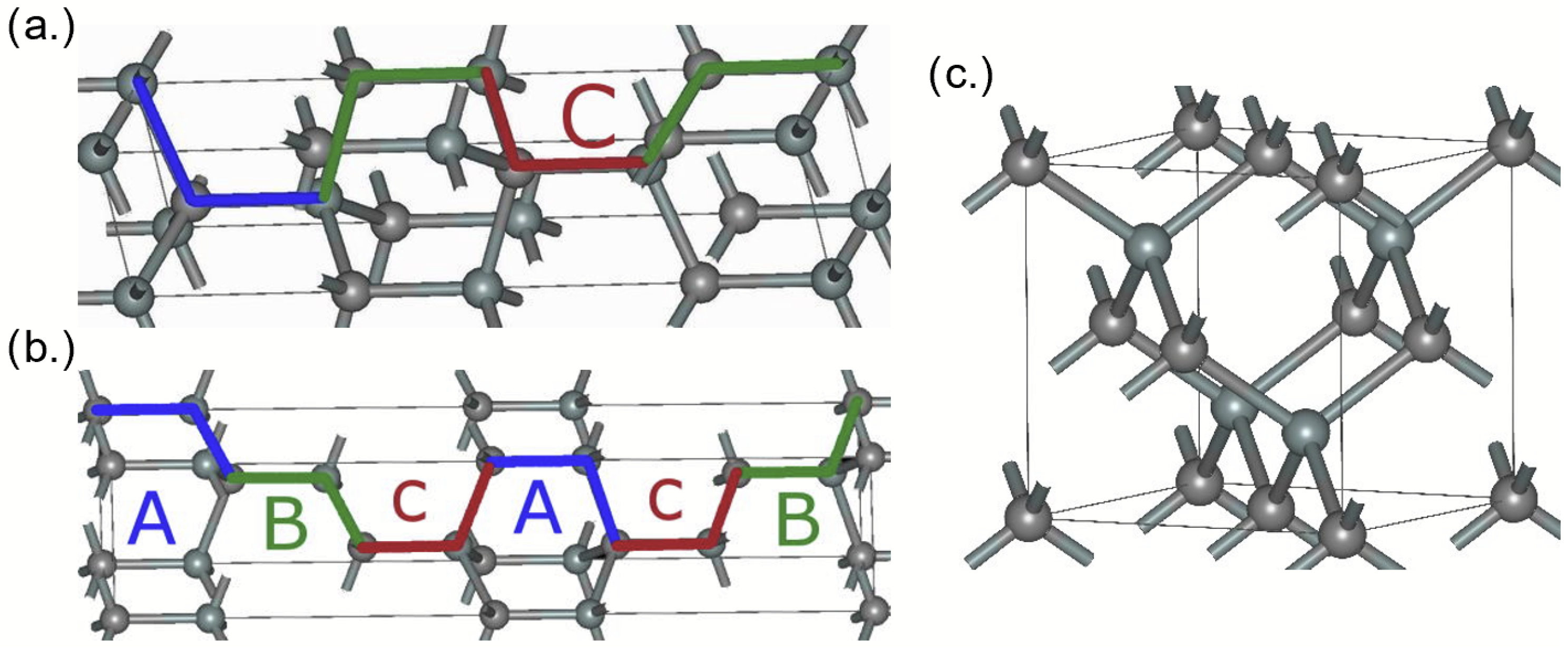
Silicon carbide (SiC) exists in numerous crystalline structures due to its polymorphic properties. Due to variations in growth conditions such as temperature, surface orientation, or supersaturation during physical vapor transport (PVT) or chemical vapor deposition (CVD) growth, different polytypes can be produced. While there are over 250 polytypes for SiC, 3C-SiC, 4H-SiC, and 6H-SiC (See Figure 4) possess higher bandgap energy and electron mobility, making them better candidates for high-power electronics [4]. Consequently, these materials have received the most attention from the power electronics industry.
These polytypes differ primarily in their bilayer stacking sequence, which alters their band structure and physical properties. The most viable and commercially available polytype is 4H-SiC [11]. This is due to its wide band gap (3.28 eV), higher electron mobility (800 cm2/Vs), and ease of manufacturing [3]. The following figure showcases each polytype’s different stacking structure, which directly correlates with its electrical properties.

2.2.2. Electrical and Thermal Properties

The bandgap, Wg, determines the electric field a material can withstand before electrical breakdown, also known as the breakdown voltage, Ecrit.
As shown in Table 1, 4H-SiC has a much higher bandgap compared with the other polytypes at 3.28 eV, which means it is more suitable for high voltage and temperature applications. 3C-SiC features the highest electron mobility, making it more suitable for high-frequency applications. Lastly, 6H-SiC achieves the best thermal conductivity compared with 4H-SiC and 3C-SiC. High thermal efficiency allows these materials to disperse heat faster, preventing a thermal runaway.

2.2.3. Substrate Issues

Silicon carbide natively produces lattice-matched single-crystal SiC substrates, which allow for homoepitaxial growth [65]. This enables the formation of high-quality SiC layers that improve device performance and reliability by reducing dislocation densities. The standard substrate material in commercial devices is 4H-SiC due to its thermodynamic stability and favorable electrical properties. However, producing wafer-scale, high-quality 3C-SiC remains challenging, largely due to its tendency to transform into more stable hexagonal polytypes, such as 4H-SiC or 6H-SiC, during high-temperature growth [66,67]. The metastable cubic phase is especially sensitive to thermal processing, and this polytype conversion leads to a high density of stacking faults and phase inclusions, limiting the commercial viability of 3C-SiC despite its higher electron mobility.
Several substrate-related challenges still affect device cost, yield, and performance. SiC substrates are typically grown using the physical vapor transport (PVT) method at temperatures near 2300 °C [60]. While PVT enables the production of large wafers—now up to 200 mm in diameter—it can introduce various crystalline defects, including micropipes, basal plane dislocations (BPDs), threading screw dislocations (TSDs), and threading edge dislocations (TEDs).
Among these, basal plane dislocations are particularly problematic in 4H-SiC power devices, where they can cause bipolar degradation and forward voltage drift [14]. BPDs tend to propagate along the growth direction, increasing defect density in thicker epitaxial layers [60]. Under high power stress conditions, such as intense ultraviolet irradiation (>1000 W/cm2), BPDs may also act as nucleation sites for stacking fault (SF) expansion, potentially reaching the surface and leading to device failure. However, it has been shown that reducing carrier lifetime in the buffer layer can suppress this expansion and mitigate performance degradation [4]. Furthermore, high-quality homoepitaxial growth, particularly on on-axis Si-face 4H-SiC substrates, has been shown to reduce BPD propagation by promoting uniform step-flow growth and minimizing dislocation conversion during epitaxy [68].
TSDs are crystallographic defects in SiC where the dislocation line and Burgers vector are both aligned along the crystal’s c-axis, forming a screw-type dislocation. They are considered among the most harmful defects because they significantly reduce breakdown voltage in power devices. TSDs can also serve as sites for defect propagation during epitaxial growth, leading to the formation of basal plane dislocations or stacking faults. Reducing TSD density is critical for improving SiC device yield and reliability.
TEDs are edge-type dislocations that also thread along the c-axis but have a Burgers vector perpendicular to the dislocation line. While less harmful than TSDs, TEDs can degrade electrical performance by acting as scattering centers that reduce carrier mobility. Under stress or during epitaxial growth, TEDs may glide into the basal plane, contributing to stacking fault formation [15]. Managing TED density and behavior is important for maintaining high-performance and long-lifetime SiC devices.

2.3. Availability

SiC substrates are commercially available and widely used in power devices, especially for 4H-SiC, the most technologically relevant polytype. SiC wafers are typically produced using physical vapor transport (PVT), which enables bulk, single-crystal growth with good structural quality. Commercial SiC wafers are now routinely available in 100 mm and 150 mm diameters, with 200 mm wafers entering the market in limited volumes.
Despite these advances, the production of SiC remains complex and expensive. Growth rates are relatively slow, and wafers often contain defects such as micropipes, dislocations, and basal plane dislocations (BPDs), which can affect device performance and yield. Continuous improvements in homoepitaxial growth, defect reduction, and wafer polishing have significantly improved wafer quality and enabled the production of vertical devices such as MOSFETs and Schottky diodes.
The availability of SiC substrates has improved substantially in the past decade, supported by large-scale investments from major semiconductor manufacturers. Nonetheless, material cost and yield remain limiting factors, particularly for high-voltage and large-area devices.
Unlike SiC, GaN substrates are not yet widely available in large sizes at a reasonable cost. High-quality bulk GaN wafers (e.g., GaN-on-GaN) are expensive and limited in size, typically 2–4 inches in diameter, due to difficulties in bulk growth. As a result, most commercial GaN devices are fabricated on foreign substrates, such as silicon (GaN-on-Si) or silicon carbide (GaN-on-SiC), using heteroepitaxial growth techniques.
Gallium nitride on silicon (GaN-on-Si) offers low-cost, large-diameter wafers (up to 200 mm) and compatibility with standard CMOS processing, which is due to the previous infrastructure of Si wafers. However, it suffers from lattice and thermal expansion mismatch, which can produce high dislocation densities and stress defects. In contrast, Gallium nitride on silicon carbide (GaN-on-SiC) provides better thermal conductivity and lattice matching but is more expensive and limited in wafer size (typically up to 150 mm).

2.4. Nanoscale Properties

As WBG devices scale toward the sub-micron range, the behavior of GaN and SiC begins to deviate from bulk properties to quantum confinement, phono-boundary scattering, and surface-to-volume ratio effects. Hopkins et al. discuss that for device layers that thin below the phonon mean free path, energy transduction across the heterojunction (e.g., GaN/SiC) becomes a heat dissipation bottleneck [69]. Adding to this, experimental work quantified the thermal boundary resistance (TBR) at the GaN/AlN interface. They showed the TBR was lower than at the GaN/SiC interface and attributed this to better vibrational matching [70].
Low-dimensional structures such as nanowires and nanosheets are emerging for their enhanced electronic and mechanical properties. SiC nanowires exhibit superior mechanical flexibility and strength compared to 4H-SiC due to a reduction in volume defects; furthermore, they allow for tunable electron mobility [71]. It was shown that monolayer SiC can be engineered to possess a direct bandgap through carbon vacancies, opening new pathways for nanoscale optoelectronics that were previously inaccessible in bulk SiC [72]. Finally, advancements in nanoscale detection, such as nano-FTIR, allow for non-destructive identification of atomic-scale defects and polytype inclusions with sub-20 nm resolution [73].

3. Substrate Platforms for GaN Devices

3.1. Device Structure: HEMTs, MOSFETs, and Related Topology

3.1.1. GaN HEMTs

Gallium nitride high-electron-mobility transistors (HEMTs) are built upon a heterostructure formed between AlGaN and GaN, which naturally induces 2DEG at the interface due to strong spontaneous and piezoelectric polarization effects inherent to the wurtzite crystal structure.
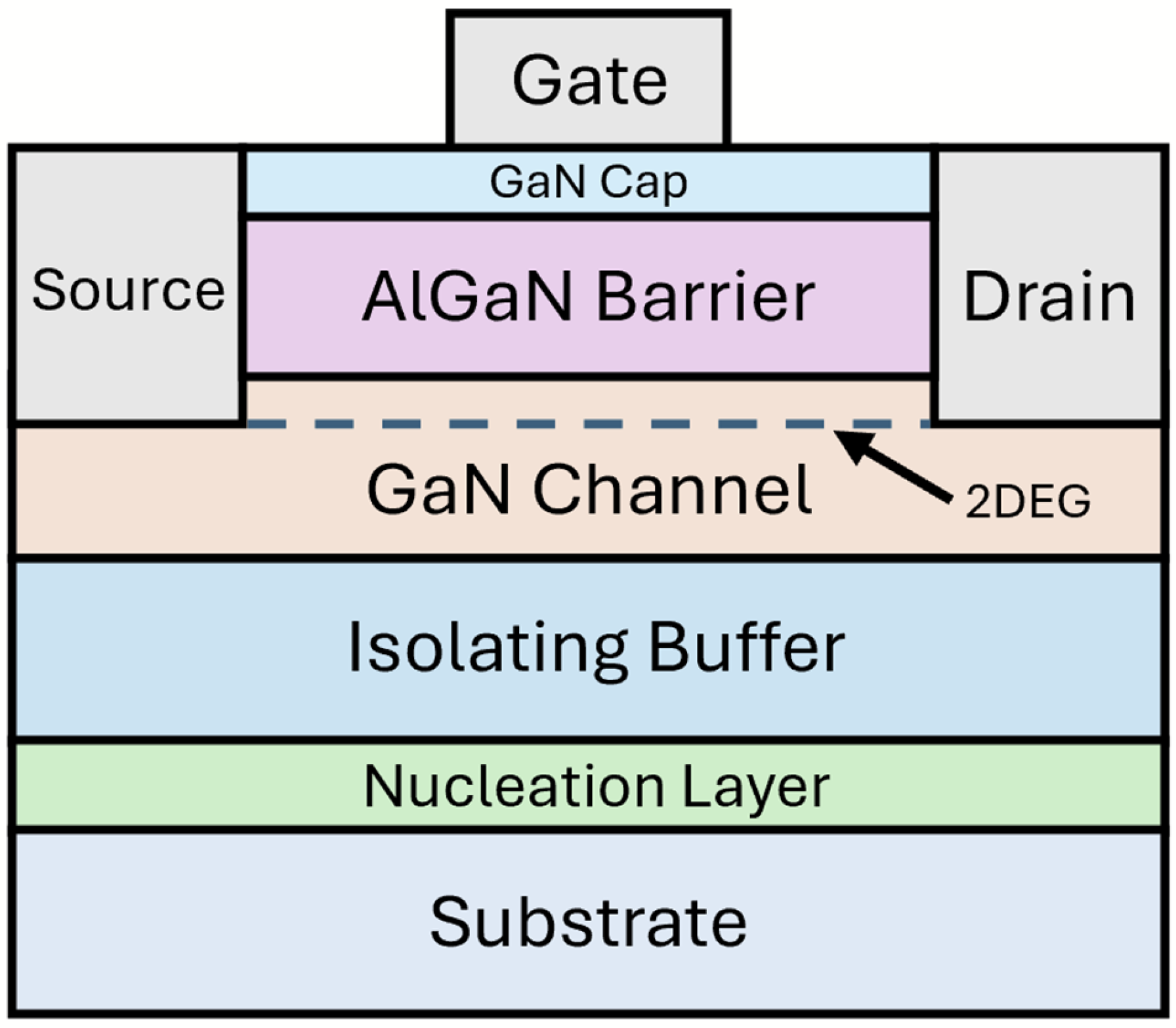
The standard GaN HEMT architecture is lateral (see Figure 5), with current flowing parallel to the wafer surface. A typical epitaxial stack includes a semi-insulating substrate: Si, SiC, or even Sapphire. The next layer is the nucleation layer: AlN is used with the Si substrate, and a thin layer of GaN or AlN is used with an SiC substrate. This is followed by the buffer layer, GaN channel, a thin AlGaN barrier layer, and the GaN cap. The source and drain contacts are placed on either side of the gate, which modulates the carrier concentration in the 2DEG channel. To improve the electric field distribution and increase the breakdown voltage, field plates are often incorporated into the gate or drain structure.
In the default configuration, GaN HEMTs are depletion-mode (normally-on) devices. However, for many power applications, enhancement-mode (normally-off) operation is preferred for fail-safe functionality. This is commonly achieved by modifying the gate region using techniques such as gate recessing [74], oxide gate stacks, or the addition of a p-GaN cap layer.
The GaN HEMT structure is optimized for low on-resistance, high breakdown voltage, and fast switching performance, making it a key device in wide-bandgap power electronics.

3.1.2. SiC MOSFETs

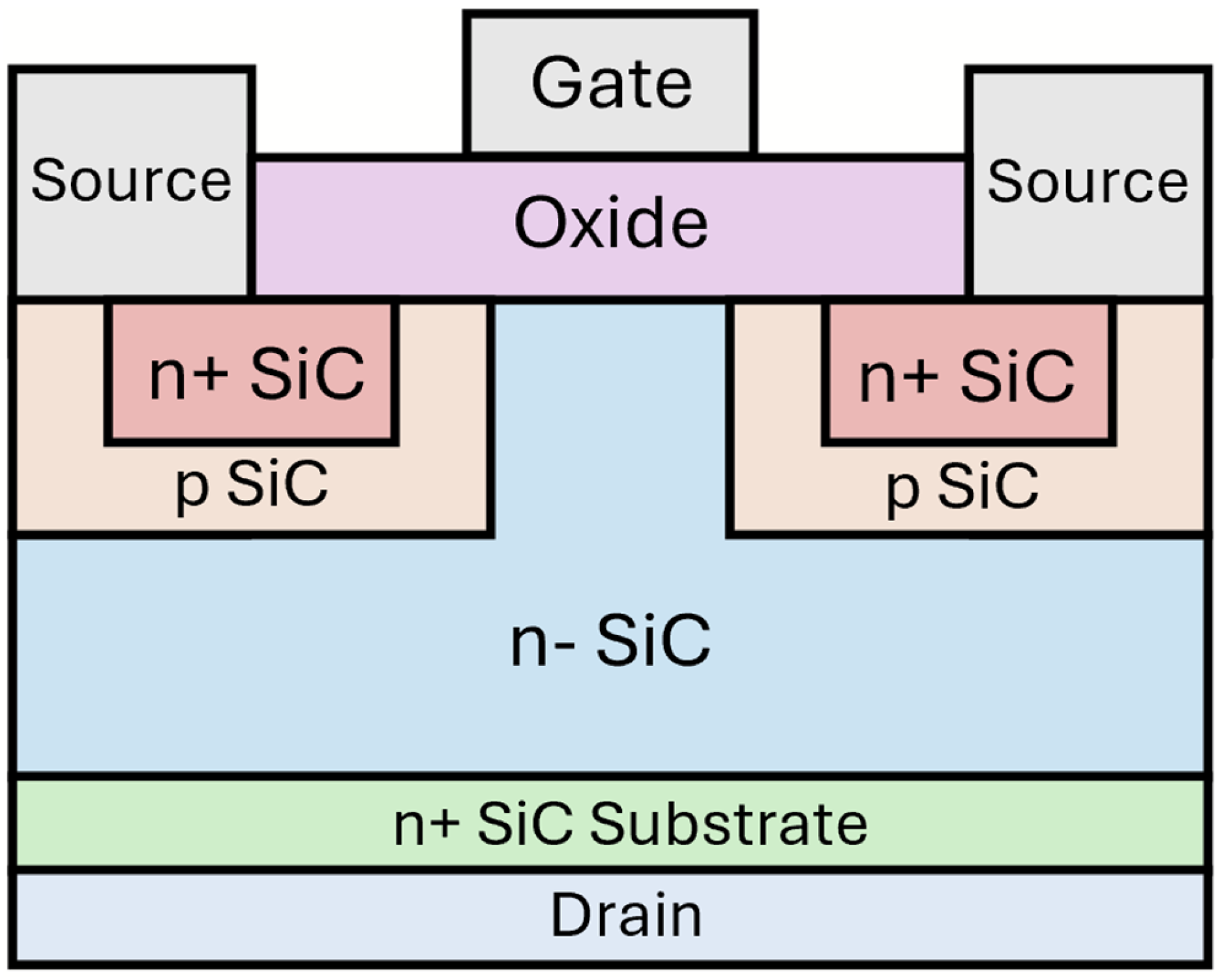
SiC metal oxide field effect transistors (MOSFETs) are vertical devices (see Figure 6) designed to handle high voltages (>900 V) and currents with high efficiency. Built on the wide bandgap material 4H-SiC, these devices benefit from high critical electric field strength, low on-resistance, and excellent thermal conductivity.
The typical SiC MOSFET has a vertical structure, where current flows perpendicularly from the source at the top to the drain at the bottom of the die. This architecture enables higher breakdown voltages and compact device layouts compared to lateral devices like GaN HEMTs [75].
The basic structure includes a heavily doped n+ source, a p SiC body, and an n drift region grown epitaxially on an n+ SiC substrate. The gate oxide (typically SiO2) lies between the gate contact and the channel region formed in the p-body. When a positive gate voltage is applied, an inversion channel is formed, allowing electrons to flow vertically through the drift region to the drain.
To improve performance and electric field distribution, devices incorporate trench gates [76] or guard rings [77]. Overall, SiC MOSFETs provide a high-performance solution for applications that demand high voltage blocking, low conduction loss, and robust thermal handling, and are increasingly replacing silicon IGBTs in many modern power systems.

3.1.3. Emerging Topologies

While GaN HEMTs and SiC MOSFETs currently dominate the landscape of WBG power devices, several emerging device topologies are being developed to address specific application requirements, such as higher voltage operation and simplified gate control.
The cascade configuration is a hybrid topology that combines a normally on GaN HEMT with a low-voltage silicon or SiC MOSFET to produce a normally off device. This approach enables the high-speed, low-loss characteristics of GaN while retaining the familiar gate drive requirements of conventional MOSFETs. Cascade GaN devices are commercially available and have proven effective in simplifying gate driver design [78]. SiC JFETs offer a simpler, unipolar structure, making them suitable for high-radiation and temperature environments [79].
Emerging vertical GaN devices, such as vertical GaN MOSFETs, vertical junction field-effect transistors (VJFETs), and FinFET-like structures, are under development to extend GaN’s voltage range beyond the limitations of lateral HEMTs [80]. These devices enable current to flow vertically through thick GaN drift regions, which allows for significantly higher breakdown voltages (>1.2 kV), reduced on-resistance, and better scalability for high-power applications. Additionally, vertical GaN power devices are immune to surface effects and high thermal dissipation. However, their development is currently limited by the availability and cost of high-quality bulk GaN substrates [80].

3.2. Fabrication Techniques

The fabrication of GaN and SiC wide-bandgap (WBG) power devices relies on specialized processing techniques tailored to their material properties, including high hardness, chemical inertness, and thermal stability. Core processes include epitaxy, doping, passivation, chemical vapor deposition (CVD), and lithography. These steps collectively determine the structural integrity, electrical performance, and reliability of the final device.

3.2.1. Epitaxy

Epitaxial growth establishes the active layers of WBG devices and plays a central role in controlling defect densities and material quality. For GaN-based devices, MOCVD is widely used for growing AlGaN/GaN heterostructures, enabling precise control of thickness and composition. To manage lattice and thermal expansion mismatch, for GaN-on-Si, buffer architectures such as AlN nucleation layers [61], graded AlGaN [81], and superlattices [58] are commonly employed.
In SiC devices, CVD is the standard method for homoepitaxial growth on 4H-SiC substrates. This technique supports high-quality drift layers with controlled doping, which are essential for vertical device architectures. Advances in epitaxial growth have led to reductions in dislocation density, improvements in interface quality, and lower stress, particularly in SiC substrates for GaN-on-SiC devices [82].

3.2.2. Doping

Doping in WBG semiconductors is critical for defining electrical regions such as channels, drift layers, and source/drain contacts. In GaN devices, traditional ion implantation is limited due to lattice damage and activation challenges. Instead, polarization-induced 2DEG formation is typically used for HEMTs [83]. For p-type regions in p-GaN devices, magnesium doping introduced during hot-wall MOCVD was shown to lower the resistivity of p-GaN layers and increase free-hole density [84].
Ion implantation in SiC and GaN allows for precise doping to create n-type and p-type regions. However, it can damage the crystalline structure and lead to amorphization of the material. High-temperature implantation between 400 °C and 1000 °C is used to limit the defects [85,86]. Additionally, it requires high-temperature annealing to electrically activate the dopants [85].
The most common dopants for SiC are nitrogen and phosphorus for n-type and aluminum for p-type. Post-implantation high-temperature annealing, above 1500 °C, is required to activate dopants and repair implantation defects. In GaN, the most common dopant is Si for n-type and Mg for p-type regions. The implantation temperature is at least 1100 °C, and the post-implantation annealing temperature is about 1050 °C to 1100 °C [34].
While ion doping allows for precise adjustments of electrical properties, properly activating the acceptors has been a source of difficulty [85]. Accurate doping profiles are essential to achieving low on-resistance and high breakdown voltage.

3.2.3. Passivation

Passivation layers protect the surface of the device from environmental contaminants, moisture, and corrosion. They play a key role in stabilizing surface states, reducing gate leakage, and preventing dynamic on-resistance degradation. In GaN HEMTs, materials such as SiN [87] and AlO [88] are deposited using plasma-enhanced chemical vapor deposition PECVD or atomic layer deposition (ALD), respectively [89]. Advanced passivation techniques, such as active passivation, have been shown to suppress surface-trapped induced dynamic RON degradation [90].
In SiC MOSFETs, gate oxide reliability is a major concern due to the high density of interface states. These defects at the SiC/SiO2 interface, known as interface trapped charges, create energy levels in the forbidden bandgap. Post-oxidation annealing in nitrogen-containing molecules (NO or N2O) and alternative dielectric stacks are used to improve channel mobility and enhance long-term reliability [91].

3.2.4. Chemical Vapor Deposition

CVD is the primary deposition technique for both epitaxial and dielectric layers in WBG devices. In GaN processing, MOCVD is used for heterostructure growth, while ALD and PECVD are applied for dielectrics and etch-stop layers. In SiC fabrication, chloride-based CVD is favored for thick, high-purity epitaxial layers with low defect densities [92].
The selection of precursors, gas flow rates, and substrate temperatures is critical for achieving uniformity and minimizing contaminants, particularly across large-diameter wafers.

3.2.5. Lithography

Lithography defines the physical layout of device structures and remains a precision-limiting step in WBG device fabrication. Photolithography is used for standard patterning, while electron-beam lithography or deep ultraviolet (DUV) techniques may be employed for submicron features.
Etching of GaN and SiC typically requires inductively coupled plasma reactive-ion etching (ICP-RIE) with various gases (BCl3, Cl2, SF6, etc.) due to their chemical stability [93]. Surface damage and etch uniformity are ongoing challenges, particularly in gate and active regions, where sidewall roughness and defect introduction can degrade performance [93].

4. Performance Comparison in Power Electronics

By 2040, global energy consumption is expected to rise by 40% with electrical energy accounting for a 60% share. Efficient power electronics will be crucial in managing this. Si-based devices are reaching their theoretical and physical limits, making them impractical for applications that increasingly demand efficient performance in high-voltage, high-power, fast switching, and high operating temperature situations. Primary losses of conventional Si-based systems lie in switching and conduction losses determined by turn-on/turn-off events and on-state resistance, respectively. Wide band gap semiconductors such as silicon carbide (SiC) and gallium nitride (GaN) have become the center of attention in power electronic applications because they boast superior material properties, such as larger band gaps, breakdown fields, thermal conductivity, and electron mobility. A summary of material properties is given in Table 2 [1,75,94]. Higher operating temperatures allow for reduced weight, size, and cooling systems. Lower on-state resistance and switching recovery time lead to reduced losses, increased efficiency, and reduced energy consumption. Higher-frequency operations yield smaller passive components and reduced costs.

4.1. Silicon Carbide

SiC is a more mature wide-band gap material when compared to GaN. This is due to the existing infrastructure for Si that can be used for SiC. The first devices were introduced in 1990 [12]. SiC has inherent properties that make it an attractive material for high-voltage and high-power applications. Most notably, the high breakdown field and wide band gap of SiC give devices large blocking voltages in the range of 400 to 3.3 kV and SiC IGBTs going as high as 15 kV. Additionally, the high thermal conductivity of SiC enables its use in applications involving high operating temperatures; devices continue to function in temperatures as high as 600 °C [13]. SiC MOSFETs, the most commercially available device, feature higher breakdown voltages, lower on-resistance, lower switching losses, lower conduction losses, lower parasitic capacitance, faster switching, and smaller sizes than Si MOSFETs. They are normally-off switches with integrated free-wheeling body-diodes [95]. Commercial devices have blocking voltages ranging from 650 V to 3.3 kV and current ratings of 10 A to 200 A [96]. Present concerns include electromagnetic interference (EMI), reliability, and heat dissipation issues. Increased switching speeds produce rapid dv/dt and di/dt changes that cause capacitive and inductive components to generate much higher peak voltages and currents, which leads to EMI interference that can affect the performance and stability of the system. At 2 μs, the short-circuit withstand time is 5× lower than that of Si IGBTs. Smaller die areas equate to higher short-circuit power density and faster junction temperature rise that can lead to breakdown faults. SiC MOSFETs have higher gate oxidation defects than Si due to the presence of carbon atoms in the manufacturing process. Known as bias-temperature instability, this can cause a bidirectional gate threshold voltage bias at different temperatures. Despite its increased thermal conductivity, SiC MOSFETs with smaller die areas reach higher temperatures more quickly than Si devices. Lastly, the cost of SiC MOSFETs is still 2–5× more than Si IGBTs; however, this cost has gone down heavily as production has ramped up since 2010. Despite these issues, SiC MOSFETs are still much more efficient and offer greater power density than Si-based devices and will find their way into power electronics applications, especially as more research is performed, processes mature, and cost continues to decline. SiC JFETs are also available. They have high switching speeds and are able to operate in high temperatures. Unfortunately, these are normally on devices. Cascode JFETs made from an SiC JFET and a Si MOSFET fix this issue. They have low on-state resistance, reverse-recovery charge, and body-diode threshold voltages. The two-device package causes greater stray inductances and will require an RC snubber in hard-switching applications [97]. SiC IGBTs are useful in high-voltage, high-power applications with moderate switching. They feature low conduction losses at high currents and are highly efficient. SiC-based Schottky diodes are strong in opposition to leakage current thermal runaway, are capable of blocking up to 3.3 kV due to the large breakdown field, and have low on-resistance. They have zero reverse recovery charge and low reverse current. SiC PiN diodes have low specific resistance but high reverse recovery charge. Junction barrier Schottky diodes combine the benefits of both aforementioned devices. SiC is most advantageous in applications requiring voltages greater than 650 V.

4.2. Gallium Nitride

GaN is another wide-band gap material that has garnered great amounts of attention due to its properties. The larger band gap and breakdown field make it a theoretically superior candidate for high-voltage performance than SiC; however, the lack of good-quality bulk substrates for vertical devices and lower thermal conductivity keep these assertions unrealized [7]. Its high electron mobility, smaller parasitic elements, packages, and driving voltage make GaN the choice for high-frequency applications [98]. GaN devices can switch at frequencies ranging from 100 s of kHz to 10 s of MHz [99]. Along with the high critical electric field, this allows for designs with shorter drift regions and lower on-resistance than Si devices. In general, GaN devices offer lower conduction and switching losses than SiC devices. Most GaN devices have lower blocking voltages than SiC, mostly under 700 V. Additionally, GaN is limited in its current-carrying capability and drain-to-source voltage (650 V) [100]. Like SiC, high-frequency switching in GaN devices triggers effects of capacitive coupling, parasitic inductance, and unusual EMI emissions. Its behavior may prevent its use on large-scale systems without cooling or shielding capabilities [101]. Additionally, GaN devices have lower max junction temperatures (~150 °C) and temperature dependence of on-state resistance. GaN high-electron mobility transistors (HEMTs) are the most common device in use. First introduced in 1993 [102], the electrical benefits and decreased space requirements of HEMTs make them particularly attractive for compact electronic equipment. While they have lower blocking voltage, they feature faster switching, small gate capacitances, and lower Ron × Qg values. The foreign substrate causes some reliability issues, including a greater chance of warpage, cracks, and defects. For the same voltage rating, GaN HEMTs offer higher operating efficiencies compared with SiC MOSFETs [103].

5. Application-Specific Use Cases

SiC and GaN are becoming increasingly effective in power electronics as more research is performed and production costs go down. Wide bandgap devices are used to enhance the efficiency of electric vehicles (EVs), power converters, grid-connected systems, propulsion, medical systems, aviation, power supplies, renewable energy, power adapters, wireless charging, and more. SiC is better suited for high-voltage (>1200 V) applications due to its high voltage blocking capability and high thermal conductivity. GaN dominates the low-voltage (<650 V) application areas and areas where fast switching is important. Both materials are used in medium-voltage (650 V) applications.

5.1. Electric Vehicles

Electric vehicles have been thrust into the center of attention because they can reduce carbon emissions by 50–70%. However, one thing holding them back from taking a larger portion of the automotive market is the driving range. Driving range is directly related to the weight of the vehicle and its operational efficiency. Motor drives are demanding increasing power density ratios, case temperatures, and carrier frequencies. Wide band gap devices can improve all of these aspects when integrated with EVs.
SiC devices are suitable for fast charging high-power on-board chargers, traction inverters, and DC-DC converters. In order to increase driving range, EVs have adopted 800 V batteries that are charged at >250 kW, replacing the old 400 V batteries. This means the traction inverter must withstand drain voltages up to 1200 V. SiC MOSFETs work well and come with lower switching losses, higher switching speeds, and smaller device footprints than conventional Si IGBTs. Commercial SiC MOSFETs are available with voltage ratings of 650–3300 V and current ratings of 10–200 A.
GaN devices are also playing an ever-increasing role in EV technology. They can be utilized in the AC-DC converter, DC-DC converter, inverter motor control unit, battery management system, and charging system. The high switching frequency of GaN devices means a size and weight reduction in supporting components, but could bring increased switching losses. GaN devices are important in increasing the efficiency of on-board chargers. GaN-based inductor–inductor–capacitor (LLC) resonant converters are efficiently superior to their Si-based counterparts. Additionally, GaN devices aid in reducing capacitor and inductor form factors because they can operate at higher switching frequencies. Reliability is still a concern as foreign substrates can cause warpage, cracks, and defects. In EV-charging systems, GaN devices are favorable due to their low turn-on voltage that stems from high electron mobility and low on-resistance. SiC’s turn-on voltage is slightly higher (about 0.50 V) to achieve equivalent drain currents, but still better than Si. GaN-based inverters achieve a minimum decrease in voltage and perform better in switching and conduction losses when compared to SiC and Si [104]. Taylor et al. compared SiC MOSFET-based and GaN HEMT-based 7.2 kW EV battery chargers and found that at similar efficiency levels, GaN chargers are more efficient, cheaper, and smaller than the SiC counterparts that have better thermal performance [105]. Wireless power transfer is often explored for EV charging. High operating frequency in MHz is necessary. Wang, et al. tested 3 H-bridge inverters with 650 V SiC MOSFETS and GaN FETs and found that the SiC system overheats beyond 3 MHz [98]. At 4 MHz, GaN devices achieve 3.8 kW at 500 V and 2.28 kW at 375 V. GaN devices show greater performance due to smaller parasitic elements, packages, and driving voltages. Challenges remain in driving power increasing with switching frequency, conduction and switching losses leading to heat dissipation, and achieving zero voltage switching. Theoretically, these can be addressed by reducing the voltage range of driving signals and gate input capacitance.

5.2. Renewable Energy

Power converters in renewable energy systems can take advantage of wide band gap devices because of their increased efficiency, faster switching, high thermal conductivity, and greater power density. Research shows that SiC is more suitable for high-power applications due to its thermal characteristics, while GaN is favorable where fast switching and small form factors are needed. Additionally, GaN’s EMI behavior may hinder performance in large-scale systems without cooling or shielding capabilities. For photovoltaic systems, SiC-based DC-DC converters are used to take an inconsistent 500 V DC and convert it into a stable 700 V DC, which is compatible with the power grid. SiC is favored over GaN in high-power DC-DC converters due to its high blocking capability, low conduction losses, and thermal characteristics. GaN devices are used in DC-AC inverters for wind energy systems. They convert a variable AC input to a constant 230 V AC compatible with the grid. High efficiency in high-frequency operations allows for a reduction in passive components that more easily meet space limitations. Ref. [101] experimented with a SiC DC-DC converter that achieved 97.8% efficiency and a power density of 24 W/cm3 and a GaN DC-AC inverter that achieved 96.4% efficiency and a power density of 35 W/cm3. For PV inverters, multilevel topologies are explored as the preferred solution thanks to their improved power quality, reduced voltage stress, higher efficiency, and operational flexibility [100]. These factors increase modularity and scalability. Multilevel topologies allow GaN devices to reach voltage levels of 1000 V to 1500 V. This way, the benefits of GaN can still be realized at high-voltages. GaN converters are reported to reach efficiencies of 99%.

5.3. Power Converters

Power converters are an area where wide band gap devices can majorly improve on efficiency, form factor, and losses. In addition to EVs and renewable energy systems, power converters are used in industrial applications, power supplies, adapters, electronics, and more. The primary objective in designing a power converter is to enhance efficiency and minimize losses. Wide bandgap DC-DC converters are reported as more efficient due to lower conduction losses, especially at higher frequencies [106]. They feature smaller passive components, reduced energy losses, lower turn-on/turn-off losses, and reduced switching losses. AC-DC rectifiers have garnered some research. GaN-based converters are shown to carry increased switching losses at higher powers. SiC rectifiers have been shown to reduce power loss, weight, and volume. Parallel devices enhance efficiency at higher loads but decrease at lighter loads due to increased switching losses. In AC-AC converters, GaN HEMTs provide less power losses than traditional Si-based converters, with SiC achieving higher efficiency as well. With AC-AC converters, remaining hurdles include device packaging, cost, high-performance gate drivers, and parasitic effects. As these areas improve, adoption should increase. Wide bandgap DC-AC converters reduce thermal losses, power losses, and size by substantial amounts. Achieving higher switching frequencies also reduces the size of passive components consequently increasing power density of the system. In many systems, total switch count can be halved compared with Si-based systems.
Combining conventional Si and wide bandgap devices offers a cost-effective solution to reducing losses. For example, combining Si IGBTs with SiC Schottky barrier diodes decreases turn-on losses and enhances efficiency. The hybrid switch of Si IGBTs and SiC MOSFETs outperforms the previous combination due to lower conduction losses and zero voltage switching of the IGBT [103]. A low-current MOSFET handles switching while a high-current Si IGBT handles static conduction. Si IBGTs paired with GaN HEMTs offer improved conduction and switching performances. This combination has seen less attention due to thermal challenges and differences in package sizes. Hybrid power switches have demonstrated acceptable trade-offs in performance and cost between pure Si and wide bandgap converters and offer a 2–6% efficiency improvement over current systems. Transitioning to fully wide bandgap systems is practically impossible at the current time. As costs go down, devices are adapted to traditional packages, availability increases, and higher-performance gate drivers are developed, and SiC adoption will increase. For GaN, limited thermal conductivity, parasitic effects, EMI issues, and reliability challenges remain. Ref. [107] analyzed hybrid switch combinations and reinforced preceding findings that Si/SiC MOSFETs and Si IGBTs in parallel are great, but are limited in high-frequency operation. The researchers also analyzed the role of turn-on/turn-off combinations in total switching loss for SiC/GaN hybrid switches. The lowest losses were achieved by turning both devices on simultaneously while turning the SiC device off first. This enables the SiC device to achieve zero voltage switching, while GaN’s low turn-off losses follow. Since GaN initiates the switching process sooner, turning both off at the same time will prevent the SiC device from zero-voltage switching.

6. Current Market Adoption

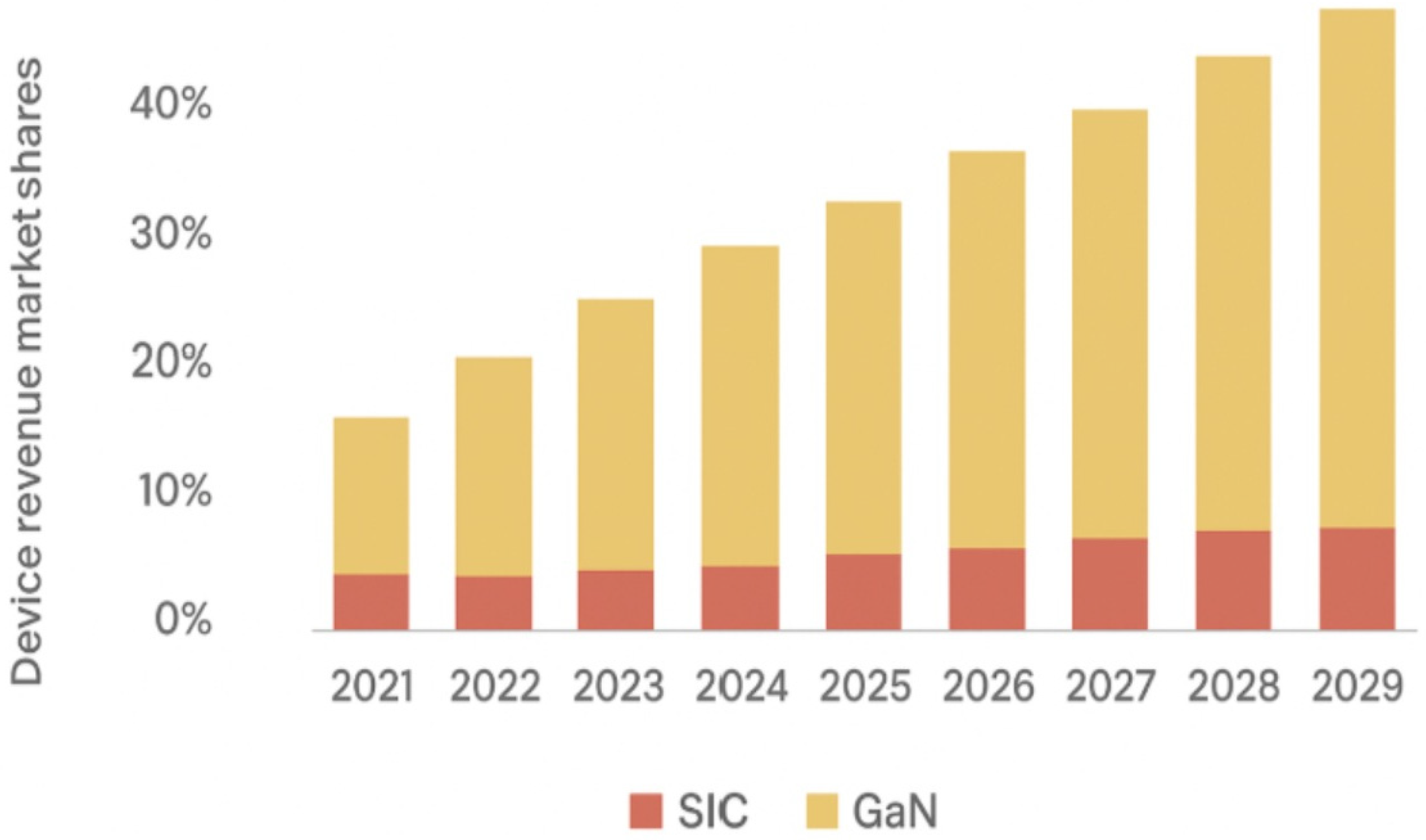
Gallium nitride (GaN) and silicon carbide (SiC) have made significant steps in the power electronics market, revolutionizing how energy is managed in high-performance applications. The enormous growth is demonstrated in Figure 7. GaN is especially prevalent in consumer electronics and data center systems, due to its capacity for high-frequency switching and compact system designs. These characteristics enable manufacturers to produce smaller, lighter, and more energy-efficient power supplies. See Table 3, below for a comparison of SiC, GaN and Si properties. Applications such as USB-C fast chargers, laptop adapters, and server power modules benefit from GaN’s superior switching speed and thermal performance compared with conventional silicon [4,108,109,110,111].
SiC, meanwhile, has seen rapid integration into electric vehicle (EV) platforms and heavy-duty industrial environments. Tesla’s use of SiC transistors in traction inverters since 2017 marked a turning point, showcasing SiC’s ability to handle high voltages and elevated operating temperatures with greater efficiency [112]. These properties make SiC ideal for applications such as onboard vehicle chargers, high-voltage DC-DC converters, and renewable energy inverters. Industrial power modules also leverage SiC for high-power motor drives and grid-interactive converters [108,113,114].
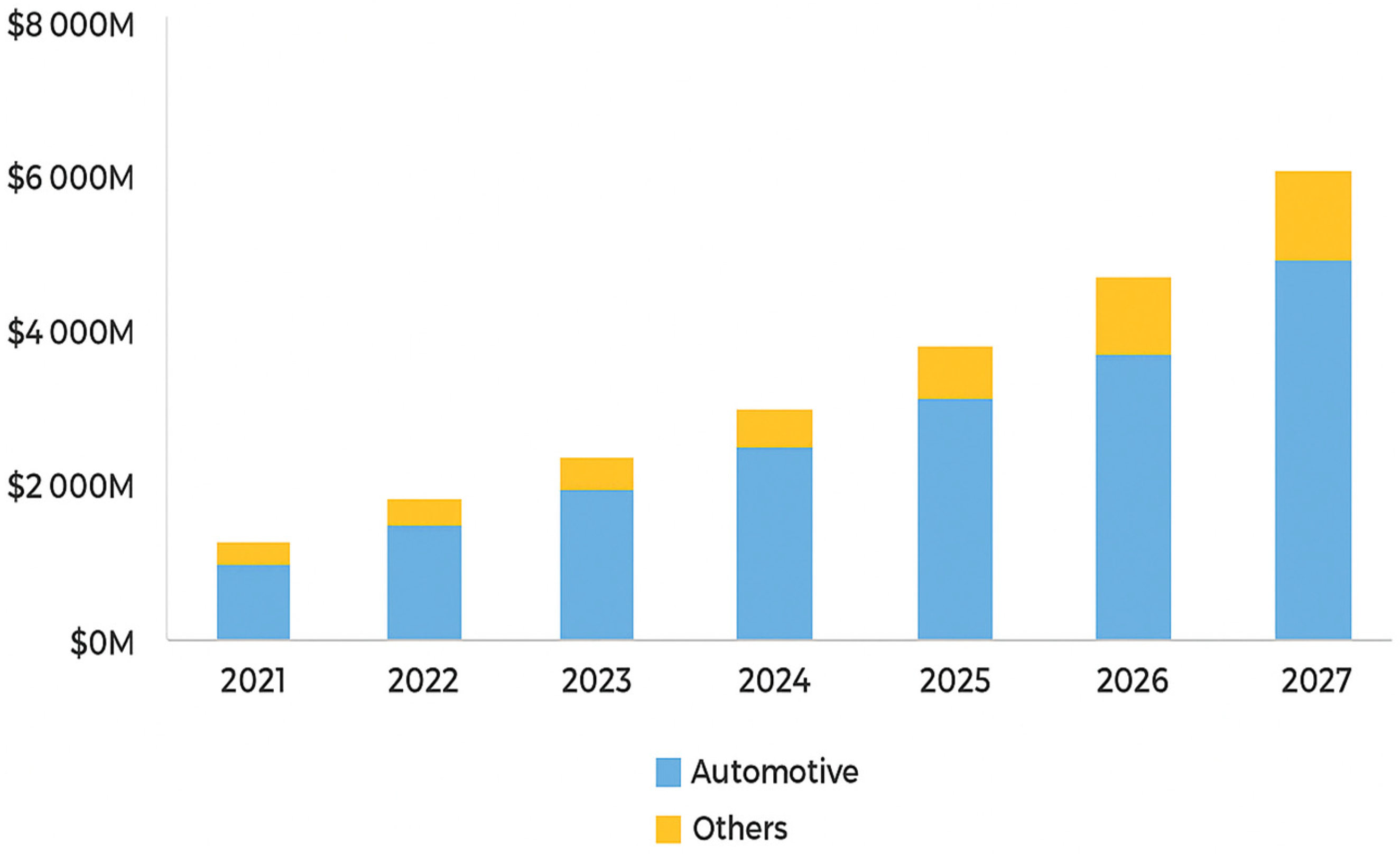
Although GaN and SiC currently occupy a small slice of the overall semiconductor market—estimated at 1–3% and 5–9% respectively—their shares are growing rapidly [111,115], see also Figure 7 and Figure 8 below. The rise of EVs, increased energy efficiency mandates, and the expansion of data infrastructure globally are all fueling this momentum [110,112]. Profit margins on wide-bandgap devices tend to be higher than silicon due to their premium performance, but these margins are balanced against the relatively high production costs and the need for advanced packaging and manufacturing expertise.
Figure 7. Current and projected SiC, GaN market shares. Modified from [116].
Hardware 04 00006 g007

6.1. Cost/Performance Trade-Offs

Despite clear performance benefits, GaN and SiC devices come at a higher manufacturing cost compared with silicon-based semiconductors. The reasons are multifaceted: both require defect-sensitive fabrication environments, advanced packaging solutions, and, in GaN’s case, substrate technologies that mitigate lattice mismatches [117,118]. GaN often uses silicon or sapphire substrates, which introduce stress due to differing thermal expansion rates, raising the complexity and cost of wafer production.
It is also important to note that while GaN and SiC devices typically have smaller die sizes, this does not equate to lower costs per unit. The higher cost per wafer, more advanced packaging needs, and strict performance validation required for these materials often outweigh any potential savings from reduced silicon area. For example, GaN devices can achieve significantly lower figures of merit in switching applications, but the improvements come with complex manufacturing and higher capital equipment investments [109].
Packaging is a particularly important cost component. Traditional silicon packages often fail to meet the thermal and electrical demands of WBG semiconductors. As a result, advanced packaging solutions—such as flip-chip bonding, chip-scale packaging, and heat spreaders made from high-thermal-conductivity materials—are essential for reliable operation [119]. These technologies not only improve heat dissipation but also reduce parasitic inductance and improve switching speed, though they also contribute significantly to total device cost [119].
Manufacturers are increasingly turning to larger wafer sizes to drive down costs. For SiC, the transition from 150 mm to 200 mm wafers is expected to lower the cost-per-die by increasing the number of chips produced per wafer [111,117]. Larger wafers also improve fab efficiency by reducing the number of wafer handling steps needed to meet demand, further optimizing production throughput [114].
Another factor contributing to the economics of WBG semiconductors is their ability to reduce system-level costs. By operating at higher frequencies and temperatures, GaN and SiC devices allow designers to use smaller passive components, reduce cooling requirements, and shrink overall system size [109,111,113]. In power converters, this translates to improved power density and longer device lifespans—factors that improve return on investment over the total cost of ownership [112].
Table 3. Power-frequency capability table comparing silicon carbide (SiC) and gallium nitride (GaN) devices. GaN dominates high-frequency, low-to-medium power ranges due to its superior switching performance, while SiC excels in high-power, high-voltage applications. Modified from ref. [120].
ParameterSilicon (Si) − MOSFET/SJ + IGBT/GTOSilicon Carbide (SiC)Gallium Nitride (GaN)
Power RangeUp to ≈10 kW (SJ MOSFETs); up to 1 MW+ (IGBT/GTO modules)Up to 100 kW+ (scalable to MW in modules)Up to 10 kW+ (scalable to MW in modules)
Switching FrequencyUp to ≈50–200 kHz (SJ MOSFETs); up to ≈20–50 kHz (IGBT/GTO)Up to ≈100–500 kHzUp to ≈1 MHz+
Key StrengthsHigh reliability, cost-effective, broad power handlingHigh efficiency, high temperature tolerance, higher frequency capabilityExtremely high efficiency, superior high-frequency performance
Key LimitationsLower efficiency at high frequencies, automotive, limited high-frequency high-power combinationHigher costHigher cost, limited high-power handling
ApplicationsConsumer electronics, power supplies, automotive (traction inverters), industrial high-power convertersElectric vehicles, renewable energy (inverters), EV chargersConsumer electronics, data centers, wireless power transfer, high-frequency applications

6.2. Industry Players and Roadmaps

Big semiconductor companies are putting serious effort into GaN and SiC to keep up with the demand for efficient, high-power components. Names like Infineon, Wolfspeed, STMicroelectronics, and Navitas are not just ramping up production, they are addressing several bottlenecks in how the materials are made and delivered [4,108,110].

6.2.1. Packaging

One key area is packaging. GaN and SiC devices operate at higher frequencies and voltages than traditional Si, which means they often require more expensive packaging methods to handle heat dissipation and electromagnetic interference. Companies are experimenting with chip scale packaging, embedded die packaging, and multiple chip modules to optimize performance and thermal control [119].

6.2.2. Wafer Capabilities

Another focus is on improving the wafer capabilities. GaN and SiC wafers are historically smaller and harder to manufacture, which limits yields and increases costs. However, players like Wolfspeed are moving toward larger wafers, which allow for more chips per wafer, which decreases costs. These larger wafers also help reduce the defect rates [114,117].

6.2.3. Vertically Integrated Supply Chains

Companies, such as Infineon, STMicroelectronics, and Wolfspeed, are shifting to in-house wafer production to cut reliance on third-party suppliers, such as Taiwan Semiconductor Manufacturing Co, and to gain better control over the quality and consistency of their products. They are also starting to use larger wafers and are forming long-term partnerships with raw material vendors to support growth and reliability [114].
Looking forward, GaN seems to lead in compact, mid-power systems, think mobile chargers and telecom gear, while SiC will remain the go-to option for high-voltage uses like electric vehicles, renewable energy converters, and transportation infrastructure [4,109,111,115].
Figure 8. Power SiC component market forecast by segment (2021–2027). Automotive remains the dominant sector for SiC adoption, driving the majority of growth through 2027. Modified from [121].
Hardware 04 00006 g008

6.3. The Semiconductor Manufacturing Cycle

One issue regarding the economics of GaN and SiC is that they are affected by the broader semiconductor manufacturing cycle. The industry has been known for its Bear and Bull behavior. When demand surges, manufacturers often find themselves unable to meet orders quickly enough. However, scaling production isn’t simple or cheap.
Sometimes companies build new facilities in response to increased demand. However, when the market cools off, those new factories just sit unused for periods until the next boom. This cycle leads investors to hesitate, which slows the progress of new technologies.
However, the industry now has companies using predictive analytics to reduce risks. Some build flexible manufacturing lines that can switch between chip types, or form partnerships with other companies to share capacity. So even though the cycle is still apparent, the damages are mitigated more effectively, which is encouraging for the future of GaN and SiC [118].

7. Thermal Management and Reliability

Thermal management is, from a certain point of view at least, the most important design factor for semiconductor devices. The reason being is that once greater thermal management is achieved, one can make the device smaller, increase the power rating, or both. Thus, the thermal management is usually the wall that power device design runs up against. Even when this is not the case, temperature is still a sensitive variable in all mean time to failure models, irrespective of the modeled failure mode—Black’s equation [122], the Coffin-Manson Model [123], and the Arrhenius Law as it is applied to electronics [124], all are exponentially dependent on temperature. Thus, improved thermal management will increase reliability in virtually every failure mode.

7.1. Material Interfaces

It’s no secret that the main impediment to heat flow in virtually any device is the device material interfaces (e.g., MOSFET, IGBT, diode, SiC/GaN transistor). In GaN HEMTs, it often takes the form of the hot-electron-self-heating effect [125], especially in the region between the gate and the drain, as this is where the electric field is strongest. In SiC, this is usually due to the semiconductor junctions. Either way, the increasing miniaturization of these devices has led to thermal boundary resistance being the primary cause of thermal resistance [16], and as such has been studied extensively. It should be noted that this term (thermal boundary resistance) has many synonyms, including Kapitza resistance, thermal interfacial resistance and thermal boundary conductance, among others. These are not always used interchangeably [16], but they will be in this paper.
For these reasons, researchers have often focused on reducing thermal boundary resistance. Advancements in this area have been made, and there are many good reviews of the research available [16,17,18,126]. To summarize, though, most of the advances have come from new methods to calculate Kapitza resistance with simulations, either from first principles [127,128,129,130] or empirical potentials [131]. Machine learning potentials have also been used; although these are still in their infancy, the results are promising [132]. Methods to calculate the conductance of individual phonon modes have also been developed [129,133]. Because of these advances, we are now better equipped to design interfaces that minimize Kapitza resistance. However, very few interface designs have shown improved thermal conductance, and even fewer have had supporting experimental evidence. Although there are exceptions [134], and one interface where the defect was thermally transparent [127]. Sadly, though, to our knowledge, none of these designs have been implemented in industry. The reason behind this is very likely due to the fact that simulations usually have pristine, perfect interfaces, whereas experiments have interfaces that are sometimes 10’s of nanometers long, with the properties of the interface gradually changing from those of one material to the other.
So far, the minimal thermal resistance achieved with GaN HEMTs has been with a diamond heat spreader [135]. Diamond is highly desirable because it has the highest thermal conductance of any dielectric material. Very often, however, the stiffness of the carbon bonds leads to high phonon/vibrational mode frequencies that are difficult to excite, which leads to high Kapitza resistance [74,75]. In the case of SiC interfaces, the phonons have been shown to be trapped at the interface [128]. The focus of this paper is, of course, power and electrical device applications. However, it is often interesting to remember that the applications of GaN and SiC often extend outside microelectronics. More broadly, the thermal pathway in GaN and SiC devices is a hierarchical hybrid stack, spanning epitaxial interfaces, contacts, die attach, and package-level thermal interfaces, so the effective thermal resistance is set by the cumulative hierarchy rather than any single idealized boundary [136].

7.2. Current Thermal Management Techniques

7.2.1. Silver Sintering

Silver sintering has the potential to somewhat alleviate this in SiC devices, with promising results in both power and thermal cycling [137,138,139,140,141,142,143]. Sintering has also been shown to be more reliable in harsh, high-temperature environments, such as when chips are needed close to brake pads [144]. The success of silver sintering is due in part to the high melting point of silver (963 °C), leading to greater mechanical strength via reduced creep failure modes compared with tin-based solders. In addition, Ag has the highest thermal conductivity of any metal, leading to better thermal management [53]. The primary failure mechanism of such bonds for SiC devices appears to be diffusion and oxidation [145]. Due to the nature of SiC devices being used with high voltage and current, Ag sintering is more useful in SiC devices than in GaN devices, where voltages are usually limited to ~650 V, and frequency switching is the target performance variable. As such, the failure modes of GaN are very different, mostly related to hot electron effects, surface traps and gate reliability. In addition, the external pressure needed for sintering risks cracking the GaN device, which is more brittle than SiC devices. However, Ag sintering without pressure has been shown to improve thermal shock reliability on a GaN die-attached module with a DBA substrate [146]. Furthermore, Abbate and coworkers found in a short-circuit, destructive test that for commercial 650 V e-mode HEMTs, the primary failure mode was likely to be the drain exceeding the melting temperature of the contacts [138], indicating that silver sintering may be very useful for GaN devices as well.
Even with improvement, silver sintering does have failure modes distinct from those of soft solder [142]. Process optimizations of variables pressure, temperature and time of the sintering process in order to produce the most reliable die attach bonds have been studied via finite element analysis [140].

7.2.2. Heat Spreaders

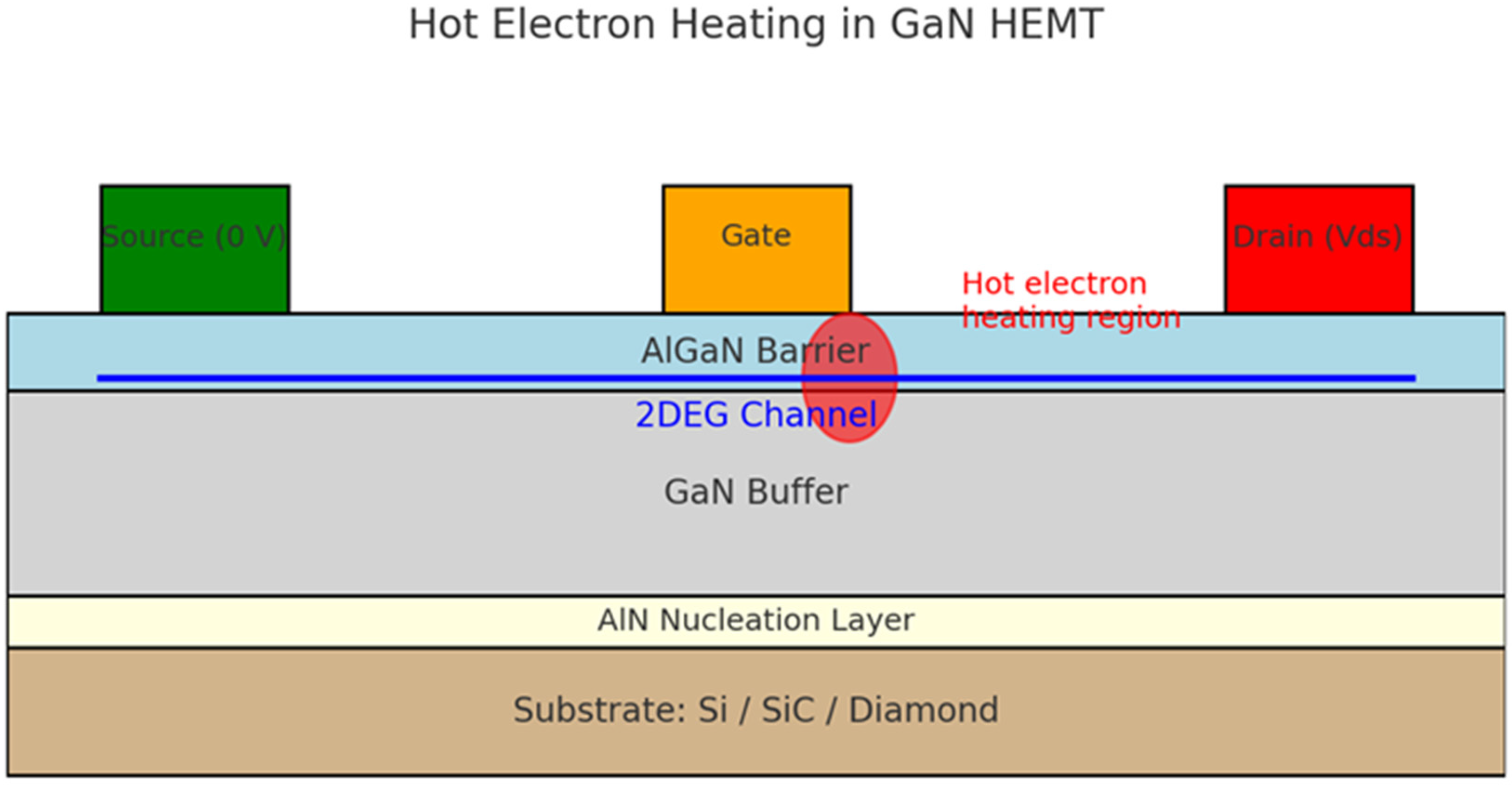
GaN HEMTs have a common failure mode caused by the hot-electron-self-heating effect [125]. This occurs when the hot electrons in the 2DEG gas between the AlGaN/GaN layer become hot and give off that heat in the region between the gate and the drain (see Figure 9). This leads to cracking, pitting, and ultimately device failure. Dissipating heat from this hotspot is critical for GaN HEMTs to reach their full potential, since failure models that account for temperature generally reflect the local temperature at the actual point of failure.
There are several options when manufacturing GaN HEMTs: one could put the GaN on Si or SiC. In either case, an interlayer of AlN is typically used. The ability to grow electronic-grade GaN on AlN is what led to the blue (and by extension white) LED [33]. In order to make this happen, Si is oriented in the (111) direction in order to mimic a hexagonal structure as closely as possible; see Figure 9, below.
Figure 9. Schematic cross-section of a lateral GaN HEMT structure. The device consists of a substrate (Si, SiC, sapphire, or diamond) with a thin AlN nucleation layer, a GaN buffer, and an AlGaN barrier layer that induces a two-dimensional electron gas (2DEG) at the heterointerface. Source, gate, and drain contacts are shown. The drain-side gate edge is highlighted to indicate the hot electron heating region, where high electric fields accelerate channel electrons, leading to localized hotspot formation [2,125].
Hardware 04 00006 g009
Furthermore, one might also try to engineer for mechanical stability, for example, by using materials with the same coefficients of thermal expansion. This is less practical, partly because materials with these properties might not exist, but also because even if they could be found, mechanical strain and stress would still be present because the device is not heated uniformly.

8. Future of Semiconductors

There are various directions and possibilities for the future of semiconductor technology. A major focus is on reducing energy consumption in data centers that support Artificial Intelligence (AI), as well as electric vehicles (EVs). Advances in wide-bandgap semiconductors such as GaN and SiC can significantly improve energy efficiency [119]. In addition, the development of AI accelerators and custom silicon architectures can better support the computational demands of large-scale generative AI workloads [147,148,149].
Research into three-dimensional stacking and advanced packaging techniques can also offer substantial performance gains by improving integration density and reducing interconnect delays [150,151]. Transistor size continues to push the limits, moving toward angstrom-level manufacturing, with process nodes targeting 2.0 nm and 1.4 nm. Though it should be noted that these labels are largely nominal; for example, IBM’s “2 nm” gate-all-around field-effect transistor (GAAFET) is roughly 75 nm tall and 50 nm wide, so getting to the true Angstrom scale is probably still way off [152,153]. Finally, research into cryogenic electronic systems and hybrid classical-quantum architectures is expanding, as these technologies may play a critical role in enabling practical quantum computing [154,155].

9. Conclusions

GaN and SiC have emerged as the most significant wide bandgap semiconductors driving the evolution of modern power electronics. While SiC offers superior thermal conductivity and high-voltage blocking capability, GaN provides faster switching speeds and compact device architectures. Each material has established a distinct application domain: SiC in high-voltage and high-power environments such as electric vehicles and renewable energy, and GaN in medium- and low-voltage systems requiring high-frequency operation and compactness.
Despite these advances, challenges remain in substrate quality, defect management, packaging, and especially thermal boundary resistance at critical interfaces. Addressing these issues will not only improve device performance but also extend operational lifetimes, reduce costs, and accelerate commercial adoption. As fabrication techniques mature and new thermal management strategies are implemented, WBG semiconductors will continue to displace silicon technologies, enabling more efficient and reliable energy systems for the next generation of applications.

Funding

This research received no external funding.

Data Availability Statement

No new data were created or analyzed in this study.

Acknowledgments

C.M.S. would like to thank all of his co-authors for all the hard work they put into the manuscript. The authors would like to acknowledge the use of Microsoft Word for checking spelling, proofreading grammar, and providing some text predictions while writing this article; Grammarly and ChatGPT 5.2 for editing and refining the article; and Zotero for managing references. The authors have reviewed the content and take full responsibility for the final version of the manuscript.

Conflicts of Interest

The authors declare no conflicts of interest.

Abbreviations

WBGWide Band Gap
BPDBasal Plane Dislocation
ALDAtomic Layer Deposition
CMOSComplementary Metal-Oxide-Semiconductor
DBADirect Bonded Aluminum
EMIElectromagnetic Interference
EVElectric Vehicle
HEMTHigh Electron-Mobility Transistor
MOSFETMetal-Oxide-Semiconductor Field-Effect Transistor(s)
LEDLight-Emitting Diode
LLCInductor-Inductor-Capacitor (resonant converter)
MOCVDMetal-Organic Chemical Vapor Deposition
NONitric Oxide (used in passivation/annealing)
PECVDPlasma-Enhanced Chemical Vapor Deposition
PVTPhysical Vapor Transport
RCResistor-Capacitor (circuit element/snubber)
R_ONOn-State Resistance
SABSurface-Activated Bonding
DFTDensity Functional Theory
STStacking Fault
TEDThreading Edge Dislocation
TSDThreading Screw Dislocation
USB-CUniversal Serial Bus Type-C

References

  1. Tolbert, L.M.; Ozpineci, B.; Islam, S.K.; Chinthavali, M.S. Wide Bandgap Semiconductors for Utility Applications. Semiconductors 2003, 1, 1–5. [Google Scholar]
  2. Kaminski, N.; Hilt, O. SiC and GaN devices–wide bandgap is not all the same. IET Circuits Devices Syst. 2014, 8, 227–236. [Google Scholar] [CrossRef]
  3. Pengelly, R.S.; Wood, S.M.; Milligan, J.W.; Sheppard, S.T.; Pribble, W.L. A Review of GaN on SiC High Electron-Mobility Power Transistors and MMICs. IEEE Trans. Microw. Theory Tech. 2012, 60, 1764–1783. [Google Scholar] [CrossRef]
  4. Buffolo, M.; Favero, D.; Marcuzzi, A.; De Santi, C.; Meneghesso, G.; Zanoni, E.; Meneghini, M. Review and Outlook on GaN and SiC Power Devices: Industrial State-of-the-Art, Applications, and Perspectives. IEEE Trans. Electron. Devices 2024, 71, 1344–1355. [Google Scholar] [CrossRef]
  5. Ambacher, O.; Smart, J.; Shealy, J.R.; Weimann, N.G.; Chu, K.; Murphy, M.; Schaff, W.J.; Eastman, L.F.; Dimitrov, R.; Wittmer, L.; et al. Two-dimensional electron gases induced by spontaneous and piezoelectric polarization charges in N- and Ga-face AlGaN/GaN heterostructures. J. Appl. Phys. 1999, 85, 3222–3233. [Google Scholar] [CrossRef]
  6. Shur, M.; Gelmont, B.; Khan, M.A. Electron mobility in two-dimensional electron gas in AIGaN/GaN heterostructures and in bulk GaN. J. Electron. Mater. 1996, 25, 777–785. [Google Scholar] [CrossRef]
  7. Millán, J.; Godignon, P.; Perpiñà, X.; Pérez-Tomás, A.; Rebollo, J. A Survey of Wide Bandgap Power Semiconductor Devices. IEEE Trans. Power Electron. 2014, 29, 2155–2163. [Google Scholar] [CrossRef]
  8. Tanaka, A.; Choi, W.; Chen, R.; Liu, R.; Mook, W.M.; Jungjohann, K.L.; Yu, P.K.L.; Dayeh, S.A. Structural and electrical characterization of thick GaN layers on Si, GaN, and engineered substrates. J. Appl. Phys. 2019, 125, 082517. [Google Scholar] [CrossRef]
  9. Zhong, Y.; Zhang, J.; Wu, S.; Jia, L.; Yang, X.; Liu, Y.; Zhang, Y.; Sun, Q. A review on the GaN-on-Si power electronic devices. Fundam. Res. 2022, 2, 462–475. [Google Scholar] [CrossRef]
  10. Amano, H.; Baines, Y.; Beam, E.; Borga, M.; Bouchet, T.; Chalker, P.R.; Charles, M.; Chen, K.J.; Chowdhury, N.; Chu, R.; et al. The 2018 GaN power electronics roadmap. J. Phys. D Appl. Phys. 2018, 51, 163001. [Google Scholar] [CrossRef]
  11. Garrido-Diez, D.; Baraia, I. Review of wide bandgap materials and their impact in new power devices. In Proceedings of the 2017 IEEE International Workshop of Electronics, Control, Measurement, Signals and their Application to Mechatronics (ECMSM), Donostia, Spain, 24–26 May 2017; IEEE: New York, NY, USA, 2017; pp. 1–6. [Google Scholar] [CrossRef]
  12. Rasul, A.; Teixeira, R.; Baptista, J. Silicon Carbide Converter Design: A Review. Energies 2025, 18, 2140. [Google Scholar] [CrossRef]
  13. Kumar, A.; Moradpour, M.; Losito, M.; Franke, W.-T.; Ramasamy, S.; Baccoli, R.; Gatto, G. Wide Band Gap Devices and Their Application in Power Electronics. Energies 2022, 15, 9172. [Google Scholar] [CrossRef]
  14. Stahlbush, R.E.; Mahadik, N.A.; Lelis, A.J.; Green, R. Effects of Basal Plane Dislocations on SiC Power Device Reliability. In Proceedings of the 2018 IEEE International Electron Devices Meeting (IEDM), San Francisco, CA, USA, 1–5 December 2018; IEEE: New York, NY, USA, 2018; pp. 19.4.1–19.4.4. [Google Scholar] [CrossRef]
  15. Mitani, T.; Eto, K.; Komatsu, N.; Hayashi, Y.; Suo, H.; Kato, T. Reduction of threading screw dislocations in 4H-SiC crystals by a hybrid method with solution growth and physical vapor transport growth. J. Cryst. Growth 2021, 568–569, 126189. [Google Scholar] [CrossRef]
  16. Giri, A.; Hopkins, P.E. A Review of Experimental and Computational Advances in Thermal Boundary Conductance and Nanoscale Thermal Transport across Solid Interfaces. Adv. Funct. Mater. 2020, 30, 1903857. [Google Scholar] [CrossRef]
  17. Stanley, C.M. Thermal Boundary Resistance: A Review of Molecular Dynamics Simulations and Other Computational Methods. Phys. Status Solidi B 2023, 260, 2300095. [Google Scholar] [CrossRef]
  18. Chen, J.; Xu, X.; Zhou, J.; Li, B. Interfacial thermal resistance: Past, present, and future. Rev. Mod. Phys. 2022, 94, 025002. [Google Scholar] [CrossRef]
  19. Tairov, Y.; Tsvetkov, V. Investigation of growth processes of ingots of silicon carbide single crystals. J. Cryst. Growth 1978, 43, 209–212. [Google Scholar] [CrossRef]
  20. Davis, R.F.; Carter, C.H., Jr.; Hunter, C.E. US4866005A-Sublimation of Silicon Carbide to Produce Large, Device Quality Single Crystals of Silicon Carbide. U.S. Patent US4866005A, 12 September 1989. Available online: https://patents.google.com/patent/US4866005A/en (accessed on 3 February 2026).
  21. Matus, L.G.; Powell, J.A.; Salupo, C.S. High-voltage 6H-SiC p-n junction diodes. Appl. Phys. Lett. 1991, 59, 1770–1772. [Google Scholar] [CrossRef]
  22. Palmour, J.W.; Lipkin, L.A. High temperature power devices in silicon carbide. Trans Second Int. High Temp. Electron. Conf. 1994, 1, XI3–XI8. [Google Scholar]
  23. Neudeck, P.G.; Powell, A.J. Performance limiting micropipe defects in silicon carbide wafers. IEEE Electron. Device Lett. 1994, 15, 63–65. [Google Scholar] [CrossRef]
  24. Larkin, D.J.; Neudeck, P.G.; Powell, J.A.; Matus, L.G. Site-competition epitaxy for superior silicon carbide electronics. Appl. Phys. Lett. 1994, 65, 1659–1661. [Google Scholar] [CrossRef]
  25. Willmeroth, A. Schottky Diode Having Overcurrent Protection and Low Reverse Current. U.S. Patent US6861723B2, 1 March 2005. Available online: https://patents.google.com/patent/US6861723B2/en (accessed on 3 February 2026).
  26. Singh, R.; Capell, D.C.; Hefner, A.R.; Lai, J.; Palmour, J.W. High-power 4H-SiC JBS rectifiers. IEEE Trans. Electron. Devices 2002, 49, 2054–2063. [Google Scholar] [CrossRef]
  27. Balkas, E. Revolutionizing Power Electronics with SiC to Pioneer Sustainable Solutions. Available online: https://www.wolfspeed.com/knowledge-center/article/revolutionizing-power-electronics-with-silicon-carbide-to-pioneer-sustainable-solutions/ (accessed on 3 February 2026).
  28. van Brunt, E.; Cheng, L.; O’Loughlin, M.J.; Richmond, J.; Pala, V.; Palmour, J.W.; Tipton, C.W.; Scozzie, C. 27 kV, 20 A 4H-SiC n-IGBTs. Mater. Sci. Forum 2015, 821–823, 847–850. [Google Scholar] [CrossRef]
  29. Kamiński, M.; Król, K.; Kwietniewski, N.; Myśliwiec, M.; Sochacki, M.; Stonio, B.; Kisiel, R.; Martychowiec, A.; Racka-Szmidt, K.; Werbowy, A.; et al. The Overview of Silicon Carbide Technology: Status, Challenges, Key Drivers, and Product Roadmap. Materials 2024, 18, 12. [Google Scholar] [CrossRef] [PubMed]
  30. ROHM Semiconductor-ROHM Co., Ltd. ROHM’s Industry-First* AC/DC Converter ICs of Surface Mount Package with Built-In 1700 V SiC MOSFET. Available online: https://www.rohm.com/news-detail?news-title=industry-first-ac-dc-converter-ics-of-surface-mount-package-w-built-in-1700v-sic-mosfte&defaultGroupId=false (accessed on 3 February 2026).
  31. Thorsen, B. Microchip Unveils Industry-Leading 3.3 kV Silicon Carbide (SiC) Power Devices Enabling New Levels of Efficiency and Reliability: Microchip Technology Incorporated (MCHP). Available online: https://ir.microchip.com/news-events/press-releases/detail/128/microchip-unveils-industry-leading-3-3-kv-silicon-carbide-sic-power-devices-enabling-new-levels-of-efficiency-and-reliability (accessed on 3 February 2026).
  32. Wolfspeed Achieves 300 mm Silicon Carbide (SiC) Technology Breakthrough. Available online: https://investor.wolfspeed.com/news/news-details/2026/Wolfspeed-Achieves-300mm-Silicon-Carbide-SiC-Technology-Breakthrough/default.aspx (accessed on 3 February 2026).
  33. Amano, H.; Sawaki, N.; Akasaki, I.; Toyoda, Y. Metalorganic vapor phase epitaxial growth of a high quality GaN film using an AlN buffer layer. Appl. Phys. Lett. 1986, 48, 353–355. [Google Scholar] [CrossRef]
  34. Amano, H.; Kito, M.; Hiramatsu, K.; Akasaki, I. P-Type Conduction in Mg-Doped GaN Treated with Low-Energy Electron Beam Irradiation (LEEBI). Jpn. J. Appl. Phys. 1989, 28, L2112–L2114. [Google Scholar] [CrossRef]
  35. Akasaki, I. Fascinating journeys into blue light (Nobel Lecture). Ann. Phys. 2015, 527, 311–326. [Google Scholar] [CrossRef]
  36. Khan, M.A.; Bhattarai, A.; Kuznia, J.N.; Olson, D.T. High electron mobility transistor based on a GaN-Alx Ga1−xN heterojunction. Appl. Phys. Lett. 1993, 63, 1214–1215. [Google Scholar] [CrossRef]
  37. Nakamura, S. Background story of the invention of efficient blue InGaN light emitting diodes (Nobel Lecture). Ann. Phys. 2015, 527, 335–349. [Google Scholar] [CrossRef]
  38. Khan, M.A.; Chen, Q.; Sun, C.J.; Yang, J.W.; Blasingame, M.; Shur, M.S.; Park, H. Enhancement and depletion mode GaN/AlGaN heterostructure field effect transistors. Appl. Phys. Lett. 1996, 68, 514–516. [Google Scholar] [CrossRef]
  39. Chen, J.; Cai, Y.; Lau, K. Monolithic Integration of Enhancement- and Depletion-Mode AlGaN/GaN HFETs. U.S. Patent US20070228416A1, 4 October 2007. Available online: https://patents.google.com/patent/US20070228416A1/en (accessed on 3 February 2026).
  40. Suh, C.S.; Mishra, U.K. P-GaN/AlGaN/AlN/GaN Enhancement-Mode Field Effect Transistor. U.S. Patent US7728356B2, 1 June 2010. Available online: https://patents.google.com/patent/US7728356B2/en?oq=US7728356B2 (accessed on 3 February 2026).
  41. Lidow, A.; Beach, R.; Nakata, A.; Cao, J.; Zhao, G.Y. Enhancement Mode GaN HEMT Device and Method for Fabricating the Same. U.S. Patent US8404508B2, 26 March 2013. Available online: https://patents.google.com/patent/US8404508B2/en (accessed on 3 February 2026).
  42. Blake, C. Transphorm Releases Industry’s First JEDEC Qualified 600 V GaN HEMT. Available online: https://www.prnewswire.com/news-releases/transphorm-releases-industrys-first-jedec-qualified-600v-gan-hemt-169500416.html?utm (accessed on 3 February 2026).
  43. Panasonic Develops 600 V GaN Power Transistor with ‘Failure-Free’ Stable Switching Operation. Available online: https://www.semiconductor-today.com/news_items/2013/APR/PANASONIC_040413.html?utm (accessed on 3 February 2026).
  44. Pansier, F. Cascoded Semiconductor Devices. U.S. Patent US20140146428A1, 29 May 2014. Available online: https://patents.google.com/patent/US20140146428A1/en (accessed on 3 February 2026).
  45. Degans, H. Imec Advances 200 mm GaN-on-Si Technology Closer to Manufacturing. Available online: https://www.imec-int.com/en/articles/imec-advances-200mm-gan-on-si-technology-closer-to-manufacturing?utm (accessed on 3 February 2026).
  46. Degans, H. 200 V and 650 V Power Devices on 200 mm Wafers. Available online: https://www.imec-int.com/en/articles/imec-world-first-to-develop-200v-and-650v-dispersion-free-normally-off-e-mode-power-devices-on-200mm-8-inch-si-wafers (accessed on 3 February 2026).
  47. Oliver, S. Navitas Delivers the World’s First GaN Power ICs. Available online: https://www.prweb.com/releases/navitas_delivers_the_world_s_first_gan_power_ics/prweb14045856.htm?utm (accessed on 3 February 2026).
  48. GaN Systems Launches Family of AEC-Q101-Qualified 650 V, 60 A Transistors. Available online: https://www.semiconductor-today.com/news_items/2020/oct/gansystems-201020.shtml?utm (accessed on 3 February 2026).
  49. Burner, M. Infineon Pioneers World’s First 300 mm Power Gallium Nitride (GaN) Technology—An Industry Game-Changer. Available online: https://www.infineon.com/press-release/2024/infxx202409-142 (accessed on 3 February 2026).
  50. Burner, M. Infineon Introduces CoolGaNTM Bidirectional Switch 650 V G5 for Enhanced Efficiency and Reliability in Power Systems. Available online: https://www.infineon.com/market-news/2025/infpss202505-103 (accessed on 3 February 2026).
  51. ROHM Semiconductor-ROHM Co., Ltd. ROHM Launches 650 V GaN HEMT in a Compact, High-Heat Dissipation TOLL Package. Available online: https://www.rohm.com/news-detail?defaultGroupId=false&news-title=2025-02-27_news_gan (accessed on 3 February 2026).
  52. Navitas. Navitas Showcases Advances in GaN and SiC Technologies, Including World’s First Production Released 650 V Bi-Directional GaNFastTM ICs at PCIM 2025. Available online: https://navitassemi.com/navitas-showcases-advances-in-gan-and-sic-technologies-including-worlds-first-production-released-650v-bi-directional-ganfast-ics-at-pcim-2025/ (accessed on 3 February 2026).
  53. Li, S.; Ouyang, C. First principles study of wurtzite and zinc blende GaN: A comparison of the electronic and optical properties. Phys. Lett. A 2005, 336, 145–151. [Google Scholar] [CrossRef]
  54. Qin, H.; Luan, X.; Feng, C.; Yang, D.; Zhang, G. Mechanical, Thermodynamic and Electronic Properties of Wurtzite and Zinc-Blende GaN Crystals. Materials 2017, 10, 1419. [Google Scholar] [CrossRef] [PubMed]
  55. Physicoro. English: Illustration of the Unit Cell of the Zincblende Structure. 2012. Available online: https://commons.wikimedia.org/wiki/File:Zincblende_structure.png#filelinks (accessed on 4 February 2026).
  56. File:Wurtzite Polyhedra.png-Wikipedia. Available online: https://commons.wikimedia.org/wiki/File:Wurtzite_polyhedra.png (accessed on 4 February 2026).
  57. Tanaka, A.; Choi, W.; Chen, R.; Dayeh, S.A. Si Complies with GaN to Overcome Thermal Mismatches for the Heteroepitaxy of Thick GaN on Si. Adv. Mater. 2017, 29, 1702557. [Google Scholar] [CrossRef] [PubMed]
  58. Lee, H.-J.; Bae, S.-Y.; Lekhal, K.; Mitsunari, T.; Tamura, A.; Honda, Y.; Amano, H. Improved crystal quality of semipolar (1013) GaN on Si(001) substrates using AlN/GaN superlattice interlayer. J. Cryst. Growth 2016, 454, 114–120. [Google Scholar] [CrossRef]
  59. Cheng, K.; Leys, M.; Degroote, S.; Germain, M.; Borghs, G. High quality GaN grown on silicon(111) using a SixNy interlayer by metal-organic vapor phase epitaxy. Appl. Phys. Lett. 2008, 92, 192111. [Google Scholar] [CrossRef]
  60. Mu, F.; Wang, Y.; He, R.; Suga, T. Direct wafer bonding of GaN-SiC for high power GaN-on-SiC devices. Materialia 2018, 3, 12–14. [Google Scholar] [CrossRef]
  61. Chen, J.-T.; Pomeroy, J.W.; Rorsman, N.; Xia, C.; Virojanadara, C.; Forsberg, U.; Kuball, M.; Janzén, E. Low thermal resistance of a GaN-on-SiC transistor structure with improved structural properties at the interface. J. Cryst. Growth 2015, 428, 54–58. [Google Scholar] [CrossRef]
  62. Materialscientist. English: 4H-SiC Structure with Stacking Sequence Marked. 2009. Available online: https://commons.wikimedia.org/wiki/File:SiC4H_structure_A.jpg (accessed on 4 February 2026).
  63. Materialscientist. English: 6H-SiC Structure with Stacking Sequence Marked. Available online: https://commons.wikimedia.org/wiki/File:SiC6HstructureA.jpg (accessed on 4 February 2026).
  64. Materialscientist. English: Structure of 2009. Available online: https://commons.wikimedia.org/wiki/File:SiC3Cstructure.jpg (accessed on 4 February 2026).
  65. Matsunami, H.; Kimoto, T. Step-controlled epitaxial growth of SiC: High quality homoepitaxy. Mater. Sci. Eng. R. Rep. 1997, 20, 125–166. [Google Scholar] [CrossRef]
  66. Wang, G.; Sheng, D.; Yang, Y.; Li, H.; Chai, C.; Xie, Z.; Wang, W.; Guo, J.; Chen, X. High-Quality and Wafer-Scale Cubic Silicon Carbide Single Crystals. ENERGY Environ. Mater. 2024, 7, e12678. [Google Scholar] [CrossRef]
  67. La Via, F.; Zimbone, M.; Bongiorno, C.; La Magna, A.; Fisicaro, G.; Deretzis, I.; Scuderi, V.; Calabretta, C.; Giannazzo, F.; Zielinski, M.; et al. New Approaches and Understandings in the Growth of Cubic Silicon Carbide. Materials 2021, 14, 5348. [Google Scholar] [CrossRef]
  68. Hassan, J.; Bergman, J.P.; Henry, A.; Janzén, E. On-axis homoepitaxial growth on Si-face 4H–SiC substrates. J. Cryst. Growth 2008, 310, 4424–4429. [Google Scholar] [CrossRef]
  69. Giri, A.; Walton, S.G.; Tomko, J.; Bhatt, N.; Johnson, M.J.; Boris, D.R.; Lu, G.; Caldwell, J.D.; Prezhdo, O.V.; Hopkins, P.E. Ultrafast and Nanoscale Energy Transduction Mechanisms and Coupled Thermal Transport across Interfaces. ACS Nano 2023, 17, 14253–14282. [Google Scholar] [CrossRef] [PubMed]
  70. Walwil, H.; Song, Y.; Shoemaker, D.C.; Kang, K.; Mirabito, T.; Redwing, J.M.; Choi, S. Thermophysical property measurement of GaN/SiC, GaN/AlN, and AlN/SiC epitaxial wafers using multi-frequency/spot-size time-domain thermoreflectance. J. Appl. Phys. 2025, 137, 095105. [Google Scholar] [CrossRef]
  71. Liu, H.; Zhang, X.; Xu, N.; Han, C.; Wu, N.; Wang, B.; Wang, Y. Progress of One-Dimensional SiC Nanomaterials: Design, Fabrication and Sensing Applications. Nanomaterials 2024, 14, 187. [Google Scholar] [CrossRef] [PubMed]
  72. Haque, M.M.; Choudhury, S.M. Tailoring electronic and optoelectronic properties of 2D-SiC via defects and doping: A first-principles study toward efficient white light-emitting diodes. RSC Adv. 2025, 15, 29335–29366. [Google Scholar] [CrossRef] [PubMed]
  73. Criswell, S.G.; Mahadik, N.A.; Gallagher, J.C.; Barnett, J.; Kim, L.; Ghorbani, M.; Kamaliya, B.; Bassim, N.D.; Taubner, T.; Caldwell, J.D. Nanoscale Infrared Spectroscopic Characterization of Extended Defects in 4H-Silicon Carbide. Nano Lett. 2024, 24, 114–121. [Google Scholar] [CrossRef]
  74. He, L.; Yang, F.; Yao, Y.; Zheng, Y.; Zhang, J.; Li, L.; He, Z.; Ni, Y.; Gu, X.; Liu, Y. A review of selective area grown recess structure for insulated-gate E-mode GaN transistors. Jpn. J. Appl. Phys. 2020, 59, SA0806. [Google Scholar] [CrossRef]
  75. Langpoklakpam, C.; Liu, A.-C.; Chu, K.-H.; Hsu, L.-H.; Lee, W.-C.; Chen, S.-C.; Sun, C.-W.; Shih, M.-H.; Lee, K.-Y.; Kuo, H.-C. Review of Silicon Carbide Processing for Power MOSFET. Crystals 2022, 12, 245. [Google Scholar] [CrossRef]
  76. Tian, K.; Hallen, A.; Qi, J.; Ma, S.; Fei, X.; Zhang, A.; Liu, W. An Improved 4H-SiC Trench-Gate MOSFET With Low ON-Resistance and Switching Loss. IEEE Trans. Electron Devices 2019, 66, 2307–2313. [Google Scholar] [CrossRef]
  77. Deng, X.; Guo, Y.; Dai, T.; Li, C.; Chen, X.; Chen, W.; Zhang, Y.; Zhang, B. A robust and area-efficient guard ring edge termination technique for 4H-SiC power MOSFETs. Mater. Sci. Semicond. Process. 2017, 68, 108–113. [Google Scholar] [CrossRef]
  78. Zhang, Y.; Li, J.; Wang, J.; Zheng, T.Q.; Jia, P. Dynamic-State Analysis of Inverter Based on Cascode GaN HEMTs for PV Application. Energies 2022, 15, 7791. [Google Scholar] [CrossRef]
  79. Neudeck, P.G.; Spry, D.J.; Krasowski, M.J.; Chang, C.W.; Gonzalez, J.M.; Rajgopal, S.; Prokop, N.F.; Greer, L.C.; Lukco, D.; Maldonado-Rivera, S.; et al. Recent Progress in Extreme Environment Durable SiC JFET-R Integrated Circuit Technology. Int. Symp. Microelectron. 2023, 2023, 43–48. [Google Scholar] [CrossRef]
  80. Fu, H.; Fu, K.; Chowdhury, S.; Palacios, T.; Zhao, Y. Vertical GaN Power Devices: Device Principles and Fabrication Technologies—Part I. IEEE Trans. Electron. Devices 2021, 68, 3200–3211. [Google Scholar] [CrossRef]
  81. Zhang, H.; Sun, Y.; Hu, K.; Yang, L.; Liang, K.; Xing, Z.; Wang, H.; Zhang, M.; Yu, H.; Fang, S.; et al. Boosted high-temperature electrical characteristics of AlGaN/GaN HEMTs with rationally designed compositionally graded AlGaN back barriers. Sci. China Inf. Sci. 2023, 66, 182405. [Google Scholar] [CrossRef]
  82. Narang, K.; Pandey, A.; Khan, R.; Singh, V.K.; Bag, R.K.; Padmavati, M.; Tyagi, R.; Singh, R. High-quality AlN nucleation layer on SiC substrate grown by MOVPE: Growth, structural and optical characteristics. Mater. Sci. Eng. B 2022, 278, 115635. [Google Scholar] [CrossRef]
  83. Singhal, J.; Chaudhuri, R.; Hickman, A.; Protasenko, V.; Xing, H.G.; Jena, D. Toward AlGaN channel HEMTs on AlN: Polarization-induced 2DEGs in AlN/AlGaN/AlN heterostructures. APL Mater. 2022, 10, 111120. [Google Scholar] [CrossRef]
  84. Papamichail, A.; Kakanakova-Georgieva, A.; Sveinbjörnsson, E.Ö.; Persson, A.R.; Hult, B.; Rorsman, N.; Stanishev, V.; Le, S.P.; Persson, P.O.Å.; Nawaz, M.; et al. Mg-doping and free-hole properties of hot-wall MOCVD GaN. J. Appl. Phys. 2022, 131, 185704. [Google Scholar] [CrossRef]
  85. Roccaforte, F.; Giannazzo, F.; Greco, G. Ion Implantation Doping in Silicon Carbide and Gallium Nitride Electronic Devices. Micro 2022, 2, 23–53. [Google Scholar] [CrossRef]
  86. Wu, F.; Zhang, J.; Xi, W.; Chi, Y.; Liu, Q.; Yang, L.; Ma, H.; Zhang, Q. Insights into the effects of Al-ion implantation temperature on material properties of 4H-SiC. Appl. Surf. Sci. 2023, 613, 156014. [Google Scholar] [CrossRef]
  87. Subhani, K.N.; Remesh, N.; S, N.; Raghavan, S.; R, M.; Nath, D.N.; Bhat, K.N. Nitrogen rich PECVD silicon nitride for passivation of Si and AlGaN/GaN HEMT devices. Solid-State Electron. 2021, 186, 108188. [Google Scholar] [CrossRef]
  88. Calzolaro, A.; Mikolajick, T.; Wachowiak, A. Status of Aluminum Oxide Gate Dielectric Technology for Insulated-Gate GaN-Based Devices. Materials 2022, 15, 791. [Google Scholar] [CrossRef]
  89. Yatabe, Z.; Asubar, J.T.; Hashizume, T. Insulated gate and surface passivation structures for GaN-based power transistors. J. Phys. Appl. Phys. 2016, 49, 393001. [Google Scholar] [CrossRef]
  90. Wu, Y.; Wei, J.; Wang, M.; Nuo, M.; Yang, J.; Lin, W.; Zheng, Z.; Zhang, L.; Hua, M.; Yang, X.; et al. An Actively-Passivated p-GaN Gate HEMT With Screening Effect Against Surface Traps. IEEE Electron. Device Lett. 2023, 44, 25–28. [Google Scholar] [CrossRef]
  91. Siddiqui, A.; Elgabra, H.; Singh, S. The Current Status and the Future Prospects of Surface Passivation in 4H-SiC Transistors. IEEE Trans. Device Mater. Reliab. 2016, 16, 419–428. [Google Scholar] [CrossRef]
  92. Yazdanfar, M.; Stenberg, P.; Booker, I.; Ivanov, I.; Kordina, O.; Pedersen, H.; Janzén, E. Process stability and morphology optimization of very thick 4H–SiC epitaxial layers grown by chloride-based CVD. J. Cryst. Growth 2013, 380, 55–60. [Google Scholar] [CrossRef]
  93. Racka-Szmidt, K.; Stonio, B.; Żelazko, J.; Filipiak, M.; Sochacki, M. A Review: Inductively Coupled Plasma Reactive Ion Etching of Silicon Carbide. Materials 2021, 15, 123. [Google Scholar] [CrossRef]
  94. Yaakub, M.F.; Radzi, M.A.M.; Noh, F.H.M.; Azri, M. Silicon carbide power device characteristics, applications and challenges: An overview. Int. J. Power Electron. Drive Syst. IJPEDS 2020, 11, 2194. [Google Scholar] [CrossRef]
  95. Cittanti, D.; Vico, E.; Bojoi, I.R. New FOM-Based Performance Evaluation of 600/650 V SiC and GaN Semiconductors for Next-Generation EV Drives. IEEE Access 2022, 10, 51693–51707. [Google Scholar] [CrossRef]
  96. Tu, C.-C.; Hung, C.-L.; Hong, K.-B.; Elangovan, S.; Yu, W.-C.; Hsiao, Y.-S.; Lin, W.-C.; Kumar, R.; Huang, Z.-H.; Hong, Y.-H.; et al. Industry perspective on power electronics for electric vehicles. Nat. Rev. Electr. Eng. 2024, 1, 435–452. [Google Scholar] [CrossRef]
  97. Shi, B.; Ramones, A.I.; Liu, Y.; Wang, H.; Li, Y.; Pischinger, S.; Andert, J. A review of silicon carbide MOSFETs in electrified vehicles: Application, challenges, and future development. IET Power Electron. 2023, 16, 2103–2120. [Google Scholar] [CrossRef]
  98. Wang, Y.; Wang, K.; Yang, Y.; Hui, S.Y.R. Design, Implementation, and Comparison of Multi-MHz Multi-kW H-Bridge Inverters Based on 650V SiC and GaN Devices for High-Frequency WPT. In Proceedings of the 2024 IEEE Energy Conversion Congress and Exposition (ECCE), Phoenix, AZ, USA, 20–24 October 2024; IEEE: Piscataway, NJ, USA, 2024; pp. 2007–2012. [Google Scholar] [CrossRef]
  99. Musumeci, S.; Barba, V. Gallium Nitride Power Devices in Power Electronics Applications: State of Art and Perspectives. Energies 2023, 16, 3894. [Google Scholar] [CrossRef]
  100. Lottis, C.; Sah, B.; Sprunck, S.; Jung, M.; Deck, P.; Dick, C. Comparison and Selection of Topology for Three Phase PV Inverters based on Power GaN Devices. In Proceedings of the 2024 Energy Conversion Congress & Expo Europe (ECCE Europe), Darmstadt, Germany, 2–6 September 2024. [Google Scholar]
  101. Abdullah, D. Comparative Analysis of SIC and GAN-Based Power Converters in Renewable Energy Systems. Natl. J. Electr. Mach. Power Convers. 2025, 1, 11–20. [Google Scholar]
  102. Xiong, Y.; Sadek, M.; Chu, R. Recent advances in GaN-based power devices and integrations. Semicond. Sci. Technol. 2025, 40, 033002. [Google Scholar] [CrossRef]
  103. Suthar, A.; Venkataramanaiah, J.; Suresh, Y. Conventional, wide-bandgap, and hybrid power converters: A comprehensive review. Renew. Sustain. Energy Rev. 2025, 213, 115419. [Google Scholar] [CrossRef]
  104. Esmer, S.; Aytar, O. Comparison of the performance of Si, SiC, and GaN based switching elements in high gain DC-DC boost converter. J. Electr. Eng. 2024, 75, 392–398. [Google Scholar] [CrossRef]
  105. Taylor, A.; Lu, J.; Zhu, L.; Bai, K.; McAmmond, M.; Brown, A. Comparison of SiC MOSFET-based and GaN HEMT-based high-efficiency high-power-density 7.2 kW EV battery chargers. IET Power Electron. 2018, 11, 1849–1857. [Google Scholar] [CrossRef]
  106. Lim, K.H.; Razali, M.A. Comparison of Silicon MOSFET, Silicon Carbide MOSFET and Gallium Nitride MOSFET in EV Charging Application. Evol. Electr. Electron. Eng. 2024, 5, 8–16. [Google Scholar]
  107. Kumar, B.A.; Alam, M. Analysis of SiC and GaN Based Hybrid Switch For Different Switching Combinations. In Proceedings of the 2024 IEEE 3rd International Conference on Electrical Power and Energy Systems (ICEPES), Bhopal, India, 21–22 June 2024; IEEE: Bhopal, India, 2024; pp. 1–6. [Google Scholar] [CrossRef]
  108. Roccaforte, F.; Fiorenza, P.; Greco, G.; Nigro, R.L.; Giannazzo, F.; Iucolano, F.; Saggio, M. Microelectronic Engineering Emerging trends in wide band gap semiconductors (SiC and GaN) technology for power devices. Microelectron. Eng. 2018, 187–188, 66–77. [Google Scholar] [CrossRef]
  109. Rafin, S.; Ahmed, R.; Haque, M.; Hossain, M.; Haque, M.; Mohammed, O. Power Electronics Revolutionized: A Comprehensive Analysis of Emerging Wide and Ultrawide Bandgap Devices. Micromachines 2023, 14, 2045. [Google Scholar] [CrossRef]
  110. Singh, S.; Chaudhary, T.; Khanna, G. Recent Advancements in Wide Band Semiconductors (SiC and GaN) Technology for Future Devices. Silicon 2022, 14, 5793–5800. [Google Scholar] [CrossRef]
  111. Chaudhary, O.S.; Denaï, M.; Refaat, S.S.; Pissanidis, G. Technology and Applications of Wide Bandgap Semiconductor Materials: Current State and Future Trends. Energies 2023, 16, 6689. [Google Scholar] [CrossRef]
  112. Warren, J.A.; Riddle, M.E.; Graziano, D.J.; Das, S.; Upadhyayula, V.K.K.; Masanet, E.; Cresko, J. Energy Impacts of Wide Band Gap Semiconductors in U.S. Light-Duty Electric Vehicle Fleet. Environ. Sci. Technol. 2015, 49, 10294–10302. [Google Scholar] [CrossRef]
  113. Rodríguez-Benítez, O.M.; Ponce-Silva, M.; Aquí-Tapia, J.A.; Claudio-Sánchez, A.; Vela-Váldes, L.G.; Lozoya-Ponce, R.E.; Cortés-García, C. Comparative Performance and Assessment Study of a Current-Fed DC-DC Resonant Converter Combining Si, SiC, and GaN-Based Power Semiconductor Devices. Electronics 2020, 9, 1982. [Google Scholar] [CrossRef]
  114. Horowitz, K.; Remo, T.; Reese, S. A Manufacturing Cost and Supply Chain Analysis of SiC Power Electronics Applicable to Medium-Voltage Motor Drives; NREL/TP--6A20-67694; Clean Energy Manufacturing Analysis Center: Golden, CO, USA, 2017; p. 1349212. [Google Scholar] [CrossRef]
  115. Tsao, J.Y.; Chowdhury, S.; Hollis, M.A.; Jena, D.; Johnson, N.M.; Jones, K.A.; Kaplar, R.J.; Rajan, S.; Van de Walle, C.G.; Bellotti, E.; et al. Ultrawide-Bandgap Semiconductors: Research Opportunities and Challenges. Adv. Electron. Mater. 2018, 4, 1600501. [Google Scholar] [CrossRef]
  116. Yole Group. YG PRESS NEWS-Investment and M&A to Transform Power SiC and GaN Markets. Available online: https://web.archive.org/web/20240724085646/https://www.yolegroup.com/press-release/yg-press-news-investment-and-ma-to-transform-power-sic-and-gan-markets/ (accessed on 3 February 2026).
  117. Yeboah, L.A.; Malik, A.A.; Oppong, P.A.; Acheampong, P.S.; Morgan, J.A.; Addo, R.A.A.; Henyo, B.W.; Taylor, S.T.; Zudor, W.M.; Osei-Amponsah, S. Wide-Bandgap Semiconductors: A Critical Analysis of GaN, SiC, AlGaN, Diamond, and Ga2O3 Synthesis Methods, Challenges, and Prospective Technological Innovations. Intell. Sustain. Manuf. 2025, 2, 10011. [Google Scholar] [CrossRef]
  118. Shangguan, Q.; Lv, Y.; Jiang, C. A Review of Wide Bandgap Semiconductors: Insights into SiC, IGZO, and Their Defect Characteristics. Nanomaterials 2024, 14, 1679. [Google Scholar] [CrossRef]
  119. Han, G.; Kim, J.; Park, S.; Bae, W. Thermal Management of Wide-Bandgap Power Semiconductors: Strategies and Challenges in SiC and GaN Power Devices. Electronics 2025, 14, 4193. [Google Scholar] [CrossRef]
  120. Choosing SiC or GaN over Si Comes with Many Considerations. Available online: https://web.archive.org/web/20251104000401/https://www.powersystemsdesign.com/articles/choosing-sic-or-gan-over-si-comes-with-many-considerations/138/20500 (accessed on 4 February 2026).
  121. Power SiC—Manufacturing 2024. Available online: https://www.yolegroup.com/product/report/power-sic---manufacturing-2024/ (accessed on 4 February 2026).
  122. Black, J.R. Electromigration—A brief survey and some recent results. IEEE Trans. Electron. Devices 1969, 16, 338–347. [Google Scholar] [CrossRef]
  123. Jacques, S.; Caldeira, A.; Batut, N.; Schellmanns, A.; Leroy, R.; Gonthier, L. A Coffin-Manson model to predict the TRIAC solder joints fatigue during power cycling. In Proceedings of the 2011 14th European Conference on Power Electronics and Applications, Birmingham, UK, 30 August–1 September 2011; pp. 1–8. [Google Scholar]
  124. Webber, A. Calculating useful lifetimes of embedded processors. Appl. Rep. Tex. Instrum. 2014, 1–9. Available online: https://www.ti.com/lit/an/sprabx4b/sprabx4b.pdf?ts=1773713603630 (accessed on 1 January 2026).
  125. Meneghini, M.; Hilt, O.; Wuerfl, J.; Meneghesso, G. Technology and Reliability of Normally-Off GaN HEMTs with p-Type Gate. Energies 2017, 10, 153. [Google Scholar] [CrossRef]
  126. Monachon, C.; Weber, L.; Dames, C. Thermal Boundary Conductance: A Materials Science Perspective. Annu. Rev. Mater. Res. 2016, 46, 433–463. [Google Scholar] [CrossRef]
  127. Stanley, C.M. The Impact of Interface Defects on Thermal Boundary Resistance at a Si|C Interface. Phys. Status Solidi A 2022, 219, 2200175. [Google Scholar] [CrossRef]
  128. Bebek, M.B.; Stanley, C.M.; Gibbons, T.M.; Estreicher, S.K. Temperature dependence of phonon-defect interactions: Phonon scattering vs. phonon trapping. Sci. Rep. 2016, 6, 32150. [Google Scholar] [CrossRef] [PubMed]
  129. Stanley, C.M.; Rader, B.K.; Laster, B.H.D.; Servati, M.; Estreicher, S.K. The Role of Interface Vibrational Modes in Thermal Boundary Resistance. Phys. Status Solidi A 2021, 218, 2100111. [Google Scholar] [CrossRef]
  130. Zhang, W.; Fisher, T.S.; Mingo, N. The Atomistic Green’s Function Method: An Efficient Simulation Approach for Nanoscale Phonon Transport. Numer. Heat. Transf. Part B Fundam. 2007, 51, 333–349. [Google Scholar] [CrossRef]
  131. Gordiz, K.; Henry, A. Phonon transport at interfaces between different phases of silicon and germanium. J. Appl. Phys. 2017, 121, 025102. [Google Scholar] [CrossRef]
  132. Wyant, S.; Rohskopf, A.; Henry, A. Machine learned interatomic potentials for modeling interfacial heat transport in Ge/GaAs. Comput. Mater. Sci. 2021, 200, 110836. [Google Scholar] [CrossRef]
  133. Gordiz, K.; Henry, A. A formalism for calculating the modal contributions to thermal interface conductance. New J. Phys. 2015, 17, 103002. [Google Scholar] [CrossRef]
  134. Giri, A.; King, S.W.; Lanford, W.A.; Mei, A.B.; Merrill, D.; Li, L.; Oviedo, R.; Richards, J.; Olson, D.H.; Braun, J.L.; et al. Interfacial Defect Vibrations Enhance Thermal Transport in Amorphous Multilayers with Ultrahigh Thermal Boundary Conductance. Adv. Mater. 2018, 30, 1804097. [Google Scholar] [CrossRef]
  135. Sang, L. Diamond as the heat spreader for the thermal dissipation of GaN-based electronic devices. Funct. Diam. 2021, 1, 174–188. [Google Scholar] [CrossRef]
  136. Medrano-Lopez, J.A.; Villalpando, I.; Salazar, M.I.; Torres-Torres, C. Hierarchical Nanobiosensors at the End of the SARS-CoV-2 Pandemic. Biosensors 2024, 14, 108. [Google Scholar] [CrossRef]
  137. Kim, D.; Yamamoto, Y.; Nagao, S.; Wakasugi, N.; Chen, C.; Suganuma, K. Measurement of Heat Dissipation and Thermal-Stability of Power Modules on DBC Substrates with Various Ceramics by SiC Micro-Heater Chip System and Ag Sinter Joining. Micromachines 2019, 10, 745. [Google Scholar] [CrossRef]
  138. Abbate, C.; Busatto, G.; Sanseverino, A.; Tedesco, D.; Velardi, F. Failure analysis of 650 V enhancement mode GaN HEMT after short circuit tests. Microelectron. Reliab. 2018, 88–90, 677–683. [Google Scholar] [CrossRef]
  139. Zhang, Z.; Chen, C.; Suetake, A.; Hsieh, M.-C.; Suganuma, K. Reliability of Ag Sinter-Joining Die Attach Under Harsh Thermal Cycling and Power Cycling Tests. J. Electron. Mater. 2021, 50, 6597–6606. [Google Scholar] [CrossRef]
  140. Calabretta, M.; Sitta, A.; Oliveri, S.M.; Sequenzia, G. Design and Process Optimization of a Sintered Joint for Power Electronics Automotive Applications. In Design Tools and Methods in Industrial Engineering; Rizzi, C., Andrisano, A.O., Leali, F., Gherardini, F., Pini, F., Vergnano, A., Eds.; Springer International Publishing: Cham, Switzerland, 2020; pp. 470–480. [Google Scholar] [CrossRef]
  141. Knoerr, M.; Schletz, A. Power semiconductor joining through sintering of silver nanoparticles: Evaluation of influence of parameters time, temperature and pressure on density, strength and reliability. In Proceedings of the 2010 6th International Conference on Integrated Power Electronics Systems, Nuremberg, Germany, 16–18 March 2010; IEEE: Nuremberg, Germany, 2010; pp. 1–6. Available online: https://ieeexplore.ieee.org/abstract/document/5730660 (accessed on 3 February 2026).
  142. Dudek, R.; Doring, R.; Sommer, P.; Seiler, B.; Kreyssig, K.; Walter, H.; Becker, M.; Gunther, M. Combined experimental- and FE-studies on sinter-Ag behaviour and effects on IGBT-module reliability. In Proceedings of the 2014 15th International Conference on Thermal, Mechanical and Mulit-Physics Simulation and Experiments in Microelectronics and Microsystems (EuroSimE), Ghent, Belgium, 7–9 April 2014; IEEE: Ghent, Belgium, 2014; pp. 1–9. [Google Scholar] [CrossRef]
  143. Knoerr, M.; Kraft, S.; Schletz, A. Reliability assessment of sintered nano-silver die attachment for power semiconductors. In Proceedings of the 2010 12th Electronics Packaging Technology Conference, Singapore, 8–10 December 2010; IEEE: Singapore, 2010; pp. 56–61. [Google Scholar] [CrossRef]
  144. Kim, S.; Kim, J.; Kim, M.-S.; Park, J.; Mhin, S.; Kim, D. Physics of failure and high-temperature reliability on Ag sintered ENIG finished die-attachments at 175 °C for integration of in-wheel motor systems. Microelectron. Reliab. 2023, 150, 115090. [Google Scholar] [CrossRef]
  145. Zhang, H.; Zhao, Z.; Zou, G.; Wang, W.; Liu, L.; Zhang, G.; Zhou, Y. Failure analysis and reliability evaluation of silver-sintered die attachment for high-temperature applications. Microelectron. Reliab. 2019, 94, 46–55. [Google Scholar] [CrossRef]
  146. Kim, D.; Chen, C.; Pei, C.; Zhang, Z.; Nagao, S.; Suetake, A.; Sugahara, T.; Suganuma, K. Thermal shock reliability of a GaN die-attach module on DBA substrate with Ti/Ag metallization by using micron/submicron Ag sinter paste. Jpn. J. Appl. Phys. 2019, 58, SBBD15. [Google Scholar] [CrossRef]
  147. Gnad, D.; Gotthard, M.; Krautter, J.; Kritikakou, A.; Meyers, V.; Rech, P.; Condia, J.E.R.; Ruospo, A.; Sanchez, E.; Dos Santos, F.F.; et al. Reliability and Security of AI Hardware. In Proceedings of the ETS 2024-29th IEEE European Test Symposium, The Hague, The Netherlands, 20–24 May 2024; IEEE: Hague, The Netherlands, 2024; pp. 1–10. Available online: https://hal.science/hal-04577494 (accessed on 6 February 2026).
  148. Song, D.; Xu, J.; Yang, W.; Su, P.; Li, D. NeuronMM: High-Performance Matrix Multiplication for LLM Inference on AWS Trainium. arXiv 2025, arXiv:2510.25977. [Google Scholar] [CrossRef]
  149. Irabor, E.; Musavi, M.; Das, A.; Abadal, S. Exploring the Potential of Wireless-enabled Multi-Chip AI Accelerators. arXiv 2025, arXiv:2501.17567. [Google Scholar] [CrossRef]
  150. Mazza, S.; Lipton, R.; Patti, R.; Islam, R. Integration and Packaging. arXiv 2022, arXiv:2203.06093. [Google Scholar] [CrossRef]
  151. Office, F.E. 3D Packaging Technology to Realize Miniaturization/High-Density and High-Performance Servers. Fujitsu Sci. Tech. J. 2017, 53, 15–22. [Google Scholar]
  152. Davis, S. IBM Announces 2 nm GAA-FET Technology–the Sum of ‘Aha!’ Moments. Semiconductor Digest. Available online: https://web.archive.org/web/20250618222635/https://www.semiconductor-digest.com/ibm-announces-2nm-gaa-fet-technology-the-sum-of-aha-moments/ (accessed on 6 February 2026).
  153. Devi, R.; Kaur, G.; Seehra, A.; Rattan, M.; Aggarwal, G.; Short, M. Low-Power Energy-Efficient Hetero-Dielectric Gate-All-Around MOSFETs: Enablers for Sustainable Smart City Technology. Energies 2025, 18, 1422. [Google Scholar] [CrossRef]
  154. Kawabata, S. Integration and Resource Estimation of Cryoelectronics for Superconducting Fault-Tolerant Quantum Computers. arXiv 2026, arXiv:2601.03922. [Google Scholar] [CrossRef]
  155. Hornibrook, J.M.; Colless, J.I.; Conway Lamb, I.D.; Pauka, S.J.; Lu, H.; Gossard, A.C.; Watson, J.D.; Gardner, G.C.; Fallahi, S.; Manfra, M.J.; et al. Cryogenic Control Architecture for Large-Scale Quantum Computing. Phys. Rev. Appl. 2015, 3, 024010. [Google Scholar] [CrossRef]
Figure 1. Timeline of SiC milestones [12,19,20,21,22,23,24,25,26,27,28,29,30,31,32].
Hardware 04 00006 g001
Figure 2. Timeline of GaN milestones [33,34,35,36,37,38,39,40,41,42,43,44,45,46,47,48,49,50,51,52].
Hardware 04 00006 g002
Figure 3. (a) Zincblende (gallium blue and nitrogen green) [55] and (b) wurtzite (gallium yellow and nitrogen white) GaN [56] structures.
Hardware 04 00006 g003
Figure 4. (a) 4H-SiC [62], (b) 6H-SiC [63], and (c) 3C-SiC [64] structures. The colored lines highlight the stacking sequence of the SiC bilayers.
Hardware 04 00006 g004
Figure 5. GaN HEMT standard device structure.
Hardware 04 00006 g005
Figure 6. SiC MOSFET standard device structure.
Hardware 04 00006 g006
Table 1. Electrical and thermal properties of GaN and SiC [2,3].
Semiconductor MaterialBand GapCritical Electric FieldElectron MobilityThermal Conductivity
Wg (eV)Ecrit (MV/cm)μn (cm2/V • s)λ (W/cm • K)
Si1.120.2913501.5
3C-SiC2.351.59003.2
4H-SiC3.282.28003.8
6H-SiC2.963.23704.9
GaN3.42.017002.5
Diamond5.520220020
Table 2. Properties of Si, SiC, and GaN [1,75,94].
PropertiesSi3C-SiC4H-SiC6H-SiCGaN
Band Gap (eV)1.122.43.263.033.45
Breakdown Field (MV/cm)0.34333.3
Thermal Conductivity (W/cm × K)1.53.24.94.91.3
Electron Mobility (cm2/Vs)15008009003702000
Useful Voltage Range (V)<1200650 to 1200+<650
Disclaimer/Publisher’s Note: The statements, opinions and data contained in all publications are solely those of the individual author(s) and contributor(s) and not of MDPI and/or the editor(s). MDPI and/or the editor(s) disclaim responsibility for any injury to people or property resulting from any ideas, methods, instructions or products referred to in the content.