
Identifying Professional Development in Teaching & Learning Needs in Higher Education: A Measure

 ,
, 
Abstract
1. Introduction
2. Literature Review
2.1. Categories of PD in Teaching and Learning
2.2. Assessment
2.3. Instructional Approaches
2.4. Delivery Modes and Communication
2.5. Digital Learning
3. Methodology
3.1. Sample and Data Collection
3.2. Instrumentation
4. Results and Discussion
4.1. Instructional Approaches
4.2. Digital Learning
4.3. Assessment
4.4. Delivery Modes and Communication
5. Practical Significance and Limitations
6. Conclusions
Author Contributions
Funding
Institutional Review Board Statement
Informed Consent Statement
Data Availability Statement
Conflicts of Interest
Appendix A
- Professional Development in Teaching and Learning Recommender Items
- Instructional Approaches
- 1.
- 13201 Building effective teaching approaches based on students’ prior knowledge
- 2.
- 13202 Providing appropriate support based on diagnoses of students’ understanding
- 3.
- 13301 Carrying out differentiated instruction in a class with diverse students
- 4.
- 13302 Engaging with students based on their learning preferences
- 5.
- 13501 Letting students have more control over their learning in the classroom
- 6.
- 13502 Engaging a big class (i.e., more than 40 students) with student-centred learning
- 7.
- 13503 Engaging a small class (i.e., fewer than 10 students) with student-centred learning
- 8.
- 13601 Incorporating microlearning to enhance student understanding and engagement
- 9.
- 13701 Designing learning that enables adult learners to thrive in changing circumstances
- 10.
- 13702 Designing learning that fosters adult learners’ lifelong learning capabilities
- Digital Learning
- 11.
- 15301 Designing technology-enabled activities to help students recall course materials
- 12.
- 15302 Designing technology-enabled activities to help students make meaningful connections in learning
- 13.
- 25101 Designing effective online teaching with a variety of digital tools
- 14.
- 25501 Using technology to support students’ co-construction of understanding
- 15.
- 35501 Applying technology to support knowledge building
- Assessment
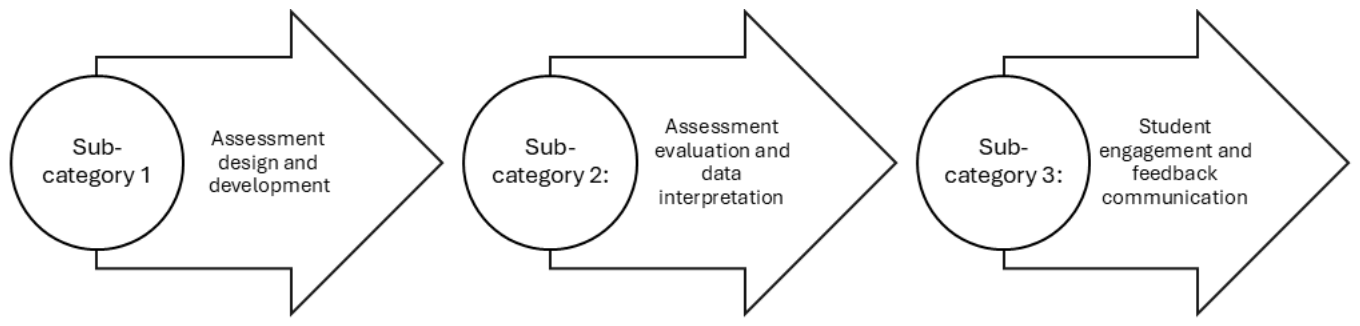
- Assessment design and development
- 16.
- 16101 Developing assignments and/or quizzes that inform student learning progress
- 17.
- 16102 Applying principles of assessment (e.g., validity, reliability, fairness) to develop assignments and/or quizzes
- 18.
- 16301 Writing different types of MCQs for different purposes
- 19.
- 16901 Applying classroom assessment strategies to assess students’ knowledge and skills
- 20.
- 16902 Applying classroom assessment strategies to assess students’ attitudes, values and self-awareness
- 21.
- 26101 Designing fit-for-purpose group-based assignments
- Student engagement and communication
- 22.
- 16502 Developing scoring rubrics that inform student learning
- 23.
- 16701 Giving feedback that students would find useful
- 24.
- 16702 Responding to student feedback appropriately
- 25.
- 26102 Facilitating student management of their own group processes
- Delivery Modes and Communication
- 26.
- 18101 Analysing student in-class comments and responding with questions to engage students in deeper thinking
- 27.
- 18102 Applying Socratic questioning techniques to extend student participation
- 28.
- 18103 Facilitating problem solving using questioning
References
- Zlatkin-Troitschanskaia, O.; Pant, H. Measurement advances and challenges in competency assessment in higher education. J. Educ. Meas. 2016, 53, 253–264. [Google Scholar] [CrossRef]
- Andrich, D.; Marais, I. A Course in Rasch Measurement Theory: Measuring in the Educational, Social and Health Sciences; Springer: Singapore, 2019. [Google Scholar]
- Ewing, M.T.; Salzberger, T.; Sinkovics, R.R. An alternate approach to assessing cross-cultural measurement equivalence in advertising research. J. Advert. 2005, 34, 17–36. [Google Scholar] [CrossRef]
- Sillat, L.; Tammets, K.; Laanpere, M. Digital competence assessment methods in higher education: A systematic literature review. Educ. Sci. 2021, 11, 402. [Google Scholar] [CrossRef]
- Lim, S.H.; Lim, L.; Lye, C.Y.; Lim, W.Y.R. Personalised professional development in teaching and learning in higher education. Trends High. Educ. 2025, 4, 16. [Google Scholar] [CrossRef]
- Badri, M.; Alnuaimi, A.; Mohaidat, J.; Yang, G.; Rashedi, A. Perception of teachers’ professional development needs, impacts, and barriers. Sage Open 2016, 6, 2158244016662901. [Google Scholar] [CrossRef]
- Ioannou, N. Professional development of adult educators: A European perspective. Int. Rev. Educ. 2023, 69, 379–399. [Google Scholar] [CrossRef]
- Badri, M.; Alnuaimi, A.; Yang, G.; Rashidi, A.A.; Sumaiti, R.A. A structural equation model of determinants of the perceived impact of teachers’ professional development—The Abu Dhabi application. Sage Open 2017, 7, 2158244017702198. [Google Scholar] [CrossRef]
- Aminipour, S.; Asgari, A.; Elaheh, H.; Roßbach, H. Home learning environments: A cross-cultural study between Germany and Iran. J. Psychoeduc. Assess. 2018, 38, 411–425. [Google Scholar] [CrossRef]
- Islam, A.; Gu, X.; Crook, C.; Spector, J. Assessment of ICT in tertiary education applying structural equation modeling and Rasch model. Sage Open 2020, 10, 2158244020975409. [Google Scholar] [CrossRef]
- Pellegrini, M.; Lake, C.; Neitzel, A.; Slavin, R. Effective programs in elementary mathematics: A meta-analysis. AERA Open 2021, 7, 2332858420986211. [Google Scholar] [CrossRef]
- Black, P.; Wiliam, D. Inside the Black Box: Raising Standards through Classroom Assessment. Phi Delta Kappan 2010, 92, 81–90. [Google Scholar] [CrossRef]
- Beardsley, M.; Albó, L.; Aragón, P.; Hernández-Leo, D. Emergency education effects on teacher abilities and motivation to use digital technologies. Br. J. Educ. Technol. 2021, 52, 1455–1477. [Google Scholar] [CrossRef]
- Kroeper, K.M.; Fried, A.C.; Murphy, M.C. Towards fostering growth mindset classrooms: Identifying teaching behaviors that signal instructors’ fixed and growth mindsets beliefs to students. Soc. Psychol. Educ. 2022, 25, 371–398. [Google Scholar] [CrossRef]
- Curwood, J.; Tomitsch, M.; Thomson, K.; Hendry, G. Professional learning in higher education: Understanding how academics interpret student feedback and access resources to improve their teaching. Australas. J. Educ. Technol. 2015, 31, 556–571. [Google Scholar] [CrossRef]
- Fischer, C.; Fishman, B.; Schoenebeck, S. New contexts for professional learning: Analyzing high school science teachers’ engagement on twitter. AERA Open 2019, 5, 2332858419894252. [Google Scholar] [CrossRef]
- Evans, J.; Yip, H.; Chan, K.; Armatas, C.; Tse, A. Blended learning in higher education: Professional development in a Hong Kong university. High. Educ. Res. Dev. 2019, 39, 643–656. [Google Scholar] [CrossRef]
- Zhao, S.; Song, J. What kind of support do teachers really need in a blended learning context? Australas. J. Educ. Technol. 2021, 37, 116–129. [Google Scholar] [CrossRef]
- Karlberg, M.; Bezzina, C. The professional development needs of beginning and experienced teachers in four municipalities in Sweden. Prof. Dev. Educ. 2020, 48, 624–641. [Google Scholar] [CrossRef]
- Dryer, R.; Brunton, R.; Krägeloh, C.; Medvedev, O. Screening for pregnancy-related anxiety: Evaluation of the Pregnancy-Related Anxiety Scale–Screener using Rasch methodology. Assessment 2022, 30, 1407–1417. [Google Scholar] [CrossRef] [PubMed]
- Berrío, Á.; Gómez-Benito, J.; Guilera, G. Differential item functioning in the WHODAS 2.0 scale in schizophrenia: An application of the Rasch trees method based on demographic and clinical covariates. Assessment 2021, 29, 1858–1868. [Google Scholar] [CrossRef] [PubMed]
- Heritage, B.; Asadi, A.; Hegney, D. Examination of the Connor-Davidson Resilience Scale 10 (CD-RISC-10) using the polytomous Rasch model. Psychol. Assess. 2021, 33, 672–684. [Google Scholar] [CrossRef]
- Yan, Z.; Pastore, S. Assessing teachers’ strategies in formative assessment: The teacher formative assessment practice scale. J. Psychoeduc. Assess. 2022, 40, 592–604. [Google Scholar] [CrossRef]
- Aryadoust, V.; Ng, L.; Sayama, H. A comprehensive review of Rasch measurement in language assessment: Recommendations and guidelines for research. Lang. Test. 2020, 38, 6–40. [Google Scholar] [CrossRef]
- Motta, C.; Carvalho, C.; Pato, M.; Castilho, P. Rasch measurement of the brief situational test of emotional management in a large Portuguese sample. J. Psychoeduc. Assess. 2020, 39, 112–127. [Google Scholar] [CrossRef]
- Waterfield, J. Convenience sampling. In The SAGE Encyclopedia of Educational Research, Measurement, and Evaluation; SAGE Publications, Inc.: Thousand Oaks, CA, USA, 2018; Volume 4, p. 403. [Google Scholar] [CrossRef]
- Linacre, J.M. Sample size and item calibration stability. Rasch Meas. Trans. 1994, 7, 328. [Google Scholar]
- Creswell, J.W.; Guetterman, T.C. Educational Research: Planning, Conducting, and Evaluating Quantitative and Qualitative Research, 7th ed.; Pearson: London, UK, 2024. [Google Scholar]
- Sharp, J.G.; Hemmings, B.; Kay, R.; Callinan, C. An application of the revised ‘Lecturer Self-Efficacy Questionnaire’: An evidence-based route for initiating transformational change. J. Furth. High. Educ. 2013, 37, 643–674. [Google Scholar] [CrossRef]
- Hagquist, C.; Bruce, M.; Gustavsson, J.P. Using the Rasch model in nursing research: An introduction and illustrative example. Int. J. Nurs. Stud. 2009, 46, 380–393. [Google Scholar] [CrossRef] [PubMed]
- Breslau, J.; Javaras, K.N.; Blacker, D.; Murphy, J.; Normand, S.T. Differential item functioning between ethnic groups in the epidemiological assessment of depression. J. Nerv. Ment. Dis. 2008, 196, 297–306. [Google Scholar] [CrossRef]
- Rosenberg, J.M.; Schultheis, E.H.; Kjelvik, M.K.; Reedy, A.M.; Sultana, O. Big data, big changes? The technologies and sources of data used in science classrooms. Br. J. Educ. Technol. 2022, 53, 1179–1201. [Google Scholar] [CrossRef]
- Batra, S.; Sharma, S.R.; Kumra, N.; Guptā, M. Traditional vs e-teaching learning due to COVID-19: A case study for Mathematics course. J. Eng. Educ. Transform. 2021, 35, 80–87. [Google Scholar] [CrossRef]
- Zhu, M.; Berri, S.; Zhang, K. Effective instructional strategies and technology use in blended learning: A case study. Educ. Inf. Technol. 2021, 26, 6143–6161. [Google Scholar] [CrossRef]
- Justo, E.; Delgado, A.; Llorente-Cejudo, C.; Aguilar, R.; Cabero-Almenara, J. The effectiveness of physical and virtual manipulatives on learning and motivation in structural engineering. J. Eng. Educ. 2022, 111, 813–851. [Google Scholar] [CrossRef]
- Sáiz, M.S.I.; Gómez, G.R.; Boud, D. The quality of assessment tasks as a determinant of learning. Assess. Eval. High. Educ. 2020, 46, 943–955. [Google Scholar] [CrossRef]
- Reimann, N.; Sadler, I.; Sambell, K. What’s in a word? Practices associated with ‘feedforward’ in higher education. Assess. Eval. High. Educ. 2019, 44, 1279–1290. [Google Scholar] [CrossRef]
- An, M.; Yu, X. A Rasch analysis of emerging adults’ health motivation questionnaire in higher education context. PLoS ONE 2021, 16, e0248389. [Google Scholar] [CrossRef] [PubMed]
- Harrell-Williams, L.M.; Lovett, J.N.; Lee, H.S.; Pierce, R.L.; Lesser, L.M.; Sorto, M.A. Validation of scores from the high school version of the self-efficacy to teach statistics instrument using preservice mathematics teachers. J. Psychoeduc. Assess. 2017, 37, 194–208. [Google Scholar] [CrossRef]
- Messick, S. Validity of psychological assessment: Validation of inferences from persons’ responses and performances as scientific inquiry into score meaning. Am. Psychol. 1995, 50, 741–749. [Google Scholar] [CrossRef]
- Masri, Y.; Andrich, D. The trade-off between model fit, invariance, and validity: The case of PISA science assessments. Appl. Meas. Educ. 2020, 33, 174–188. [Google Scholar] [CrossRef]
- Trolian, T.; Culver, K. Advancing evidence-based instruction for the public good. New Dir. Teach. Learn. 2020, 2020, 115–126. [Google Scholar] [CrossRef]



| n | % | |
|---|---|---|
| Gender | 117 | 47.8 |
| Female | ||
| Male | 128 | 52.2 |
| Years of teaching | 129 | 52.7 |
| Less than five years | ||
| Five to less than 10 years | 59 | 24.1 |
| 10 or more years | 57 | 23.3 |
| Average instructor ratings from January 2022 to July 2023 | 24 | 9.8 |
| Observations with at least one or more ratings missing | ||
| Poor | 44 | 18.0 |
| Fair | 44 | 18.0 |
| Good | 45 | 18.4 |
| Very good | 44 | 18.0 |
| Excellent | 44 | 18.0 |
| School participant taught with | 31 | 12.7 |
| Multiple schools | ||
| School N | 31 | 12.7 |
| School B | 76 | 31.0 |
| School H | 53 | 21.6 |
| School S | 35 | 14.3 |
| School C | 19 | 7.8 |
| Item | Sub-Category |
|---|---|
| 16101 Developing assignments and/or quizzes that inform student learning progress | 1 |
| 16102 Applying principles of assessment (e.g., validity, reliability, fairness) to develop assignments and/or quizzes | 1 |
| 16201 Designing a curriculum map that supports adaptive learning | 4 a |
| 16301 Writing different types of MCQs for different purposes | 1 |
| 16302 Interpreting MCQ item data to inform student learning | 2 b |
| 16501 Developing scoring rubrics that support consistency in marking | 2 b |
| 16502 Developing scoring rubrics that inform student learning | 3 |
| 16601 Creating an item bank through applying adaptive learning principles | 4 a |
| 16701 Giving feedback that students would find useful | 3 |
| 16702 Responding to student feedback appropriately | 3 |
| 16901 Applying classroom assessment strategies to assess students’ knowledge and skills | 1 |
| 16902 Applying classroom assessment strategies to assess students’ attitudes, values and self-awareness | 1 |
| 26101 Designing fit-for-purpose group-based assignments | 1 |
| 26102 Facilitating student management of their own group processes | 3 |
| 26201 Interpreting adaptive learning data to inform teaching and learning | 4 a |
Disclaimer/Publisher’s Note: The statements, opinions and data contained in all publications are solely those of the individual author(s) and contributor(s) and not of MDPI and/or the editor(s). MDPI and/or the editor(s) disclaim responsibility for any injury to people or property resulting from any ideas, methods, instructions or products referred to in the content. |
© 2026 by the authors. Licensee MDPI, Basel, Switzerland. This article is an open access article distributed under the terms and conditions of the Creative Commons Attribution (CC BY) license.
Share and Cite
Lim, L.; Lye, C.Y.; Lim, S.H.; Lim, W.Y.R.; Neo, C.; See, P.J. Identifying Professional Development in Teaching & Learning Needs in Higher Education: A Measure. Trends High. Educ. 2026, 5, 43. https://doi.org/10.3390/higheredu5020043
Lim L, Lye CY, Lim SH, Lim WYR, Neo C, See PJ. Identifying Professional Development in Teaching & Learning Needs in Higher Education: A Measure. Trends in Higher Education. 2026; 5(2):43. https://doi.org/10.3390/higheredu5020043
Chicago/Turabian StyleLim, Lyndon, Che Yee Lye, Seo Hong Lim, Wei Ying Rebekah Lim, Cindy Neo, and Pei Jun See. 2026. "Identifying Professional Development in Teaching & Learning Needs in Higher Education: A Measure" Trends in Higher Education 5, no. 2: 43. https://doi.org/10.3390/higheredu5020043
APA StyleLim, L., Lye, C. Y., Lim, S. H., Lim, W. Y. R., Neo, C., & See, P. J. (2026). Identifying Professional Development in Teaching & Learning Needs in Higher Education: A Measure. Trends in Higher Education, 5(2), 43. https://doi.org/10.3390/higheredu5020043