Article

Application of the AgS (Agricultural Crop Simulator) Model to Simulate the Biomass Production of Marandu Palisadegrass Managed Under Rotational Stocking with Cattle


by
Fernando Oliveira Bueno
1,
Santiago Vianna Cuadra
2,
Monique Pires Gravina de Oliveira
2,
Fabiani Denise Bender
2,
José Ricardo Macedo Pezzopane
3,
Patricia Menezes Santos
3,
Sandra Furlan Nogueira
4,
Luciana Gerdes
1 and
Flavia Maria de Andrade Gimenes
1,*
1
Pasture and Animal Feed Research Division, Instituto de Zootecnia, Nova Odessa 13380-011, SP, Brazil
2
EMBRAPA Digital Agriculture, Campinas 13083-886, SP, Brazil
3
EMBRAPA Southeast Livestock, São Carlos 13560-970, SP, Brazil
4
EMBRAPA Environment, Jaguariúna 13820-000, SP, Brazil
*
Author to whom correspondence should be addressed.
Grasses 2025, 4(4), 50; https://doi.org/10.3390/grasses4040050
Submission received: 30 August 2025 / Revised: 18 October 2025 / Accepted: 1 December 2025 / Published: 4 December 2025

Abstract

The use of plant growth simulation models, such as the Agricultural Crop Simulator (AgS), can support planning and management decisions in pasture-based animal production systems. AgS is a biophysical model that is being developed to focus on crops relevant to the Brazilian economy. Originally, the model was parameterized for Marandu palisadegrass (Urochloa brizantha cv. Marandu) under continuous stocking method and cutting regimes. The objective of this study was to parametrize and evaluate the performance of AgS in simulating Marandu palisadegrass biomass production under rotational stocking methods. Field data from an experiment assessing pre-grazing heights of Marandu palisadegrass grazed by beef cattle was used to evaluate the model. The simulations initially underestimated leaf and total biomass production, regardless of pre-grazing height. These results suggested that differences between cutting and grazing methods make additional model calibration necessary. Differences related to regrowth of leaves were addressed and the new calibration resulted in higher biomass allocation to leaves and stems, reducing the mean error in the 25 cm treatment from −1.001 to −253 kg ha−1 and the rRMSE from 41% to 34%. AgS showed potential for simulating rotational stocking after adjustments were made, and future calibrations should consider different management and environmental conditions.

1. Introduction

Beef and dairy cattle farming are relevant in several countries, playing a strategic role in food production and occupying vast areas of pasture. In tropical and subtropical regions, the animals are predominantly fed on pasture. Brazil has the largest cattle herd in the world, with 194 million heads [1], a result of significant expansion over the last 40 years. The area of Brazilian pastureland is approximately 160 million hectares [1], with Marandu grass being the most widely planted forage crop [2]. However, biomass production varies throughout the year due to climatic seasonality. This variability requires management strategies that ensure a balance between forage supply and animals’ nutritional needs, especially in pasture-based production systems, which predominate in countries in Latin America, Africa, Asia, and Oceania. In this context, the use of tools that assist in planning forage production over time is essential.
Plant growth simulation models integrate information on the interactions among climate, soil, plants, and animals, enabling better planning of forage crop supply and an improvement in the decision-making process on farms. The CROPGRO-Perennial Forage Model (CROPGRO-PFM) from the Decision Support System for Agrotechnology Transfer (DSSAT) platform and the APSIM-Tropical Pasture model from the Agricultural Production Systems Simulator (APSIM) platform have been widely analyzed and used in Brazil [3,4,5,6,7,8,9,10,11]. Alternatively, simpler models with fewer parameters and more simplified equations have also been developed and applied [12].
These previous models’ calibrations and evaluations were performed considering pasture management under cut and carry. In this scenario, this study describes the application and evaluates the performance of the Agricultural Crop Simulator (AgS) model [13] under a rotational grazing method. The model was originally evaluated in continuous stocking and mowing systems [13]. Evaluating forage growth models under rotational stocking is particularly challenging, as this management involves intermittent, non-uniform defoliation and variable regrowth, unlike the more stable canopy structure under continuous stocking or the uniform removal with low losses in mechanical cutting [14,15]. The evaluation presented in this study used data from a previous study [16,17], in which pre-grazing heights of 25 and 35 cm were chosen to represent contrasting canopy structures and grazing intensities [17]. These heights correspond to approximately 95 and 100% interception of incident light (IL) for Marandu palisadegrass, where 95% IL indicates optimal leaf area index, higher leaf proportion, and lower amounts of stem and dead material [18]. The 25 cm height reflects a more frequent defoliation strategy with greater forage intake [19], forage quality, and animal productivity [15].
We hypothesize that the Agricultural Crop Simulator (AgS) model, previously calibrated for Marandu palisadegrass under cutting and continuous stocking systems, is capable of simulating biomass production of Marandu palisadegrass managed under rotational stocking with cattle grazing. This article presents the simulation results of the AgS model for Marandu palisadegrass biomass production under rotational stocking methods. To this end, we first present results from simulations using parameters calibrated against field data from paddocks under continuous stocking or from mechanically defoliated plots. Then we present results from simulations made after recalibration of parameters associated with the biomass allocation.

2. Materials and Methods

2.1. Material

2.1.1. Plant Species, Site, and Soil of the Experiment

The species evaluated was Marandu palisadegrass [Urochloa brizantha (syn. Brachiaria brizantha (Hochst. ex A. Rich.) Stapf. cv. Marandu)], Poaceae [20]. The full pasture, with a total area of 48 hectares, was established in 1995 by seeds and has been maintained since then without the need for reseeding.
The experiment was carried out in the municipality of Nova Odessa, SP, Brazil (22° 42′ S, 47° 18′ W and 528 m a.s.l.). The soil in the experimental area is classified as a Rhodic Ferralsol (Dystric). Soil chemical characteristics in the 0–20 cm layer were pH in CaCl2 sol = 4.5; OM = 37.2 g dm−2; P = 1.6 mg dm−3; K = 2.1 mmolc dm−3; Ca = 14.9 mmolc dm−3; Mg = 10.4 mmolc dm−3; H + Al = 40.7 mmolc dm−3; sum of bases = 27.4 mmolc dm−3; cation exchange capacity = 68.1 mmolc dm−3; and base saturation = 39.5%. A base saturation (V%) target of 50% was established, which determined the need for dolomitic limestone application. Phosphorus and potassium were applied in combination with nitrogen using N-P-K formulations during the rainy season. Nitrogen fertilization totaled 200 kg ha−1 of N (urea), applied in January (50 kg ha−1), and the remainder was divided into two split applications in February and March 2009.

2.1.2. Experimental Design and Field Assessments

Eight rotationally grazed systems, with six paddocks of 5000 m2 each system, were used for the experiment in a randomized complete block design with two treatments and four replicates (blocks). The treatments consisted of two pre-grazing pasture height targets of 25 and 35 cm, corresponding to approximately 95% and 100% LI by the forage canopy, respectively. These recommendations were generated in previous grazing experiments [15,16,17].
Target post-grazing pasture height was 15 cm. As such, canopy height was monitored frequently with a sward stick [21] along predefined transect lines covering the entire area of each paddock before and after grazing (100 readings per paddock). Grazing cycles were determined by pasture heights totaling 9.3 and 5.9 grazing cycles for 25 and 35 cm, respectively, from February 2009 to April 2010, as described by Gimenes et al. [15]. The average heights of the forage canopy in pre- and post-grazing, for the 25 and 35 cm treatments, were 25.2 and 34.9 cm and 16.2 and 20.4 cm, respectively.
Each sample was divided into two subsamples: one for determining dry matter content and the other for determining the botanical/morphological composition of the forage. The samples for determining dry matter content were dried in a forced air circulation oven at 65 °C until constant weight. For the samples subjected to manual separation, the botanical components (Marandu palisadegrass and other species) and morphological components (leaf blades for leaves, leaf sheaths and stems for stems, and dead material) were separated and subjected to oven drying. The pre- and post-grazing forage mass values were used to calculate biomass production. Due to the large percentage and quantity of dead material in pastures (a consequence of their previous use), the results for forage mass and biomass production and the respective components were calculated using only the morphological components leaves and stems (living material).

2.1.3. Climate and Meteorological Data During the Experiment

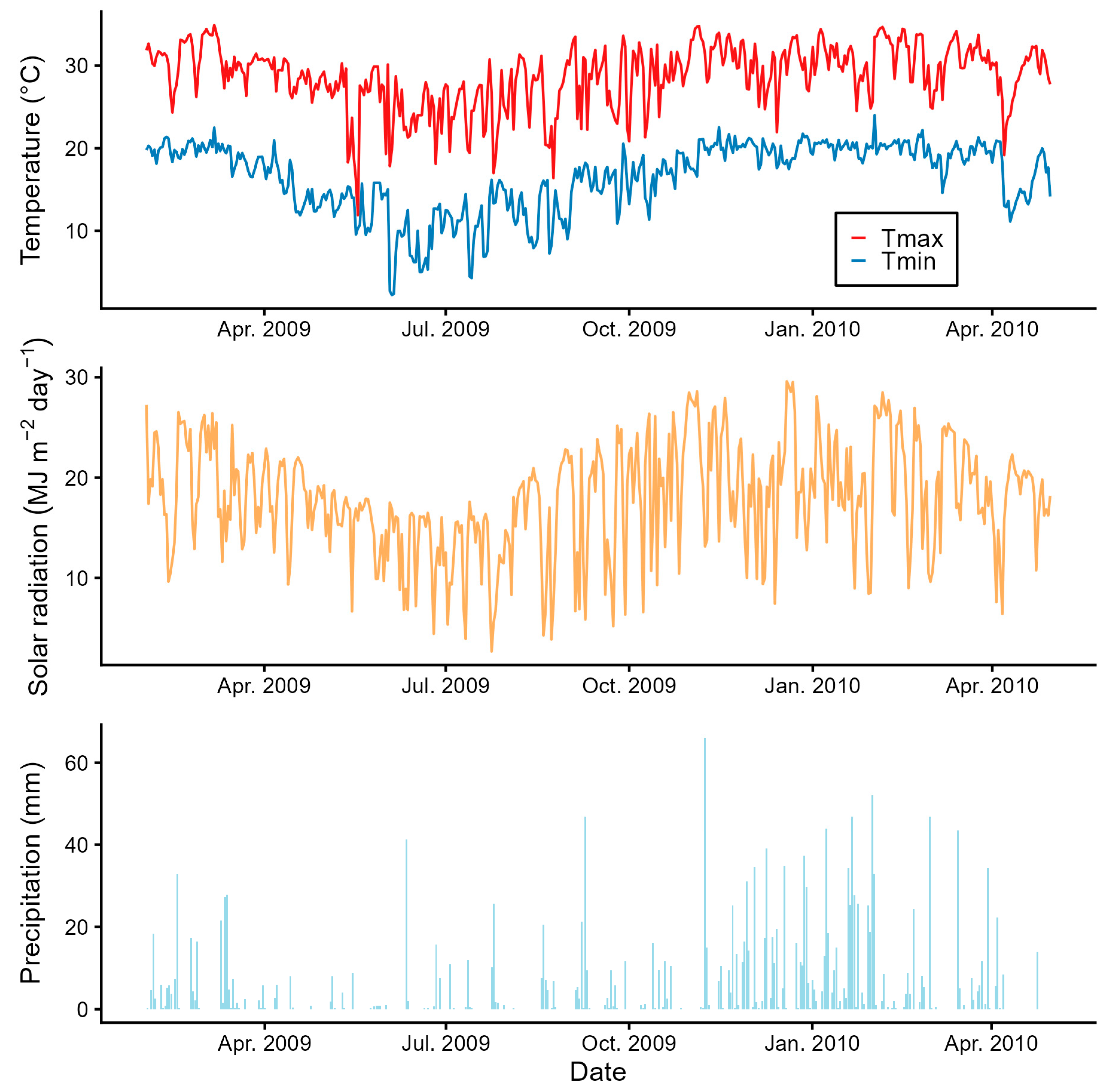
According to the Köppen classification, the region’s climate is characterized as humid mesothermal, subtropical with dry winters, type Cwa, with average temperatures below 18 °C in the coldest month and above 22 °C in the hottest period. The average annual rainfall over the last 30 years in the municipality was 1270 mm, with approximately 30% concentrated between May and September. Meteorological data during the experiment were collected at an automatic meteorological station located 4.0 km from the experimental area (Figure 1).

2.2. Methods

2.2.1. AgS Model

The AgS model [13] was used to generate simulations of Marandu palisadegrass biomass growth. In general, the model simulates daily biomass accumulation based on the balance between photosynthesis and the maintenance and growth respirations of each plant organ. This balance is affected by the morphological characteristics and responses of different agricultural crops to water availability, carbon dioxide concentration in the air, evaporative demand, and air temperature. The photoassimilate production capacity is a function of canopy development, which constrains solar radiation interception; of the species’ photosynthetic efficiency; and of the crop’s water status. Gross photosynthesis is determined as a function of the maximum photosynthesis value for the species and its relationship with solar radiation intercepted during the day and modifiers of environmental variables. Crop state variables represent the morphological characteristics of plants and characterize crop growth. They represent the leaf area index (LAI), the fraction of solar radiation intercepted, maintenance respiration, and root system depth. Biomass in the model is divided into fine and coarse roots, reserve carbohydrates, stem biomass, grain biomass and its associated structures, such as pods and ears, and green and dead leaves. Variables representing biomass are linked to soil water availability through evapotranspiration, which, in turn, interacts with the physical properties of the soil profile, the water balance and root depth, both of which are also simulated by the model.
Soil water content is calculated based on the balance of inputs and outputs and water fluxes in the profile. Water is added through rain precipitation and irrigation. The infiltration of this volume into the topsoil is a function of surface runoff calculations. Saturated and unsaturated flows determine water movement in the profile, and base drainage is calculated according to the water content in the topsoil. Simultaneously, water is extracted through evapotranspiration: water extraction from the layers is weighted by each layer’s water content and the layer’s root occupancy fraction. The water-holding capacity of soil layers is defined by the difference between field capacity and the permanent wilting point. The total volume of water that can be stored in each layer is defined by the product of the layer’s thickness and the maximum retention capacity, given by the difference between total saturation and the permanent wilting point. To calculate the extractable water volume available for evapotranspiration, the available volume in each layer is weighted by the layer’s root fraction. The calculation of potential evapotranspiration utilizes the reference evapotranspiration and the reference coefficient, which depend on the soil characteristics and management practices.

2.2.2. AgS Forage Module

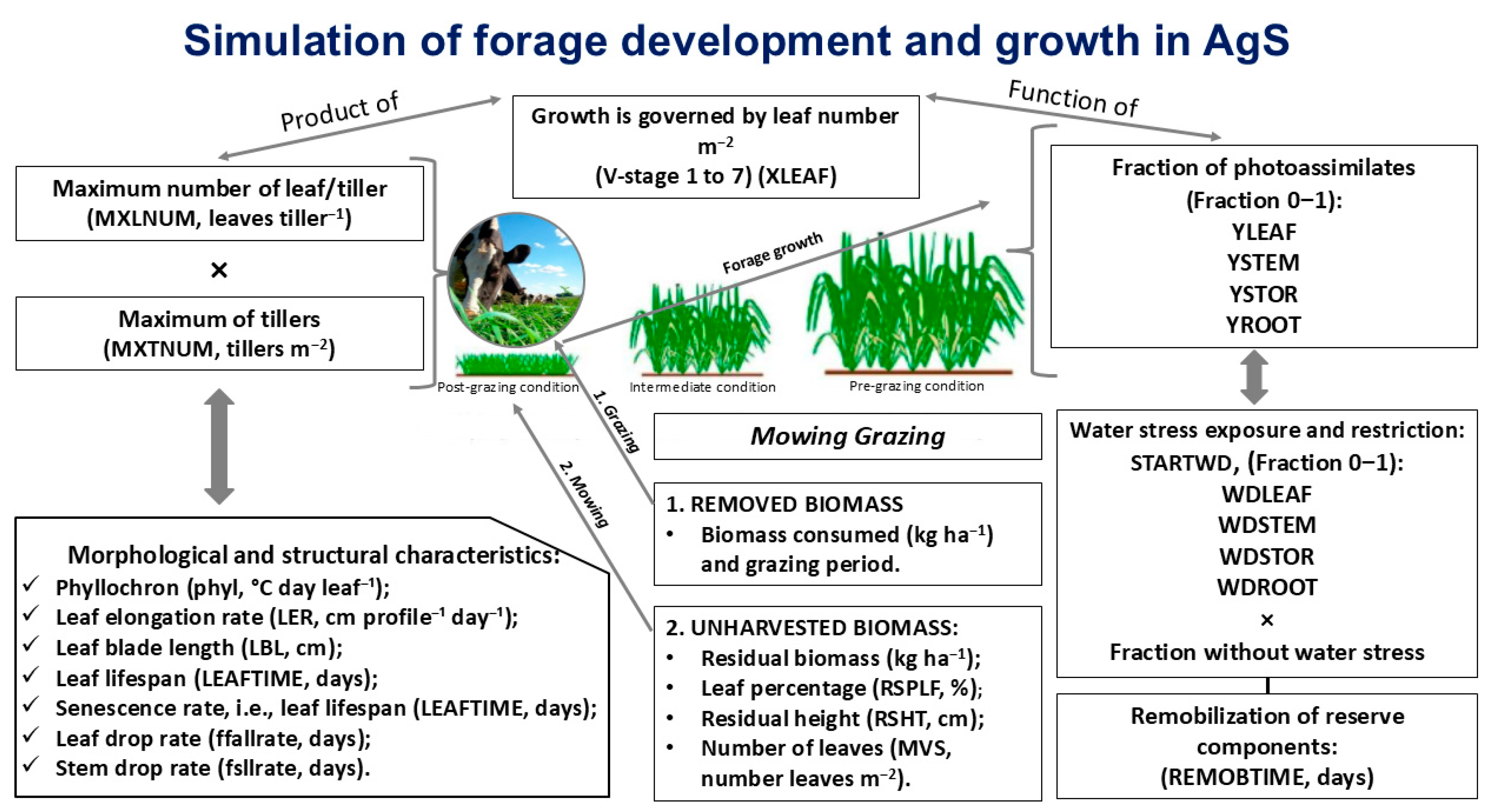
The forage phenology and growth module described in Bender et al. [22] was implemented in the AgS model to simulate the growth and development of tropical forage grasses. This module has a set of specific parameters (described in Table 1), in addition to those of the AgS model. Vegetative growth is governed by the number of leaves or their vegetative stage (Vstage), simulated by the balance between the creation of new leaves and the mortality of existing leaves. The increase in Vstage is determined by the product of the number of tillers (tillers m−2) and the daily rate of leaf appearance per tiller (leaf tiller−1 day−1) (Figure 2). The leaf appearance rate is computed as a function of the accumulated daily thermal time (TTd) divided by the phyllochron (thermal time between the appearance of successive leaves, PHYL) and is also affected by water status, in which a water stress factor (DRYSTRESS) reduces the production of new leaves. The number of tillers was adjusted to vary between the minimum and maximum number of tillers (MNTN and MXTN, tillers m−2), as a function of the vegetation cover fraction (fGSolar) (Equation (1)).
V s t a g e t = V s t a g e t 1 1 + T T d P H Y L × D R Y S T R E S S × [ M N T N + f G S o l a r t × M X T N M N T N ]
Vstage varies on a scale between 0 and 1, where 1 corresponds to the maximum number of leaves per area, calculated by multiplying the maximum number of tillers by the maximum number of leaves per tiller (Figure 2). This scale is discretized into seven stages.
Net primary production is allocated into four compartments, leaves (aleaf), stems (astem), reserves (astor), and roots (aroot), with the proportion of photoassimilates depending on the period associated with Vstage. Since the plant is affected by water stress (DRYSTRESS ≤ STARTWD), in a condition in which the fraction of daily available water relative to the maximum water availability stored in the root zone is less than or equal to the STARWD parameter (STARTWD, a fraction from 0 to 1), the biomass allocation rates change for each of the respective components. This representation allows for a decrease in the allocation of shoots and an increase in the allocation of reserve organs during periods of water deficit. However, during a period of growth resumption, i.e., when the plant has a low leaf area index and the environment is free of growth restrictions, the reserve component is remobilized for the development of vegetative parts: leaves and stems. The rate of this flow is a function of the remobilization time (REMOBTIME, days) (Figure 2).
To calculate leaf and stem decay, the age, size, and weight of each leaf are recorded individually. The model records the age of each leaf individually, and whenever the lifespan equals the leaf lifespan parameter (LEAFTIME, days), the leaf senesces. After senescence, the leaf and stem are not shed immediately. A fraction of the leaf and stem’s biomass is subtracted and added to the pool of dead leaves and stems that are deposited in the soil, where they decay to form the litter. According to the decay parameters (ffalllrate and ffallsrate, days), dead roots decay directly into the soil and do not interfere with plant growth. Decayed leaves and stems interfere with the interception of solar radiation by living leaves and consequently reduce photosynthesis (Figure 2).
A specific characteristic of forage is that harvesting can occur on multiple dates in the same year, carried out either by grazing, characterized as direct defoliation of the plant by animals, or by mowing, which involves manual or mechanical harvesting, generally for storage as silage or hay. In general, cutting is associated with one-day removal events. It can be quantified by residual forage mass (MOW, kg ha−1). In contrast, grazing is associated with longer periods and can be quantified as a daily amount of forage mass consumed by animals (Daily Consumption, kg ha−1). Cutting events are defined similarly to CROPGRO-PFM [6,7], in which the model is informed of the day’s post-harvest residual biomass (MOW, kg ha−1), the leaf fraction of the residue (RSPLF, %), the number of leaves after harvest (MVS, leaf m−2), and residual height (RSHT, cm) (Figure 2). After a cutting event, leaf biomass (BLEAFG), stems (structural and reserve, BSTEMS and BSTEMR), roots (BROOF), dead fraction (AGDB), and root zone depth (RZD) are adjusted according to Equations (2)–(7). Vstage is also adjusted after the cutting event, based on the number of leaves after harvest.
B L E A F G t = R S P L F 100 × M O W t
B S T E M S t = 1 R S P L F 100 × M O W t × ( 1 S T E M R )
B S T E M R t = 1 R S P L F 100 × M O W t × S T E M R
A G D B t = A G D B t A G D B t × A G G B t M O W t A G G B t
B R O O F t = B R O O F t B R O O F t × A G G B t M O W t A G G B t
R Z D t = R Z D t R Z D t × A G G B t M O W t A G G B t

2.2.3. AgS Model Calibration

The initial calibration structure of the model was configured considering a hierarchical approach to calibration, in which the processes represented by the model are grouped and adjusted sequentially, similar to that proposed by Wallach et al. [23]. This study used the parameters calibrated and described in Cuadra et al. [13]. For that study, the authors first adjusted the parameters related to biomass production, using daily flux tower data, which estimates fluxes in carbon, radiation, and water in the soil–plant–atmosphere system. They were followed by parameters related to leaf area under potential conditions, that is, considering experiments without the occurrence of water or nutritional deficits. Finally, parameters related to the effect of water stress on growth were adjusted, with data obtained from an experiment without irrigation.
At each stage, hundreds of groups of parameters were used to perform simulations, and the group with the lowest value of an error metric was selected. In this process, data from both continuous stocking and grass cutting experiments, described in previous studies [6,22], were used.
To calibrate the partitioning and stress parameters, two configurations were generated for the studied cultivar, considering the defoliation strategies of each grazing system: one to represent plant growth under cutting and the other under continuous stocking. The remaining parameters were treated as species parameters and assigned equally to all experiments. The first evaluation, performed with the data from the experiment conducted in Nova Odessa, São Paulo, used the calibration for cutting from Cuadra et al. [13].
A subsequent calibration step was performed, this time with the data from the Nova Odessa experiment. In this step, the model was adjusted to the data, modifying mainly biomass partitioning parameters. In this case, the adjustment was performed manually to better understand the parameters, as described in Pasley et al. [24].

2.2.4. Model Performance Assessment

To assess model performance, the Nash–Suttcliff efficiency (NSE) was used, which characterizes the extent to which the model captured the variability of the observed data by comparing it to its mean. For error analysis, we considered the mean error (ME), which indicates the error trend; the root mean square error (RMSE), which indicates the error magnitude [25]; and the relative root mean square error (rRMSE), where yi and xi correspond to the simulated and observed values, respectively; xm is the mean of the observed values, and the indices i and n represent each and the maximum of the observations, respectively. These were calculated according to Equations (8)–(11):
N S E = 1 i = 1 n y i x i 2 i = 1 n y i x m + x i x m 2
M E = 1 n i = 1 n y i x i
R M S E = 1 n i = 1 n y i x i 2
r R M S E = 1 n i = 1 n y i x i 2 x m
These metrics were calculated both for the evaluation of the parameter set described in Cuadra et al. [13] and, for goodness-of-fit assessment, with the parameter set determined when using the dataset from the experiment in Nova Odessa.

3. Results and Discussion

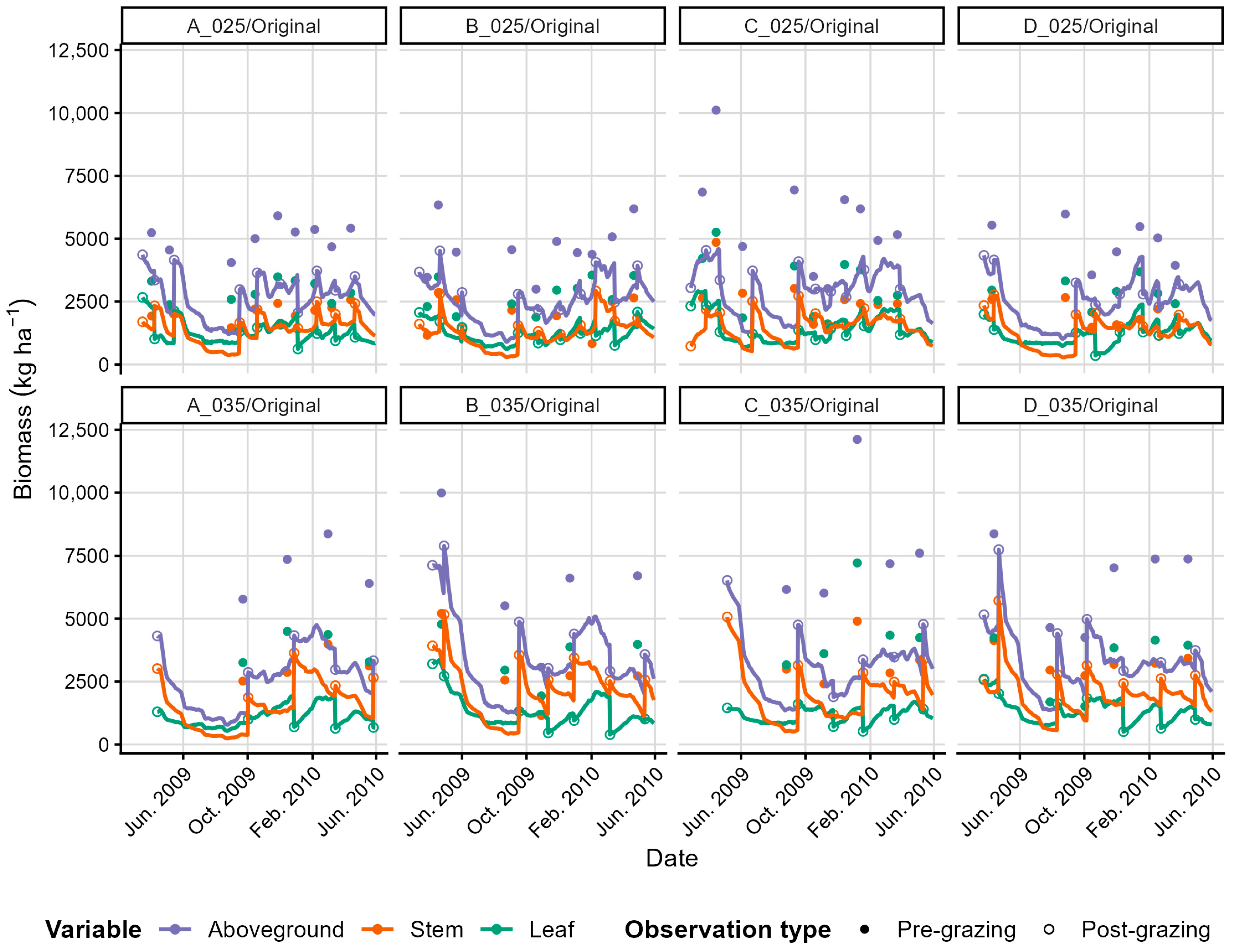
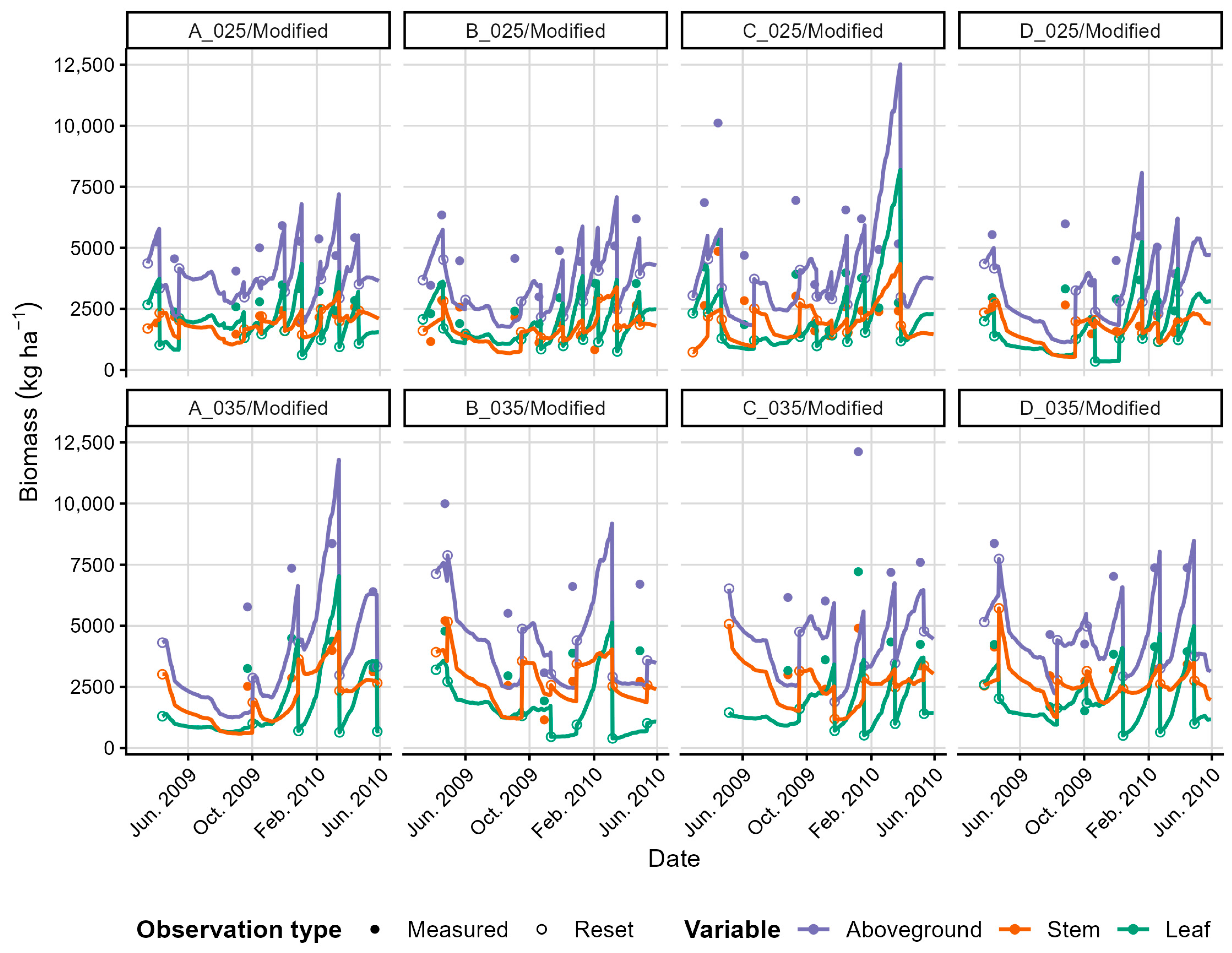
In general, the AgS simulations with the original parameters (Original) underestimated the observed values, regardless of the pre-grazing height management employed (Figure 3). The underestimations occurred for leaf and stem partitions, and consequently for total aboveground biomass. Naturally, the underestimation is more pronounced in treatments with higher biomass, that is, those with a pre-grazing height of 35 cm. Since biomass is imputed after grazing, abrupt variations in the variables occur during the cycle to correct the growth trajectory. Despite the trajectory corrections, there was insufficient growth in cases where reintroduction of animals was more immediate, as it required a shorter period for growth, or in cases where there was a longer interval.
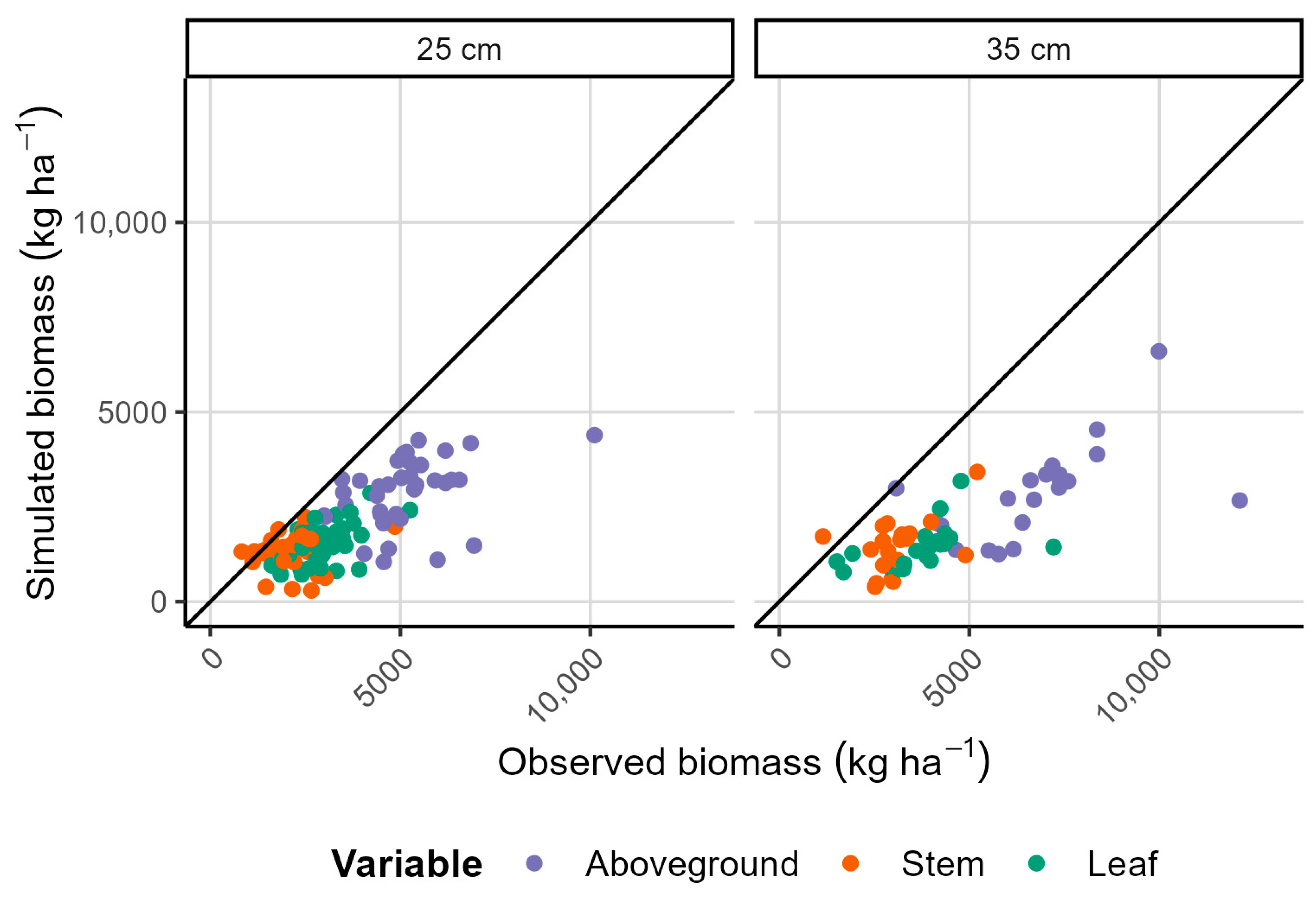
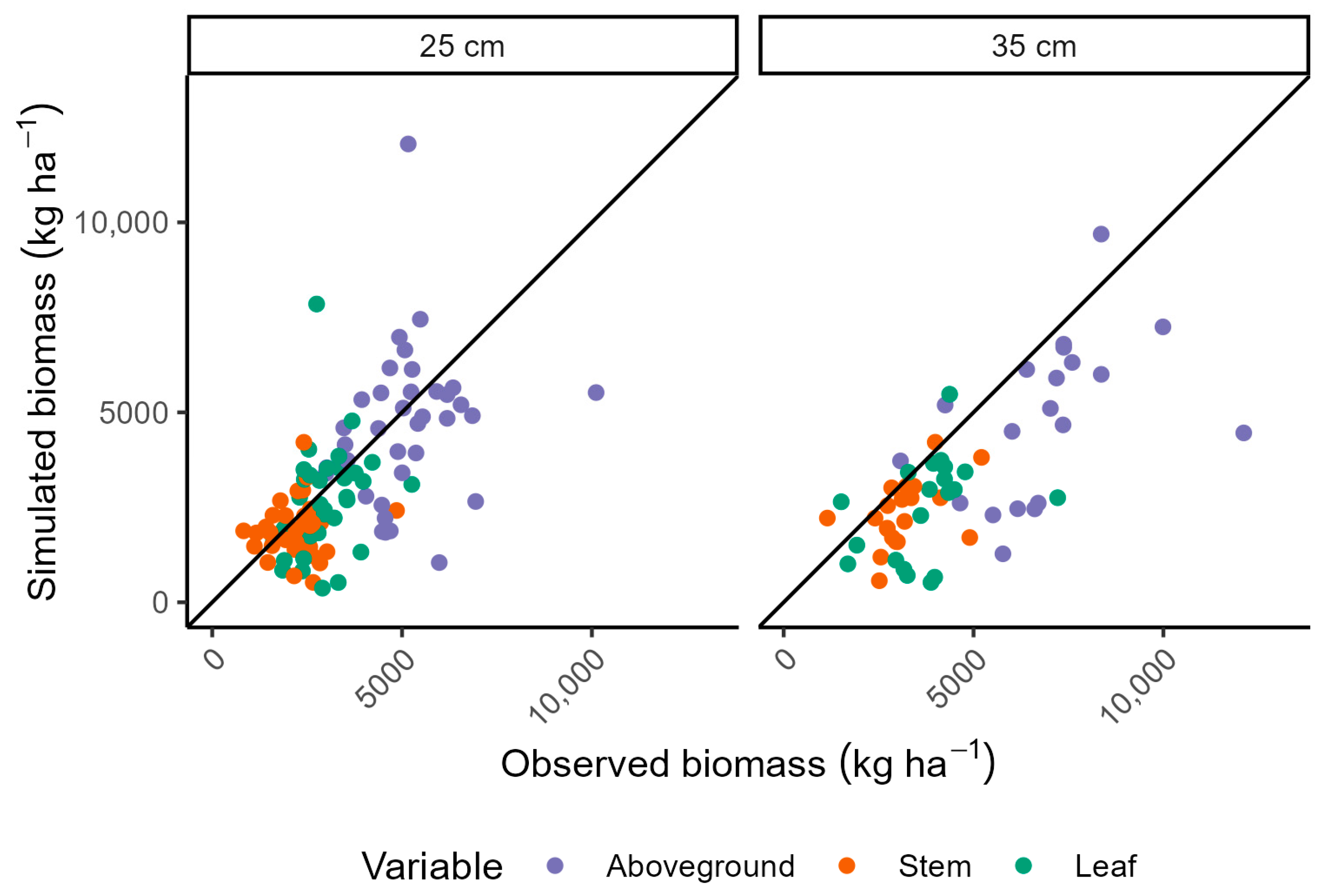
The dispersion analysis of all components (Figure 4) reinforces the perception of the model’s underestimation. However, when observing the isolated biomass components of the partitions, it becomes clear that on some occasions, the production of stalks was overestimated, so that the underestimations were more closely associated with the production of leaves.
Calibration data from experiments subjected to cutting were used for the simulations. There are several fundamental differences between cutting and grazing, but in this case, one of the factors that may have affected this was regrowth height. Two previous studies [6,12] have reported a cutting height of 10 cm, while in the experiment reported here, the average post-grazing heights were 16.2 and 20.4 cm for the 25 and 35 cm treatments, respectively. It is therefore possible that in the experiment used for calibration, the proportion of leaves and stems in relation to the total biomass was lower than in the experiment used in this study, delaying the onset of the regrowth process because the plants had to use more reserves compared to pastures with greater leaf mass. Furthermore, in pastures with a shorter regrowth period, there is less allocation to stems and more to leaves compared to situations with longer regrowth periods. Therefore, we decided to modify the biomass partitioning using new parameters to allocate photoassimilates to leaves, stems, storage, and roots (Modified). By increasing the partitioning to the first two components during the initial stages of re-growth (YLEAF and YSTEM) and reducing it for the last two components (YSTOR and YROOT) (Table 2), the model simulates a more realistic redistribution pattern. The parameter REMOBTIME, which controls the daily rate of biomass remobilization, depending on the water available to the plants, was reduced so that the system could accelerate the release of carbohydrates stored in the reserve organs and redistribute them to the leaves, stems, and roots (Table 2).
The simulation of the number of leaves (V-stage, leaves m−2) results from the balance between the emergence of new leaves and the senescence of existing ones, with the lifespan of each leaf accounted for individually. Thus, increasing the LEAFTIME parameter was essential to augment photosynthetic activity, and thereby enhance leaf and stem biomass accumulation (Table 2). In parallel, increasing the dead leaves attached to the stems (F_DEAD_LEAVES) parameter reduces the proportion of green leaf area index, thus prioritizing resource allocation to leaf and stem growth (Table 2). It is worth noting that in the experiments used in the previous calibration of the model (Original), there was no significant amount of attached dead leaves due to the homogeneous cutting. Therefore, the previously calibrated value is likely not very reliable, given that in those experiments, dead leaves did not impact pasture growth.
Similar changes were made by Pequeno et al. [6]; by using the CROPGRO-PFM to simulate the growth of irrigated and rainfed Marandu grass, the researchers changed the parameters previously calibrated for Xaraés grass (same species) because under non-limiting water conditions, there was a need to increase the allocation to stem growth, especially for the 42-day harvest frequency and low cutting frequency treatment. As a result, the storage partitioning increased considerably to reduce the dependence of regrowth on the remaining or post-grazing leaf area, since the residual mass was low (10 cm), leaving few leaves in the forage canopy.
The modified parameters improved the AgS model’s performance in capturing forage growth for both components, and therefore for total live biomass (Figure 5), in comparison with the results using the original parameters. This better correspondence between the simulated and observed values for leaf and stem partitions, and for the total aboveground biomass, can be confirmed in the scatterplot of data from each of the observations compared to the first situation (Figure 4 and Figure 6).
Overall, the improvement in model performance is also reflected in the model fit assessment metrics (Table 3). Initially, the model struggled to capture total biomass, underestimating it by an average of over 1300 kg ha−1, with a more pronounced effect for the 35 cm treatment. Although it still underestimated all components on average, the parameterization changes led to a positive NSE for the 35 cm treatment and for leaf biomass in the 25 cm treatment, albeit only as a goodness-of-fit evaluation.
Although the model’s relative errors are still high, generally exceeding 30%, suggesting the need for improvement, it is important to note that forage crops are relatively highly dependent on management practices that impact growth dynamics [26]. A central point in forage modeling work is that, as noted by Bosi et al. [8], in the case of the APSIM-Tropical Pasture model, it is possible that the model was unable to simulate the effect of animal trampling and grazing on pasture structure and productivity, as well as the removal of apical meristems by animals at different heights of the post-grazing residue. Furthermore, the AgS model considers the removal of forage biomass through grazing events (forage consumption by animals) or cutting and loading. Hence, for application in the case evaluated in this study, in which forage removal was achieved through animal grazing, quantification of residual forage mass is necessary. Although the use of post-grazing forage mass enabled the use of the model, collecting these data in field situations is quite laborious and difficult to implement. Therefore, further evaluations of the AgS model’s use should be conducted to use animal consumption estimates as a method to measure forage removal. Moreover, additional testing with real farm data is still required, as pasture and cattle management practices influence forage growth, and the model must be evaluated in an independent setting, under real-world conditions, before it can be recommended for operational use.

4. Conclusions

The AgS model yielded good results in simulating Marandu grass growth under rotational stocking, provided it is properly adjusted, but relative errors remain high (>30%) and continuous model improvement is necessary. Future calibrations should consider specific grazing experiments and different soil and climate regions to increase the model’s robustness and reliability. Additionally, the use of variables such as animal intake and visual management indicators as a proxy for forage consumption are necessary for practical applicability in livestock systems.

Author Contributions

Conceptualization, S.V.C., M.P.G.d.O., F.D.B., and F.M.d.A.G.; methodology, S.V.C., M.P.G.d.O., F.D.B., J.R.M.P., P.M.S., S.F.N., and L.G.; validation, S.V.C., M.P.G.d.O., F.D.B., and P.M.S.; formal analysis, F.O.B., S.V.C., M.P.G.d.O., F.D.B., J.R.M.P., P.M.S., S.F.N., and L.G.; investigation, F.O.B., S.V.C., M.P.G.d.O., F.D.B., J.R.M.P., P.M.S., S.F.N., L.G., and F.M.d.A.G.; data curation, F.M.d.A.G.; writing—original draft, F.O.B., S.V.C., M.P.G.d.O., F.D.B., P.M.S., and F.M.d.A.G.; writing—review and editing, F.O.B., S.V.C., M.P.G.d.O., F.D.B., J.R.M.P., P.M.S., and F.M.d.A.G.; project administration, S.V.C., L.G., and F.M.d.A.G. All authors have read and agreed to the published version of the manuscript.

Funding

The field rotational stocking experiment received external funding from grant 2008/56748-5, São Paulo Research Foundation (FAPESP).

Data Availability Statement

The raw data supporting the conclusions of this article will be made available by the authors on request.

Acknowledgments

The authors are grateful to Sila Carneiro da Silva for their coordination of and guidance for the field work.

Conflicts of Interest

Authors Santiago Vianna Cuadra, Monique Pires Gravina de Oliveira and Fabiani Denise Bender are employed by the EMBRAPA Digital Agriculture. The remaining authors declare that the research was conducted in the absence of any commercial or financial relationships that could be construed as a potential conflict of interest.

References

  1. ABIEC. Beef Report 2025; Associação Brasileira das Indústrias Exportadoras de Carnes: Sao Paulo, Brazil, 2025. [Google Scholar]
  2. Jank, L.; Barrios, S.C.; do Valle, C.B.; Simeão, R.M.; Alves, G.F. The Value of Improved Pastures to Brazilian Beef Production. Crop Pasture Sci. 2014, 65, 1132–1137. [Google Scholar] [CrossRef]
  3. Pedreira, B.C.; Pedreira, C.G.S.; Boote, K.J.; Lara, M.A.S.; Alderman, P.D. Adapting the CROPGRO Perennial Forage Model to Predict Growth of Brachiaria brizantha. Field Crops Res. 2011, 120, 370–379. [Google Scholar] [CrossRef]
  4. Lara, M.A.; Pedreira, C.G.; Boote, K.J.; Pedreira, B.C.; Moreno, L.S.; Alderman, P.D. Predicting Growth of Panicum Maximum: An Adaptation of the CROPGRO–Perennial Forage Model. Agron. J. 2012, 104, 600–611. [Google Scholar] [CrossRef]
  5. Araujo, L.C.; Santos, P.M.; Rodriguez, D.; Pezzopane, J.R.M.; Oliveira, P.P.; Cruz, P.G. Simulating Guinea Grass Production: Empirical and Mechanistic Approaches. Agron. J. 2013, 105, 61–69. [Google Scholar] [CrossRef]
  6. Pequeno, D.N.L.; Pedreira, C.G.S.; Boote, K.J. Simulating Forage Production of Marandu Palisade Grass (Brachiaria brizantha) with the CROPGRO-Perennial Forage Model. Crop Pasture Sci. 2014, 65, 1335. [Google Scholar] [CrossRef]
  7. Pequeno, D.N.L.; Pedreira, C.G.S.; Boote, K.J.; Alderman, P.D.; Faria, A.F.G. Species-Genotypic Parameters of the CROPGRO Perennial Forage Model: Implications for Comparison of Three Tropical Pasture Grasses. Grass Forage Sci. 2018, 73, 440–455. [Google Scholar] [CrossRef]
  8. Bosi, C.; Sentelhas, P.C.; Huth, N.I.; Pezzopane, J.R.M.; Andreucci, M.P.; Santos, P.M. APSIM-Tropical Pasture: A Model for Simulating Perennial Tropical Grass Growth and Its Parameterisation for Palisade Grass (Brachiaria brizantha). Agric. Syst. 2020, 184, 102917. [Google Scholar] [CrossRef]
  9. Gomes, F.J.; Bosi, C.; Pedreira, B.C.; Santos, P.M.; Pedreira, C.G.S. Parameterization of the APSIM Model for Simulating Palisadegrass Growth under Continuous Stocking in Monoculture and in a Silvopastoral System. Agric. Syst. 2020, 184, 102876. [Google Scholar] [CrossRef]
  10. Brunetti, H.B.; Boote, K.J.; Santos, P.M.; Pezzopane, J.R.M.; Pedreira, C.G.S.; Lara, M.A.S.; Moreno, L.S.B.; Hoogenboom, G. Improving the CROPGRO Perennial Forage Model for Simulating Growth and Biomass Partitioning of Guineagrass. Agron. J. 2021, 113, 3299–3314. [Google Scholar] [CrossRef]
  11. de Souza, D.P.; Mendonça, F.C.; Bosi, C.; Pezzopane, J.R.M.; Santos, P.M. APSIM-Tropical Pasture Model Parameterization for Simulating Marandu Palisade Grass Growth and Soil Water in Irrigated and Rainfed Cut-and-carry Systems. Grass Forage Sci. 2022, 77, 216–231. [Google Scholar] [CrossRef]
  12. Pezzopane, J.R.M.; Santos, P.M.; Cruz, P.G.D.; Bosi, C.; Sentelhas, P.C. An Integrated Agrometeorological Model to Simulate Marandu Palisade Grass Productivity. Field Crops Res. 2018, 224, 13–21. [Google Scholar] [CrossRef]
  13. Cuadra, S.V.; de Oliveira, M.P.G.; Bender, F.D.; Silva, L.E.A.; Cabral, O.M.R.; Colmanetti, M.A.A.; Monteiro, J.E.B.d.A.; Victoria, D.d.C.; de Oliveira, A.F.; Boote, K.; et al. Agricultural Crop Simulator (AgS). SSRN 2025. [Google Scholar] [CrossRef]
  14. Silva, S.C.D.; Gimenes, F.M.A.; Sarmento, D.O.L.; Sbrissia, A.F.; Oliveira, D.E.; Hernadez-Garay, A.; Pires, A.V. Grazing Behaviour, Herbage Intake and Animal Performance of Beef Cattle Heifers on Marandu Palisade Grass Subjected to Intensities of Continuous Stocking Management. J. Agric. Sci. 2013, 151, 727–739. [Google Scholar] [CrossRef]
  15. Gimenes, F.M.d.A.; da Silva, S.C.; Fialho, C.A.; Gomes, M.B.; Berndt, A.; Gerdes, L.; Colozza, M.T. Ganho de Peso e Produtividade Animal Em Capim-Marandu Sob Pastejo Rotativo e Adubação Nitrogenada. Pesqui. Agropecu. Bras. 2011, 46, 751–759. [Google Scholar] [CrossRef]
  16. Giacomini, A.A.; Da Silva, S.C.; Sarmento, D.O.D.L.; Zeferino, C.V.; Trindade, J.K.D.; Souza Júnior, S.J.; Guarda, V.D.; Sbrissia, A.F.; Nascimento Júnior, D.D. Components of the Leaf Area Index of Marandu Palisadegrass Swards Subjected to Strategies of Intermittent Stocking. Sci. Agric. 2009, 66, 721–732. [Google Scholar] [CrossRef]
  17. Giacomini, A.A.; da Silva, S.C.; Sarmento, D.O.d.L.; Zeferino, C.V.; Souza Júnior, S.J.; da Trindade, J.K.; Guarda, V.D.; do Nascimento Júnior, D. Growth of Marandu Palisadegrass Subjected to Strategies of Intermittent Stocking. Sci. Agric. 2009, 66, 733–741. [Google Scholar] [CrossRef]
  18. Alberto Depablos Alviarez, L.; Grossi Costa Homem, B.; Hevilen do Couto, P.; Carlos Batista Dubeux, J., Jr.; Fernandes Bernardes, T.; Rume Casagrande, D.; André Stefanelli Lara, M. Managing “Marandu” Palisadegrass and Calopo Pastures Based on Light Interception. Grass Forage Sci. 2020, 75, 447–461. [Google Scholar] [CrossRef]
  19. Ferreira, I.M.; Homem, B.G.C.; de Lima, I.B.G.; Dubeux Junior, J.C.B.; Bernardes, T.F.; Danés, M.d.A.C.; Casagrande, D.R. Twenty-Five-Centimeter Pre-Grazing Canopy Height in Palisade Grass and Forage Peanut. Sci. Agric. 2022, 79, e20200090. [Google Scholar] [CrossRef]
  20. Cronquist, A. The Evolution and Classification of Flower Plants; The New York Botanical Garden: Bronx, NY, USA, 1988. [Google Scholar]
  21. Barthram, G. Experimental Techniques: The HFRO Sward Stick; The Hill Farming Research Organization: Edinburgh, UK, 1985. [Google Scholar]
  22. Bender, F.D.; Cuadra, S.V.; Dias, H.B.; Silva, L.E.A.; Gravina De Oliveira, M.P.; Lamparelli, R.A.C.; Cabral, O.M.R.; Nogueira, S.F.; Pezzopane, J.R.M.; Bosi, C.; et al. A New Perennial Forage Module Coupled with the ECOSMOS Terrestrial Ecosystem Model: Calibration and Evaluation for Urochloa (syn. Brachiaria) brizantha. Eur. J. Agron. 2024, 159, 127253. [Google Scholar] [CrossRef]
  23. Wallach, D.; Buis, S.; Seserman, D.-M.; Palosuo, T.; Thorburn, P.; Mielenz, H.; Justes, E.; Kersebaum, K.-C.; Dumont, B.; Launay, M.; et al. A Calibration Protocol for Soil-Crop Models. Environ. Model. Softw. 2024, 180, 106147. [Google Scholar] [CrossRef]
  24. Pasley, H.; Brown, H.; Holzworth, D.; Whish, J.; Bell, L.; Huth, N. How to Build a Crop Model. A Review. Agron. Sustain. Dev. 2023, 43, 2. [Google Scholar] [CrossRef]
  25. Wallach, D.; Makowski, D.; Jones, J.W.; Brun, F. (Eds.) Chapter 9—Model Evaluation. In Working with Dynamic Crop Models, 3rd ed.; Academic Press: Cambridge, MA, USA, 2019; pp. 311–373. ISBN 978-0-12-811756-9. [Google Scholar]
  26. Grace, C.; Boland, T.M.; Sheridan, H.; Brennan, E.; Fritch, R.; Lynch, M.B. The Effect of Grazing versus Cutting on Dry Matter Production of Multispecies and Perennial Ryegrass Only Swards. Grass Forage Sci. 2019, 74, 437449. [Google Scholar] [CrossRef]
Figure 1. Meteorological conditions during the experiment. Maximum (Tmax) and minimum (Tmin) temperatures [°C], solar radiation [MJ m−2 day−1], and precipitation [mm] during the experiment.
Grasses 04 00050 g001
Figure 2. Diagram representing the operation of the AgS model to simulate forage growth.
Grasses 04 00050 g002
Figure 3. Original simulation of live biomass production in Marandu grass pastures under rotational stocking with cattle. The filled points correspond to the observations pre-grazing; biomass measured before livestock were introduced to the paddock for grazing. The unfilled points correspond to the post-grazing biomass; biomass after livestock were removed from the paddock. Post-grazing biomass was imputed in the model through the grazing input file. The simulations were restarted at the unfilled points. Experimental units with pre-grazing entry height of 25 cm (A_025, B_025, C_025, D_025) and with pre-grazing entry height of 35 cm (A_035, B_035, C_035, D_035).
Grasses 04 00050 g003
Figure 4. Scatterplot of biomass production and green leaf and stem components observed and simulated in Marandu grass pastures under rotational stocking with cattle using the original parameters of the AgS model for the two pre-grazing height treatments.
Grasses 04 00050 g004
Figure 5. Simulation with modified parameters of live biomass production in Marandu grass pastures under rotational stocking with cattle. The filled points correspond to the observations pre-grazing, biomass measured before livestock were introduced to the paddock for grazing, and the unfilled points correspond to the post-grazing biomass, biomass after livestock were removed from the paddock. Post-grazing biomass was imputed in the model through the grazing input file. The simulations were restarted at the unfilled points. Experimental units had a pre-grazing entry height of 25 cm (A_025, B_025, C_025, D_025) and a pre-grazing entry height of 35 cm (A_035, B_035, C_035, D_035).
Grasses 04 00050 g005
Figure 6. Scatter plot of biomass production and green leaf and stem components observed and simulated in Marandu grass pastures under rotational stocking with cattle using the modified parameters of the AgS model.
Grasses 04 00050 g006
Table 1. Values of the parameters used in the AgS model for the simulation of Marandu grass with cutting.
ParametersDefinitionsUnitsValues
GDDFORAGEForage growing degree days, m.e. units of heat accumulation during the growing seasondegree days (°GD)2500
PHYLThermal time interval between the appearance of two successive leaves(°C day leaf−1)237
MXLNUMMaximum number of leaves per tillerleaves tiller−14
MXTNMaximum number of tillerstiller m−21000
XLEAF1 to XLEAF7Percentage of leaves or vegetative stage (V-stage) at which partitioning is defined% leaves m−20, 5, 7.5, 15, 25, 60, 75
YLEAF1 to YLEAF7Partitioning of dry matter to leaves as a function of V-stagefraction (0–1)0.60, 0.50, 0.40, 0.25, 0.25, 0.30, 0.30
YSTEM1 to YSTEM7Partitioning of dry matter into stems according to V-stagefraction (0–1)0.10, 0.10, 0.10, 0.10, 0.15, 0.20, 0.20
YSTOR1 to YSTOR7Partitioning of dry matter to reserves as a function of V-stagefraction (0–1)0.10, 0.10, 0.20, 0.30, 0.30, 0.30, 0.30
YROOT1 to YROOT7Dry matter partitioning to roots as a function of V-stagefraction (0–1)0.20, 0.30, 0.30, 0.35, 0.30, 0.20, 0.20
STARTWDStart of penalty in the partitioning due to water deficitfraction (0–1)0.70
WDLEAFCorrection factor due to water deficit in the partitioning of dry matter to leavesfraction (0–1)−0.10
WDSTEMCorrection factor due to water deficit in the partitioning of dry matter to stemfraction (0–1)−0.05
WDSTORCorrection factor due to water deficit in dry matter partitioning for storagefraction (0–1)0.10
WDROOTCorrection factor due to water deficit in dry matter partitioning of the rootsfraction (0–1)0.05
LERLeaf elongation ratecm tiller−1 day0.85
LBLLeaf blade lengthcm18.00
LEAFTIMELeaf lifespandays50
FFALLSRATEDecay rate of dead stems in litterdays30
FFALLLRATEDecay rate of dead leaves in litterdays30
F_DEAD_LEAVESRelative impact of dead leaves%0.05
REMOBTIMERemobilization of reservesdays14
Table 2. Initial (Original) and new (Modified) parameters used in the AgS model simulations for Marandu grass under rotational stocking. Parameter values that were kept unchanged are marked as “-”.
ParametersUnitsOriginalModified
GDDFORAGEDegree-day (°GD)2500-
PHYL(°C day leaf−1)237-
MXLNUMleaves tiller−14-
MXTNUMtiller m−21000-
XLEAF1 to XLEAF7% leaves m−20, 5, 7.5, 15, 25, 60, 75-
YLEAF1 to YLEAF7fraction (0–1)0.60, 0.50, 0.40, 0.25, 0.25, 0.30, 0.300.80, 0.75, 0.70, 0.65, 0.60, 0.55, 0.50
YSTEM1 to YSTEM7fraction (0–1)0.10, 0.10, 0.10, 0.10, 0.15, 0.20, 0.200.16, 0.16, 0.16, 0.21, 0.21, 0.21, 0.21
YSTOR1 to YSTOR7fraction (0–1)0.10, 0.10, 0.20, 0.30, 0.30, 0.30, 0.300.02, 0.05, 0.05, 0.05, 0.1, 0.15, 0.2
YROOT1 to YROOT7fraction (0–1)0.20, 0.30, 0.30, 0.35, 0.30, 0.20, 0.200.02, 0.04, 0.09, 0.09, 0.09, 0.09, 0.09
STARTWDfraction (0–1)0.70-
WDLEAFfraction (0–1)−0.10-
WDSTEMfraction (0–1)−0.05-
WDSTORfraction (0–1)0.10-
WDROOTfraction (0–1)0.05-
LERcm tiller−1 day−10.85-
LBLcm18.00-
LEAFTIMEdays5086
FFALLSRATEdays30-
FFALLLRATEdays30-
F_DEAD_LEAVES%0.050.5
REMOBTIMEdays147
Table 3. Performance metrics of the AgS model in simulating the growth of Marandu grass managed under rotational stocking with cattle using the parameterization for removal by cutting, for experiments conducted between 2009 and 2010 in Nova Odessa/SP. Mean error (ME); root mean square error (RMSE); relative root mean square error (rRMSE); Nash–Suttcliff efficiency (NSE).
ParametersTreatmentVariableMERMSErRMSENSE
Original25 cmAboveground biomass [kg ha−1]−100117260.412−0.8017
Leaf biomass [kg ha−1]−67110970.514−0.2440
Stem biomass [kg ha−1]−3307060.344−0.5859
35 cmAboveground biomass [kg ha−1]−177428370.519−0.8691
Leaf biomass [kg ha−1]−108217280.729−0.2137
Stem biomass [kg ha−1]−69311810.381−1.0859
Modified25 cmAboveground biomass [kg ha−1]−25314410.342−0.2314
Leaf biomass [kg ha−1]−1448940.4150.1486
Stem biomass [kg ha−1]−1096290.307−0.2401
35 cmAboveground biomass [kg ha−1]−93119070.3480.1794
Leaf biomass [kg ha−1]−56511870.4990.3853
Stem biomass [kg ha−1]−3657960.2570.0986
Disclaimer/Publisher’s Note: The statements, opinions and data contained in all publications are solely those of the individual author(s) and contributor(s) and not of MDPI and/or the editor(s). MDPI and/or the editor(s) disclaim responsibility for any injury to people or property resulting from any ideas, methods, instructions or products referred to in the content.