


Echogenicity, Entropy, and Skin Temperature in Breast Cancer-Related Lymphoedema: A Cross-Sectional Study
 ,
,
Abstract
1. Introduction
2. Results
2.1. Maximum Skin Temperature
2.2. Comparison Between Homolateral and Contralateral Limbs
2.3. Comparison Between Participants with and Without BCRL (Homolateral Limb)
2.4. Association Between Ultrasound Parameters and Skin Temperature
3. Discussion
Study Limitations
4. Materials and Methods
5. Conclusions
Supplementary Materials
Author Contributions
Funding
Institutional Review Board Statement
Informed Consent Statement
Data Availability Statement
Acknowledgments
Conflicts of Interest
Abbreviations
| BCRL | Breast cancer–related lymphoedema |
| BMI | Body mass index |
| CI | Confidence interval |
| CL | Contralateral limb |
| ENT | Entropy |
| ECHO | Echogenicity |
| GLCM | Gray-Level Co-occurrence Matrix |
| HL | Homolateral limb |
| ImageJ | Image processing and analysis software |
| LAFISMA | Women’s Health Physiotherapy Laboratory |
| ROI | Region of interest |
| SD | Standard deviation |
| STT | Subcutaneous tissue thickness |
| TA | Forearm region of interest (10 cm distal to the elbow) |
| TB | Upper arm region of interest (10 cm proximal to the elbow) |
| Tmax | Maximum skin temperature |
| US | Ultrasonography |
References
- Sleigh, B.C.; Manna, B. Lymphedema. In StatPearls; StatPearls Publishing: Treasure Island, FL, USA, 2025. [Google Scholar]
- Sung, H.; Ferlay, J.; Siegel, R.L.; Laversanne, M.; Soerjomataram, I.; Jemal, A.; Bray, F. Global Cancer Statistics 2020: GLOBOCAN Estimates of Incidence and Mortality Worldwide for 36 Cancers in 185 Countries. CA Cancer J. Clin. 2021, 71, 209–249. [Google Scholar] [CrossRef]
- He, L.; Qu, H.; Wu, Q.; Song, Y. Lymphedema in Survivors of Breast Cancer. Oncol. Lett. 2020, 19, 2085–2096. [Google Scholar] [CrossRef]
- Rupp, J.; Hadamitzky, C.; Henkenberens, C.; Christiansen, H.; Steinmann, D.; Bruns, F. Frequency and Risk Factors for Arm Lymphedema after Multimodal Breast-Conserving Treatment of Nodal Positive Breast Cancer—A Long-Term Observation. Radiat. Oncol. Lond. Engl. 2019, 14, 39. [Google Scholar] [CrossRef]
- Azhar, S.H.; Lim, H.Y.; Tan, B.-K.; Angeli, V. The Unresolved Pathophysiology of Lymphedema. Front. Physiol. 2020, 11, 137. [Google Scholar] [CrossRef]
- Zampell, J.C.; Aschen, S.; Weitman, E.S.; Yan, A.; Elhadad, S.; De Brot Andrade, M.; Mehrara, B.J. Regulation of Adipogenesis by Lymphatic Fluid Stasis Part I: Adipogenesis, Fibrosis, and Inflammation. Plast. Reconstr. Surg. 2012, 129, 825–834. [Google Scholar] [CrossRef]
- Ghanta, S.; Cuzzone, D.A.; Torrisi, J.S.; Albano, N.J.; Joseph, W.J.; Savetsky, I.L.; Gardenier, J.C.; Chang, D.; Zampell, J.C.; Mehrara, B.J. Regulation of Inflammation and Fibrosis by Macrophages in Lymphedema. Am. J. Physiol. Heart Circ. Physiol. 2015, 308, H1065–H1077. [Google Scholar] [CrossRef]
- Ly, C.L.; Kataru, R.P.; Mehrara, B.J. Inflammatory Manifestations of Lymphedema. Int. J. Mol. Sci. 2017, 18, 171. [Google Scholar] [CrossRef]
- Donahue, P.M.C.; MacKenzie, A.; Filipovic, A.; Koelmeyer, L. Advances in the Prevention and Treatment of Breast Cancer-Related Lymphedema. Breast Cancer Res. Treat. 2023, 200, 1–14. [Google Scholar] [CrossRef]
- Ashikaga, T.; Burns, D.; O’Brien, P.; Schaberg, K.B.; Huston, D. Texture Analysis of Post Breast Cancer Lymphedema Ultrasound Images Obtained Using a Portable Device—A Pilot Study. Lymphat. Res. Biol. 2005, 3, 147–155. [Google Scholar] [CrossRef] [PubMed]
- Johnson, K.C.; DeSarno, M.; Ashikaga, T.; Dee, J.; Henry, S.M. Ultrasound and Clinical Measures for Lymphedema. Lymphat. Res. Biol. 2016, 14, 8–17. [Google Scholar] [CrossRef] [PubMed]
- Perez, C.S.; Mestriner, C.; Ribeiro, L.T.N.; Grillo, F.W.; Lemos, T.W.; Carneiro, A.A.; Guirro, R.R.d.J.; Guirro, E.C.O. Relationship between Lymphedema after Breast Cancer Treatment and Biophysical Characteristics of the Affected Tissue. PLoS ONE 2022, 17, e0264160. [Google Scholar] [CrossRef]
- Yang, E.J.; Kim, S.Y.; Lee, W.H.; Lim, J.-Y.; Lee, J. Diagnostic Accuracy of Clinical Measures Considering Segmental Tissue Composition and Volume Changes of Breast Cancer-Related Lymphedema. Lymphat. Res. Biol. 2018, 16, 368–376. [Google Scholar] [CrossRef] [PubMed]
- Côrte, A.C.R.E.; Hernandez, A.J. Termografia médica infravermelha aplicada à medicina do esporte. Rev. Bras. Med. Esporte 2016, 22, 315–319. [Google Scholar] [CrossRef]
- Pirri, C.; Pirri, N.; Ferraretto, C.; Bonaldo, L.; De Caro, R.; Masiero, S.; Stecco, C. Ultrasound Imaging of the Superficial and Deep Fasciae Thickness of Upper Limbs in Lymphedema Patients Versus Healthy Subjects. Diagnostics 2024, 14, 2697. [Google Scholar] [CrossRef]
- Mander, A.; Venosi, S.; Menegatti, E.; Byung-Boong, L.; Neuhardt, D.; Maietti, E.; Gianesini, S. Upper Limb Secondary Lymphedema Ultrasound Mapping and Characterization. Int. Angiol. 2019, 38, 334–342. [Google Scholar] [CrossRef]
- Gomes, V.M.d.S.A.; Brioschi, M.L.; da Silva, A.R.C.; Tenório, N.; Oliveira, L.R.P.; da Silva, A.C.S.; Maia, J.N.; Dantas, D. Accuracy of Infrared Thermography in Diagnosing Breast Cancer-Related Lymphedema. J. Clin. Med. 2024, 13, 6054. [Google Scholar] [CrossRef] [PubMed]
- Fernández-Cuevas, I.; Bouzas Marins, J.C.; Arnáiz Lastras, J.; Gómez Carmona, P.M.; Piñonosa Cano, S.; García-Concepción, M.Á.; Sillero-Quintana, M. Classification of Factors Influencing the Use of Infrared Thermography in Humans: A Review. Infrared Phys. Technol. 2015, 71, 28–55. [Google Scholar] [CrossRef]
- Dębiec-Bąk, A.; Skrzek, A.; Woźniewski, M.; Malicka, I. Using Thermography in the Diagnostics of Lymphedema: Pilot Study. Lymphat. Res. Biol. 2020, 18, 247–253. [Google Scholar] [CrossRef]
- Nahm, F.S. Infrared Thermography in Pain Medicine. Korean J. Pain 2013, 26, 219–222. [Google Scholar] [CrossRef]
- De Jesus Guirro, R.R.; Oliveira Lima Leite Vaz, M.M.; Das Neves, L.M.S.; Dibai-Filho, A.V.; Carrara, H.H.A.; De Oliveira Guirro, E.C. Accuracy and Reliability of Infrared Thermography in Assessment of the Breasts of Women Affected by Cancer. J. Med. Syst. 2017, 41, 87. [Google Scholar] [CrossRef] [PubMed]
- Ibarra Estupiñán, A.; Pons Playa, G.; Ferández Garrido, M.; Zamora Alarcon, P.; Olivares Dominguez, L.; Vega García, C.; Masia Ayala, J. Correlation between Indocyanine Green Lymphography and Thermography to Evaluate Areas of Dermal Backflow in Lymphedema. J. Plast. Reconstr. Aesthet. Surg. 2020, 73, 1897–1916. [Google Scholar] [CrossRef] [PubMed]
- Gomes, V.M.d.S.A.; Tenório, N.; da Silva, A.R.C.; Oliveira, L.R.P.; da Silva, A.C.S.; Maia, J.N.; Brioschi, M.L.; Dantas, D. Reproducibility of Thermography for Measuring Skin Temperature of Upper Limbs in Breast Cancer Survivors. Biomedicines 2024, 12, 2465. [Google Scholar] [CrossRef] [PubMed]
- Simões, R.F.M.; Oliveira, L.R.P.; da Silva, A.C.S.; da Silva, A.R.C.; Lima, M.G.A.; Tenório, N.; Gomes, V.M.d.S.A.; Dantas, D. Comparative Analysis of Ultrasound and Thermography for Detecting Tissue Alterations in Breast Cancer-Related Lymphedema. J. Adv. Med. Med. Res. 2024, 36, 236–245. [Google Scholar] [CrossRef]
- Campanholi, L.L.; Baiocchi, J.M.T.; Batista, B.N.; Bergmann, A.; Fregnani, J.H.T.G.; Duprat Neto, J.P. Agreement Between Optoelectronic Volumetry and Circumferential Girth Measurements to Diagnose Lymphedema in Patients Submitted to Axillary Radical Lymphadenectomy for Treatment of Cutaneous Melanoma. Lymphat. Res. Biol. 2021, 19, 568–572. [Google Scholar] [CrossRef]
- Borman, P. Lymphedema Diagnosis, Treatment, and Follow-up from the View Point of Physical Medicine and Rehabilitation Specialists. Turk. J. Phys. Med. Rehabil. 2018, 64, 179–197. [Google Scholar] [CrossRef]
- Rönkä, R.H.; Pamilo, M.S.; Von Smitten, K.A.J.; Leidenius, M.H.K. Breast Lymphedema after Breast Conserving Treatment. Acta Oncol. 2004, 43, 551–557. [Google Scholar] [CrossRef]
- Adriaenssens, N.; Verbelen, H.; Lievens, P.; Lamote, J. Lymphedema of the Operated and Irradiated Breast in Breast Cancer Patients Following Breast Conserving Surgery and Radiotherapy. Lymphology 2012, 45, 154–164. [Google Scholar]
- Wratten, C.R.; O’Brien, P.C.; Hamilton, C.S.; Bill, D.; Kilmurray, J.; Denham, J.W. Breast Edema in Patients Undergoing Breast-Conserving Treatment for Breast Cancer: Assessment via High Frequency Ultrasound. Breast J. 2007, 13, 266–273. [Google Scholar] [CrossRef]
- Formenti, D.; Ludwig, N.; Rossi, A.; Trecroci, A.; Alberti, G.; Gargano, M.; Merla, A.; Ammer, K.; Caumo, A. Is the Maximum Value in the Region of Interest a Reliable Indicator of Skin Temperature? Infrared Phys. Technol. 2018, 94, 299–304. [Google Scholar] [CrossRef]
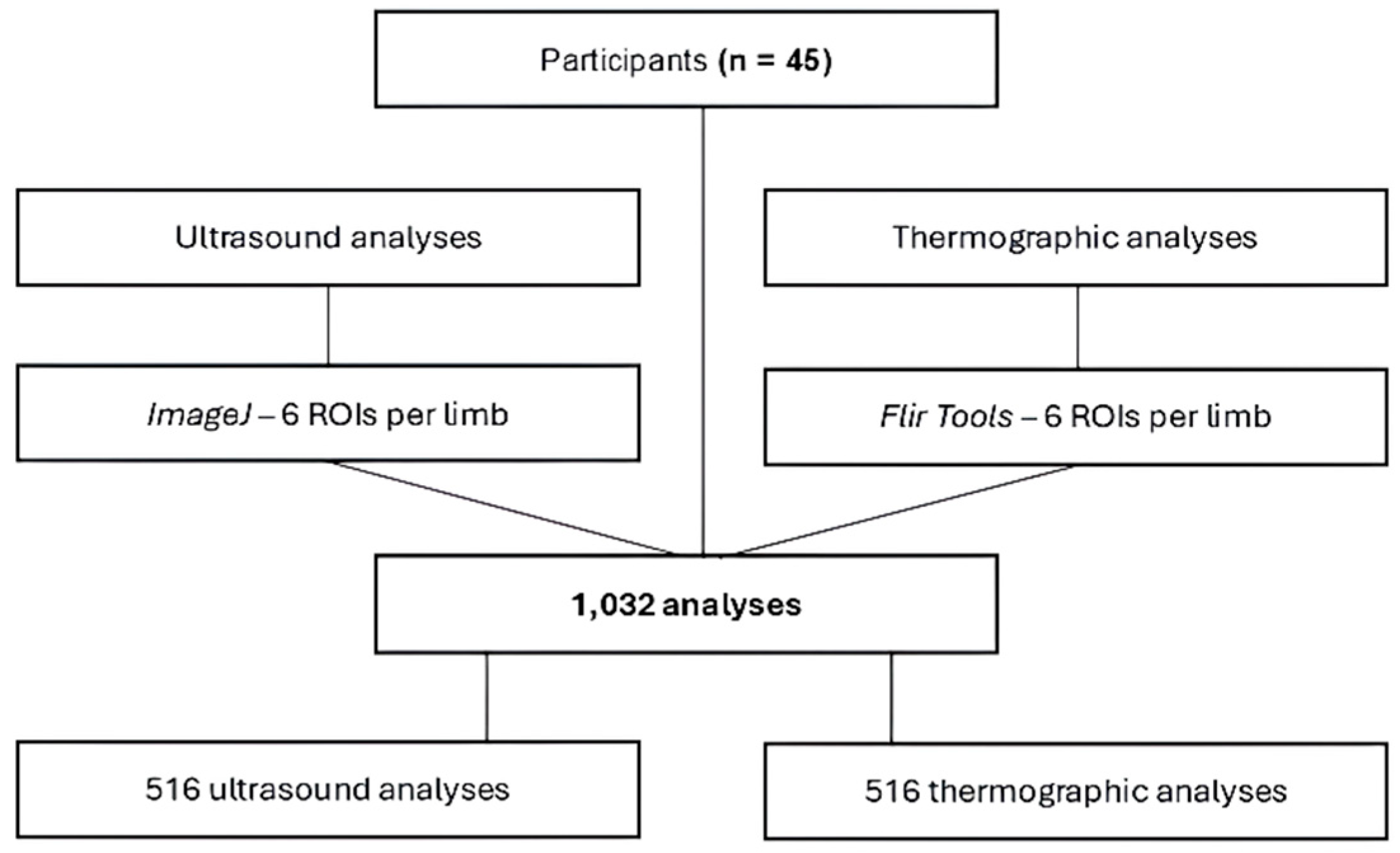
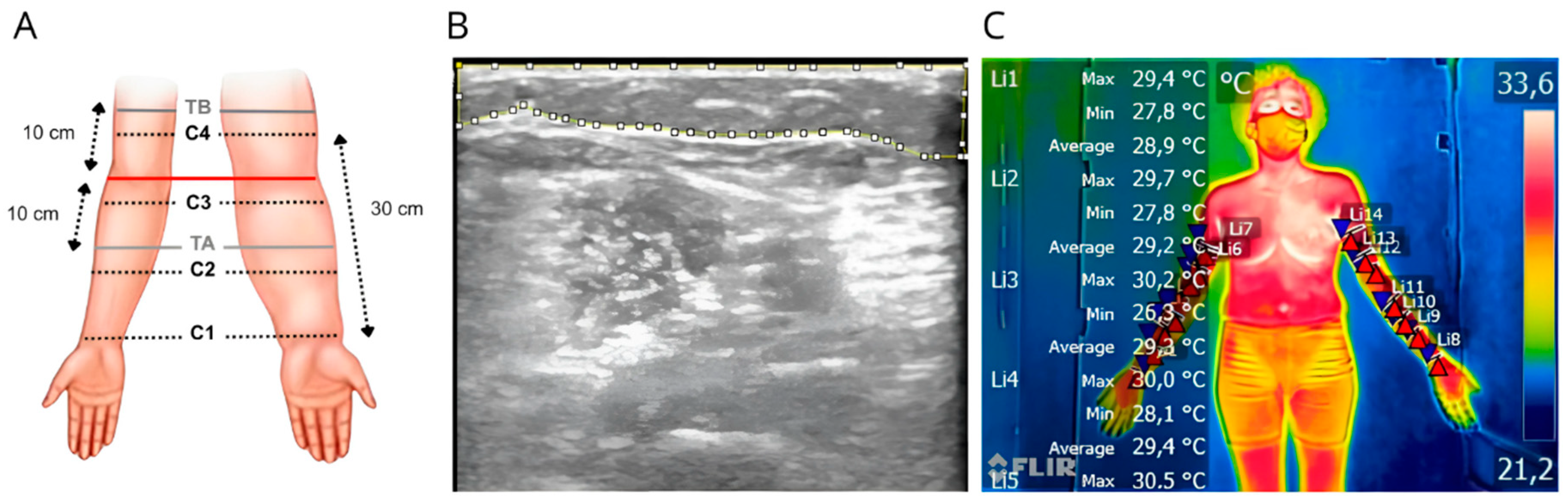

| Variable | with BCRL (n = 20, 44.4%) | Without BCRL (n = 25, 55.6%) | p-Value |
|---|---|---|---|
| Age (years) | 51.8 ± 6.8 | 55.7± 7.9 | 0.074 ¶ |
| Body Mass Index (kg/m2) | 28.8 ± 5.3 | 27.8 ± 5.1 | 0.500 ¶ |
| Handedness | 0.815 † | ||
| Right-handed | 18 (90%) | 23 (92%) | |
| Left-handed | 2 (10%) | 2 (8%) | |
| Type of Mastectomy | 0.923 † | ||
| Total | 1(5%) | 2 (8%) | |
| Modified radical | 14 (70%) | 17 (68%) | |
| Radical | 5 (25%) | 6 (24%) | |
| Axillary lymph node dissection | 20 (100%) | 23 (92%) | 0.196 † |
| Tmáx per ROI | |||
| C1 | 26.3 ± 2.2 | 30.7 ± 1.7 | <0.001 ¶ |
| C2 | 26.9 ± 2.2 | 30.4 ± 1.4 | <0.001 ¶ |
| C3 | 27.05 ± 2.3 | 30.5 ± 1.4 | <0.001 ¶ |
| TA | 26.8 ± 1.9 | 30.4 ± 1.4 | <0.001 ¶ |
| C4 | 27.5 ± 2.1 | 30.6 ± 1.6 | <0.001 †† |
| TB | 27.9 ± 2.1 | 31.2 ±1.5 | <0.001 †† |
| ROI | Mean Difference (°C) | 95% CI | p-Value | p (Holm) | p (FDR) |
|---|---|---|---|---|---|
| C1 | −4.37 | −5.53 to −3.21 | <0.001 | <0.001 | <0.001 |
| C2 | −3.54 | −4.64 to −2.44 | <0.001 | <0.001 | <0.001 |
| C3 | −3.45 | −4.58 to −2.32 | <0.001 | <0.001 | <0.001 |
| TA | −3.63 | −4.63 to −2.64 | <0.001 | <0.001 | <0.001 |
| C4 | −3.18 | −4.27 to −2.10 | <0.001 | <0.001 | <0.001 |
| TB | −3.31 | −4.37 to −2.25 | <0.001 | <0.001 | <0.001 |
| Variable | ROI | Mean Difference HL–CL (95% CI) | p-Value | p (Holm) | p (FDR) |
|---|---|---|---|---|---|
| Subcutaneous tissue thickness (STT) | C1 | −0.57 (−7.18 to 6.04) | 0.865 | 1.000 | 0.865 |
| C2 | −1.10 (−6.02 to 3.82) | 0.661 | 1.000 | 0.793 | |
| C3 | −1.85 (−5.85 to 2.14) | 0.363 | 1.000 | 0.544 | |
| TA | 3.44 (−1.96 to 8.84) | 0.211 | 1.000 | 0.493 | |
| C4 | 2.66 (−1.84 to 7.15) | 0.247 | 1.000 | 0.493 | |
| TB | 5.37 (2.15 to 8.59) | 0.001 | 0.006 | 0.006 | |
| Entropy (ENT) | C1 | −0.06 (−0.15 to 0.04) | 0.239 | 0.801 | 0.359 |
| C2 | −0.05 (−0.14 to 0.03) | 0.200 | 0.801 | 0.359 | |
| C3 | 0.01 (−0.08 to 0.09) | 0.901 | 1.000 | 0.901 | |
| TA | −0.02 (−0.09 to 0.04) | 0.516 | 1.000 | 0.619 | |
| C4 | 0.05 (0.00 to 0.11) | 0.042 | 0.250 | 0.250 | |
| TB | −0.06 (−0.13 to 0.02) | 0.133 | 0.665 | 0.359 | |
| Echogenicity (ECHO) | C1 | −1.66 (−6.11 to 2.79) | 0.465 | 1.000 | 0.986 |
| C2 | −0.73 (−3.63 to 2.17) | 0.623 | 1.000 | 0.986 | |
| C3 | 0.33 (−2.76 to 3.42) | 0.834 | 1.000 | 0.986 | |
| TA | −0.04 (−4.75 to 4.67) | 0.986 | 1.000 | 0.986 | |
| C4 | 0.28 (−3.30 to 3.86) | 0.879 | 1.000 | 0.986 | |
| TB | 2.78 (−0.27 to 5.83) | 0.074 | 0.443 | 0.443 |
| Variable | ROI | Mean Difference (95% CI) | p-Value | p (Holm) | p (FDR) |
|---|---|---|---|---|---|
| Subcutaneous tissue thickness (STT) | C1 | 6.89 (−3.39 to 17.18) | 0.189 | 1.000 | 0.584 |
| C2 | −4.53 (−13.25 to 4.20) | 0.309 | 1.000 | 0.584 | |
| C3 | 3.35 (−6.10 to 12.80) | 0.487 | 1.000 | 0.584 | |
| TA | 3.49 (−6.05 to 13.04) | 0.473 | 1.000 | 0.584 | |
| C4 | 4.16 (−5.56 to 13.89) | 0.401 | 1.000 | 0.584 | |
| TB | 0.45 (−8.92 to 9.82) | 0.925 | 1.000 | 0.925 | |
| Entropy (ENT) | All ROIs | No differences observed after adjustment | — | — | — |
| Echogenicity (ECHO) | C1 | 6.75 (−1.71 to 15.22) | 0.118 | 0.590 | 0.354 |
| C2 | −4.33 (−13.56 to 4.90) | 0.358 | 1.000 | 0.715 | |
| C3 | −0.68 (−10.86 to 9.49) | 0.896 | 1.000 | 0.896 | |
| TA | 2.94 (−5.78 to 11.66) | 0.509 | 1.000 | 0.763 | |
| C4 | −2.10 (−11.08 to 6.87) | 0.646 | 1.000 | 0.775 | |
| TB | 9.77 (2.29 to 17.24) | 0.010 | 0.063 | 0.063 |
| Predictor | ROI | β (95% CI) | p-Value | p (Holm) | p (FDR) |
|---|---|---|---|---|---|
| STT | TB | 0.022 (0.004 to 0.040) | 0.015 | 0.088 | 0.088 |
| ENT | C2 | 0.982 (0.426 to 1.538) | <0.001 | 0.003 | 0.003 |
| ECHO | All ROIs | No associations after adjustment | — | — | — |
Disclaimer/Publisher’s Note: The statements, opinions and data contained in all publications are solely those of the individual author(s) and contributor(s) and not of MDPI and/or the editor(s). MDPI and/or the editor(s) disclaim responsibility for any injury to people or property resulting from any ideas, methods, instructions or products referred to in the content. |
© 2026 by the authors. Licensee MDPI, Basel, Switzerland. This article is an open access article distributed under the terms and conditions of the Creative Commons Attribution (CC BY) license.
Share and Cite
Amaral Lima, M.G.; Souza da Silva, A.C.; da Silva Alves Gomes, V.M.; de Oliveira, N.P.D.; de Sousa, V.P.S.; Dantas, D. Echogenicity, Entropy, and Skin Temperature in Breast Cancer-Related Lymphoedema: A Cross-Sectional Study. Lymphatics 2026, 4, 26. https://doi.org/10.3390/lymphatics4020026
Amaral Lima MG, Souza da Silva AC, da Silva Alves Gomes VM, de Oliveira NPD, de Sousa VPS, Dantas D. Echogenicity, Entropy, and Skin Temperature in Breast Cancer-Related Lymphoedema: A Cross-Sectional Study. Lymphatics. 2026; 4(2):26. https://doi.org/10.3390/lymphatics4020026
Chicago/Turabian StyleAmaral Lima, Maria Gabriela, Ana Cláudia Souza da Silva, Vanessa Maria da Silva Alves Gomes, Nayara Priscila Dantas de Oliveira, Vanessa Patrícia Soares de Sousa, and Diego Dantas. 2026. "Echogenicity, Entropy, and Skin Temperature in Breast Cancer-Related Lymphoedema: A Cross-Sectional Study" Lymphatics 4, no. 2: 26. https://doi.org/10.3390/lymphatics4020026
APA StyleAmaral Lima, M. G., Souza da Silva, A. C., da Silva Alves Gomes, V. M., de Oliveira, N. P. D., de Sousa, V. P. S., & Dantas, D. (2026). Echogenicity, Entropy, and Skin Temperature in Breast Cancer-Related Lymphoedema: A Cross-Sectional Study. Lymphatics, 4(2), 26. https://doi.org/10.3390/lymphatics4020026

