
Molecular PET/CT in Systemic Sclerosis-Associated Interstitial Lung Disease (SSc-ILD)


Abstract
1. Search Strategy and Methods
1.1. Review Design
1.2. Literature Search
1.3. Inclusion and Exclusion Criteria
- Studies reporting PET/CT imaging (any tracer) in SSc-ILD or related fibrotic ILDs.
- Original research articles, case reports, case series, and conference abstracts.
- Review articles specifically addressing molecular imaging in ILD or SSc.
- Publications in English.
- Studies exclusively reporting non-PET imaging modalities without PET comparison.
- Animal studies without human data.
- Case reports unrelated to SSc-ILD or ILD.
1.4. Quality Appraisal
2. Introduction
3. Clinical Background: SSc-ILD
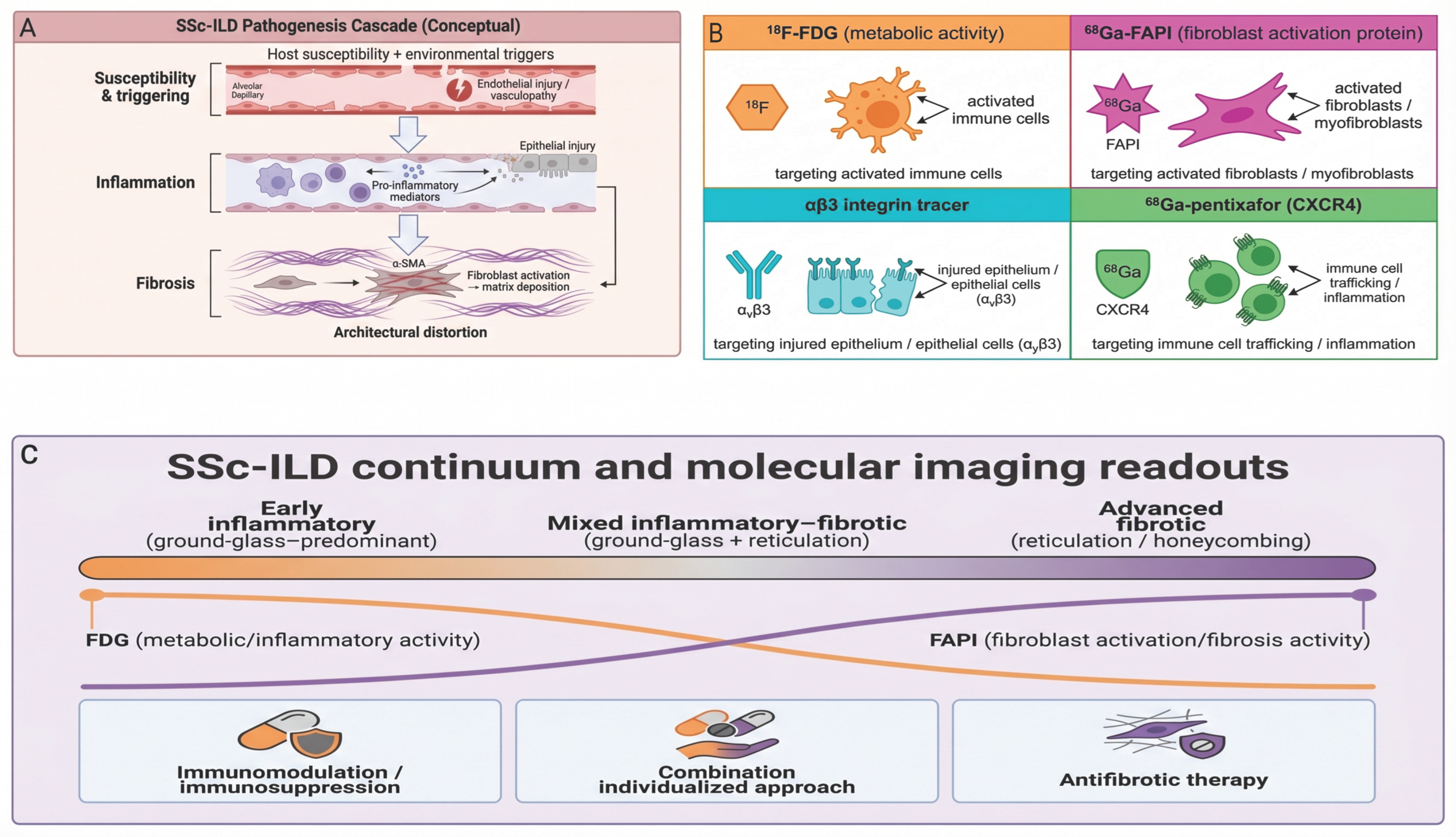
3.1. Pathophysiology of SSc-ILD
3.2. Current Role of HRCT in SSc-ILD
3.3. Pulmonary Function Tests and Biomarkers
3.4. Unmet Needs in SSc-ILD Assessment
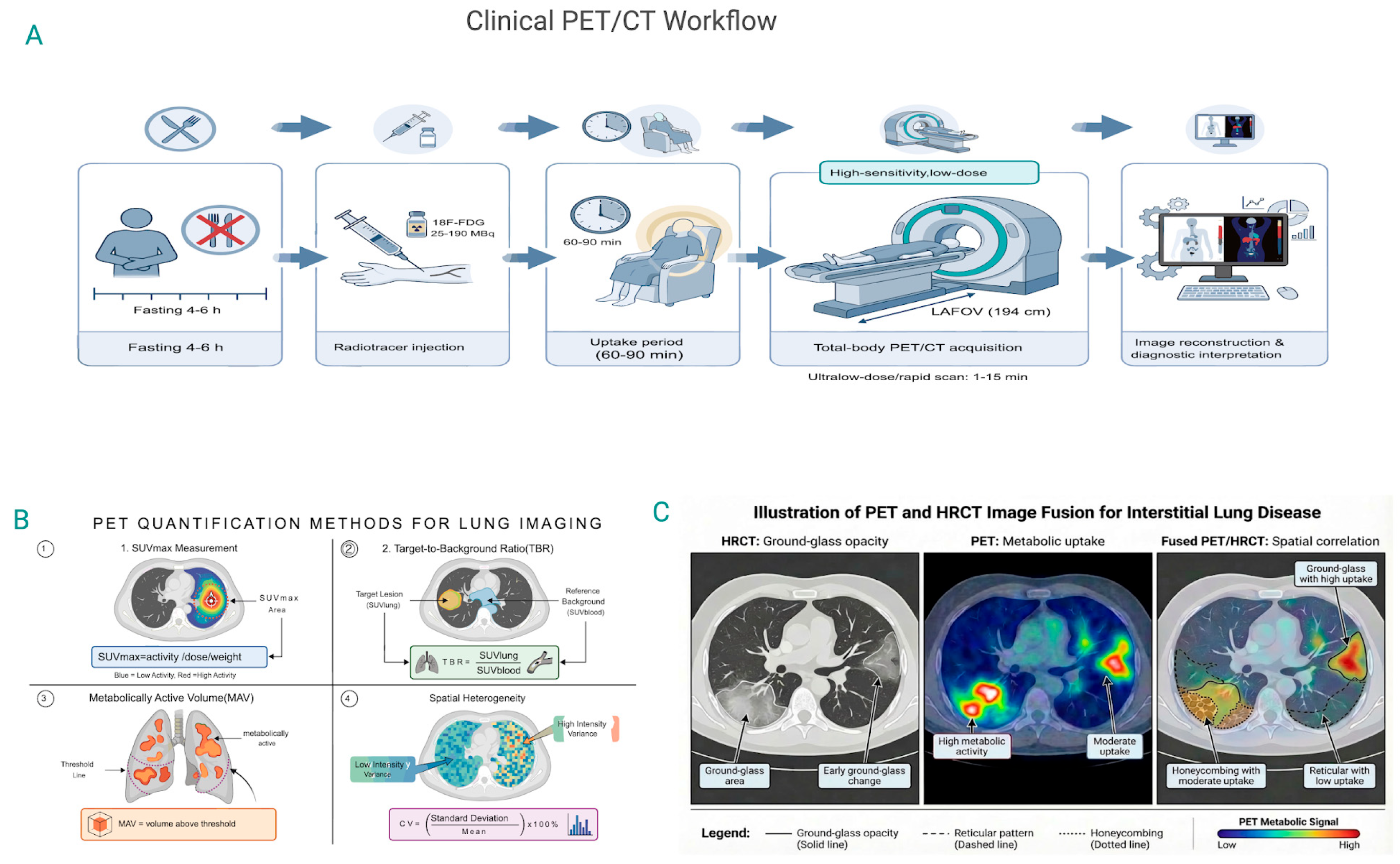
3.5. Technical Parameters for HRCT and PET/CT: Key Differences
- Recommended Imaging Protocol for SSc-ILD
4. FDG PET/CT in SSc-ILD
4.1. Biological Rationale for FDG PET/CT in SSc-ILD
4.2. Clinical Studies of FDG PET/CT in SSc-ILD
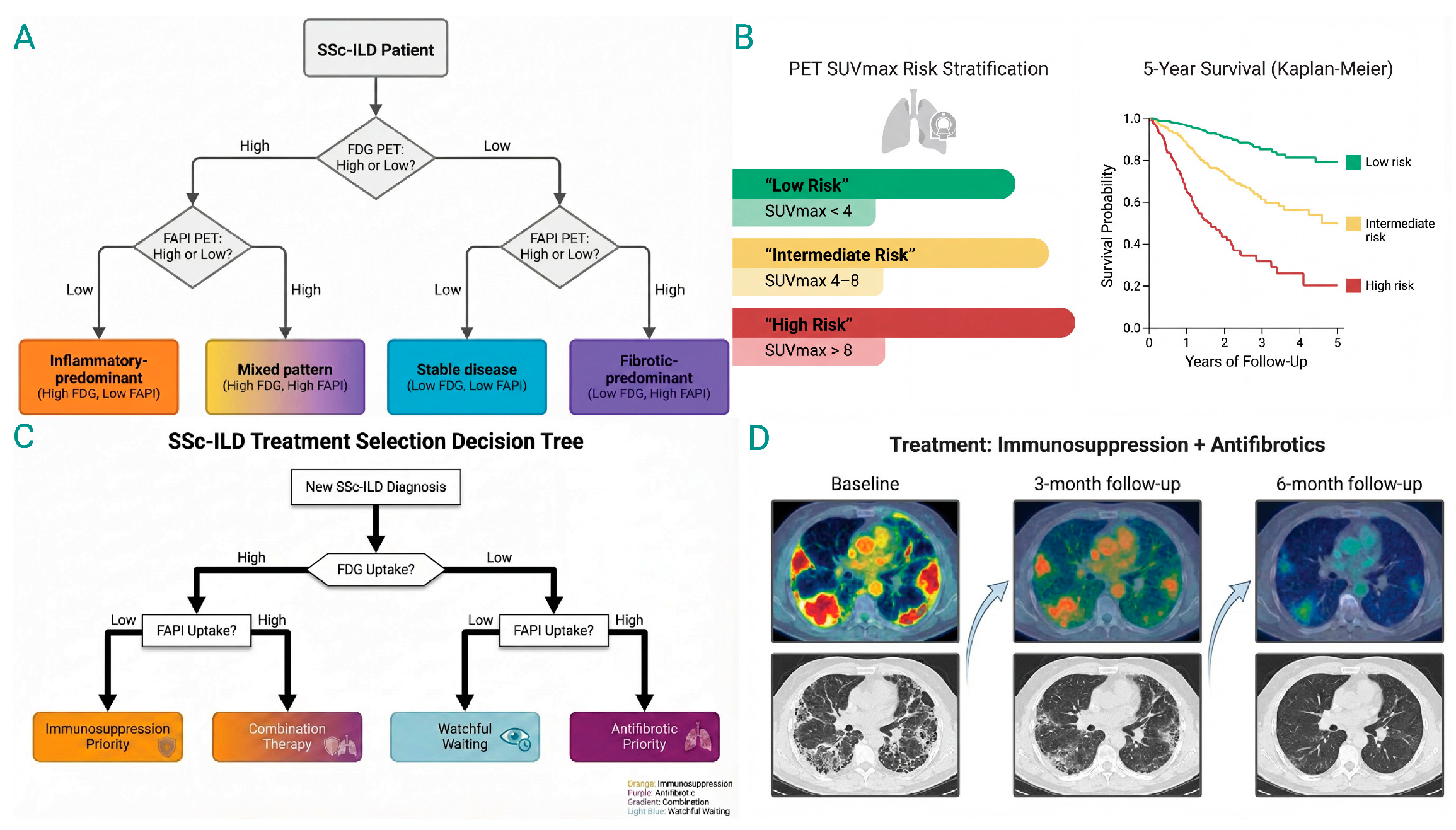
4.3. Prognostic Value
4.4. Comparison with HRCT and PFTs
4.5. Radiation Dosimetry for Serial Imaging
- Cumulative Dose Estimates for Serial Imaging (illustrative 2-year protocol):
- FDG PET/CT every 6 months (4 scans): ~28–56 mSv cumulative.
- FAPI PET/CT every 6 months (4 scans): ~16–24 mSv cumulative.
- ICRP occupational recommendation: <20 mSv/year averaged over 5 years.
- Clinical Implications:
4.6. Limitations of FDG PET/CT Evidence in SSc-ILD
- Small sample sizes: Most published studies enrolled 10–30 patients, with only a few exceeding 40 participants [6,13,17,18]. The largest prospective cohort to date (Lilburn 2025 [18]) enrolled 45 patients with a mean 44.8-month follow-up, representing a significant advance but still insufficient for definitive clinical validation.
- Heterogeneous study designs: Studies vary in patient selection criteria, disease duration, immunosuppressive treatment exposure, PET acquisition protocols, and quantification methods, limiting cross-study comparisons.
- Single-centre studies: All published SSc-ILD FDG PET/CT studies are single-centre, introducing potential selection bias (see Section 9.5).
- Lack of standardized quantification: No consensus exists on the optimal PET metric (SUVmax, SUVmean, TBR, or volumetric measures) for SSc-ILD assessment (see Section 7.2).
- Absence of prospective treatment response data: No randomized controlled trial has used FDG PET/CT as a primary endpoint or response biomarker in SSc-ILD.
5. FAPI PET/CT in SSc-ILD
5.1. Biological Rationale
5.2. Clinical Studies in SSc-ILD
5.3. Comparison with FDG PET/CT
5.4. Limitations of FAPI PET/CT Evidence in SSc-ILD
- Very limited SSc-ILD-specific data: As of the search date, FAPI PET/CT evidence in SSc-ILD consists of one single case report (Khadka 2025 [26], n = 1), one small case series in fibrotic ILD (Lam 2023 [25], n = 5, not exclusively SSc-ILD), one single-centre pilot study in SSc-ILD (Schmidkonz 2021 [7], n = 12), and one exploratory study in SSc-ILD (Tai 2026 [27], n = 22).
- Tracer heterogeneity: Published studies have used different FAPI tracers (68Ga-FAPI-04 and 68Ga-FAPI-46), different imaging timepoints (10 min and 60 min), and different quantification methods, limiting comparability.
- Absence of longitudinal data: No published study has evaluated FAPI PET/CT as a longitudinal monitoring tool in SSc-ILD with serial imaging over time.
- No treatment response data: No study has evaluated FAPI PET/CT changes in response to immunosuppressive or antifibrotic therapy in SSc-ILD.
6. Other Molecular Tracers in SSc-ILD and Related Fibrotic ILDs
6.1. Overview of Emerging Tracers
6.2. CXCR4-Targeted Imaging
6.3. Integrin-Targeted Imaging
6.4. Macrophage-Targeted Imaging
6.5. Preclinical and Emerging Tracers
- Matrix metalloproteinases (MMPs), which mediate extracellular matrix remodelling. Radiolabeled MMP inhibitors have shown uptake in fibrotic lung tissue in preclinical models, but no human SSc-ILD data are available [8].
- Collagen synthesis markers, including radiolabeled collagen-binding peptides targeting newly synthesized type I collagen. These tracers aim to directly quantify active fibrogenesis but remain in preclinical stages [8].
- Apoptosis markers, including radiolabeled annexin V and caspase-targeted probes. These may provide insights into cell death pathways in SSc-ILD but have not been evaluated in human ILD cohorts [8].
- Other emerging targets include lysyl oxidase (involved in collagen crosslinking), transglutaminase, and cytokine receptors (e.g., IL-13Rα2 and TGF-β receptors) [8].
6.6. Limitations of Other Tracer Evidence
- CXCR4 imaging: Evidence is limited to one full article (Kopp 2025 [28]) and one conference abstract (Kopp 2025 [29], preliminary conference data). These represent two separate publications reporting related data; the conference abstract [29] should be interpreted as preliminary evidence pending full peer-reviewed publication.
- Integrin imaging: Evidence consists of one study in SSc-ILD/ILD (Schniering 2019 [9]). No replication data exist.
- Macrophage imaging: Evidence consists of one study in scleroderma alveolitis (Branley 2008 [30], n = 15 FASSc + n = 7 controls), with a non-significant trend for PK11195 uptake reduction (p = 0.09). This is the oldest study in the review and uses older PET technology.
- Preclinical tracers: No human SSc-ILD data exist for MMPs, collagen synthesis markers, or apoptosis markers. All evidence is from animal models or other disease contexts [8].
7. Quantitative PET Metrics and Artificial Intelligence
7.1. Overview of Quantitative PET Metrics
7.2. Limitations of SUVmax and Alternative Quantification Metrics
7.2.1. SUVmax (Maximum SUV)
7.2.2. SUVmean (Mean SUV)
7.2.3. SUVpeak (Peak SUV)
7.2.4. Volumetric Metrics
7.2.5. Target-to-Background Ratio (TBR)
7.2.6. Recommendation
7.3. Harmonization with HRCT and PFTs
7.4. Radiomics and Texture Analysis
7.5. Artificial Intelligence Integration
7.6. Limitations of AI/Radiomics Evidence in SSc-ILD
- Single-centre studies: Most AI studies are single-centre, limiting generalizability.
- Retrospective design: Most studies are retrospective, introducing selection bias.
- No prospective validation: No AI model has been prospectively validated in an independent multicenter SSc-ILD cohort.
8. Clinical Applications and Future Perspectives
8.1. Current Clinical Applications
8.2. Future Perspectives
9. Limitations of This Review
9.1. Evidence Quality and Study Design Limitations
- Small sample sizes: Most studies enrolled 10–30 patients. Only Lilburn in 2025 [18] exceeded 40 participants (n = 45).
- Heterogeneous study designs: Studies vary in patient selection, disease duration, treatment exposure, PET protocols, and quantification methods.
- Single-centre studies: All published SSc-ILD PET studies are single-centre, limiting generalizability.
- Predominantly retrospective design: Most studies are retrospective, introducing potential selection bias.
- Conference abstract data: Several included studies are conference abstracts, representing preliminary data without full peer review.
- Tracer heterogeneity: Different FAPI tracer variants (FAPI-04, FAPI-46) and imaging timepoints are used across studies.
9.2. Narrative Review Methodology
9.3. Lack of Formal Quality Appraisal
- Selection bias: Patients in single-centre PET studies are typically recruited from tertiary referral centres, enriching the cohort for more severe or complex disease (see Section 9.5).
- Information bias: Retrospective studies rely on medical records, which may have incomplete or inconsistently recorded data.
- Measurement bias: Variability in PET acquisition protocols, scanner hardware, and reconstruction algorithms across studies may introduce systematic measurement error.
- Attrition bias: Longitudinal studies may have differential loss to follow-up related to disease severity.
- Publication bias: Positive or feasibility studies are more likely to be published than negative studies, potentially overestimating the utility of molecular PET/CT in SSc-ILD.
9.4. Accessibility and Generalizability of PET/CT
9.5. Selection Bias and Generalizability
- Tertiary referral centre bias: All published SSc-ILD PET studies were conducted at tertiary academic medical centres. Patients referred to these centres typically have more severe, complex, or treatment-refractory disease compared to the broader SSc-ILD population managed in community settings.
- Disease severity enrichment: PET studies tend to enrol patients with established ILD and measurable PFT impairment, underrepresenting patients with early or subclinical disease.
- Treatment exposure confounding: Patients enrolled in PET studies are often on immunosuppressive therapy (mycophenolate mofetil, cyclophosphamide, and nintedanib), which may suppress the metabolic and fibrotic activity detectable by PET, potentially underestimating true PET signal in untreated disease.
- Socioeconomic and geographic barriers: PET/CT access is limited by cost, infrastructure, and geographic availability. Studies from high-resource academic centres may not reflect real-world practice in lower-resource settings.
- Implications for clinical translation: The generalizability of current PET findings to the broader SSc-ILD population, including patients with early disease, mild ILD, or those managed in non-academic settings, remains uncertain. Prospective multicenter studies recruiting diverse patient populations are needed.
10. Conclusions
Supplementary Materials
Author Contributions
Funding
Data Availability Statement
Conflicts of Interest
References
- Fischer, A.; Patel, N.M.; Volkmann, E.R. Interstitial lung disease in systemic sclerosis: Focus on early detection and intervention. Open Access Rheumatol. 2019, 11, 283–307. [Google Scholar] [CrossRef] [PubMed]
- Walsh, S.L.; Devaraj, A.; Enghelmayer, J.I.; Kishi, K.; Silva, R.S.; Patel, N.; Rossman, M.D.; Valenzuela, C.; Vancheri, C. Role of imaging in progressive-fibrosing interstitial lung diseases. Eur. Respir. Rev. 2018, 27, 180073. [Google Scholar] [CrossRef] [PubMed]
- Hoffmann-Vold, A.-M.; Distler, O.; Crestani, B.; Antoniou, K.M. Recent advances in the management of systemic sclerosis-associated interstitial lung disease. Curr. Opin. Pulm. Med. 2022, 28, 441–448. [Google Scholar] [CrossRef]
- Wolf, M.; Montesi, S.B. Novel imaging strategies in systemic sclerosis. Curr. Rheumatol. Rep. 2020, 22, 57. [Google Scholar] [CrossRef]
- Cho, E.-J.; Park, K.-J.; Ko, D.-H.; Koo, H.J.; Lee, S.M.; Song, J.W.; Lee, W.; Lee, H.K.; Do, K.-H.; Chun, S.; et al. Analytical and clinical performance of the Nanopia KL 6 assay in Korean patients with interstitial lung diseases. Ann. Lab. Med. 2019, 39, 245–251. [Google Scholar] [CrossRef]
- Bellando-Randone, S.; Tartarelli, L.; Cavigli, E.; Tofani, L.; Bruni, C.; Lepri, G.; Blagojevic, J.; Moggi-Pignone, A.; Mihai, C.; Avouac, J.; et al. 18F-fluorodeoxyglucose positron-emission tomography/CT and lung involvement in systemic sclerosis. Ann. Rheum. Dis. 2019, 78, 577–578. [Google Scholar] [CrossRef]
- Schmidkonz, C.; Distler, J.; Treutlein, C.; Atzinger, A.; Prante, O.; Ritt, P.; Götz, T.; Bäuerle, T.; Cordes, M.; Köhner, M.; et al. 68Ga-FAPI-04 PET/CT for molecular assessment of fibroblast activation and risk evaluation in systemic sclerosis-related interstitial lung disease. NuklearMedizin 2021, 60, 361–369. [Google Scholar] [CrossRef]
- Broens, B.; Duitman, J.-W.; Zwezerijnen, G.J.; Nossent, E.J.; van der Laken, C.J.; Voskuyl, A.E. Novel tracers for molecular imaging of interstitial lung disease: A state of the art review. Autoimmun. Rev. 2022, 21, 103202. [Google Scholar] [CrossRef]
- Schniering, J.; Benešová, M.; Brunner, M.; Haller, S.; Cohrs, S.; Frauenfelder, T.; Vrugt, B.; A Feghali-Bostwick, C.; Schibli, R.; Distler, O.; et al. Visualisation of interstitial lung disease by molecular imaging of integrin αvβ3 and somatostatin receptor 2. Ann. Rheum. Dis. 2019, 78, 218–227. [Google Scholar] [CrossRef]
- Occhipinti, M.; Bosello, S.; Sisti, L.G.; Cicchetti, G.; De Waure, C.; Pirronti, T.; Ferraccioli, G.; Gremese, E.; Larici, A.R. Quantitative and semi-quantitative computed tomography analysis of interstitial lung disease associated with systemic sclerosis: A longitudinal evaluation of pulmonary parenchyma and vessels. PLoS ONE 2019, 14, e0213444. [Google Scholar] [CrossRef] [PubMed]
- Broens, B.; van der Laken, C.J.; Simons, I.A.; Dekker, T.; Duitman, J.-W.; Voskuyl, A.E. Longitudinal assessment of circulating fibroblast activation protein in systemic sclerosis-associated interstitial lung disease. Arthritis Res. Ther. 2025, 27, 184. [Google Scholar] [CrossRef]
- Suman, G.; Koo, C.W. Recent advancements in computed tomography assessment of fibrotic interstitial lung diseases. J. Thorac. Imaging 2023, 38, 347–359. [Google Scholar] [CrossRef]
- Peelen, D.M.; Zwezerijnen, B.G.J.C.; Nossent, E.J.; Meijboom, L.J.; Hoekstra, O.S.; Van der Laken, C.J.; E Voskuyl, A. The quantitative assessment of interstitial lung disease with positron emission tomography scanning in systemic sclerosis patients. Rheumatology 2020, 59, 1407–1415. [Google Scholar] [CrossRef] [PubMed]
- Schniering, J.; Maciukiewicz, M.; Gabrys, H.S.; Brunner, M.; Blüthgen, C.; Meier, C.; Braga-Lagache, S.; Uldry, A.-C.; Heller, M.; Guckenberger, M.; et al. Computed tomography-based radiomics decodes prognostic and molecular differences in interstitial lung disease related to systemic sclerosis. Eur. Respir. J. Open Res. 2021, 59, 2004503. [Google Scholar] [CrossRef] [PubMed]
- Bellando-Randone, S.; Matucci-Cerinic, M. The race against time to disclose lung inflammation in interstitial lung disease in systemic sclerosis: Is PET scan the winning solution? Rheumatology 2020, 59, 2639–2641. [Google Scholar] [CrossRef]
- Ledoult, E.; Morelle, M.; Soussan, M.; Mékinian, A.; Béhal, H.; Sobanski, V.; Hachulla, E.; Huglo, D.; Le Gouellec, N.; Remy-Jardin, M.; et al. 18F-FDG positron emission tomography scanning in systemic sclerosis-associated interstitial lung disease: A pilot study. Arthritis Res. Ther. 2021, 23, 76. [Google Scholar] [CrossRef]
- Broens, B.; van der Laken, C.J.; Zwezerijnen, G.J.; Nossent, E.J.; Meijboom, L.J.; Spierings, J.; de Vries-Bouwstra, J.K.; van Laar, J.M.; Voskuyl, A.E. Positron emission tomography to improve assessment of interstitial lung disease in patients with systemic sclerosis eligible for autologous stem cell transplantation. Front. Immunol. 2022, 13, 923869. [Google Scholar] [CrossRef]
- Lilburn, D.M.; Garthwaite, H.S.; Ganeshan, B.; Win, T.; Screaton, N.J.; Hoy, L.R.; Walls, D.; Endozo, R.; Shortman, R.I.; Fraioli, F.; et al. [18F]FDG PET/CT predicts patient survival in patients with systemic sclerosis–associated interstitial lung disease. J. Nucl. Med. 2025, 66, 1135–1141. [Google Scholar] [CrossRef] [PubMed]
- Uehara, T.; Takeno, M.; Hama, M.; Yoshimi, R.; Suda, A.; Ihata, A.; Ueda, A.; Tateishi, U.; Ishigatsubo, Y. Deep-inspiration breath-hold 18F-FDG-PET/CT is useful for assessment of connective tissue disease associated interstitial pneumonia. Mod. Rheumatol. 2016, 26, 121–127. [Google Scholar] [CrossRef]
- Bastos, A.L.; A Ferreira, G.; Mamede, M.; Mancuzo, E.V.; Teixeira, M.M.; Santos, F.P.S.T.; Ferreira, C.S.; A Correa, R. PET/CT and inflammatory mediators in systemic sclerosis-associated interstitial lung disease. J. Bras. Pneumol. 2022, 48, e20210329. [Google Scholar] [CrossRef]
- Broens, B.; Zwezerijnen, G.C.J.; Nossent, E.; Meijboom, L.; Yaqub, M.; Spierings, J.; De Vries-Bouwstra, J.; Van Laar, J.M.; Van der Laken, C.J.; Voskuyl, A. 18F-FDG PET-CT of interstitial lung disease in patients with early systemic sclerosis. Ann. Rheum. Dis. 2023, 82, 750–751. [Google Scholar] [CrossRef]
- Peelen, D.; Zwezerijnen, B.; Nossent, E.; Meijboom, L.; Hoekstra, O.; van der Laken, C.; Voskuyl, A. The use of positron emission tomography (PET)-scan for the quantitative assessment of interstitial lung disease in systemic sclerosis [abstract]. Arthritis Rheumatol. 2017, 69. Available online: https://acrabstracts.org/abstract/the-use-of-positron-emission-tomography-pet-scan-for-the-quantitative-assessment-of-interstitial-lung-disease-in-systemic-sclerosis/ (accessed on 11 February 2026).
- Ivorra, J.; Martinez, M.; Loaiza, J.; Garijo, M.; Alegre, J.; Herrera, S.; Chalmeta, I.; Gonzalez, L.; Negueroles, R.; Alcañiz, C.; et al. 18FDG PET/CT predicts decline in functional respiratory tests in systemic sclerosis patients but not in rheumatoid arthritis patients. Ann. Rheum. Dis. 2018, 77, 1595. [Google Scholar] [CrossRef]
- Nishiyama, Y.; Yamamoto, Y.; Dobashi, H.; Kameda, T. Clinical value of 18F-fluorodeoxyglucose positron emission tomography in patients with connective tissue disease. Jpn. J. Radiol. 2010, 28, 405–413. [Google Scholar] [CrossRef]
- Lam, W.; Noviani, M.; Chua, W.; Tham, W.; Ng, C.; Lim, G.; Lam, W.; Ng, D.; Xie, W.; Low, A. Non-invasive assessment of fibrotic activity in systemic sclerosis-associated interstitial lung disease using 68Ga-FAPI-04 PET/CT. Int. J. Rheum. Dis. 2023, 26, 587–591. [Google Scholar] [CrossRef]
- Khadka, A.; Singh, C.B.; Gujral, K.; Bhandari, S.; Sing, S. FAPI PET/CT for assessment of interstitial lung disease. J. Nucl. Med. 2025, 66, 251486. [Google Scholar]
- Tai, S.B.; Chua, W.M.; Ng, C.W.Q.; Noviani, M.; Tham, W.P.; Saffari, S.E.; Lam, W.W.C.; Ng, D.C.E.; Low, A.S.C.S.; Xie, W.; et al. Exploratory evaluation of early 68Ga-FAPI-46 PET/CT volume-based parameters in systemic sclerosis-associated interstitial lung disease. Eur. J. Nucl. Med. 2026, 53, 4115–4129. [Google Scholar] [CrossRef] [PubMed]
- Kopp, C.R.; Sharma, S.K.; Krishnaraju, V.S.; Sood, A.; Kumar, R.; Sinha, A.; Dhooria, S.; Singh, J.; Anand, S.; Minz, R.W.; et al. Chemokine receptor CXCR4 based positron emission tomography imaging in systemic sclerosis-related interstitial lung disease. Rheumatology 2025, 64, i28–i36. [Google Scholar] [CrossRef] [PubMed]
- Kopp, C.; Sharma, S.; Krishnaraju, V.; Sood, A.; Basher, R.; Sinha, A.; Dhooria, S.; Singh, J.; Anand, S.; Minz, R.W.; et al. POS0247 peripheral CXCR4+ immune cells correlate with CXCR4 uptake in lung regions on positron emission tomography scan in systemic sclerosis-related interstitial lung disease. Ann. Rheum. Dis. 2025, 84, 517–518. [Google Scholar] [CrossRef]
- Branley, H.M.; du Bois, R.M.; Wells, A.U.; Jones, H.A. PET scanning of macrophages in patients with scleroderma fibrosing alveolitis. Nucl. Med. Biol. 2008, 35, 901–909. [Google Scholar] [CrossRef]
- Chassagnon, G.; Vakalopoulou, M.; Régent, A.; Zacharaki, E.I.; Aviram, G.; Martin, C.; Marini, R.; Bus, N.; Jerjir, N.; Mekinian, A.; et al. Deep Learning–based approach for automated assessment of interstitial lung disease in systemic sclerosis on CT images. Radiol. Artif. Intell. 2020, 2, e190006. [Google Scholar] [CrossRef]
- Martini, K.; Baessler, B.; Bogowicz, M.; Blüthgen, C.; Mannil, M.; Tanadini-Lang, S.; Schniering, J.; Maurer, B.; Frauenfelder, T. Applicability of radiomics in interstitial lung disease associated with systemic sclerosis: Proof of concept. Eur. Radiol. 2021, 31, 1987–1998. [Google Scholar] [CrossRef] [PubMed]
- Refaee, T.; Salahuddin, Z.; Frix, A.-N.; Yan, C.; Wu, G.; Woodruff, H.C.; Gietema, H.; Meunier, P.; Louis, R.; Guiot, J.; et al. Diagnosis of idiopathic pulmonary fibrosis in high-resolution computed tomography scans using a combination of handcrafted radiomics and deep learning. Front. Med. 2022, 9, 915243. [Google Scholar] [CrossRef]
- Chassagnon, G.; Vakalopoulou, M.; Régent, A.; Sahasrabudhe, M.; Marini, R.; Hoang-Thi, T.-N.; Dinh-Xuan, A.-T.; Dunogué, B.; Mouthon, L.; Paragios, N.; et al. Elastic registration–driven deep learning for longitudinal assessment of systemic sclerosis interstitial lung disease at CT. Radiology 2021, 298, 457–466. [Google Scholar] [CrossRef] [PubMed]
- Walsh, S.L.F.; Mackintosh, J.A.; Calandriello, L.; Silva, M.; Sverzellati, N.; Larici, A.R.; Humphries, S.M.; Lynch, D.A.; Jo, H.E.; Glaspole, I.; et al. Deep learning–based outcome prediction in progressive fibrotic lung disease using high-resolution computed tomography. Am. J. Respir. Crit. Care Med. 2022, 206, 883–891. [Google Scholar] [CrossRef] [PubMed]
- Stock, C.J.W.; Nan, Y.; Fang, Y.; Kokosi, M.; Kouranos, V.; George, P.M.; Chua, F.; Jenkins, G.R.; Devaraj, A.; Desai, S.R.; et al. Deep-learning CT imaging algorithm to detect usual interstitial pneumonia pattern in patients with systemic sclerosis-associated interstitial lung disease: Association with disease progression and survival. Rheumatology 2024, 64, 3045–3053. [Google Scholar] [CrossRef]
- Jia, J.; Hernández-Girón, I.; Schouffoer, A.A.; de Vries-Bouwstra, J.K.; Ninaber, M.K.; Korving, J.C.; Staring, M.; Kroft, L.J.M.; Stoel, B.C. Explainable fully automated CT scoring of interstitial lung disease for patients suspected of systemic sclerosis by cascaded regression neural networks. Sci. Rep. 2024, 14, 26666. [Google Scholar] [CrossRef]
- Lee, K.; Lee, J.H.; Koh, S.Y.; Park, H.; Goo, J.M. Risk factors and prognostic indicators for progressive fibrosing interstitial lung disease: A deep learning-based CT quantification approach. Eur. Radiol. 2025, 35, 1234–1245. [Google Scholar] [CrossRef]
- Ammeter, M.; Chen, Y.; Müller, M.; Zhou, S.; De Sadeleer, L.J.; Brunner, M.; Distler, O.; Gabryś, H.S.; Tanadini-Lang, S.; Luecken, M.D.; et al. Deciphering the spatial heterogeneity of interstitial lung disease by integrative radiomics and single-nucleus transcriptomics. Eur. Respir. J. Open Sci. 2024, 10, 140. [Google Scholar] [CrossRef]
- Le Gall, A.; Hoang-Thi, T.-N.; Porcher, R.; Dunogué, B.; Berezné, A.; Guillevin, L.; Le Guern, V.; Cohen, P.; Chaigne, B.; London, J.; et al. Prognostic value of automated assessment of interstitial lung disease on CT in systemic sclerosis. Rheumatology 2023, 63, 103–110. [Google Scholar] [CrossRef]
- Kim, H.G.; Tashkin, D.P.; Clements, P.J.; Li, G.; Brown, M.S.; Elashoff, R.; Gjertson, D.W.; Abtin, F.; A Lynch, D.; Strollo, D.C.; et al. A computer-aided diagnosis system for quantitative scoring of extent of lung fibrosis in scleroderma patients. Clin. Exp. Rheumatol. 2010, 28, S26–S32. [Google Scholar]



| Parameter | PET/CT (CT Component) | Diagnostic HRCT |
|---|---|---|
| Tube voltage | 120 kVp | 120–140 kVp |
| Tube current | 40–80 mAs (low-dose) | 200–400 mAs |
| Slice thickness | 3–5 mm | 0.5–1.5 mm |
| Reconstruction kernel | Standard (soft tissue) | High-resolution (sharp/bone) |
| Primary purpose | Attenuation correction + anatomical localization | Detailed parenchymal assessment |
| Modality | Effective Dose per Exam | Source |
|---|---|---|
| 18F-FDG PET/CT (standard protocol) | ~7–14 mSv | FDG ~5–7 mSv + CT ~2–7 mSv |
| 68Ga-FAPI PET/CT (standard protocol) | ~4–6 mSv | FAPI ~2–3 mSv + CT ~2–3 mSv |
| Diagnostic HRCT | ~1–3 mSv | High-resolution protocol |
| Annual background radiation | ~3 mSv/year | ICRP reference |
| Study | Year | Study Design | n | Tracer | Key Finding |
|---|---|---|---|---|---|
| Bellando-Randone [6] | 2019 | Letter—Retrospective case series | 7 | 18F-FDG | nmSUV (normalized mean SUV) elevated in GGO segments; GGO segments ~24% higher uptake than morphologically normal segments |
| Ledoult [16] | 2021 | Full article—Pilot study | 19 | 18F-FDG | SUVmax and TBR elevated; correlates with PFT impairment |
| Peelen [13] | 2020 | Full article—Cross-sectional | 30 | 18F-FDG | PET detects metabolic activity in stable PFT patients |
| Uehara [19] | 2016 | Full article—Retrospective | 18 | 18F-FDG | Breath-hold improves image quality; mixed CTD population |
| Bastos [20] | 2022 | Full article—Cross-sectional | 23 | 18F-FDG | SULmean elevated across all HRCT patterns; FDG cannot distinguish fibrotic patterns in chronic SSc; CCL2 correlated with FVC |
| Broens [17] | 2022 | Full article—Retrospective | 15 | 18F-FDG | Metabolic activity in SSc-ILD pre-ASCT |
| Broens [21] | 2023 | Conference abstract (EULAR 2023) * | 13 | 18F-FDG | Early SSc (≤2 years): FDG uptake higher in ILD vs. no-ILD (p = 0.03); preliminary data only |
| Peelen [22] | 2017 | Conference abstract * | 12 | 18F-FDG | Pilot feasibility |
| Ivorra [23] | 2018 | Conference abstract (EULAR 2018) * | 14 | 18F-FDG | PET predicts PFT decline |
| Nishiyama [24] | 2010 | Conference abstract * | 10 | 18F-FDG | FDG in connective tissue disease |
| Lilburn [18] | 2025 | Full article—Prospective cohort | 45 | 18F-FDG | Background lung SUVmin independently predicts survival; enhances ILD-GAP index prognostic performance |
| Study | Year | Study Design | n | Tracer | Population | Key Finding |
|---|---|---|---|---|---|---|
| Schmidkonz [7] | 2021 | Full article—Single-centre pilot | 12 | 68Ga-FAPI-04 | SSc-ILD | FAP uptake correlates with HRCT extent and PFTs |
| Lam [25] | 2023 | Full article—Case series | 5 | 68Ga-FAPI-04 | Fibrotic ILD (not exclusively SSc-ILD) * | Heterogeneous FAP uptake; feasibility demonstrated |
| Khadka [26] | 2025 | Full article—Case report ** | 1 | 68Ga-FAPI | ILD | Single case; feasibility only |
| Tai [27] | 2026 | Full article—Exploratory prospective | 22 | 68Ga-FAPI-46 | SSc-ILD | Early volume-based parameters (TL-FAPI at 0 min) distinguish progressors from non-progressors (AUC 0.80); early timepoint outperforms late timepoint |
| Study | Year | Study Design | Tracer | Population | Key Finding |
|---|---|---|---|---|---|
| Schniering [9] | 2019 | Full article—Preclinical + human pilot | Integrin αvβ3 tracer | SSc-ILD/ILD | Feasibility of integrin αvβ3-targeted imaging in ILD demonstrated |
| Kopp [28] | 2025 | Full article | CXCR4 ligand | SSc-ILD | CXCR4 uptake correlates with peripheral CXCR4+ immune cell counts |
| Kopp [29] | 2025 | Conference abstract (EULAR 2025) | CXCR4 ligand | SSc-ILD | Peripheral CXCR4+ immune cells correlate with CXCR4 PET uptake in lung regions; preliminary data only |
| Branley [30] | 2008 | Full article | Macrophage tracer (11C-PK11195) | Scleroderma alveolitis (FASSc); n = 15 FASSc + n = 7 controls | Trend of reduced PK11195 uptake in FASSc (p = 0.09, not statistically significant); lung density significantly elevated (p < 0.005) |
| Broens [8] | 2022 | Review article (not a primary clinical study) | Various (MMPs, collagen markers, apoptosis markers) | Preclinical/multiple | Comprehensive narrative review of novel and preclinical PET tracers for ILD molecular imaging |
| Study | Year | Study Design | Imaging | Key Finding |
|---|---|---|---|---|
| Schniering [14] | 2021 | Full article | CT + PET (only study integrating PET/HRCT radiomics) | CT-based radiomics decodes prognostic and molecular differences in SSc-ILD |
| Chassagnon [34] | 2021 | Full article | CT only | Elastic registration-driven deep learning for longitudinal SSc-ILD assessment |
| Walsh [35] | 2022 | Full article | CT only | Deep learning outcome prediction in progressive fibrotic ILD |
| Stock [36] | 2024 | Full article | CT only | Deep learning algorithm to detect UIP pattern in SSc-ILD |
| Jia [37] | 2024 | Full article | CT only | Explainable AI CT scoring of ILD |
| Lee [38] | 2025 | Full article | CT only | Risk factors for progressive fibrosing ILD using deep learning CT quantification |
| Ammeter [39] | 2024 | Full article | CT only | Spatial heterogeneity of ILD by integrative radiomics and single-nucleus transcriptomics |
| Hoang-Thi [40] | 2023 | Full article | CT only | Prognostic value of automated CT assessment of ILD in systemic sclerosis |
| Kim [41] | 2010 | Full article | CT only | Computer-aided diagnosis for quantitative scoring of lung fibrosis extent in scleroderma |
| Chassagnon [31] | 2020 | Full article | CT only | Deep learning-based automated assessment of SSc-ILD on CT images |
| Martini [32] | 2021 | Full article | CT only | Applicability of radiomics in SSc-ILD: proof of concept |
Disclaimer/Publisher’s Note: The statements, opinions and data contained in all publications are solely those of the individual author(s) and contributor(s) and not of MDPI and/or the editor(s). MDPI and/or the editor(s) disclaim responsibility for any injury to people or property resulting from any ideas, methods, instructions or products referred to in the content. |
© 2026 by the authors. Licensee MDPI, Basel, Switzerland. This article is an open access article distributed under the terms and conditions of the Creative Commons Attribution (CC BY) license.
Share and Cite
Banala, M.; Ghazaryan, L.; Ezuddin, S. Molecular PET/CT in Systemic Sclerosis-Associated Interstitial Lung Disease (SSc-ILD). Sclerosis 2026, 4, 11. https://doi.org/10.3390/sclerosis4020011
Banala M, Ghazaryan L, Ezuddin S. Molecular PET/CT in Systemic Sclerosis-Associated Interstitial Lung Disease (SSc-ILD). Sclerosis. 2026; 4(2):11. https://doi.org/10.3390/sclerosis4020011
Chicago/Turabian StyleBanala, Mallareddy, Lilit Ghazaryan, and Shabbir Ezuddin. 2026. "Molecular PET/CT in Systemic Sclerosis-Associated Interstitial Lung Disease (SSc-ILD)" Sclerosis 4, no. 2: 11. https://doi.org/10.3390/sclerosis4020011
APA StyleBanala, M., Ghazaryan, L., & Ezuddin, S. (2026). Molecular PET/CT in Systemic Sclerosis-Associated Interstitial Lung Disease (SSc-ILD). Sclerosis, 4(2), 11. https://doi.org/10.3390/sclerosis4020011