Article

Sex Differences in the Associations of Sports App Use and Clustered Lifestyle Behaviors with Mental Well-Being Among College Students: A National Cross-Sectional Study in China


1
Institute of Child and Adolescent Health, School of Public Health, Peking University, Beijing 100191, China
2
National Health Commission Key Laboratory of Reproductive Health, Peking University, Beijing 100191, China
3
Vanke School of Public Health, Tsinghua University, Beijing 100084, China
4
Department of Sport, Physical Education and Health, Hong Kong Baptist University, Kowloon Tong, Hong Kong 999077, China
5
Laboratory of Exercise Science and Health, BNU-HKBU United International College, Zhuhai 519087, China
*
Author to whom correspondence should be addressed.
Future 2026, 4(2), 13; https://doi.org/10.3390/future4020013
Submission received: 10 January 2026 / Revised: 13 March 2026 / Accepted: 26 March 2026 / Published: 30 March 2026

Abstract

Objectives: This study aimed to explore whether the association of lifestyle behaviors with mental well-being differed by sports app use among college students, while also examining differences by sex. Methods: A total of 38,738 Chinese college students aged 19–22 years from a nationally cross-sectional survey in 2019 were included in this study. The Warwick Edinburgh Mental Wellbeing Scale was applied to evaluate mental well-being. Clustered lifestyle behaviors were defined as unfavorable (zero to two healthy factors), intermediate (three healthy factors), or favorable (four to five healthy factors). The use of sports apps was classified as dichotomized frequently (sometimes and often) and infrequently (never, rarely, and occasionally). Log-binomial regression was used to investigate the associations. Results: Intermediate (PR = 1.14, 95% CI: 1.11–1.18) and unfavorable (PR = 1.29, 95% CI: 1.26–1.33) lifestyles were positively associated with low mental well-being. Infrequently using sports apps was associated with low mental well-being (PR = 1.08, 95% CI: 1.06–1.10). The magnitude of the association between an unfavorable lifestyle and low mental well-being was smaller among girls who frequently used sports apps (PR = 1.22, 95% CI: 1.16–1.27) than among those who used them infrequently (PR = 1.31, 95% CI: 1.24–1.38). Conclusion: These findings suggest that integrating engagement with digital sports apps into campus health promotion strategies might help support mental well-being, especially for college students with multiple unhealthy lifestyle behaviors.

1. Introduction

Mental health is recognized as an essential component of public health [1]. Mental well-being, used interchangeably with mental health, is generally defined as the presence of positive emotions, the absence of negative emotions, and satisfaction with life [2]. It has important implications for health promotion and quality of life [3]. Importantly, the absence of mental disorders does not necessarily indicate optimal mental well-being [4]. Although increasing attention has been paid to mental well-being, existing research has predominantly focused on children, adolescents, and older adults [5,6], while college students have received comparatively less attention. College represents a transitional period characterized by academic demands, social adaptation, and increasing independence, which may be associated with vulnerability in mental well-being [7,8,9]. A global survey supported by the World Health Organization (WHO) reported that approximately 20.3% of college students have mental disorders [8]. A cross-sectional study in China showed that nearly 50% of college students reported low mental well-being [9]. These findings underscore the need to better understand factors related to mental well-being in this population.
Lifestyle-related behaviors are modifiable and socially patterned determinants of health and have been consistently associated with mental well-being [10,11]. In young adults, key behaviors commonly examined include physical activity, sedentary behavior, sleep duration, and dietary patterns [4,11,12,13]. Emerging evidence suggests plausible pathways linking lifestyle behaviors to mental well-being. Higher physical activity and adequate sleep have been associated with better emotional regulation and lower stress, whereas prolonged sedentary behavior and insufficient sleep have been linked to psychological distress and mood disturbances [14,15]. Healthier dietary patterns have also been associated with more favorable mental well-being, potentially through metabolic and inflammatory processes [16]. Importantly, these behaviors rarely occur in isolation. Physical inactivity, prolonged sedentary time (ST), inadequate sleep, and unhealthy diet often cluster within individuals and might share common determinants. Therefore, examining clustered lifestyle behaviors may provide a more integrated understanding of their joint associations with mental well-being beyond single-behavior approaches [17].
Over the past two decades, information and communication technology (ICT) has become increasingly integrated into daily life and health management [18,19,20]. Sports applications (apps), as new products of further development and examples of the functional diversification of ICT, typically include functions such as self-monitoring, feedback, goal setting, and social interaction (e.g., the KEEP app [21]). These features may influence lifestyle behaviors through enhanced self-regulation, motivation, and perceived social support, which, in turn, could be related to mental well-being. In China, approximately 60% of college students report using sports apps, suggesting that digital engagement has become common in this population [22]. Several intervention studies have examined app-based lifestyle programs and reported improvements in physical activity and, in some cases, mental health outcomes [23,24]. However, existing evidence remains mixed, and many studies focus on single behaviors or intervention effects rather than examining how the use of sports apps relates to mental well-being in real-world settings [25]. Furthermore, few studies have explicitly considered whether sports app use is associated with the relationship between clustered lifestyle behaviors and mental well-being. Therefore, it remains unclear whether sports app use modifies the relationship between clustered lifestyle behaviors and mental well-being in college populations.
Sex differences represent another important but underexplored dimension. Previous research has documented disparities between sexes in mental disorders and psychological vulnerability [26,27], with girls often reporting lower levels of mental well-being than boys. Several mechanisms have been proposed to explain this pattern, including differences in biological development, exposure to social stressors, cognitive styles, and emotional reactivity in response to stress [27]. In addition, patterns of lifestyle behaviors and engagement with digital health tools may differ between boys and girls [28]. Prior research suggests that boys and girls may vary in their motivations for app use, adherence to digital interventions, and responsiveness to feedback or social features embedded in digital platforms [29]. Despite these observations, limited research has explored whether the associations between lifestyle behaviors, sports app use, and mental well-being differ by sex in college populations.
Taken together, existing evidence suggests that lifestyle behaviors may be associated with mental well-being both individually and in combination, and that engagement with sports apps may be related to these behavioral patterns through self-regulatory and motivational processes. At the same time, documented differences between sexes for psychological vulnerability, lifestyle behaviors, and digital health engagement indicate that these associations may not be uniform across boys and girls. Based on the above considerations, we propose the following research questions: (1) Are individual and clustered lifestyle behaviors associated with mental well-being among college students? (2) Is the use of sports apps associated with mental well-being, and do the associations between clustered lifestyle behaviors and mental well-being vary according to sports app use, with potential differences by sex? Using data from a 2019 national cross-sectional survey of college students in China, we aimed to: (1) examine the associations of individual and clustered lifestyle behaviors with mental well-being, and (2) assess the associations of sports app use with mental well-being and its role in the relationship between clustered lifestyle behaviors and mental well-being, stratified by sex.

2. Materials and Methods

2.1. Sample and Procedure

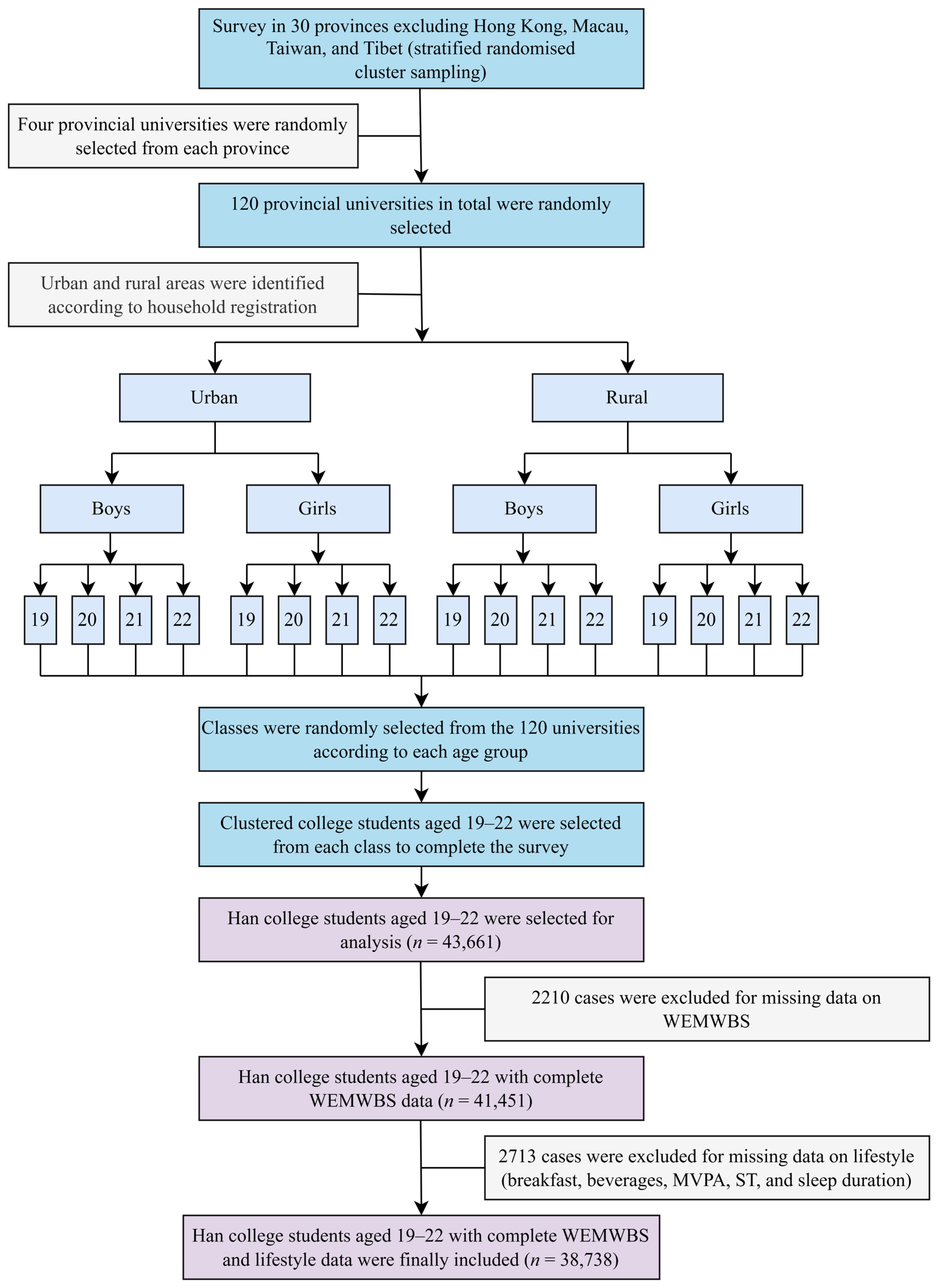
In this cross-sectional study, data were extracted from the 2019 Chinese National Survey on Students’ Constitution and Health (CNSSCH), China’s largest nationally representative survey on school-aged students. Based on a stratified cluster sampling design that differed from the design previously described for children and adolescents aged 7–18 [28], the sampling process of college students aged 19–22 from 30 provinces (Hong Kong, Macau, Tibet, and Taiwan not included) was described as follows: First, four provincial universities were randomly selected in each province. Subsequently, college students were divided into four categories by sex and urban–rural residences. Each category was further subdivided into four age groups (19–22 years), resulting in 16 strata. Finally, to achieve approximately 100 students per stratum in each province, cluster sampling by class was carried out within the selected universities.
After selecting college students as the primary sample (N = 43,661), participants with missing data on key variables, including mental well-being (N = 2210) or lifestyle behaviors (N = 2713), were excluded from the analysis (Figure 1). The primary analysis was conducted using a complete-case approach. Differences between the primary and analytic samples were examined to assess potential selection bias (Table S1). No statistically significant differences were observed in basic characteristics, including age, sex, and residence (p > 0.05), suggesting that the impact of missing data on sample representativeness was likely limited.

2.2. Questionnaire and Measurements

WEMWBS was used to assess the mental well-being of college students, given its suitability for large-scale population surveys. In addition, it has demonstrated good validity and internal consistency when applied to college students for psychometric evaluation [30]. Students were asked to report the frequency of the 14 items over the past four weeks as “none of the time”, “rarely”, “some of the time”, “often”, or “all of the time” (Figure S1). Each item was scored on a 5-point Likert scale according to frequency, yielding a total score ranging from 14 to 70, with higher scores indicating higher levels of mental well-being. As no internationally agreed cutoff has been established for the WEMWBS, we adopted a threshold of 56 points based on prior studies conducted in similar populations in China [31,32]. Participants scoring <56 were classified as having lower mental well-being. Additional analyses were conducted using the total score of WEMEBS as a continuous variable to examine the robustness of the findings.
Breakfast consumption, beverage intake, moderate-to-vigorous physical activity (MVPA), ST, and sleep duration were included as key lifestyle behaviors among college students. These variables were assessed using a structured self-reported questionnaire administered as part of the national survey. The questionnaire items were developed based on commonly used measures in large-scale health behavior surveys among Chinese students. These items were reviewed and refined through expert consultation to ensure content validity and have been applied in previous national studies [28]. Detailed questionnaire items and variable definitions were provided in Table S2 and are summarized below for clarity. In brief, having breakfast every day and drinking no beverage were considered healthy factors according to a previous study [28]. A regular MVPA was defined as at least 75 min of vigorous-intensity physical activity, at least 150 min of moderate-intensity physical activity, or an equivalent combination of moderate and vigorous physical activity throughout a week [33]. An ST of no more than 8 h per day [33] and a sleep duration of at least 7 h per day [34] were also classified as healthy behaviors. College students scored one point for each of the five defined health behaviors, resulting in a total score ranging from 0 to 5. Clustered lifestyle behaviors were defined as the summed score, which has been widely applied in previous studies to construct composite lifestyle scores [35,36]. This approach offers a transparent and reproducible framework for integrating multiple behaviors into a single index, which supports consistent estimation and comparability across analyses. In our study, the distribution of the summed lifestyle scores was as follows: 1.1% (N = 444) of participants scored 0, 12.8% (N = 4974) scored 1, 33.1% (N = 12,819) scored 2, 35.4% (N = 13,698) scored 3, 15.5% (N = 5989) scored 4, and 2.1% (N = 814) scored 5. Based on this distribution and to ensure an adequate sample size within categories, the total score was further classified into three groups. Scores of 0–2 were defined as an unfavorable lifestyle (47.1%), a score of 3 was defined as an intermediate lifestyle (35.4%), and scores of 4–5 were defined as a favorable lifestyle (17.6%). This categorization was data-informed and intended to enhance statistical stability across the groups.
In this study, sports apps were broadly defined to include pedometers, wearables, and mobile devices with physical activity monitoring functions. To assess usage, students were asked the following question during the survey: “Are you using pedometers, sports apps or wearing sport devices?” Response options were: “never”, “rarely”, “occasionally”, “sometimes”, and “often.” (Table S2). Based on their answers, the usage of sports apps was then classified as either dichotomized frequently (sometimes and often) or infrequently (never, rarely, and occasionally) [37].
Common sociodemographic indicators were selected as adjusted covariates, including age, sex, province, residence, single-child status, parental education levels, and body mass index (BMI). In total, 30 provinces were divided into eastern, central, western, and northeastern regions, symbolizing the four economic zones according to the National Bureau of Statistics. Parental education levels were classified according to the education system in China: primary or below, secondary or equivalent, and junior college or higher. BMI (kg/m2) was calculated as body weight (kg) divided by height squared (m2).

2.3. Statistical Analysis

Quantitative variables were characterized as the mean (standard deviation) or median (interquartile range), depending on the normality of the distribution tested by Kolmogorov–Smirnov, and categorical variables were shown as the frequency (percentage). In addition, the Mann–Whitney U test was used to compare differences between quantitative variables with non-normal distributions, while the chi-squared test was used to compare differences between categorical variables.
Given the relatively high prevalence of the outcomes (>20%), log-binomial regression models were used in the primary analyses to estimate prevalence ratios (PRs) and 95% confidence intervals (CIs) [38]. To account for clustering at the school level, mixed-effects models were applied, with school ID specified as a random effect. To assess whether the association between lifestyle behaviors and mental well-being differed according to the use of sports apps, interaction terms between lifestyle categories and sports app use were included in the fully adjusted models. Stratified analyses were conducted where appropriate. Because the WEMWBS scores showed a wide distribution and did not meet normality assumptions, they were standardized to Z-scores and analyzed using linear mixed-effects regression as a sensitivity analysis. According to previous studies [35,39,40], the fully adjusted models included age, region, residence, single-child status, paternal education level, and maternal education level as sociodemographic covariates, as well as BMI, lifestyle behaviors, and sports app use frequency. These variables were included to account for potential confounding factors and provide adjusted estimates of the associations of interest.
A two-sided p-value < 0.05 was considered statistically significant, and all statistical analyses were done with IBM SPSS Statistics version 26.0 (SPSS Inc, Chicago, IL, USA) and R Version 4.0.5 (R Development Core Team, Vienna, Austria).

3. Results

3.1. Study Sample

Characteristics of the study population stratified by sex are shown in Table 1. A total of 19,184 boys and 19,554 girls were included in the final analysis. Several sociodemographic and lifestyle characteristics differed by sex, including single-child status, parental education level, BMI, breakfast consumption, beverage intake, MVPA, ST, and sleep duration (all p < 0.05). Boys and girls also differed in the use and frequency of sports apps, with a higher proportion of frequent use found in girls (54.2% vs. 52.3%, p < 0.001). In terms of mental well-being, the median WEMWBS score for the overall sample was 54.0, with an interquartile range of 14.0. Boys had a slightly higher median score than girls (55.0 vs. 53.0, p < 0.001). Accordingly, girls had a higher prevalence of low mental well-being than boys (61.5% vs. 52.8%, p < 0.001).

3.2. Distribution of Low Mental Well-Being

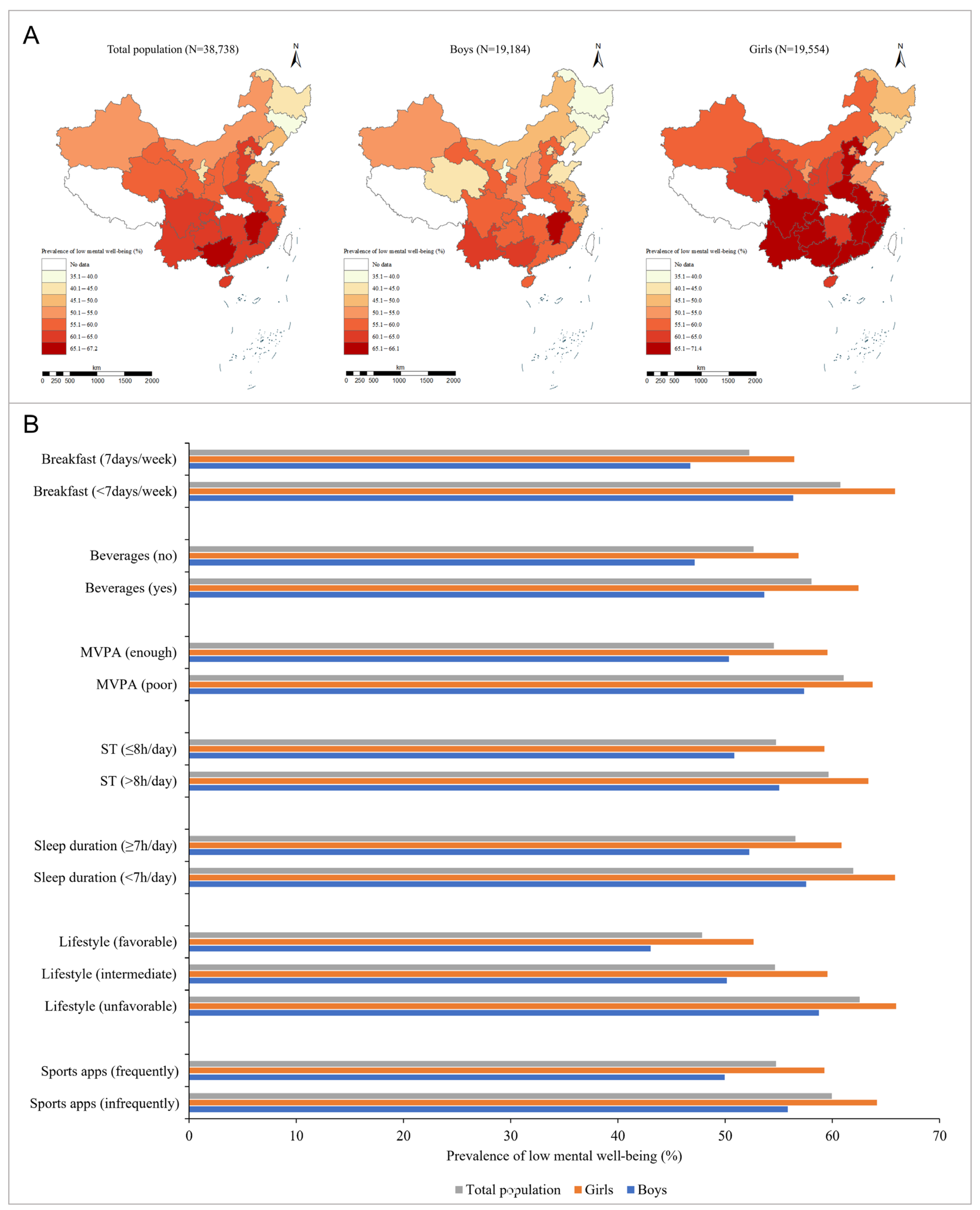
Response frequencies for each of the 14 items on WEMWBS are shown in Figure S1. The overall prevalence reported for low mental well-being among Chinese Han college students aged 19–22 was about 57.2%, ranging from 39.9% to 67.2% across provinces, with the northeastern region appearing to have a lower prevalence of no more than 50.0%, while parts of the central and western regions had a higher prevalence of more than 60.0% (Figure 2). In addition, the prevalence of low mental well-being varied across subgroups of lifestyle behaviors and sports apps, as shown in Figure 2. Significantly, college students with unfavorable lifestyles had a higher prevalence of low mental well-being (62.6%), followed by individuals with intermediate (54.7%) and favorable (47.9%) lifestyles. Furthermore, college students who infrequently used sports apps had a higher proportion of low mental well-being (60.0%), followed by individuals who frequently used sports apps (54.8%).

3.3. Association of Low Mental Well-Being with Lifestyle Behaviors and Sports Apps

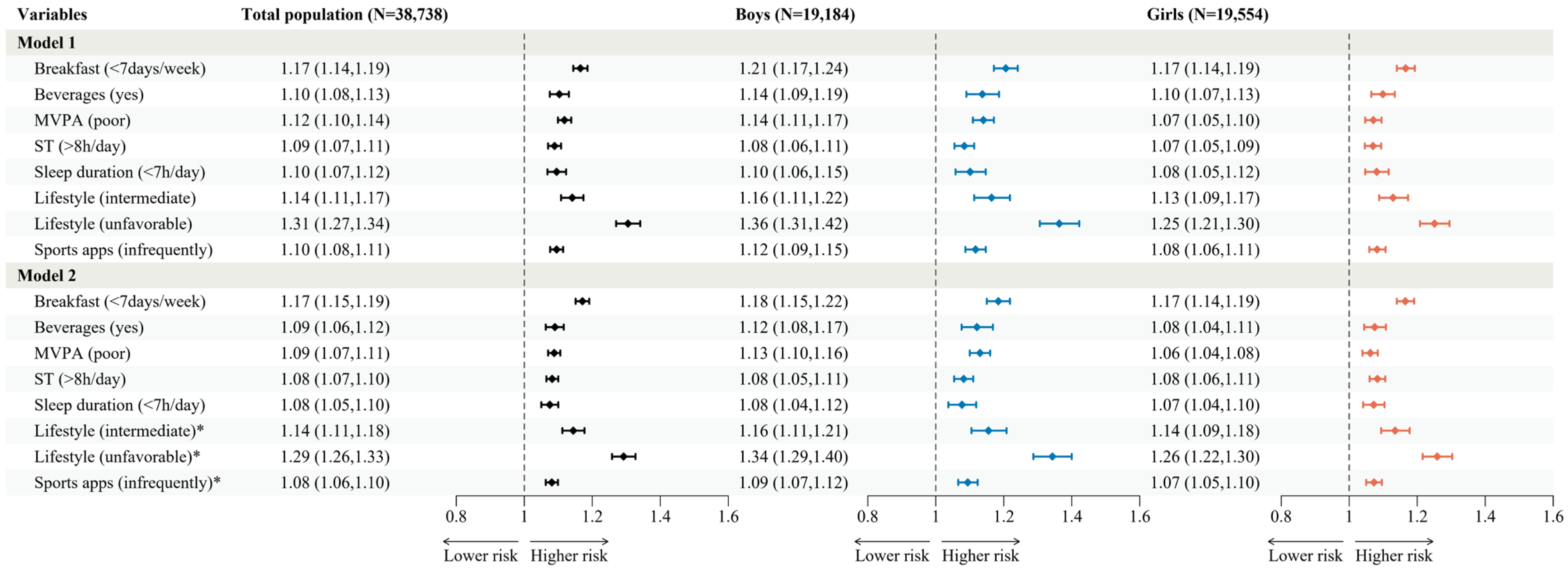
The results of the univariate analyses for low mental well-being are presented in Table S3. After adjusting for differences by school, age, region, residence, single-child status, paternal education level, maternal education level, and BMI, it was found that having breakfast <7 days/week, drinking beverages, having poor MVPA, having prolonged ST, and having insufficient sleep duration were statistically associated with low mental well-being (Figure 3). Importantly, intermediate (PR = 1.14, 95% CI: 1.11–1.18) and unfavorable (OR = 1.29, 95% CI: 1.26–1.33) lifestyles were positively associated with low mental well-being. In addition, college students who infrequently use sports apps had a higher proportion of low mental well-being (PR = 1.08, 95% CI: 1.06–1.10). In sensitivity analyses based on standardized WEMWBS scores, intermediate and unfavorable lifestyles were associated with lower scores compared with a favorable lifestyle. Infrequent use of sports apps was also associated with lower scores. These results were consistent with the primary analyses (Figure S2).

3.4. Associations of Sports Apps Use with the Relationships Between Lifestyle Behaviors and Mental Well-Being

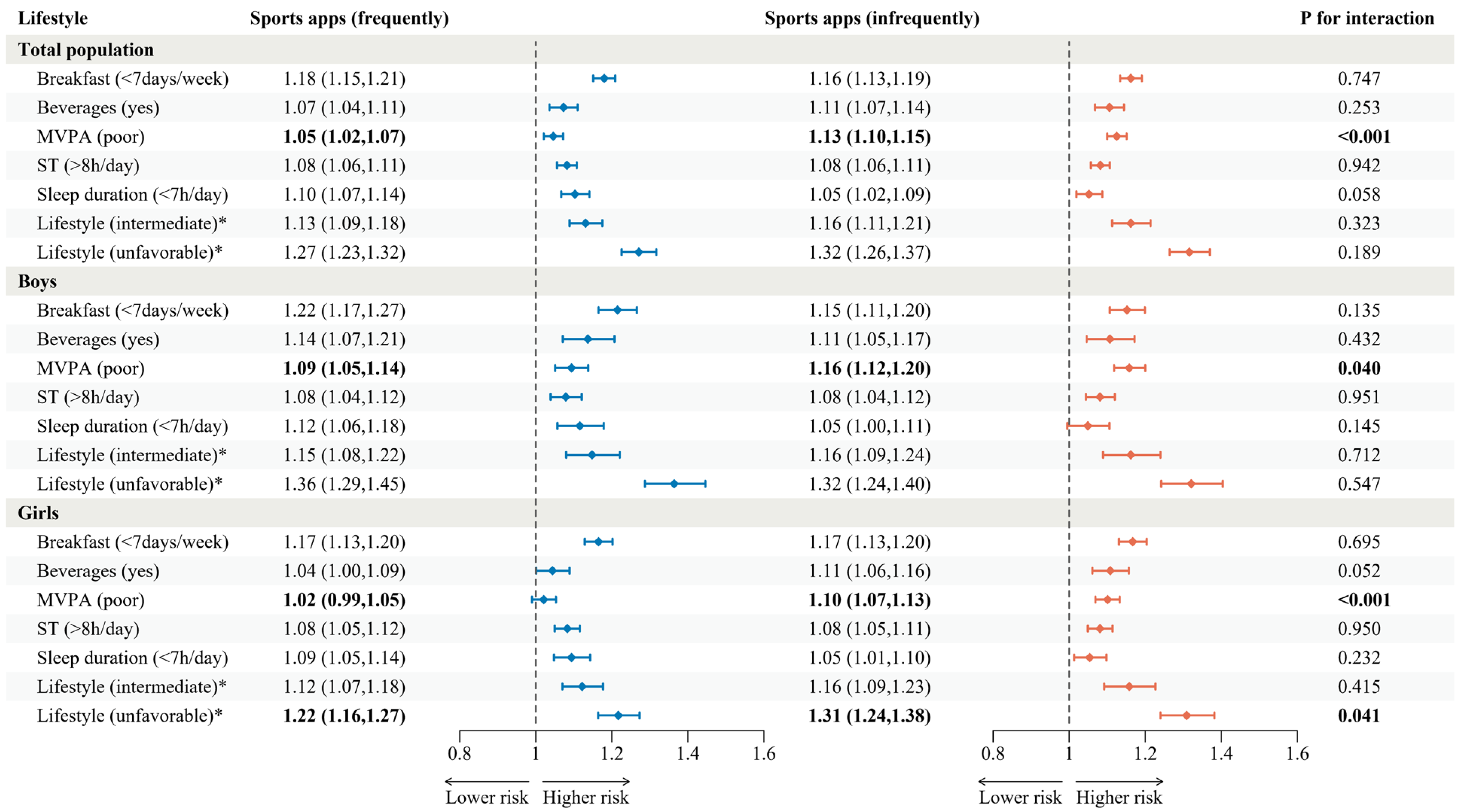
As presented in Figure 4, the magnitude of the association between MVPA and mental well-being was smaller among students who frequently used sports apps (PR = 1.05, 95% CI: 1.02–1.07) than among those who used them infrequently (PR = 1.13, 95% CI: 1.10–1.15). This pattern was consistent in boys and girls. For clustered lifestyle behaviors, a significant interaction with sports app use was observed for an unfavorable lifestyle among girls (P for interaction = 0.041). The magnitude of the association between an unfavorable lifestyle and low mental well-being was smaller among girls who frequently used sports apps (PR = 1.22, 95% CI: 1.16–1.27) than among those who used them infrequently (PR = 1.31, 95% CI: 1.24–1.38). For sensitivity analyses based on standardized WEMWBS scores, the results were consistent with the primary analyses (Figure S3).

4. Discussion

This study utilized a sample of nearly 40,000 college students from most provinces in China to reach the three findings. First, a considerable proportion of students (57.2%) were classified as having low mental well-being. Second, individual and clustered lifestyle behaviors were associated with mental well-being. Third, sports app use was associated with mental well-being, and the associations between clustered lifestyle behaviors and mental well-being differed according to sports app use, particularly among girls.
Regarding mental well-being status, the mean WEMWBS score (approximately 54) among Chinese college students in our study was higher than that reported in a previous study in China (47.41 ± 8.93 scores) [30]. The reason for this might be that the previous study covered only one university and the proportion of girls was relatively large. Compared with similar age groups in other countries, such as Norway (50.2 ± 9.8 scores) [41] and the United Kingdom (48.8 ± 8.6 scores) [42], college students in China have higher average scores on the WEMWBS. Consistent with previous studies [43,44], girls and students living in the central and western regions exhibited lower mental well-being. Differences by sex in mental well-being could be attributed to affective, biological, and cognitive differences between boys and girls. Girls often have more ruminating thoughts, focusing on the causes or symptoms of distress without taking active steps to relieve their feelings, are more genetically vulnerable to potent genotype–stress interactions, and have greater cognitive vulnerability to stress [27,43]. As for regional differences, poor economic support and parental absence might be the reasons for low mental well-being in underdeveloped areas [44].
This study provides general support for the awareness that unhealthy lifestyle behaviors like skipping breakfast, sugar-sweetened beverage consumption, physical inactivity, prolonged ST, and insufficient sleep duration are negatively associated with mental well-being [9,10,11]. When considering lifestyle behaviors collectively, students with a greater number of unhealthy behaviors tend to report lower mental well-being. This pattern is broadly consistent with prior prospective research indicating that adherence to multiple healthy lifestyle recommendations is associated with better mental health outcomes [36]. However, the magnitude of associations observed in the present study was generally modest, and the cross-sectional design precludes causal interpretation. These findings nevertheless suggest that considering multiple lifestyle behaviors together may provide a more comprehensive perspective than focusing on a single behavior alone.
Our results found that more than half of college students frequently used sports apps, confirming the prevalence and significance of sports app use among college students. We observed that frequently using sports apps was associated with mental well-being, and the associations between unhealthy lifestyle behaviors and low mental well-being were weaker among frequent users. These findings extend previous mHealth research, which has primarily focused on intervention trials targeting single behaviors, by examining interaction patterns within a large sample of college students. Several potential explanations might account for these observations [45]. From a neurobiological perspective, sports apps might influence mental well-being by facilitating physical activity, which stimulates the release of mood-regulating neurotransmitters and endogenous opioids. From a psychosocial perspective, interactive functions of sports apps such as progress tracking, feedback, and social sharing could enhance perceived competence, social connectedness, and body-related self-perceptions. For behavioral mechanisms, sports apps could promote the duration and quality of behaviors, thus promoting individuals to develop self-regulation skills, which are beneficial to mental well-being. Notably, these proposed mechanisms are inferred from prior literature and theoretical frameworks and warrant confirmation in future longitudinal and experimental studies.
In addition, it was proven that the influence of sports apps on the association between lifestyle and mental well-being was stronger among girls. Girls reported more frequent use of sports apps, suggesting greater appeal within this group in China. Given that girls generally engage in lower levels of physical activity than boys, and that exercise monitoring is a core function of sports apps, the relative benefit may be more pronounced among girls [28]. Psychologically, girls are more susceptible to internalizing symptoms and health-related concerns, including worries about body image and well-being [46,47,48]. By providing objective feedback on weight, activity, and other health indicators, sports apps may enhance perceived control and reduce uncertainty, thereby alleviating psychological distress. Furthermore, heightened body image pressures among girls may increase stress levels, and structured lifestyle guidance delivered through apps may help mitigate such pressures through goal-setting, feedback, and self-management support [47,49]. Nevertheless, these interpretations remain speculative, as empirical research on the sex-specific mechanisms of sports app engagement is limited. Future studies should examine these pathways more directly and consider the development of sex-responsive digital health tools to address differing behavioral needs.
Under the exacerbated burden of mental health problems globally, it is of great significance to explore new measures to intervene in lifestyle behaviors, given the importance of lifestyle to mental well-being and the low adherence to healthy behaviors [50]. Today, ICT is prevalent on a global scale and is universally supported as an effective approach to preventing suicide by reaching various populations and identifying at-risk individuals as well as providing support [18,51]. As a result, it is reasonable to consider ICT as a potential breakthrough for the promotion of mental well-being. Additionally, a fitness blogger in China recently succeeded in leading millions of girls in the nation to do bodybuilding every day with the aid of the internet and a live streaming platform [52], implying that lifestyle-related behaviors could be changed and improved with the support of ICT. Therefore, ICT has the potential to play important roles in improving mental well-being and lifestyle behaviors, owing to its diverse functions such as barrier-free interaction and intelligent monitoring. Notably, our research proves that, as a product of ICT, sports apps are associated with mental well-being and influence the relationship between lifestyle behaviors and mental well-being. Another matter worthy of note is that college students are highly receptive and curious about new things; their eagerness for attention means they have a higher acceptance of smart devices, such as sports apps, with a higher possibility of benefiting from them [53,54], which is exactly why this study chose to focus on this population. Consequently, when it comes to concerns about mental well-being for college students, new strategies based on smart devices, such as sports apps, may enhance the collective potential to offer more personalized and responsive support that is suitable across campuses and their social properties.
Several limitations remain. First, the cross-sectional design prevented causal inference, and reverse associations could not be excluded. Students with better mental well-being may be more likely to engage in healthy behaviors and use sports apps more frequently. Longitudinal studies are needed to establish temporal directionality. Second, all exposures and outcomes were self-reported, introducing potential recall and social desirability bias. The reliance on a single reporting source also raised the possibility of common-method bias, whereby health-conscious individuals might simultaneously report healthier lifestyles, greater app use, and better well-being, potentially inflating observed associations. Third, the absence of standardized definitions and frameworks for categorizing sports apps posed a challenge for this study. This lack of clarity constrained our ability to assess which specific types of apps might be more effective in promoting mental well-being. Advancing this field would require the development of consistent classification criteria and more detailed investigations into how specific characteristics of sports apps influence psychological outcomes. Fourth, the sample consisted exclusively of Chinese undergraduate students. Therefore, the findings may not be generalizable to postgraduate students, other young adult groups, or populations from different ethnic, cultural, or national contexts. Fifth, the clustered lifestyle score used in this study has not been formally psychometrically validated as a composite measure. The categorization and corresponding cutoffs were derived based on the distribution of the study data and prior literature rather than clinically established thresholds. Finally, although multiple sociodemographic variables were adjusted for, residual confounding could not be excluded. Important determinants of mental well-being, such as academic stress, broader socioeconomic conditions, and prior mental health history, were not available and might have influenced both sports app engagement and psychological outcomes.

5. Conclusions

In conclusion, mental well-being among college students remained a concern and was closely linked to clustered unhealthy lifestyle behaviors. Frequent sports app use was independently associated with better mental well-being and was linked to weaker associations between unfavorable lifestyle patterns and mental well-being, particularly among girls. These findings suggested that digital tools integrating lifestyle monitoring and behavioral feedback might serve as accessible platforms for mental health promotion in university settings. Universities and public health practitioners may consider incorporating sports app-based strategies into sex-sensitive health programs, while app developers could optimize features that enhance self-monitoring, engagement, and psychosocial support for diverse student needs. Future longitudinal and intervention studies are warranted to establish causal relationships and evaluate the effectiveness of tailored digital interventions in improving both lifestyle behaviors and mental well-being.

Supplementary Materials

The following supporting information can be downloaded at https://www.mdpi.com/article/10.3390/future4020013/s1. Table S1: Demographic differences between primary sample and final sample; Table S2: Description of variables and categories of options about lifestyle and sports apps; Table S3: Univariate analysis for low mental well-being; Figure S1: WEMWBS question responses among college students aged 19–22 years; Figure S2: Association of WEMWBS scores with lifestyle behaviors and sports apps; Figure S3: Association between WEMWBS scores and lifestyle behaviors stratified by sports apps.

Author Contributions

S.C. conceptualized and designed the study, completed the statistical analyses, drafted the initial manuscript, and reviewed and revised the manuscript. Y.S., J.M. and G.Z. contributed to the conceptualization and design of the study, supervised the data collection, performed statistical analyses, and reviewed and revised the manuscript. P.W.C.L. contributed to interpretation of the data and extensive revision of the manuscript. N.M., Y.L., J.D., P.Z., D.S., P.H. and Y.D. assisted with data interpretation, and reviewed and revised the manuscript. All authors have read and agreed to the published version of the manuscript.

Funding

This work was supported by a grant from the Beijing Office for Education Sciences Planning (No. BBAA22027 to Yi Song).

Institutional Review Board Statement

The 2019 CNSSCH was approved by the Medical Research Ethics Committee of the Peking University Health Science Center after obtaining informed consent from the survey population (No. IRB00001052-19095; approved on 2 September 2019).

Informed Consent Statement

Informed consent was obtained from all subjects involved in the study.

Data Availability Statement

The data used and analyzed during the current study are available from the corresponding author upon reasonable request. The data are not publicly available due to privacy and ethical restrictions.

Acknowledgments

We thank the participants of the 2019 Chinese National Survey on Students’ Constitution and Health for their commitment to and involvement in the study, and the dedicated team of research staff and ancillary staff for their assistance in collecting and processing the data.

Conflicts of Interest

The authors declare no conflicts of interest.

References

  1. World Health Organization. The WHO Special Initiative for Mental Health (2019–2023): Universal Health Coverage for Mental Health. Available online: https://apps.who.int/iris/handle/10665/310981 (accessed on 25 July 2022).
  2. Centers for Disease Control and Prevention. Well-Being Concepts. Available online: https://archive.cdc.gov/www_cdc_gov/hrqol/wellbeing.htm (accessed on 25 July 2022).
  3. La Placa, V.; Knight, A. Well-being: Its influence and local impact on public health. Public Health 2014, 128, 38–42. [Google Scholar] [CrossRef] [PubMed]
  4. Velten, J.; Bieda, A.; Scholten, S.; Wannemüller, A.; Margraf, J. Lifestyle choices and mental health: A longitudinal survey with German and Chinese students. BMC Public Health 2018, 18, 632. [Google Scholar] [CrossRef]
  5. World Health Organization. Comprehensive Mental Health Action Plan 2013–2030. Available online: https://www.who.int/publications/i/item/9789240031029 (accessed on 25 July 2022).
  6. WBI Studies Repository. World Happiness Report 2022. Available online: https://www.wellbeingintlstudiesrepository.org/hw_happiness/2/ (accessed on 25 July 2022).
  7. Regehr, C.; Glancy, D.; Pitts, A. Interventions to reduce stress in university students: A review and meta-analysis. J. Affect. Disord. 2013, 148, 1–11. [Google Scholar] [CrossRef] [PubMed]
  8. Auerbach, R.P.; Alonso, J.; Axinn, W.G.; Cuijpers, P.; Ebert, D.D.; Green, J.G.; Hwang, I.; Kessler, R.C.; Liu, H.; Mortier, P.; et al. Mental disorders among college students in the World Health Organization World Mental Health Surveys. Psychol. Med. 2016, 46, 2955–2970. [Google Scholar] [CrossRef] [PubMed]
  9. Jiang, Y.; Lu, C.; Chen, J.; Miao, Y.; Li, Y.; Deng, Q. Happiness in University Students: Personal, Familial, and Social Factors: A Cross-Sectional Questionnaire Survey. Int. J. Environ. Res. Public Health 2022, 19, 4713. [Google Scholar] [CrossRef]
  10. Pengpid, S.; Peltzer, K. Sedentary Behaviour, Physical Activity and Life Satisfaction, Happiness and Perceived Health Status in University Students from 24 Countries. Int. J. Environ. Res. Public Health 2019, 16, 2084. [Google Scholar] [CrossRef]
  11. Piqueras, J.A.; Kuhne, W.; Vera-Villarroel, P.; van Straten, A.; Cuijpers, P. Happiness and health behaviours in Chilean college students: A cross-sectional survey. BMC Public Health 2011, 11, 443. [Google Scholar] [CrossRef]
  12. Alosaimi, N.; Sherar, L.B.; Griffiths, P.; Pearson, N. Clustering of diet, physical activity and sedentary behaviour and related physical and mental health outcomes: A systematic review. BMC Public Health 2023, 23, 1572. [Google Scholar] [CrossRef]
  13. Pengpid, S.; Peltzer, K. Skipping Breakfast and Its Association with Health Risk Behaviour and Mental Health Among University Students in 28 Countries. Diabetes Metab. Syndr. Obes. 2020, 13, 2889–2897. [Google Scholar] [CrossRef]
  14. Teychenne, M.; Sousa, G.M.; Baker, T.; Liddelow, C.; Babic, M.; Chauntry, A.J.; France-Ratcliffe, M.; Guagliano, J.; Christie, H.E.; Tremaine, E.M.; et al. Domain-specific physical activity and mental health: An updated systematic review and multilevel meta-analysis in a combined sample of 3.3 million people. Br. J. Sports Med. 2026, 60, 267–285. [Google Scholar] [CrossRef]
  15. Ahmed, O.; Walsh, E.I.; Dawel, A.; Alateeq, K.; Espinoza Oyarce, D.A.; Cherbuin, N. Social media use, mental health and sleep: A systematic review with meta-analyses. J. Affect. Disord. 2024, 367, 701–712. [Google Scholar] [CrossRef]
  16. Berding, K.; Vlckova, K.; Marx, W.; Schellekens, H.; Stanton, C.; Clarke, G.; Jacka, F.; Dinan, T.G.; Cryan, J.F. Diet and the Microbiota-Gut-Brain Axis: Sowing the Seeds of Good Mental Health. Adv. Nutr. 2021, 12, 1239–1285. [Google Scholar]
  17. Uddin, R.; Lee, E.Y.; Khan, S.R.; Tremblay, M.S.; Khan, A. Clustering of lifestyle risk factors for non-communicable diseases in 304,779 adolescents from 89 countries: A global perspective. Prev. Med. 2020, 131, 105955. [Google Scholar] [CrossRef]
  18. Rassy, J.; Bardon, C.; Dargis, L.; Côté, L.P.; Corthésy-Blondin, L.; Mörch, C.M.; Labelle, R. Information and Communication Technology Use in Suicide Prevention: Scoping Review. J. Med. Internet Res. 2021, 23, e25288. [Google Scholar] [CrossRef] [PubMed]
  19. Thangavel, G.; Memedi, M.; Hedström, K. Customized Information and Communication Technology for Reducing Social Isolation and Loneliness Among Older Adults: Scoping Review. JMIR Ment. Health 2022, 9, e34221. [Google Scholar] [CrossRef]
  20. Luo, Z.; Jia, Q.; Fang, P.; Wang, L. The association between the use and acceptance of information and communication technology and mental health in students. China Educ. Technol. 2017, 4, 109–115. (In Chinese) [Google Scholar]
  21. Baidu Encyclopedia. KEEP. Available online: https://baike.baidu.com/item/keep/17618239?fr=aladdin (accessed on 25 July 2022).
  22. Cheng, Y.; Peng, Y.; Li, Y. Associated factors of fitness APP usage among college students. J. Chin. Sch. Health 2022, 43, 1007–1010. (In Chinese) [Google Scholar]
  23. Paganini, S.; Terhorst, Y.; Sander, L.B.; Catic, S.; Balci, S.; Küchler, A.M.; Schultchen, D.; Plaumann, K.; Sturmbauer, S.; Krämer, L.V.; et al. Quality of Physical Activity Apps: Systematic Search in App Stores and Content Analysis. JMIR mHealth uHealth 2021, 9, e22587. [Google Scholar] [CrossRef]
  24. Puterman, E.; Hives, B.; Mazara, N.; Grishin, N.; Webster, J.; Hutton, S.; Koehle, M.S.; Liu, Y.; Beauchamp, M.R. COVID-19 Pandemic and Exercise (COPE) trial: A multigroup pragmatic randomised controlled trial examining effects of app-based at-home exercise programs on depressive symptoms. Br. J. Sports Med. 2022, 56, 546–552. [Google Scholar] [CrossRef] [PubMed]
  25. Milne-Ives, M.; Lam, C.; De Cock, C.; Van Velthoven, M.H.; Meinert, E. Mobile Apps for Health Behavior Change in Physical Activity, Diet, Drug and Alcohol Use, and Mental Health: Systematic Review. JMIR mHealth uHealth 2020, 8, e17046. [Google Scholar] [CrossRef]
  26. Bentivegna, F.; Patalay, P. The impact of sexual violence in mid-adolescence on mental health: A UK population-based longitudinal study. Lancet Psychiatry 2022, 9, 874–883. [Google Scholar] [CrossRef]
  27. Hyde, J.S.; Mezulis, A.H.; Abramson, L.Y. The ABCs of depression: Integrating affective, biological, and cognitive models to explain the emergence of the gender difference in depression. Psychol. Rev. 2008, 115, 291–313. [Google Scholar] [CrossRef]
  28. Cai, S.; Liu, Y.; Dang, J.; Zhong, P.; Shi, D.; Chen, Z.; Hu, P.; Ma, J.; Dong, Y.; Song, Y.; et al. Clustering of Multilevel Factors Among Children and Adolescents: Associations with Health-Related Physical Fitness. J. Phys. Act. Health 2024, 21, 29–39. [Google Scholar] [CrossRef]
  29. Corrick, S.; Johnson, E.; Isley, S.; Vandermeer, B.; Dolgoy, N.; Bates, J.; Godfrey, E.; Soltys, C.; Muir, C.; Tegg, N.; et al. Sex and gender reporting in RCTs of internet and mobile-based interventions for depression and anxiety in chronic conditions: A secondary analysis of a systematic review. PLoS Ment. Health 2024, 1, e0000048. [Google Scholar] [CrossRef]
  30. Fung, S.F. Psychometric evaluation of the Warwick-Edinburgh Mental Well-being Scale (WEMWBS) with Chinese University Students. Health Qual. Life Outcomes 2019, 17, 46. [Google Scholar] [CrossRef]
  31. Zhang, T. Exploration of the Interventional Effect of Aerobic Exercise on the Mental Health of Postgraduate Students: Based on the Perspective of the Two-Factor Model of Mental Health. Master’s Thesis, Southwest University, Chongqing, China, 2013. (In Chinese) [Google Scholar]
  32. Yang, R.; Cai, S.; Ma, N.; Dang, J.; Liu, Y.; Zhang, Y.; Chen, Z.; Li, J.; Huang, T.; Lu, L.; et al. Association between mental health and muscle strength among Chinese adolescents aged 13–18. Chin. J. Sch. Health 2025, 46, 1232–1236+1241. (In Chinese) [Google Scholar]
  33. World Health Organization. WHO Guidelines on Physical Activity and Sedentary Behaviour. Available online: https://www.who.int/publications/i/item/9789240015128 (accessed on 25 July 2022).
  34. Hirshkowitz, M.; Whiton, K.; Albert, S.M.; Alessi, C.; Bruni, O.; DonCarlos, L.; Hazen, N.; Herman, J.; Katz, E.S.; Kheirandish-Gozal, L.; et al. National Sleep Foundation’s sleep time duration recommendations: Methodology and results summary. Sleep Health 2015, 1, 40–43. [Google Scholar] [CrossRef] [PubMed]
  35. Dang, J.; Chen, T.; Ma, N.; Liu, Y.; Zhong, P.; Shi, D.; Dong, Y.; Zou, Z.; Ma, Y.; Song, Y.; et al. Associations between Breastfeeding Duration and Obesity Phenotypes and the Offsetting Effect of a Healthy Lifestyle. Nutrients 2022, 14, 1999. [Google Scholar] [CrossRef] [PubMed]
  36. Loewen, O.K.; Maximova, K.; Ekwaru, J.P.; Faught, E.L.; Asbridge, M.; Ohinmaa, A.; Veugelers, P.J. Lifestyle Behavior and Mental Health in Early Adolescence. Pediatrics 2019, 143, e20183307. [Google Scholar] [CrossRef]
  37. Sun, Z.; Zhong, X.; Yang, Y.; Dang, J.; Cai, S.; Liu, Y.; Li, J.; Huang, T.; Zhang, X.; Xue, M.; et al. Association between wearable device usage and obesity transition in children and adolescents: A nationwide longitudinal study. Metab. Target. Organ. Damage 2025, 5, 57. [Google Scholar] [CrossRef]
  38. Antay-Bedregal, D.; Camargo-Revello, E.; Alvarado, G.F. Associated factors vs risk factors in cross-sectional studies. Patient Prefer. Adherence 2015, 9, 1635–1636. [Google Scholar] [CrossRef]
  39. Shi, D.; Dang, J.; Ma, N.; Liu, Y.; Zhong, P.; Cai, S.; Ma, Y.; Zou, Z.; Dong, Y.; Song, Y.; et al. The Combined Effect of Birth Weight and Lifestyle on Clustered Cardio-Metabolic Risk Factors in Children and Adolescents: A National School-Based Cross-Sectional Survey. Nutrients 2022, 14, 3131. [Google Scholar] [CrossRef]
  40. Cai, S.; Dang, J.; Zhong, P.; Ma, N.; Liu, Y.; Shi, D.; Zou, Z.; Dong, Y.; Ma, J.; Song, Y. Sex differences in metabolically healthy and metabolically unhealthy obesity among Chinese children and adolescents. Front. Endocrinol. 2022, 13, 980332. [Google Scholar]
  41. Ringdal, R.; Bradley Eilertsen, M.E.; Bjørnsen, H.N.; Espnes, G.A.; Moksnes, U.K. Validation of two versions of the Warwick-Edinburgh Mental Well-Being Scale among Norwegian adolescents. Scand. J. Public Health 2018, 46, 718–725. [Google Scholar]
  42. Morey, Y.; Mellon, D.; Dailami, N.; Verne, J.; Tapp, A. Adolescent self-harm in the community: An update on prevalence using a self-report survey of adolescents aged 13-18 in England. J. Public Health 2017, 39, 58–64. [Google Scholar] [CrossRef]
  43. Jose, P.E.; Weir, K.F. How is anxiety involved in the longitudinal relationship between brooding rumination and depressive symptoms in adolescents? J. Youth Adolesc. 2013, 42, 1210–1222. [Google Scholar] [CrossRef]
  44. Zhong, B.L.; Ding, J.; Chen, H.H.; Li, Y.; Xu, H.M.; Tong, J.; Wang, A.Q.; Tang, G.Z.; Zhu, J.S.; Yang, D.Q.; et al. Depressive disorders among children in the transforming China: An epidemiological survey of prevalence, correlates, and service use. Depress. Anxiety 2013, 30, 881–892. [Google Scholar] [CrossRef]
  45. Lubans, D.; Richards, J.; Hillman, C.; Faulkner, G.; Beauchamp, M.; Nilsson, M.; Kelly, P.; Smith, J.; Raine, L.; Biddle, S. Physical Activity for Cognitive and Mental Health in Youth: A Systematic Review of Mechanisms. Pediatrics 2016, 138, e20161642. [Google Scholar] [CrossRef] [PubMed]
  46. Kim, H.; Park, K.H.; Park, S. Gender Differences in Lifestyle and Mental Health among Senior High School Students in South Korea. Int. J. Environ. Res. Public Health 2021, 18, 10746. [Google Scholar] [CrossRef] [PubMed]
  47. Christiansen, D.M.; McCarthy, M.M.; Seeman, M.V. Where Sex Meets Gender: How Sex and Gender Come Together to Cause Sex Differences in Mental Illness. Front. Psychiatry 2022, 13, 856436. [Google Scholar] [CrossRef] [PubMed]
  48. Hartung, C.M.; Lefler, E.K. Sex and gender in psychopathology: DSM-5 and beyond. Psychol. Bull. 2019, 145, 390–409. [Google Scholar] [CrossRef] [PubMed]
  49. Tronieri, J.S.; Wurst, C.M.; Pearl, R.L.; Allison, K.C. Sex Differences in Obesity and Mental Health. Curr. Psychiatry Rep. 2017, 19, 29. [Google Scholar] [CrossRef]
  50. Stonerock, G.L.; Blumenthal, J.A. Role of Counseling to Promote Adherence in Healthy Lifestyle Medicine: Strategies to Improve Exercise Adherence and Enhance Physical Activity. Prog. Cardiovasc. Dis. 2017, 59, 455–462. [Google Scholar] [CrossRef]
  51. Larsen, M.E.; Nicholas, J.; Christensen, H. A Systematic Assessment of Smartphone Tools for Suicide Prevention. PLoS ONE 2016, 11, e0152285. [Google Scholar] [CrossRef]
  52. ECNS Wire. Taiwan Singer Liu Genghong Goes Viral After Fitness Livestream. Available online: http://www.ecns.cn/news/cns-wire/2022-04-25/detail-ihaxrxye1107404.shtml (accessed on 25 July 2022).
  53. Zhang, H.; Zhang, J.; Du, X.; Meng, F.; Zhang, C. Research progress of sports APP on exercise habits in college students. J. Chin. Sch. Health 2021, 42, 1586–1589+1595. (In Chinese) [Google Scholar]
  54. Melcher, J.; Hays, R.; Torous, J. Digital phenotyping for mental health of college students: A clinical review. Evid. Based Ment. Health 2020, 23, 161–166. [Google Scholar] [CrossRef] [PubMed]
Figure 1. Flow chart of data from the Chinese National Survey on Students’ Constitution and Health. Notes: MVPA = moderate to vigorous physical activity; ST = sedentary time; WEMWBS = Warwick Edinburgh Mental Wellbeing Scale.
Future 04 00013 g001
Figure 2. Distribution of the prevalence of low mental well-being. Notes: (A) the prevalence of low mental well-being by provinces; (B) the prevalence of low mental well-being by lifestyle and sports apps. MVPA = moderate to vigorous physical activity; ST = sedentary time.
Future 04 00013 g002
Figure 3. Association of low mental well-being with lifestyle behaviors and sports apps. Notes: Model 1 is the crude model, only adjusted for school; Model 2 is adjusted for school, age, region, residence, single-child status, paternal education level, maternal education level, BMI, single lifestyle behaviors, and frequency of sports apps. * Adjusted for school, age, region, residence, single-child status, paternal education level, maternal education level, BMI, clustered lifestyle behaviors, and frequency of sports app use; BMI = body mass index.
Future 04 00013 g003
Figure 4. Association between low mental well-being and lifestyle behaviors stratified by sports apps. Notes: The model was adjusted for school, age, region, residence, single-child status, paternal education level, maternal education level, BMI, and single lifestyle behaviors. * Adjusted for school, age, region, residence, single-child status, paternal education level, maternal education level, BMI, and clustered lifestyle behaviors; BMI = body mass index.
Future 04 00013 g004
Table 1. Baseline characteristics.
CharacteristicsTotal (N = 38,738)Boys (N = 19,184)Girls (N = 19,554)p-Value
Age, year *20.99 (1.94)21.01 (1.93)20.99 (1.95)0.243
Region 0.051
    Eastern13,788 (35.6)6938 (36.2)6850 (35.0)
    Central7347 (19.0)3635 (18.9)3712 (19.0)
    Western13,761 (35.5)6696 (34.9)7065 (36.1)
    Northeastern3842 (9.9)1915 (10.0)1927 (9.9)
Residence 0.764
    Rural19,104 (49.3)9446 (49.2)9658 (49.4)
    Urban19,634 (50.7)9738 (50.8)9896 (50.6)
Single child <0.001
    No22,969 (59.3)10,436 (54.4)12,533 (64.1)
    Yes15,769 (40.7)8748 (45.6)7021 (35.9)
Paternal education level 0.001
    Primary or below21,718 (56.1)10,568 (55.1)11,150 (57)
    Secondary or equivalent9270 (23.9)4688 (24.4)4582 (23.4)
    Junior college or above7750 (20.0)3928 (20.5)3822 (19.5)
Maternal education level 0.021
    Primary or below24,690 (63.7)12,096 (63.1)12,594 (64.4)
    Secondary or equivalent8162 (21.1)4115 (21.5)4047 (20.7)
    Junior college or above5886 (15.2)2973 (15.5)2913 (14.9)
BMI, kg/m2 *20.94 (4.03)21.67 (4.50)20.32 (3.40)<0.001
Breakfast <0.001
    <7 days/week22,377 (57.8)11,985 (62.5)10,392 (53.1)
    7 days/week16,361 (42.2)7199 (37.5)9162 (46.9)
Beverages <0.001
    Yes32,546 (84.0)16,475 (85.9)16,071 (82.2)
    No6192 (16.0)2709 (14.1)3483 (17.8)
MVPA <0.001
    Poor15,470 (39.9)6623 (34.5)8847 (45.2)
    Enough23,268 (60.1)12,561 (65.5)10,707 (54.8)
ST <0.001
    >8 h/day19,273 (49.8)8762 (45.7)10,511 (53.8)
    ≤8 h/day19,465 (50.2)10,422 (54.3)9043 (46.2)
Sleep duration <0.001
    <7 h/day4292 (11.1)2008 (10.5)2284 (11.7)
    ≥7 h/day34,446 (88.9)17,176 (89.5)17,270 (88.3)
Lifestyle <0.001
    Unfavorable18,237 (47.1)8640 (45.0)9597 (49.1)
    Intermediate13,698 (35.4)7146 (37.2)6552 (33.5)
    Favorable6803 (17.6)3398 (17.7)3405 (17.4)
Sports apps <0.001
    Infrequently18,106 (46.7)9157 (47.7)8949 (45.8)
    Frequently20,632 (53.3)10,027 (52.3)10,605 (54.2)
WEMWBS, scores *54.00 (14.00)55.00 (16.00)53.00 (46.00)<0.001
WEMWBS <0.001
    <56 scores22,165 (57.2)10,134 (52.8)12,031 (61.5)
    ≥56 scores16,573 (42.8)9050 (47.2)7523 (38.5)
Note: * Quantitative variables with non-normal distribution are shown as median (interquartile range). Abbreviations: BMI = body mass index; MVPA = moderate to vigorous physical activity; ST = sedentary time; WEMWBS = Warwick Edinburgh Mental Wellbeing Scale.
Disclaimer/Publisher’s Note: The statements, opinions and data contained in all publications are solely those of the individual author(s) and contributor(s) and not of MDPI and/or the editor(s). MDPI and/or the editor(s) disclaim responsibility for any injury to people or property resulting from any ideas, methods, instructions or products referred to in the content.