
Analytics and Business Survival—Critical Success Factors and the Demise of HP Bulmer Ltd.



Abstract
1. Introduction
2. Research Methods
3. Results
3.1. RQ1: What Are the Critical Success Factors (CSFs) for Successful Deployment of Analytics Software in Industry?
3.2. RQ2: Can a Conceptual Framework Be Developed to Encompass the Required Pillars for Successful Analytics Deployment?
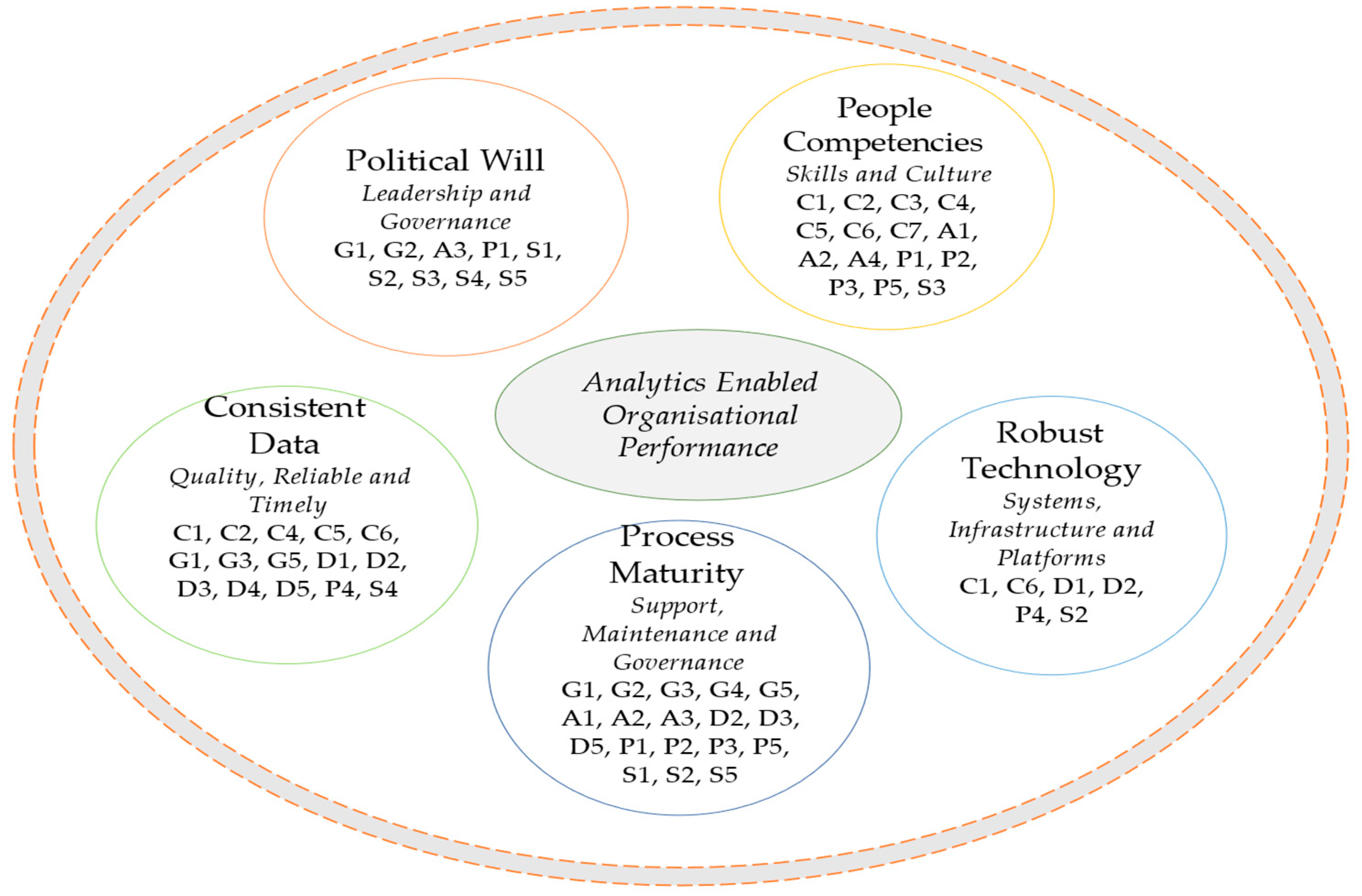
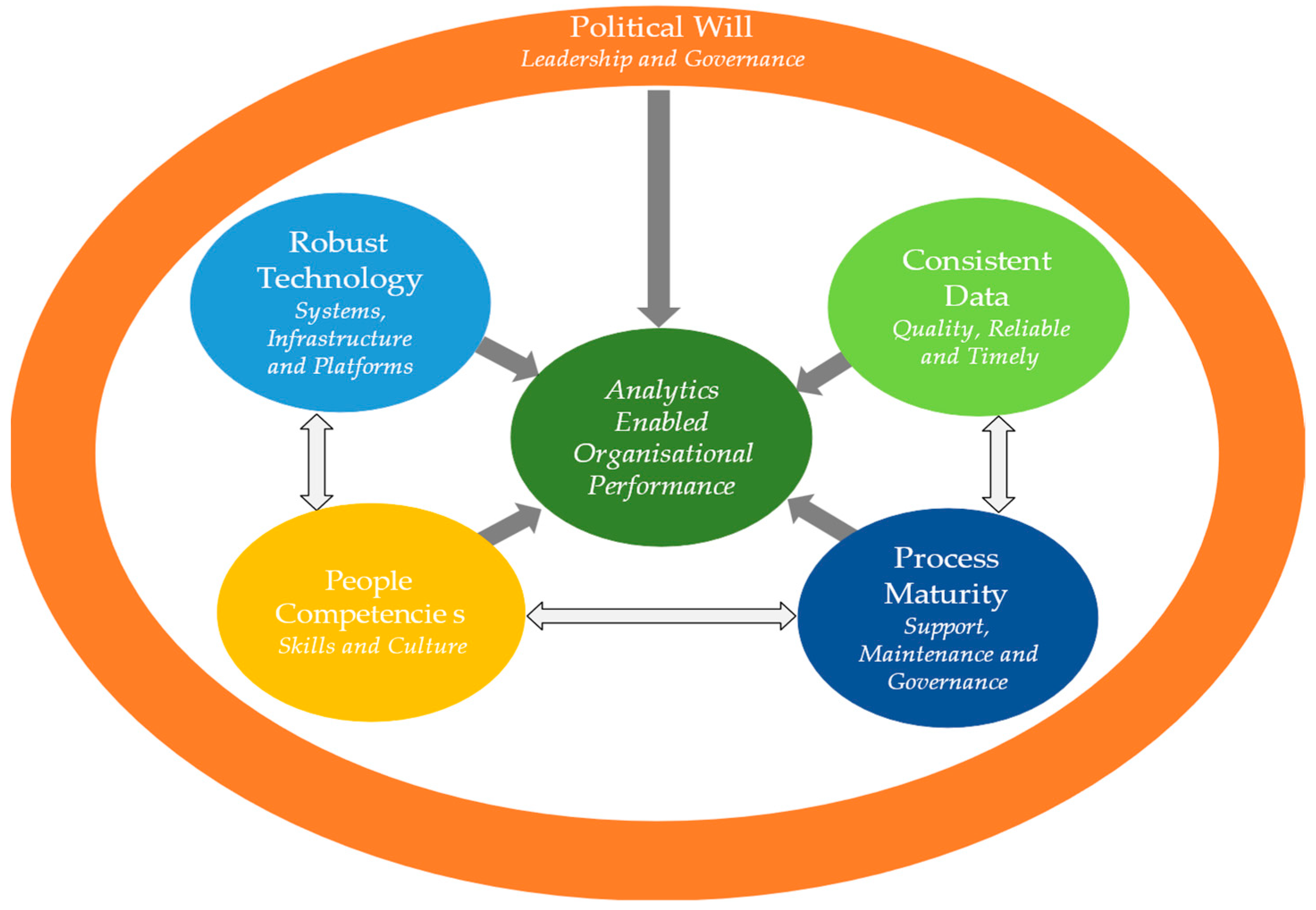
- Robust Technology: Refers specifically to the digital infrastructure, platforms, and software systems required to collect, process, and analyse organisational data. This element reflects the need for scalable, reliable, and appropriately integrated technologies aligned with organisational analytical requirements [1,2,3,5,6,7,8,10,11,33,38,39,40,41,42,43,44,47,48,55,56,58,63,64].
- People Competencies: Captures the human capabilities required to generate and interpret insights, including analytical expertise, data literacy, and organisational culture. This includes analytical and technical skills, business domain knowledge, user engagement, and change management. It also includes the requirement for an organisational culture supportive of evidence-based decision making [1,2,4,6,7,10,33,34,36,38,39,40,41,42,43,44,46,47,48,49,50,51,57,58,59,63,64].
- Process Maturity: Refers to the organisational routines, workflows, and decision structures through which analytics is embedded into operational and strategic activities. This element reflects the need for analytics systems to be explicitly linked to organisational strategy and critical success factors, ensuring that analytical outputs address areas of strategic importance rather than becoming isolated reporting tools [1,2,3,4,6,7,10,11,14,19,32,33,34,36,37,38,39,40,41,42,43,44,45,46,47,48,49,51,54,56,59,63,64]. Although process maturity may incorporate governance practices, the pillar specifically refers to the operational embedding of analytics within business workflows.
- Political Will: Represents the strategic commitment of senior leadership to support and prioritise analytics-driven decision making, including resource allocation and the authority to act on analytical insights to produce strategic outcomes [1,2,3,4,6,10,11,14,19,32,33,34,36,37,38,39,40,41,42,43,44,48,49,50,51,53,57,58,59,60,63,64]. It extends beyond traditional notions of top-management support by emphasising the organisational authority and commitment required to act upon analytically derived insights. It is an overarching component within the framework, enabling and shaping priorities, resolving conflicts, and driving action within the organisation.
3.2.1. Capability Development Mechanisms
- Training programmes for analytics and data literacy (C1).
- Awareness campaigns on data-driven decision making (C2).
- Cascade briefings from senior leadership (C3).
- Communities of practice for analytics users (C4).
- Cross-functional analytics teams (C5).
- Professional development in analytics and data governance (C6).
- User adoption and onboarding programmes (C7).
3.2.2. Governance Mechanisms
- Data governance frameworks (G1).
- Executive analytics steering committees (G2).
- Data ownership and stewardship structures (G3)
- Analytics investment prioritisation processes (G4).
- Ethical oversight and compliance structures (G5).
3.2.3. Alignment and Communication Mechanisms
- Management dashboards and reporting systems (A1).
- Organisational learning and training (A2).
- Executive sponsorship communication (A3).
- Knowledge sharing platforms (A4).
3.2.4. Data Management Mechanisms
- Master data management (D1).
- Enterprise data architecture (D2).
- Data quality management processes (D3).
- Data integration frameworks (D4).
- Data lifecycle management (D5).
3.2.5. Process Integration Mechanisms
- Business process redesign incorporating analytics (P1).
- Standard operating procedures for analytics usage (P2).
- Analytics-enabled performance management (P3).
- Feedback loops between operational systems and analytics platforms (P4).
- Continuous improvement processes (P5).
3.2.6. Strategic Leadership Mechanisms
- Executive sponsorship of analytics programmes (S1).
- Strategic analytics roadmaps (S2).
- Performance incentives aligned with analytics use (S3).
- Accountability for data-driven decision making (S4).
- Digital transformation leadership structures (S5).
3.3. RQ3: What Lessons Can Be Learnt from the Application of This Framework to the Deployment of Analytics Software at HP Bulmer Ltd.?
3.3.1. Spreadsheet-Based Analytics Prototyping (1992–94)
3.3.2. Financial Management System (FMS) (1993–98)
3.3.3. Profit Management Programme (PMP) (1998–2001)
4. Discussion
5. Conclusions
Author Contributions
Funding
Data Availability Statement
Conflicts of Interest
Appendix A. Additional Data Regarding the Phase 1 Source Literature

| Source/Emergent Themes | Technology | Data | People | Process | Political Will |
|---|---|---|---|---|---|
| Vaidya et al. [1] | Advanced analytics | Predictive data | Analytical expertise | Smart manufacturing processes | Strategic intent |
| Chen et al. [2] | Predictive analytics technologies and implementation architectures | Data availability and quality for predictive modelling | Cross-functional expertise and organisational readiness for analytics | Socio-technical implementation processes integrating analytics into decision making | Executive sponsorship and organisational commitment |
| Radyanto et al. [3] | BI supported performance measurement | Data collection and integration | Managerial capability to apply analytical insights | Performance measurement frameworks | Strategic commitment from business leadership |
| Harfoush [4] | Organisational change | BI adaptation processes | Leadership behaviour | ||
| Chaudhuri et al. [5] | BI architectures | Data management | |||
| Shmueli & Koppius [6] | Predictive analytics models and tools | Data for forecasting and modelling | Analytical expertise and interpretation | Embedding prediction in decision processes | Managerial use of predictive insight |
| Watson & Wixom [7] | BI systems | Adoption readiness | |||
| Chen et al. [8] | Analytics platforms | Data integration | |||
| Gao et al. [9] | Data flows | Process-centric CSFs | |||
| Altundag & Wynn [10] | Advanced analytics systems | Data management maturity | Procurement capability | Strategic integration | Managerial commitment |
| Ajjan [11] | IT portfolio alignment | Investment prioritisation | Executive Decision making | ||
| Rockart [14] | Strategy and CSFs | Executive priorities | |||
| Bullen & Rockart [32] | IS strategy focus | Top-management support | |||
| AlMarri et al. [33] | ERP systems | Data integrity | Training and skills | Risk management processes | Leadership commitment |
| Mukred et al. [34] | Information quality | Decision competence | ERP enabled decisions | Institutional governance | |
| Yeoh & Popovič [36] | Information quality | Information quality | BI implementation processes | BI implementation processes | |
| Davenport [37] | Analytics–strategy alignment | Leadership commitment | |||
| Wixom & Watson [38] | BI capability | User engagement | Senior sponsorship | ||
| Atlas, Yitong & Khan [39] | Big data analytics infrastructure | Data resources supporting knowledge management | Analytics talent capability | Knowledge management processes | Organisational commitment to analytics capability |
| Song et al. [40] | Digital analytics technologies. | Data-driven opportunity recognition | Digital entrepreneurial capability | Innovation processes enabled by analytics | Institutional and organisational support for analytics adoption |
| Vesterinen, Mero & Skippari [41] | Big data analytics platforms and tools | Integration of market and customer data | Analytical capability development | Marketing agility and adaptive processes | Strategic commitment to analytics-enabled competitiveness |
| Huang et al. [42] | Digital transformation technology infrastructure | Data-enabled organisational capability | Dynamic managerial capabilities | Digital transformation processes | Leadership support for digital transformation |
| Ghafoori et al. [43] | Analytics tools supporting organisational decision making | Data-driven culture and data-oriented management practices | Managerial analytical skills and organisational learning capabilities | Integration of analytics into management control and decision processes | Top-management support promoting analytics as a strategic priority |
| Álvarez-Foronda, De-Pablos-Heredero & Rodríguez-Sánchez [44] | Data analytics technologies | Organisational data access, digitisation of information systems, and analysis of large transactional datasets | Auditor training and development of analytical skills to use data analytics tools | Integration of analytics across audit phases including planning, execution, reporting and follow-up | Executive awareness and organisational support for adopting data analytics within governance and internal audit functions |
| Dearle [45] | Software deployment architectures | Deployment processes | |||
| Kankaanpää [46] | User adoption | Implementation processes | |||
| Turulja et al. [47] | Data analysis integration | Knowledge data | Knowledge workers | Knowledge processes | |
| Faruq et al. [48] | AI-enabled analytics | Integrated datasets | Digital skills | Digital transformation | Strategic leadership |
| Thummala & Saxena [49] | Data-driven metrics | Managerial capability | Program management processes | Evidence-based decisions | |
| Kiron et al. [50] | Evidence-based culture | Leadership behaviour | |||
| Wynn & Brinkmann [51] | Information quality | Knowledge management | BI in strategy | Governance alignment | |
| Rangineni et al. [52] | Data quality enhancement | ||||
| Khatri & Brown [53] | Data governance | Governance accountability | |||
| Zhang et al. [54] | Data quality discovery | Data reuse processes | |||
| Inmon [55] | Data warehouse design | Data consistency | |||
| Romero & Abad [56] | Cloud and ERP analytics integration | Big data pipelines | Platform-enabled processes | ||
| McAfee & Brynjolfsson [57] | Data-driven skills | Willingness to act on analytics | |||
| Wixom et al. [58] | BI competence centres | Cross-functional skills | Organisational routines | Governance structures | |
| Davenport & Harris [59] | Analytical capability | Competitive processes | Executive sponsorship | ||
| Power [60] | Decision rights and action | ||||
| Chang [63] | Information systems as organisational control and resource mechanisms | Information flows embedded within organisational power structures | Political behaviours among stakeholders during IS implementation | Interaction of political behaviour patterns shaping IS implementation processes | Power dynamics and organisational influence affecting implementation outcomes |
| Imran et al. [64] | Information technology systems supporting financial reporting and fraud monitoring | Quality of financial reporting information and data transparency | Organisational accountability and financial management roles | Financial governance and fraud prevention processes | Political will supporting fraud prevention and oversight mechanisms |
References and Notes
- Vaidya, M.; Singh, S.; Jaisinghani, B. The Analytics Advantage: Sculpting Tomorrow’s Decisions Today. In Data Analytics and Artificial Intelligence for Predictive Maintenance in Smart Manufacturing, 1st ed.; CRC Press: Boca Raton, FL, USA, 2024; pp. 163–183. [Google Scholar]
- Chen, L.; Nath, R.; Rocco, N. Key Issues of Predictive Analytics Implementation: A Sociotechnical Perspective. J. Int. Technol. Inf. Manag. 2021, 32, 239–270. [Google Scholar] [CrossRef]
- Radyanto, R.R.; Hayati, E.N.; Ekoanindiyo, F.A. Theoretical Framework for the Implementation of Data Analytics in Measuring Small Business Performance in Indonesia. In Proceedings of the 4th Borobudur International Symposium on Science and Technology 2022 (BIS-STE 2022); Series Advances in Engineering Research; Atlantis Press: Dordrecht, The Netherlands, 2023; ISBN 978-94-6463-284-2. ISSN 2352-5401. [Google Scholar] [CrossRef]
- Harfoush, B. Impact of Organizational Changes on BI Critical Success Factors. Ph.D. Thesis, Dakota State University, Madison, SD, USA, November 2024. [Google Scholar]
- Chaudhuri, S.; Dayal, U.; Narasayya, V. An overview of business intelligence technology. Commun. ACM 2011, 54, 88–98. [Google Scholar] [CrossRef]
- Shmueli, G.; Koppius, O.R. Predictive analytics in information systems research. MIS Q. 2011, 35, 553–572. [Google Scholar] [CrossRef]
- Watson, H.J.; Wixom, B.H. The current state of business intelligence. Computer 2007, 40, 96–99. [Google Scholar] [CrossRef]
- Chen, H.; Chiang, R.H.L.; Storey, V.C. Business intelligence and analytics: From big data to big impact. MIS Q. 2012, 36, 1165–1188. [Google Scholar] [CrossRef]
- Gao, J.; Koronios, A.; Selle, S. Towards a process view on critical success factors in big data analytics projects. In Proceedings of the AMCIS 2015, Fajardo, Puerto Rico, 13–15 August 2015. [Google Scholar]
- Altundag, A.; Wynn, M.G. Advanced analytics and data management in the procurement function: An aviation industry case study. Electronics 2024, 13, 1554. [Google Scholar] [CrossRef]
- Ajjan, H. Information Technology Portfolio Management. In Information Resources Management: Concepts, Methodologies, Tools and Applications; Information Resources Management Association: Hershey, PA, USA, 2010; Volume 19. [Google Scholar]
- van Raaij, E.M.; Vernooij, M.J.A.; van Triest, S. The implementation of customer profitability analysis: A case study. Ind. Mark. Manag. 2003, 32, 573–583. [Google Scholar] [CrossRef]
- Lueg, R.; Ilieva, D. Customer Profitability Analysis in decision-making–The roles of customer characteristics, cost structures, and strategizing. PLoS ONE 2024, 19, e0296974. [Google Scholar] [CrossRef] [PubMed]
- Rockart, J.F. Chief executives define their own data needs. Harv. Bus. Rev. 1979, 57, 81–93. [Google Scholar]
- Mak, S.; Thomas, A. Steps for Conducting a Scoping Review. J. Grad. Med. Educ. 2022, 14, 565–567. [Google Scholar] [CrossRef]
- Arksey, H.; O’Malley, L. Scoping studies: Towards a methodological framework. Int. J. Soc. Res. Methodol. 2005, 8, 19–32. [Google Scholar] [CrossRef]
- Colquhoun, H.L.; Levac, D.; O’Brien, K.K.; Straus, S.; Tricco, A.C.; Perrier, L.; Kastner, M.; Moher, D. Scoping reviews: Time for clarity in definition, methods, and reporting. J. Clin. Epidemiol. 2014, 67, 1291–1294. [Google Scholar] [CrossRef]
- Porter, A.L.; Kongthon, A.; Lu, J.C. Research Profiling: Improving the Literature Review. Scientometrics 2002, 53, 351–370. [Google Scholar] [CrossRef]
- Snyder, H. Literature review as a research methodology: An overview and guidelines. J. Bus. Res. 2019, 104, 333–339. [Google Scholar] [CrossRef]
- Tricco, A.C.; Lillie, E.; Zarin, W.; O’Brien, K.K.; Colquhoun, H.; Levac, D.; Moher, D.; Peters, M.D.J.; Horsley, T.; Weeks, L.; et al. PRISMA extension for scoping reviews (PRISMA-ScR): Checklist and explanation. Ann. Intern. Med. 2018, 169, 467–473. [Google Scholar] [CrossRef]
- Parker, C.; Scott, S.; Geddes, A. Snowball Sampling. In SAGE Res. Methods Found.; Atkinson, P., Delamont, S., Cernat, A., Sakshaug, J., Williams, R., Eds.; SAGE: Thousand Oaks, CA, USA, 2019. [Google Scholar] [CrossRef]
- Bell, E.; Harley, B.; Bryman, A. Business Research Methods, 6th ed.; Oxford University Press: Oxford, UK, 2022. [Google Scholar]
- Elo, S.; Kyngäs, H. The qualitative content analysis process. J. Adv. Nurs. 2008, 62, 107–115. [Google Scholar] [CrossRef]
- Goldsmith, L.J. Using framework analysis in applied qualitative research. Qual. Rep. 2021, 26, 2061–2076. [Google Scholar] [CrossRef]
- Partelow, S. What is a framework? Understanding their purpose, value, development and use. J. Environ. Stud. Sci. 2023, 13, 510–519. [Google Scholar] [CrossRef]
- Jabareen, Y. Building a conceptual framework: Philosophy, definitions, and procedure. Int. J. Qual. Methods 2009, 8, 49–62. [Google Scholar] [CrossRef]
- Clark, S.G.; Wallace, R.L. Integration and interdisciplinarity: Concepts, frameworks, and education. Policy Sci. 2015, 48, 233–255. [Google Scholar] [CrossRef]
- Yin, R.K. Case Study Research and Applications: Design and Methods, 6th ed.; Sage Publications: Newbury Park, CA, USA, 2018. [Google Scholar]
- Ravitch, S.M.; Riggan, M. Reason & Rigor: How Conceptual Frameworks Guide Research; Sage Publications: Newbury Park, CA, USA, 2016; pp. 111–138. [Google Scholar]
- Stake, R. Case studies. In Handbook of Qualitative Research; Denzin, N., Lincoln, Y., Eds.; Sage: Newbury Park, CA, USA, 1994. [Google Scholar]
- Saldaña, J.; Omasta, M. Qualitative Research: Analyzing Life; Sage Publications: Newbury Park, CA, USA, 2018; pp. 65–79. [Google Scholar]
- Bullen, C.V.; Rockart, J.F. A primer on critical success factors. Cent. Inf. Syst. Res. 1981, 69, 72–75. [Google Scholar]
- AlMarri, M.; Al-Ali, M.; Alzarooni, M.; AlTeneiji, A.; Al-Ali, K.; Bahroun, Z. Enterprise resource planning systems for health, safety, and environment management: Analyzing critical success factors. Sustainability 2025, 17, 2947. [Google Scholar] [CrossRef]
- Mukred, M.; Alotaibi, F.M.; Yusof, Z.M.; Mokhtar, U.A.; Hawash, B.; Ahmed, W.A. Enterprise resource planning adoption model for well-informed decision in higher learning institutions. J. Inf. Sci. 2023, 49, 792–813. [Google Scholar] [CrossRef]
- Skuridin, A.; Wynn, M. Chatbot Design and Implementation: Towards an Operational Model for Chatbots. Information 2024, 15, 226. [Google Scholar] [CrossRef]
- Yeoh, W.; Popovič, A. Extending the understanding of critical success factors for implementing business intelligence systems. J. Assoc. Inf. Sci. Technol. 2016, 67, 134–147. [Google Scholar] [CrossRef]
- Davenport, T.H.; Harris, J.G. Competing on Analytics: The New Science of Winning; Harvard Business School Press: Boston, MA, 2007; pp. 2–34. [Google Scholar]
- Wixom, B.H.; Watson, H.J. The BI-based organization. Int. J. Bus. Intell. Res. 2010, 1, 13–28. [Google Scholar] [CrossRef]
- Atlas, F.; Yitong, Y.; Khan, K.U. The financial and market impact of big data analytics and big data talent analytics capability: A knowledge management perspective. Humanit. Soc. Sci. Commun. 2025, 12, 1–11. [Google Scholar] [CrossRef]
- Song, J.; Huang, Q.; Li, H.; Yang, P. Improving firm performance through big data analytics capability: The role of corporate digital entrepreneurship and institutional support. Int. Rev. Financ. Anal. 2025, 104, 104344. [Google Scholar] [CrossRef]
- Vesterinen, M.; Mero, J.; Skippari, M. Big data analytics capability, marketing agility, and firm performance: A conceptual framework. J. Mark. Theory Pract. 2024, 33, 310–330. [Google Scholar] [CrossRef]
- Huang, J.; Raja Yusof, R.N.; Rahman, A.A.; Rahman, R.A. The antecedents and outcomes of dynamic capabilities in digital transformation: A study of Chinese manufacturing companies. J. Knowl. Econ. 2025, 17, 642–669. [Google Scholar] [CrossRef]
- Ghafoori, A.; Gupta, M.; Merhi, M.I.; Gupta, S.; Shore, A.P. Toward the role of organizational culture in data-driven digital transformation. Int. J. Prod. Econ. 2025, 271, 109205. [Google Scholar] [CrossRef]
- Álvarez-Foronda, R.; De-Pablos-Heredero, C.; Rodríguez-Sánchez, J.L. Implementation model of data analytics as a tool for improving internal audit processes. Front. Psychol. 2023, 14, 1140972. [Google Scholar] [CrossRef]
- Dearle, A. Software deployment, past, present and future. In Future of Software Engineering (FOSE ’07); IEEE: New York, NY, USA, 2007; pp. 269–284. [Google Scholar]
- Kankaanpää, T. Enterprise System Implementation—A Case Study About Key Factors in Successful Adoption. Master’s Thesis, Aalto University, Espoo, Finland, 7 May 2010. [Google Scholar]
- Turulja, L.; Celjo, A.; Bach, M.P.; Bajgoric, N. Integrating ERP systems and knowledge management. In Progress in IS; Spinger: New York, NY, USA, 2024; pp. 33–39. [Google Scholar]
- Faruq, O.; Islam, M.I.; Islam, M.S.; Tarafder, M.T.R.; Rahman, M.M.; Islam, M.S.; Mohammad, N. Re-imagining Digital Transformation in the United States: Harnessing Artificial Intelligence and Business Analytics to Drive IT Project Excellence in the Digital Innovation Landscape. J. Posthumanism 2025, 5, 333–354. [Google Scholar] [CrossRef]
- Thummala, V.R.; Saxena, S. Data-driven decision-making for enhanced program management. Integr. J. Res. Arts Humanit. 2024, 4, 427–443. [Google Scholar]
- Kiron, D.; Prentice, P.K.; Ferguson, R.B. Raising the bar with analytics. MIT Sloan Manag. Rev. 2014, 55, 29–33. [Google Scholar]
- Wynn, M.G.; Brinkmann, D. Exploiting business intelligence for strategic knowledge management: A German healthcare insurance industry case study. Int. J. Bus. Intell. Res. 2016, 7, 11–24. [Google Scholar] [CrossRef]
- Rangineni, S.; Bhanushali, A.; Suryadevara, M.; Venkata, S.; Peddireddy, K. A Review on enhancing data quality for optimal data analytics performance. Int. J. Comput. Sci. Eng. 2023, 11, 51–58. [Google Scholar] [CrossRef]
- Khatri, V.; Brown, C.V. Designing data governance. Commun. ACM 2010, 53, 148–152. [Google Scholar] [CrossRef]
- Zhang, R.; Indulska, M.; Sadiq, S. Discovering data quality problems: The case of repurposed data. Bus. Inf. Syst. Eng. 2019, 61, 575–593. [Google Scholar] [CrossRef]
- Inmon, W.H. Building the Data Warehouse, 4th ed.; Wiley: Hoboken, NJ, USA, 2005; pp. 12–29. [Google Scholar]
- Romero, J.A.; Abad, C. Cloud-based big data analytics integration with ERP platforms. Manag. Decis. 2022, 60, 3416–3437. [Google Scholar] [CrossRef]
- McAfee, A.; Brynjolfsson, E. Big data: The management revolution. Harv. Bus. Rev. 2012, 90, 60–68. [Google Scholar]
- Wixom, B.H.; Watson, H.J.; Werner, T. Developing an enterprise business intelligence capability. MIS Q. Exec. 2011, 10, 13–28. [Google Scholar]
- Davenport, T.H. Big Data at Work; Harvard Business School Press: Boston, MA, USA, 2014; pp. 27–96. [Google Scholar]
- Power, D.J. Data science: Supporting decision-making. J. Decis. Syst. 2016, 25, 345–356. [Google Scholar] [CrossRef]
- Heeks, R. Information Systems and Developing Countries: Failure, Success, and Local Improvisations. Inf. Soc. 2002, 18, 101–112. [Google Scholar] [CrossRef]
- Rezaeian, M.; Wynn, M. ERP implementation in manufacturing SMEs: Lessons from the Knowledge Transfer Partnership scheme. InImpact J. Innov. Impact 2015, 8, 75–92. [Google Scholar]
- Chang, C.L.H. The interaction of political behaviors in information systems implementation processes—Structuration Theory by Chang. Comput. Hum. Behav. 2014, 33, 79–91. [Google Scholar] [CrossRef]
- Imran, H.; Hasan, H.; Syamsuddin; Fatmawati; Dewi, A.R.S.; Imran Oemar, M.; Razak, L.A. The effect of political will, information technology, and the quality of financial reporting information on fraud prevention. Public Munic. Financ. 2025, 14, 13–22. [Google Scholar] [CrossRef]
- Bloor, R. Technology Migration—Case Study: HP Bulmer. In Corporate Computer Strategy; Butler Bloor Ltd.: Milton Keynes, UK, 1993; pp. 154–164. [Google Scholar]
- Mellows, P. Exclusive Interview: How Government Got the Beer Orders Wrong. Morning Advertiser. 15 February 2019. Available online: https://www.morningadvertiser.co.uk/Article/2019/02/15/How-did-the-Beer-Orders-impact-the-UK-pub-trade/ (accessed on 21 February 2026).
- IT Skills Forum. Six of the Best—Managing the Skills to Optimise IT for Succes: HP Bulmer. IT Skills Forum Stepping Stones Series, 1996.
- Dudman, J. Vats Integration. DEC User. 1994 (April). Site Report.
- Stephenson, C.; Wynn, M. Oracle Applications in the Food and Drink Industries. In: Oracle Applications User Group. 2–4 May 1994; Keystone, Colorado, USA, (Unpublished). Available online: https://eprints.glos.ac.uk/5479/ (accessed on 12 February 2026).
- Wynn, M. The Business Benefits of an Open Systems Strategy: The Bulmer Experience. In Proceedings of the Oracle Beverages Showcase, Birmingham, UK, 16 March 1994. [Google Scholar]
- Sweet, P. Apple of Bulmer’s Eye. Computing, 17 February 1994; p. 37, Management Briefing.
- Warren, L. In Cider Warehouse. Client Server Magazine, November 1995; pp. 24–28.
- Anon. PC Express provides analysis tool. Financial Times, 26 September 1994; Using Computers in Business Survey.
- Jones, R. IRI users welcome Oracle. Computing, 29 June 1995; p. 19.
- Anon. Bulmer creates heady brew of new technology. Financial Times, 14 September 1995; Business Computing Brief 280/11.
- Wynn, M. Implementing Oracle Applications for Increased Business Advantage. In: UK Oracle User Group Applications Day. 24 November 1997; Birmingham (Unpublished). Available online: https://eprints.glos.ac.uk/8681/ (accessed on 25 February 2026).
- Wynn, M.; Flower, R. Distributed Decision-Making: Putting Data where it counts. In Proceedings of the Data Warehousing 1997. Business Intelligence Conference, London, UK, 18–19 November 1997; Available online: https://eprints.glos.ac.uk/15769/ (accessed on 25 February 2026).
- Wynn, M.; Flower, R. Building a Customer Profitability system based on OLAP technology. In Proceedings of the Customer Profitability in FMCG. Vision in Business Conference, London, UK, 24–25 February 1998; Available online: https://eprints.glos.ac.uk/8686/ (accessed on 22 January 2026).
- Wynn, M. The CIO Role-the Most Difficult Job on the Board. In: IT Directors’ Forum: The Future of the CIO, 6 December 2000, Cranfield University, UK. (Unpublished). Available online: https://eprints.glos.ac.uk/4270/ (accessed on 25 February 2026).
- H P Bulmer Holding PLC & Subsidiaries. Bulmers Annual Report & Accounts 2000–2001; HP Bulmer Holdings: Hereford, UK, 2001. [Google Scholar]
- Wynn, M. From E-Commerce to E-Business at HP Bulmer: Pioneering technologies in the drinks industry. Virtual Bus. 2000, 4, 18–21. [Google Scholar]
- Greene, M. Bulmer’s Cider—How It All Began. 2005. Available online: https://htt.herefordshire.gov.uk/herefordshires-past/the-post-medieval-period/agriculture-and-industry/herefordshire-agriculture/cider/bulmers-cider/ (accessed on 25 February 2026).
- Blackwell, D. Bulmer calls in rescue expert after warning. Financial Times, 5 October 2002; p. 22, Companies and Finance section.
- Bird, J. The latest intelligence. Management Today, August 1995; pp. 52–55.
- Cherns, A. The principles of socio-technical design. Hum. Relat. 1976, 29, 783–792. [Google Scholar] [CrossRef]
- Bostrom, R.; Heinen, J. MIS problem and failures: A socio-technical perspective PART II: The application of socio-technical theory. MIS Q. 1977, 1, 11–28. [Google Scholar] [CrossRef]
- Rouse, W.; Baba, M. Enterprise transformation. Commun. ACM 2006, 49, 67–72. [Google Scholar] [CrossRef]
- Maroufkhani, P.; Wan Ismail, W.K.; Ghobakhloo, M. Big data analytics adoption model for small and medium enterprises. J. Sci. Technol. Policy Manag. 2020, 11, 171–201. [Google Scholar] [CrossRef]
- Parks, R.; Thambusamy, R. Understanding business analytics success and impact: A qualitative study. Inf. Syst. Educ. J. 2017, 15, 43–55. [Google Scholar]
- Bulmer, E. How politicians squeezed out a family company. Daily Telegraph, 6 April 2015; Letters to the Editor.
- H P Bulmer Holding PLC & Subsidiaries. Bulmers Revised Annual Report and Accounts 2001–2002; HP Bulmer Holdings: Hereford, UK, 2002. [Google Scholar]
- Ary, D.; Jacobs, L.C.; Irvine, C.K.S.; Walker, D.A. Introduction to Research in Education, 10th ed.; Cengage: Boston, MA, USA, 2019; pp. 390–395. [Google Scholar]



| Code | CSF | Pillar Alignment | Source |
|---|---|---|---|
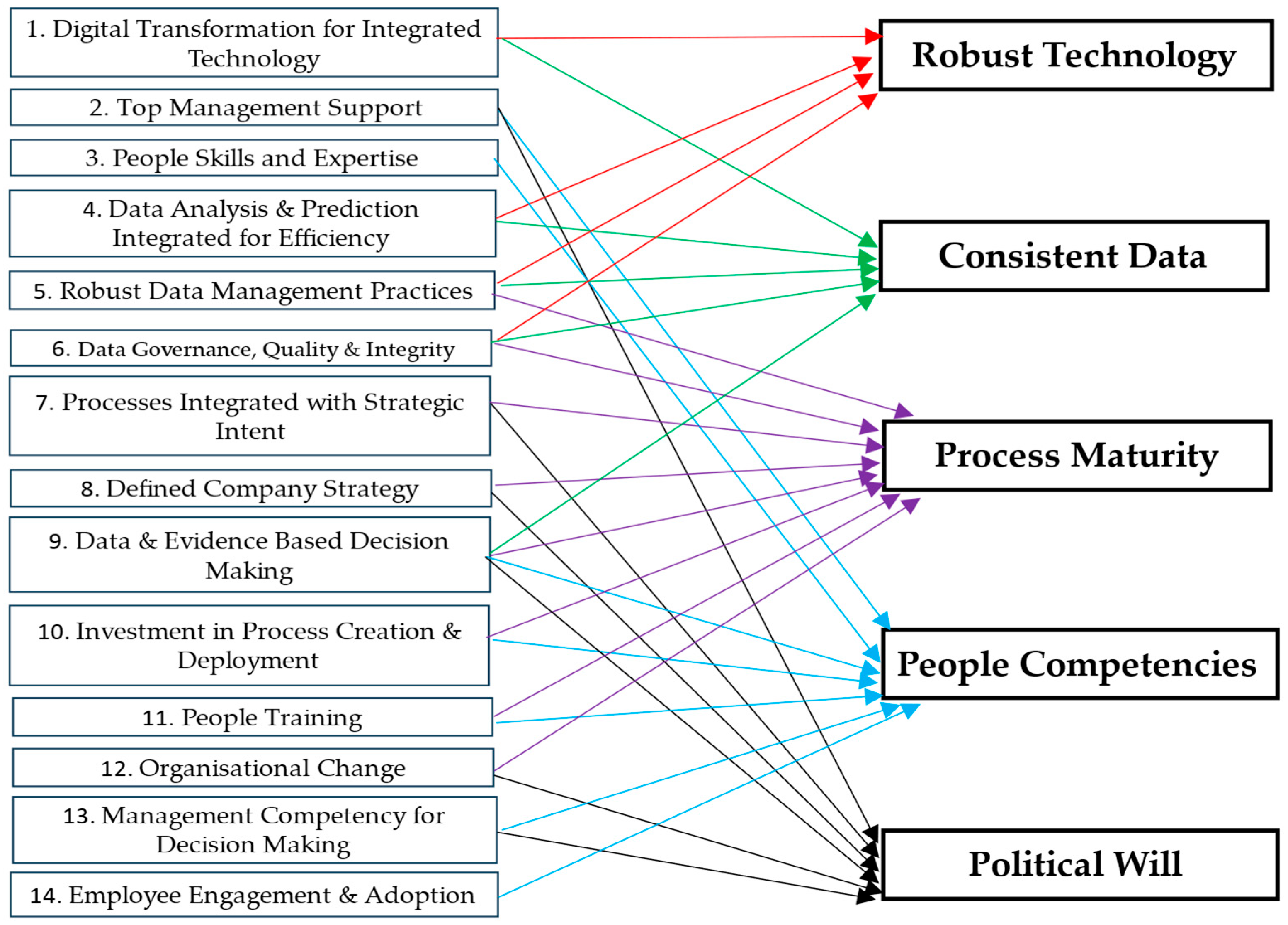
| 1 | Adoption of Digital Transformation for Integrated Technology | Robust Technology, Consistent Data | [1,4,5,7,8,11,33,36,38,40,42,48,55,56,58] |
| 2 | Top-Management Support | People Competencies, Political Will | [2,3,4,10,11,14,32,33,42,43,44,48,50,53,59] |
| 3 | People Skills and Expertise | People Competencies | [1,3,7,32,33,36,39,42,43,47,48,57,58,59,61,62] |
| 4 | Data Analysis and Prediction Integrated for Efficiency | Robust Technology, Consistent Data | [2,3,4,6,34,36,39,40,41,43,44,45,47,48,59] |
| 5 | Robust Data Management Practices | Consistent Data, Process Maturity | [1,3,5,10,32,33,39,56,63] |
| 6 | Data Governance, Quality and Integrity | Robust Technology, Consistent Data, Process Maturity | [33,34,36,43,51,52,53,54,55,64] |
| 7 | Processes Integrated with Strategic Intent | Process Maturity, Political Will | [2,9,10,11,14,32,41,43,51] |
| 8 | Defined Company Strategy | Process Maturity, Political Will | [1,34,40,41,43,51,53,58] |
| 9 | Data and Evidence-Based Decision Making | Consistent Data, People Competencies, Political Will | [32,43,44,49,50,57,60,64] |
| 10 | Investment in Process Creation and Deployment | Process Maturity, People Competencies | [3,11,39,40,45,46,47,49] |
| 11 | People Training | Process Maturity, People Competencies | [7,36,44,49,51] |
| 12 | Organisational Change | Process Maturity, Political Will | [2,4,46,49,63] |
| 13 | Management Competency for Decision Making | People Competencies, Political Will | [3,34,50,64] |
| 14 | Employee Engagement and Adoption | People Competencies | [14,38] |
| Pillar/ Project | Robust Technology | Data Consistency | Process Maturity | People Competencies | Political Will |
|---|---|---|---|---|---|
| 1992–94 End-User Prototypes [69] | No. Standalone departmental spreadsheets were stable, but not suitable for a corporate system. | No. Data was assembled on an ad hoc basis from disparate sources. | No. There was no cross-company process or procedure for data governance, ownership or maintenance. | No. Restricted to the marketing research manager and his assistant. National account managers were not adequately briefed or trained. | Yes. Moving to a profit-led culture was supported by senior management. |
| Financial Management System (FMS) 1993–98 [72,73,74,75,76,77,84] | Partially. The PC Express product was adequate but automation of integration with feeder systems was problematic. | No. Allocating appropriate cost data from a variety of transaction processing systems was an ongoing problem. | Partially. Data ownership and maintenance responsibilities were recognised and appropriate staffing and procedures were in place. | Yes. IT project management, data maintenance, and end-user (national account managers) competencies were well advanced. | Yes, but data and process issues thwarted successful implementation. |
| Profit Management Programme 1998–2001 [78,79,83] | Yes. The FMS was stable and well supported. The JDA Boost product was available for national account managers for further analysis. | Yes. The allocation of costs by customer was largely resolved. Automated update of FMS was in place. | Yes. Processes were reviewed and verified. Data governance was in place. National account managers were trained and supported. | Yes. IT support skills, data maintenance competence, and end-user training were well advanced. | Yes, initially, but soon undermined by broader corporate ambition. |
| Change Mechanisms/Analytics Projects/CSFs | Change Mechanisms | 1992–94 | 1993–98 | 1998–2001 |
|---|---|---|---|---|
| 1. Adoption of Digital Transformation for Integrated Technology | D4, P1, S5 | R | G | G |
| 2. Top-Management Support | A3, G2, S3 | R | G | A |
| 3. People Skills and Expertise | C1, C6, A4 | R | A | G |
| 4. Data Analysis and Prediction Integrated for Efficiency | C5, D4, P4 | R | A | G |
| 5. Robust Data Management Practices | G3, D1, D5 | R | A | G |
| 6. Data Governance, Quality, and Integrity | G1, G5, D3 | R | A | G |
| 7. Processes Integrated with Strategic Intent | G4, P1, P3 | R | G | A |
| 8. Defined Company Strategy | G1, D2, S2 | G | G | G |
| 9. Data and Evidence-Based Decision Making | C2, A1, S4 | R | A | A |
| 10. Investment in Process Creation and Deployment | C6, G4, P5 | R | G | G |
| 11. People Training | C1, C4, A2 | R | G | G |
| 12. Organisational Change | G3, P1, S5 | R | G | G |
| 13. Management Competency for Decision Making | C2, C6, G2 | R | G | G |
| 14. Employee Engagement and Adoption | C3, C7, A3 | R | A | A |
Disclaimer/Publisher’s Note: The statements, opinions and data contained in all publications are solely those of the individual author(s) and contributor(s) and not of MDPI and/or the editor(s). MDPI and/or the editor(s) disclaim responsibility for any injury to people or property resulting from any ideas, methods, instructions or products referred to in the content. |
© 2026 by the authors. Licensee MDPI, Basel, Switzerland. This article is an open access article distributed under the terms and conditions of the Creative Commons Attribution (CC BY) license.
Share and Cite
Wynn, M.; Reed, C. Analytics and Business Survival—Critical Success Factors and the Demise of HP Bulmer Ltd. Analytics 2026, 5, 17. https://doi.org/10.3390/analytics5020017
Wynn M, Reed C. Analytics and Business Survival—Critical Success Factors and the Demise of HP Bulmer Ltd. Analytics. 2026; 5(2):17. https://doi.org/10.3390/analytics5020017
Chicago/Turabian StyleWynn, Martin, and Catherine Reed. 2026. "Analytics and Business Survival—Critical Success Factors and the Demise of HP Bulmer Ltd." Analytics 5, no. 2: 17. https://doi.org/10.3390/analytics5020017
APA StyleWynn, M., & Reed, C. (2026). Analytics and Business Survival—Critical Success Factors and the Demise of HP Bulmer Ltd. Analytics, 5(2), 17. https://doi.org/10.3390/analytics5020017