


Abstract
Self-efficacy in clinical performance reflects nursing students’ confidence in their ability to perform clinical activities and is an important contributor to competence and confidence at graduation. Understanding and evaluating this construct requires valid and reliable instruments that can be used across different stages of a nursing degree. Using a cross-sectional design, Year 1, 2 and 3 students enrolled in a three-year undergraduate nursing programme completed a Modified Self-Efficacy in Clinical Performance Scale. Content validity was investigated through nurse education expert review, construct validity through known-group comparisons and confirmatory factor analysis, and convergent validity and internal consistency using correlation measures, Cronbach’s alpha and McDonald’s omega. An analysis of 512 surveys demonstrated expected differences between known groups, including students with and without clinical placement experience. A revised four-factor model demonstrated acceptable but not unequivocally strong structural validity (CMIN/df = 4.84). Scores were strongly correlated with visual analogue self-efficacy ratings (r = 0.77, p < 0.001). Internal consistency was acceptable (Cronbach’s alpha = 0.98, McDonald’s omega = 0.98). The Modified Self-Efficacy in Clinical Performance Scale demonstrated promising validity and strong internal consistency for assessing clinical performance self-efficacy among nursing students in this sample and may facilitate the evaluation of curricular initiatives. Further cross-institutional, cross-cultural and longitudinal research should be conducted to test its performance.
1. Introduction
Registered nurses perform a range of clinical activities in healthcare settings that directly influence patient outcomes and safety [1]. Effective clinical performance requires nurses to have sound knowledge and skills related to patient assessment and to be competent and confident to prioritise and plan care, implement evidence-based nursing interventions and evaluate the outcomes of such interventions [2]. For decades, the cycle of assess, plan, implement and evaluate has been a common thread underpinning nurses’ clinical performance across healthcare contexts [2]. Popularised with Orlando’s Nursing Process [3], the cycle has been used to guide decision making and problem solving in professional nursing practice in countries such as the United States [4]. In 2010, Levett-Jones [5] and colleagues integrated the concepts of assess, plan, implement and evaluate into their Clinical Reasoning Cycle (CRC), a widely used clinical decision-making framework for nurses in complex healthcare situations. Today, professional nursing bodies such as the United Kingdom’s Nursing and Midwifery Council [6], the Nursing and Midwifery Board of Australia [7] and the American Nurses Association [8] include assessment, planning, implementation and evaluation in their professional standards, reinforcing the cycle’s contribution to nurses’ clinical performance and patient safety.
Despite integration into nursing frameworks and standards, research from several countries suggests that many graduate nurses lack confidence in their clinical performance, particularly in relation to assessment, planning and implementing care. In New Zealand, Taylor and colleagues [9] studied 137 newly graduated nurses working in adult healthcare settings and found that almost 30% of participants lacked confidence when assessing patients and felt ill-prepared for this aspect of critical thinking. A qualitative Swedish study similarly found that newly graduated nurses were challenged in complex situations in appropriately assessing patients and prioritising, planning and coordinating care, particularly without support from more experienced nurses [10]. In countries such as the United States, Taiwan and Turkey, low confidence related to clinical performance has been identified as a contributor to graduate nurses’ intention or decision to leave the nursing profession within the first few years of practice [11,12,13]. This is particularly concerning, given the current and predicted future global nursing workforce shortages [14].
Research suggests that to improve newly graduated nurses’ clinical performance in assessment, planning, implementation and evaluation, it is essential to first strengthen their self-efficacy beliefs [15]. Self-efficacy is a central construct in Bandura’s Social Cognitive Theory and refers to people’s beliefs about their own capabilities to perform a task and succeed in performing that task in the future [16]. Individuals with strong self-efficacy beliefs are more likely to think they can overcome challenges related to specific situations and are more resilient when faced with setbacks and disappointments [16]. Conversely, individuals with low self-efficacy beliefs are less confident in their ability to perform a task, believing they will execute it poorly and tending to avoid such tasks [16]. For qualified nurses, increased levels of self-efficacy have been associated with improved clinical performance and greater emotional intelligence [17], as well as increased resilience when faced with challenges [18]. For nursing students, self-efficacy beliefs have been positively correlated with competence and confidence in performing clinical activities [19].
The development of a nursing workforce that is self-efficacious in their clinical performance is the responsibility of educators, who design and deliver nursing degree programmes to undergraduate students [17]. Such educators are expected to support nursing students to develop their self-efficacy beliefs throughout their degree programme, in order that students meet the challenges of professional practice upon graduation [15]. To rigorously assess nursing students’ self-efficacy in clinical performance across an undergraduate nursing degree programme, a psychometrically sound instrument, psychometrically evaluated with students at each year level of study, is required. To date, no such work across year levels has been undertaken. This study aims to examine the content validity, construct validity, convergent validity and internal consistency of a self-efficacy in clinical performance scale with a sample of nursing students enrolled in each year of an undergraduate nursing degree programme.
The results of this study will support future investigations of nursing students’ self-efficacy in clinical performance and may provide a means for tertiary educators to assess, contrast and enhance their curricular activities in relation to students’ self-efficacy in clinical performance.
2. Materials and Methods
2.1. Design
This study used a cross-sectional quantitative survey design and a four-stage approach to psychometric investigation [20]. The stages involved: (1) the identification of potentially suitable instruments, (2) the expert review of domains and items for suitability to the Australian undergraduate nursing context, (3) data collection and (4) psychometric analysis.
2.2. Searching for Instruments
In 2022, a research team member, with help from a university librarian, undertook a targeted search of the nursing education literature to identify existing instruments measuring self-efficacy in clinical performance. The purpose of the search was to identify potentially suitable instruments for psychometric evaluation within the Australian undergraduate nursing context rather than to conduct a systematic review of the literature. Self-efficacy in clinical performance was defined as a belief in one’s ability to perform clinical activities related to patient care [19] and was presumed to be underpinned by assessment, planning, implementation and evaluation. Five potentially suitable instruments were identified [21,22,23,24,25] and then assessed by two research team members for their relevance to undergraduate nursing students at varying levels of study. While the Clinical Skills Self-Efficacy Scale [23], Nursing Competence Self-Efficacy Scale [22], Nursing Student Self-Efficacy Scale [24] and Evidence-Based Nursing Practice Self-Efficacy Scale [25] had all been administered to nursing students or registered nurses, each instrument included items that were not relevant to Australian undergraduate nursing students’ clinical performance at a junior (Year 1) level. These included more complex nursing tasks (e.g., urinary catheter insertion, nasogastric tube insertion, venipuncture), tasks undertaken in specialty clinical areas (e.g., palliative care and critical care) and activities undertaken by more experienced nurses (e.g., influencing senior management and interprofessional networks).
Ultimately, the Self-Efficacy in Clinical Performance Scale (SECP) [21] was the most suited to varying year levels of undergraduate nursing students. Originating in Iran, the 37-item scale was underpinned by Social Cognitive Theory and aligned to the nursing process framework [21]. The original authors validated the instrument with a sample of final-year Iranian undergraduate nursing students. Using exploratory factor analysis, they organised the scale’s items into four domains: (1) Assessment, (2) Diagnosis and Planning, (3) Implementation and (4) Evaluation [21]. The scale has since been used in undergraduate nursing research in Iran [26,27,28,29], Turkey [30,31], Australia [32] and the United States [33,34,35]. Although the SECP has previously been developed, adapted and/or used in multiple countries, no study has examined its psychometric properties with nursing students across all year levels of an undergraduate nursing degree programme. The present study therefore aimed to address this gap by evaluating the modified SECP with students enrolled in Years 1, 2 and 3 of an undergraduate nursing degree.
2.3. Review of Domains and Items
Following instrument identification, four nurse education experts, each registered nurses with postgraduate qualifications and minimum 10 years’ experience in tertiary education/research, reviewed the SECP Scale to provide evidence relating to content validity. Using a structured review template, the experts assessed the items’ relevance to Australian undergraduate nursing students’ scope of practice, together with their comprehensiveness and comprehensibility. Written feedback was also sought regarding item clarity, conciseness and underlying constructs. Two reviewers suggested minor wording amendments to improve the clarity of five items, while two reviewers recommended no changes to item wording. All experts suggested the removal of items related to nursing diagnoses. Expert suggestions were collated by the research team, resulting in the removal of four questions related to nursing diagnoses. Nursing diagnoses are not typically formulated by nurses and nursing students in Australia; rather, priority problems and objectives are generated [36]. Items related to priority problems and objectives were therefore retained. Pilot testing was not conducted with nursing students as other than removing the four items as described above, no significant modifications were made to the scale, which has been previously utilised in several English-language studies [33,34,35]. The final modified version of the scale, titled the Modified Self-Efficacy in Clinical Performance Scale (M-SECP Scale), had 33 items related to clinical activities. For each item, students were required to use an 11-point Likert scale (from 0 = cannot do at all to 10 = highly certain I can do) to identify their confidence with a particular clinical activity.
During the item review phase, two items were added to a demographic section accompanying the M-SECP Scale. The first item captured participants’ level of study (Year 1, 2 or 3) and the second item identified whether participants had completed at least one clinical placement experience. These items were included to investigate the M-SECP Scale’s known-group validity—its ability to distinguish scores between two or more sub-groups within the sample [37]. A scale’s known-group validity supports its construct validity, particularly when a scale is measuring an unobservable construct, such as self-efficacy [38]. In relation to the M-SECP Scale, it was expected that:
- The mean M-SECP score of Year 3 participants, who had engaged with more clinical, laboratory and theoretical learning related to clinical activities, would be statistically greater than that of Year 2 and Year 1 participants.
- The mean M-SECP score of participants who had completed at least one clinical placement experience, and presumably performed more clinical activities, would be statistically greater than that of participants without clinical placement experience.
As a final component of the item review phase, a Self-Efficacy in Clinical Performance Visual Analogue Scale (SECP-VAS), adapted from Tutticci and colleagues [39], was reviewed by the nurse education experts and included with the scale. Lewis and colleagues [40] proposed that a scale’s convergent validity can be established by concurrently examining its relationship with a separate scale measuring the same concept. Scores from each scale should be positively correlated [40]. The validity and reliability of visual analogue scales are well-established [41], and they have been widely utilised in nurse education research [20,42]. With the SECP-VAS, participants rated their self-efficacy in clinical performance by placing an ‘X’ on a horizontal line measuring 100 millimetres (mm) in length. The line was labelled at the far left (0 mm) with ‘cannot do at all’ and the far right (100 mm) with ‘highly certain I can do’. Following data collection, participants’ self-efficacy in clinical performance was established by measuring from 0 mm to the participants’ ‘X’. The demographic items, M-SECP and SECP-VAS formed the final survey package.
2.4. Data Collection
The recruitment of nursing students occurred in August and September 2022 at a multi-campus metropolitan university in Queensland, Australia. Students were eligible to participate if enrolled in Year 1, 2 or 3 (full-time equivalent) of the three-year undergraduate nursing degree programme. The programme included a constructivist curriculum, which integrated increasingly complex nursing knowledge and psychomotor skills across year levels. The number and duration of clinical placement experiences also increased throughout the programme. In accordance with undergraduate nursing programme accreditation requirements [43], students were expected to demonstrate the achievement of the NMBA [7] Registered nurse standards for practice upon graduation.
A sample size of at least 330 participants was sought to achieve a 95% confidence interval [44]. In instrument validation research involving confirmatory factor analysis (CFA), a ratio of 5–10 participants to one item is recommended, with a minimum 100 participants regardless of item numbers [45,46].
Nursing students were approached by a research team member at the start of their tutorials and provided with a verbal explanation of this study and a research information sheet detailing this study’s aim, voluntary and anonymous nature, time commitment, data usage, dissemination intentions, contact details and Human Research Ethics Committee (HREC) approval number. It also specified that survey completion implied informed consent. Participants took approximately 10–15 min to complete the anonymous survey, and they were encouraged to check their survey for completeness prior to returning it to a secure collection box. There were no known connections between the research team member who performed data collection and the students/participants.
2.5. Data Analysis
Survey data were entered into Lime Survey [47], uploaded into IBM SPSS Version 30.0 [48], examined for normality and checked for missing items. Surveys with one or more missing M-SECP responses were excluded from analysis, and a complete-case approach was adopted to avoid introducing additional assumptions through the imputation of item responses. Descriptive statistics were used to analyse demographic data and M-SECP scores for each participant year level. For construct validity (known-group validity), prespecified pairwise comparisons between Year 1, Year 2 and Year 3 participants were conducted using Welch’s independent-samples t-test, with equal variances not assumed. Pairwise tests were selected because the hypotheses specified expected differences between particular year level groups. Welch’s independent-samples t-test was also used to compare participants who had/had not completed a clinical placement experience. For all comparisons, Cohen’s d identified whether the strength of differences in scores across groups was small (0.2), medium (0.5) or large (0.8), and a Bonferroni correction, set at p < 0.0125, safeguarded against Type I errors [49,50].
The 11-point M-SECP item responses demonstrated only minimal departures from normality (skewness = −1.09 to −0.25; kurtosis = −0.18 to 0.77) and were therefore treated as approximately continuous for CFA purposes. Accordingly, to further investigate the scale’s construct validity, CFA using Maximum Likelihood (ML) estimation was performed in IBM Amos Version 29.0 [51]. With CFA, the correlations between an instrument’s domains (i.e., factors) and its assigned items (i.e., indicators) are assessed to determine whether the instrument’s theorised structure is a ‘good fit’ with the sample’s data [52,53]. With the CFA, several model fit indices were generated, including chi-square (X2), relative chi-square (CMIN/df), Standardised Root Mean Square Residual (SRMR), Root Mean Square Error of Approximation (RMSEA), Comparative Fit Index (CFI), Incremental Fit Index (IFI), Lewis Index (TLI), Normed Fit Index (NFI) and Relative Fit Index (RFI) [53]. The Modification Index (MI) was examined to determine correlated error terms and the need to adjust parameters [54]. Standardised regression estimates were generated to identify the effect of the factors on the indicators assigned to them [53]. Each factor’s convergent validity was investigated with Average Variance Extracted (AVE), and discriminant validity was examined with Heterotrait–Monotrait Ratios of Correlations (HTMTs) [53,55].
For convergent validity, Pearson product-moment correlation was used to establish a statistical association between total M-SECP scores and SECP-VAS scores for each year level sample [50]. Cronbach’s alpha and McDonald’s omega examined internal consistency [50].
2.6. Ethical Approval
The authors’ university’s Human Research Ethics Committee granted ethics approval for this study before participant recruitment.
3. Results
3.1. Participant Demographics
A total of 534 participants completed the survey (response rate = 33.6%). Twenty-two (4.1%) surveys had missing data and were excluded, resulting in an analysis of 512 surveys (completion rate = 32.2%). Given the small proportion of incomplete surveys and the sensitivity of CFA to value estimation, no imputation procedures were undertaken. Participants were mostly females (84.6%) and enrolled full time (88.5%), reflecting the Australian nursing student population [56]. Participants were enrolled in Year 1 (37.7%), Year 2 (35.7%) and Year 3 (26.6%) of the three-year undergraduate nursing degree programme, and 55.9% had completed one or more clinical placements at the time of survey completion (Table 1).
Table 1.
Participant demographics.
3.2. Construct Validity: Comparison of Self-Efficacy Scores Across Year Levels
The total sample (n = 512) had a mean M-SECP score of 234.8 (SD = 50.5), out of a maximum 330.0. Year 3 participants’ mean M-SECP score was significantly greater than Year 2 participants’ mean score (M difference = 13.8, 95% CI [4.3, 23.4], p = 0.005) and Year 1 participants’ mean score (M difference = 43.5, 95% CI [33.1, 53.9], p < 0.001). These differences were small and large in strength, respectively [49]. Year 2 participants’ mean M-SECP score was significantly greater than Year 1 participants’ mean score (M difference = 29.7, 95% CI [19.7, 39.6], p < 0.001). The strength of this difference was medium [49] (Table 2).
Table 2.
Modified self-efficacy in clinical performance total scores by year level.
3.3. Construct Validity: Comparison of Self-Efficacy Scores Based on Clinical Placement Experience
Participants who completed at least one prior clinical placement in the nursing degree programme had a significantly greater mean M-SECP score compared to participants who had not completed a clinical placement (M difference = 32.2, 95% CI [23.6, 40.8], p < 0.001). The strength of this difference was medium [49] (Table 3).
Table 3.
Comparison of modified self-efficacy in clinical performance total scores of participants with and without clinical placement experience.
3.4. Construct Validity: Confirmatory Factor Analysis
In accordance with Cheraghi and colleagues’ [21] original M-SECP domains and items, a four-factor model was developed and analysed using CFA with ML. The model loaded Factor 1 Assessment with indicators (items) 1–11, Factor 2 Planning with indicators 12–17, Factor 3 Implementation with indicators 18–27 and Factor 4 Evaluation with indicators 28–33. A measurement error was added to each indicator (e1–e33) to account for unexplained variances between factors and indicators [53].
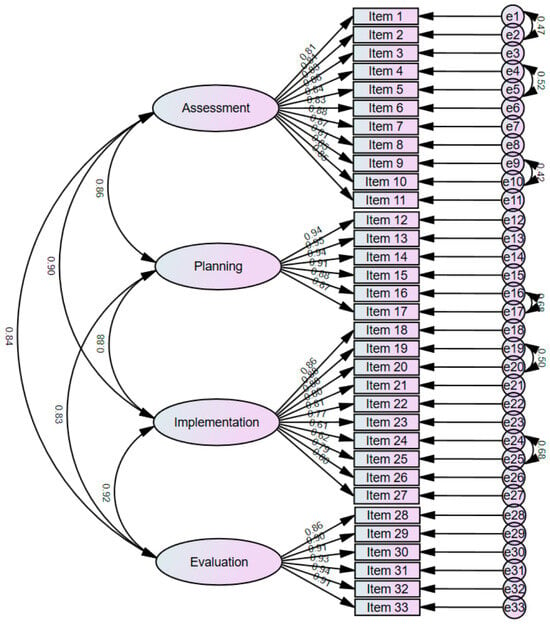
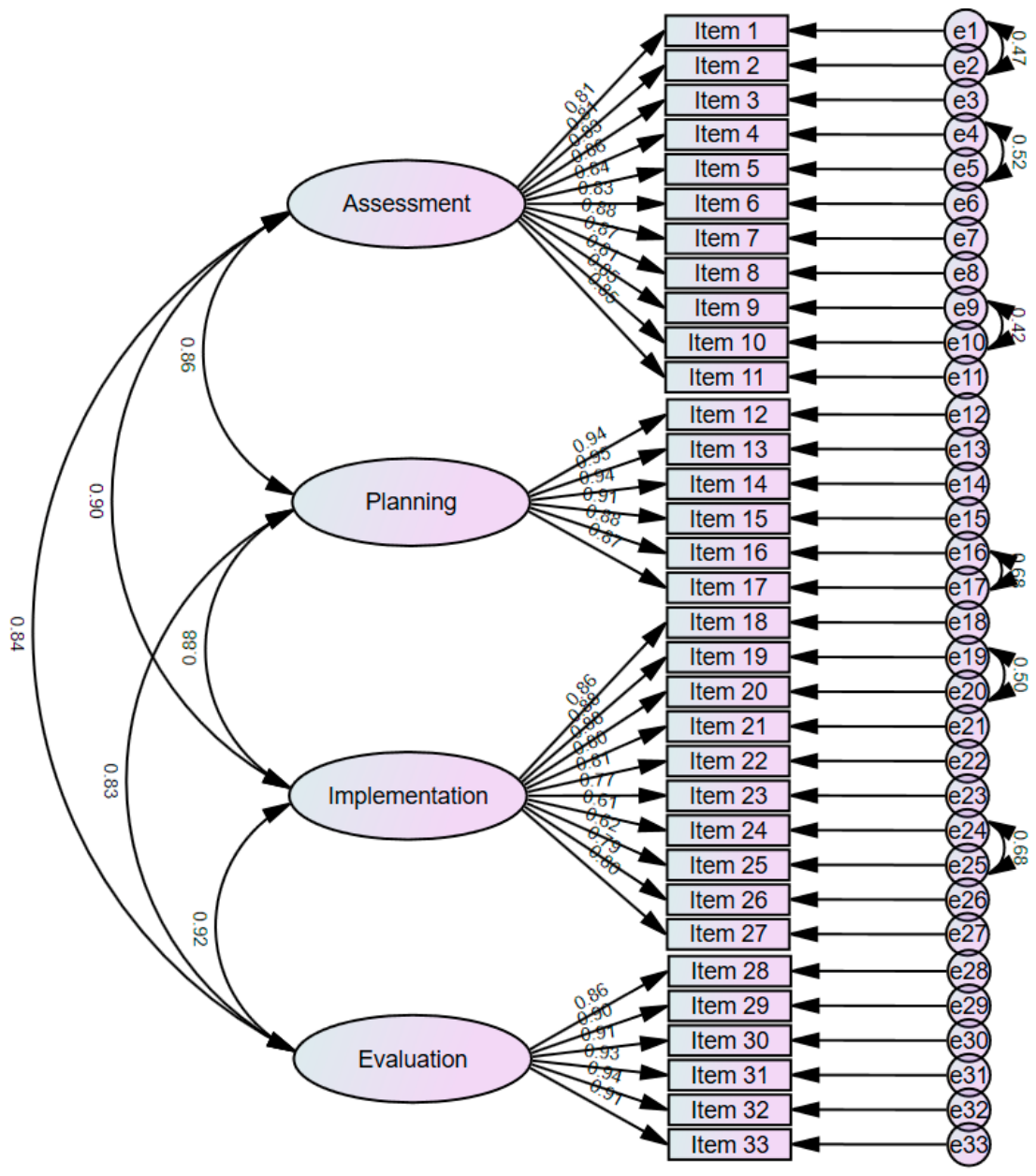
The initial results indicated a poor fit between the proposed four-factor model and the sample’s data. The chi-square (X2 [489, n = 512] = 3377.66, p <.001) suggested that the proposed model was significantly different from a ‘perfect model’. The relative chi-square (CMIN/df = 6.91) was also outside the acceptable range of <5.00 [57]. The MI indicated that there were strong correlations between six pairs of measurement errors that were assigned to indicators. These measurement error pairs were associated with indicators 1–2 (MI = 99.88), 4–5 (MI = 116.55), 9–10 (MI = 105.66), 16–17 (MI = 230.08), 19–20 (MI = 91.67) and 24–25 (MI = 241.99). While MIs were used to identify areas of model strain, correlated residuals were only added where a theoretical rationale was evident. Items 1 and 2 relate to collecting patient assessment information through physical assessment and health history taking. Items 4 and 5 both relate to the collection of assessment data concerning a patient’s health condition. Items 9 and 10 concern the interpretation of assessment findings and identification of patient strengths and concerns. Items 16 and 17 both address the formulation of care-plan goals. Items 19 and 20 relate to the implementation of nursing care within the context of clinical decision making. Items 24 and 25 relate to seeking and responding to support from mentors and staff during clinical practice. Because these pairs represent closely related clinical activities within the same domain of the nursing process, some shared variance beyond that explained by the latent factor was considered theoretically plausible. As the errors/indicators within each pair were assigned to the same single factor (e.g., errors/indicators 1 and 2 were both assigned to Factor 1 Assessment, errors/indicators 24 and 25 were both assigned to Factor 3 Implementation), the four-factor model was adjusted to account for these error pairs and then re-analysed [54]. The revised model is presented in Figure 1.
Figure 1.
Revised four-factor model for Modified Self-Efficacy in Clinical Performance Scale.
The revised model’s chi-square (X2 [483, n = 512] = 2339.21, p <.001) continued to indicate a significant difference between the proposed model and a perfect model; however the relative chi-square (CMIN/df = 4.84) was within the reasonable range of <5.00 [57], and the SRMR (0.043) indicated a good model fit at <0.05 [53]. The RMSEA (0.087) was considered marginal to acceptable [58]. Other model fit statistics (IFI = 0.915; TLI = 0.907; CFI = 0.915) were acceptable or borderline (NFI = 0.896; RFI = 0.886) when compared to the preferred criterion of them being >0.90 [53]. Thus, the revised model demonstrated mixed fit indices that were not unequivocally strong.
Standardised regression estimates for Factor 1 Assessment (0.808–0.876), Factor 2 Planning (0.871–0.946), Factor 3 Implementation (0.605–0.882) and Factor 4 Evaluation (0.862–0.941) satisfied the acceptability criterion of them being >0.60 [59], and all but two indicators (24 and 25) achieved the more stringent criterion of being >0.70 [53]. While outside the more stringent criteria, indicators 24 and 25 were retained in the model as they capture help-seeking and responsiveness to feedback from mentors and staff, which are important components of safe clinical practice. Their retention reflects a deliberate balance between comparatively weaker structural performance and preservation of theoretically important content.
The factors’ AVEs (0.620–0.836) were within the appropriate criterion of being >0.50, implying convergence between indicators and their assigned factors [53]. The HTMT Correlation Ratios for factors ranged from 0.822 to 0.907. Although these values satisfied the criterion of being <1.00 adopted in this study [55], they approached or exceeded other more conservative thresholds proposed in the literature. The standardised regression estimates are presented in Table 4.
Table 4.
Standardised regression estimates for factors and their assigned indicators.
3.5. Convergent Validity: Correlation of Self-Efficacy Scores with Visual Analogue Scores
The total sample’s M-SECP scores were strongly and positively correlated with their SECP-VAS scores (r = 0.77, n = 509, p < 0.001 [two-tailed]; shared variance = 58.5%) [49]. There was also a moderate to strong positive correlation between M-SECP scores and SECP-VAS scores for Year 1 participants (r = 0.76, n = 192, p < 0.001 [two-tailed]; shared variance = 57.3%), Year 2 participants (r = 0.69, n = 181, p < 0.001 [two-tailed]; shared variance = 47.6%) and Year 3 participants (r = 0.74, n = 136, p < 0.001 [two-tailed]; shared variance = 55.2%) [49].
3.6. Internal Consistency: Cronbach’s Alpha and McDonald’s Omega
For the total sample, Cronbach’s alpha and McDonald’s omega for the M-SECP Scale were both 0.98, and corrected item–total correlations were 0.60–0.87 (indicating a correlation between each item scores and the M-SECP total score) [50]. Domain-level internal consistency was also high for Assessment (α = 0.97; ω = 0.96), Planning (α = 0.97; ω = 0.97), Implementation (α = 0.94; ω = 0.94) and Evaluation (α = 0.97; ω = 0.97). For Year 1, Year 2, and Year 3 participants, Cronbach’s alpha for the M-SECP was also 0.98, and corrected item–total correlations were 0.55–0.88 (Year 1), 0.53–0.85 (Year 2) and 0.59–0.87 (Year 3). For the total sample and year level samples, there was no improvement in internal consistency when items were removed.
4. Discussion
This is the first known study to investigate the validity and internal consistency of a self-efficacy in clinical performance scale with students enrolled in each year level of an Australian undergraduate nursing degree programme. Four nursing experts undertook a structured review that provided evidence concerning the relevance, comprehensiveness and comprehensibility of the revised scale’s items and domains within the Australian undergraduate nursing context. Centred on the concepts of assessment, planning, implementation and evaluation, the M-SECP’s domains and items were initially generated by Cheraghi and colleagues [21] through a review of the nursing literature, an examination of Iranian nursing curricula, and interviews and focus groups with final-year Iranian nursing students. The expert review undertaken with this study aligns the M-SECP’s domains and items with Australian professional nursing requirements.
In relation to construct validity and the known-group approach, the M-SECP Scale distinguished between students enrolled in different year levels of study and between students with and without clinical placement experience. As proposed, Year 3 participants’ mean M-SECP score was statistically greater than the scores of Year 2 and Year 1 participants. Year 2 participants’ mean M-SECP score was also statistically greater than that of Year 1 participants. These differences may arise from the constructivist nature of the participants’ nursing curriculum, which was designed to progressively build students’ nursing knowledge and psychomotor skills across the three-year degree programme [60]. However, these between-group differences may also be associated with differences in curricular and clinical learning opportunities across year levels, and the cross-sectional design does not establish individual change or causation. Liu and colleagues [61] found that the development of university students’ self-efficacy beliefs is not an inevitable outcome of their progression through a degree. Rather, students’ self-efficacy beliefs develop when they repeatedly engage with educational activities that integrate active and interactional learning opportunities [15]. This aligns with Bandura’s [16] theory, which proposed that a person’s self-efficacy beliefs develop when they frequently attempt and master tasks that are challenging but achievable.
As anticipated, participants who had completed at least one clinical placement had a statistically greater mean M-SECP score compared to participants who had not completed a clinical placement. The findings were consistent with the hypothesised association between clinical placement experience and clinical performance self-efficacy. According to Berndtsson and colleagues [62], clinical placements provide important opportunities for nursing students to apply their theoretical knowledge and psychomotor skills to the care of patients in real-life healthcare contexts. Within these contexts, nursing students can develop their capabilities related to patient assessment, as well as their abilities to plan, implement and evaluate nursing care [62]. In Australia, clinical placements start in the first year of a degree programme to introduce students to the professional realities of nursing; the final clinical placement in a programme is longer in duration (e.g., 8 weeks), enabling students to demonstrate their achievement of the NMBA [7] Registered nurse standards for practice. While this study reinforced the likely role of clinical placements in developing students’ self-efficacy in clinical performance, further research is required to determine the models (e.g., clinical facilitator, near-peer) and aspects of clinical placement that most significantly impact students’ self-efficacy beliefs [20].
In this study, CFA with a four-factor model was used to further investigate the M-SECP Scale’s construct validity. The initial model was a poor fit for the data, with both the chi-square and the (arguably more important) relative chi-square being outside of the acceptable range. The MI, however, identified six pairs of strongly related error terms. Pan et al. [54] suggest that freeing error terms from their initial parameters (rather than deleting items/indicators) is an acceptable way to enhance a model’s fit without deviating from the theory-driven nature of CFA. In this study, each pair of indicators represented similar and conceptually related clinical activities occurring within the same theoretical domain of the nursing process. The correlated residuals therefore likely reflect shared wording, sequential clinical tasks or closely related behaviours not fully captured by the broader latent factor. The revised model produced several fit indices within acceptable parameters, and the relative chi-square, AVE and HTMT also indicated an improved and generally acceptable, although not unequivocally strong, model of fit. Nevertheless, because the model modifications were identified and evaluated using the same dataset, the possibility of sample-specific optimisation cannot be excluded. The replication of the revised model in an independent sample would provide a stronger test of its stability and generalisability.
Confirmatory factor analysis is known to be more restrictive than other factor analysis methods, such as exploratory factor analysis [54]. Accordingly, the results of CFA should be interpreted in relation to the theory that underlies the scale’s construction [63]. In this instance, Cheraghi et al. [21], and the expert reviewers from this study, examined the scale, its domains and items, in relation to well-established nursing theory, which emphasises the importance of assessment, planning, implementation and evaluation in safe quality nursing practice. Furthermore, the major constructs of the scale align with multiple countries’ nursing standards and codes. This solid theoretical base, combined with the results of the CFA and known-group testing, provides support for the scale’s construct validity. The high factor correlations and HTMT values approaching 0.90 suggest some overlap between the four domains. This overlap is not unexpected, as assessment, planning, implementation and evaluation represent sequential and interdependent components of the nursing process that are frequently applied simultaneously in clinical practice. While the four-domain structure remains theoretically meaningful, future studies should compare its fit with alternative models, including higher-order or single-factor structures.
The M-SECP and SECP-VAS scores from the total and year level samples were strongly and positively correlated, providing evidence supporting convergent validity. In their initial validation study, Chergahi et al. [21] established the scale’s convergent validity by correlating the results with those from a general self-efficacy scale (i.e., not specific to the domain of clinical performance). In this study, the use of a visual analogue scale provided a domain-specific means of investigating convergent validity. Domain specificity is an important aspect of self-efficacy theory, as a person may be self-efficacious in one task (or domain) but not another [16]. In the absence of an established self-efficacy in clinical performance scale, an adapted domain-specific visual analogue scale was deemed appropriate; such an approach has been used in other validation studies in nursing education [20].
In terms of internal consistency, the scale’s Cronbach’s alpha and McDonald’s omega (both 0.98) were consistent with Cheraghi et al.’s [21] original validation study (α = 0.96) and with two Turkish nurse education studies (α = 0.82–0.98) [29,30]. Cronbach’s alpha coefficients > 0.70 are generally deemed appropriate [64], while those greater than 0.80 are preferred [50]. Some researchers suggest that high Cronbach’s alpha and McDonald’s omega coefficients can signify item replication [65]. Considering the six pairs of strongly related measurement errors that were identified with CFA, item redundancy within the M-SECP Scale is possible. An exploratory factor analysis of the M-SECP Scale, following administration to an independent sample of nursing students, would help to determine the items, if any, that can be deleted [54] and further test the factor structure. Future studies should also examine test–retest reliability or measurement error to determine reliability.
The study results suggest that the M-SECP Scale demonstrates promising validity and strong internal consistency as a tool for assessing students’ self-efficacy in clinical performance across an undergraduate nursing degree programme. Instrument validity and reliability are the cornerstones of survey research [66], and programmatic approaches to curriculum evaluation are essential for maintaining the integrity and quality of a degree programme [67]. Accordingly, the M-SECP Scale may offer nurse educators and researchers a measure for investigating nursing students’ clinical performance self-efficacy in relation to curricular initiatives. It may also support the evaluation of curricular initiatives and remedial activities aimed at enhancing students’ success in clinical placement [68]. Lastly, M-SECP may offer a means of comparing student outcomes related to the assessment, planning, implementation and evaluation of care, contributing to a greater understanding of the emerging nursing workforce. The further testing of the factor structure would provide greater clarity about its suitability in other contexts and countries.
This study has a number of limitations. Firstly, all participants were from a single Queensland university, impacting this study’s generalisability. Although expert review examined the relevance, comprehensiveness and comprehensibility of the M-SECP items, content validity indices were not evaluated, and cognitive interviews with undergraduate nursing students were not undertaken. Future testing with students from a range of settings would further strengthen evidence regarding item interpretation and generalisability. Secondly, the strong correlation between M-SECP and the SECP-VAS may be potentially inflated by common method variance because both measures are self-reported assessments of the same construct collected simultaneously from the same respondents. While providing supporting evidence, the finding does not provide independent convergent validation. Thirdly, as students were not surveyed longitudinally during their programmes, the findings demonstrate differences between year level groups rather than individual development over time. Furthermore, because measurement invariance across year levels was not examined, comparisons across year levels should be interpreted with caution. Fourthly, while the number of participants was substantially greater than the minimum acceptable sample, the survey response rate was only 33.6%. Though the demographic composition reflects the Australian nursing student population, this does not demonstrate that respondents and non-respondents were equivalent. Students with particularly high or low confidence, greater engagement with clinical education, or stronger perceptions of the curriculum may have been more likely to participate. Fifthly, the revised CFA model included six theoretically justified correlated residuals; however, these may be sample-specific and require confirmation in an independent sample. Finally, self-report surveys can result in social desirability response bias [69]. Future research might benefit from the direct observation of nursing students’ assessment, planning, implementation and evaluation skills to determine the extent to which these align with their self-report self-efficacy beliefs. Future studies could prespecify and test whether known-group differences are consistent across the four proposed domains. A longitudinal study would also provide insight into the impact of students’ clinical performance self-efficacy on their future nursing practice.
5. Conclusions
Nursing students’ self-efficacy in clinical performance should be developed during their undergraduate studies. Despite this, little is known about the extent to which nursing students develop their self-efficacy in clinical performance throughout their degree programme. This is the first known study to psychometrically evaluate a self-efficacy in clinical performance scale with students in all year levels of their degree programme. Through expert review, known-group comparison, CFA and correlation analysis, the M-SECP Scale’s content, construct and convergent validity were examined. Cronbach’s alpha and McDonald’s omega were used to support internal consistency. M-SECP demonstrated promising, although not unequivocally strong, validity and strong internal consistency for assessing clinical performance self-efficacy among nursing students in this sample. Subject to further psychometric testing, M-SECP may support the future longitudinal evaluation of nursing students’ clinical performance self-efficacy in relation to curricular initiatives. Further cross-institutional, cross-cultural and longitudinal research should be conducted to test its performance. The independent replication of the revised CFA model is required to confirm the stability of the factor structure and associated correlated residuals.
Author Contributions
Conceptualisation, B.P., T.v.d.M. and J.A.; methodology, B.P., T.v.d.M. and J.A.; validation, B.P.; formal analysis, B.P.; investigation, B.P.; data curation, B.P.; writing—original draft preparation, B.P.; writing—review and editing, T.v.d.M. and J.A.; visualisation, B.P.; supervision, T.v.d.M. and J.A.; project administration, B.P.; funding acquisition, B.P. All authors have read and agreed to the published version of the manuscript.
Funding
This research was partially funded by a postgraduate completion scholarship from Griffith University.
Institutional Review Board Statement
Thes study was conducted in accordance with the Declaration of Helsinki and approved by the Ethics Committee of Griffith University (protocol code 2022/373; date of approval: 13 June 2022).
Informed Consent Statement
Informed consent was obtained from all subjects involved in this study.
Data Availability Statement
The dataset is available on request from the authors.
Conflicts of Interest
The authors declare no conflicts of interest.
Abbreviations
The following abbreviations are used in this manuscript:
| AVE | Average Variance Extracted |
| CFA | Confirmatory Factor Analysis |
| CFI | Comparative Fit Index |
| CMIN/df | Relative Chi-Square |
| HTMT | Heterotrait–Monotrait Ratio of Correlations |
| IFI | Incremental Fit Index |
| M | Mean |
| M-SECP | Modified Self-Efficacy in Clinical Performance Scale |
| MI | Modification Index |
| NFI | Normed Fit Index |
| RFI | Relative Fit Index |
| RMSEA | Root Mean Square Error of Approximation |
| SECP | Self-Efficacy in Clinical Performance Scale |
| SD | Standard Deviation |
| SRMR | Standardised Root Mean Square Residual |
| TLI | Lewis Index |
References
- International Council of Nurses. Position Statement: Patient Safety. 2023. Available online: https://www.icn.ch/sites/default/files/2023-08/ICN%20Position%20Statement%20Patient%20Safety%202023%20FINAL_EN.pdf (accessed on 1 July 2025).
- Hants, L.; Bail, K.; Paterson, C. Clinical decision-making and the nursing process in digital health systems: An integrated systematic review. J. Clin. Nurs. 2023, 32, 7010–7035. [Google Scholar] [CrossRef] [Scilit]
- Orlando, I.J. The Dynamic Nurse-Patient Relationship: Function, Process, and Principles; G.P. Putnam’s Sons: New York, NY, USA, 1961. [Google Scholar]
- American Nurses Association. The Nursing Process. 2025. Available online: https://www.nursingworld.org/practice-policy/workforce/what-is-nursing/the-nursing-process/ (accessed on 1 July 2025).
- Levett-Jones, T.; Hoffman, K.; Dempsey, J.; Yuen-Sim, S.; Noble, D.; Norton, C.A.; Roche, J.; Hickey, N. The five rights of clinical reasoning: An educational model to enhance nursing students’ ability to identify and manage clinically at-risk patients. Nurse Educ. Today 2010, 30, 515–520. [Google Scholar] [CrossRef] [Scilit]
- Nursing and Midwifery Council. Future Nurse Proficiencies. 2018. Available online: https://www.nmc.org.uk/globalassets/sitedocuments/standards-of-proficiency/nurses/future-nurse-proficiencies.pdf (accessed on 1 July 2025).
- Nursing and Midwifery Board of Australia. Registered Nurse Standards for Practice. 2016. Available online: https://www.nursingmidwiferyboard.gov.au/Codes-Guidelines-Statements/Professional-standards/registered-nurse-standards-for-practice.aspx (accessed on 1 July 2025).
- American Nurses Association. Nursing: Scope and Standards of Practice, 4th ed.; American Nurses Association: Silver Spring, MD, USA, 2022; Available online: https://www.nursingworld.org/practice-policy/scope-of-practice/ (accessed on 1 July 2025).
- Taylor, P.; Hudson, D.; Thomson, P.; Greenlees-Rae, J. Newly graduated registered nurses’ evaluation of their preparedness, confidence and attitudes towards clinical assessments. J. Clin. Nurs. 2021, 30, 929–941. [Google Scholar] [CrossRef] [Scilit]
- Willman, A.; Bjuresäter, K.; Nilsson, J. Insufficiently supported in handling responsibility and demands: Findings from a qualitative study of newly graduated nurses. J. Clin. Nurs. 2021, 30, 83–92. [Google Scholar] [CrossRef] [Scilit]
- Beecroft, P.C.; Dorey, F.; Wenten, M. Turnover intention in new graduate nurses: A multivariate analysis. J. Adv. Nurs. 2008, 62, 41–52. [Google Scholar] [CrossRef] [Scilit]
- Cheng, C.Y.; Tsai, H.M.; Chang, C.H.; Liou, S.R. New graduate nurses’ clinical competence, clinical stress, and intention to leave: A longitudinal study in Taiwan. Sci. World J. 2014, 2014, 748389. [Google Scholar] [CrossRef] [Scilit]
- Ulupinar, S.; Aydogan, Y. New graduate nurses’ satisfaction, adaptation and intention to leave in their first year: A descriptive study. J. Nurs. Manag. 2021, 29, 1830–1840. [Google Scholar] [CrossRef] [Scilit]
- Boniol, M.; Kunjumen, T.; Nair, T.S.; Siyam, A.; Campbell, J.; Diallo, K. The global health workforce stock and distribution in 2020 and 2030: A threat to equity and universal health coverage. BMJ Glob. Health 2022, 7, e009316. [Google Scholar] [CrossRef] [Scilit]
- Abusubhiah, M.; Walshe, N.; Creedon, R.; Noonan, B.; Hegarty, J. Self-efficacy in the context of nursing education and transition to practice as a registered practitioner: A systematic review. Nurs. Open 2023, 10, 6650–6667. [Google Scholar] [CrossRef] [Scilit]
- Bandura, A. Self-Efficacy: The Exercise of Eontrol; Freeman: New York, NY, USA, 1977. [Google Scholar]
- Kim, M.S.; Sohn, S.K. Emotional intelligence, problem solving ability, self-efficacy, and clinical performance among nursing students: A structural equation model. J. Korean Acad. Adult Nurs. 2019, 31, 380–388. [Google Scholar] [CrossRef] [Scilit]
- Wang, L.; Tao, H.; Bowers, B.J.; Brown, R.; Zhang, Y. Influence of social support and self-efficacy on resilience of early career registered nurses. West. J. Nurs. Res. 2018, 40, 648–664. [Google Scholar] [CrossRef] [Scilit]
- Mohamadirizi, S.; Kohan, S.; Shafei; F. Mohamadirizi, S. The relationship between clinical competence and clinical self-efficacy among nursing and midwifery students. Iran. J. Pediatr. 2015, 25, 1117–1123. [Google Scholar] [CrossRef] [Scilit]
- Pierce, B.; Allen, J.; van de Mortel, T. Examining the psychometric properties of the Self-Efficacy in Clinical Teaching Scale with undergraduate nursing students: A cross-sectional study. Nurse Educ. Pract. 2024, 79, 104093. [Google Scholar] [CrossRef] [Scilit]
- Cheraghi, F.; Hassani, P.; Yaghmaei, F.; Alavi-Majed, H. Developing a valid and reliable self-efficacy in clinical performance scale. Int. Nurs. Rev. 2009, 56, 214–221. [Google Scholar] [CrossRef] [Scilit]
- Kennedy, E.; Murphy, G.T.; Misener, R.M.; Alder, R. Development and psychometric assessment of the nursing competence self-efficacy scale. J. Nurs. Educ. 2015, 54, 550–558. [Google Scholar] [CrossRef] [Scilit]
- Oetker-Black, S.L.; Kreye, J.; Underwood, S.; Price, A.; DeMetro, N. Psychometric evaluation of the clinical skills self-efficacy scale. Nurs. Educ. Pers. 2014, 35, 253–256. [Google Scholar] [CrossRef] [Scilit]
- Stump, G.S.; Husman, J.; Brem, S.K. The nursing student self-efficacy scale: Development using item response theory. Nurs. Res. 2012, 61, 149–158. [Google Scholar]
- Tucker, S.; Zadvinskis, I.M.; Connor, L. Development and psychometric testing of the Implementation Self-efficacy for EBP (ISE4EBP) Scale. West. J. Nurs. Res. 2021, 43, 45–52. [Google Scholar] [CrossRef] [Scilit]
- Azizi, M.; Ramezani, G.; Karimi, E.; Hayat, A.A.; Faghihi, S.A.; Keshavarzi, M.H. A comparison of the effects of teaching through simulation and the traditional method on nursing students’ self-efficacy skills and clinical performance: A quasi-experimental study. BMC Nurs. 2022, 21, 283. [Google Scholar] [CrossRef] [Scilit]
- Moeini, M.; Sarikhani-Khorrami, E.; Ghamarani, A. The effects of self-compassion education on the self-efficacy of the clinical performance of nursing students. Iran. J. Nurs. Midwifery Res. 2019, 24, 469–471. [Google Scholar] [CrossRef] [Scilit]
- Moradi, F.; Vaezi, A.; Karimi, V. Investigating the relationship between self-efficacy in clinical performance and psychological empowerment among nursing students. Prev. Care Nurs. Midwifery J. 2024, 14, 1–9. [Google Scholar] [CrossRef] [Scilit]
- Pourteimour, S.; Jamshidi, H.; Parizad, N. Clinical belongingness and its relationship with clinical self-efficacy among nursing students: A descriptive correlational study. Nurs. Midwifery Stud. 2021, 10, 47–51. [Google Scholar] [CrossRef] [Scilit]
- Altintaş, S.; Çelik, S.; Karahan, E.; Uçar, Ö.; Yücel, M. Investigation of the relationship between the self-efficacy levels in clinical practice and coping behaviors with stress among international nursing students. Nurse Educ. Today 2024, 143, 106366. [Google Scholar] [CrossRef] [Scilit]
- Zaybak, A.; Pozam, M. Adaptation of the self-efficacy scale in clinical performance into Turkish and examination of its psychometric properties. Ege Üniv. Hemşire. Fak. Derg. 2016, 32, 100–117. Available online: https://dergipark.org.tr/tr/pub/egehemsire/issue/49328/630084 (accessed on 1 July 2025).
- Pierce, B.; Allen, J.; van de Mortel, T. Development of undergraduate nursing students’ clinical performance self-efficacy beliefs: A cross-sectional study. Educ. Sci. 2026, 16, 784. [Google Scholar] [CrossRef] [Scilit]
- Hultquist, B.L. A Mixed Methods Study of the Sources of Clinical Self-Efficacy Beliefs in Undergraduate Nursing Students. Ph.D. Thesis, Mercer University, Macon, GA, USA, 2014. [Google Scholar]
- Huston-Shaikh, C.J. Self-Efficacy and Competence for Clinical Skills In Nursing Education. Ph.D. Thesis, Capella University, Minneapolis, MN, USA, 2015. [Google Scholar]
- Rice, E.W. The Relationship Between Emotional Intelligence, Self-Efficacy, and Clinical Performance in Associate Degree Nursing Students. Ph.D. Thesis, Capella University, Minneapolis, MN, USA, 2013. [Google Scholar]
- Johnson, L.; Edward, K.L.; Giandinoto, J.A. A systematic literature review of accuracy in nursing care plans and using standardised nursing language. Collegian 2018, 25, 355–361. [Google Scholar] [CrossRef] [Scilit]
- Davidson, M. Known-groups validity. In Encyclopedia of Quality of Life and Well-Being Research; Maggino, F., Ed.; Springer: Dordrecht, The Netherlands, 2024; p. 3764. [Google Scholar]
- Tsang, S.; Royse, C.F.; Terkawi, A.S. Guidelines for developing, translating, and validating a questionnaire in perioperative and pain medicine. Saudi J. Anaesth. 2017, 11, S80–S89. [Google Scholar] [CrossRef] [Scilit]
- Tutticci, N.; Lewis, P.A.; Coyer, F. Measuring third-year undergraduate nursing students’ reflective thinking skills and critical reflection self-efficacy following high fidelity simulation: A pilot study. Nurse Educ. Pract. 2016, 18, 52–59. [Google Scholar] [CrossRef] [Scilit]
- Lewis, C.C.; Mettert, K.D.; Stanick, C.F.; Halko, H.; Nolen, E.; Powell, B.; Weiner, B. The psychometric and pragmatic evidence rating scale (PAPERS) for measure development and evaluation. Implement. Res. Pract. 2021, 2, 26334895211037391. [Google Scholar] [CrossRef] [Scilit]
- Gift, A.G. Visual analogue scales: Measurement of subjective phenomena. Nurs. Res. 1989, 38, 286–288. [Google Scholar]
- Caloca-Amber, S.; Mauriz, E.; Vázquez-Casares, A.M. Exploring eye-tracking data as an indicator of situational awareness in nursing students during a cardiorespiratory arrest simulation. Nurse Educ. Pract. 2024, 76, 103911. [Google Scholar] [CrossRef] [Scilit]
- Australian Nursing and Midwifery Accreditation Council. Registered Nurse Accreditation Standards 2019. Available online: https://anmac.org.au/sites/default/files/2024-06/registerednurseaccreditationstandards2019_0.pdf (accessed on 1 July 2025).
- Raosoft. Sample Size Calculator. 2026. Available online: https://raosoftcalculator.com/#google_vignette (accessed on 1 July 2025).
- Gorsuch, R.L. Factor Analysis, 2nd ed.; Lawrence Erlbaum Associates: New York, NY, USA, 1983. [Google Scholar]
- Nunnally, J.C.; Bernstein, I.H. Psychometric Theory, 3rd ed.; McGraw-Hill: New York, NY, USA, 1994. [Google Scholar]
- LimeSurvey. 2026. Available online: https://www.limesurvey.org/ (accessed on 1 July 2025).
- IBM SPSS Statistics for Windows, version 30.0; IBM Corp.: Armonk, NY, USA, 2024.
- Cohen, J. Statistical Power Analysis for the Behavioral Sciences, 2nd ed.; Lawrence Erlbaum Associates: Hillsdale, NJ, USA, 1988. [Google Scholar]
- Pallant, J. SPSS Survival Manual: A Step by Step Guide to Data Analysis Using IBM SPSS, 7th ed.; Routledge: London, UK, 2020. [Google Scholar]
- IBM SPSS Amos for Windows, version 29.0; IBM Corp: New York, NY, USA, 2024.
- Brown, T.A. Confirmatory Factor Analysis for Applied Research, 2nd ed.; Guilford Press: New York, NY, USA, 2015. [Google Scholar]
- Collier, J. Applied Structural Equation Modeling Using AMOS; Routledge: London, UK, 2020. [Google Scholar]
- Pan, J.; Ip, E.H.; Dubé, L. An alternative to post hoc model modification in confirmatory factor analysis: The Bayesian lasso. Psychol. Methods 2017, 22, 687–704. [Google Scholar] [CrossRef] [Scilit]
- Henseler, J.; Ringle, C.M.; Sarstedt, M. A new criterion for assessing discriminant validity in variance-based structural equation modeling. J. Acad. Mark. Sci. 2015, 43, 115–135. [Google Scholar] [CrossRef] [Scilit]
- Andrew, L.; Robinson, K.; Dare, J.; Costello, L. Nursing students doing gender: Implications for higher education and the nursing profession. Nurs. Inq. 2023, 30, e12516. [Google Scholar] [CrossRef] [Scilit]
- Marsh, H.W.; Hocevar, D. Application of confirmatory factor analysis to the study of self-concept: First- and higher-order factor models and their invariance across groups. Psychol. Bull. 1985, 97, 562–582. [Google Scholar] [CrossRef] [Scilit]
- MacCallum, R.C.; Browne, M.W.; Sugawara, H.M. Power analysis and determination of sample size for covariance structure modeling. Psychol. Methods 1996, 1, 130–149. [Google Scholar] [CrossRef] [Scilit]
- Hair, J.F.; Hult, G.T.M.; Ringle, C.M.; Sarstedt, M. A Primer on Partial Least Squares Structural Equation Modeling (PLS-SEM); Sage Publications: Los Angeles, CA, USA, 2017. [Google Scholar]
- Epp, S.; Reekie, M.; Denison, J.; de Bosch Kemper, N.; Willson, M.; Marck, P. Radical transformation: Embracing constructivism and pedagogy for an innovative nursing curriculum. J. Prof. Nurs. 2021, 37, 804–809. [Google Scholar] [CrossRef] [Scilit]
- Liu, X.; Ji, X.; Zhang, Y. Trajectories of college students’ general self-efficacy, the related predictors, and depression: A piecewise growth mixture modeling approach. Heliyon 2023, 9, e15750. [Google Scholar] [CrossRef] [Scilit]
- Berndtsson, I.; Dahlborg, E.; Pennbrant, S. Work-integrated learning as a pedagogical tool to integrate theory and practice in nursing education: An integrative literature review. Nurse Educ. Pract. 2020, 42, 102685. [Google Scholar] [CrossRef] [Scilit]
- Marsh, H.W.; Hau, K.T.; Wen, Z. In search of golden rules: Comment on hypothesis-testing approaches to setting cutoff values for fit indexes and dangers in overgeneralizing Hu and Bentler’s (1999) findings. Struct. Equ. Model. 2004, 11, 320–341. [Google Scholar] [CrossRef] [Scilit]
- Taber, K.S. The use of Cronbach’s alpha when developing and reporting research instruments in science education. Rese Sci. Educ. 2018, 48, 1273–1296. [Google Scholar] [CrossRef] [Scilit]
- Tavakol, M.; Dennick, R. Making sense of Cronbach’s alpha. Int. J. Med. Educ. 2011, 2, 53–55. [Google Scholar] [CrossRef] [Scilit]
- Einola, K.; Alvesson, M. Behind the numbers: Questioning questionnaires. J. Manag. Inq. 2021, 30, 102–114. [Google Scholar] [CrossRef] [Scilit]
- van de Mortel, T.; Mitchell, C.; Shuker, M.A.; Needham, J.; Kain, V.; Sanger, G.; Pierce, B. A program quality framework: A collaborative teaching team approach to quality assurance, quality enhancement and staff capacity building. Front. Med. 2023, 10, 1242408. [Google Scholar] [CrossRef] [Scilit]
- Hughes, L.J.; Alcock, J.; Wardrop, R.; Stone, R.; Pierce, B. Remediation in clinical practice for student nurses: A scoping review. Nurse Educ. Today 2024, 137, 106180. [Google Scholar] [CrossRef] [Scilit]
- van de Mortel, T.F. Faking it: Social desirability response bias in self-report research. Aust. J. Adv. Nurs. 2008, 25, 40–48. [Google Scholar] [CrossRef] [Scilit]

Disclaimer/Publisher’s Note: The statements, opinions and data contained in all publications are solely those of the individual author(s) and contributor(s) and not of MDPI and/or the editor(s). MDPI and/or the editor(s) disclaim responsibility for any injury to people or property resulting from any ideas, methods, instructions or products referred to in the content. |
© 2026 by the authors. Published by MDPI on behalf of the Academic Society for International Medical Education. Licensee MDPI, Basel, Switzerland. This article is an open access article distributed under the terms and conditions of the Creative Commons Attribution (CC BY) license.