1. Introduction
Medical education has increasingly integrated digital technologies into instructional design, particularly in disciplines that require high levels of spatial reasoning such as human anatomy. In the “Digital Era” and the creation of new technologies, it was decided to implement these new resources to transmit information based on tools such as computers, games, etc., which resulted in a more striking medium for students in their academic activities, achieving increased motivation in their learning process. More active methods ease the learning–teaching process in students, and it is elemental to update teachers regarding this item as it can optimize the cognitive process and the acquisition of new abilities [
1,
2,
3].
In 2019, due to the COVID-19 pandemic, the lecture method underwent significant modifications as a result of social isolation, prompting institutions to increase the use of Information and Communication Technologies (ICTs), defined as digital tools that facilitate the transmission of information or data [
1,
2,
4,
5]. In this context, teachers began implementing new strategies involving New Information and Communication Technologies (NICTs), which, in addition to incorporating digital tools, include diverse formats such as audio, binary coding systems, and interactive videos, among others [
3,
6]. In parallel, medical education has increasingly incorporated digital technologies into instructional design, particularly in disciplines that require a high level of spatial reasoning, such as human anatomy. The rapid expansion of ICT, accelerated during the pandemic, has contributed to an ongoing transition toward blended and technology-enhanced learning environments, as described by Mesner, who highlights that anatomy is one of the disciplines requiring particular attention due to its strong tradition of cadaver-based learning, a pedagogical approach whose value remains significant and should not be entirely replaced by technological alternatives [
1,
2,
4,
6,
7].
While traditional lecture-based instruction remains prevalent, digital visualization tools are now widely incorporated to support active learning and student engagement [
5,
6,
8,
9]. The principal difference between ICT and NICTs is the transmission format: ICT only refers to the tools used (computers, web, internet, etc.), whereas NICTs include fast interaction forms (forums, chats, educative platforms, etc.) [
10,
11].
Human anatomy is one of the fundamental basic subjects in the study of medical sciences because it allows for the correlation of morphological structures and their function; therefore, when homeostasis is lost, the pathological process occurs: a student who understands the loss of function will be able to assess abnormal situations and their possible solutions in medical practice. The teaching of human anatomy has changed over time and has been supported by different teaching resources to achieve a better understanding, such as cadaveric dissection, processed specimens, models, radiological-living anatomy teaching, digital technologies, 3D printing, body painting, and problem-based learning [
9]. Of these, digital technologies are novel and striking for students and allow a 2D or 3D visualization of anatomical structures, making their analysis more accessible.
Among digital innovations, virtual learning environments can be categorized as immersive or non-immersive. Immersive technologies rely on head-mounted displays and sensory devices that create fully simulated environments. In contrast, non-immersive tools operate through standard digital interfaces (e.g., computers or tablets), enabling interactive manipulation of three-dimensional models without specialized equipment [
10,
12,
13]. Due to their accessibility, scalability, and lower implementation costs, non-immersive technologies are increasingly adopted in undergraduate medical education.
Two non-immersive platforms frequently implemented in anatomy instruction are the Sectra® Table and Complete Anatomy®. Both provide interactive 3D visualization and virtual dissection capabilities; however, they differ in portability, accessibility, cost structure, and instructional flexibility. Despite their growing integration into curricula, empirical evidence comparing their pedagogical impact—particularly regarding student motivation—remains limited.
In this context, digital anatomy tools should be considered alongside the classical approach of cadaveric dissection, which remains a foundational element of anatomical education. Within the basic medical sciences, anatomy is an essential discipline, as it is based on the analysis of the visible structures of the human body. Traditionally, instruction in this field has relied on anatomical dissection and the use of textbooks, tools that have enabled students to gain practical experience in understanding the structural organization of the human body [
11].
During dissection sessions, students spend a considerable amount of time identifying anatomical structures and gaining knowledge about adjacent tissues and organs, their relationships, and interconnections, thereby fostering the gradual development of a more comprehensive three-dimensional understanding of the human body [
14].
This traditional approach, based on the direct examination and observation of real tissues, helps students understand the complexity of biological systems, fosters respect for donated bodies, and encourages active engagement with the human body. Beyond its educational value, learning based on cadaver dissection creates a meaningful formative experience that accompanies students’ journey toward becoming healthcare professionals, reinforcing fundamental values such as empathy, respect, and professionalism. However, there are certain limitations to performing dissections, such as restrictions on the acquisition of cadavers, difficulties in their preservation, the complexity and demands of the dissection process, the increase in the teacher–student ratio, changes in students’ learning methods, as well as the cultural and ethical considerations associated with body dissection, and the perspective of younger generations, who report that exposure to a cadaver causes anxiety and stress. It is described as a transition from the body to the image, where, due to cadaver shortages and the psychological perceptions of younger generations, we now rely on the widespread use of medical imaging (X-rays, CT scans, MRIs, etc.) and digital resources [
15,
16].
In this regard, despite the growing integration of technology-supported anatomy instruction into curricula, empirical evidence comparing its pedagogical impact—particularly with regard to student motivation—remains limited.
Academic motivation is a central construct in educational research because it influences engagement, persistence, and academic achievement. In technology-enhanced learning contexts, motivation is strongly shaped by instructional design. Keller’s ARCS model conceptualizes motivation through four dimensions: attention, relevance, confidence, and satisfaction [
17,
18,
19]. These constructs provide an operational framework for evaluating how instructional resources influence learners’ motivational engagement. Within digital learning environments, interactive features, feedback mechanisms, and perceived authenticity may directly affect these dimensions.
Although previous studies suggest that digital visualization tools can enhance engagement and knowledge retention [
11,
19,
20,
21,
22,
23], few investigations have examined how specific non-immersive platforms relate to distinct motivational constructs in medical students. Furthermore, comparative analyses between platforms are scarce, limiting evidence-based decisions regarding technology selection in anatomy curricula.
From an instructional design perspective, understanding how different digital tools are associated with attention, relevance, confidence, and satisfaction may inform more effective integration strategies in blended learning environments. Identifying the motivational profiles associated with each platform may also contribute to optimizing student-centered learning experiences. The use of non-immersive digital tools attracts students’ attention and facilitates the learning and integration of difficult concepts, particularly for those studying medicine. As explored, in this context, motivation drives individuals to complete their school activities to improve their academic performance. By implementing e-learning through tools such as the Sectra Table or the Complete Anatomy, students are encouraged to make sense of what they study.
Therefore, the objective of this study was to determine which of the two non-immersive tools (Sectra® Table and Complete Anatomy®) medical students feel most motivated to study with, and the relationship between the spheres of attention, confidence, satisfaction, and relevance with motivation when using said digital tool.
2. Materials and Methods
2.1. Study Design and Context
An analytical cross-sectional study was conducted at the Universidad Autónoma de Guadalajara (Mexico) during the 2023 academic year. The Faculty of Medicine operates two concurrent curricula: the traditional LMC13 program, organized by disciplines (e.g., anatomy, physiology, biochemistry), and the recently implemented LMC23 curriculum, structured by integrated organ systems.
Within these curricula, non-immersive digital tools were incorporated into anatomy-related instructional activities. The study compared two instructional modalities: the Sectra® Table (institution-based, instructor-guided sessions) and the Complete Anatomy® application (multiplatform, self-directed digital tool).
The study aimed to evaluate the association between the use of these non-immersive technologies and academic motivation, operationalized through the ARCS motivational framework.
2.2. Participants
A total of 109 medical students participated in the study. The inclusion criteria were as follows: (1) enrollment in the medical program, (2) age ≥ 18 years, and (3) voluntary agreement to participate. Two academic groups from each curriculum, LMC13 (n = 55) and LMC23 (n = 54), were randomly selected through a random sampling procedure from the 15 groups available per curriculum. Participants were distributed according to the instructional tool implemented in their scheduled academic activities and corresponding curricular programs: (1) the Complete Anatomy® group comprising students enrolled in the LMC23 curriculum, and (2) the Sectra® Table group comprising students enrolled in the LMC13 curriculum. Because allocation was determined by existing curricular organization rather than individual randomization, the study should be considered quasi-experimental.
2.3. Didactic Intervention
Students in the LMC13 curriculum (first semester) participated in 12 instructor-guided laboratory sessions using the Sectra® Table (50 min per session) over a six-month period, covering general human anatomy. Students in the LMC23 curriculum (fourth semester) completed six sessions using Complete Anatomy® (approximately 30 min per session) over the same six-month period, focusing on the musculoskeletal system. Both tools supported a representation of three-dimensional anatomical structures, three-dimensional anatomical visualization, and spatial reasoning; however, they differed in accessibility, degree of autonomous interaction, and instructional structure. To facilitate transparency regarding the comparability of the study conditions, the pedagogical interventions and participant groups differed in the aspects outlined in the following subsections.
2.3.1. Differences Between Pedagogical Interventions
Instructional Format: Sectra® Table sessions were fully instructor-guided, whereas Complete Anatomy® sessions were student-led with instructor supervision.
Student Engagement: In the Sectra® Table sessions, students primarily observed while the instructor manipulated the platform; in contrast, the Complete Anatomy® sessions required students to independently manipulate the digital models.
Learning Structure: Sectra® Table activities were conducted as whole-group, team-based laboratory sessions, whereas Complete Anatomy® was implemented using a station-based laboratory design.
Exposure Duration and Intensity: Sectra® Table users completed 12 sessions of 50 min each, while Complete Anatomy® users completed 6 sessions of approximately 30 min each.
Pedagogical Focus: Sectra® Table sessions emphasized guided exploration and instructor explanation, whereas Complete Anatomy® sessions emphasized autonomous exploration and self-regulated learning.
2.3.2. Differences Between Student Groups
Academic Level: LMC13 participants were first-semester medical students, whereas LMC23 participants were fourth-semester students.
Curricular Organization: LMC13 followed a discipline-based curriculum with anatomy throughout the semester, whereas LMC23 followed a system-based curriculum with anatomy concentrated in the initial instructional units.
Prior Learning Experience: Due to curricular progression, LMC23 students were expected to have greater prior exposure to university-level learning and digital educational environments.
Accordingly, the use of Sectra® Table and Complete Anatomy® was determined by curricular design and course organization rather than by individual allocation or experimental assignment. This curricular alignment reflects routine instructional practice within each program and underpins the quasi-experimental nature of the study.
2.4. Educational Tools
The Sectra® Table (Sectra AB, Linköping, Sweden) is a fixed institutional device equipped with a large touchscreen interface that allows anatomical visualization and radiological case exploration derived from CT and MRI imaging. Its use is instructor-guided and restricted to scheduled laboratory environments.
Complete Anatomy® (Elsevier; developed by 3D4Medical, Dublin, Ireland) is a multiplatform digital application accessible via personal devices (computer, tablet, smartphone). It provides interactive 3D anatomical models, layer-by-layer dissection, animations, and multimedia learning resources designed to facilitate self-directed study.
A comparative summary of technical and instructional characteristics is presented in
Table 1.
2.5. Variables and Measures
The variables were as follows: dependent variable—motivation; independent variables—attention, relevance, confidence, and satisfaction. They were correlated through the shortened version of the Instructional Material Motivational Survey by Keller from 2010, validated by Loorbach, Peters, Karreman, and Steehouder in 2015 [
18], which consists of 12 questions. The survey was administered to each group of medical students studying human anatomy, both to the group that studied using the Sectra Table and to the group that used Complete Anatomy
®.
Keller’s original Educational Materials Motivational Survey (IMMS) from 2010 consists of 36 questions categorized into four subscales: attention, relevance, confidence, and satisfaction. It is a self-report questionnaire and only assesses perceived motivation. This questionnaire indicates that for the implementation of an educational tool to have an impact on motivation, it must be attractive and interesting, and its design must be consistent with the session objectives. To measure people’s reactions to educational materials, the structure and validity of the IMMS were evaluated, and the “Reduced Education Materials Motivation Survey IMMS” (RIMMS) was developed, a shortened IMMS questionnaire. It reduces its items to questions that categorize the same four subscales (attention, relevance, confidence, satisfaction) and is designed to measure reactions to self-directed instructional materials.
We evaluated motivation through the Reduced Instructional Materials Motivation Survey (RIMMS), validated by Loorbach, Peters, Karreman, and Steehouder (2015) [
18] for use in self-directed learning in educational materials. This questionnaire is designed to measure the reactions to the self-directed instruction materials.
The RIMMS consists of 12 items equally distributed in four spheres, namely attention, relevance, confidence, and satisfaction, with each composed of three items. Responses are recorded on a five-point Likert-type scale (1 = not true at all; 5 = completely true), which allows for the generation of independent scores per subscale, as well as an overall motivation score. It has an internal consistency superior to 0.70 (alpha greater than 0.81 for all constructs), with an internal correlation statistically significant with a p-value ≤ 0.05.
The evaluation of the two instructional modalities on students’ perceived learning was assessed using a 12-item ad hoc scale, with items rated on a four-point Likert scale (1 = disagree, 2 = indifferent, 3 = agree, 4 = strongly agree). The instrument captured four motivational spheres—attention, relevance, confidence, and satisfaction—each represented by three items.
The RIMMS instrument operationalizes the ARCS motivational model by measuring four key components—attention, relevance, confidence, and satisfaction—that collectively shape students’ motivation to engage with instructional materials. In the context of this study, higher perceived learning is expected when a digital tool is able to capture students’ attention, demonstrate clear relevance to their academic goals, foster a sense of confidence in their ability to understand the content, and generate satisfaction with the learning experience. By assessing each of these components independently, RIMMS provides a coherent framework for understanding how specific features of each non-immersive tool translate into differences in overall motivation, which is the central construct under investigation [
17,
18].
2.6. Ethical Considerations
The study was conducted in accordance with the Declaration of Helsinki. Participation was voluntary, and written informed consent was obtained from all students. Data were anonymized using alphanumeric codes accessible only to the research team.
2.7. Statistical Analysis
Statistical analyses were performed using R version 4.4.3 (R Foundation for Statistical Computing, Vienna, Austria). Internal consistency of the RIMMS subscales was assessed using Cronbach’s α and McDonald’s ω.
Given the non-normal distribution of Likert-scale data and heterogeneity of variances, multivariate group differences were evaluated using permutation multivariate analysis of variance (PERMANOVA) with 999 stratified permutations. Effect sizes were reported as R2 values.
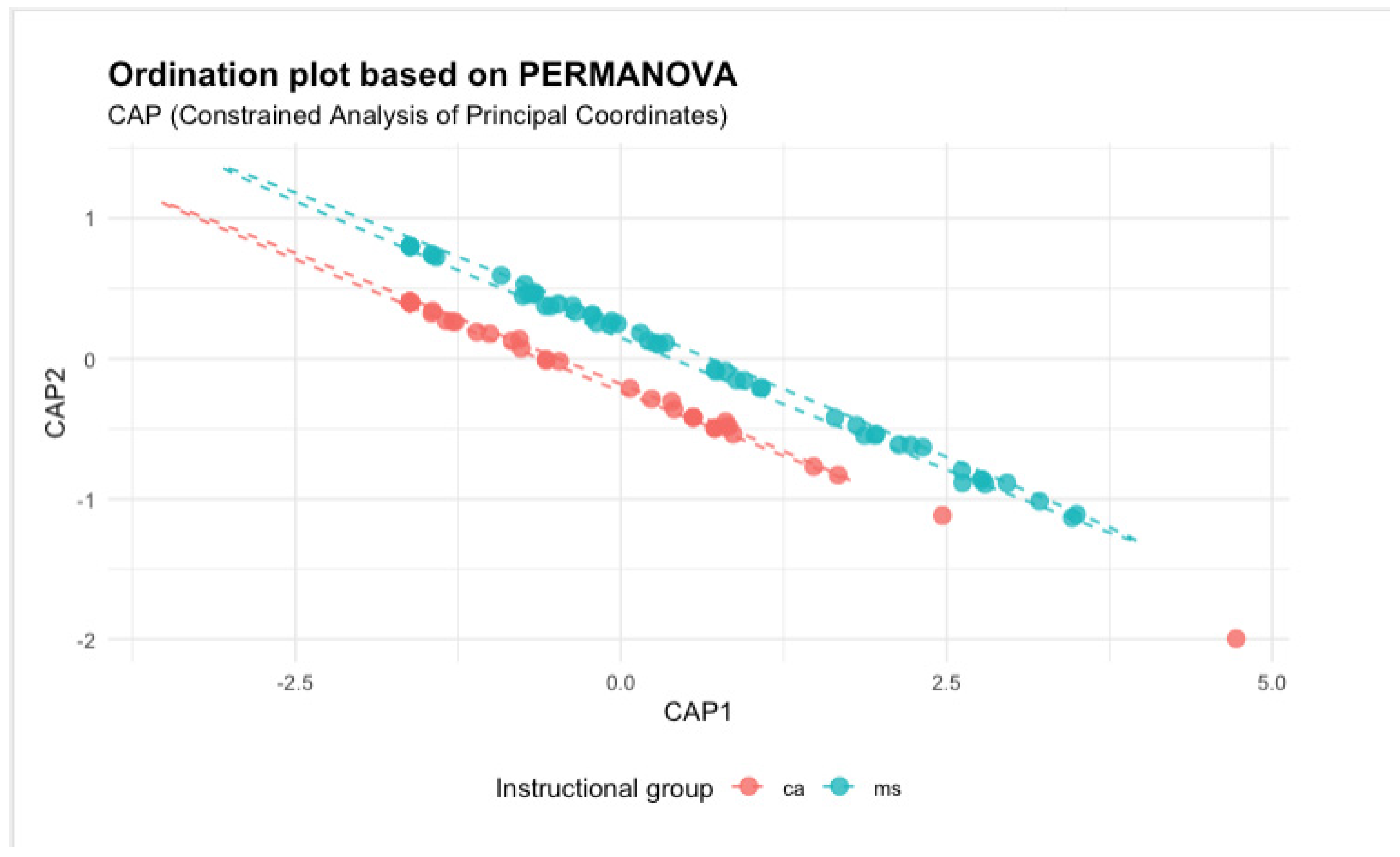
Separate PERMANOVA models were conducted for each ARCS domain (attention, relevance, confidence, satisfaction). Multivariate separation was visualized through constrained principal coordinates analysis (CAP) with 95% confidence ellipsoids. Statistical significance was set at p < 0.05 (two-sided).
3. Results
The mean age of the participants was 19 ± 1.09 years, and 61.5% were women. Students reported dedicating an average of 1.47 ± 0.89 h per week to independent anatomy study.
Shapiro–Wilk tests indicated non-normal distribution across several RIMMS items (p < 0.001), and Levene’s test revealed heterogeneity of variances between instructional groups (p = 0.0037), supporting the use of non-parametric multivariate procedures.
The RIMMS demonstrated adequate internal consistency across the attention (α = 0.86; ω = 0.88), relevance (α = 0.85; ω = 0.86), confidence (α = 0.88; ω = 0.89), and satisfaction (α = 0.81; ω = 0.82) subscales, indicating reliable measurement of motivational domains.
The overall PERMANOVA based on all 12 RIMMS items revealed a statistically significant difference between instructional groups (F(1107) = 9.07, p = 0.001), with group membership explaining 7.8% of the total variance (R2 = 0.17). Although statistically significant, this effect size reflects a small-to-moderate multivariate effect.
The constrained principal coordinates analysis (CAP) plot (
Figure 1) illustrates partial separation between groups, with students in the Complete Anatomy
® group tending to report higher motivational scores compared to the Sectra
® Table group.
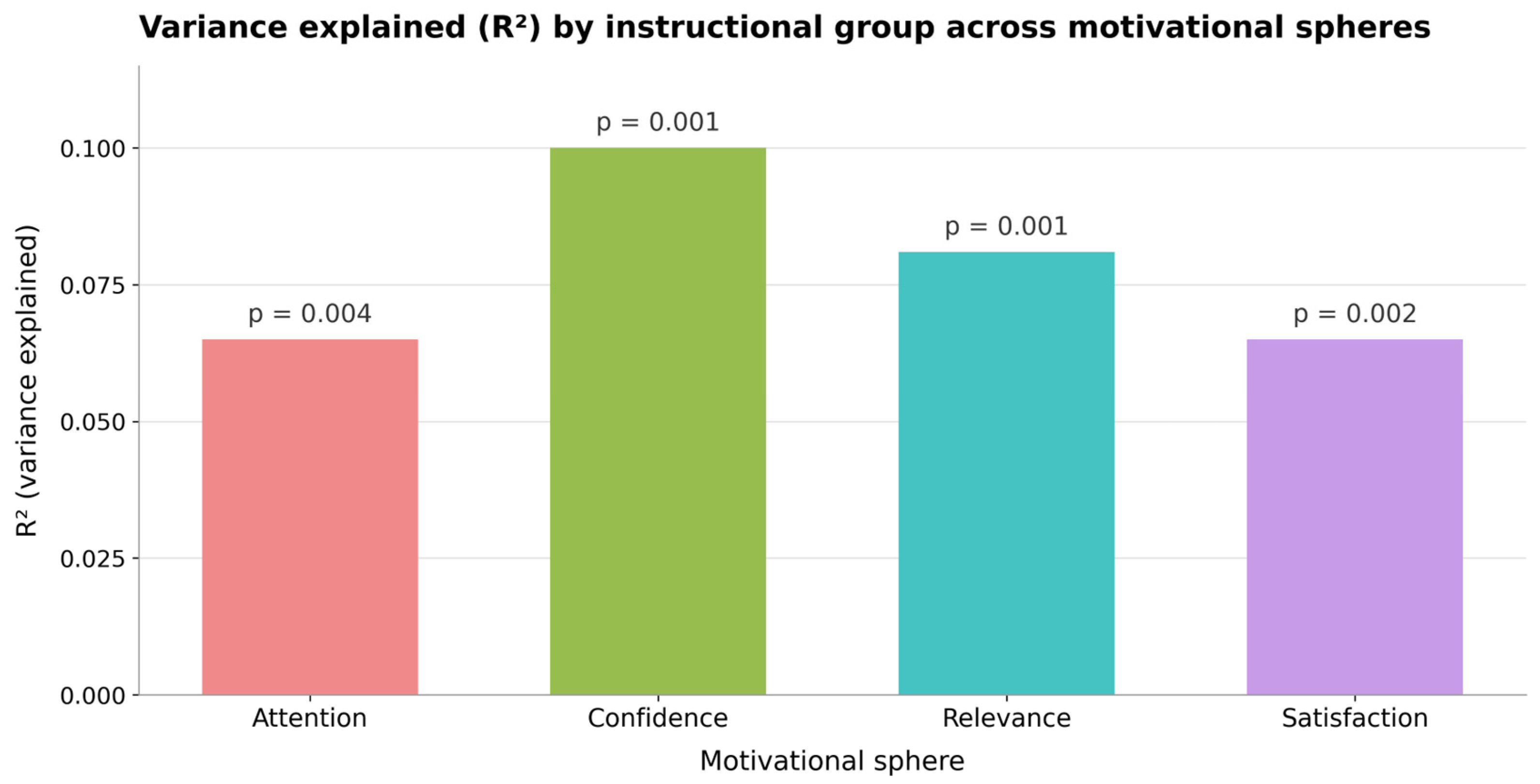
Separate PERMANOVA analyses by ARCS domains revealed significant differences across all four motivational spheres.
These findings suggest that the type of instructional modality had a differential impact on academic motivation across specific motivational components. The ordination plot based on constrained analysis of principal coordinates (CAP) (
Figure 2) illustrates distinct clustering of the two instructional groups, with students in the Complete Anatomy group tending to report higher perceived learning scores than those in the Mesa Sectra group.
4. Discussion
This study examined the association between two non-immersive instructional modalities and academic motivation among medical students, operationalized through the ARCS framework. These results align with prior research indicating that interactive, student-centered digital tools can enhance engagement and perceived learning in anatomy education [
24,
25]. While much of the existing literature in digital anatomy education has focused primarily on objective knowledge acquisition and performance outcomes [
26], this study contributes novel insights by examining motivational processes using a multidimensional framework. By analyzing attention, relevance, confidence, and satisfaction simultaneously, the present findings expand current understanding of how non-immersive digital tools may differentially relate to students’ motivational experiences, an area that remains underexplored in anatomy and health sciences education.
Both Sectra
® Table and Complete Anatomy
® represent robust non-immersive digital tools with distinct pedagogical advantages and limitations. Although they share core functionalities related to digital visualization and virtual dissection, their instructional affordances differ substantially. Following the comparative analysis, students using Complete Anatomy
® reported higher motivational scores across domains. This pattern may be partly attributed to the platform’s ease of access, lower individual cost, and personalized acquisition, which allows students to engage with content beyond scheduled institutional settings [
27,
28]. In contrast, the Sectra
® Table offers institution-based, instructor-guided experiences that may support clinical contextualization but provide fewer opportunities for self-directed exploration.
Consistent with these findings, Çolak et al. observed that the use of the Complete Anatomy application positively influenced medical students’ motivation to study human anatomy at the university level [
27]. One plausible explanation for this association is the greater interactivity, flexibility, and immediate visual feedback offered by Complete Anatomy
®. Such features may enhance perceived relevance by facilitating connections between anatomical structures and clinical applications, while also strengthening confidence through active manipulation and control of the learning process, key dimensions within Keller’s ARCS model [
29]. In contrast, the more structured and instructor-led nature of the Sectra
® Table may limit the development of learner autonomy and self-efficacy, particularly in early stages of independent learning.
Non-immersive digital technologies such as Complete Anatomy
® have been shown to support essential cognitive skills in anatomy education, including three-dimensional spatial understanding, accurate identification of anatomical structures, and comprehension of spatial relationships [
30]. Students frequently report high educational value when using these tools, perceiving them as facilitators of understanding, motivation, and efficient study when compared with traditional instructional approaches [
31]. Moreover, Complete Anatomy
® has been described as a valuable complementary resource following cadaveric dissection, enhancing visualization of complex structures and improving depth perception through digital representations [
30]. Importantly, these tools should be understood not as replacements for anatomical reality but as simulations that may support learning through repeated, flexible engagement. Importantly, because this study did not include a reference condition such as cadaveric dissection or traditional laboratory instruction, the findings cannot be interpreted as favoring digital methods over established anatomical pedagogy but rather as comparative insights between two non-immersive digital platforms.
Motivation is known to increase when learning experiences are active, technologically innovative, and meaningfully connected to professional practice [
29]. This aligns closely with Keller’s ARCS model, which conceptualizes motivation as a process that extends beyond capturing initial attention to sustaining relevance, building confidence, and fostering satisfaction. From a broader motivational perspective, elements of self-actualization, situated at the highest level of Maslow’s hierarchy of needs, may also be reflected in students’ desire not merely to pass examinations but to achieve personal growth, competence, and mastery within their professional formation.
This study presents several methodological strengths. To our knowledge, it is among the first to apply a multivariate analytical approach (PERMANOVA) to examine motivational domains in anatomy education. Given the non-normal distribution of Likert-scale data, the use of permutation-based methods provides a robust strategy for evaluating group differences without relying on parametric assumptions. Moreover, the use of a validated multidimensional instrument (RIMMS) allowed for a nuanced examination of motivational constructs across instructional modalities, extending prior work by this research group comparing immersive and non-immersive technologies in medical education [
29].
From a curricular perspective, the present findings align with contemporary approaches that advocate for blended models of anatomy education, rather than exclusively in-person or fully online formats. While non-immersive digital platforms offer advantages related to accessibility, flexibility, and opportunities for autonomous engagement—features that were associated with higher motivational scores in this study—evidence suggests that fully remote instruction may pose challenges for applied disciplines such as anatomy, particularly about social interaction, collaborative learning, and professional identity formation. In-person instructional components, especially structured laboratory experiences, continue to play a critical role in supporting ethical development, teamwork, and contextual understanding of anatomical knowledge. Accordingly, curricular decisions should emphasize the strategic integration of non-immersive digital tools as complementary resources within presential or hybrid curricula, leveraging their motivational and visualization benefits while preserving instructor-guided activities that foster clinical relevance and professional development [
32,
33,
34,
35,
36].
6. Conclusions
This study examined the association between two non-immersive digital instructional tools and academic motivation among medical students within the ARCS framework. The findings indicate that instructional modality is significantly associated with motivational dimensions, particularly confidence and relevance, although the magnitude of these effects was modest. Students using the more accessible and self-directed platform (Complete Anatomy®, LMC23) tended to report higher motivational scores compared to those using the instructor-guided Sectra® Table (LMC13). These differences may reflect the role of accessibility, autonomy, and instructional design characteristics in shaping motivational engagement within digital learning environments.
Given the quasi-experimental design, the differences between curricular contexts, and the absence of a reference condition (e.g., cadaveric dissection or traditional instruction), these findings should be interpreted cautiously and do not allow for broader conclusions to be made regarding the comparative effectiveness of instructional modalities in anatomy education. Rather, the results provide comparative insights between two non-immersive digital approaches.
From a curricular perspective, the findings support the integration of digital tools as complementary elements within blended learning environments, where opportunities for autonomous interaction can be balanced with structured, instructor-guided experiences. Future research using longitudinal and controlled designs is warranted to further clarify these associations and explore their implications for sustained engagement and educational outcomes.



 ,
,