1. Introduction
Glyphosate-based herbicides are among the most widely used broad-spectrum weed control agents in modern agriculture [
1]. First introduced in the 1970s under commercial formulations such as Roundup
®, these products contain glyphosate (N-(phosphonomethyl)glycine,
Supplementary Figure S1) as the active ingredient and are extensively applied for crop management. Their adoption is largely attributed to their effectiveness against a wide range of plant species, rapid adsorption to soil matrices, biodegradability, and historical low toxicity towards non-target plant organisms and vertebrate fauna [
2]. Despite their widespread and prolonged use, glyphosate-based formulations have attracted increasing scientific attention due to ongoing discussions regarding their environmental behavior and ecological effects [
3]. Residues have been reported in agricultural soils and water bodies, prompting continued evaluation of their environmental fate and persistence. As a result of decades of intensive use, glyphosate-based herbicides remain among the most extensively applied agrochemicals [
4].
The phytotoxic action of glyphosate, the active ingredient in many commercial glyphosate-based herbicide formulations, is primarily attributed to the inhibition of 5-enolpyruvylshikimate-3-phosphate synthase (EPSPS) [
5], a key enzyme in the shikimate pathway [
6,
7]. This pathway is responsible for the biosynthesis of aromatic amino acids (tryptophan, phenylalanine, and tyrosine), which serve as precursors for proteins and numerous secondary metabolites involved in plant growth, structural integrity, and defense. Disruption of this pathway interferes with amino acid production and metabolic balance, ultimately impairing plant development. Beyond its primary target, exposure to glyphosate-based herbicides has been associated with alterations in additional physiological and biochemical processes, including photosynthesis, carbon metabolism, nutrient uptake, and oxidative stress responses [
8].
Although glyphosate-based herbicides are primarily applied to target weeds, unintended exposure of non-target plants may occur under certain agricultural scenarios. For example, spray drift during foliar application can result in unintended exposure and consequently impact other crops or native vegetation [
9]. In addition, residues may persist in soil following application and decomposition of treated plant material [
10]. Such exposure routes can lead to sublethal contact with non-target flora, potentially influencing physiological processes even in the absence of visible injury [
8,
11].
Despite numerous studies investigating the physiological and genomic effects of glyphosate, its effects on lipid metabolism remain comparatively less explored. Recent lipidomic investigations have reported alterations in lipid profiles following glyphosate exposure across different biological systems [
12]. Lipids play essential roles in plant biology, contributing to membrane structure, energy balance, and signal transduction [
13,
14]. As major components of cellular membranes, lipids maintain membrane integrity, fluidity, and compartmentalization [
15]. In photosynthetically active tissues, phosphatidylglycerols and galactolipids are key constituents of chloroplast thylakoid membranes, which are central to photosynthetic function [
16]. Variations in the abundance or composition of these lipids may influence photosynthetic performance and energy metabolism. Beyond structural functions, several lipid species act as signaling molecules that participate in developmental and stress-related processes [
17]. The plant lipidome is highly dynamic, comprising thousands of molecular species undergoing continuous biosynthesis and remodeling, enabling plants to adjust their physiological state in response to environmental stimuli [
14,
18].
Among abiotic stressors, herbicide exposure has been reported to influence lipid metabolism in plants. In the case of glyphosate, inhibition of the shikimate pathway has been associated with changes in redox balance and oxidative stress responses [
19]. These processes may affect membrane-associated lipids and related metabolic pathways. Nevertheless, the specific effects of glyphosate-based herbicide exposure on the structural and signaling lipidome remain insufficiently characterized. While most investigations have focused on the primary metabolic target of glyphosate, potential downstream effects, including lipid-related alterations, have received comparatively less attention [
20]. A more detailed characterization of lipidomic profiles under sublethal herbicide exposure may contribute to a better understanding of plant metabolic adjustments to chemical stress.
In the present study, we investigated the effects of sublethal foliar exposure to a commercial glyphosate-based herbicide on carrot (Daucus carota L.) plants using a combination of morphological evaluation and untargeted lipidomic profiling. Plants were grown under controlled conditions, and untargeted lipidomic analyses were performed in leaves, leaf stalks (petioles), and storage roots to assess tissue-specific responses. Carrot was selected due to its agronomic relevance, well-defined storage organ, and suitability for controlled cultivation and tissue-specific sampling. Therefore, the aim of this work was to characterize lipidomic profile variations under sublethal herbicide exposure in the absence of severe visible toxicity in an untargeted manner, contributing to understanding plant metabolic responses to chemical stress.
2. Materials and Methods
2.1. Chemicals and Reagents
A commercial glyphosate-based herbicide formulation (Roundup® Ultra Plus; 450 g·L−1 glyphosate acid equivalent) was acquired from Monsanto (Saint Louis, MO, USA). Carrot seeds (Chantenay variety) were purchased from Batlle (Molins de Rei, Spain). The Chantenay variety is a widely cultivated carrot type characterized by a conical storage root, good adaptability to different soil conditions, and suitability for controlled growth experiments and tissue-specific studies. Peat (Blumenerde) and Ferticote® fertilizer were supplied by Burés (Sant Boi de Llobregat, Spain).
Calcium carbonate, methyl tert-butyl ether (MTBE, 99%), ammonium acetate, and potassium hydroxide were obtained from Merck (Darmstadt, Germany). Methanol (99.99%) and isopropanol (≥99%) were purchased from Carlo Erba Reagents (Milan, Italy), and acetic acid (≥99.5%) from PanReac AppliChem (Barcelona, Spain). LC-MS grade acetonitrile and water (Optima™) were obtained from Fisher Chemical (Fair Lawn, NJ, USA). Internal lipid standards were purchased from Avanti Polar Lipids (Alabaster, AL, USA). Water used for plant irrigation and preparation of herbicide dilutions was purified using a Milli-Q system (Merck Millipore, Darmstadt, Germany), yielding ultrapure water (18.2 MΩ·cm and TOC under 5 ppb).
2.2. Plant Growth Conditions and Herbicide Treatment
The experimental design included controlled plant cultivation, defined herbicide treatments, and subsequent morphological and lipidomic analyses.
The soil mixture used for carrot cultivation consisted of 1.9 kg of peat (organic growing medium), 1.5 kg of vermiculite, 5 g of fertilizer (Ferticote
®), and 5 g of calcium carbonate to regulate soil acidity. Carrot seeds (Chantenay variety) were planted in rectangular planters (12 cm × 30 cm × 11 cm) placed on separate watering trays. Before sowing, 1 L of purified water was added to the soil. After sowing, planters were irrigated daily by filling the trays with 400 mL of Milli-Q water. Seeds were planted at a depth of 1 cm and spaced 5 cm apart following the supplier’s instructions. Carrot plants were cultivated in an environmental test chamber (Panasonic MLE-352H, Osaka, Japan) under controlled conditions: 80% relative humidity and 14 h light/10 h dark photoperiod (additional details are shown in
Supplementary Figure S2).
The commercial glyphosate-based herbicide formulation was applied 30 days after sowing by foliar spraying. The manufacturer’s recommended application rate (3375 mg·L−1 glyphosate acid equivalent, corresponding to 15 mL of product diluted in 2 L of water) was used as reference to prepare sublethal dilutions. The experimental design included four treatment conditions (control, low, medium, and high exposure levels). Carrot plants were sprayed with dilutions corresponding to 1/10 (337.5 mg·L−1, high), 1/20 (168.75 mg·L−1, medium), and 1/50 (67.5 mg·L−1, low) of the recommended rate. Control plants received foliar application of Milli-Q water. The specific contribution of co-formulants present in the commercial formulation was not evaluated separately.
Following treatment, carrot plants were maintained under the same controlled conditions for 30 days before harvesting. For untargeted lipidomic analysis, three independent pooled biological replicates were obtained per tissue (leaves, leaf stalks, and storage roots) and treatment condition. Each replicate included material from multiple individual plants grown under identical experimental conditions, allowing a representative characterization of each group while reducing intra-group variability.
2.3. Morphological Assessment
For each treatment condition, four individual plants were selected for morphological evaluation. The number of plants evaluated corresponded to the maximum number of individual plants available per treatment level and was sufficient to provide a representative assessment of morphological parameters. The following parameters were measured: total plant height, storage root length, leaflet length, number of leaf stalks, and number of nodes. Measurements were performed manually using a graduated ruler or by direct counting, depending on the parameter evaluated. Statistical comparisons between control and treated groups were performed using independent two-sample t-tests for each parameter. Differences were considered statistically significant at p < 0.05.
2.4. Lipid Extraction and Untargeted Lipidomic Analysis by UHPLC-MS
Harvested tissues were separated into leaves, leaf stalks, and storage roots, immediately frozen in liquid nitrogen, and stored at −80 °C until further processing. Prior to extraction, samples were ground using a pre-chilled mortar and pestle and lyophilized. For lipid extraction, 10 mg of dry powdered tissue was transferred into 2 mL microcentrifuge tubes.
Lipids were extracted using a biphasic solvent system based on methanol and methyl tert-butyl ether (MeOH:MTBE, 1:3, v/v), following an adapted protocol for untargeted plant lipidomics. Samples were spiked with 1 mL of MeOH:MTBE containing 10 μL of a premixed internal standard solution. The internal standard mixture included six representative lipid species: 1,2,3-triheptadecanoin (17:0 TG), 1,3-di(17:0)-D5 diacylglycerol, 17:0 cholesteryl ester, 17:1 lysophosphatidylethanolamine, 17:1 lysophosphatidylglycerol, and 17:1 lysophosphatidylserine (200 pmol each). These standards were used for normalization, monitoring extraction efficiency, and retention time consistency.
Samples were vortexed for 1 min and sonicated for 10 min at room temperature. Phase separation was induced by adding 500 μL of water:methanol (3:1,
v/
v), followed by vortexing and centrifugation (10,000×
g for 10 min). The upper organic phase was collected and evaporated under a gentle nitrogen stream to minimize oxidation and thermal degradation [
21]. The dried extract was reconstituted in 150 μL of acetonitrile, centrifuged (10,000×
g for 10 min), and 130 μL of the clarified supernatant was transferred to conical HPLC vials. Quality control samples were prepared by pooling aliquots from all extracts and injected periodically throughout the analytical sequence to monitor system stability and reproducibility. Solvent blanks and extraction blanks were included to assess background contamination and carry-over. The injection order of samples was randomized to minimize potential batch effects and instrumental drift.
Untargeted lipidomic analyses were performed using a Waters Acquity UHPLC system coupled to an LCT Premier XE time-of-flight (TOF) mass spectrometer (Waters Corp., Milford, MA, USA). Chromatographic separation was achieved on a Kinetex C8 column (100 mm × 2.1 mm, 1.7 μm, 100 Å; Phenomenex, Torrance, CA, USA). The mobile phases consisted of (A) water and (B) acetonitrile:isopropanol (7:3,
v/
v), both containing 1% (
v/
v) of a 1 M ammonium acetate and 0.1% acetic acid to improve ionization efficiency and chromatographic reproducibility [
22]. The column temperature was maintained at 30 °C, the injection volume was 10 μL, and the flow rate was 0.4 mL·min
−1. The elution gradient started at 45:55 (A:B) for 1 min, changed to 35:65 at 4 min, then to 11:89 at 12 min, followed by 1:99 for 3 min. The system was re-equilibrated to initial conditions by 18 min, with a total run time of 22 min per sample.
Mass spectrometry was performed in both positive and negative electrospray ionization (ESI) modes. Data were acquired in centroid mode over an m/z range of 50–1800 with a scan time of 0.3 s and a cone voltage of 50 V. Mass accuracy was maintained using leucine enkephalin as lock mass via the LockSpray interface (Waters, Millford, MA, USA). Data acquired in positive and negative modes were processed separately and combined during data processing.
2.5. Untargeted Lipidomic Data Analysis
Raw UHPLC–MS data were converted to NetCDF format and processed in MATLAB
® R2023a using the MSroi toolbox [
23]. Feature extraction was performed using the ROIMCR workflow [
24], which combines region-of-interest (ROI) selection and multivariate curve resolution–alternating least squares (MCR–ALS) deconvolution [
25]. A detailed description of data processing parameters is provided in the
Supplementary Methods S1.
The experimental design included four treatment conditions (control, low, medium, and high herbicide dilution), with three pooled samples per tissue and treatment. Consequently, 12 samples per tissue type (leaves, leaf stalks, storage roots) were analyzed in both positive and negative ionization modes (see
Supplementary Figure S3). Lipid abundances were expressed as normalized peak areas relative to the internal standards and are therefore considered semiquantitative. For each tissue and ionization mode, extracted features were organized into matrices for multivariate analysis [
26].
ASCA was applied to evaluate the contribution of tissue type and treatment to lipidomic variation [
27]. PCA was used to explore general variance structure and sample distribution patterns. PLS–DA was performed to compare control samples with each treatment group separately (pairwise comparisons) [
28]. Variables with VIP > 1 were considered contributors to class discrimination. Model performance was assessed using the Matthews Correlation Coefficient (MCC) with leave-one-out cross-validation [
29]. Detailed data processing parameters and model settings are provided in
Supplementary Methods S2.
Finally,
m/
z features associated with multivariate models were tentatively annotated as lipid species by comparison with data from the LipidMaps and LipidBlast databases [
30,
31]. The reported lipid species represent putative assignments corresponding to total carbon number and unsaturation, without confirmation of individual fatty acyl chain positions or composition. Consequently, the results are interpreted at the lipid family level, focusing on overall lipid remodeling patterns rather than on definitive structural identification of individual molecular species.
2.6. Software
Raw UHPLC–MS data were processed using MassLynx™ v4.1 (Waters Corp., Milford, MA, USA) and converted to NetCDF format using DataBridge™ (Waters Corp., Milford, MA, USA). Data analysis was performed in MATLAB
® R2023a (The MathWorks Inc., Natick, MA, USA), including ROI–MCR processing and multivariate modeling using the MSroi [
23], MCR–ALS [
25], and PLS-Toolbox toolboxes (Eigenvector Research Inc., Wenatchee, WA, USA). Data visualization and graphical representation were carried out in R using ggplot2 [
32], ggrepel [
33], ComplexHeatmap [
34], dplyr [
35] and tidyr [
36].
3. Results
3.1. Morphological Effects on Glyphosate-Based Herbicide Exposure
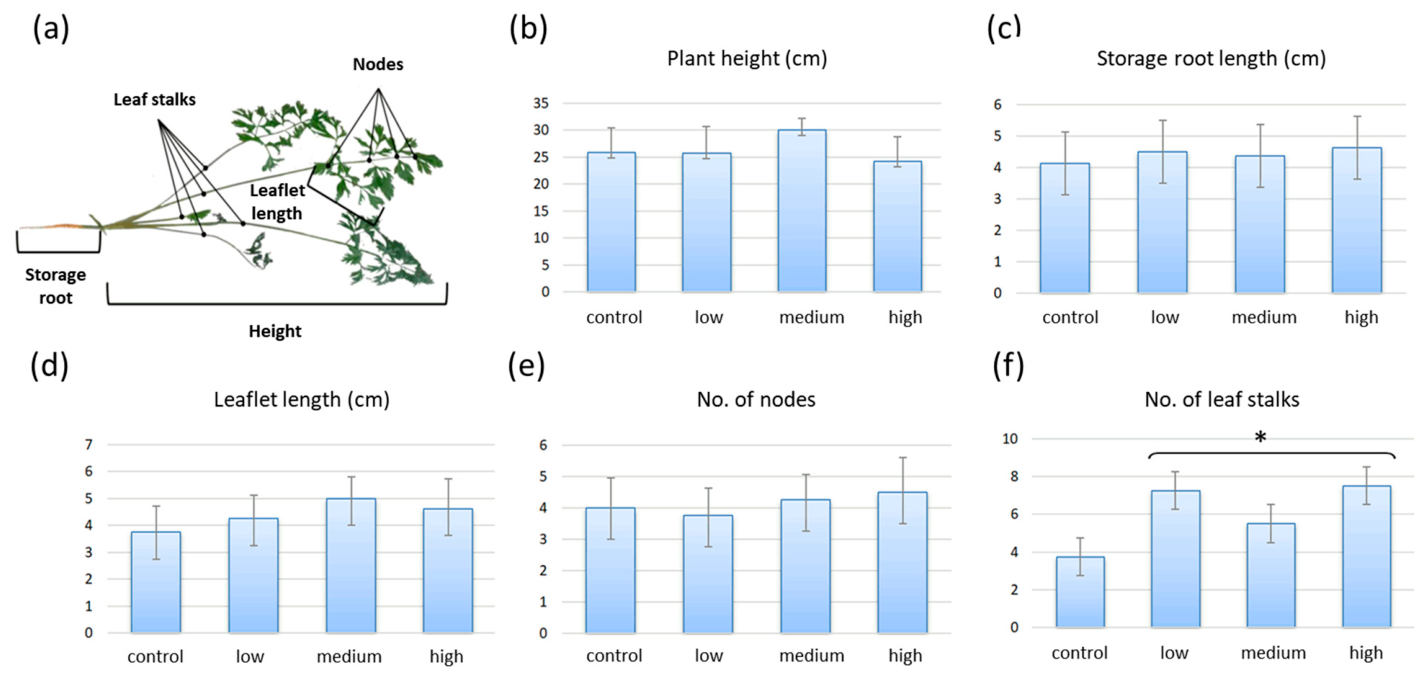
Carrot plants were exposed to diluted solutions of a glyphosate-based herbicide formulation corresponding to 1/50, 1/20, and 1/10 of the recommended application rate, representing low, medium, and high exposure levels, respectively. Carrot plants were grown under controlled environmental conditions and harvested 30 days after treatment. Several morphological parameters were recorded at harvest to evaluate plant growth characteristics, including total plant height, storage root length, leaflet length, number of leaf stalks, and number of nodes. These measured parameters are graphically summarized in
Figure 1.
Figure 1 summarizes the morphological measurements obtained for control and herbicide-treated plants. No statistically significant differences were observed in plant height, storage root length, leaflet length, or number of nodes between treated and control plants (
Figure 1b–e). Although minor variations were observed across treatments, particularly in leaflet length, these differences were not statistically significant.
In contrast, the number of leaf stalks showed a statistically significant increase in treated plants compared with the control group (
Figure 1f). This increase was observed in treated plants across exposure levels compared with the control group. In general, the measured morphological parameters indicated limited visible effects of the herbicide treatment under the conditions tested, although a significant increase in shoot branching was detected.
3.2. Lipidomic Variation Across Carrot Tissues
Following the morphological assessment, untargeted lipidomic analysis was carried out to examine lipid profiles in distinct carrot tissues exposed to low-dose herbicide treatments (a representative chromatogram is provided in the
Supplementary Figure S4). After data preprocessing and feature resolution, integrated peak areas of detected lipid components were used for multivariate analysis.
To identify the main sources of variance in the dataset, ASCA was first applied, considering as factors the tissue type, herbicide treatment, and the interaction between them. The ASCA results indicate that tissue type was the only statistically significant factor (p = 0.001), whereas herbicide treatment (p = 0.1) and their interaction term (p = 0.5) were not statistically significant. These results indicate that lipidomic profiles differed primarily among tissues. Therefore, subsequent analyses were performed separately for each tissue type. When ASCA was repeated, considering herbicide treatment as the only factor, significant treatment effects were detected across all tissues (leaf: p = 0.008; leaf stalk: p = 0.016; storage root: p = 0.001).
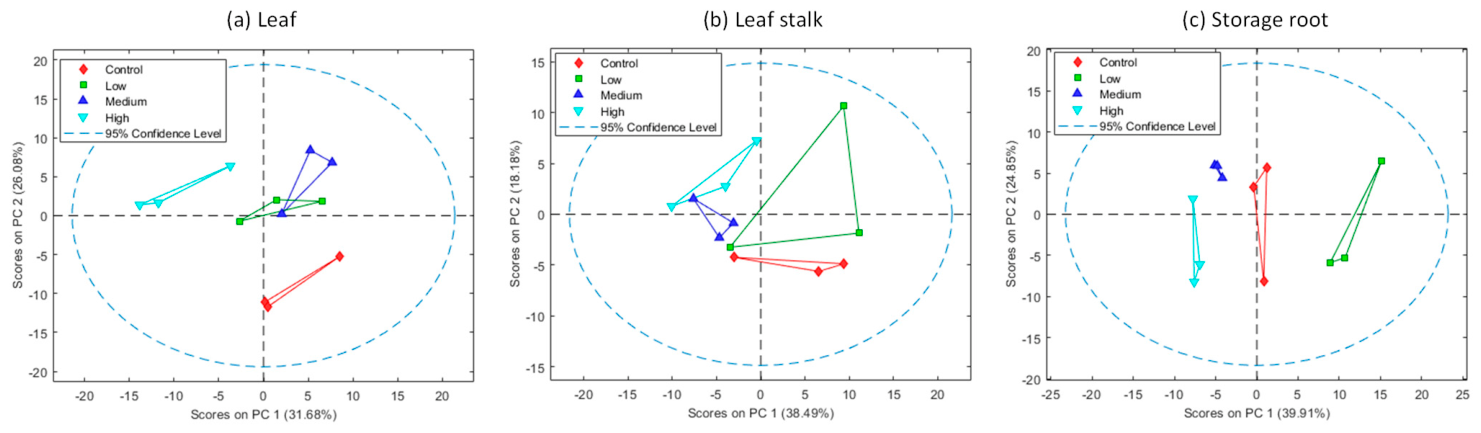
PCA was then performed separately for each tissue to explore general patterns of variation in the untargeted lipidomic data. As shown in
Figure 2, PCA score plots indicated separation between control and treated samples in leaves (
Figure 2a) and leaf stalks (
Figure 2b), with the first two components explaining almost a 60% of the total variance. In contrast, in root storage tissues (
Figure 2c), separation between groups was also observed, mainly along PC1 (40% of explained variance). The distribution of samples differed among tissues, indicating tissue-dependent differences in lipidomic profiles between control and treated samples.
Partial least squares discriminant analysis (PLS–DA) was performed separately for each tissue to evaluate the ability of lipidomic features to discriminate between control and treated samples. Model performance was evaluated using leave-one-out cross-validation, and classification accuracy was assessed using the Matthews correlation coefficient (MCC). The resulting models showed high classification performance, with MCC values of 1.0 in cross-validation. Although these results indicate strong separation, they should be interpreted with caution given the limited number of samples. Variables with VIP scores greater than 1 were considered relevant contributors to class discrimination and were used to prioritize discriminant lipid features for further analysis.
Among the analyzed tissues, leaf samples showed clear separation between control and treated groups in the multivariate analyses, followed by leaf stalk samples, whereas storage root tissues displayed comparatively weaker group separation.
3.3. Lipid Species Contributing to Treatment Discrimination
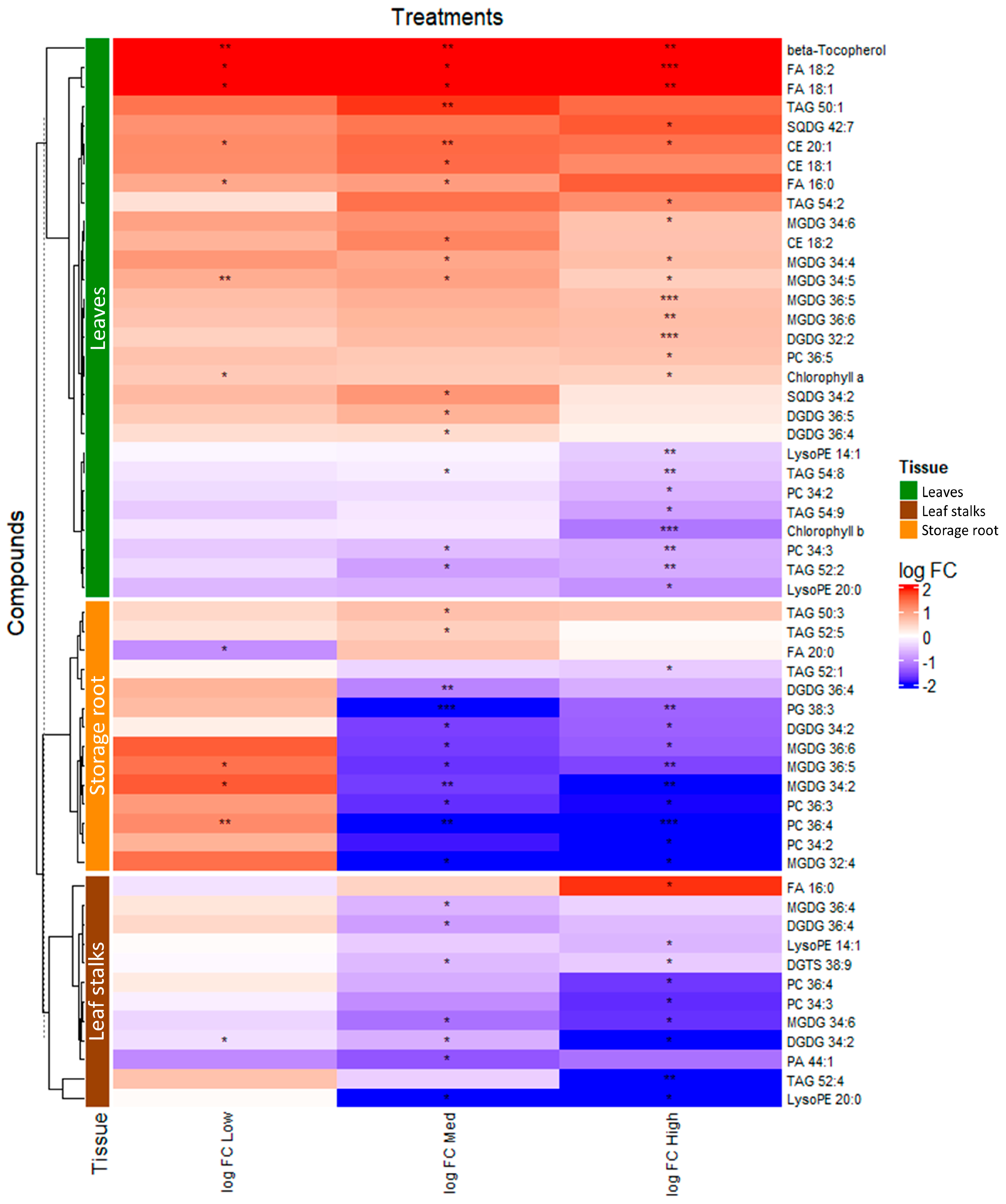
Following the multivariate analyses, lipid species showing significant differences between treatments and control samples were examined across tissues and exposure levels. A global heatmap summarizing the relative changes in lipid abundance across tissues (leaf, leaf stalk and storage root) and treatment levels relative to control is shown in
Figure 3. In addition, volcano plots combining magnitude of change (log
2 fold change) and statistical significance (−log
10 p-value) are presented in
Supplementary Material Figure S5. A complete list of significantly different lipid species in each tissue and treatment is provided in the
Supplementary Material (Supplementary Material Table S1). Lipid annotations were considered tentative and were assigned based on accurate mass matching with lipid databases. Although individual lipid species are shown for visualization purposes, the interpretation of these results focuses on consistent trends at the lipid class level rather than on specific molecular species.
In comparison, fewer lipid species showed significant differences in leaf stalk and storage root tissues than in leaves. In leaf stalk tissue, lipidomic differences between herbicide treatments and control samples were generally limited. At the lowest exposure level, only a small number of lipid species showed significant differences. At the intermediate exposure level, additional lipids displayed negative fold changes, including galactolipids and glycerolipids. The heatmap also showed decreases in abundance for MGDG and DGDG species within the leaf stalk-specific cluster. At the highest exposure level, the number of significantly different lipid species increased slightly, including compounds such as LysoPE 20:0 and TAG 52:4. However, the magnitude of fold changes generally remained lower than those observed in leaf tissue.
In storage root tissues, the number of lipid species showing significant differences generally increased with herbicide exposure level. The heatmap and volcano plots showed that more lipid features were significantly altered in storage roots than in leaf stalk tissue. At the lowest exposure level, only a limited number of lipids showed significant differences, including species such as PC 36:4. At the intermediate exposure level, the number of significantly altered lipids increased and was composed of several TAGs and glycerophospholipids. Finally, at the highest exposure level, the largest number of significant lipid changes was observed, with several fold changes detected in structural lipids (e.g., PC and MGDG species) and free fatty acids such as FA 20:0, many of them showing negative fold changes. This pattern was consistent with the heatmap representation, where the storage root cluster showed a higher density of significantly altered lipid species at this exposure level.
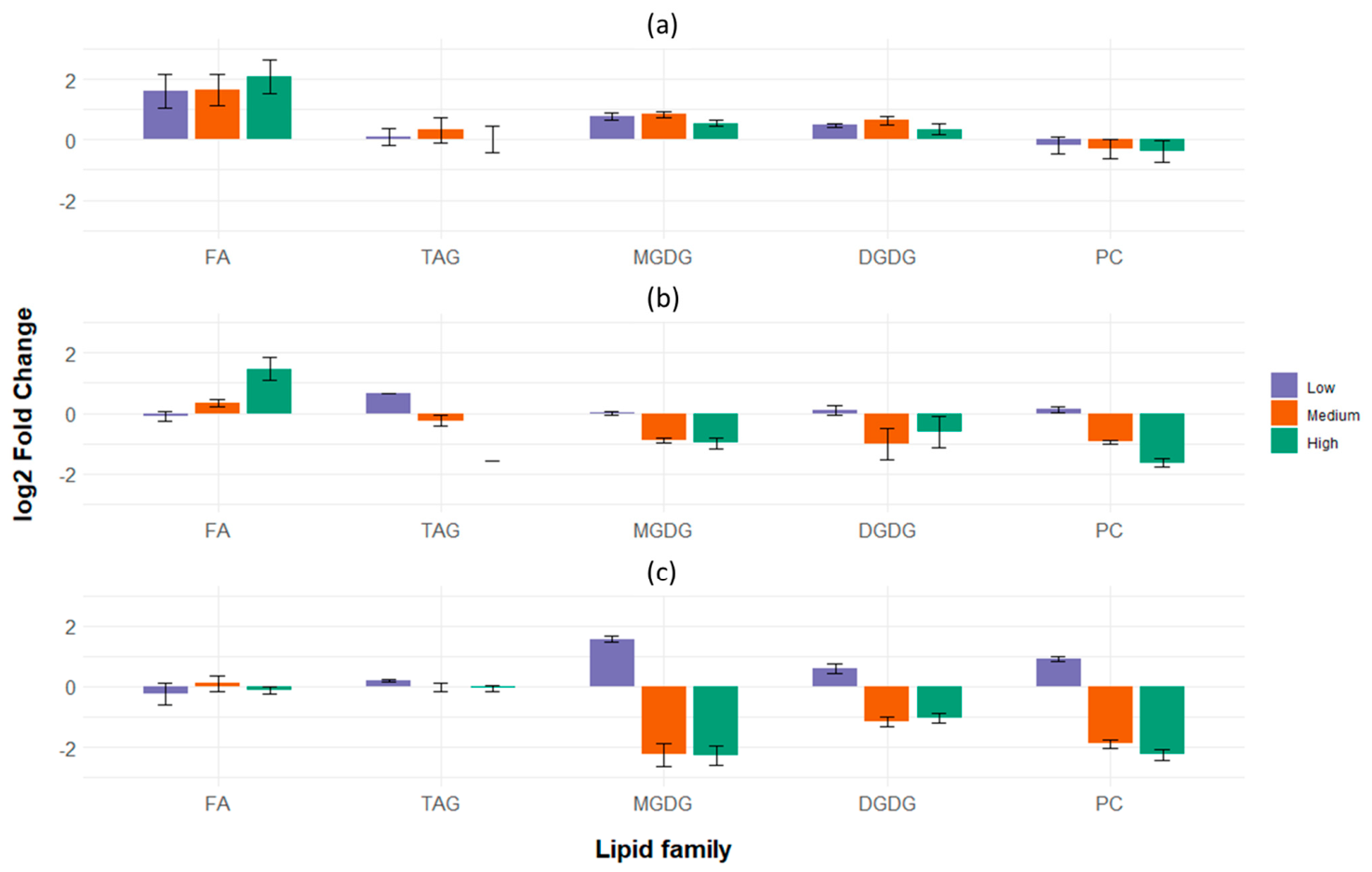
To complement the compound-level analysis, lipid species were organized into lipid families to examine broader patterns across tissues and herbicide exposure levels. This class-level approach revealed clear trends and facilitated biological interpretation of lipid remodeling.
Figure 4 summarizes the log
2 fold change values for five major lipid families showing significant differences between treatments and control samples (i.e., FA, TAG, MGDG, DGDG and PC). In leaf tissue, FA showed the largest positive fold changes across treatments. MGDG also displayed positive fold changes, whereas DGDG and TAG showed smaller increases. In contrast, PC showed slight decreases across treatments. In leaf stalk tissue, MGDG and DGDG families generally showed negative fold changes across treatments. PC also tended to decrease at higher exposure levels, whereas TAG showed smaller variations. In contrast, FA displayed a different pattern, with a marked increase at the highest exposure level. Finally, in storage root tissue, several lipid families showed negative fold changes at intermediate and high exposure levels, including MGDG, DGDG, and PC, especially at the higher exposure levels. In contrast, FA showed relatively minor variations across treatments compared with the other families.
Overall, the class-level analysis revealed distinct lipid family patterns across tissues and herbicide exposure levels, reflecting tissue-specific differences in lipidomic responses to herbicide exposure.
4. Discussion
This study investigated tissue-specific lipidomic responses in carrot plants following sublethal exposure to a glyphosate-based herbicide formulation. The results revealed distinct lipidomic patterns among tissues, with leaf samples showing the largest number of significantly altered lipid species, whereas leaf stalk tissues displayed comparatively limited changes. Storage root tissues also showed detectable lipidomic differences, particularly at higher exposure levels, despite not being directly exposed during herbicide foliar application. These observations suggest that untargeted lipidomic profiling can capture subtle metabolic alterations even under sublethal exposure conditions where visible morphological effects remain limited.
Leaf tissues showed the most pronounced lipidomic response to glyphosate-based herbicide exposure, both in terms of the number of altered lipid species and the magnitude of the observed changes. This pattern is consistent with the direct exposure of leaf surfaces during foliar application and with the high abundance of polyunsaturated membrane lipids in photosynthetic tissues. Among the most notable changes were increases in free FAs and β-tocopherol, together with alterations in several galactolipid species such as MGDG and DGDG. Galactolipids are major components of chloroplast thylakoid membranes and play a central role in photosynthetic membrane organization [
37]. Changes in these lipid classes may therefore reflect membrane remodeling processes associated with stress responses [
38]. Similar lipidomic patterns have been reported in plants exposed to abiotic stressors, including pure glyphosate, where oxidative stress and lipid peroxidation are recognized components of the stress response [
8]. In this context, the concurrent increase in FAs together with changes in galactolipids and TAGs suggests an active remodeling of membrane lipids in response to stress conditions, likely involving increased membrane turnover and reallocation of fatty acids toward transient storage pools. Such processes are commonly associated with stress responses and membrane remodelling mechanisms [
39]. Consistently, Wang reported dynamic changes in membrane lipid composition, including alterations in galactolipids and fatty acid profiles, in wheat leaves under PEG-induced water stress [
38]. These coordinated processes may also explain the opposite trends observed among different lipid classes, where increases in free fatty acids are associated with enhanced membrane lipid turnover, TAG accumulation reflects transient storage of released fatty acids, and decreases in galactolipids such as MGDG and DGDG may indicate restructuring of plastid membranes.
Compared with leaves, leaf stalk tissues showed fewer lipidomic alterations. This more limited response may be associated with differences in metabolic activity between tissues, with leaf stalks showing a reduced lipid remodeling response compared with photosynthetically active leaves. Many of the observed changes in leaf stalks involved decreases in membrane-associated lipids, particularly galactolipid species, which may reflect localized adjustments in membrane composition rather than a broad metabolic reorganization [
15]. In contrast, storage root tissues displayed detectable lipidomic alterations, especially at higher exposure levels. Although these tissues were not directly exposed to the herbicide, the active ingredient glyphosate is known to be systemically translocated through plant vascular tissues, allowing it to reach metabolically active organs distant from the site of application [
1]. Similar systemic redistribution patterns have been reported in other plant species, including soybean and willow, where glyphosate accumulation has been detected in root tissues following foliar exposure. In carrot plants, the presence of galactolipids such as MGDG and DGDG in storage roots is generally associated with plastid membranes, including amyloplasts and chromoplasts, which are involved in carbohydrate storage and pigment metabolism [
40]. Changes in these lipid classes, many of which showed negative fold changes, may therefore reflect alterations in plastid-related lipid metabolism within storage tissues following systemic herbicide exposure [
40,
41]. These results support the systemic nature of the herbicide response, confirming that metabolic effects are not restricted to directly exposed tissues but can also translocate and affect to storage organs. These changes in storage roots could potentially influence crop quality, nutritional value, or post-harvest properties, although further studies would be required to assess these effects.
At the lipid class level, several trends suggested broader changes in fatty acid metabolism under herbicide exposure. These alterations may be linked to the disruption of the shikimate pathway by glyphosate, which can lead to broader metabolic imbalances affecting carbon metabolism and redox homeostasis, and indirectly influence lipid biosynthesis and turnover. In particular, increases in several free fatty acids, such as FA 18:1 and FA 18:2 in leaf tissues and FA 20:0 in storage roots, were observed together with alterations in membrane galactolipids such as MGDG and DGDG. These patterns were accompanied by increased levels of β-tocopherol, a lipid-soluble antioxidant associated with protection against oxidative damage in plant membranes [
42]. Shifts in fatty acid saturation and antioxidant lipid accumulation have been previously associated with plant responses to oxidative stress, as shifts in fatty acid composition together with increased antioxidant capacity may help limit lipid peroxidation and stabilize membrane structures [
38]. Such changes may also reflect alterations in the activity of fatty acid desaturase enzymes involved in the biosynthesis of polyunsaturated lipids [
43]. Beyond their structural role, several fatty acids also serve as precursors for signaling molecules involved in stress responses. For example, polyunsaturated fatty acids such as 18:3 are precursors of oxylipins, including jasmonic acid, a key mediator of plant defense signaling [
44]. Previous studies have reported that pure glyphosate or glyphosate-based herbicide exposure can interfere with jasmonate-related pathways [
8]. Although oxylipins were not directly measured in the present study, the observed modulation of fatty acids and galactolipids may reflect changes in lipid turnover and potentially in signaling pathways associated with stress adaptation. Consequently, these patterns are consistent with a coordinated metabolic adjustment aimed at maintaining membrane integrity and cellular homeostasis under chemical stress conditions.
The herbicide concentrations used in this study were environmentally relevant and did not produce visible symptoms of toxicity in carrot plants. Nevertheless, the lipidomic alterations observed across tissues indicate that glyphosate-based herbicides may induce metabolic responses, particularly affecting lipid pathways associated with membrane composition and fatty acid metabolism. Also, it should be noted that the observed effects correspond to the complete formulation rather than to glyphosate alone. Co-formulants present in commercial glyphosate-based herbicides [
45], particularly surfactants, are known to interact with biological membranes and can affect membrane permeability, fluidity and integrity [
46,
47]. These interactions may alter lipid bilayer organization and influence membrane-associated processes, potentially contributing to the lipidomic alterations observed in this study. Therefore, the results should be interpreted as the combined effect of the active ingredient and the co-formulants present in the commercial formulation. Future studies including formulation-only controls (without glyphosate) would help to better separate the specific contribution of co-formulants and the active ingredient to the observed lipidomic responses.
These results highlight the sensitivity of untargeted lipidomic profiling for detecting subtle metabolic responses that may not be evident through conventional morphological observations. The number of biological replicates per condition was limited, as the study was designed as an exploratory lipidomic assessment based on pooled biological samples. While this approach enabled the identification of consistent tissue-specific trends, further studies including a larger number of independent biological replicates will be necessary to confirm these observations.
As this study relies on untargeted lipidomic profiling, the observed changes should be interpreted as associations rather than direct evidence of causal mechanisms. In addition, lipid identification was based on accurate mass and retention time comparison without MS/MS or ion mobility confirmation, and should therefore be considered putative. Consequently, the biological interpretation is primarily performed at the lipid family level, focusing on global lipid remodeling patterns rather than at the level of individual molecular species.
Targeted lipid analysis and complementary physiological measurements would be required to confirm the functional implications of the observed lipidomic alterations. In addition, the slight stimulation of some morphological parameters observed at low exposure levels may be consistent with a possible hormetic response, where low doses of a stressor induce adaptive physiological adjustments [
48]. Such responses may involve the modulation of plant hormonal pathways, particularly auxins and cytokinins, which play a central role in the regulation of shoot branching and adaptive growth responses under stress conditions [
49,
50]. In root crops such as carrot, metabolic alterations occurring in aerial tissues could potentially influence the accumulation of reserves in storage organs, although further studies would be required to assess possible consequences for crop physiology or quality. Together, these results suggest that low-dose herbicide exposure should not necessarily be considered biologically neutral in terms of plant metabolism and illustrate the potential of lipidomic approaches to reveal early metabolic responses in plants.