


Abstract
Robotic systems increasingly operate in complex and distributed environments, where software deployment and orchestration pose major challenges. This paper presents a model-driven approach that automates the containerized deployment of robotic systems in Internet of Robotic Things (IoRT) environments. Our solution integrates Model-Driven Engineering (MDE) with containerization technologies to improve scalability, reproducibility, and maintainability. A dedicated metamodel introduces high-level abstractions for describing deployment architectures, repositories, and container configurations. A web-based tool enables collaborative model editing, while an external deployment automator generates validated Docker and Compose artifacts to support seamless multi-host orchestration. We validated the approach through real-world experiments, which show that the method effectively automates deployment workflows, ensures consistency across development and production environments, and significantly reduces configuration effort. These results demonstrate that model-driven automation can bridge the gap between Software Engineering (SE) and robotics, enabling Software-Defined Robotics (SDR) and supporting scalable IoRT applications.
1. Introduction
Robotic systems play an increasingly critical role in sectors such as healthcare, logistics, and service industries, where they operate autonomously in dynamic, human-centered environments. Their development remains challenging due to the inherent complexity and cyber-physical nature of robotic systems. Current robotics software practices often lack systematic Software Engineering (SE) methods, which reduces software quality, reusability, and maintainability [1].
The Robot Operating System 2 (ROS 2) [2] has become the de facto standard for robotics software development, offering a modular, scalable, and reliable architecture for modern applications. ROS 2 improves upon its predecessor by addressing real-time performance, security, and multi-robot communication. It integrates the Data Distribution Service (DDS) middleware to enable deterministic communication and robust system integration [3]. Its widespread adoption in both academia and industry highlights its central role in advancing autonomous systems.
The Internet of Robotic Things (IoRT) has emerged as a promising paradigm that connects robotics, IoT, and cloud computing to create intelligent robotic systems capable of distributed sensing, processing, and actuation. IoRT enables coordinated operation among heterogeneous robotic devices, supporting new applications in smart manufacturing, healthcare, and autonomous transportation. However, implementing IoRT systems remains difficult. Developers must define standardized architectures, ensure security and privacy, and integrate diverse technologies [3]. Deployment and orchestration are particularly challenging, since distributed robotic systems require scalable and robust mechanisms to guarantee reliable operation and efficient resource use [4].
Container technologies such as Docker and Kubernetes increasingly support ROS 2 deployments by encapsulating dependencies and improving system scalability [5]. Containers provide lightweight and consistent runtime environments that package configurations, libraries, and ROS 2 nodes, ensuring portability across heterogeneous platforms. This approach simplifies integration and testing, enhances reproducibility, and enables dynamic scaling of robotic applications. Orchestration tools further support automated deployment, monitoring, and lifecycle management of distributed ROS 2 systems—capabilities essential for multi-robot scenarios.
Model-Driven Engineering (MDE) offers a powerful way to manage the growing complexity of robotic systems by raising the level of abstraction in system design and deployment [6]. MDE allows developers to define platform-independent models that transformation tools convert into platform-specific implementations. This capability simplifies deployment, reduces configuration errors, and facilitates reuse. In robotics, MDE helps engineers describe system architectures, behaviors, and deployment strategies, enabling domain experts—who may lack DevOps expertise—to work at a higher abstraction level while maintaining correctness and consistency.
In this paper, we introduce a technological solution that combines MDE and containerization to automate the distributed deployment of robotic systems in IoRT environments. Our approach enhances collaboration during development, accelerates the reconstruction of testing environments, and promotes the reuse of software components. As a result, it improves the efficiency, reproducibility, and maintainability of robotic software deployment. The key contributions of this paper are:
- A dedicated deployment metamodel that provides high-level abstractions for describing deployments, repositories, container configurations, and execution dependencies in ROS 2 and IoRT environments.
- A semantic validation mechanism based on OCL-like constraints to ensure well-formed, consistent, and error-free deployment models before artifact generation.
- A web-based collaborative modeling toolchain that integrates modeling, versioning, repository retrieval, and deployment automation within a unified workflow.
- An automated model-to-text (M2T) generator that produces Dockerfiles and docker-compose specifications directly from the deployment model, removing manual configuration effort.
- Full support for multi-host container orchestration, enabling reproducible, scalable, and consistent deployments across distributed IoRT infrastructures.
- Validation in real-world industrial scenarios using components from a European research project, demonstrating reduced configuration time, improved reproducibility, and easier redeployment.
The remainder of the paper is structured as follows. Section 2 reviews related work on containerized deployment, ROS 2 automation, and MDE-based approaches. Section 3 presents the proposed solution, including the architecture, metamodel, modeling toolbox, and M2T automation process. Section 4 demonstrates the approach in real-world scenarios and discusses lessons learned. Finally, Section 5 concludes the paper and outlines future work.
2. Related Work
Our approach builds on advances in the integration of MDE and containerization technologies for robotics, particularly in the context of robotic systems and IoRT environments. This section reviews related literature across three main areas: the application of MDE in robotics, domain-specific and low-code development for ROS 2, and containerized deployment automation including formal and semi-formal validation strategies.
2.1. Model-Driven Engineering for Robotics
Researchers increasingly adopt MDE techniques to address the growing complexity of robotic software, enhance reusability, and promote platform independence. Several contributions introduce Domain-Specific Modeling Languages (DSMLs) that describe robotic software architectures independently of specific middleware platforms.
RsaML [7] defines a DSML for real-time robotic software architectures, providing a metamodel that captures functional and non-functional aspects. ROS2ML [8] extends SysML with ROS 2 concepts and integrates robotics middleware directly into systems engineering workflows. MeROS [9] generalizes this integration by defining a platform-specific metamodel for both ROS 1 and ROS 2, with the goal of standardizing architectural descriptions and facilitating system documentation, analysis, and reuse.
Other authors focus on practical modeling tools. RoBMEX [10] introduces a graphical modeling framework that allows end users to specify drone missions via DSMLs and automatically generates ROS-compliant code. These approaches demonstrate the value of MDE for robotic software development, but they rarely address deployment and orchestration in distributed environments.
Systematic reviews further examine the maturity and limitations of MDE in robotics. De Araujo Silva et al. [6] analyze MDE approaches across the robotics domain and identify strong emphasis on model transformation and code generation, alongside a lack of industrial validation and limited standardization among DSMLs. Casalaro et al. [11] classify 80 primary studies on mobile robotics and highlight prevalent modeling paradigms (e.g., DSMLs and UML profiles such as SmartSoft, SysML, and RobotML) and automation mechanisms (model transformation and code generation). Moin et al. [12] examine the convergence of MDE with machine learning in IoT and robotic systems, describing modeling languages and frameworks that support intelligent and adaptive robotic behaviors.
2.2. Containerized Deployment of Robotics Solutions
Containerization plays an increasingly important role in robotic system deployment because it encapsulates dependencies and ensures repeatability. Tools such as docker-ros [13] automate the generation of container images for ROS 1 and ROS 2 nodes and support CI/CD pipelines across heterogeneous hardware platforms. Other efforts [14] apply Docker to mobile robotic platforms, including advanced setups based on Docker Compose and shared volumes.
However, multi-host ROS communication introduces challenges due to dynamic and bidirectional message flows. To mitigate these issues, Wendt and Schüppstuhl [15] propose a Layer 7 transparent proxy that bridges communication between containerized ROS nodes deployed across multiple hosts.
Researchers also explore orchestration and lifecycle management for containerized robotics. Harzenetter et al. [16] generate automated workflows based on TOSCA models to support deployment tasks such as testing, reconfiguration, and rollback. At the level of code correctness, ROSGen [17] uses the Coq proof assistant to generate verified glue code from architectural models and ensures correct data flow between sensors, controllers, and actuators through the Verified Software Toolchain (VST). However, ROSGen focuses on message-level correctness and does not address high-level deployment abstraction or automation.
Waseem et al. [18] provide a systematic mapping study on multi-cloud containerization. They identify four key themes—scalability and availability, performance optimization, security and privacy, and dynamic adaptation and monitoring—and catalog 74 deployment strategies and 47 tactics aimed at ensuring quality attributes across heterogeneous infrastructures. Their insights benefit distributed IoRT scenarios, but they do not integrate model-driven methods or ROS 2-specific middleware.
Industrial studies also examine the role of containerization in robotics. Mäkinen [19] introduces a deployment framework for robotics applications in mobile machinery using Docker and CI/CD pipelines to automate updates and reduce integration overhead. Although the approach improves reproducibility and automation, it lacks a modeling abstraction layer and relies on manually defined deployment configurations.
Additional studies review ROS 2 architectural considerations and distributed deployment challenges. Macenski et al. [2] provide an extensive overview of the ROS 2 architecture and its deployment across diverse application domains. Zhang et al. [4] analyze deployment patterns for distributed robotic systems in edge–cloud environments, focusing on container orchestration and Kubernetes integration.
More recently, FogROS2 [20] enables the deployment of ROS 2 nodes across heterogeneous edge and cloud platforms by automating node offloading to reduce latency and balance computational load. FogROS2 relies on containerization and orchestrators such as Kubernetes to handle remote execution. Although it supports runtime distribution and resource management, it does not incorporate high-level model-driven abstractions, semantic validation of deployment models, or automatic generation of multi-host orchestration artifacts.
To clarify how the proposed approach compares with existing containerization solutions, we include a summary table that highlights the main differences between RoboDeploy and three representative frameworks: ROSMOD, FogROS2, and docker-ros. Our solution is based on explicit deployment models and can be integrated within a model-driven design approach. While these tools address specific aspects of robotic deployment—such as code generation, distributed execution, or container packaging—they do not simultaneously provide a model-driven abstraction layer, semantic validation, and automated generation of multi-host orchestration artifacts. Table 1 synthesizes these distinctions and helps elucidate the specific contribution of RoboDeploy within the landscape of containerized robotics deployment.
Table 1.
Comparison of RoboDeploy with ROSMOD, FogROS2, and docker-ros.
Despite the relevance of these contributions, existing approaches exhibit important limitations when applied to IoRT environments. First, most model-driven solutions focus on architectural description and code generation, but they do not support deployment automation or multi-host orchestration. Second, containerization frameworks such as docker-ros or FogROS2 lack a high-level modeling abstraction and therefore require manual or ad-hoc configuration, which reduces reproducibility and scalability. Third, current tools generally do not provide semantic validation of deployment models, resulting in fragile or error-prone deployments in distributed settings. Finally, none of the reviewed works integrates repository management, multi-component retrieval, Dockerfile and Compose generation, and distributed deployment automation within a unified model-driven workflow.
These limitations become even more restrictive in IoRT scenarios, where heterogeneous devices, distributed sensing, and multi-host communication demands require deployment approaches that are reproducible, validated, and capable of coordinating multiple containerized components automatically. IoRT systems particularly benefit from high-level model-driven abstractions, which reduce configuration complexity, enforce consistency across distributed hosts, and enable scalable orchestration that traditional ROS-centric or container-centric tools do not provide.
2.3. Research Gap and Rationale
The reviewed literature reveals limited support for deployment automation and distributed scalability when using MDE or containerization alone. To address these challenges, we integrate MDE with containerized deployment to improve correctness, maintainability, and system performance. Existing model-based approaches—such as RsaML [7], MeROS [9], and ROS2ML [8]—primarily focus on architectural modeling and functional specification without extending into distributed deployment automation.
In summary, existing solutions either (i) provide architectural modeling without deployment automation, or (ii) offer container-based deployment without high-level modeling or semantic validation. None of them addresses the complete pipeline required for scalable and reliable IoRT deployments.
Conversely, containerization and orchestration solutions—including docker-ros [13], multi-host communication proxies [15], and TOSCA-based automation [16]—target runtime efficiency and reproducibility but operate at lower abstraction levels and remain decoupled from architectural models. ROSGen [17] provides formal guarantees at the message level but does not integrate DevOps practices, modular deployment artifacts, or system-level abstractions.
This fragmentation creates the need for a comprehensive framework that: (i) models software architecture using DSMLs tailored for ROS 2 and IoRT, (ii) automatically generates deployment artifacts such as Dockerfiles and Compose files, (iii) supports containerized deployment across heterogeneous edge–cloud infrastructures, and (iv) integrates DevOps workflows such as CI/CD pipelines, image registries, and monitoring tools. Current solutions do not combine these capabilities, limiting the scalability and reliability of distributed robotic systems. Our approach addresses this gap by unifying architectural modeling and deployment automation through containerization, thereby improving maintainability, scalability, and reusability in robotic applications.
In contrast to frameworks such as ROSMOD [21] or FogROS2 [20], our solution integrates design-time modeling and runtime deployment automation within a single model-driven workflow, enabling reproducible and fully automated multi-host deployments for robotics-based systems.
3. Solution Approach
3.1. RoboDeploy Deployment Flow
Figure 1 summarizes the complete workflow of the RoboDeploy framework using a step–based flow diagram. The process begins in Step 1, where the user creates or edits the deployment model using the web-based editor. The model is stored in the underlying database and can also be exported as a JSON serialization.
In Step 2, the deployment process may be triggered either manually from the modeling tool or automatically from a CI/CD pipeline such as GitLab or Jenkins. The pipeline invokes the REST API of the Deployment Automator and provides either the identifier of the stored model or a JSON payload.
Step 3 is executed by the Deployment Automator, which retrieves the model (via ZeroMQ adapters when necessary), performs structural and semantic validation, and, if the validation succeeds, retrieves the required repositories, generates the Dockerfiles and docker-compose specifications, builds the images, and optionally pushes them to a Nexus registry or commits the artifacts back to Git.
Once all artifacts have been produced (Step 4), they can be deployed in two ways. In Step 5, operators may perform a distributed deployment by running docker-compose up on each target machine. Alternatively, in Step 6, the generated artifacts may be consumed by downstream CI/CD jobs for automated testing, simulation, packaging, or release tasks.
This step–oriented workflow provides a clear and reproducible execution path that covers manual use, full DevOps automation, and scalable multi-host orchestration.
3.2. RoboDeploy Metamodel
We defined the deployment metamodel using Ecore, the core metamodeling language of the Eclipse Modeling Framework (EMF). The metamodel provides a structured and extensible description of the key entities involved in the configuration and orchestration of software deployment environments. The central class, DeploymentModel, acts as the root container for all deployment elements, as shown in Figure 2. The diagram corresponds to an Ecore metamodel represented using UML class diagram notation, where classes denote metamodel entities and associations define their structural relationships. Association cardinalities follow standard UML semantics, with fixed bounds indicating constrained multiplicities and the symbol * denoting an unbounded number of instances (i.e., equivalent to N).
The DeploymentModel class encapsulates a collection of elements, all derived from the abstract superclass DeploymentModelElement. This abstraction enables uniform handling of heterogeneous model components while enforcing naming consistency across instances. All specialized elements such as Deployment, RepositoryStore, Container, or Note extend this common base and provide specific semantics relevant to the deployment domain.
The Deployment class models a deployment environment, which typically corresponds to a physical or virtual machine (VM). It contains one or more Container instances that define how software components are packaged and deployed. Additionally, each Deployment includes a set of Network configurations to define internal or external connectivity options. The enumeration DeploymentTypeEnum defines the deployment type, distinguishing between development (dev) and production (prod) environments.
The RepositoryStore element describes an access point to code or binary repositories and manages associated authentication credentials. It aggregates three types of deployable resources: Repository (source code repositories), Library (external libraries, either source or binary), and ConfigurationFile (component-specific or system-wide configuration artifacts). The store type is specified via the RepositoryStoreTypeEnum enumeration, which currently supports git, ftp, and nexus systems.
Figure 1.
Step-based flow diagram of the RoboDeploy framework. The figure illustrates the complete model-driven deployment process, including model creation, CI/CD-triggered execution, semantic validation, automatic generation of Docker and docker-compose artifacts, optional publication to Git and Nexus, and multi-host deployment.
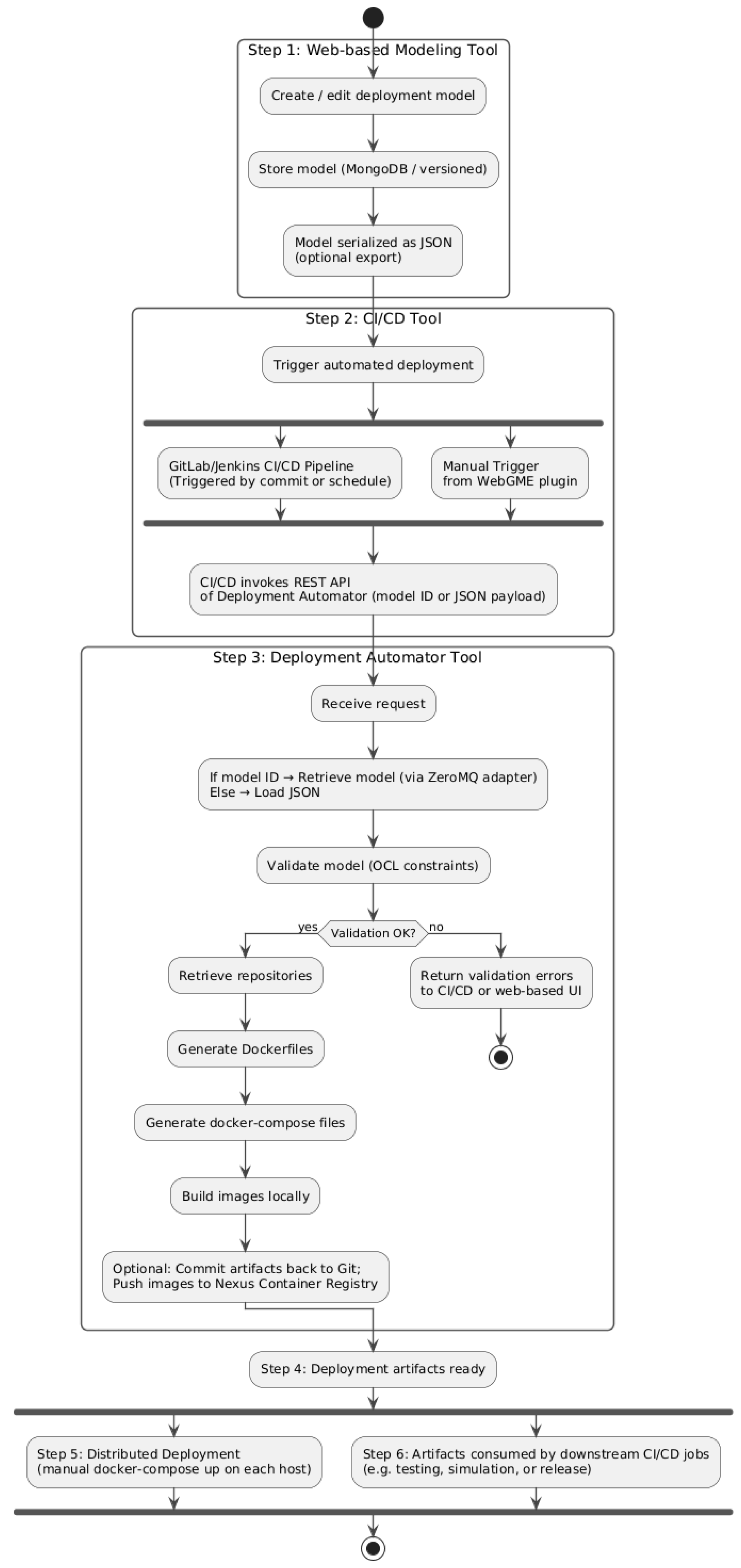
Figure 2.
Ecore-based definition of the RoboDeploy metamodel, showing the main classes, relationships, and deployment abstractions used for model-driven automation.
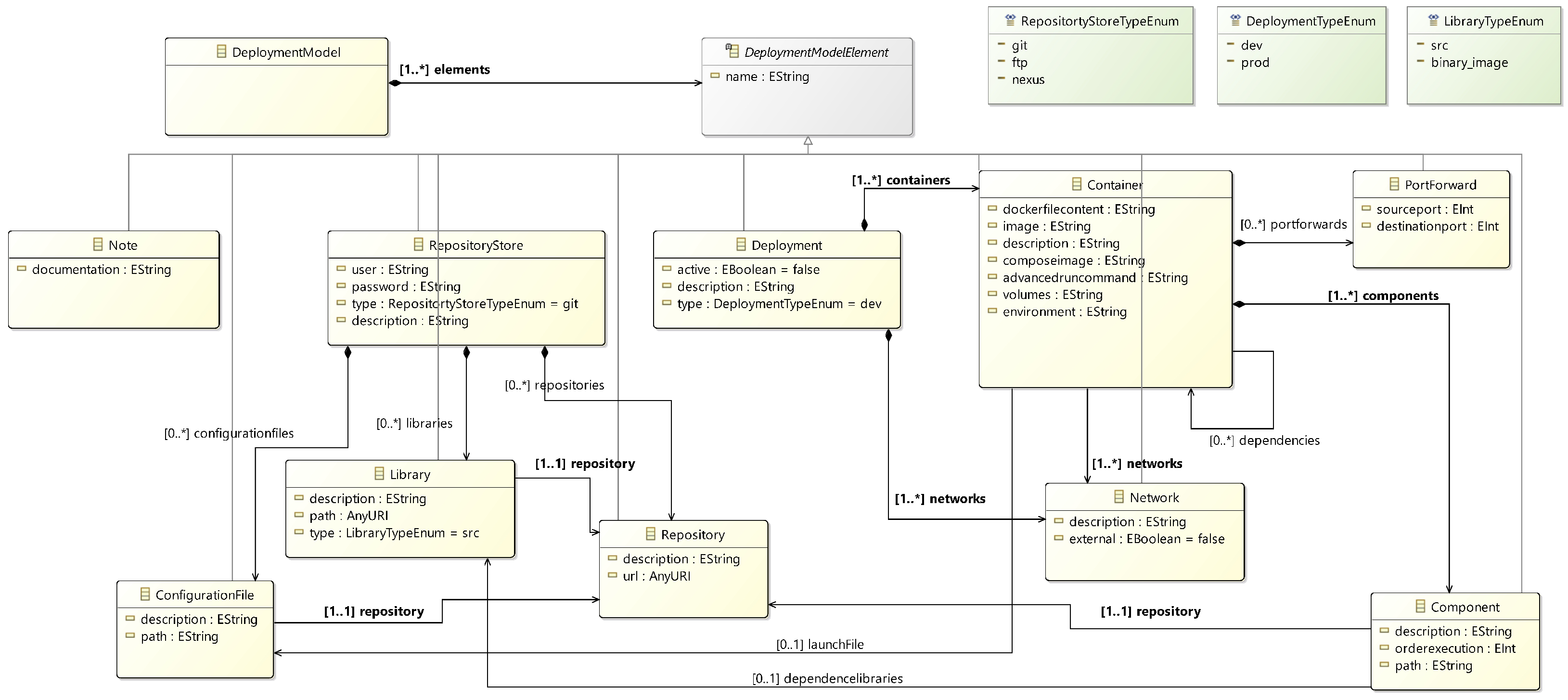
A Container defines a deployable software unit within a deployment. It may embed custom Dockerfile content or reference a base image from which a Dockerfile can be generated. Each container includes configuration attributes for image customization (composeimage, volumes, environment), and execution (advancedruncommand). Containers also manage execution dependencies with other containers and associate themselves with specific Network configurations and one optional ConfigurationFile for launch scripts.
Each Container includes one or more Component instances, representing software executables. In ROS-based systems, these are typically interpreted as ROS nodes. Components define their repository location, execution order, and any library dependencies.
Library elements describe external code dependencies required to build or run components. Each library is typed via LibraryTypeEnum, indicating whether the artifact is source-based or a binary image. Libraries reference their source Repository and are stored under a RepositoryStore.
ConfigurationFile elements model textual configuration artifacts such as ROS launch files or environment-specific setup files. Each configuration file also references a Repository and is stored under a RepositoryStore.
The Network class models container networking contexts, including internal virtual networks and externally managed networks. Each container must associate with at least one Network. The PortForward class defines explicit port redirections between container ports and host-level ports, enabling controlled exposure of services.
The Note class provides support for non-functional annotations and documentation within the deployment model. These elements are ignored during code generation and are solely intended to assist model comprehension and maintainability.
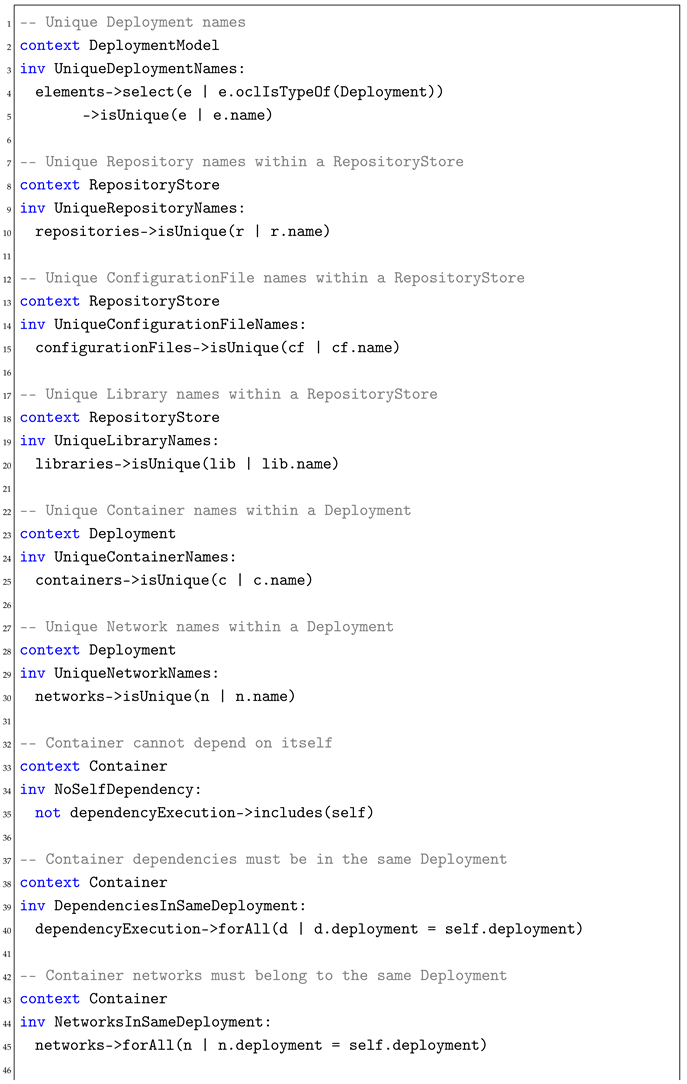
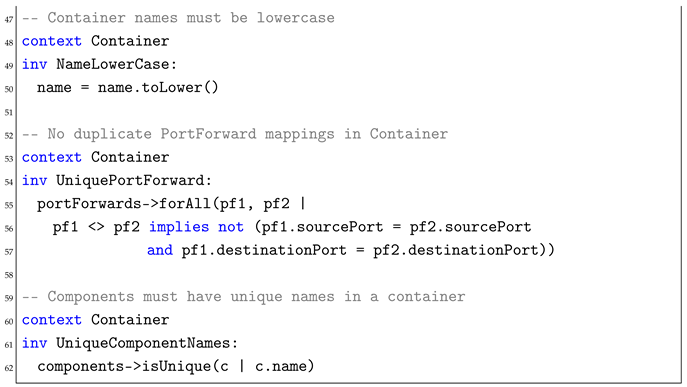
To complete the description of the metamodel, we specify a set of well-formedness rules using the Object Constraint Language (OCL) [22], as shown in Listing 1. These constraints define semantic invariants over model elements to ensure consistency, correctness, and structural soundness. For instance, the DeploymentModel enforces unique names for all contained Deployment instances. Similarly, within each RepositoryStore, Repository, Library, and ConfigurationFile elements must each have distinct names to avoid ambiguity during resource resolution. At the level of a Deployment, constraints guarantee that Container and Network instances maintain unique identifiers. The Container element is further governed by rules prohibiting self-dependencies, ensuring that all declared execution dependencies and associated networks reside within the same deployment, and requiring lowercase naming conventions. Additional constraints validate the uniqueness of port mappings and enforce non-redundant Component names. Collectively, these OCL constraints enable early detection of modeling errors and provide a formal mechanism for validating model instances against the intended semantics.
| Listing 1. OCL Restrictions |
 |
 |
3.3. RoboDeploy Model Editor
During the development of the modeling environment, we compared several MDE tools to identify an editor that supports graphical modeling, collaboration, extensibility, and suitability for the robotics domain.
We initially evaluated Papyrus for Robotics, an Eclipse-based platform with graphical modeling and native ROS 2 code generation, and Cameo Systems Modeler, which offers SysML/UML modeling with strong support for requirement traceability and validation [23]. We also reviewed Eclipse Capella, which provides system-level modeling based on the Arcadia method and supports collaborative work [24,25]. Tools such as Acceleo and Modelio [26,27,28] offer robust code generation and extensibility but focus more on model transformation than on collaborative graphical editing.
We also considered ROSMOD [21], which provides a web-based collaborative modeling environment for ROS systems. However, because ROSMOD does not support ROS 2, it does not meet the requirements of modern robotic applications.
Based on this evaluation, we selected the Web-based Generic Modeling Environment (WebGME) as the base for our editor. WebGME is an open-source, browser-based environment that supports collaborative modeling, version control, custom metamodels, and extensible model transformations. It enables real-time collaborative editing, integrates versioning and change tracking, and allows developers to define domain-specific modeling languages. Although it does not support OCL natively, it supports custom validation logic through plugins. Its web-based architecture simplifies multi-user access and distributed development.
WebGME adopts its own meta-metamodel rather than relying on the MOF standard [29], prioritizing flexibility and integration with its web infrastructure [30]. The platform relies on prototypal inheritance, containment hierarchies, and named associations. All elements derive from the First Class Object (FCO). Containment forms strict trees rooted at a special ROOT node, ensuring structural consistency. Pointers and sets express associations similar to UML constructs.
Metamodels in WebGME define valid attributes, children, connections, and constraints using inheritance, mixins, and aspects. Mixins promote reuse of modeling definitions, while aspects organize complex metamodels into meaningful views. Despite lacking MOF compatibility, WebGME provides high modeling expressiveness and strong support for collaborative, web-based domain-specific modeling [31].
The WebGME data model is based on prototypal inheritance, containment trees, and named associations. Inheritance is structural: derived nodes inherit both attributes and internal structure. Containment relationships form strict trees rooted at a special ROOT node, and cycles are disallowed to preserve model integrity. Pointers and sets express one-to-one and one-to-many associations, respectively, in a manner similar to UML associations and aggregations.
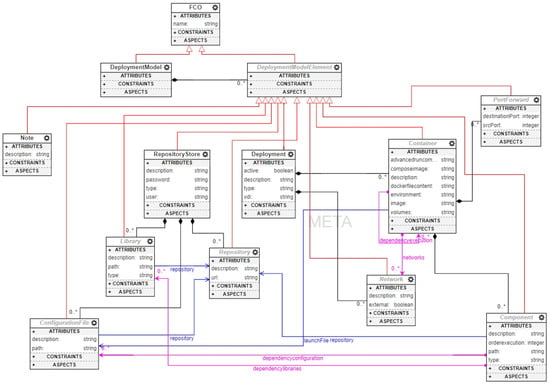
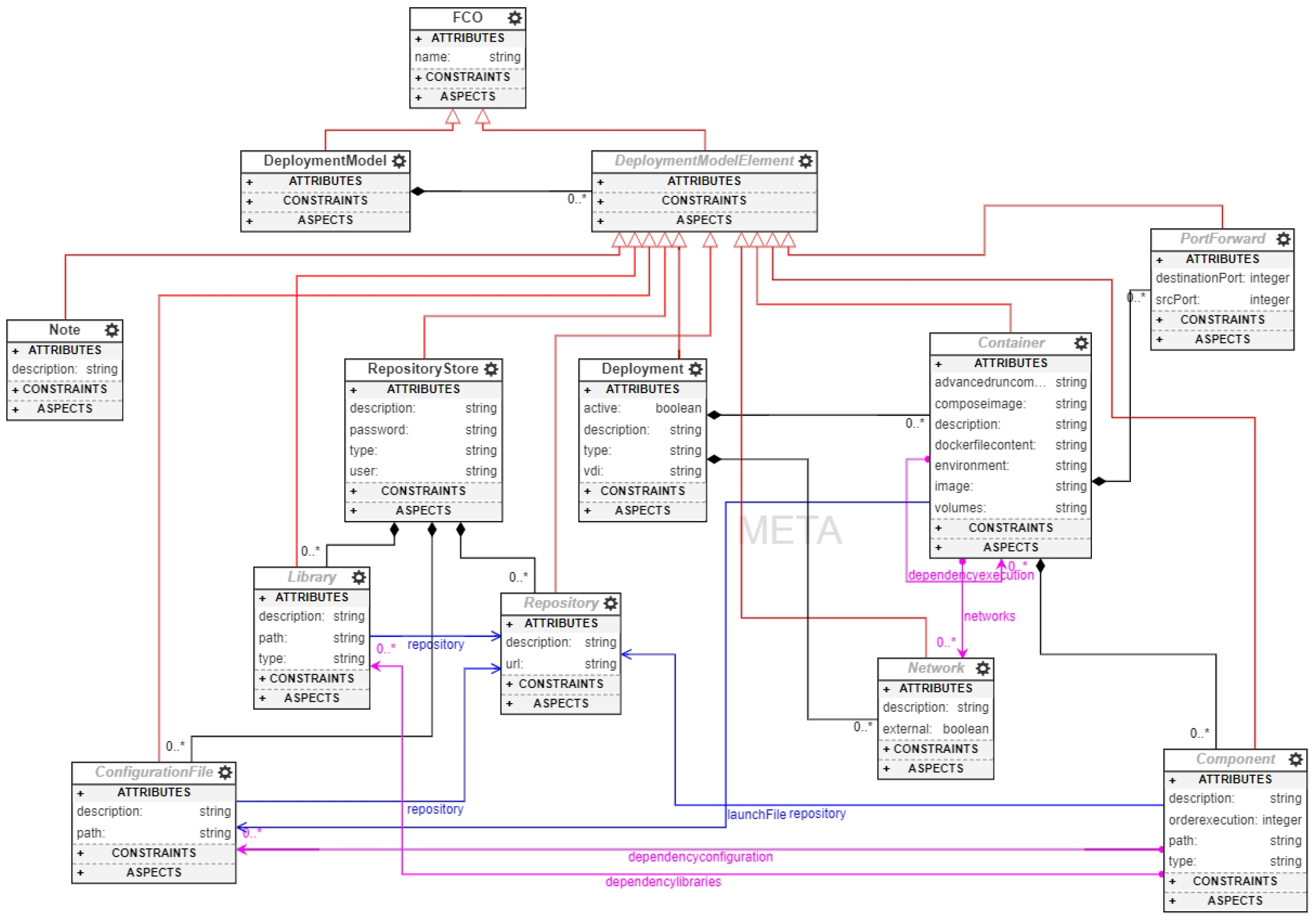
Figure 3 shows the metamodel adapted for WebGME, including the inheritance hierarchy rooted in the FCO, the containment structure, and associations implemented through pointers and sets. This diagram corresponds to WebGME’s native metamodel representation, which serves as a tool-specific alternative to a UML class diagram. It depicts modeling elements together with their attributes and relationships, where inheritance relationships are shown in red, pointer-based associations in blue, and set-based associations in pink. Relationship cardinalities follow standard modeling conventions, with explicit bounds where applicable and the symbol * indicating an unbounded multiplicity, equivalent to an arbitrary number of instances (N).
Figure 3.
Metamodel definition according to WebGME Metamodel.
3.4. RoboDeploy Deployment Automator
The RoboDeploy Deployment Automator is the software component responsible for executing the model-to-deployment pipeline described in the previous subsection. While the workflow diagram (Figure 1) illustrates the end-to-end sequence of steps, this subsection focuses on the internal mechanisms that implement those steps and enable both interactive and fully automated execution.
A key design decision was to decouple deployment automation from the modeling environment. Instead of embedding code-generation logic inside WebGME’s JavaScript plugin system, we implemented an external service exposing a REST API. This separation improves maintainability, allows for independent evolution of the tooling, and enables straightforward integration with DevOps pipelines. As a result, the Deployment Automator can be triggered in two ways:
- Step 1: Interactive execution: A WebGME client plugin allows the user to invoke the deployment process directly from the editor. The plugin identifies the model, branch, and commit, ensuring that the automator operates on the exact version of the deployment model.
- Step 2: CI/CD-triggered execution: Pipelines in GitLab or Jenkins may call the REST API of the Deployment Automator, providing either a model identifier stored in WebGME or a JSON serialization exported during the build process. This enables automated deployment, continuous testing, and reproducible releases.
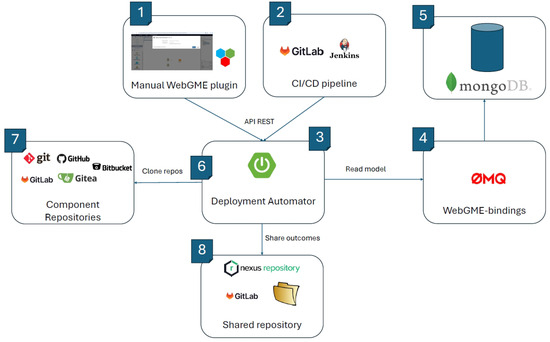
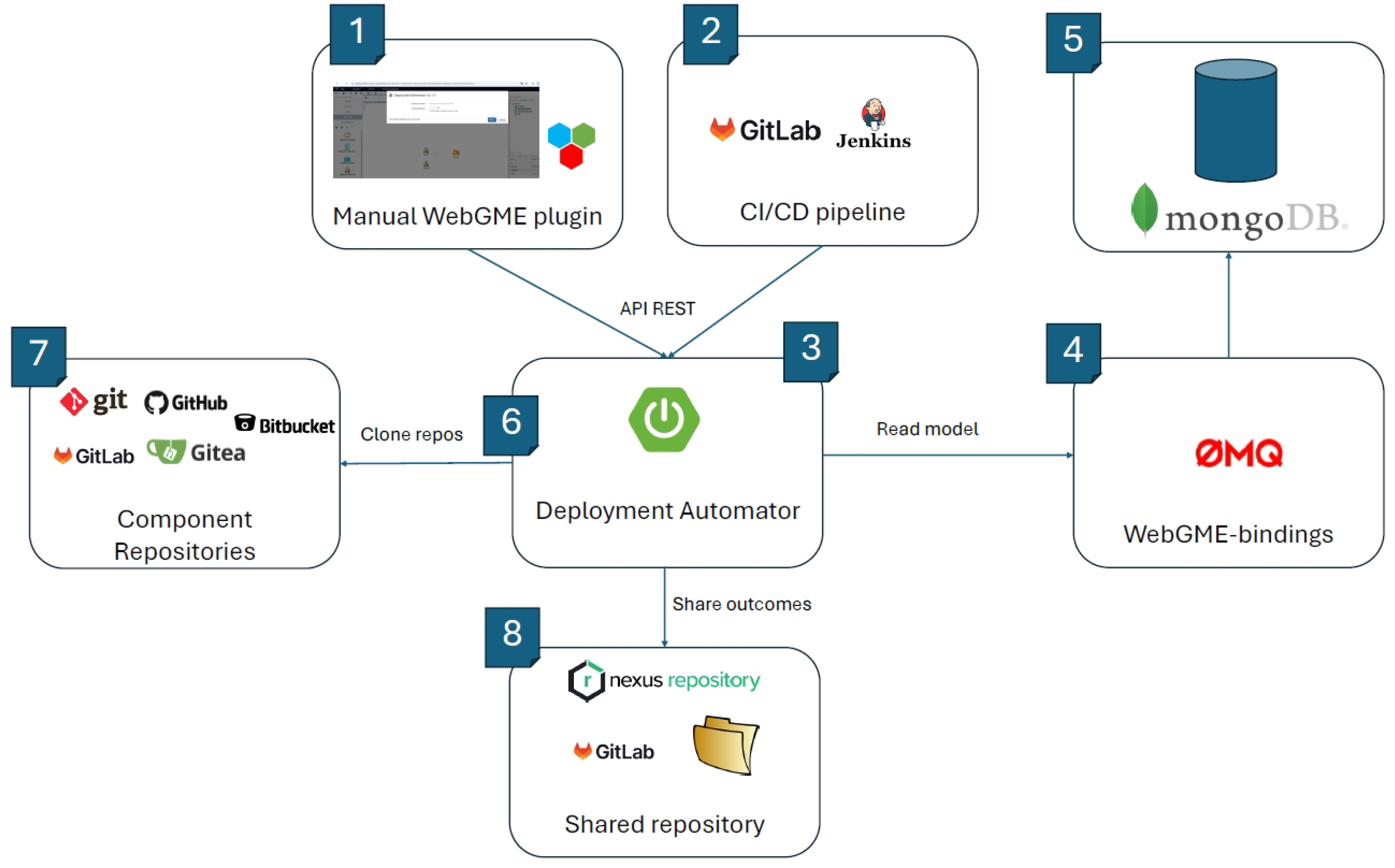
Figure 4 presents the internal architecture of the Deployment Automator and highlights how it interacts with WebGME, model storage, and repository sources. The numbered elements in the figure correspond to the sequential steps of the deployment process, which are described and discussed in more detail in the following paragraphs.
Figure 4.
Internal architecture of the RoboDeploy Deployment Automator, illustrating its interaction with WebGME, ZeroMQ adapters, the model database, repository sources, and the generators that produce Dockerfiles and docker-compose artifacts.
Once triggered, the Deployment Automator executes the following sequence of operations, aligned with the steps of the general workflow:
- Step 3: Invocation and model loading. The automator receives the request through the REST API. If a model identifier is provided, the automator prepares to retrieve it; otherwise, it loads the JSON model directly from the request payload.
- Step 4: Model retrieval via ZeroMQ. When a model identifier is used, the automator requests the corresponding model from WebGME through a ZeroMQ-based adapter, ensuring consistency with the exact version selected by the user or the CI/CD pipeline.
- Step 5: MongoDB access. The automator retrieves the stored model data from the underlying MongoDB database using the WebGME Python v1.3.0 bindings, which provide structured access to all nodes, attributes, and relationships of the deployment model.
- Step 6: Semantic and structural validation. The automator applies the OCL-like constraints defined in the metamodel to detect invalid configurations such as self-dependencies, name clashes, missing networks, or inconsistent repository structures. Execution halts on validation failure, returning diagnostics to the UI or CI/CD pipeline.
- Step 7: Repository integration and M2T generation. After successful validation, the automator connects to all declared repositories and retrieves the required software components. It then generates the Dockerfiles and docker-compose specifications based on the model, including build steps, volumes, environment variables, network settings, and execution dependencies.
- Step 8: Artifact publication. The generated deployment structure—including Dockerfiles, docker-compose files, and built container images—is published according to the configuration: (i) pushed to a Nexus registry, (ii) committed back to a Git repository, or (iii) exported to a target folder for manual deployment.
This internal execution pipeline allows RoboDeploy to support both interactive, ad-hoc deployments and fully automated DevOps workflows, ensuring reproducibility, traceability, and scalability across heterogeneous IoRT environments.
To further clarify how RoboDeploy translates high-level model abstractions into executable deployment artifacts, we provide a detailed mapping between metamodel entities and the generated Dockerfiles and Compose specifications. The mapping follows the actual M2T logic implemented in our framework, where the automation tool transforms containers, components, repositories, and configuration files into concrete Docker build instructions and service definitions. Table 2 summarizes this correspondence.
Table 2.
Mapping between RoboDeploy metamodel elements and generated Docker/Compose artifacts (based on the actual M2T implementation).
4. Usage in Real-Life Environments and Discussion
4.1. Validation
We validated the proposed approach by automating the deployment of several robotic components in different contexts. Although the development of RoboDeploy was carried out independently from any project, the COGNIMAN initiative (http://cogniman.eu/ (accessed on 14 October 2025)) provided a rich and fully publishable environment for evaluating the framework in realistic conditions. COGNIMAN offers a modular toolchain of reusable robotic and manufacturing components, including simulations, digital twins, advanced sensors, machine learning modules, and cognitive robotics elements.
Beyond this use case, RoboDeploy has also been applied in multiple internal proof-of-concept studies involving heterogeneous IoRT configurations, as well as in collaborative projects with industrial partners under confidentiality agreements. In these settings, the framework was used to automate deployments involving distributed sensing, edge processing, and multi-host orchestration. Although the details of these industrial deployments cannot be disclosed, they consistently demonstrated the generality, robustness, and applicability of RoboDeploy beyond the domain of digital manufacturing. For this paper, we selected COGNIMAN as a representative, publishable case study that illustrates the behaviour of the framework on real robotic components.
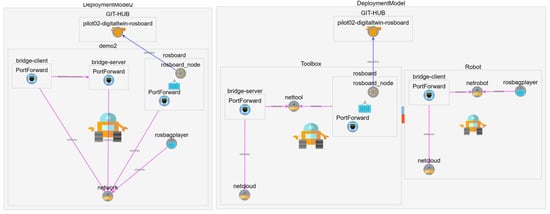
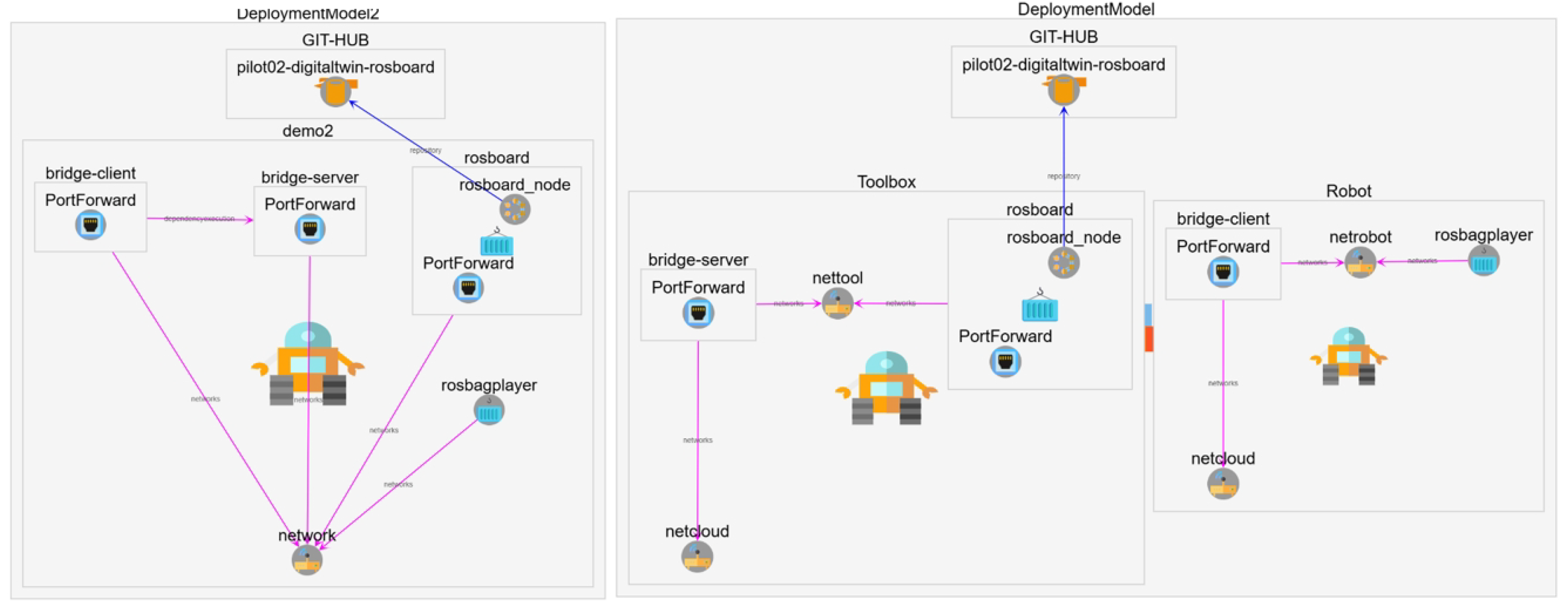
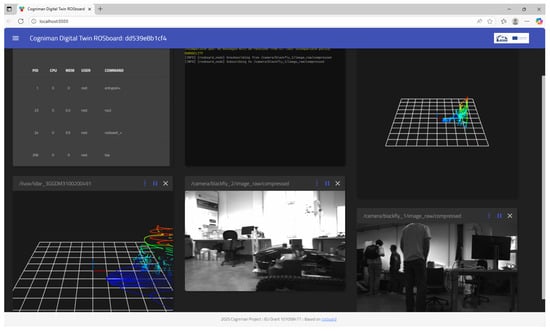
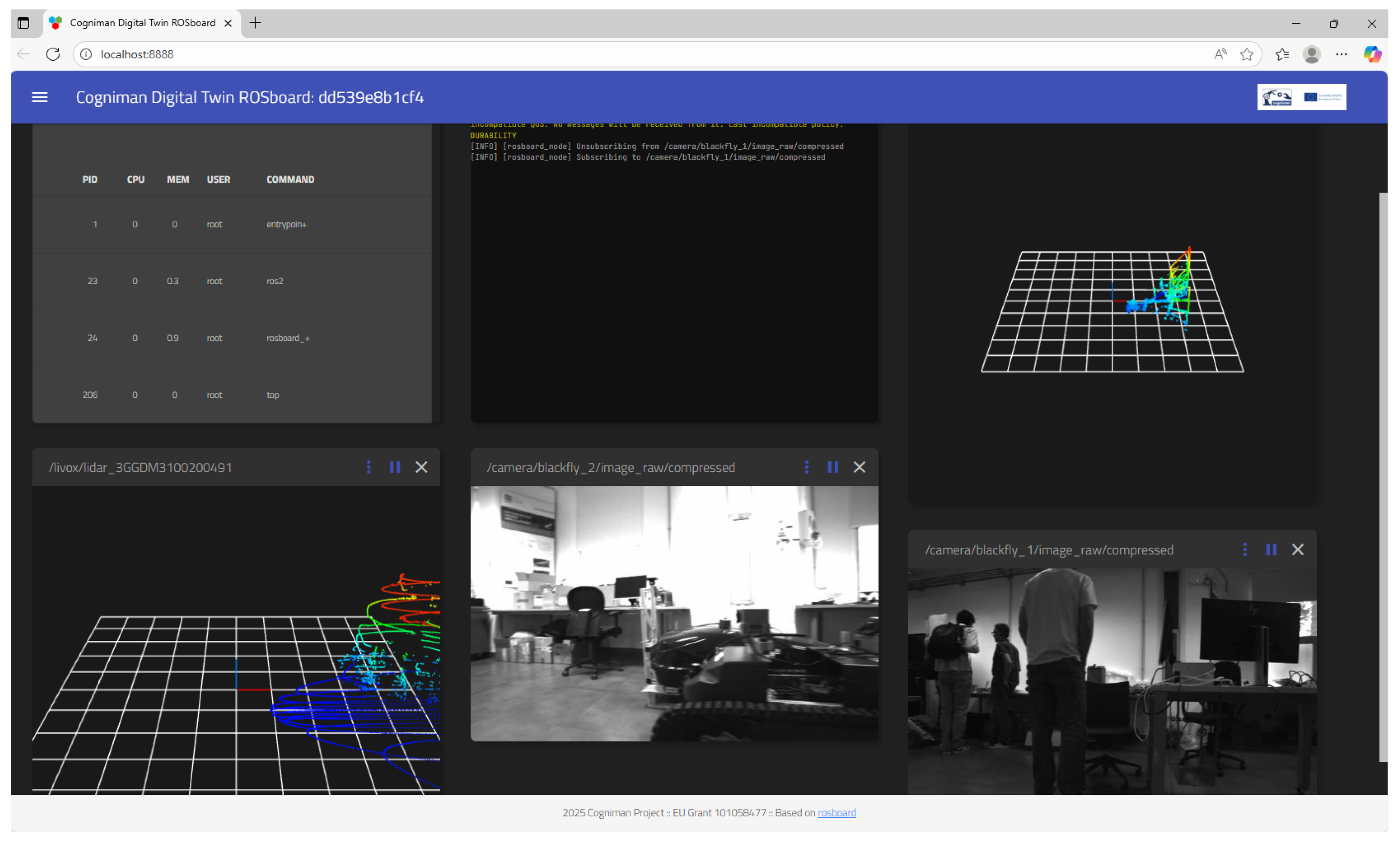
To demonstrate the approach, we deployed multiple components from the COGNIMAN toolbox (https://toolbox.cogniman.eu/ (accessed on 14 October 2025)) automatically. Specifically, we deployed the modules pilot02-digitaltwin-rosbag-player, pilot02-connectivity-bridge-ros2-dds, and pilot02-digitaltwin-rosboard across different configurations. These ranged from single machine deployments (Figure 5, left) to multi machine setups using DDS proxies (Figure 5, right). Figure 6 shows the successful execution of the distributed system, where all ROS 2 topics were correctly visualized and synchronized.
Figure 5.
Examples of deployment models used during the validation process, including both single machine and multi host configurations.
Figure 6.
Execution result of the deployed system, showing the Real-Time ROS 2 Board receiving and visualizing synchronized topics during validation.
Although the industrial environments used for validation did not permit systematic instrumentation for exact timing measurements, several qualitative improvements were observed consistently across all experiments. RoboDeploy avoided repeated compilation of large ROS 2-related libraries, reduced the time required to recreate testing environments, and enabled reproducible deployment across heterogeneous machines without modifying configuration files. Furthermore, developers who were not involved in the original setup were able to deploy complete environments reliably, demonstrating improved team onboarding and reduced dependency on expert configuration knowledge. These observations, replicated across internal testbeds and confidential industrial pilots, provide evidence of practical efficiency gains even in the absence of formal quantitative benchmarks.
The hardware and software configuration used for the COGNIMAN experiments consisted of two identical virtual machines running Ubuntu 22.04.5 LTS with Docker 27.5.1 and the ROS 2 Humble distribution. Each VM was allocated 32 GiB RAM and 4 vCPUs on an Intel Xeon Silver 4314 host; full details are provided for reproducibility.
4.2. Discussion
The results obtained across the different evaluation contexts—internal proof-of-concept studies, confidential industrial deployments, and the publicly reproducible COGNIMAN case—illustrate how RoboDeploy effectively reduces the effort required to configure, deploy, and maintain distributed robotic systems. Although the environments involved in these deployments varied in scale, infrastructure, and specific requirements, the behaviour of the framework remained consistent and reliable.
A first source of benefit is the reduction in manual configuration effort. Traditional robotics and manufacturing workflows often require 4–6 h of manual setup to prepare development and production environments. With RoboDeploy, the initial modelling phase typically takes 1–2 h, after which the entire deployment process is automated. Even in the absence of precise timing measurements, qualitative evidence across multiple projects indicates that the removal of repeated environment configuration, dependency installation, and ad-hoc scripting yields substantial time savings and minimizes configuration errors.
The model validation stage constitutes a second important advantage. By enforcing structural and semantic correctness before artifact generation, RoboDeploy helps developers identify issues early, reducing debugging effort and preventing faulty deployments. This validation layer is particularly valuable in distributed or multi-host scenarios, where small inconsistencies can lead to system-level failures that are difficult to diagnose manually.
Another meaningful outcome relates to reusability and reproducibility. Since container images and deployment descriptors are generated directly from the model, identical environments can be recreated on different machines without modification. This supports team onboarding: developers who did not participate in the original setup were able to deploy environments reliably using only the generated artifacts. Such reproducibility also facilitates iterative development, testing, and integration activities across teams and projects.
The approach brings additional value to heterogeneous or large-scale deployments. The ability to generate multi-host docker-compose structures simplifies the orchestration of components across different machines, including setups that combine digital twins, data bridges, visualization tools, and DDS proxies. In practice, these features align with the principles of Software-Defined Robotics (SDR), where abstractions and automation replace manual configuration and system-specific scripting.
Despite these advantages, some limitations remain. Container-based deployments may introduce performance overhead, as previously reported in the literature; high-frequency control loops or latency-sensitive applications may still require optimization or partial migration to bare-metal execution. Additionally, the learning curve associated with domain-specific modelling may initially slow adoption, especially for teams unfamiliar with MDE concepts. Finally, the current metamodel does not capture all ROS 2-specific runtime parameters, and some low-level adjustments (e.g., environment variables or middleware fine-tuning) may still require manual refinement.
Overall, the validation results demonstrate that model-driven deployment offers a robust, flexible, and reproducible foundation for robotic software engineering. RoboDeploy not only reduces configuration effort but also promotes architectural consistency, supports component reuse, and enables scalable distributed deployments. These properties represent a practical step toward integrating Model-Based Systems Engineering (MBSE) principles in robotics, with the potential to extend automation to additional lifecycle phases such as testing, simulation-based verification, and continuous deployment.
5. Conclusions and Future Work
This paper introduced RoboDeploy, a metamodel-driven framework that automates the generation of containerized deployment artifacts for distributed robotic systems. By separating the modeling and execution layers, RoboDeploy enables reproducible, maintainable, and scalable deployments across heterogeneous environments. The automated generation of Dockerfiles and docker-compose structures, combined with semantic model validation, reduces configuration effort, prevents common deployment errors, and supports seamless integration with DevOps pipelines.
The validation performed with components from the COGNIMAN project demonstrated that the approach is practical and effective in real industrial manufacturing scenarios. RoboDeploy accelerated the reconstruction of testing environments, increased deployment consistency across machines, and facilitated collaboration between robotics engineers and DevOps teams. The model-driven abstraction also promoted component reuse and supported the coexistence of heterogeneous ROS 2 configurations and third-party dependencies.
This study revealed several key insights. First, automation significantly reduces manual setup time and human error in distributed ROS 2 deployments. Second, the use of high-level modeling encourages architectural discipline, enabling developers to focus on algorithmic and domain-specific logic rather than low-level system configuration. Finally, the framework provides a foundation for SDR by capturing deployment intent at the model level and generating consistent runtime artifacts.
Despite these advantages, this approach presents certain limitations. Containerization may introduce latency or resource overhead in performance-critical applications, and some configuration-level issues still require manual debugging beyond the model abstraction. Furthermore, while RoboDeploy improves reproducibility, its current validation mechanisms do not yet incorporate quantitative performance metrics or automated optimization feedback. These aspects highlight opportunities for future enhancement.
Future work will address several complementary directions. First, we will broaden the applicability of RoboDeploy to larger and more complex ecosystems, such as autonomous driving platforms (e.g., Autoware) and robotic systems with real-time constraints. These domains require deterministic performance, fine-grained resource isolation, and tighter integration between middleware configuration and deployment artifacts. Extending the metamodel to capture real-time parameters and scheduling constraints will be a key step toward supporting such systems.
Second, we will continue aligning RoboDeploy with Software-Defined Vehicle (SDV) architectures, particularly through the SOAFEE standard. This work is being advanced within the Collaborative Development Framework for Electric Software-defined Vehicles (CODE4EV) project (https://code4ev.eu/ (accessed on 19 October 2025)) and aims to support safety-critical cyber-physical deployments across embedded ECUs, edge nodes, and cloud infrastructure.
Third, we plan to introduce analytics and benchmarking capabilities into the deployment pipeline. By collecting execution metrics—including build times, startup overhead, resource consumption, and latency under load—RoboDeploy will be able to provide actionable insights to optimize deployments, recommend model improvements, and automatically validate performance expectations across hosts.
Finally, we will extend the metamodel and the automation toolchain to support Model-Based Testing (MBT). This includes generating verification and validation environments directly from deployment models, integrating ROS-based components with simulated or emulated elements, and enabling end-to-end automation from system modeling to deployment, testing, and performance evaluation. These enhancements will increase reliability, improve regression testing, and strengthen lifecycle continuity in complex robotic software engineering processes.
Author Contributions
Conceptualization, related work and metamodel, M.Á.B. and L.G.-B.; toolchain and validation, P.T. and A.B.R.; writing—original draft preparation, M.Á.B. and L.G.-B.; writing—review and editing, M.Á.B., L.G.-B., P.T. and A.B.R.; supervision, L.G.-B.; project administration, M.Á.B. All authors have read and agreed to the published version of the manuscript.
Funding
This research received no external funding.
Data Availability Statement
The original contributions presented in this study are included in this article; further inquiries can be directed to the corresponding author.
Conflicts of Interest
The authors declare no conflicts of interest.
Abbreviations
The following abbreviations are used in this manuscript:
| API | Application Programming Interface |
| CI/CD | Continuous Integration/Continuous Deployment |
| CPU | Central Processing Unit |
| DDS | Data Distribution Service |
| DevOps | Development and Operations |
| DSMLs | Domain-Specific Modeling Languages |
| EMF | Eclipse Modeling Framework |
| FCO | First-Class Object |
| IoRT | Internet of Robotic Things |
| IoT | Internet of Things |
| MDE | Model-Driven Engineering |
| MBSE | Model-Based Systems Engineering |
| MBT | Model-Based Testing |
| MOF | Meta Object Facility |
| M2T | Model-To-Text |
| OCL | Object Constraint Language |
| REST | Representational State Transfer |
| ROS | Robot Operating System |
| SDR | Software-Defined Robotics |
| SDV | Software-Defined Vehicle |
| SDX | Software-Defined X |
| SE | Software Engineering |
| SOAFEE | Scalable Open Architecture for Embedded Edge |
| TOSCA | Topology and Orchestration Specification for Cloud Applications |
| VM | Virtual Machine |
| VST | Verified Software Toolchain |
| WebGME | Web-based Generic Modeling Environment |
References
- García, S.; Strüber, D.; Brugali, D.; Berger, T.; Pelliccione, P. Robotics software engineering: A perspective from the service robotics domain. In Proceedings of the 28th ACM Joint Meeting on European Software Engineering Conference and Symposium on the Foundations of Software Engineering, New York, NY, USA, 8 November 2020; pp. 593–604. [Google Scholar]
- Macenski, S.; Foote, T.; Gerkey, B.; Lalancette, C.; Woodall, W. Robot Operating System 2: Design, architecture, and uses in the wild. Sci. Robot. 2022, 7, eabm6074. [Google Scholar] [CrossRef] [Scilit] [PubMed]
- Bonci, A.; Gaudeni, F.; Giannini, M.C.; Longhi, S. Robot Operating System 2 (ROS2)-Based Frameworks for Increasing Robot Autonomy: A Survey. Appl. Sci. 2023, 13, 12796. [Google Scholar] [CrossRef] [Scilit]
- Zhang, J.; Keramat, F.; Yu, X.; Montero Hernández, D.; Peña Queralta, J.; Westerlund, T. Distributed Robotic Systems in the Edge-Cloud Continuum with ROS 2: A Review on Novel Architectures and Technology Readiness. arXiv 2022, arXiv:2211.00985. [Google Scholar] [CrossRef] [Scilit]
- Betz, T.; Wen, L.; Pan, F.; Kaljavesi, G.; Zuepke, A.; Bastoni, A.; Caccamo, M.; Knoll, A.; Betz, J. A Containerized Microservice Architecture for a ROS 2 Autonomous Driving Software: An End-to-End Latency Evaluation. arXiv 2024. [Google Scholar] [CrossRef] [Scilit]
- de Araújo Silva, E.; Valentin, E.; Carvalho, J.R.H.; da Silva Barreto, R. A survey of Model Driven Engineering in robotics. J. Comput. Lang. 2021, 62, 101021. [Google Scholar] [CrossRef] [Scilit]
- Monthe, V.M.; Nana, L.; Kouamou, G.E. A Model-Based Approach for Common Representation and Description of Robotics Software Architectures. Appl. Sci. 2022, 12, 2982. [Google Scholar] [CrossRef] [Scilit]
- Guizani, A.; Aloui, K.; Hammadi, M.; Soriano, T.; Haddar, M. A new SysML profile for autonomous mobile robots development: ROS2ML. Proc. Inst. Mech. Eng. Part C J. Mech. Eng. Sci. 2023, 16, 3650–3664. [Google Scholar] [CrossRef] [Scilit]
- Winiarski, T. MeROS: SysML-based Metamodel for ROS-based Systems. IEEE Access 2023, 11, 91933–91948. [Google Scholar] [CrossRef] [Scilit]
- Ladeira, M.; Ouhammou, Y.; Grolleau, E. RoBMEX: ROS-based modelling framework for end-users and experts. J. Syst. Archit. 2021, 117, 102089. [Google Scholar] [CrossRef] [Scilit]
- Casalaro, G.L.; Cattivera, G.; Ciccozzi, F.; Malavolta, I.; Wortmann, A.; Pelliccione, P. Model-driven engineering for mobile robotic systems: A systematic mapping study. Softw. Syst. Model. 2022, 21, 19–49. [Google Scholar] [CrossRef] [Scilit]
- Moin, A.; Silva, A.; Ferreira, J. Model-Driven Engineering Techniques and Tools for Machine Learning-Enabled IoT Applications: A Scoping Review. Sensors 2023, 23, 1458. [Google Scholar] [CrossRef] [Scilit]
- Busch, J.P.; Reiher, L.; Eckstein, L. Deployment of Any-Scale Robotic Applications in Microservice Architectures through Automated Containerization. In Proceedings of the IEEE International Conference on Robotics and Automation (ICRA), Yokohama, Japan, 13–17 May 2024; IEEE: New York, NY, USA, 2024. [Google Scholar]
- Naser, A.; Ennasr, O.; Soylemezoglu, A.; Glaspell, G. Docker Containers and Images for Robot Operating System (ROS)–Based Applications. In Technical Report; US Army Engineer Research and Development Center (ERDC): Vicksburg, MI, USA, 2023. [Google Scholar]
- Wendt, A.; Schüppstuhl, T. Proxying ROS communications—Enabling containerized ROS deployments in distributed multi-host environments. In Proceedings of the IEEE/SICE International Symposium on System Integration (SII), Narvik, Norway, 9–12 January 2022; IEEE: New York, NY, USA, 2022. [Google Scholar]
- Harzenetter, L.; Breitenbücher, U.; Leymann, F.; Saatkamp, K.; Weder, B.; Wurster, M. Automated Generation of Management Workflows for Applications Based on Deployment Models. In Proceedings of the IEEE International EDOC Conference, Paris, France, 28–31 October 2019; IEEE: New York, NY, USA, 2019; pp. 216–225. [Google Scholar]
- Meng, W.; Park, J.; Sokolsky, O.; Weirich, S.; Lee, I. Verified ROS-Based Deployment of Platform-Independent Control Systems. In Proceedings of the NASA Formal Methods Symposium, Pasadena, CA, USA, 6–8 May 2014; Springer: Cham, Switzerland, 2014; pp. 194–209. [Google Scholar]
- Waseem, M.; Ahmad, A.; Liang, P.; Akbar, M.A.; Khan, A.A.; Ahmad, I.; Setälä, M.; Mikkonen, T. Containerization in Multi-Cloud Environment: Roles, Strategies, Challenges, and Solutions for Effective Implementation. ACM Trans. Softw. Eng. Methodol. 2024, 1. [Google Scholar] [CrossRef] [Scilit]
- Mäkinen, J.O. Improving Software Deployment for Mobile Machinery: A Case Study and Proof of Concept Implementation. Master’s Thesis, Aalto University/TU Eindhoven, Espoo, Finland, 2023. [Google Scholar]
- Berkeley Automation. FogROS2. 2025. Available online: https://github.com/BerkeleyAutomation/FogROS2 (accessed on 14 October 2025).
- Kumar, P.S.; Emfinger, W.; Karsai, G.; Watkins, D.; Gasser, B.; Anilkumar, A. ROSMOD: A toolsuite for modeling, generating, deploying, and managing distributed real-time component-based software using ROS. Electronics 2016, 5, 53. [Google Scholar] [CrossRef] [Scilit]
- Object Management Group. Object Constraint Language (OCL) Specification, Version 2.4. Specification ptc/2014-06-01, Object Management Group, 2014. Available online: https://www.omg.org/spec/OCL/ (accessed on 14 October 2025).
- Systèmes, D. Cameo Systems Modeler. 2025. Available online: https://www.3ds.com/products/catia/no-magic/cameo-systems-modeler (accessed on 14 October 2025).
- Alonso, L.S. Modelado de un Sistema de Planificación de Procesos de Fabricación Mediante técnicas Basadas en Model Based System Engineering. 2022. Available online: https://biblus.us.es/bibing/proyectos/abreproy/72249/fichero/TFM-2249+SOLDADO+ALONSO%2C+LIDIA.pdf (accessed on 14 October 2025).
- Eclipse Foundation; PolarSys Industry Working Group. Capella: Open Source Model-Based Systems Engineering Tool. 2025. Available online: https://mbse-capella.org/ (accessed on 14 October 2025).
- Foundation, E. Acceleo. 2025. Available online: https://eclipse.dev/acceleo/ (accessed on 14 October 2025).
- Morelli, M. Automated generation of robotics applications from Simulink and SysML models. In Proceedings of the 30th Annual ACM Symposium on Applied Computing, Salamanca, Spain, 13–17 April 2015; pp. 1948–1954. [Google Scholar]
- Modelio. Modelio. 2025. Available online: https://www.modelio.org/index.htm (accessed on 14 October 2025).
- Object Management Group. Meta Object Facility (MOF) Core Specification, Version 2.5.1. Specification ptc/2021-06-01, Object Management Group, 2021. Available online: https://www.omg.org/spec/MOF/ (accessed on 14 October 2025).
- Maróti, M.; Kecskés, T.; Asztalos, M.; Ledeczi, Á. Next generation (meta) modeling: Web-and cloud-based collaborative tool infrastructure. In Proceedings of the 17th ACM/IEEE International Conference on Model Driven Engineering Languages and Systems, Nashville, TN, USA, 28 September–3 October 2014; IEEE: New York, NY, USA, 2014; pp. 41–45. [Google Scholar]
- Vanderbilt University/WebGME Team. WebGME Documentation, Version 1.0.0. Manual Webgme-Docs-1.0.0, Institute for Software Integrated Systems (ISIS), Vanderbilt University, 2025. Available online: https://webgme.readthedocs.io/_/downloads/en/latest/pdf/ (accessed on 14 October 2025).

Disclaimer/Publisher’s Note: The statements, opinions and data contained in all publications are solely those of the individual author(s) and contributor(s) and not of MDPI and/or the editor(s). MDPI and/or the editor(s) disclaim responsibility for any injury to people or property resulting from any ideas, methods, instructions or products referred to in the content. |
© 2025 by the authors. Licensee MDPI, Basel, Switzerland. This article is an open access article distributed under the terms and conditions of the Creative Commons Attribution (CC BY) license.