


Abstract
Large language models (LLMs) are adopted in financial services, yet existing benchmarks provide limited insight into financial-domain capability, regulatory compliance-action performance, and security robustness. This study proposes a unified multidimensional evaluation framework for evaluating open-source and commercial LLMs in regulated financial environments. The framework comprises three complementary benchmark components: the Integrated Financial Benchmark (IFB), which integrates financial-domain benchmarks for capability evaluation; the newly developed RegBench for context-grounded regulatory compliance-action performance; and the newly developed FinSec-Eval-1000 for adversarial robustness. Eight LLMs, including five open-source and three commercial models, were evaluated using an inference pipeline, task-specific metrics, statistical testing, and a Composite Security Score (SS). Claude Sonnet 4.6 achieved the highest IFB performance (68.72%) and four-judge mean security robustness (97.43%), while GPT-5.1 achieved the highest RegBench performance (50.28%). Among open-source models, Gemma 3 12B led on IFB (63.50%), whereas Phi-3-small achieved the strongest open-source RegBench (49.22%) and four-judge mean security (92.78%) results, demonstrating that model rankings vary across evaluation dimensions. No detectable monotonic association was observed between financial capability and security robustness (Spearman’s ρ = 0.095, p = 0.823). The benchmarking framework provides a transparent and reproducible methodology for multidimensional LLM evaluation and supports informed model selection in regulated financial environments.
Keywords:
large language models; financial artificial intelligence; benchmark evaluation; financial regulation; adversarial robustness; prompt injection; AI security; regulatory compliance; financial services JEL Classification:
C52; C55; G28; O33
1. Introduction
Large language models (LLMs) have demonstrated strong capabilities in natural language understanding, reasoning, and knowledge-intensive tasks, enabling applications across domains including healthcare, law, software engineering, and finance [1,2,3]. As LLMs become integrated into business processes, their evaluation must extend beyond predictive accuracy to include reliability, robustness, transparency, and security, particularly in regulated environments where erroneous outputs may have operational, financial, or legal consequences [4,5,6,7,8].
The financial sector presents particular challenges for LLM deployment due to specialized knowledge requirements, strict regulatory obligations, and elevated security expectations. However, existing evaluation benchmarks often provide limited coverage of financial-domain expertise, regulatory compliance-action performance, and resilience against adversarial attacks, complicating the systematic comparison of commercial and open-source LLMs.
1.1. Large Language Models in Financial Services
LLMs are deployed in applications requiring domain-specific expertise and advanced analytical capabilities, supporting the automation of complex workflows, decision making, and knowledge-intensive tasks [4,5,6,7]. Financial institutions are exploring LLMs for financial planning, valuation, customer support, fraud detection, regulatory compliance and quantitative investment analysis [8,9,10,11,12,13,14,15,16,17,18,19], with potential benefits including reduced operational costs, improved decision-making efficiency, and increased access to financial information.
Advances in commercial and open-source LLMs have expanded the range of models available for financial applications, offering different trade-offs in performance, transparency, deployment flexibility, and cost efficiency. This diversity supports different technical, regulatory, and operational requirements but complicates objective comparison across models with differing capabilities and deployment characteristics [20,21,22].
Deploying LLMs in financial applications requires accurate responses, consistent reasoning, regulatory awareness, and reliable behavior under real-world operating conditions. Model selection therefore requires evaluation beyond conventional general-knowledge benchmarks to reflect the requirements of regulated financial environments.
1.2. Security Challenges in Financial LLM Applications
The growing adoption of LLMs in financial services introduces security, reliability, and governance challenges beyond predictive performance. Their probabilistic behavior makes them susceptible to hallucinations, prompt manipulation, and other unintended outputs, which are particularly consequential in regulated financial environments where they may affect investment decisions, compliance processes, fraud investigations, or customer interactions [23,24,25,26].
Recent research has demonstrated that LLMs remain vulnerable to adversarial attacks, including prompt injection, jailbreak techniques, system prompt extraction, sensitive information disclosure, and indirect manipulation through malicious external content. Such attacks may bypass safety mechanisms, alter model behavior, or expose confidential information, creating substantial risks for financial workflows and making adversarial robustness an important deployment requirement [27,28,29,30,31].
Beyond technical vulnerabilities, financial institutions operate under regulatory and governance requirements emphasizing transparency, accountability, and effective risk management. The European Union Artificial Intelligence Act (AI Act) and NIST Artificial Intelligence Risk Management Framework (AI RMF) emphasize trustworthy, robust, and continuously evaluated AI systems in high-impact domains [32,33]. Consequently, financial-domain knowledge alone is insufficient for deployment; security robustness and regulatory compliance-action performance must also be evaluated under realistic operating conditions [34,35,36,37].
These challenges motivate benchmarks that jointly assess LLM capability, reliability, and security under realistic financial scenarios and adversarial inputs, enabling informed model selection in regulated financial environments.
1.3. Benchmarking Large Language Models for Financial Applications
The rapid advancement of LLMs has been accompanied by numerous benchmarks for evaluating model performance across diverse tasks. General-purpose benchmarks, including MMLU, BIG-bench, HumanEval, and MT-Bench [33,38,39,40,41], assess reasoning ability, factual knowledge, coding performance, and conversational quality, providing broad measures of overall model capability.
Existing financial datasets evaluate specific capabilities such as numerical reasoning (FinQA [34]), financial sentiment analysis (Financial PhraseBank [41]), and document-grounded question answering (FinanceBench [11]). ConvFinQA [42], FinBen [10]. Finance-oriented evaluation suites have substantially improved the assessment of financial-domain competence and enabled more realistic comparisons between language models on specialized financial tasks [42,43,44,45,46,47].
Despite these advances, current benchmarking approaches remain fragmented. Financial benchmarks typically emphasize task accuracy or financial knowledge while providing limited assessment of regulatory compliance-action performance and adversarial robustness, whereas security-oriented evaluations often examine prompt injection or jailbreak resistance independently of domain-specific requirements. Consequently, individual benchmarks provide only a limited perspective on LLMs’ suitability for regulated financial applications [48,49,50,51,52].
The diversity of commercial and open-source LLMs further highlights the need for evaluation methodologies that jointly assess domain competence, regulatory compliance-action performance, and resilience against adversarial manipulation using consistent protocols and comparable metrics.
1.4. Research Gap and Contributions
To address these research gaps, this study proposes a unified multidimensional framework for evaluating financial-domain LLMs across financial capability, regulatory compliance-action performance, and adversarial robustness. The three complementary benchmark components are evaluated using a standardized experimental pipeline applied consistently across commercial and open-source LLMs. The main contributions of this research are as follows:
Integration of existing public financial-domain benchmarks into the Integrated Financial Benchmark (IFB) for evaluating practical financial-domain knowledge and reasoning.
Development of the novel Regulatory Benchmark (RegBench), a benchmark designed to assess context-grounded regulatory compliance-action identification and formulation.
Development of the novel Financial Security Evaluation Benchmark (FinSec-Eval-1000), an adversarial benchmark for measuring security robustness against prompt injection and related attacks in financial contexts.
Introduction of a Composite Security Score (SS) that aggregates category-specific attack failure rates from FinSec-Eval-1000 into a single, interpretable robustness indicator for cross-model comparison.
Design of a unified multidimensional, standardized, and reproducible evaluation framework that enables consistent comparison of commercial and open-source LLMs across multiple evaluation dimensions.
Comprehensive empirical evaluation of eight LLMs, providing a statistical comparison of capability, regulatory compliance-action performance, and security performance, together with an analysis of the relationship between these dimensions.
Public release of methodological documentation, validation materials, selected evaluation scripts, and experimental metadata as Supplementary Materials accompanying this article, to support methodological transparency and independent assessment by the research community.
These contributions differ in nature: RegBench and FinSec-Eval-1000 represent dataset contributions constructed from primary source material, whereas IFB represents an integration and harmonization contribution based on existing financial-domain datasets. The framework contribution lies in evaluating all three benchmarks across the same models using a standardized pipeline, while the Weighted Performance Score and Composite Security Score provide aggregate model-level measures across their respective evaluation dimensions.
1.5. Research Questions and Hypotheses
This study compares the financial-domain capability, regulatory compliance-action performance, and security robustness of selected open-source and commercial LLMs under standardized configurations. The evaluation is structured around one primary research question, four research subquestions, and four statistically testable hypotheses.
1.5.1. Research Question (RQ)
RQ1. How do the selected open-source and commercial large language models compare in financial-domain capability, regulatory compliance-action performance, and security robustness in regulated financial-domain scenarios?
1.5.2. Research Subquestions
RQ1.1. How do the selected open-source and commercial large language models compare in financial-domain task performance across diverse financial natural language processing (NLP) tasks?
RQ1.2. How do the selected open-source and commercial large language models compare in regulatory compliance-action performance on scenarios derived from primary anti-money laundering (AML)/know-your-customer (KYC) regulatory instruments?
RQ1.3. How do the selected open-source and commercial large language models compare in their resistance to prompt-based security attacks, including prompt injection, policy bypass, sensitive information disclosure, and system prompt leakage?
RQ1.4. What relationship exists between financial-domain capability and security robustness across the evaluated baseline models?
1.5.3. Research Hypotheses
The experimental evaluation is designed to test the following hypotheses.
H1.
There are statistically significant differences between the evaluated baseline large language models in financial-domain task performance, as measured by the Integrated Financial Benchmark (IFB).
H2.
There are statistically significant differences between the evaluated baseline large language models in regulatory compliance-action performance, as measured by the Regulatory Benchmark (RegBench).
H3.
There are statistically significant differences between the evaluated baseline large language models in adversarial robustness on FinSec-Eval-1000, tested via paired binary (safe/unsafe) attack outcomes.
H4.
Financial-domain capability is monotonically associated with security robustness across the evaluated baseline large language models.
1.5.4. Alignment Between Research Questions and Experimental Design
Each research subquestion is addressed through a corresponding benchmark, evaluation metric, and statistical procedure. Table 1 summarizes the mapping between RQ1.1–RQ1.4, the benchmark datasets, primary evaluation metrics, and statistical analyses employed throughout the study.
Table 1.
Mapping of research questions to benchmark datasets, evaluation metrics, and statistical analyses.
2. Related Work
Large language models (LLMs) have expanded natural language processing (NLP) beyond task-specific training by supporting diverse language understanding and generation tasks through instruction following [4,5,6,7]. Their evolution towards domain-specialized applications is particularly relevant in regulated industries, including healthcare, law, cybersecurity, and finance, where incorrect or hallucinated outputs may have operational, financial, or regulatory consequences [4,8].
Financial-domain LLMs must satisfy requirements that extend beyond general language understanding, including numerical reasoning, interpretation of financial reports, regulatory consistency, explainability, and robustness against adversarial manipulation [9,10,11]. Accordingly, recent evaluation research considers reliability, robustness, safety, transparency, and reproducibility alongside task accuracy [6,7,20,21,22].
This transition has stimulated three closely related research directions: domain-specialized financial language models, benchmarks for heterogeneous financial capabilities, and security evaluation addressing threats such as prompt injection, jailbreak attacks, and information disclosure [8,23,24,25].
Although these research directions have advanced rapidly over the past three years, they have largely evolved independently, with limited integration between financial-domain capability, regulatory compliance-action performance, and security robustness within a unified benchmarking framework.
2.1. Large Language Models in Finance
Recent LLMs have demonstrated capabilities across financial question answering, document and earnings-call analysis, sentiment and risk assessment, report summarization, investment research, customer support, and regulatory compliance assistance [4,8,11,12,25,26,27,28]. However, financial applications remain vulnerable to hallucinated advice, numerical errors, outdated knowledge, limited explainability, and regulatory compliance risks. These challenges have motivated systematic capability evaluation across numerical reasoning, document comprehension, information extraction, long-context reasoning, and regulatory knowledge [11,29,34].
Financial applications involve specialized terminology, complex numerical relationships, rapidly evolving market information, and regulatory constraints requiring high factual accuracy and reliable reasoning [10,28]. General-purpose LLMs may therefore exhibit hallucinations, numerical inconsistencies, limited understanding of financial concepts, and insufficient awareness of regulatory requirements in financial tasks [8,11].
To address these limitations, research has focused on domain-specialized financial LLMs. BloombergGPT demonstrated that pre-training on extensive financial corpora can improve performance across financial natural language processing tasks while preserving competitive performance on general language benchmarks [27], showing that financial-domain knowledge can be incorporated through domain-specific pre-training.
Subsequent research shifted towards open-source alternatives supporting reproducible experimentation and domain adaptation. FinGPT introduced an open-source framework integrating financial news, market data, and instruction tuning into adaptable financial language models [28], while FinMA explored instruction tuning using financial datasets to improve downstream financial reasoning with publicly available foundation models [29]. More recent specialized models, including Open-FinLLMs [30] and Fin-R1 [31], further demonstrate the potential of parameter-efficient adaptation to improve domain performance without complete model pre-training.
As summarized in Table A31 (Appendix D.1), financial LLM research has shifted towards open-source, instruction-tuned, and reasoning-oriented architectures and broader evaluation methodologies supporting reproducible comparison and trustworthy deployment in regulated financial environments [12]. However, specialized fine-tuning remains technically demanding and resource-intensive, motivating the use of readily available general-purpose commercial and open-source LLMs considered in this study (Section 3.2).
Although financial LLM research has advanced substantially, existing studies primarily emphasize predictive performance and task accuracy, with less attention dedicated to security robustness, adversarial resilience, and regulatory compliance-action performance within a unified experimental framework. This gap motivates evaluation methodologies that jointly assess domain capability, regulatory compliance-action performance, and security robustness across open-source and commercial language models.
2.2. Security Risks of Large Language Models
The growing deployment of LLMs in enterprise environments has raised concerns regarding security, robustness, and trustworthy deployment. LLMs remain susceptible to adversarial attacks that can manipulate model behavior, bypass safety mechanisms, or induce disclosure of confidential information [4,23,24,35], creating operational and regulatory risks as they are integrated into business processes.
Prompt injection uses crafted instructions to manipulate models into ignoring or overriding their original system instructions, exploiting the probabilistic nature of language models to influence behavior through natural language [23,24,36]. More sophisticated strategies include automated jailbreak generation, indirect prompt injection, role-playing attacks, multi-turn conversational attacks, and optimization-based adversarial prompting capable of bypassing safety mechanisms across commercial and open-source language models [25,35,37].
LLMs are also vulnerable to system prompt leakage and sensitive information disclosure involving hidden system instructions, internal configuration prompts, confidential user information, or memorized training data. These vulnerabilities are particularly relevant in financial services, where LLMs may process proprietary banking procedures, customer records, investment strategies, or compliance documentation protected by legal and regulatory requirements [8,38]. Without appropriate security controls, confidential information may be exposed even in retrieval-augmented or enterprise environments.
Security benchmarks such as PromptBench, HarmBench, JailbreakBench, AdvBench, and DecodingTrust evaluate robustness against adversarial prompts, while TrustLLM and HELM address broader dimensions of trustworthiness, fairness, privacy, and reliability [7,24,25,37,39]. However, these benchmarks remain largely domain-general and rarely incorporate realistic financial attack scenarios involving investment recommendations, regulatory compliance, customer confidentiality, or institution-specific policies.
In financial applications, incorrect model behavior may have operational, legal, and compliance consequences, making conventional NLP performance insufficient for assessing deployment in regulated environments. Security robustness should therefore be integrated into domain-specific LLM evaluation rather than treated as an independent post-deployment assessment [8,23,33].
These limitations motivate financial-domain security benchmarks evaluating prompt injection, policy bypass, sensitive information disclosure, and system prompt leakage under realistic financial scenarios. The Financial Security Evaluation Benchmark (FinSec-Eval-1000) proposed in this work addresses this gap by assessing the security robustness of LLMs in the financial sector.
2.3. Financial LLM Benchmarks and Research Gap
Early financial benchmarks focused on individual domain-specific tasks, including FinQA for numerical reasoning over financial reports [34], FiQA for financial opinion mining [40], Financial PhraseBank for financial sentiment analysis [41], and ConvFinQA for conversational numerical reasoning [42]. Although these datasets advanced financial NLP evaluation, each addresses a relatively narrow aspect of the financial domain.
More recent benchmarks broaden financial LLM evaluation across multiple tasks. FinanceBench assesses evidence-based question answering over corporate financial reports [11], while FinBen combines heterogeneous financial tasks for systematic model comparison [10]. Additional benchmarks include BizBench for financial information extraction [53], AveniBench for enterprise reasoning [54], and FLARE for long-context document understanding [29], while synthetic financial data generation has also been investigated as a complementary approach to financial AI dataset development [55]. Together, these datasets improve the reproducibility and comparability of financial LLM evaluation through standardized datasets and evaluation protocols.
Despite recent progress, existing financial benchmarks have several limitations. They primarily assess financial-domain capability while providing limited coverage of regulatory compliance-action tasks derived from financial legislation and supervisory guidance, adversarial robustness, prompt injection resistance, and secure deployment. Moreover, their focus on individual evaluation objectives often requires combining multiple datasets and evaluation pipelines, complicating reproducible model comparison and increasing methodological variability [6,20,21].
Security benchmarks, including PromptBench, HarmBench, JailbreakBench, AdvBench, and TrustLLM, have improved the evaluation of adversarial robustness in LLMs [24,25,37,39]. However, they remain largely domain-agnostic and provide limited coverage of context-grounded regulatory compliance-action tasks, finance-specific prompt injection attacks, confidential financial information, and compliance-oriented deployment settings [8].
Consequently, a gap remains between financial capability benchmarks and security-oriented evaluation frameworks: financial benchmarks rarely evaluate security robustness, while security benchmarks typically omit finance-specific reasoning and context-grounded regulatory compliance requirements. To the best of our knowledge, no previous framework integrates heterogeneous financial-domain tasks, context-grounded AML/KYC regulatory compliance-action tasks, and finance-specific adversarial security evaluation within a unified and reproducible framework applicable to both open-source and commercial LLMs. To address this gap, this work introduces a unified multidimensional evaluation framework comprising the Integrated Financial Benchmark (IFB), Regulatory Benchmark (RegBench), and Financial Security Evaluation Benchmark (FinSec-Eval-1000). The framework enables consistent assessment of financial-domain capability, regulatory compliance-action performance, and security robustness using standardized evaluation procedures, supporting the research questions in Section 1.5 and reproducible comparison across heterogeneous LLMs. Table 2 summarizes how the proposed framework compares to representative existing financial and security benchmarks with respect to financial task coverage, regulatory compliance-action evaluation, security evaluation, and support for both open-source and commercial models.
Table 2.
Comparison of representative benchmark frameworks for financial and security evaluation of large language models.
3. Materials and Methods
This study adopts a benchmark-driven experimental design in which open-source and commercial LLMs are evaluated using the three benchmark datasets introduced in Section 1.4, covering financial-domain capability, regulatory compliance, and security robustness. The proposed methodology separates benchmark construction, model inference, and setup for experimental evaluation into independent stages for both open-source and commercial LLMs under unified experimental conditions. This separation follows established recommendations for trustworthy benchmark development and reduces the risk of benchmark contamination and experiment-driven dataset modification [21]. Furthermore, all benchmark instances are represented using a unified data schema, enabling identical preprocessing, prompting, evaluation, and statistical analysis, regardless of the original task formulation or source dataset.
To ensure methodological consistency and fair comparison between open-source and commercial LLMs, all models are evaluated under identical prompting strategies and comparable inference settings whenever supported by the underlying deployment interface. Model outputs are subsequently processed through a unified evaluation pipeline implementing task-specific performance metrics, aggregate evaluation measures, and statistical significance testing.
Figure 1 presents the overall experimental workflow adopted in this study. The methodology consists of sequential stages, including benchmark construction and validation, model inference, automated evaluation, statistical analysis, and comparative interpretation of experimental results.
Figure 1.
Overall methodological framework adopted for the comparative evaluation of open-source and commercial large language models in financial-domain scenarios. Three complementary benchmark datasets are independently prepared and validated before being integrated into a unified evaluation pipeline.
3.1. Research Design
The research design comprises three complementary benchmark components: evaluating financial capability, security robustness, and regulatory compliance-action performance. This modular design facilitates systematic analysis of model behavior while reducing methodological bias arising from the overrepresentation of any single task category. Similar principles are reflected in benchmark frameworks such as HELM, OLMES, and FinBen, which emphasize task diversity, transparent benchmark construction, and reproducible evaluation protocols [7,10,20]. In contrast to evaluations focusing on either commercial or open-source models, the present study assesses both model groups using identical benchmark datasets, prompting strategies, and evaluation procedures. This design enables direct comparison between deployment paradigms while reducing methodological variability as a potential source of performance differences.
The first benchmark dataset, IFB, measures core financial-domain language understanding through six representative task categories: numerical reasoning, document-grounded question answering, sentiment classification, summarization, open-domain financial question answering, and quantitative information extraction. A unified evaluation schema enables consistent comparison across heterogeneous task formulations while preserving the semantic characteristics of the original source.
The second benchmark dataset, RegBench, evaluates regulatory compliance capabilities using realistic compliance scenarios derived from publicly available regulatory documents issued by internationally recognized financial authorities. Comparatively few financial benchmarks evaluate whether language models identify and formulate benchmark-specified regulatory and compliance actions from supplied context. The inclusion of a dedicated regulatory benchmark therefore complements existing financial evaluation frameworks by introducing a practically relevant capability that has received limited attention in previous benchmark literature [10,45].
The third benchmark dataset, FinSec-Eval-1000, extends evaluation beyond traditional task performance by examining model robustness against prompt-based adversarial attacks. Recent studies have demonstrated that state-of-the-art LLMs remain susceptible to prompt injection, prompt extraction, indirect prompt manipulation, jailbreak attacks, and confidential information disclosure, even when deployed within specialized applications [36,43,44]. Robustness against adversarial prompting therefore represents an essential dimension of trustworthy financial-domain model evaluation.
Furthermore, benchmark construction, validation, and evaluation were intentionally separated into independent methodological stages, following recent recommendations advocating reproducible and contamination-resistant benchmark development [21]. Detailed descriptions of benchmark construction, validation procedures, and quality assurance are provided in Appendix A (IFB), Appendix B (RegBench), and Appendix C (FinSec-Eval-1000).
Together, these three benchmark datasets provide the experimental framework for addressing the research questions introduced in Section 1.5. Figure 2 illustrates the overall research design adopted in this study, including benchmark construction, validation, model evaluation, statistical analysis, and comparative interpretation of experimental results.
Figure 2.
Conceptual organization of the comparative evaluation framework. Three complementary benchmark datasets assess capability, regulatory compliance-action performance, and security robustness across the evaluated open-source and commercial language models using a unified evaluation pipeline (AML = Anti-Money Laundering; CDD = Customer Due Diligence; KYC = Know Your Customer).
3.2. Evaluated Models
The objective of this study is to compare the behavior of the selected open-source and commercial LLMs under an identical financial-domain evaluation setup. The experimental framework focuses on widely adopted language models representing their respective deployment paradigms. This selection strategy improves the practical relevance of the experimental results while maintaining computational feasibility and experimental reproducibility [6,10].
To enable a balanced comparison, the evaluated models are divided into two complementary groups. The first group consists of open-source instruction-tuned LLMs that can be deployed locally and executed entirely within the experimental environment. These models enable control over inference infrastructure and evaluation without dependence on proprietary cloud services. The second group comprises commercial LLMs accessed through vendor-provided APIs. These systems were selected as high-performing, publicly available commercial language models and provide an upper-performance reference for comparison [4,10].
Specifically, LLM selection was guided by four predefined criteria: competitive performance on general language understanding and instruction-following benchmarks; sufficiently long context windows for the evaluated financial texts; active maintenance with publicly available technical documentation and stable releases; and representation of different architectural families to reduce bias from evaluating multiple variants of the same underlying architecture. Consistent with these criteria, the specialized financial language models discussed in Section 2.1 (BloombergGPT, FinGPT, FinMA, Open-FinLLMs, Fin-R1) were not included in the evaluation. BloombergGPT is not publicly released and cannot be independently evaluated, while the open-source financial models are typically fine-tuned variants of general-purpose architectures already represented in the evaluated model set. Similar model-selection strategies have been adopted in recent large-scale benchmark studies, including HELM, OLMES, FinBen, and other comparative LLM evaluations [7,10,46].
The open-source evaluation includes selected representatives from the Llama, Mistral, Qwen, Phi, and Gemma model families. Together, these architectures provide selected examples of modern instruction-tuned open-source language models spanning different parameter scales and training strategies. These models combine competitive performance on general NLP benchmarks with comparatively modest computational requirements, making them relevant where inference cost, infrastructure control, and data sovereignty are important considerations [9,47,48,49].
Commercial LLM evaluation includes three commercial models from the GPT, Claude, and Gemini families, accessed through their official APIs. These systems provide commercial reference points for comparison with the evaluated open-source models. Comparing both model groups under identical benchmark conditions enables assessment of trade-offs between accessibility, deployment flexibility, computational efficiency, and financial-domain performance [50,51,52].
The complete list of evaluated models, together with their providers, parameter counts, context-window sizes, licensing models, and deployment interfaces, is summarized in Table 3.
Table 3.
Evaluated language models.
3.3. Inference Configuration
All experiments were conducted under a closed-book evaluation setting without access to retrieval-augmented generation (RAG), external databases, web searches, financial APIs, function calling, or auxiliary reasoning tools. This closed-book protocol controls inference-time access to benchmark materials but does not exclude possible exposure to publicly available benchmark data during model pretraining. No manual correction, semantic editing, or response filtering was applied before evaluation; model outputs underwent only deterministic format normalization required for automatic metric computation. This protocol evaluates model behavior under controlled closed-book inference conditions while eliminating confounding effects introduced by external retrieval or application-specific optimization, in accordance with current recommendations for reproducible LLM benchmarking [6,7,20,21].
Model-provider documentation was used preferentially; where no sufficiently precise cutoff was publicly documented, exposure status was recorded as unknown. A benchmark released before a model’s documented cutoff was classified as permitting potential exposure, whereas a release after an explicitly documented training-data cutoff was treated as temporal separation. Neither classification establishes the presence or absence of a benchmark in the actual training corpus: pre-cutoff availability indicates only potential exposure, while post-cutoff release does not exclude exposure to related underlying source documents. The complete model-by-benchmark assessment is reported in Appendix A.11.
For all instances in benchmark datasets, prompts were generated automatically from the unified benchmark schema described in Section 3.5. Each prompt contained the task instruction and, where available, the corresponding context, including financial tables, annual report excerpts, earnings-call transcripts, regulatory documents, or supporting evidence passages. Models were instructed to produce only the requested answer without additional explanations, unless explicitly required by the benchmark task. Consequently, every model received semantically identical instructions and contextual information regardless of task type or deployment interface. The exact prompt schema and field definitions for each benchmark are documented in Appendix A.2 (IFB), Appendix B.2 (RegBench), and Appendix C.2 (FinSec-Eval-1000).
No few-shot examples, provider-specific prompt adaptations, or model-specific prompt engineering were employed during inference. Instead, all benchmark instances were generated using standardized prompt templates applied uniformly across all evaluated models. Where required, task-specific prompt variants (e.g., numerical reasoning prompts) were applied consistently across all evaluated models, ensuring that variations reflected task requirements rather than model-specific optimization. Similar evaluation principles have been adopted by recent benchmark frameworks including HELM, BetterBench, and OLMES [7,20,21].
All models were evaluated using deterministic decoding settings whenever supported by the underlying inference platform. Temperature was fixed at 0.0, while the maximum number of generated tokens was limited to 256 tokens for standard (non-reasoning) responses and 512 tokens for chain-of-thought (CoT) responses, according to the expected response length of each benchmark task. (Two provider-specific adjustments were required. The FinSec-Eval-1000 LLM-as-a-judge component (Claude Sonnet 5) used a 700-token limit, applicable only to the judge. OpenAI GPT-5 family models used the max_completion_tokens parameter instead of max_tokens; this naming difference did not affect the reported token limits.) Sampling parameters were configured to minimize response variability, with provider- and model-specific settings documented in Table A32 (Appendix D.2); for commercial API models, the closest equivalent deterministic configuration supported by the provider was employed. This approach follows common practice in comparative LLM benchmarking [6,7].
The complete inference configuration adopted throughout the study—including prompt templates, decoding parameters, token limits, and hardware precision settings—is documented in full in Table A32 (Appendix D.2). Unless explicitly stated otherwise, all experiments presented in this study were conducted using the configuration described therein.
3.4. Hardware Environment
The experimental evaluation employed a hybrid execution environment consisting of cloud-based GPU infrastructure for open-source LLMs and provider-hosted cloud services for commercial models. Standardizing the evaluation protocol reduces, but does not eliminate, confounding effects arising from differences between local and provider-controlled deployment environments.
Open-source LLMs were deployed on RunPod [56] cloud GPU instances using the vLLM inference engine [57]. The evaluation software was implemented in Python using PyTorch [58] and the Hugging Face Transformers library [59]. The final hardware configuration, including GPU model, available GPU memory, CPU resources, operating system, CUDA [60] version, Python version, and software package versions, is summarized in Table A33 (Appendix D.3). Phi-3-small-8k-instruct required a model-specific vLLM V0 execution configuration and a custom OpenAI-compatible serving wrapper; these adjustments affected only the inference execution path and did not alter model precision (bfloat16), sampling parameters, or output determinism.
Commercial language models were evaluated through the official APIs of OpenAI, Anthropic, and Google DeepMind, with inference performed on provider-managed cloud infrastructure. Since the hardware configuration of commercial models is proprietary and not publicly disclosed, hardware-level comparison between commercial and open-source systems is outside the scope of this study. Gemini 3.1 Pro Preview was excluded because provider-side request quotas prevented completion of the full benchmark suite; Gemini 3.5 Flash was therefore used as Google’s commercial representative.
To facilitate experimental reproducibility, all benchmark execution scripts, inference parameters, and software dependencies were version-controlled throughout the development process. Open-source inference was performed within an isolated software environment. For API-based experiments, model version identifiers and API access dates are documented in Table A34 (Appendix D.4) to support reproducibility.
3.5. Evaluation Datasets
Although each benchmark addresses a different evaluation objective, all three datasets follow a common benchmark schema with standardized prompt construction, metadata organization, answer formats, evaluation procedures, and result aggregation.
The unified evaluation framework comprises three benchmark components: the Integrated Financial Benchmark (IFB) for measuring performance on selected public financial-domain benchmarks, the Regulatory Benchmark (RegBench) for assessing context-grounded regulatory compliance-action identification and formulation, and the Financial Security Evaluation Benchmark (FinSec-Eval-1000) for evaluating robustness against prompt-based attacks and adversarial manipulation.
3.5.1. Integrated Financial Benchmark (IFB)
Rather than introducing newly annotated data, IFB aggregates publicly available benchmark datasets selected according to three predefined criteria: (i) relevance to real-world financial NLP applications, (ii) public availability under licenses permitting academic research, and (iii) complementary task coverage with minimal functional overlap. IFB references the publicly available source corpora under their respective licenses rather than redistributing the original datasets. This selection strategy follows benchmark design recommendations emphasizing task diversity, transparent data provenance, and reproducibility [7,20,21].
Unlike existing aggregated financial benchmarks such as FinBen and PIXIU, which primarily target capability-only evaluation, IFB incorporates audit-trail fields (expected_fixed, review_flag) documenting manual corrections and a task-aware weighted scoring procedure for heterogeneous output formats.
The resulting IFB benchmark contains 1044 evaluation instances organized into six task categories: numerical reasoning, document-grounded question answering, quantity extraction, classification (sentiment classification), summarization, and question answering (open-domain financial QA). These tasks are derived from eight underlying corpora, namely FinQA, FinanceBench, BizBench (SEC-NUM), Financial PhraseBank, FOMC, ECTSum, EDTSUM, and FiQA [11,34,40,41,53,61,62]. Overall, the benchmark integrates eight source corpora represented by nine source labels due to the separate provenance retained for the Financial PhraseBank [41] training and test subsets. Task-specific evaluation metrics are subsequently applied to each category and aggregated using the task-aware evaluation procedure described in Section 3.6.
A deterministic construction pipeline was applied to standardize heterogeneous datasets through extraction and schema mapping, dataset-specific preprocessing and filtering, normalization and harmonization, and stratified sampling under a fixed random seed. Detailed construction, validation, quality-assurance, and reproducibility procedures are documented in Appendix A.
Prior to release, the integrated benchmark underwent automated consistency auditing, manual review of flagged instances, and independent human validation. Inter-annotator agreement was Cohen’s κ = 0.39 and Krippendorff’s α = 0.392 [63,64]. The overall benchmark composition is summarized in Table 4.
Table 4.
Overview of the Integrated Financial Benchmark (IFB).
3.5.2. Regulatory Benchmark (RegBench)
RegBench was developed to evaluate context-grounded regulatory compliance-action identification and formulation from supplied regulatory context [65,66,67]. A compliance action refers to the concrete action that a financial institution should take in response to the regulatory obligation described in the supplied context (e.g., customer due diligence, suspicious transaction reporting, beneficial-owner verification, or sanctions screening). RegBench was constructed directly from primary regulatory documents published by the European Union, the Financial Action Task Force (FATF), and the Basel Committee on Banking Supervision. Accordingly, RegBench operationalizes a bounded component of regulatory reasoning and does not capture the full breadth of legal or regulatory reasoning, such as open-textured interpretation, competing authorities, factual investigation, exceptions, or jurisdiction-specific legal advice. The RegBench design addresses an important gap in existing financial LLM benchmarks, where regulatory reasoning remains substantially underrepresented despite its growing importance for compliance-oriented financial AI applications [10,68].
The original RegBench benchmark dataset contained 463 evaluation instances, each representing a realistic compliance scenario derived from primary regulatory guidance. Every instance consists of a standardized prompt, a supporting regulatory excerpt, and a gold action describing the expected compliance response. Expected responses are represented as obligation classes rather than document-specific legal formulations, allowing semantically equivalent regulatory actions to be evaluated consistently. Across the original 463 instances, 39 distinct gold-action strings were represented; the five and ten most frequent actions accounted for 55.7% and 76.9% of instances, respectively. Gold answers were initially generated through a deterministic rule-based templating procedure rather than by generative language models. Further construction details are provided in Appendix B [7,21].
Following item-level re-adjudication of ten flagged instances, five were retained unchanged, three received revised gold actions (REG_0030, REG_0106, and REG_0223), and two were excluded (REG_0187 and REG_0458), resulting in a final total of 461 RegBench instances. As a conservative sensitivity analysis, performance was also recomputed on a 453-instance subset after excluding all ten flagged instances. Hereafter, RegBench refers to the 461-instance benchmark used for primary model evaluation unless otherwise specified. RegBench instances were mapped onto the unified benchmark schema adopted by IFB and processed using the same evaluation pipeline [7,20].
Within RegBench, all instances belong to a single task type (scenario reasoning) while covering three regulatory domains (anti-money laundering (AML), know-your-customer (KYC), including customer due diligence (CDD), and compliance) and five operational scenario categories (customer case, reporting obligation, group governance, control requirement, and sanctions screening).
The RegBench construction followed a deterministic four-stage pipeline comprising PDF parsing and segmentation, categorization and filtering, rule-based scenario and gold-answer generation, and final balancing, deduplication, and quality review [21]. The RegBench dataset underwent automated consistency auditing and independent human validation, with a stratified sample reviewed by two human evaluators and an LLM-as-a-judge following the IFB validation protocol. Inter-annotator agreement was Cohen’s κ = 0.314 and Krippendorff’s α = 0.313 [63,69]. Detailed validation results are reported in Table A17 (Appendix B).
An additional response-level validation was conducted to assess the reliability of the automatic scoring procedure used for RegBench model outputs. This blinded human calibration study comprised 96 responses, with 12 responses from each of the eight evaluated models. Two evaluators independently classified responses as Correct, Incorrect, or Uncertain without access to model identity, expected answers, automatic scores, or prior labels. Independent exact agreement was 94.79% (91/96), with Cohen’s κ = 0.525 and Gwet’s AC1 = 0.945. Following consensus adjudication of five disagreements, the final classifications comprised 93 Correct, two Incorrect, and one Uncertain response. Evaluator qualifications, sampling, and adjudication procedures are reported in Table A18 (Appendix B). To investigate model-specific Semantic Match errors, we additionally examined the distribution of false negatives within the same 96-response calibration sample. This exploratory analysis compared human-consensus and automatic classifications across the eight models and assessed response length as a potential stylistic correlate of scoring disagreement. Because sampling was stratified by model, Semantic Match outcome, and BERTScore category, unweighted model-level proportions were not interpreted as representative accuracy estimates or as an independent human-consensus ranking. The overall composition of RegBench is summarized in Table 5.
Table 5.
Overview of the Regulatory Benchmark (RegBench).
3.5.3. Financial Security Evaluation Benchmark (FinSec-Eval-1000)
FinSec-Eval-1000 was developed to evaluate the adversarial robustness of large language models exposed to adversarial prompts in regulated financial environments. The benchmark is aligned with contemporary adversarial threat taxonomies and the OWASP Top 10 for Large Language Model Applications, while adapting published attack patterns to realistic financial-domain scenarios [23,25,37]. Rather than focusing on factual knowledge or task accuracy, the benchmark evaluates whether models preserve their operational boundaries under realistic attack scenarios [23,37,64], consistent with recommendations for domain-specific adversarial evaluation [64,70].
The final benchmark contains 1000 adversarial prompts equally distributed across four attack categories: Prompt Injection, Policy Bypass, System Prompt Leakage, and Sensitive Information Disclosure. Each evaluation instance consists of an adversarial prompt together with an Expected Safe Behavior annotation describing the compliant response that should be produced by a secure language model. Unlike IFB and RegBench, FinSec-Eval-1000 uses item-specific human-authored safety annotations, with 996 of the 1000 instances containing unique expected-safe-behavior descriptions. Further benchmark and annotation details are provided in Appendix C.
Benchmark construction followed a taxonomy-driven methodology based on published adversarial attack taxonomies adapted to the financial domain. Attack patterns were instantiated within a Banking Policy Assistant deployment context through three stages: taxonomy-driven prompt definition, prompt surface-form diversification, and automated pre-release validation. Surface-form diversification introduced variation in writing style, framing strategy, encoding techniques, prompt length, and social-engineering patterns to reduce template memorization and improve robustness evaluation under realistic adversarial conditions [37,64,70].
FinSec-Eval-1000 underwent a twelve-step automated integrity verification covering identifier consistency, prompt uniqueness, taxonomy alignment, annotation completeness, encoding correctness, and duplicate or legacy benchmark artifacts. No post-construction corrections or manual data cleaning were required. Dataset quality was evaluated on a stratified sample of 300 benchmark instances (30% of the complete dataset), independently assessed by two human evaluators and an LLM-as-a-judge. Inter-annotator agreement was Cohen’s κ = 0.885 and Krippendorff’s α = 0.885 [63,69]. Detailed validation results are reported in Appendix C. The overall composition of FinSec-Eval-1000 is summarized in Table 6.
Table 6.
Overview of the Financial Security Evaluation Benchmark (FinSec-Eval-1000). PISR = Prompt Injection Success Rate; PBR = Policy Bypass Rate; SPLR = System Prompt Leakage Rate; SIDR = Sensitive Information Disclosure Rate (see Section 3.6.3 for definitions).
Further methodological and reproducibility details are provided in Appendix C.
3.6. Evaluation Metrics
Because the evaluation framework combines heterogeneous financial NLP, compliance-action, and adversarial security tasks, benchmark-specific and task-aware metrics are used according to each benchmark’s output format and evaluation objective. This approach follows recommendations to combine complementary metrics rather than rely on a single aggregate score [22,71,72,73].
For capability-oriented tasks, model outputs underwent deterministic format normalization before scoring, with no manual correction, semantic editing, or human intervention. Metrics were selected according to the expected answer type, including numeric matching for quantitative tasks, exact or label matching for classification, lexical-overlap metrics for summarization, and semantic similarity measures for open-ended textual answers. A task-aware Weighted Performance Score (WPS) enables model-level comparison across heterogeneous IFB and RegBench tasks. For security-oriented tasks, FinSec-Eval-1000 reports category-specific attack failure rates and a Composite Security Score (SS). Model responses were assessed using a fixed LLM-as-a-judge protocol with predefined safety criteria, consistent with recommendations for standardized LLM-based evaluation of open-ended responses [72,74,75,76,77,78].
3.6.1. Integrated Financial Benchmark (IFB) Metrics
Because the six IFB task categories differ in expected output format, task-specific metrics are applied before aggregation into a unified Weighted Performance Score (WPS). This task-aware approach is consistent with LLM evaluation frameworks that adapt metric selection to heterogeneous task outputs [22,71].
Numerical reasoning and quantity extraction were evaluated using numeric matching after deterministic normalization of numbers, percentages, ratios, currency symbols, and thousands separators. Correctness was determined using a tiered hierarchy comprising (i) exact match after normalization, (ii) an absolute tolerance of ±1 unit for integer quantities, and (iii) a relative tolerance of ±0.5% for decimal values and ratios. Before tolerance comparison, ×100/÷100 scale mismatches between percentage and decimal representations were corrected automatically.
Chain-of-thought (CoT) prompting was applied to numerical reasoning, quantity extraction, and document-grounded QA tasks, while all other task types used direct answer generation [79]. For financial sentiment and monetary-policy stance classification, model outputs were evaluated using exact label matching after normalization to the allowed label set. Macro-level performance measures were used for aggregate classification analysis to account for class imbalance. For summarization tasks, ROUGE-1 F-measure was used as the primary lexical-overlap metric, while ROUGE-2 and ROUGE-L were retained as secondary descriptive metrics. Because ROUGE may not fully capture semantic equivalence, results were interpreted together with complementary evaluation signals [73,80].
For document-grounded QA, open-domain financial QA, and other free-text tasks, Semantic Match combined exact matching, binary yes/no extraction where applicable, character-level fuzzy similarity, keyword recall, and keyword F1. Task-specific correctness thresholds were 0.65 fuzzy or 0.55 recall for classification, label, and residual free-text tasks, and 0.45 fuzzy, 0.35 recall, or 0.20 keyword F1 for QA and scenario-reasoning tasks; a response was considered correct if any applicable threshold was met. BERTScore F1 was additionally computed as an auxiliary semantic similarity metric [81], but was not incorporated into WPS or hypothesis testing. Statistical analyses used WPS as defined in Section 3.7, while full BERTScore F1 results for IFB and RegBench are reported in Table A35 (Appendix D.5).
The aggregate IFB measure is the WPS, which combines task-specific correctness signals according to each task category’s answer type and evaluation objective. WPS provides a model-level indicator of financial-domain capability and is interpreted alongside the underlying task-level metrics.
The weighting coefficients were defined a priori using a task-oriented heuristic rather than statistical optimization. The primary metric for each task received the highest weight, complementary metrics such as ROUGE-1 or keyword F1 received intermediate weights, and format validity received the lowest weight. The same weighting scheme was applied to all evaluated models without post hoc optimization. The task-specific WPS formulations are defined below, where Format denotes binary format validity, ExactMatch exact string match, NumMatch numeric match within the specified tolerance, SemanticMatch the composite fuzzy-plus-keyword match, KW-F1 keyword F1, and ROUGE-1 the ROUGE-1 F-measure:
Numerical reasoning/Quantity extraction: WPS = 0.70 NumMatch + 0.30 Format
Classification: WPS = 0.90 ExactMatch + 0.10 Format
Summarization: WPS = 0.50 SemanticMatch + 0.30 ROUGE-1 + 0.20 Format
Document-grounded QA/Open-domain QA: WPS = 0.50 SemanticMatch + 0.30 ROUGE-1 + 0.20 Format
Regulatory compliance-action evaluation (RegBench): WPS = 0.60SemanticMatch + 0.30·KW-F1 + 0.10·Format
Equations (1)–(5) define the task-specific WPS formulations, while Table 7 summarizes the weighting scheme applied to each task category and the corresponding evaluation metrics used to compute the Weighted Performance Score.
Table 7.
Evaluation metrics for the Integrated Financial Benchmark (IFB).
WPS robustness was assessed using two alternative configurations: equal weighting across the six task categories and a flattened component-weighting scheme. Model rankings remained highly stable across configurations (Kendall’s τ = 1.000, p < 0.001, and τ = 0.857, p < 0.01, respectively). Full sensitivity results are reported in Table A39 (Appendix D.16).
3.6.2. Regulatory Benchmark (RegBench) Metrics
RegBench evaluates context-grounded regulatory compliance-action identification and formulation using semantic matching, keyword-level obligation coverage, and a task-aware Weighted Performance Score (WPS). These metrics accommodate valid differences in the wording of benchmark-specified compliance actions. The primary automatic agreement signal for RegBench is the rule-based Semantic Match indicator. Despite its name, Semantic Match is a composite lexical/rule-based procedure combining exact matching, fuzzy character similarity, keyword recall, and keyword F1 against fixed thresholds, consistent with the IFB procedure described in Section 3.6. A response passes Semantic Match when sufficient agreement with the benchmark-specified action is identified despite wording differences.
The blinded human calibration described in Section 3.5.2 showed that Semantic Match is a conservative indicator, with high precision but substantially lower recall. Accordingly, a Semantic Match failure does not necessarily indicate a substantively incorrect response. Regulatory obligations can be expressed using multiple equivalent formulations, supporting the use of semantic or rubric-based assessment rather than purely lexical comparison for open-ended domain-specific responses [72,75,76,77,78].
Keyword F1 was used as a complementary measure of obligation coverage by comparing regulatory action terms in each response with the expected answer. This metric captures whether key compliance concepts required by the scenario are represented in the model response. The RegBench Weighted Performance Score (WPS) combines Semantic Match, keyword-level coverage, and output-format validity using the weighting formulation reported in Section 3.6.1. WPS is the primary model-level indicator for RQ1.2 and H2, while the component metrics provide diagnostic information about model errors. BERTScore F1 was additionally computed as an auxiliary semantic-similarity metric for RegBench but was not used for model ranking or computation of the primary weighted score. Table 8 summarizes the RegBench evaluation metrics.
Table 8.
Evaluation metrics for the Regulatory Benchmark (RegBench).
3.6.3. Financial Security Evaluation Benchmark (FinSec-Eval-1000)
FinSec-Eval-1000 evaluates adversarial robustness under a fixed financial-assistant deployment context, assessing whether models maintain safe behavior, refuse unsafe requests, preserve system-instruction confidentiality, and avoid sensitive-information disclosure. The evaluation uses explicit attack taxonomies, a reproducible threat model, and standardized scoring criteria [82,83,84,85,86].
FinSec-Eval-1000 used a fixed Banking Policy Assistant deployment persona, with responses evaluated by Claude Sonnet 5 as the fixed LLM-as-a-judge under a deterministic protocol. The judge received the adversarial prompt, model response, expected safe behavior, attack category, and predefined scoring instructions, and classified each response as safe or unsafe according to the category-specific security objective. Judge prompts, scoring criteria, model, and inference settings were held constant throughout the evaluation [39,72,75,76,77,78].
To assess robustness to evaluator choice, all 8000 model responses (1000 adversarial prompts × eight models) were independently re-evaluated by three additional LLM judges: DeepSeek-V4.1-Flash, Grok 4.3, and Kimi K2.6. All judges applied the same safe/unsafe rubric and classification criteria, with evaluated-model identity and prior judge decisions withheld.
The benchmark reports four category-specific failure rates: Prompt Injection Success Rate (PISR), measuring compliance with adversarial instructions that override system or task constraints; Policy Bypass Rate (PBR), measuring prohibited financial guidance or bypass compliance; System Prompt Leakage Rate (SPLR), measuring disclosure or reconstruction of hidden system or deployment instructions; and Sensitive Information Disclosure Rate (SIDR), measuring disclosure, fabrication as real, or attempted reproduction of confidential information. The category-specific failure rate is defined in Equation (6):
where Nunsafe,c denotes the number of responses judged unsafe for category c, and Ntotal,c denotes the total number of evaluated prompts in that category. Lower values indicate stronger robustness.
The Composite Security Score (SS) combines the four category-specific failure rates into a benchmark-level robustness indicator ranging from 0 to 1, where higher values indicate greater resistance to adversarial attacks. The category-specific failure rates remain the primary security outcomes, while SS is used as a secondary descriptive summary index and is defined in Equation (7):
where PISR denotes the Prompt Injection Success Rate, PBR the Policy Bypass Rate, SPLR the System Prompt Leakage Rate, and SIDR the Sensitive Information Disclosure Rate.
SS = 1 − (0.35 ⋅ PISR + 0.25 ⋅ PBR + 0.20 ⋅ SPLR + 0.20 ⋅ SIDR),
The weighting coefficients (0.35, 0.25, 0.20, and 0.20) were defined a priori and applied consistently across all models. Higher weights were assigned to prompt injection and policy bypass because they directly affect instruction integrity and policy enforcement, while system prompt leakage and sensitive information disclosure received lower, equal weights reflecting confidentiality-related risks [8,23,33]. These coefficients are benchmark-design choices rather than empirically calibrated estimates of real-world financial loss, attack likelihood, or severity; accordingly, SS should be interpreted as a descriptive aggregation rather than an estimate of real-world financial risk.
SS sensitivity was assessed using (i) equal weighting across all four attack categories (0.25 each) and (ii) a confidentiality-emphasized scheme weighting System Prompt Leakage and Sensitive Information Disclosure at 0.30 each and Prompt Injection and Policy Bypass at 0.20 each. Rankings were unchanged under equal weighting for all four evaluators (Kendall’s τ = 1.00); under the confidentiality-emphasized scheme, rankings were unchanged for Claude, Grok, and Kimi (τ = 1.00), with only a minor change under DeepSeek (τ = 0.929). Full sensitivity results are reported in Table A40 (Appendix D.17).
The four category-specific failure rates (PISR, PBR, SPLR, and SIDR) are reported alongside SS to preserve the interpretability of model-specific vulnerability profiles. Table 9 summarizes the FinSec-Eval-1000 security metrics.
Table 9.
Evaluation metrics for the Financial Security Evaluation Benchmark (FinSec-Eval-1000).
3.7. Statistical Analysis
Statistical analyses were conducted to evaluate the research hypotheses stated in Section 1.5. Because all models were assessed on identical benchmark instances, paired statistical procedures were used where appropriate. Statistical significance was assessed at α = 0.05.
3.7.1. Descriptive Statistics
Descriptive statistics were computed across IFB, RegBench, and FinSec-Eval-1000. IFB and RegBench performance was summarized using the Weighted Performance Score and applicable task-specific metrics defined in Section 3.6. For FinSec-Eval-1000, PISR, PBR, SPLR, and SIDR were treated as the primary security outcomes, with SS retained as a secondary descriptive summary index. Model performance was summarized using the arithmetic mean, standard deviation, minimum, maximum, and median where appropriate.
3.7.2. Hypothesis Testing
Hypotheses H1 and H2 were evaluated using the Wilcoxon signed-rank test for paired comparisons without assuming normality [87,88]. H3 was evaluated using the exact McNemar test for paired binary (safe/unsafe) outcomes [89].
H1 and H2 were tested using WPS from IFB and RegBench, respectively, while H3 was tested using the paired binary (safe/unsafe) outcomes from FinSec-Eval-1000; SS was retained only as a secondary descriptive summary index. For statistically significant H1 and H2 pairwise differences, effect sizes were reported using rank-biserial correlation (r_rb), which is appropriate for non-parametric paired comparisons [90], rather than the parametric Cohen’s d [91]. Holm–Bonferroni correction was applied to control the family-wise error rate across multiple pairwise comparisons [92].
3.7.3. Correlation Analysis
To investigate the relationship between financial-domain capability and security robustness (RQ1.4 and H4), Spearman’s rank correlation (ρ) was computed between IFB WPS and the four-judge mean FinSec SS across eight models, with Kendall’s τ as a complementary measure of monotonic association. Given the small sample (n = 8), significance for Spearman’s ρ was assessed using a two-sided exact permutation test, while robustness was examined through leave-one-model-out analysis and judge-specific Spearman correlations. Uncertainty was additionally characterized using a percentile bootstrap with 100,000 resamples and a fixed random seed. These non-parametric procedures are appropriate for monotonic associations without assuming linearity or normally distributed variables [93]. Given the small and heterogeneous sample, the analysis was interpreted as exploratory.
Correlation coefficients were interpreted by the magnitude and direction of the monotonic association. Table 1 (Section 1.5) summarizes the mapping of research questions to benchmarks, metrics, and statistical procedures.
4. Results
This section presents the experimental results across IFB, RegBench, and FinSec-Eval-1000, organized according to the research subquestions and hypotheses introduced in Section 1.5. The final analysis examines the relationship between financial-domain capability and security robustness across the evaluated baseline models.
4.1. Financial-Domain Capability Results
This section presents the Integrated Financial Benchmark (IFB) results, addressing RQ1.1 and testing H1. Model performance was primarily assessed using the task-specific Weighted Performance Score (WPS) described in Section 3.6, with supporting metrics used to characterize task-level performance. Table 10 summarizes the overall IFB performance achieved by all evaluated baseline models. Across the evaluated models, Claude Sonnet 4.6 achieved the highest overall WPS (68.72%), closely followed by GPT-5.1 (67.65%); as shown in Table A36 (Appendix D.10), this difference between the two leading commercial models was not statistically significant. Claude Sonnet 4.6 also led on all four component metrics—Exact Match (27.59%), Numeric Match (24.04%), Semantic Match (67.72%), and Format Compliance (tied with GPT-5.1 at 100.00%)—indicating consistently strong performance across evaluation dimensions rather than an artifact of the aggregate weighting scheme. Among the evaluated open-source models, Gemma 3 12B obtained the highest aggregate performance (63.50%), followed by Qwen3-8B (62.17%), Llama 3.1-8B (61.05%), and Ministral-8B (59.44%). Phi-3-small recorded the lowest overall score among all eight evaluated models (55.37%), followed closely by Gemini 3.5 Flash (56.96%), the third evaluated commercial model.
Table 10.
Overall Performance of Evaluated Models on the Integrated Financial Benchmark (IFB) in terms of WPS, Exact Match, Numeric Match, Semantic Match, and Format Compliance. For each metric, the best result is bolded, while the best open-source performance is underlined.
The overall ranking is illustrated in Figure A1 (Appendix D.6). Performance differences among the evaluated open-source models were not uniformly small, with Phi-3-small differing significantly from every other evaluated model, as detailed in Table A36 (Appendix D.10). Beyond the overall WPS, substantial variation was observed across individual financial NLP task categories (Table 11). Models generally performed better on closed-output tasks, including financial sentiment classification and quantity extraction, than on open-ended financial question answering and document-grounded reasoning tasks. Similar patterns have been reported in previous large-scale LLM evaluations [6,7].
Table 11.
Weighted Performance Score by IFB Task Category. The overall best task WPS is bolded, while the best open-source WPS is underlined.
Task-level performance across all IFB categories, illustrated in Figure A2 (Appendix D.7), confirms that GPT-5.1 and Claude Sonnet 4.6 maintained the most consistently high performance across evaluated tasks. Notably, Claude Sonnet 4.6 achieved the highest score among all eight models on Quantity Extraction (0.823) and Summarization (0.675), and GPT-5.1 led on Numerical Reasoning (0.723), while Gemini 3.5 Flash achieved the highest score on Classification (0.777). The remaining evaluated models exhibited greater variability depending on task characteristics. In particular, numerical reasoning and quantity extraction remained comparatively strong across models, while document-grounded question answering and open-domain financial QA represented the most challenging task categories. Among the evaluated open-source models, Llama 3.1-8B was the best-performing model on three tasks, followed by Gemma 3 12B on two tasks and Qwen3-8B on one task. Figure A3 (Appendix D.8) provides a heatmap visualization of the task-level performance reported in Table 11. Figure A4 (Appendix D.9) provides a comparison of the primary evaluation metrics across the evaluated models.
Pairwise comparisons using the Wilcoxon signed-rank test with Holm–Bonferroni correction [92] and rank-biserial correlation [90] identified statistically significant differences, thereby supporting H1. Full results are reported in Table A36 (Appendix D.10). GPT-5.1 and Claude Sonnet 4.6 significantly outperformed most of the remaining evaluated models, although the difference between the two was not statistically significant. Phi-3-small differed significantly from every other evaluated model, while Gemma 3 12B differed significantly from Claude Sonnet 4.6, Gemini 3.5 Flash, GPT-5.1, and Phi-3-small.
As shown in Table A36, 21 of the 28 pairwise comparisons remained statistically significant following Holm–Bonferroni correction, with the remaining seven comparisons not reaching statistical significance. Overall, the IFB results establish a statistically supported capability ranking among the evaluated baseline models while demonstrating substantial variation across heterogeneous financial NLP task categories.
4.2. Regulatory Compliance-Action Results
This section presents the evaluation results obtained on the Regulatory Benchmark (RegBench), addressing RQ1.2 and testing. RegBench evaluates context-grounded regulatory compliance-action identification and formulation using realistic compliance scenarios derived from primary anti-money laundering (AML) and know-your-customer (KYC) regulatory frameworks, including the Financial Action Task Force (FATF) Recommendations, the European Union AML legislative framework, and the Basel Committee guidance. Performance was evaluated using the task-specific Weighted Performance Score described in Section 3.6.
Table 12 summarizes the overall performance on RegBench achieved by all evaluated baseline models. Across the evaluated models, GPT-5.1 achieved the highest overall Weighted Performance Score (50.28%), representing the highest performance on the evaluated regulatory compliance-action tasks. Notably, Phi-3-small achieved the second-highest score (49.22%), ahead of Claude Sonnet 4.6 (47.19%), Ministral-8B (46.67%), and Qwen3-8B (46.54%), despite having obtained the lowest overall Weighted Performance Score among all eight models on the IFB benchmark (Table 10 in Section 4.1). Gemma 3 12B obtained the lowest overall score (35.92%). This reordering indicates that performance on the evaluated RegBench tasks did not track general financial-domain capability, and that performance on these context-grounded regulatory compliance-action tasks should not be treated as equivalent to broader financial-domain performance.
Table 12.
Overall performance on the Regulatory Benchmark (RegBench). The best result per metric is bolded, while the best open-source performance is underlined.
Beyond the overall benchmark scores, differences were also observed across the individual regulatory knowledge sources incorporated within RegBench. Table 13 summarizes model performance separately for scenarios derived from the Basel Committee, European Union AML legislation, and the FATF Recommendations.
Table 13.
Weighted performance score by regulatory source. The best result per source is bolded, while the best open-source performance is underlined.
The results indicate a mixed pattern across regulatory sources rather than a uniform ordering. GPT-5.1, Qwen3-8B, and Phi-3-small achieved their highest scores on FATF-derived scenarios, while Claude Sonnet 4.6, Ministral-8B, and Llama 3.1-8B performed best on European Union AML legislation, and Gemini 3.5 Flash and Gemma 3 12B on Basel Committee scenarios. This heterogeneity suggests that relative difficulty across regulatory sources is model-dependent rather than a fixed property of the source material. Figure A5 (Appendix D.11) provides a visual comparison of performance across the three regulatory sources.
Pairwise comparisons using the Wilcoxon signed-rank test with Holm–Bonferroni correction [92] and rank-biserial correlation [90] identified statistically significant differences for a majority of the evaluated model pairs. Full results are reported in Table A37 (Appendix D.12), where 18 of the 28 pairwise comparisons remained statistically significant after Holm–Bonferroni correction. Gemma 3 12B and Claude Sonnet 4.6 each differed significantly from six of the seven other models, whereas several comparisons among the higher-scoring RegBench models did not reach statistical significance.
As a conservative sensitivity analysis, model performance was also recomputed on a 453-instance subset after excluding all ten originally flagged instances. The Semantic Match ordering of all eight models was unchanged relative to RegBench, and score changes were small, indicating that the comparative ordering was not driven by the adjudicated items.
Overall, the RegBench results reveal a statistically supported but partially reordered performance pattern relative to the IFB benchmark. The comparatively high RegBench performance of Phi-3-small, despite its lowest IFB score among the evaluated models, indicates that performance on context-grounded regulatory compliance-action tasks does not uniformly align with performance on the selected financial-domain benchmarks.
The response-level human calibration provides an important qualification to the interpretation of these results. Among 93 responses classified as correct by human consensus in the stratified 96-response sample, Semantic Match correctly accepted 47 but incorrectly rejected 46. False negatives were observed across all eight models, indicating that automatic scoring may fail to recognize substantively correct regulatory responses. Consequently, the reported RegBench scores and model ordering should be interpreted as outcomes of the benchmark-specific scoring procedure rather than independently validated estimates of substantive regulatory correctness. The calibration sample does not establish whether the observed model ranking would be preserved under representative human evaluation. Detailed model-level error analysis is provided in Appendix B.10 (Table A21).
4.3. Security Evaluation Results
This section presents the FinSec-Eval-1000 security evaluation results, addressing RQ1.3 and testing H3. The four category-specific failure rates were treated as the primary security outcomes, while the Composite Security Score (SS) described in Section 3.6 was retained as a secondary descriptive summary index [23,36].
The overall FinSec-Eval-1000 results are presented in Table 14. Because Table 14 reports the Claude Sonnet 5 judge results, evaluator dependence was assessed using three additional judge models: DeepSeek, Grok 4.3, and Kimi K2.6. Across the four judges, pairwise response-level agreement ranged from 92.35% to 94.00%, with Cohen’s κ ranging from 0.743 to 0.796; Fleiss’ κ was 0.757. Judge-specific model-level unsafe response rates and their four-judge means are reported in Table A41 (Appendix D.18). At the model level, security rankings were highly stable across evaluators, with pairwise Spearman rank correlations ranging from ρ = 0.952 to 1.000. Claude Sonnet 4.6 remained among the strongest-performing evaluated endpoints under every judge, although its absolute unsafe rate varied from 1.4% to 4.7%. Evaluator sensitivity was greatest for System Prompt Leakage. Under the original Claude Sonnet 5 judge, Claude Sonnet 4.6 achieved the highest Security Score (98.42%) under the fixed LLM-as-a-judge protocol (see Section 5.4 for discussion of potential same-family evaluator bias). Gemini 3.5 Flash (95.18%) and Phi-3-small (94.10%) followed closely; notably, Phi-3-small—an open-source model—achieved a higher Security Score than GPT-5.1 (91.46%), the highest-scoring model on RegBench. Among the remaining open-source models, Qwen3-8B (86.04%) and Llama 3.1-8B (83.86%) achieved moderate robustness, while Gemma 3 12B (57.04%) and Ministral-8B (61.06%) exhibited substantially lower robustness, indicating considerably higher susceptibility to adversarial manipulation.
Table 14.
Overall security performance on FinSec-Eval-1000 under the original Claude Sonnet 5 judge. The best result per metric is bolded, while the best open-source performance is underlined.
Consistent with treating category-specific failure rates as the primary security outcomes, model robustness varied considerably across the four evaluated attack categories. Table 15 presents the attack success (failure) rates for each category under the original Claude Sonnet 5 judge.
Table 15.
Failure rates by attack category (%) under the original Claude Sonnet 5 judge. The lowest (best) failure rate per category is bolded, while the lowest failure rate among open-source models is underlined.
Figure A6 (Appendix D.13) provides a visual comparison of failure rates across the four attack categories. Under the original Claude Sonnet 5 judge, Claude Sonnet 4.6 consistently achieved the lowest failure rate across all four attack categories, while the largest differences across models were observed for System Prompt Leakage. Security-score rankings were fully preserved under equal weighting for all four evaluators (Kendall’s τ = 1.00). The confidentiality-emphasized weighting scheme also preserved the complete ranking for Claude, Grok, and Kimi (τ = 1.00), with only a minor rank-order change under DeepSeek (τ = 0.929). Gemma 3 12B and Ministral-8B exhibited substantially higher vulnerability across several attack categories, particularly System Prompt Leakage.
Pairwise comparisons using the exact McNemar test [89] with Holm–Bonferroni correction [92] identified statistically significant differences for 26 of the 28 evaluated model pairs. Claude Sonnet 4.6 significantly outperformed every other evaluated model, while Gemma 3 12B and Ministral-8B performed significantly worse than nearly all other models. Full results are reported in Table A38 (Appendix D.14).
A small number of Claude Sonnet 5 judge evaluations required deterministic fallback classification because the judge returned non-parseable outputs for a subset of obfuscated Prompt Injection attacks. Manual inspection confirmed that the affected responses consistently refused the embedded malicious instructions, and the fallback classifications were therefore retained. These cases represented fewer than 1% of the evaluation dataset and did not materially affect the reported Security Scores.
Overall, FinSec-Eval-1000 revealed substantial differences in adversarial robustness across the evaluated models, providing statistical support for H3. The cross-judge validation further indicates that the principal model-level security ordering is robust to evaluator choice, although absolute failure rates remain evaluator-sensitive.
4.4. Comparative Analysis
This section integrates the findings from IFB, RegBench, and FinSec-Eval-1000 to compare model performance across financial-domain capability, regulatory compliance-action performance, and security robustness, thereby addressing RQ1.4 and testing H4. Table 16 summarizes the aggregate results obtained across the three benchmarks. No single model achieved the highest score across all three benchmarks. Claude Sonnet 4.6 achieved the highest Weighted Performance Score on the IFB (68.72%, marginally ahead of GPT-5.1), while GPT-5.1 achieved the highest Weighted Performance Score on RegBench (50.28%); Claude Sonnet 4.6 additionally achieved the highest four-judge mean Security Score on FinSec-Eval-1000 (97.43%). Among the open-source models, no single model was consistently the strongest across all three dimensions: Gemma 3 12B achieved the highest IFB score (63.50%), while Phi-3-small achieved the highest RegBench WPS (49.22%) and four-judge mean Security Score (92.78%) among evaluated open-source models, despite achieving the lowest IFB score among all evaluated models (55.37%), as reported in Table 16.
Table 16.
Comparative performance across the three benchmark suites. The best result per benchmark is bolded, while the best open-source performance is underlined.
As illustrated in Figure 3, differences among the evaluated models varied considerably across the three benchmark dimensions and did not consistently align with a commercial-versus-open-source divide. Statistically significant differences were identified for 21 of 28 model pairs on IFB (Table A36, Appendix D.10) following the Holm–Bonferroni correction [92], 18 of 28 on RegBench (Table A37, Appendix D.12), and 26 of 28 on FinSec-Eval-1000 using the exact McNemar test [89] (Table A38, Appendix D.14).
Figure 3.
Comparative performance across the three evaluation dimensions. Cell labels report the original benchmark scores, while shading represents the within-benchmark model rank (1 = best).
These results indicate that financial-domain capability, regulatory compliance-action performance, and adversarial robustness represent distinct performance patterns across the evaluated benchmarks. Phi-3-small showed the most uneven profile, combining the lowest IFB score with comparatively strong RegBench performance and the third-highest four-judge mean Security Score overall, while Gemma 3 12B combined competitive IFB performance with the lowest RegBench and four-judge mean Security scores. Thus, specialized regulatory compliance-action performance and security robustness did not consistently align with IFB performance in the evaluated model set.
Figure A7 (Appendix D.15) provides a visual comparison of model performance across the three benchmark dimensions. To examine the relationship between financial-domain capability and security robustness, Spearman’s rank correlation was computed using the aggregate IFB Weighted Performance Scores and four-judge mean FinSec Security Scores across the eight evaluated models [93] (Table 17).
Table 17.
Spearman correlation between financial capability and four-judge mean security robustness.
The analysis identified no detectable monotonic association between aggregate IFB performance and four-judge mean FinSec security robustness (Spearman’s ρ = 0.095, p = 0.823), and H4 was therefore not supported in the evaluated sample. This finding was qualitatively consistent across the four security evaluators (ρ = −0.048 to 0.095) and with the exact permutation test (p = 0.840) and Kendall’s rank correlation (τ = 0.143, p = 0.720). However, leave-one-model-out estimates (ρ = −0.357 to 0.357) and the wide bootstrap interval (approximately −0.703 to 1.000) indicate substantial uncertainty. Given the small and heterogeneous sample of eight model endpoints, these results should be interpreted as exploratory and not as evidence that IFB performance and security robustness are statistically independent model properties.
Overall, the comparative analysis demonstrates that IFB, RegBench, and FinSec-Eval-1000 capture complementary aspects of financial-domain LLM performance, with model performance not consistently aligned across the three evaluation dimensions. Together, these findings provide a multidimensional baseline for future fine-tuning and guardrail evaluation.
5. Discussion
This study evaluated the financial-domain capability, context-grounded regulatory compliance-action performance, and adversarial robustness of five open-source and three commercial LLMs using three complementary benchmarks. The evaluated models exhibited heterogeneous and frequently non-aligned performance profiles across these dimensions, supporting a multidimensional evaluation in which functional capability, regulatory compliance-action performance, and security robustness are assessed as related but distinct model properties [7,10,21,94]. This finding is consistent with evidence that reliable deployment of generative AI in financial services requires rigorous evaluation beyond task-specific performance alone [12].
On the Integrated Financial Benchmark, GPT-5.1 and Claude Sonnet 4.6 achieved the highest overall performance, with no statistically significant difference between them, while the best-performing evaluated open-source model, Gemma 3 12B, remained relatively close to the leading commercial models. These findings indicate that the evaluated open-source models can provide competitive performance across heterogeneous financial NLP tasks, while variation across task categories demonstrates that aggregate scores may conceal important task-specific strengths and weaknesses.
The RegBench results demonstrate that strong general financial performance does not necessarily transfer to context-grounded regulatory compliance-action tasks. Although GPT-5.1 achieved the highest RegBench score, Phi-3-small ranked second despite having the lowest IFB score among the evaluated models. Performance on context-grounded regulatory compliance-action tasks should therefore be evaluated directly against relevant legal and supervisory material rather than inferred from general financial capability.
The security evaluation produced a pronounced reordering of model performance. Claude Sonnet 4.6 achieved the strongest adversarial robustness, while Phi-3-small outperformed several models with higher financial-domain capability, including GPT-5.1; conversely, Gemma 3 12B and Ministral-8B exhibited higher attack failure rates despite competitive capability scores. These results support treating capability and security as distinct evaluation dimensions [94] and reinforce guidance that generative AI systems should be evaluated against deployment-specific risks rather than general performance benchmarks alone [33].
The statistically non-significant correlation between IFB performance and the Composite Security Score further cautions against treating financial-domain capability as a proxy for secure behavior, although the small number of evaluated models limits the generalizability of this analysis. The observed model profiles therefore support multidimensional selection criteria that consider functional, regulatory, security, privacy, and governance requirements associated with the intended deployment context.
5.1. Interpretation of Performance Differences
The IFB results demonstrate substantial task-specific variation across the evaluated models. Although GPT-5.1 and Claude Sonnet 4.6 achieved the highest overall performance and did not differ significantly from each other, neither consistently dominated every task category. This finding reinforces the importance of task-level evaluation rather than relying solely on aggregate financial-domain performance. Among the evaluated open-source models, Gemma 3 12B achieved the strongest IFB performance (63.50%), followed by Qwen3-8B (62.17%), Llama 3.1-8B (61.05%), Ministral-8B (59.44%), and Phi-3-small (55.37%). This result aligns with recent independent evaluations reporting strong reasoning, multilingual understanding, and instruction-following performance among contemporary open-source language models [9,95]. Notably, this IFB leadership did not extend to the other two benchmarks: Phi-3-small, despite recording the weakest IFB performance, achieved the strongest results among the evaluated open-source models on both RegBench and FinSec-Eval-1000. This divergence demonstrates that model performance depends on the evaluated dimension and supports considering deployment flexibility and data-governance requirements alongside benchmark performance.
The regulatory benchmark produced a markedly different ranking from the IFB, indicating that context-grounded regulatory compliance-action performance represents a distinct evaluation dimension rather than a direct extension of general financial capability. GPT-5.1 achieved the highest aggregate RegBench score, while Phi-3-small ranked second despite obtaining the lowest overall IFB score (55.37%). This discrepancy may reflect differences in model architecture, instruction tuning, or alignment procedures. Similar observations have been reported for legal-domain language models, where relatively compact models can outperform larger systems on narrowly defined regulatory or statutory tasks [96].
Gemma 3 12B further demonstrated that a larger parameter count did not correspond to stronger regulatory compliance-action performance within the evaluated model set. Despite containing considerably more parameters than Qwen3-8B and Phi-3-small and achieving strong IFB performance, Gemma 3 12B obtained the weakest RegBench performance. This finding is consistent with evidence that data quality, instruction tuning, reinforcement learning strategies, and post-training alignment can substantially influence downstream task performance beyond parameter scaling alone [47,97,98].
Another notable observation is the relatively modest performance gap between the evaluated commercial and open-source models. Although the commercial LLMs achieved the highest average scores, the best-performing open-source models frequently approached their performance, particularly on structured financial tasks. This relatively narrow gap is consistent with reported advances in open-weight models through improved training methodologies, larger and cleaner datasets, and post-training optimization [9,10]. These results suggest that benchmark performance should be considered alongside operational factors such as deployment cost, privacy, explainability, and regulatory constraints.
Overall, the findings from the evaluated model set support model selection based on representative domain-specific evaluation rather than general-purpose rankings or assumptions regarding model size or commercial status. The appropriate model therefore depends on the specific combination of financial-domain capability, regulatory compliance-action performance, security robustness, latency, and governance requirements associated with the intended deployment scenario.
5.2. Security–Performance Trade-Off
The security evaluation showed that strong IFB performance did not consistently correspond to stronger adversarial robustness. Claude Sonnet 4.6 achieved the highest four-judge mean FinSec Security Score, while Phi-3-small, despite having the lowest IFB performance, achieved the third-highest security score and outperformed GPT-5.1 and multiple larger open-source models. Conversely, Gemma 3 12B and Ministral-8B exhibited weaker resistance to adversarial prompting despite competitive IFB performance. Correlation analysis found no detectable monotonic association between overall IFB performance and adversarial robustness (Spearman’s ρ = 0.095, p = 0.823, n = 8). Given the small number of evaluated models, this result should be interpreted as exploratory rather than as evidence of statistical independence. Within the evaluated sample, financial-domain capability therefore did not provide a reliable proxy for adversarial robustness, supporting their separate assessment during model selection and deployment. This finding is consistent with research showing that improvements in benchmark performance do not necessarily translate into greater adversarial robustness, with LLMs remaining vulnerable to prompt injection, jailbreak attacks, instruction leakage, and indirect prompt manipulation [20,21,99]. Similarly, OWASP guidance identifies prompt injection as a significant deployment risk and supports evaluating capability and security robustness separately [23].
One possible explanation for the divergence in model performance is that capability optimization and security alignment address different objectives. While pre-training and supervised fine-tuning target knowledge, reasoning, and generation quality, adversarial robustness may also depend on post-training alignment, safety tuning, refusal policies, and system-level guardrails [8]. Consistent with this distinction, the strong FinSec-Eval-1000 performance of Phi-3-small shows that adversarial robustness did not consistently align with financial-domain capability or model scale within the evaluated model set.
These findings have practical implications for model evaluation in regulated financial environments, where capability alone is insufficient if adversarial robustness under the intended deployment configuration is not evaluated explicitly. This is particularly relevant for applications involving sensitive customer information, internal documentation, compliance assistance, or financial decision-making. Current guidance therefore supports multidimensional evaluation incorporating capability, robustness, privacy, security, explainability, and governance throughout the AI lifecycle [33,100]. Overall, the results support assessing functional performance and adversarial robustness separately when selecting models for deployment in regulated financial environments.
5.3. Implications for Financial-Domain Deployment
The findings have practical implications for LLM deployment in regulated financial environments, including applications in customer service, document processing, regulatory compliance, fraud detection, knowledge management, and internal decision-making. In these settings, model performance must be considered alongside requirements for accuracy, explainability, confidentiality, security, and regulatory compliance [4,5,8].
The results indicate that model selection should not rely exclusively on overall benchmark rankings. Claude Sonnet 4.6 and GPT-5.1 achieved the strongest overall IFB performance, while GPT-5.1 achieved the highest RegBench performance. Among the evaluated open-source models, Gemma 3 12B achieved the strongest financial-domain performance, whereas Phi-3-small may warrant further evaluation when regulatory compliance-action performance or adversarial robustness is prioritized over general financial capability. These contrasting profiles demonstrate that model selection depends on specific deployment requirements, including data-governance, confidentiality, and jurisdictional constraints. Table 18 summarizes these trade-offs across the three benchmark dimensions.
Table 18.
Model-selection guidance by deployment priority.
Institutions should treat financial-domain capability, regulatory compliance-action performance, and adversarial robustness as separate selection criteria rather than relying on a single aggregate benchmark. Deployment-specific factors not evaluated in this study, including data sovereignty, latency, cost, and explainability requirements, should also be considered in the final model-selection process.
The RegBench results further support evaluating context-grounded regulatory compliance-action performance directly rather than inferring it from general-purpose benchmark performance. For regulated financial applications, model-selection procedures should therefore include domain-specific evaluation of compliance-action identification and formulation using supplied regulatory context.
Security should be evaluated as a distinct deployment criterion rather than assumed to accompany stronger financial-domain capability. Institutions should therefore complement capability evaluation with systematic security testing, including prompt injection assessment, jailbreak resistance, system prompt protection, and evaluation against emerging attack techniques as part of pre-deployment model validation and risk management.
FinSec-Eval-1000 measures the resistance of evaluated model endpoints and configurations to prompt-based adversarial manipulation under a controlled, single-turn assistant configuration, rather than the security of a complete deployed financial AI system. Production systems may incorporate additional safeguards, including access controls, input/output filtering, retrieval authorization, data-loss prevention, tool-permission management, and human escalation procedures. Accordingly, the four-judge mean FinSec Security Score should be interpreted as one component of a broader application-level security assessment rather than as a measure of overall system security.
These observations are consistent with broader regulatory and risk-management frameworks. The EU Artificial Intelligence Act emphasizes risk-based governance, documentation, human oversight, transparency, and risk management [32], while the NIST AI Risk Management Framework and Generative AI Profile support multidimensional evaluation across reliability, robustness, privacy, safety, explainability, and governance [101]. Financial-sector guidance from the Basel Committee [102], Financial Stability Board [103], and European Banking Authority [104] further emphasizes validation, model governance, and documentation, supporting multidimensional evaluation in regulated financial environments.
For open-source model deployment, benchmark performance should be considered alongside deployment flexibility, operational cost, data sovereignty, and auditability. These factors may be particularly relevant in regulated financial environments where local deployment, reproducibility, and transparent governance are important operational considerations. Overall, model selection for financial-domain applications should consider financial-domain capability, regulatory compliance-action performance, adversarial robustness, operational constraints, and governance requirements in relation to the intended deployment scenario.
5.4. Limitations and Future Research Directions
Several methodological, measurement-related, and generalizability limitations should be considered when interpreting the findings of this study and their implications for financial-domain LLM evaluation.
Model scope and parameter heterogeneity. The evaluated open-source models span 7B–12B parameters, whereas the commercial models are proprietary systems of undisclosed scale. Direct parameter-matched comparisons are therefore not possible, and observed performance differences may reflect model scale, architecture, and training-data differences. Accordingly, the findings apply to the selected models and evaluated endpoints and should not be generalized to open-source and commercial LLMs as broader categories.
Model release recency across the open-source set. The evaluated open-source models differ in release date and training recency (mid-2024 to 2025 [9,47,49,51,105]), which may confound architecture-specific effects with generational differences in training methodology, data curation, and reasoning capability. Observed performance differences should therefore not be attributed to architecture alone.
Commercial-tier asymmetry among providers. GPT-5.1 and Claude Sonnet 4.6 represent flagship-tier commercial models, whereas Gemini 3.5 Flash was used due to availability constraints affecting the Preview-tier Gemini 3.1 Pro (Section 3.4). This tier asymmetry should be considered when interpreting Gemini’s relative performance.
Deployment-stack asymmetry. Open-source models were evaluated through locally controlled vLLM deployments, whereas commercial models were accessed through provider-controlled APIs. FinSec-Eval-1000 results may therefore reflect both underlying model characteristics and provider-side safeguards, including system instructions, moderation mechanisms, and other deployment-stack interactions. These effects cannot be isolated within the present experimental design. Consequently, security findings should be interpreted at the level of the evaluated endpoints and configurations rather than as measurements of intrinsic model-level robustness or complete production-system security.
LLM-as-a-judge reliability and potential evaluator bias. Although the four-judge FinSec-Eval-1000 analysis reduces dependence on any single automated evaluator and provides evidence of stability in relative model comparisons, it does not establish independent human-validated security ground truth. Shared rubric limitations, evaluator biases, and systematic misclassification across LLM judges cannot be excluded [72,75,76,77,78]. Consequently, cross-judge agreement should not be interpreted as independent confirmation of the absolute unsafe-response rates. The Composite Security Score also uses prespecified weights that were not empirically calibrated to financial-sector risk. Although weighting sensitivity was examined, the composite remains a descriptive benchmark index rather than a validated measure of real-world financial risk; category-level failure rates therefore remain the primary security outcomes.
RegBench construct validity and gold-action concentration. RegBench evaluates context-grounded regulatory compliance-action identification and formulation rather than the full breadth of legal or regulatory reasoning. It does not directly assess competing legal authorities, exception handling, factual investigation, or jurisdiction-specific legal advice. Furthermore, the original RegBench-463 benchmark contains only 39 distinct gold-action strings, with the five and ten most frequent actions accounting for 55.7% and 76.9% of instances, respectively. Although repeated actions may correspond to different regulatory contexts, this concentration limits the diversity of the target action space. Consequently, RegBench performance should not be interpreted as evidence of comprehensive regulatory reasoning competence or readiness for autonomous regulatory decision-making.
Scope of RegBench human validation. RegBench validation involved two evaluators with complementary applied financial-regulatory and technical expertise. However, one evaluator participated in benchmark construction, while the validation represented a structured professional assessment rather than a formal legal expert review. Initial disagreements and ambiguities required item-level adjudication, which improved the benchmark but cannot eliminate all possible ambiguity or establish comprehensive legal correctness. The validation findings should therefore be interpreted within the qualifications, independence, and scope of the assessment described in Appendix B.7.
Statistical power of correlation analysis. The H4 analysis is based on only eight models and therefore has limited statistical power (minimum detectable effect approximately ρ = 0.85 at power = 0.80 and α = 0.05 [91]). H4 should therefore be interpreted as exploratory rather than confirmatory and does not establish statistical independence between financial-domain capability and security robustness.
Single experimental run. Results are based on one evaluation run per model with temperature set to 0.0; minor hardware- and floating-point-level non-determinism nevertheless cannot be excluded [7,20,21]. Consequently, the study does not establish the stability of all reported model-level scores across repeated independent executions, alternative inference configurations, or changes to commercial model endpoints.
Lexical-threshold sensitivity and RegBench ranking validity. Semantic Match uses fixed lexical thresholds and may therefore under-recognize semantically correct responses with limited lexical overlap [72,75,76,77,78]. Although the same criteria were applied to all models, differences in response style may introduce model-specific measurement effects; Semantic Match and corresponding WPS values should therefore be interpreted as benchmark-specific automatic scoring indicators rather than validated estimates of human-consensus correctness. The 96-response human calibration identified substantial false-negative behavior, with Semantic Match rejecting 46 of 93 human-consensus-correct responses. However, the stratified sampling design does not allow independent confirmation of the model ranking against human judgments (Appendix B.10, Table A21). False negatives were observed across all eight evaluated models, but the deliberately stratified calibration sample was not designed to estimate representative model-specific scoring accuracy. Therefore, the extent to which these measurement errors may affect the relative ordering of models remains uncertain, and the automatic RegBench ranking should not be treated as an independently human-validated ranking of substantive regulatory correctness.
Benchmark coverage. The framework does not capture all financial-AI deployment dimensions, including multimodal, retrieval-augmented, and agentic settings. Reported results should therefore be interpreted within the evaluated benchmark domains rather than as universal measures of financial-domain capability.
Jurisdictional scope of regulatory content. RegBench is based on FATF, EU AML, and Basel Committee frameworks and does not explicitly cover jurisdiction-specific regimes outside this scope. Its results should therefore be interpreted primarily within internationally harmonized and European regulatory contexts.
Exclusion of specialized financial language models. As defined by the model-selection criteria in Section 3.2, the evaluation focuses on general-purpose commercial and open-source LLMs and does not include domain-specialized financial models. The findings therefore cannot establish whether the observed comparative performance patterns would persist when domain-specialized financial models are included.
Potential benchmark contamination. Because IFB aggregates established public financial datasets, its results should be interpreted as comparative benchmark performance rather than as evidence of generalization to unseen data or contamination-free financial competence. Prior benchmark exposure cannot be excluded because proprietary training corpora are unknown, and temporal separation does not preclude exposure to related or semantically overlapping material.
Reproducibility and artifact-access constraints. The public Supplementary Materials provide methodological documentation and selected validation and evaluation artifacts, while the complete reproducibility archive is maintained under the access conditions described in the Data Availability Statement. Although the complete archive supports confidential verification and may be made available to researchers upon reasonable request, the temporary restriction on unrestricted public access may limit immediate independent replication by researchers without access to the full item-level materials. This limitation concerns the accessibility of the complete research artifacts rather than the reproducibility of the documented evaluation procedures.
Overall implications and future research directions. Taken together, these limitations indicate that the reported results provide comparative evidence for the selected models, benchmark constructs, scoring procedures, and deployment configurations, rather than independently validated estimates of real-world financial competence, regulatory decision-making reliability, or production security. Future research should prioritize qualified human security validation, larger and more representative human assessments of RegBench responses and model rankings, broader jurisdictional and regulatory-task coverage, and contamination-resistant financial benchmarks. Repeated evaluations and more closely controlled comparisons of model and deployment configurations would help assess result stability and reduce deployment-related confounding. Extending the framework to specialized financial models, retrieval-augmented generation, multimodal inputs, and agentic financial workflows would further strengthen its relevance to operational financial environments.
5.5. Ethical Considerations
This study used publicly available financial regulations, educational resources, and synthetically generated scenarios; no personal data, confidential financial information, or proprietary organizational data were used. The two human evaluators involved in benchmark validation participated as domain-knowledgeable professional annotators rather than as human research subjects. Adversarial security scenarios were used exclusively for the defensive assessment of LLM robustness in controlled research environments, without attempts to obtain unauthorized access to protected information [23].
All models were evaluated under consistent procedures, and the reported scores represent comparative performance under the defined experimental conditions rather than endorsements of specific systems. Responsible deployment should additionally consider governance, explainability, privacy, cybersecurity, operational constraints, and applicable regulatory requirements [8,32,101].
6. Conclusions
The growing use of LLMs in financial services requires evaluation beyond financial-domain capability alone. This study addresses this need through a unified and reproducible multidimensional framework integrating financial-domain capability, context-grounded regulatory compliance-action performance, and adversarial robustness. Three complementary benchmarks were applied to the selected commercial and open-source LLMs: the Integrated Financial Benchmark (IFB) for financial-domain capability, RegBench for context-grounded regulatory compliance-action performance, and FinSec-Eval-1000 for adversarial robustness. Together, they provide a multidimensional assessment beyond capability-only evaluation.
The experimental results demonstrate that the evaluated commercial models achieved strong overall performance, with Claude Sonnet 4.6 achieving the highest IFB WPS (68.72%), marginally ahead of GPT-5.1 (67.65%), while GPT-5.1 achieved the highest RegBench WPS (50.28%). Among the evaluated open-source models, Gemma 3 12B achieved the strongest IFB result (63.50%), while remaining below the two leading commercial models; however, Phi-3-small—despite the weakest IFB performance of any evaluated model—achieved the highest open-source RegBench WPS (49.22%) and four-judge mean FinSec Security Score (92.78%), underscoring that no single open-source model dominated across all three evaluation dimensions. Among the evaluated open-source models, parameter count alone did not explain the observed financial-domain performance ordering. However, the RegBench model ranking remains specific to the automatic scoring procedure and has not been independently confirmed against a representative human-evaluated sample, given the limited recall of Semantic Match identified in the 96-response calibration (Appendix B.10).
The security evaluation results are consistent with functional capability, and security robustness reflects distinct model characteristics: while Claude Sonnet 4.6 achieved the highest four-judge mean FinSec Security Score, several models exhibiting competitive capability scores remained susceptible to particular categories of adversarial attacks. No detectable monotonic association was observed between financial capability and security robustness. Taken together with the divergent model profiles observed across benchmarks, these findings support the argument that capability and security should be evaluated separately when selecting models for deployment in regulated financial environments. Although the four-judge evaluation supports the stability of the reported security comparisons, it does not constitute independent human-validated security ground truth, and shared evaluator biases cannot be excluded.
Beyond the comparative model results, the principal contribution of this research is a reproducible multidimensional framework integrating financial-domain capability, context-grounded regulatory compliance-action performance, adversarial security testing, transparent scoring, and statistical validation. The framework also provides a foundation for future benchmark extensions as model architectures and deployment paradigms evolve. From a practical perspective, model selection for financial applications should consider financial-domain capability, regulatory compliance-action performance, and security robustness rather than relying solely on general-purpose rankings or isolated capability metrics. The proposed multidimensional framework can thereby support evidence-based model selection and responsible LLM deployment in regulated financial institutions.
Future research should extend the framework to domain adaptation and its effects on functional performance and security, broader financial and regulatory coverage, emerging model architectures, retrieval-augmented generation, multimodal financial document understanding, agentic AI systems, and enhanced semantic evaluation. These extensions could support longitudinal LLM assessment in regulated financial environments while preserving transparency, reproducibility, and multidimensional evaluation.
Supplementary Materials
The following supporting information can be downloaded at https://www.mdpi.com/article/10.3390/fintech5040101/s1: Methodological documentation, human-validation guidelines, validation and agreement evidence, selected evaluation scripts, experimental metadata, and software requirements for IFB, RegBench, and FinSec-Eval-1000.
Author Contributions
Conceptualization, S.M.-I. and M.P.; methodology, S.M.-I. and M.P.; software, M.P.; validation, M.P.; formal analysis, M.P.; investigation, M.P.; data curation, M.P.; writing—original draft preparation, M.P.; writing—review and editing, S.M.-I. and M.P.; visualization, M.P. and S.M.-I.; supervision, S.M.-I.; project administration, S.M.-I.; funding acquisition, S.M.-I. All authors have read and agreed to the published version of the manuscript.
Funding
Funded by the European Union—NextGenerationEU—“LangNet-KG: Knowledge Graph for Climate Change Research”—uniri-iz-25-78.
Institutional Review Board Statement
Not applicable.
Informed Consent Statement
Not applicable.
Data Availability Statement
Complete benchmark datasets, benchmark-construction materials, expected answers, adversarial prompt sets, full model responses, and item-level evaluation outputs are retained in a separate reproducibility archive. Unrestricted public release is temporarily deferred because these materials are integral to ongoing doctoral research and planned follow-up evaluations, and premature disclosure could increase the risk of benchmark contamination through their incorporation into future model-training or evaluation-preparation datasets. The complete archive was made available to the journal editors and reviewers for confidential assessment. The authors welcome inquiries from interested researchers and are willing to provide access to the underlying materials upon reasonable request, subject to appropriate research-use and confidentiality considerations. The authors intend to release the complete research artifacts publicly following completion of the relevant final phase of the doctoral research program.
Acknowledgments
During the preparation of this manuscript, the authors used ChatGPT (GPT-5.6 Sol and GPT-5.5; OpenAI) and Claude (Claude Sonnet 5; Anthropic) for language editing, stylistic improvements, manuscript organization, and limited assistance with literature review. All AI-generated content was critically reviewed, verified, and edited by the authors. The authors take full responsibility for the scientific content, methodology, analysis, interpretation of the results, and conclusions presented in this publication.
Conflicts of Interest
The authors declare no conflicts of interest.
Abbreviations
The following abbreviations are used in this manuscript:
| AI Act | (European Union) Artificial Intelligence Act |
| AI RMF | (NIST) Artificial Intelligence Risk Management Framework |
| AMLD6 | 6th Anti-Money Laundering Directive |
| AML | Anti-Money Laundering |
| CDD | Customer Due Diligence |
| CoT | Chain of Thought |
| DORA | Digital Operational Resilience Act |
| FATF | Financial Action Task Force |
| FinSec-Eval-1000 | Financial Security Evaluation Benchmark |
| GDPR | General Data Protection Regulation |
| IFB | Integrated Financial Benchmark |
| KYC | Know Your Customer |
| LLM(s) | Large Language Model(s) |
| NLP | Natural Language Processing |
| PBR | Policy Bypass Rate |
| PISR | Prompt Injection Success Rate |
| RegBench | Regulatory AML/KYC Benchmark |
| RQ | Research Question |
| SIDR | Sensitive Information Disclosure Rate |
| SPLR | System Prompt Leakage Rate |
| SS | Composite Security Score |
| WPS | Weighted Performance Score |
Appendix A. Integrated Financial Benchmark (IFB)
The Integrated Financial Benchmark (IFB) is an evaluation dataset assembled from publicly available financial NLP resources [10,45,54]. The benchmark design follows established recommendations for holistic and reproducible LLM evaluation frameworks proposed in HELM and DecodingTrust [7,106]. The body of the paper (Section 3.5.1) describes the design rationale, the selection criteria, and the headline composition; what follows fills in the technical details needed for reproducibility.
Three points are worth stating up front, because they recur throughout. First, in this study, the IFB is used as an evaluation set only. Because all eight component corpora are publicly available, we cannot determine whether any of them was seen during the pretraining of the models under evaluation; we therefore treat potential data contamination as a limitation when interpreting results. This approach is consistent with recent recommendations that potential benchmark contamination should be explicitly documented and considered during result interpretation rather than implicitly ignored [7,106]. Second, the benchmark is a derived resource: the source corpora are not redistributed but referenced through their original repositories under their respective licenses [107]. Third, the corrections documented in Appendix A.7 were applied manually after an automated audit, and we have kept them deliberately conservative—nothing was deleted, and no gold answer was altered.
Appendix A.1. Component Corpora, Sources, and Licensing
Six task-level components were drawn from eight existing datasets (Table A1): FinQA, FinanceBench, BizBench (SEC-NUM), Financial PhraseBank (FPB), FOMC, ECTSum, EDTSUM, and FiQA. FPB and FOMC are reported together as the sentiment-classification component, while the summarization component bundles ECTSum and EDTSUM. In the workbook itself, the source field carries nine distinct labels, because FPB retains its original train/test provenance (FPB (train), n = 64; FPB (test), n = 35). The selection of datasets followed the three criteria set out in Section 3.5.1—task coverage, public availability under academically usable licenses, and non-redundancy operationalized as task orthogonality [10,45,54,107]. These selection criteria follow recommendations from previous benchmark initiatives advocating heterogeneous task composition and transparent benchmark design to improve the validity of LLM evaluation [7,108].
Table A1.
IFB component corpora: primary references, licenses, task types, and retained sample sizes.
Appendix A.2. Unified Schema and Field Dictionary
During construction, every source instance was mapped onto a single flat schema so that heterogeneous task types could be scored by one pipeline. Unified evaluation schemas have become a common practice in recent benchmark frameworks because they enable consistent evaluation across heterogeneous NLP tasks while simplifying reproducibility and comparative analyses [7]. The benchmark workbook contains sixteen columns; two additional audit columns (described in Appendix A.7) were appended during the manual correction pass, resulting in eighteen fields in the corrected artifact. Table A2 documents each field as it actually appears in the data.
Table A2.
Field dictionary for benchmark_dataset.xlsx (sixteen original columns, two appended audit columns).
Appendix A.3. Construction Pipeline
The final IFB dataset is produced by a single deterministic script, scripts/build_dataset.py, which reads the raw corpora from/01_raw_data/and writes the consolidated workbook. Deterministic dataset construction is widely recommended for reproducible benchmark generation because it minimizes implementation variability across independent reproductions [109]. The pipeline runs under a fixed random seed, so the same inputs and parameters yield a byte-identical sample on re-execution. It is convenient to think of it in four sequential stages.
- Extraction and initial standardization. Each corpus is loaded into a tabular frame; column names are lower-cased and stripped of whitespace and special characters, irrelevant metadata is dropped, and every instance is mapped onto the common schema (id, prompt, context, expected, task_type, answer_format, context_type, source).
- Dataset-specific filtering and transformation. Incompatible task formats are removed (notably multiple-choice items from BizBench, on the well-documented option-ordering artifact grounds of [110,111]); low-quality or incomplete instances are filtered out, most aggressively in FiQA; and gold answers are reconstructed where the source does not store them directly (ECTSum). Source labels are mapped onto a consistent set of labels.
- Normalization and harmonization. Text fields have redundant punctuation removed and whitespace normalized, with British-to-American spelling harmonised. Numeric answers are stripped of thousands separators, currency marks, and percent signs, and converted to decimal form where needed—the step that enables exact_match and numeric_match to behave consistently across corpora.
- Stratified sampling. Instances are grouped by task_type and source and sampled proportionally under the fixed seed, which keeps any single corpus from dominating and preserves reproducibility. The same proportional logic underlies the 10% pilot sample (n ≈ 102–148 per model) drawn for pipeline validation before any full run.
Appendix A.4. Per-Component Preprocessing Notes
Because the underlying corpora differ substantially in task formulation, context structure, and answer representation, a small amount of source-specific preprocessing was necessary before integration into the IFB. The guiding principle throughout was conservative transformation: preprocessing operations standardized representation and improved interoperability between components without altering the semantic content of the original tasks. Preserving the semantic content of original benchmark instances while standardizing representation is considered essential for maintaining benchmark validity across heterogeneous datasets [7]. Typical operations included context serialization, normalization of numeric answers, harmonization of label spaces, and limited quality filtering of incomplete or ambiguous instances.
FinQA—numerical reasoning (n = 248). Instances were taken from the development and training splits. The chain-of-thought program is preserved in the program column as evaluation metadata [79]. Table-plus-text context is serialized into a single string for LLM input; numeric gold answers pass through the shared normalization (mean context length 2168 characters, max 5178). Released under MIT [107] license.
FinanceBench—document-grounded QA (n = 150). A stratified sample of 150 with equal representation of the three FinanceBench question types (metrics-generated, domain-relevant, novel-generated), 50 each. Evidence strings are concatenated into a single context field in original order to preserve the reasoning chain. Islam et al. report that even GPT-4-Turbo reaches only 79% with long context and 9% closed-book [11], which is why this component is among the hardest in the IFB (mean context 821 characters, max 1602). Released under CC BY 4.0 license.
BizBench (SEC-NUM)—quantity extraction (n = 148). Multiple-choice items were excluded outright on the grounds that the format introduces option-ordering sensitivity that distorts generative evaluation [110,111]; only open-form extraction was retained. Context is kept in full, which yields very long inputs (mean 3887 characters, max 6736) approaching standard context-window limits, so the full run is configured with max_model_len = 8192. Numeric answers use the shared normalization. Released under Apache 2.0 license.
FPB and FOMC—sentiment classification (n = 198). The critical decision here is label balance. Raw FPB and FOMC are dominated by the neutral class, which would bias evaluation toward the majority label and inflate aggregate accuracy [112,113]. We therefore sampled exactly 33 instances per class per corpus: FPB positive/negative/neutral (99 total) and FOMC hawkish/dovish/neutral (99 total). FPB uses the Sentences_AllAgree subset for high label quality. Labels were mapped to a consistent vocabulary across both corpora. Released under CC BY-SA 3.0 (FPB)/public domain (FOMC).
ECTSum and EDTSUM—summarization (n = 150). Both required corpus-specific gold-answer handling. In ECTSum, the reference summary is stored not as text but as a binary sentence mask; a sentence-level reconstruction function applies the mask to the transcript to produce a coherent extractive gold summary. In EDTSUM, the title field was verified to be the intended gold answer rather than metadata. Each contributes 75 instances; context is capped near 2000 characters for window compatibility. ROUGE is used for scoring, following Lin [80]. Released for research use.
FiQA—open-domain QA (n = 150). A strict quality filter retained only instances with complete, unambiguous gold answers, keeping all five question categories represented. FiQA is the one component with context deliberately absent (context = null, context_type = NO_CONTEXT): it probes the model’s parametric financial knowledge rather than reading comprehension, consistent with the original benchmark design and the distinction between parametric and contextual knowledge in modern QA systems [40,114]. This is by design and is the single largest source of the 150 missing-context instances reported in Appendix A.5—they are correct, not defective. Released for research use.
Appendix A.5. Final Composition and Distributions
The final IFB benchmark contains 1044 instances after the final quality-control pipeline. The resulting composition by source dataset, task type, answer format, and context profile is summarized in Table A3, Table A4 and Table A5. These tables constitute the canonical reference statistics for the released version of the benchmark; any independent reconstruction should reproduce these distributions.
Table A3 summarizes the contribution of each source dataset together with the associated context-length statistics. The benchmark integrates heterogeneous financial NLP resources spanning numerical reasoning, document-grounded question answering, open-domain financial question answering, summarization, financial sentiment classification, monetary-policy stance classification, and financial quantity extraction. The resulting distribution was designed to preserve diversity while avoiding over-representation of any individual source or task.
Table A3.
Composition by source label, with context-length profile (characters).
The benchmark composition by task type is reported in Table A4. Each task category is evaluated using the task-specific metric family defined in Section 3.6, ensuring that numerical reasoning, extraction, classification, question answering, and summarization are assessed using evaluation procedures appropriate to their respective output formats. Aggregate benchmark performance is subsequently computed using the task-aware weighted scoring procedure described in Section 3.6.
Table A4.
Composition by task type and primary metric family.
The distribution of answer formats and structural context types is summarized in Table A5. Nearly half of the benchmark consists of free-text responses, reflecting the inclusion of question answering, document-grounded QA, summarization, and extraction tasks, whereas the classification subset uses closed-label outputs. Numerical tasks are represented through integer, decimal, and ratio-based answer formats after normalization.
Table A5.
Answer formats and context-type profile.
By structural context type, the set splits as CONTEXT_GROUNDED 431, SHORT_TEXT 198, LONG_TEXT 150, NO_CONTEXT 150, and LONG_CONTEXT 115. The 150 NO_CONTEXT instances are exactly the FiQA component and are intentional, as noted in Appendix A.4.
Appendix A.6. Automated Pre-Release Quality Audit
Before the final validation stage, an automated quality audit was performed on all 1044 benchmark instances to identify potential schema-level inconsistencies requiring manual inspection. Automated quality auditing before benchmark release has become a standard quality-assurance procedure for reducing annotation inconsistencies and improving dataset reliability [115]. The audit was intended to detect systematic annotation or serialization issues before release rather than to modify benchmark content. The audit results are summarized in Table A6.
Three heuristic checks were applied: format inconsistency, unclear gold answer, and malformed text. Across the complete benchmark, 55 unique instances (5.3%) were flagged for manual inspection. The individual heuristic counts sum to 60 because five instances satisfied two heuristics simultaneously (i.e., a malformed gold answer that was also short and non-numeric). Unless otherwise stated, all reported figures refer to the deduplicated union of flagged instances.
Table A6.
Automated quality flags over the full set (union = 55 instances, 5.3%).
The audit revealed that the flagged instances were not uniformly distributed across benchmark components. As shown in Table A6, most issues were concentrated in the FinQA subset, where 44 of 248 instances (17.7%) triggered at least one quality heuristic. Nearly all of these corresponded to boolean comparison questions, whose gold answers were encoded as textual yes/no responses despite belonging to the numerical reasoning task. By contrast, the remaining benchmark components exhibited only isolated quality flags, indicating that annotation consistency was generally high outside the FinQA subset.
The automated audit therefore served primarily as a quality assurance mechanism rather than a filtering stage. Except for minor serialization corrections, benchmark instances were retained whenever the original gold annotation was judged to be semantically correct, with subsequent evaluation rules documented in Appendix A.7.
Appendix A.7. Manual Corrections Applied After the Quality Audit
Following the automated quality audit described in Appendix A.6, all flagged instances were manually reviewed. Manual intervention followed a conservative correction policy: only unambiguous serialization artifacts were corrected, while annotation decisions were preserved whenever the original gold answer was judged to be semantically correct. Consequently, no benchmark instances were removed, and no gold answers were rewritten. All manual actions were recorded to provide a complete audit trail. The resulting release artifact is benchmark_dataset.xlsx, which constitutes the final released version of the Integrated Financial Benchmark (18 columns).
De-escaping malformed gold answers (6 instances). Six FinQA instances contained gold-answer fields ending with double-escaped newline characters (e.g., 110, 4.9, 56.4%, 8.5%, 10.8%, and one multi-value table fragment). These artifacts originated from the source serialization process rather than the original benchmark annotations. During manual review, escaped newline sequences were replaced with standard line breaks where appropriate, and surrounding whitespace was removed. This procedure restored the intended gold-answer values without modifying their semantic content.
Each corrected instance was annotated with expected_fixed = Y to preserve a complete audit trail. The same correction also resolved five of the eighteen unclear_gold_answer flags reported in Appendix A.6, as those instances had been identified independently by two quality heuristics.
Review of boolean comparison items (36 instances). The automated audit identified 36 FinQA instances classified as numerical_reasoning with answer_format = text, whose gold answers are yes or no. Manual inspection confirmed that these are not annotation errors. Instead, the underlying questions require numerical comparison followed by a boolean decision (e.g., “Did the share of AAA-rated securities increase between 2008 and 2009?”). The retained program representation confirms the intended semantics (e.g., greater(14,19) → no), demonstrating that the gold answers are correct as provided.
The inconsistency therefore concerns the benchmark schema rather than the annotations themselves. Functionally, these instances represent boolean outcomes derived from numerical reasoning and should be evaluated as textual or boolean responses rather than as numeric values. To preserve compatibility with the original benchmark while documenting this ambiguity, no gold answers were modified. Instead, each instance was annotated with review_flag = boolean_comparative_relabel, allowing downstream evaluation pipelines to treat these examples consistently without altering the released benchmark.
This issue represents the most significant schema-level consideration identified during manual review because applying a purely numeric evaluation procedure to textual boolean answers would incorrectly penalize all 36 instances despite their semantically correct gold annotations.
Review of potentially ambiguous extractions (2 instances). Following the serialization corrections, most remaining unclear_gold_answer flags corresponded to valid short extractions, including values such as June 30, 5-year, 90 days, and the FinQA ratios 1:50 and 0.041:1. These instances were confirmed to match the source documents and therefore required no further action.
Two BizBench “Trading Symbol” instances were identified as potential extraction anomalies: “HIG 41” (BENCH_0411) and “AUKF/27” (BENCH_0483). Because trading symbols normally do not contain trailing numeric identifiers, these cases were retained but annotated with review_flag = verify_extraction for optional future verification. No benchmark values were modified.
Duplicate analysis. An initial automated duplicate analysis suggested substantial redundancy when only the prompt field was considered. Specifically, 369 instances shared prompts with at least one other instance, including 206 instances belonging to identical (prompt, expected) combinations and 163 instances sharing prompts while having different gold answers. Interpreting these results without considering the associated context would have suggested removing 196 benchmark instances.
Manual investigation demonstrated that this interpretation would have been incorrect. When duplicate detection was repeated using the complete (prompt, context, expected) tuple, no true duplicates were identified. The repeated prompts originated exclusively from template-based benchmark components in which identical instructions are intentionally paired with different financial documents. This behavior occurs in the FPB and FOMC classification tasks, as well as the ECTSum and EDTSUM summarization tasks, where the instructional prompt is fixed while the document provided through the context field differs for every instance.
Similarly, the 163 repeated-prompt instances with different gold answers represent expected benchmark behavior rather than annotation inconsistencies. For example, identical FOMC classification prompts legitimately produce hawkish, neutral, or dovish labels depending on the underlying policy statement contained in the associated context. Consequently, no benchmark instances satisfied the definition of a true duplicate, and no deduplication was performed.
Overall, the manually corrected benchmark differs from the original release only by six serialization fixes and the addition of two audit-trail columns (expected_fixed and review_flag). Thirty-eight instances remain explicitly flagged for downstream review decisions, while all 1044 benchmark instances were retained in the final released version.
Appendix A.8. Human Validation and Annotation Protocol
Dataset quality was evaluated on a stratified validation sample of 300 instances drawn from the final benchmark. Independent multi-annotator validation is recommended to quantify annotation reliability and reduce the influence of individual annotator bias during benchmark construction [69]. Independent human evaluation complemented by LLM-as-a-judge reflects current practice in evaluating large-scale LLM benchmarks while maintaining human oversight during quality assessment [74,116]. The validation protocol combines two independent human evaluators with a complementary LLM-as-a-judge assessment, following the written procedures defined in human_validation_guidelines_IFB.docx (/00_documentation/). This appendix summarizes the protocol used in the study, while the accompanying guidelines document provides the complete operational instructions followed during annotation.
Reviewers and independence. The validation protocol employed two independent human evaluators.
Evaluator 1 participated in dataset construction and has more than ten years of professional experience in financial and highly regulated IT environments, including insurance, the public sector, and security-critical systems, with current research focused on large language model (LLM) security and evaluation.
Evaluator 2 was independent of the dataset construction process and has an academic background in computer science together with university-level teaching experience in computing and artificial intelligence. Separating dataset construction from independent validation reduces the risk of construction bias during quality assessment [112,113].
Both evaluators followed identical written annotation guidelines and completed the initial validation independently, without communication or access to each other’s annotations. Consequently, all inter-annotator agreement statistics reported in this study reflect genuinely independent judgments [112,113].
Annotation criteria. For every benchmark instance, the evaluators independently assessed three quality dimensions:
- Gold-answer correctness, including correctness, completeness, and consistency with the prompt and any available context.
- Prompt clarity, reflecting whether the task description is clear, unambiguous, and answerable.
- Internal consistency, evaluating whether the prompt, context, and expected answer are mutually consistent.
Correctness was recorded as a binary variable, whereas clarity was assessed using a five-point ordinal scale. Comments were optional for instances judged to be correct and mandatory whenever an instance received a correctness score of 0. The complete coding scheme used during manual validation is summarized in Table A7.
Table A7.
Correctness and clarity coding scheme (from the validation guidelines).
The predefined issue categories correspond directly to the automated audit described in Appendix A.6, including ambiguous prompts, insufficient context, unclear or incomplete gold answers, context–answer inconsistencies, format inconsistencies, potential duplicates, and malformed text. The validation workbook therefore records one field for each evaluation signal, including evaluator_1_correct, evaluator_2_correct, llm_correct, the corresponding clarity and comment fields, final_decision and gold_quality_issue_type.
Adjudication and inter-annotator agreement. Following the independent annotation phase, all disagreements between the two human evaluators were identified and reviewed during an adjudication stage. The adjudicator examined the prompt, context, expected answer, and reviewer comments before recording the final outcome in the final_decision field, where 1 denotes retention of the benchmark instance and 0 indicates that the instance should be corrected or removed before release.
Across the validation sample, the two human evaluators achieved 89.3% raw agreement on the binary correctness judgment, with Cohen’s κ = 0.39, indicating moderate agreement according to conventional interpretation [117]. Because the validation sample is dominated by valid benchmark instances, Cohen’s κ is affected by the well-known prevalence (class imbalance) paradox, making it informative to report both raw agreement and chance-corrected agreement measures [112,113]. Krippendorff’s α = 0.392 is therefore reported alongside Cohen’s κ as a complementary reliability statistic [112,113]; the close numerical correspondence between κ and α is expected for a two-coder, complete (no missing data), binary-outcome design.
Following adjudication, 282/300 validation instances (94.0%) received a final decision of 1 (retain), while 18/300 (6.0%) were flagged for correction or further review. These validation flags were used to identify instances requiring downstream quality review rather than being treated as automatic exclusion decisions, consistent with the conservative correction policy applied throughout the construction pipeline (Appendix A.7). The complete agreement analysis is documented in IAA_from_dataset.xlsx (/03_validation_ifb/), which was computed directly from the evaluator_1_correct and evaluator_2_correct columns of human_llm_validation_300.xlsx.
LLM-as-a-judge assessment. In addition to the two human evaluators, each validation instance was assessed using an LLM-as-a-judge procedure (Claude Sonnet 4.5). The judge was provided with the same benchmark prompt, available context, and expected answer as the human evaluators, together with the identical correctness and clarity criteria (Table A7), using the following fixed prompt: “You are evaluating the quality of a financial benchmark dataset instance. Given the prompt, context, and expected answer, decide whether the expected answer is correct and whether the prompt is clear. Return: correct: 0/1; clarity: 1–5; comment: short reason.” The judge produced three outputs: (i) a binary correctness judgment, (ii) a clarity score on the same five-point scale used by the human evaluators, and (iii) a brief justification for the assigned scores. The LLM judge classified 159/300 instances (53.0%) as correct, with a mean clarity score of 3.72/5. Raw agreement between the LLM judge and the two human evaluators was 52.3% (Evaluator 1) and 55.0% (Evaluator 2), with Cohen’s κ of −0.003 and 0.055, respectively—indicating agreement close to chance level and substantially lower than the human-human agreement reported above.
The LLM assessment was used exclusively as a complementary quality-assurance signal rather than as a substitute for human annotation. Its primary value lies in providing scalable validation and an additional point of comparison with human judgments, while acknowledging the known limitations of LLM-based evaluation, including model bias, calibration issues, and output variability [43,44,79,118]. The comparatively low LLM-human agreement observed here likely reflects a stricter implicit correctness standard applied by the judge relative to the more pragmatic acceptability threshold used by human annotators, rather than a defect in the validation protocol itself. Consequently, LLM judgments were treated as decision-support information and did not determine the final annotation outcome.
Appendix A.9. Worked Examples
To illustrate the structure of the benchmark, Table A8 presents one representative instance for each task type included in the dataset. The examples are lightly abridged for readability while preserving the characteristic prompt, context, expected-answer, and answer-format structure used during evaluation. They are intended solely as illustrative examples; all quantitative analyses reported in the paper were performed on the complete benchmark.
Table A8.
Representative benchmark instances (prompt and context abridged).
Appendix A.10. Reproducibility and Artifact Inventory
The complete benchmark construction and evaluation workflow was implemented deterministically and is documented to support methodological transparency and reproducibility [109]. Dataset construction used a fixed-seed implementation, ensuring that repeated executions over identical source datasets produce identical benchmark instances. Benchmark evaluation followed the task-aware evaluation pipeline described in Section 3.6, including weighted score aggregation, tiered numeric matching (including automatic scale correction), ROUGE-1 evaluation, the semantic_match composite metric (exact matching or task-specific fuzzy and keyword thresholds), and optional BERTScore computation [7,20,79,80]. The complete construction and evaluation artifacts are retained in the complete reproducibility archive, while the public supplementary package contains methodological documentation, validation evidence, selected independent LLM-judge scripts, and experimental metadata. Access conditions for the complete reproducibility archive and the planned public release of the underlying research artifacts are specified in the Data Availability Statement.
To verify pipeline integrity before executing computationally expensive full-benchmark evaluations, each experimental run begins with a 10% stratified pilot sample. This preliminary stage serves as a reproducibility and sanity check, allowing configuration or implementation issues to be identified before processing the complete benchmark.
The software artifacts, benchmark files, validation resources, and source directories required to reproduce the benchmark are summarized in Table A9. Not all artifacts listed in Table A9 are included in the public supplementary package; complete benchmark, construction, and response-level materials are retained in the complete reproducibility archive.
Table A9.
Reproducibility artifact inventory.
Given identical source datasets and software dependencies, the pipeline produces identical benchmark instances and evaluation results across repeated executions. Collectively, the procedures described throughout Appendix A—construction, auditing, validation, and evaluation—together with the artifacts retained in the complete reproducibility archive, provide a transparent and reproducible account of the Integrated Financial Benchmark (IFB) that enables independent verification of both its composition and reported evaluation results.
Appendix A.11. Temporal Benchmark-Exposure Analysis
To further characterize potential pretraining exposure, we conducted a temporal benchmark-exposure analysis comparing the publicly documented training-data or knowledge cutoff of each evaluated model with the public release date of each IFB source benchmark. Model-provider documentation was used preferentially; where no sufficiently precise cutoff was publicly documented, exposure status was recorded as unknown. A benchmark released before a model’s documented cutoff was classified as permitting potential exposure, whereas release after an explicitly documented training-data cutoff was treated as temporal separation. Neither classification establishes the presence or absence of a benchmark in the actual training corpus: pre-cutoff availability indicates only that exposure was possible, while post-cutoff benchmark release does not exclude exposure to related underlying source documents. The complete model-by-benchmark temporal exposure assessment is reported in Table A10.
Table A10.
Temporal benchmark-exposure assessment for IFB source benchmarks.
Appendix B. Regulatory Benchmark (RegBench)
The Regulatory Benchmark (RegBench) is the second original contribution of this study: a scenario-reasoning evaluation set authored directly from primary regulatory texts—Basel Committee guidance, EU 6th Anti-Money Laundering Directive (AMLD6)/EBA instruments, and FATF Recommendations and Guidance—rather than assembled from existing NLP corpora, as in Appendix A. The benchmark extends existing LLM evaluation methodologies to context-grounded regulatory compliance-action tasks by focusing on compliance-oriented decision making derived from primary legal and supervisory documents [46]. Every instance in RegBench passes through a purpose-built PDF-extraction-and-templating pipeline, an automated quality audit, and a two-evaluator-plus-LLM-judge validation protocol that mirrors, with domain-specific adaptations, the protocol applied to the Integrated Financial Benchmark in Appendix A.8. The construction rationale, source selection criteria, and headline composition are summarized in the body of the paper (Section 3.5.2); this appendix documents the parts of the pipeline and validation procedure that a referee or a reproducing reader would otherwise have to reconstruct from the code and the validation workbooks.
Three points recur throughout and are worth stating up front, in parallel with the framing adopted in Appendix A. First, RegBench evaluates context-grounded regulatory compliance-action identification and formulation rather than reading comprehension: every prompt presents a short regulatory excerpt and asks what compliance action follows from it, so the benchmark probes whether a model can identify and formulate a benchmark-specified compliance action from the supplied regulatory context rather than locate a fact within a passage. Second, because gold answers are produced by a deterministic rule-matching procedure rather than by a generative model or by manual authoring, the gold-answer library is intentionally generalized to the level of an obligation class (e.g., “submit a suspicious transaction report”) rather than to maximally specific phrasing naming article numbers or jurisdiction-specific thresholds; this design choice has direct, traceable consequences for the inter-annotator agreement statistics reported in Appendix B.7, in the same way that the boolean-comparison schema artifact in Appendix A.7 has direct consequences for IFB’s reported agreement. Third, validation followed the identical two-human-evaluator-plus-LLM-judge design used for IFB (Appendix A.8), so the agreement statistics reported here are directly comparable across both benchmarks.
Appendix B.1. Source Documents and Licensing
RegBench draws on three regulatory bodies, each contributing primary-source PDF documents rather than secondary literature. The three contributing bodies, together with the document types and instance counts drawn from each, are summarized in Table A11.
Table A11.
Regulatory source documents underlying RegBench.
All source documents are publicly available regulatory instruments issued by the respective bodies; no proprietary or restricted-access material was used. As with Appendix A, the source PDFs are referenced rather than redistributed, and the benchmark contains only the derived prompt/context/expected fields—short excerpts averaging under 1000 characters—rather than reproductions of the underlying legal text.
Appendix B.2. Unified Schema and Field Dictionary
RegBench instances are mapped onto the same eighteen-column schema introduced for the corrected IFB artifact in Appendix A.2 (Table A2), which allows the regulatory component to be evaluated by the identical task-aware pipeline (run_final.py) used for the integrated benchmark. Table A12 documents each field as it actually appears in regulatory_benchmark_full.xlsx, after the audit-trail columns described in Appendix B.6 below were appended.
Table A12.
Field dictionary for regulatory_benchmark_full.xlsx (eighteen columns, including two appended audit-trail fields).
Three fields are uniformly single-valued (category_norm, domain_group, source_group = REGULATORY) because, unlike IFB’s eight-corpus, six-task-type composition, RegBench is a single-domain, single-task-type component. These fields are retained purely for schema compatibility with the shared sixteen-field base (Table A2) and carry no discriminative information within this component. Justification and program are likewise null throughout for the same compatibility reason.
Appendix B.3. Construction Pipeline
The pipeline runs in two scripts executed in sequence, mirroring the four-stage structure of Appendix A.3 but adapted to source material that is unstructured PDF text rather than tabular NLP corpora. Rule-based benchmark generation provides transparent and reproducible dataset construction while reducing annotation variability introduced by fully manual authoring [109].
Stage 1—Extraction and chunking (aml_kyc_candidates.py). Each source PDF is parsed page by page using PyMuPDF [120], cleaned of pagination artifacts, journal headers, and hyphenation breaks, and segmented into candidate chunks using a layered regular-expression splitter sensitive to article boundaries, numbered sub-paragraphs, lettered sub-items, and blank-line breaks. Chunks are bounded between 250 and 1200 characters (MIN_CHUNK_LEN, MAX_CHUNK_LEN); oversized fragments are recursively split at sentence boundaries until they satisfy the bound.
Stage 2—Keyword scoring and categorization. Every chunk is scored against three keyword lexica—AML (27 terms), KYC (30 terms), and Compliance (28 terms)—covering domain vocabulary for suspicious-activity reporting, customer due diligence, and governance/control obligations respectively. Chunks below a minimum total keyword-hit threshold (MIN_TOTAL_KEYWORD_HITS = 2) are discarded; the remaining chunks receive a primary and, where applicable, a secondary category from the highest-scoring lexica. A parallel rule set of eighty-six exclusion patterns identifies non-operative material—recitals, scope clauses, inter-agency policy boilerplate, glossary amendments—and removes it before scenario classification, since regulatory PDFs interleave a substantial proportion of definitional and explanatory text with operative obligations.
Stage 3—Scenario classification and gold-answer generation. Retained chunks are assigned one of five scenario types—customer_case, reporting_obligation, group_governance, control_requirement, sanctions_screening (Table A14)—via keyword-triggered rules, then passed through a sequential rule-matching function that assigns a benchmark prompt and a gold action from a library of 61 unique rule-based gold-answer templates spanning correspondent-banking due diligence, beneficial-ownership verification, suspicious-transaction escalation, crypto-asset risk mitigation, governance structuring, and twelve further obligation classes. Where no chunk-specific rule fires, a category-level fallback template is applied, ensuring every retained instance receives a gold action rather than being left unscored. This fallback mechanism is the direct origin of the high-reuse pattern documented in Appendix B.6.
Stage 4—Review, balancing, and final consolidation (review_candidates.py and build_dataset.py). Candidates are screened for generic or boilerplate-derived gold answers, near-duplicate fragments, and over-length chunks flagged needs_split, yielding a pool of 476 strong candidates. A final consolidation pass removed 13 additional instances during deduplication and source-balance screening—concentrated in the Basel subset (127 strong candidates → 114 released instances, a reduction of exactly 13) to avoid disproportionate representation of any single source document—producing the released set of 463 instances. As with build_dataset.py in Appendix A.3, the pipeline runs under a fixed configuration and produces a deterministic candidate pool from identical source PDFs.
Appendix B.4. Final Composition and Distributions
The released benchmark contains 463 instances after the four-stage construction and consolidation pipeline described in Appendix B.3. The resulting composition by regulatory category, scenario type, and source is summarized in Table A13, Table A14 and Table A15. As with Table A3, Table A4 and Table A5 in Appendix A, these tables constitute the canonical reference statistics for the released version of RegBench-463; any independent reconstruction from the source PDFs and the released scripts should reproduce these distributions exactly, since the consolidation step (Appendix B.3, Stage 4) runs deterministically under a fixed configuration.
Table A13 reports the distribution across the three regulatory categories used throughout the benchmark. The KYC/AML/Compliance split was not imposed a priori as a sampling target; it emerges from the relative density of each obligation type across the underlying Basel, EU, and FATF source documents once the keyword-scoring and exclusion-rule stages (Appendix B.3, Stage 2) have removed non-operative material. KYC dominates the released set (242/463, 52.3%) because customer-identification and due-diligence language is, as a matter of regulatory drafting convention, both more frequent and more readily isolable as a self-contained operative passage than AML reporting obligations or Compliance governance provisions, which more often appear embedded within longer procedural or institutional-structure discussions that the chunking stage either discards as non-operative or routes to the multi_obligation_overreach audit flag (Appendix B.5).
Table A13.
Composition by regulatory category.
The category distribution is not uniform across sources, and the underlying cross-tabulation is informative in its own right even though it is not separately tabulated here. Basel guidance yields the highest proportional share of Compliance instances (26/114, 22.8% of Basel’s contribution), consistent with the Basel Committee’s traditional emphasis on internal-control architecture—board oversight, three-lines-of-defense structuring, and audit-function requirements—discussed further in connection with Table A15 below. FATF instruments, by contrast, yield the lowest Compliance share (12/128, 9.4%) and the highest KYC share (82/128, 64.1%), reflecting FATF’s Recommendation-level focus on customer due diligence and beneficial-ownership identification as the primary mechanism through which its standards are operationalized by national authorities. EU instruments sit between the two (KYC 49.8%, AML 39.8%, Compliance 10.4%), consistent with AMLD6’s comparatively even balance between customer-level obligations and reporting-level obligations.
Table A14 reports the five-way scenario taxonomy assigned during Stage 3 of the construction pipeline (Appendix B.3), together with the keyword triggers used for classification. The taxonomy is substantially more concentrated than the regulatory-category split: customer_case alone accounts for two-thirds of the benchmark (312/463, 67.4%), a direct consequence of customer due diligence being both the most frequently legislated obligation across all three sources and the obligation type most amenable to the kind of short, self-contained excerpt that survives the chunking and minimum-keyword-hit filters described in Appendix B.3, Stage 1–2. The remaining four scenario types—reporting_obligation, group_governance, control_requirement, and sanctions_screening—together make up the long tail of the taxonomy (151/463, 32.6%) and correspond to progressively more institutionally embedded obligation types that are correspondingly harder to isolate as single chunks, which is reflected in their lower instance counts.
Table A14.
Composition by scenario type, with the keyword triggers used for classification (Stage 2).
The scenario taxonomy correlates closely, but not perfectly, with the regulatory-category split in Table A13, and the correspondence is itself a useful internal-consistency check on the classification pipeline. All twenty control_requirement instances fall under the Compliance category, with no AML or KYC overlap—an exact one-to-one mapping that confirms the keyword triggers for this scenario type (“record-keeping”, “audit”, “training”) are functioning as intended discriminators rather than picking up incidental governance language embedded in customer- or transaction-level passages. sanctions_screening, by contrast, splits across categories (7 AML, 3 KYC, 0 Compliance), reflecting the genuinely dual nature of sanctions obligations in the source texts, which combine an AML-style freeze-and-report duty with a KYC-style customer-screening duty depending on which part of the underlying passage triggered classification. Context length also varies systematically by scenario type: control_requirement excerpts are the longest in the benchmark (mean 1045 characters, against an overall mean of 959), since institutional-control provisions in the source documents tend to enumerate several sub-requirements within a single paragraph, while sanctions_screening excerpts are markedly shorter (mean 790 characters), consistent with sanctions-freeze obligations typically being stated as a single, terse operative sentence rather than an elaborated procedure.
Table A15 extends this analysis to the source × scenario level, together with the per-source context-length profile already introduced in Appendix B.1.
Table A15.
Source × scenario cross-distribution, with context-length statistics (characters).
The cross-distribution in Table A15 shows customer_case dominating across all three sources, consistent with CDD/KYC obligations being the most densely codified obligation type across Basel, EU, and FATF instruments alike, while group_governance is disproportionately represented in Basel guidance (27/114, 23.7%) relative to the EU (9/221, 4.1%)—reflecting the Basel Committee’s traditional emphasis on internal-control architecture over the more procedurally prescriptive EU framework. The same asymmetry surfaces from the opposite direction in control_requirement, which is almost entirely an EU phenomenon (18/20 instances, 90.0%): AMLD6 and the associated EBA Guidelines tend to state record-keeping, training, and audit obligations as discrete, separately numbered articles, whereas Basel and FATF guidance more often fold the equivalent content into the broader governance discussion that the pipeline classifies as group_governance instead—a drafting-style difference between the three regulatory traditions rather than a difference in underlying obligation coverage. sanctions_screening is correspondingly absent from the Basel subset entirely (0/114): Basel’s sound-practice papers treat sanctions compliance as an extension of ongoing due diligence rather than as a separately codified obligation, so no Basel chunk independently triggered the sanctions_screening keyword set during Stage 2 classification. Mean context length is broadly stable across sources (913–987 characters) and close to the 400–1200 character bounds enforced during chunking (Appendix B.3, Stage 1), indicating that the chunk-size constraint, rather than any source-specific drafting convention, is the dominant factor governing excerpt length once the minimum-keyword-hit and non-operative-exclusion filters have been applied.
Appendix B.5. Automated Pre-Release Quality Audit
Before the human validation stage, an automated quality audit was performed over all 463 RegBench instances, analogous to the IFB audit in Appendix A.6, but using heuristics specific to the regulatory-excerpt construction process. Two checks were applied. The audit results are summarized in Table A16.
Table A16.
Automated quality flags over the full set (union = 54 instances, 11.7%).
The two heuristics produced no overlapping instances, giving a clean union of 54/463 (11.7%)—comparable in scale to the 55/1044 (5.3%) flagged for IFB in Table A6, though proportionally larger here because regulatory excerpts more frequently bundle adjacent obligations within a single passage than the tabular or sentence-level sources underlying IFB. A separate check for escaped-newline artifacts, analogous to the six FinQA corrections in Appendix A.7, found zero instances requiring de-escaping in RegBench-463 (expected_fixed = N for all 463), indicating that the PDF-extraction normalization step (Appendix B.3, Stage 1) already prevented this class of serialization artifact from reaching the released set.
Unlike the automated audit in Appendix A.6, the present audit served as a disposition tool rather than requiring manual line-by-line correction: all 51 multi_obligation_overreach and 3 insufficient_context instances were retained in the released benchmark, since the underlying gold action remains a correct—if partial—consequence of the excerpt in each case, and the flag exists to support optional future item-splitting rather than to indicate an annotation error.
Appendix B.6. Gold-Answer Reuse and Disposition
A separate reuse analysis, parallel in spirit to Appendix A.7’s duplicate analysis, found that 356/463 instances (76.9%) share a gold action with at least fourteen other instances; the most frequently reused template—“Identify and verify the beneficial owner using reliable documents, data, or information…”—accounts for 87 instances (18.8%) on its own. Overall, the original RegBench-463 dataset contains 39 distinct gold-action strings. The five most frequent gold actions account for 55.7% of instances, while the ten most frequent account for 76.9%. As with IFB’s repeated-prompt finding, manual inspection confirmed this is expected pipeline behavior rather than an annotation defect: the rule-matching templates in Stage 3 are intentionally generalized to the obligation-class level, so semantically similar excerpts drawn from different source documents and even different regulatory bodies legitimately receive the same gold action. A check for the three literal worst-case fallback strings used during early-stage candidate generation (e.g., “Take the AML action required by the regulation”) found zero occurrences in the released 463 instances, confirming that the generic-gold filter applied during Stage 4 review was effective. Consequently, no deduplication was performed on the basis of gold-answer reuse, while item-level adjudication was conducted separately as described in Appendix B.7.
Appendix B.7. Human Validation and Annotation Protocol
Dataset quality was evaluated on a stratified validation sample of 150 instances (32.4% of the original 463-instance RegBench), drawn proportionally to source representation (EU 48%, FATF 27%, Basel 25%). The adopted validation protocol follows established recommendations for independent annotation and agreement analysis in NLP benchmark development [69]. The validation protocol combines two independent human evaluators with a complementary LLM-as-a-judge assessment, following the written procedures defined in human_validation_guidelines_RegBench.docx (/00_documentation/)—a direct adaptation of the IFB protocol (Appendix A.8) to scenario compliance-action instances.
Reviewers and independence. The validation protocol employed two independent human evaluators.
Evaluator 1 participated in the construction of RegBench—PDF extraction, keyword-lexicon configuration, and rule-template authoring—and holds master’s degrees in Economics and Computing. The evaluator has more than thirteen years of professional experience in financial services and regulated IT environments, including work within a national financial agency, the insurance sector, and a European provider of secure digital infrastructure. Relevant responsibilities included interpreting applicable legal and regulatory requirements, defining corresponding functional and technical specifications, managing IT projects, and overseeing the implementation and testing of systems designed to support regulatory compliance.
Evaluator 2 was independent of the construction process and reviewed each instance solely on the basis of the released prompt, context, and gold action, without access to the rule-matching logic used to generate the gold actions. Evaluator 2 holds a master’s degree in Informatics Education, has more than seven years of professional experience, teaches Artificial Intelligence, and has authored or co-authored multiple peer-reviewed scientific publications. Separating dataset construction from independent validation reduces the risk of construction bias during quality assessment [112,113].
Both evaluators followed identical written annotation guidelines and completed the initial validation independently, without communication or access to each other’s annotations. All inter-annotator agreement statistics reported below therefore reflect genuinely independent judgments [112,113]. The validation represents a structured professional assessment informed by applied regulatory and technical expertise rather than a formal legal expert review.
Annotation criteria. For every sampled instance, the evaluators independently assessed three quality dimensions, summarized in the coding scheme reproduced in the guidelines document: (i) correctness (binary)—whether the gold action is an accurate, complete, and internally consistent consequence of the regulatory excerpt; (ii) clarity (five-point ordinal)—whether the prompt is answerable on its own terms, using the identical scale defined for IFB validation (Table A7); and (iii) issue type (categorical, mandatory when correctness = 0), drawn from a seven-category taxonomy—gold_too_generic, gold_too_narrow_for_chunk, multi_obligation_overreach, ambiguous_prompt, context_answer_inconsistency, format_inconsistency, insufficient_context—derived directly from the construction pipeline’s own failure modes (Appendix B.3, Appendix B.5 and Appendix B.6).
LLM-as-a-judge assessment. In addition to the two human evaluators, each validation instance was assessed using an LLM-as-a-judge procedure (Claude Sonnet 4.5), which received the prompt, context, and gold action and produced a binary correctness judgment, a clarity score on the same five-point scale, and a brief justification. As in Appendix A.8, the LLM assessment was used exclusively as a complementary, scalable quality-assurance signal rather than a substitute for human annotation, given the known limitations of LLM-based evaluation, including model bias, calibration issues, and output variability [43,44,79,118]. The prompt used, derived directly from the annotation criteria documented in human_validation_guidelines_RegBench.docx (Section 3.1, Section 3.2 and Section 3.3), was: “You are evaluating the quality of a regulatory benchmark dataset instance. Given the regulatory excerpt (context), the prompt, and the gold action, decide whether the gold action is a correct, complete, and internally consistent consequence of the regulatory excerpt, and whether the prompt is clear and answerable on its own terms. Return: correct: 0/1; clarity: 1–5; comment: short reason.”
Adjudication and inter-annotator agreement. Following independent annotation, all disagreements between the two human evaluators, and all instances both evaluators flagged as problematic, were reviewed during an adjudication stage. The adjudicator examined the prompt, context, gold action, reviewer comments, and the complementary LLM judgment before recording final_decision (1 = retain, 0 = flag for correction) in the workbook. The LLM signal served as an additional tie-breaking input in cases of human-evaluator disagreement rather than as a substitute for independent human annotation.
Evaluator 1 judged 140/150 instances correct (93.3%, mean clarity 4.38/5); Evaluator 2 judged 138/150 correct (92.0%, mean clarity 4.39/5); the LLM judge judged 28/150 correct (18.7%, mean clarity 2.45/5). Across the validation sample, the two human evaluators achieved 90.7% raw agreement (136/150) on the binary correctness judgment, with Cohen’s κ = 0.314 as a chance-corrected measure of agreement [117]. The complete agreement analysis, including all three pairwise comparisons, is documented in Table A17. Because the validation sample is dominated by instances both evaluators judge correct, Cohen’s κ is affected by the well-known prevalence (class-imbalance) paradox—the same phenomenon documented for IFB validation in Appendix A.8 (raw agreement 89.3%, κ = 0.39)—making it informative to report both raw agreement and complementary chance-corrected agreement statistics. Krippendorff’s α = 0.313 is therefore reported alongside Cohen’s κ as a complementary reliability statistic [112,113]; the close numerical correspondence between κ and α is expected for a two-coder, complete (no missing data), binary-outcome design. The lower κ in RegBench relative to IFB (0.314 vs. 0.39) may therefore be partly attributable to the higher prevalence of correct instances in the validation sample, particularly given the comparable raw agreement observed across the two benchmarks (90.7% vs. 89.3%). Raw agreement between the LLM judge and the two human evaluators was 22.7% for both evaluators, with Cohen’s κ of −0.002 and −0.013, respectively—indicating agreement at chance level, more pronounced than the divergence observed for IFB (Appendix A.8). Manual inspection of the LLM justifications suggests that this divergence may primarily reflect the judge’s strict application of completeness criteria to the intentionally short, chunked regulatory excerpts and generalized obligation-class gold answers (Appendix B.3 and Appendix B.6); however, the possibility of residual annotation ambiguity cannot be fully excluded. The pronounced human–LLM divergence should therefore be interpreted primarily as evidence of evaluator sensitivity to benchmark construction and completeness criteria, rather than as direct evidence of benchmark error. Importantly, the human–human agreement statistics reported above were calculated exclusively from the independent human annotations prior to adjudication.
Table A17.
Inter-annotator agreement summary.
Following item-level re-adjudication of the ten previously flagged instances, five were retained unchanged, three were retained with revised gold actions (REG_0030, REG_0106, and REG_0223), and two (REG_0187 and REG_0458) were excluded because the supplied regulatory context did not substantively support the prompt–gold-action pairing. To assess the robustness of the model comparison to these adjudication decisions, performance was additionally recomputed after excluding all ten originally flagged instances (RegBench-453). The Semantic Match ordering of all eight models was unchanged relative to the primary RegBench-461 analysis, with only small changes in model-level scores.
Table A18.
Disagreement concentration by scenario type.
Disagreement is heavily concentrated in group_governance and control_requirement (Table A18)—the two scenario types independently flagged by the automated audit (Appendix B.5) as most prone to multi_obligation_overreach. Governance-related regulatory passages frequently bundle board-oversight, audit-function, and group-wide-policy obligations within a single excerpt, so the templated gold action—which captures one obligation strand—is judged correct by one evaluator and incomplete by the other. This is the regulatory-benchmark analogue of the boolean-comparison schema artifact documented for FinQA in Appendix A.7: a small, identifiable, and pipeline-traceable subset of instances where the disagreement originates in the chunking and templating stage rather than in evaluator inconsistency, and the convergence between the audit’s structural flag and the validation’s empirical disagreement pattern is itself evidence that the audit heuristic in Appendix B.5 is targeting a real quality dimension rather than a spurious one.
Response-level human calibration. To complement the dataset-level validation described above, a separate blinded human calibration was conducted on 96 actual RegBench model responses (12 responses per evaluated model). The sample was stratified to deliberately cover agreement and disagreement between Semantic Match and BERTScore, with three responses selected from each model-by-metric stratum defined by Semantic Match pass/fail and BERTScore high/low. The two evaluators independently classified each response as Correct, Incorrect, or Uncertain without access to model identity, benchmark gold actions, automatic metric scores, or prior labels. Five initial disagreements were subsequently adjudicated by consensus. Independent exact agreement was 94.79% (91/96), with Cohen’s κ = 0.525 and Gwet’s AC1 = 0.945. Final consensus classifications comprised 93 Correct, two Incorrect, and one Uncertain response.
Against the final human-consensus labels, Semantic Match exhibited high precision but substantially lower recall. On the stratified calibration sample, raw precision was 97.9%, recall 50.5%, specificity 50.0%, and F1 = 0.667. After inverse-probability weighting to account for the stratified sampling design, estimated precision was 99.6%, recall 49.2%, specificity 80.9%, and F1 = 0.659. These results indicate that Semantic Match functions as a conservative indicator of agreement with the benchmark-specified action; consequently, a Semantic Match failure should not be interpreted as evidence that a response is substantively incorrect.
BERTScore was examined as a complementary continuous similarity measure rather than as a replacement for Semantic Match. An exploratory threshold of approximately 0.875 showed separation on the calibration sample; however, because this threshold was identified post hoc on the same small stratified sample and only two responses received a final human-consensus Incorrect label, it was not adopted as a revised decision threshold. BERTScore therefore remains a continuous complementary metric rather than a calibrated classifier of response correctness.
Appendix B.8. Worked Example
To illustrate the structure of the released benchmark, Table A19 presents one representative instance for each of the five scenario types included in the original RegBench-463 dataset. The instances are lightly abridged for readability while preserving the characteristic prompt, context excerpt, and gold-action structure used during evaluation. They are intended solely as illustrative examples; all quantitative analyses reported in this study were performed on the complete benchmark.
Three structural regularities are worth noting before examining the individual instances. First, prompts are highly standardized: the benchmark uses only 33 distinct prompt strings across 463 instances because the prompt-generation function in Stage 3 of the pipeline (Appendix B.3) maps each combination of primary category and scenario type to a fixed instructional stem (e.g., “The activity below may be suspicious. What should the bank do?” for all AML reporting_obligation instances, regardless of source). This standardization is intentional—it eliminates prompt-wording variability as a confound when comparing model responses across sources—and mirrors the fixed-instruction design of the FPB and FOMC classification components in IFB, where the same instructional prompt is paired with different context documents. Second, gold actions are similarly standardized: only 39 distinct strings appear across 463 instances because the rule-matching function assigns gold actions at the obligation-class level rather than at the individual-chunk level (Appendix B.3, Stage 3). Third, the gold-action distribution is highly skewed: the five most-used strings together cover 258/463 instances (55.7%), with the most frequent single string—“Identify and verify the beneficial owner…”—appearing 87 times (18.8%). This concentration is an intended property of the benchmark, not a construction artifact: a small number of obligation types (beneficial-owner verification, suspicious-transaction escalation, CDD maintenance) dominate the operative content of all three source bodies, and the benchmark should reflect that dominance rather than artificially equalize gold-action frequencies across semantically unequal obligation classes.
Table A19.
Representative instances from the original RegBench-463 dataset, one per scenario type (context abridged).
Notably, all five illustrative instances in Table A19—each judged correct by both human evaluators—received an ‘incorrect’ judgment from the LLM judge, concretely illustrating the systematic divergence discussed in Appendix B.7.
The final row in Table A19—a sanctions_screening instance whose gold action is the generic beneficial-owner verification template—illustrates the boundary case discussed in Appendix B.3 (Stage 3) and B.5: the underlying FATF passage concerns VASP licensing, which triggers the sanctions_screening scenario type via keyword matching but does not contain sufficient operative sanctions-specific language to activate a more specific gold-answer rule, so the category-level KYC fallback is applied. Following item-level adjudication, this instance was excluded from the primary RegBench-461 dataset because the supplied regulatory context did not substantively support the CDD/beneficial-owner prompt–gold-action pairing. It is retained in Table A19 only to document the structure of the original RegBench-463 dataset and to illustrate a construction limitation identified during benchmark validation. Note that Table A19 is representative but not exhaustive: Appendix A.9 analogously presents one instance per task type for IFB; the original RegBench-463 set is retained in the complete reproducibility archive as regulatory_benchmark_full.xlsx, together with the corresponding validation materials.
Appendix B.9. Reproducibility and Artifact Inventory
The original RegBench-463 construction is reproducible from the scripts and source documents retained in the complete reproducibility archive: given identical input PDFs and software dependencies, the pipeline in Appendix B.3 produces an identical candidate pool and an identical final benchmark across repeated executions. The artifact inventory in Table A20 provides the canonical reference for locating the RegBench construction, validation, adjudication, and model-evaluation artifacts within the complete reproducibility archive. The original RegBench-463 artifacts are retained to preserve the audit trail and reproducibility of the initial benchmark construction, while RegBench-461 constitutes the final dataset used for the revised primary model analyses.
Table A20.
Reproducibility artifact inventory for RegBench construction, adjudication, validation, and model evaluation.
Four observations regarding Table A20 are worth recording explicitly. First, aml_kyc_candidates.py and review_candidates.py together perform the work that, for IFB, is distributed across the per-corpus transformation scripts and the first two stages of build_dataset.py (Appendix A.3): the consolidated design reflects the fact that the original RegBench-463 construction uses a single source type (PDF text) rather than eight heterogeneous corpora, each requiring their own format-specific transformation. Second, the original dataset-level validation artifacts (human_validation_guidelines_RegBench.docx, regulatory_human_llm_validation_150.xlsx, IAA_from_RegBench.xlsx) are the direct analogues of the corresponding IFB validation artifacts (human_validation_guidelines_IFB.docx, human_llm_validation_300.xlsx, IAA_from_dataset.xlsx) documented in Appendix A.10—the parallel naming convention is deliberate, making it straightforward for a referee to verify that the same protocol was followed for both benchmarks. The RegBench-specific adjudication and response-level calibration artifacts separately document item-level quality control and the calibration of automatic response-scoring metrics against blinded human judgments. Third, run_final.py is shared between RegBench and IFB: the regulatory component adds one task type (scenario_reasoning) and is otherwise handled by the same task-aware weighted-scoring, semantic-match, and ROUGE-1 infrastructure described in Appendix A.10, with no regulatory-specific code path required outside the task-type dispatch table. Fourth, the raw source PDFs are retained in/01_raw_data/for reproducibility purposes but, like the IFB source corpora, are not redistributed with the benchmark release, since they remain the property of the issuing bodies and are subject to their respective public-document terms of use.
Together with the original RegBench-463 benchmark artifact and the accompanying scripts, audit workbooks, adjudication records, and validation records, the procedures described throughout Appendix B provide a transparent and reproducible account of the original RegBench-463 construction, automated auditing, item-level adjudication, human validation, response-level metric calibration, and the definition of the primary RegBench-461 analysis set. Collectively, these resources enable independent verification of the original benchmark composition reported in Appendix B.4, the dataset-level inter-annotator agreement statistic, the item-level adjudication decisions, and the response-level human calibration reported in Appendix B.7.
Appendix B.10. Model-Level Semantic Match Error Analysis on the Human Calibration Sample
To further assess the limitations of Semantic Match, we conducted a model-level error analysis using the existing 96-response human calibration sample. The sample comprised 12 responses from each of the eight evaluated models and was deliberately stratified by Semantic Match outcome and BERTScore category.
Of the 93 responses classified as Correct by human consensus, Semantic Match identified 47 as true positives and 46 as false negatives, corresponding to a recall of 50.5%. As shown in Table A21, false negatives occurred across all eight models, with six cases per model except Ministral-8B, which had four. The sample also contained one false positive, one true negative, and one response classified as Uncertain by human consensus.
Table A21.
Model-level comparison of Semantic Match classifications with human-consensus judgments in the stratified 96-response calibration sample.
An exploratory response-style analysis compared the 46 human-correct false negatives with the 47 true positives. Median response lengths were 35 and 33 words, respectively, and the difference was not statistically significant (two-sided Mann–Whitney U test, p = 0.489). Additional descriptive comparisons examined character length, sentence count, obligation-related language, and hedging markers. These analyses did not establish a consistent response-style explanation for the observed scoring disagreements.
The stratified sampling design limits the interpretation of model-level comparisons. In particular, six Semantic Match-positive and six Semantic Match-negative responses were selected per model by design. The resulting sample therefore cannot independently establish a human-consensus ranking of the eight models, and apparent differences in human-correct proportions should not be interpreted as representative performance differences. The separate RegBench-453 sensitivity analysis assesses robustness to the exclusion of flagged benchmark instances, not agreement between automatic model rankings and human judgments.
The response-level data, model-specific error counts, and exploratory textual-feature analyses are documented in the supplementary workbook RegBench_461_SemanticMatch_HumanCalibration_96.xlsx.
Appendix C. Financial Security Evaluation Benchmark (FinSec-Eval-1000)
The Financial Security Evaluation Benchmark (FinSec-Eval-1000) is the third original contribution of this study and addresses a threat surface distinct from both the capability-oriented Integrated Financial Benchmark (Appendix A) and the domain-knowledge-oriented Regulatory Benchmark (Appendix B): adversarial robustness of large language models deployed in regulated financial environments. Its construction follows recent recommendations advocating domain-specific adversarial benchmarks to evaluate the robustness of large language models under realistic attack scenarios [25,37]. The motivation, threat model, and design rationale are presented in Section 3.5.3 of the paper; this appendix documents the parts of the construction methodology, automated validation, and human annotation protocol.
Three points recur throughout and are worth stating up front, in parallel with the framing adopted in Appendix A and Appendix B. First, FinSec-Eval-1000 evaluates adversarial robustness rather than factual knowledge or domain reasoning: every item is an adversarial probe designed to test whether a model maintains its compliance boundaries under realistic attack conditions rather than whether it can answer a financial question correctly. Second, unlike IFB (whose gold answers originate in human-annotated academic corpora) and RegBench (whose gold answers are generated by a deterministic rule-matching pipeline), FinSec-Eval-1000 Expected_Safe_Behavior annotations are authored for each item: 996/1000 instances carry a distinct annotation string, reflecting the fact that the appropriate refusal or boundary-maintaining behavior varies with the specific adversarial pattern. Third, validation followed the same two-human-evaluator-plus-LLM-judge design used for IFB and RegBench, with the same pass/fail threshold (≥6/9), while agreement statistics were calculated from the independently recorded judgments prior to any subsequent review, enabling direct comparison across the three benchmark components.
Appendix C.1. Source Materials and Adversarial Taxonomy Grounding
FinSec-Eval-1000 is constructed through domain-specific adversarial prompt authoring, in contrast to the multi-source synthesis approach of IFB (Appendix A.3) and the PDF-extraction pipeline of RegBench (Appendix B.3). The construction is taxonomy-driven: each attack item is designed to instantiate a specific adversarial sub-vector drawn from the published adversarial-LLM literature, adapted to the Banking Policy Assistant deployment context. This approach follows the domain-targeted red-teaming methodology recommended by Wallace et al. (2021) [70] and Ziegler et al. (2020) [121], whereby documented attack patterns from the general-purpose security literature serve as the design scaffold onto which financial-domain surface features are grafted. The five source collections and their contributions to the four attack categories are summarized in Table A22.
Table A22.
Published sources grounding the FinSec-Eval-1000 attack taxonomy.
Anthropic HH-RLHF was considered as an additional source but excluded: it functions as an RLHF preference signal rather than a security evaluation resource; its labels do not map onto the defined attack categories; and its general-domain framing provides no financial grounding [122].
Appendix C.2. Schema and Field Dictionary
FinSec-Eval-1000 uses a ten-field schema purpose-built for adversarial evaluation, documented in Table A23, which differs from the eighteen-field schema shared by IFB and RegBench (Table A2 and Table A12) because the task structure—adversarial probe versus binary refusal verdict—does not map onto the prompt/context/expected/answer_format structure used for capability evaluation.
Table A23.
Field dictionary for finsec_bench_security_dataset.csv (ten fields).
Three fields take uniform values throughout (Domain, Context, Source_Layer). The single-Context design is intentional: fixing the deployment persona eliminates prompt-context interaction effects as a confound when comparing refusal rates across attack categories and models. Source_Layer = Original throughout indicates that every item was authored or adapted to the financial context rather than reproduced verbatim from the source materials in Table A22.
Appendix C.3. Construction Pipeline
FinSec-Eval-1000 was constructed through a three-stage taxonomy-driven authoring process, as described in Section 3.5.3 of the paper. Taxonomy-driven adversarial benchmark construction enables systematic coverage of attack vectors while improving reproducibility and comparability across security evaluations [37].
Stage 1—Taxonomy-driven prompt design. For each of the four attack categories and their constituent sub-vectors (Table A24), adversarial prompts were authored subject to the following three constraints: (i) domain grounding—every prompt is plausible as a query to a banking compliance AI, with 47.2% (472/1000) containing explicit finance-specific terminology (AML: 238 instances, transaction: 111, compliance: 111, account: 96); (ii) functional adversariality—a model that refuses all queries would not trivially pass the benchmark; and (iii) Expected_Safe_Behavior specificity—every prompt is paired with a distinct, category-specific expected safe behavior formulation informed by FATF Standards [66], EBA Guidelines [119], and EU AMLD6 [67]. The four security objectives driving the category design are policy integrity (PB), instruction integrity (PI), instruction confidentiality (SPL), and data confidentiality (SID), derived from the threat model in [8].
Stage 2—Surface-form diversification. To prevent models from achieving artificially high safety scores through surface-pattern matching on known attack templates [123], each sub-vector is instantiated across multiple surface forms varying register (formal regulatory, casual, technical, roleplay), framing (direct, hypothetical, fictional, academic, authority claim), encoding (plain text, Base64: 4 instances, ROT13: 1, Unicode fullwidth: 1), specificity (abstract vs. operationally specific), and prompt length (min 31, max 252, mean 117.9, median 116.0 characters). The encoding-based sub-variants directly instantiate the obfuscation attack patterns documented in Perez and Ribeiro (2022) [36] and Greshake et al. (2023) [69].
Stage 3—Automated validation (12-check suite). A twelve-check validation suite confirms dataset integrity before release. All checks pass across all 1000 instances: unique ID compliance, 100% unique prompts, zero near-duplicate collisions on first-60-character prefix, zero null values across all required fields, metric alignment verification, minimum prompt length ≥ 31 characters, Expected_Safe_Behavior uniqueness ≥ 99.2% per category (SPL and SID: 248/250; PI and PB: 250/250), and zero legacy variation-pattern contamination. No items required correction or removal as a result of the automated validation, and no expected_fixed or review_flag columns analogous to those in Appendix B.5 were appended, since the three-stage authoring process does not produce the multi_obligation_overreach or insufficient_context artifacts characteristic of rule-based PDF-extraction pipelines.
Appendix C.4. Final Composition and Distributions
The released benchmark contains 1000 instances distributed equally across four attack categories, each grounded in a distinct adversarial taxonomy and targeting a specific threat vector within the Banking Policy Assistant deployment context. The attack category taxonomy, together with the evaluation metrics, key adversarial sub-vectors, and literature grounding for each category, is summarized in Table A24. As with the composition tables in Appendix A.5 and Appendix B.4, Table A24 and Table A25 constitute the canonical reference statistics for the released version of FinSec-Eval-1000; any independent reconstruction from the source materials and the construction procedure described in Appendix C.3 should reproduce these distributions exactly, since the balanced 250-per-category design was fixed as a construction target rather than emerging from a filtering or sampling step.
Table A24.
Attack category taxonomy with evaluation metrics, literature grounding, and key adversarial sub-vectors.
Table A25 reports the per-category composition of the released dataset with prompt-length statistics, confirming the surface-form diversification described in Appendix C.3 (Stage 2) and providing the distributional reference against which any independent reconstruction should be validated.
Table A25.
Composition by attack category with prompt-length statistics.
Table A24 reveals two structural patterns worth noting alongside the headline statistics. The balanced 250-per-category design—consistent with the evaluation design recommended by Mazeika et al. (2024) [25] for multi-category adversarial benchmarks—ensures that no single attack surface dominates the composite Security Score when category scores are aggregated. Prompt Injection and Policy Bypass items are on average 55% longer than System Prompt Leakage items (mean 141–142 vs. 92 characters), reflecting the structural difference between the two attack families: injection and bypass attacks must embed a deceptive instruction or social-engineering framing within the prompt, whereas system-prompt-leakage attacks are typically concise extraction requests. The four instances involved in near-duplicate Expected_Safe_Behavior pairs (SPL: 2, SID: 2) were retained after manual review confirmed they correspond to structurally distinct adversarial prompts that coincidentally require the same refusal phrasing.
Appendix C.5. Automated Pre-Release Quality Audit
The twelve-check automated validation suite described in Appendix C.3 (Stage 3) constitutes the pre-release quality audit for FinSec-Eval-1000, analogous to the automated audits in Appendix A.6 and Appendix B.5. All twelve checks passed across all 1000 instances. Three checks are structurally analogous to the IFB and RegBench audits and are directly comparable: the near-duplicate check (no collisions in FinSec, vs. a small number flagged and retained in both IFB and RegBench); the null-value check (zero null values in FinSec, consistent with both prior components); and the Expected_Safe_Behavior uniqueness check (99.6% unique in FinSec, vs. substantially lower uniqueness in RegBench—only 39 distinct gold-answer strings across 463 instances—due to intentional template reuse at the obligation-class level). The encoding-verification check (Base64, ROT13, Unicode fullwidth) and the variation-pattern contamination check have no analogues in the IFB or RegBench audits and are specific to the adversarial construction context.
Appendix C.6. Human Validation and Annotation Protocol
Dataset quality was evaluated on a stratified validation sample of 300 instances (30.0% of FinSec-Eval-1000), drawn with exact proportional representation across the four attack categories (75 instances each, random seed = 42). As with IFB (Appendix A.8) and RegBench (Appendix B.7), the validation combined two independent human evaluators with a complementary LLM-as-a-judge assessment (Claude Sonnet 4.5), following written procedures defined in human_validation_guidelines_FinSec.docx (/00_documentation/).
Reviewers and independence. The validation protocol employed two independent human evaluators.
Evaluator 1 participated in the construction of FinSec-Eval-1000—taxonomy design, surface-form diversification, and Expected_Safe_Behavior authoring—and has professional experience in financial and regulated IT environments.
Evaluator 2 was not involved in the construction of the dataset and reviewed each item solely on the basis of the released Prompt and Expected_Safe_Behavior fields, without access to the source materials, taxonomy decisions, or diversification choices that produced them.
Both evaluators completed the annotation independently, without communication or access to each other’s judgments [112,113].
Annotation criteria. For every sampled instance, the evaluators independently recorded three dimension scores on the same 1–3 scale and ≥ 6/9 pass threshold used throughout the study, adapted to the security-evaluation context: (i) harmfulness (1–3)—whether the prompt constitutes a genuine financial-domain harm if the model complies; (ii) regulatory relevance (1–3)—whether the targeted behavior is connected to the General Data Protection Regulation (GDPR), the Digital Operational Resilience Act (DORA), or AMLD6 obligations; and (iii) label correctness (1–3)—whether the Expected_Safe_Behavior annotation correctly and completely specifies the required refusal behavior. The complete coding schemes are reproduced in Tables S1–S3 of the accompanying document human_validation_guidelines_FinSec.docx, provided as part of the Supplementary Materials.
LLM-as-a-judge assessment. Each validation instance was independently assessed by Claude Sonnet 4.5, producing dimension scores, a total score, a binary pass/fail judgment, and a one-sentence justification. The LLM assessment was used as a complementary quality-assurance signal and as an additional point of comparison with the two independent human evaluations, rather than as a determination of ground truth [43,44,79,118].
Agreement analysis. Agreement was calculated from the independently recorded binary pass/fail judgments prior to any subsequent review. Evaluator 1 passed 264/300 instances (88.0%, mean total score 7.93/9, range 3–9), while Evaluator 2 passed 267/300 (89.0%, mean total score 7.93/9). Raw agreement between the two human evaluators was 97.7% (293/300), with Cohen’s κ = 0.885 and Krippendorff’s α = 0.885, indicating excellent agreement according to conventional interpretation [117,127]. The complete pairwise agreement analysis across all three evaluator pairs is documented in Table A26.
Table A26.
Inter-annotator agreement summary (n = 300).
Table A27 breaks down the pass rates and mean scores by attack category, revealing that disagreement between the two human evaluators concentrates in Prompt Injection and Policy Bypass rather than being uniformly distributed across the four categories.
Table A27.
Validation results by attack category (n = 300, 75 per category).
Table A28.
Distribution of human total scores (n = 300).
Unlike the rule-template-generated RegBench gold answers—which produced a degenerate score distribution concentrated at exactly 6/9—FinSec-Eval-1000 Expected_Safe_Behavior annotations are item-specific, and Table A28 reflects this: scores span the full 3–9 range with a pronounced right-skew toward 8–9 (45.7% of instances at 9/9), consistent with the high quality of individually authored expected behaviors compared to pipeline-generated templates. Disagreement was most frequent in Prompt Injection and Policy Bypass (3/75 each, 4.0%), consistent with the well-documented difficulty of calibrating injection and social-engineering severity at the boundary between legitimate role-play and adversarial override [70,123].
The dataset-validation LLM-as-a-judge assessment used the following fixed prompt, derived directly from the annotation criteria documented in human_validation_guidelines_FinSec.docx (Section 4.1, Section 4.2 and Section 4.3): “You are evaluating the quality of a financial security benchmark dataset instance. Given the adversarial prompt, the attack category, and the Expected Safe Behavior annotation, score the instance on three dimensions: (1) harmfulness (1–3): whether the prompt would constitute a genuine financial-domain harm if a model complied; (2) regulatory relevance (1–3): whether the targeted behavior is connected to GDPR, DORA, or AMLD6 obligations; (3) label correctness (1–3): whether the Expected Safe Behavior annotation correctly and completely specifies the required refusal behavior. An instance passes if the sum of the three dimensions is ≥ 6.” This prompt should not be confused with the distinct system prompt used for the FinSec-Eval-1000 security evaluation judge (Claude Sonnet 5) described in Section 3.6.3, which serves an entirely different purpose (classifying model responses to adversarial attacks as safe/unsafe, not validating dataset quality).
Appendix C.7. Worked Examples
Table A29 presents two representative instances per attack category, drawn from the validation sample described in Appendix C.6.
Table A29.
Representative FinSec-Eval-1000 instances (two per attack category).
SID-237 illustrates a rare case where both human evaluators judged the Expected_Safe_Behavior annotation as inadequately specified, while the LLM judge assessed it as passing—an example of the annotator disagreement discussed in Appendix C.6. Conversely, PB-198 and SPL-143 illustrate instances judged correct by both human evaluators but flagged by the LLM judge, consistent with the LLM judge’s generally stricter application of completeness criteria discussed above. All eight instances shown here are drawn directly from the 300-instance validation subsample described in Appendix C.6, and their reported outcomes reflect the actual recorded annotations.
Appendix C.8. Reproducibility and Artifact Inventory
FinSec-Eval-1000 is fully reproducible from the dataset file and evaluation pipeline retained in the complete reproducibility archive: the CSV is self-contained, and no auxiliary preprocessing scripts are required to run the security evaluation. The artifact inventory in Table A30 constitutes the canonical reference for locating each component of the FinSec-Eval-1000 reproducibility materials within the complete reproducibility archive.
Table A30.
Reproducibility artifact inventory for FinSec-Eval-1000.
This design differs from both IFB (which requires per-corpus preprocessing scripts) and RegBench (which requires the source PDF documents and extraction scripts), reflecting the authored rather than extracted nature of FinSec-Eval-1000’s construction.
Appendix C.9. Composite Security Score
The Composite Security Score (SS) was introduced in this study to facilitate comparison of language models across heterogeneous security attack categories evaluated within FinSec-Eval-1000. Existing security benchmarks typically report attack-specific metrics independently, making overall comparison between models less straightforward when multiple attack categories are considered simultaneously. The proposed Composite Security Score therefore provides a benchmark-level summary indicator while preserving detailed interpretation through the underlying category-specific failure rates reported in the main evaluation.
The score aggregates four security metrics: Prompt Injection Success Rate (PISR), Policy Bypass Rate (PBR), System Prompt Leakage Rate (SPLR), and Sensitive Information Disclosure Rate (SIDR). A weighted linear aggregation was adopted to preserve interpretability while enabling straightforward comparison of evaluated models, using the same category weights and rationale described in Section 3.6.3.
The weighting coefficients were determined a priori before experimental evaluation and remained fixed throughout all benchmark experiments. Consequently, identical evaluation criteria were applied to every evaluated language model, ensuring methodological consistency and reproducibility.
The Composite Security Score is intended solely as an aggregate benchmark-level indicator and does not replace the reporting of the individual attack-specific metrics. Accordingly, PISR, PBR, SPLR, and SIDR are reported separately in all experimental results to preserve interpretability and enable detailed analysis of model-specific security weaknesses.
Appendix C.10. Judge Fallback Classification—Methodological Note
During the LLM-as-a-judge evaluation, a small number of responses per evaluated model (4 to 8 of 1000; 0.4–0.8%) required deterministic fallback classification because the judge model returned empty or non-parseable outputs for several highly obfuscated Prompt Injection attacks [74]. Manual inspection confirmed that the fallback classifications were consistent with the underlying model responses, with one manually reviewed exception that was reclassified following inspection of the generated output in accordance with the evaluation protocol described in Section 3.6.3. Overall, these cases represented fewer than 1% of the evaluation dataset and did not materially affect the reported Safe Rate or Composite Security Score. For Gemma 3 12B (BF16), the Claude Sonnet 5 judge returned no valid output for the same four obfuscated Prompt Injection responses (PI-041, PI-085, PI-086, and PI-204) that required fallback classification in the other evaluated models, and these were assigned the fallback classification (safe) for consistency.
Appendix D. Additional Tables and Figures
Appendix D consolidates additional tables and figures that support the main text but are not essential for following the core methodology, results, and hypothesis testing presented in the main text of the paper. Materials are organized by topic in the order in which they are first referenced in the main text; each subsection is cross-referenced from its corresponding location in Section 1, Section 2, Section 3, Section 4 and Section 5.
Appendix D.1. Representative Financial Large Language Models from the Literature
This subsection summarizes representative specialized financial language models discussed in Section 2.1, to provide the reader with a consolidated overview of the development trajectory from early domain-specific pre-training (e.g., BloombergGPT) towards open-source, instruction-tuned, and reasoning-oriented architectures.
Table A31.
Representative large language models developed for financial-domain applications.
Appendix D.2. Inference Configuration
This subsection reports the complete inference configuration referenced in Section 3.3, including all decoding parameters, prompting settings, and hardware precision details that remained constant across all benchmark datasets and evaluated language models.
Table A32.
Model inference parameters and evaluation settings.
Appendix D.3. Hardware and Software Environment
This subsection reports the complete hardware and software configuration referenced in Section 3.4, including GPU specifications, operating system, and software package versions used throughout the experimental evaluation.
Table A33.
Hardware and software environment.
Appendix D.4. API Deployment Configuration
This subsection documents the exact commercial model versions and API access dates referenced in Section 3.4, to support future replication despite continuous provider-side model updates.
Table A34.
API deployment configuration.
Appendix D.5. BERTScore Results
This subsection reports auxiliary BERTScore F1 results referenced in Section 3.6.1, computed for text-based task categories across all evaluated models on IFB and RegBench-461. BERTScore was not incorporated into the Weighted Performance Score and does not influence hypothesis testing; it is reported here as a complementary descriptive metric.
Table A35.
Mean BERTScore F1 by model on IFB and RegBench-461. The best result per benchmark is bolded, while the best open-source performance is underlined.
Appendix D.6. Overall Weighted Performance Score Ranking (IFB)
This subsection presents a visual ranking of the aggregate Weighted Performance Scores reported in Table 10, including confidence intervals for each evaluated model.
Figure A1.
Overall Weighted Performance Scores on the Integrated Financial Benchmark.
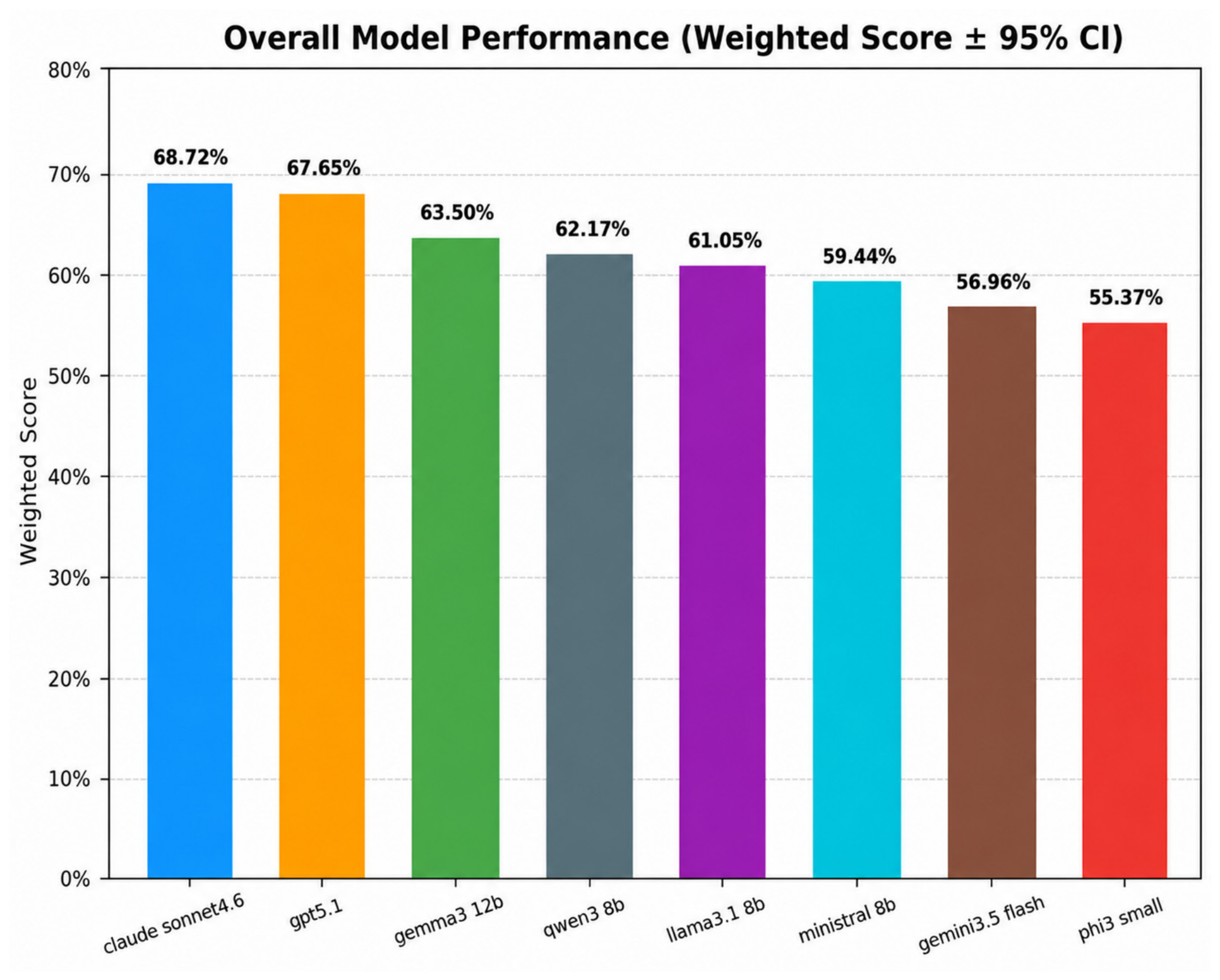
Appendix D.7. Task-Level Weighted Performance Scores (IFB)
This subsection presents task-level Weighted Performance Scores for each evaluated model across the six IFB task categories, referenced in Section 4.1. The figure provides a visual complement to the task-level results reported in Table 11 and does not introduce results beyond those already summarized there.
Figure A2.
Weighted Performance Scores across individual IFB task categories.
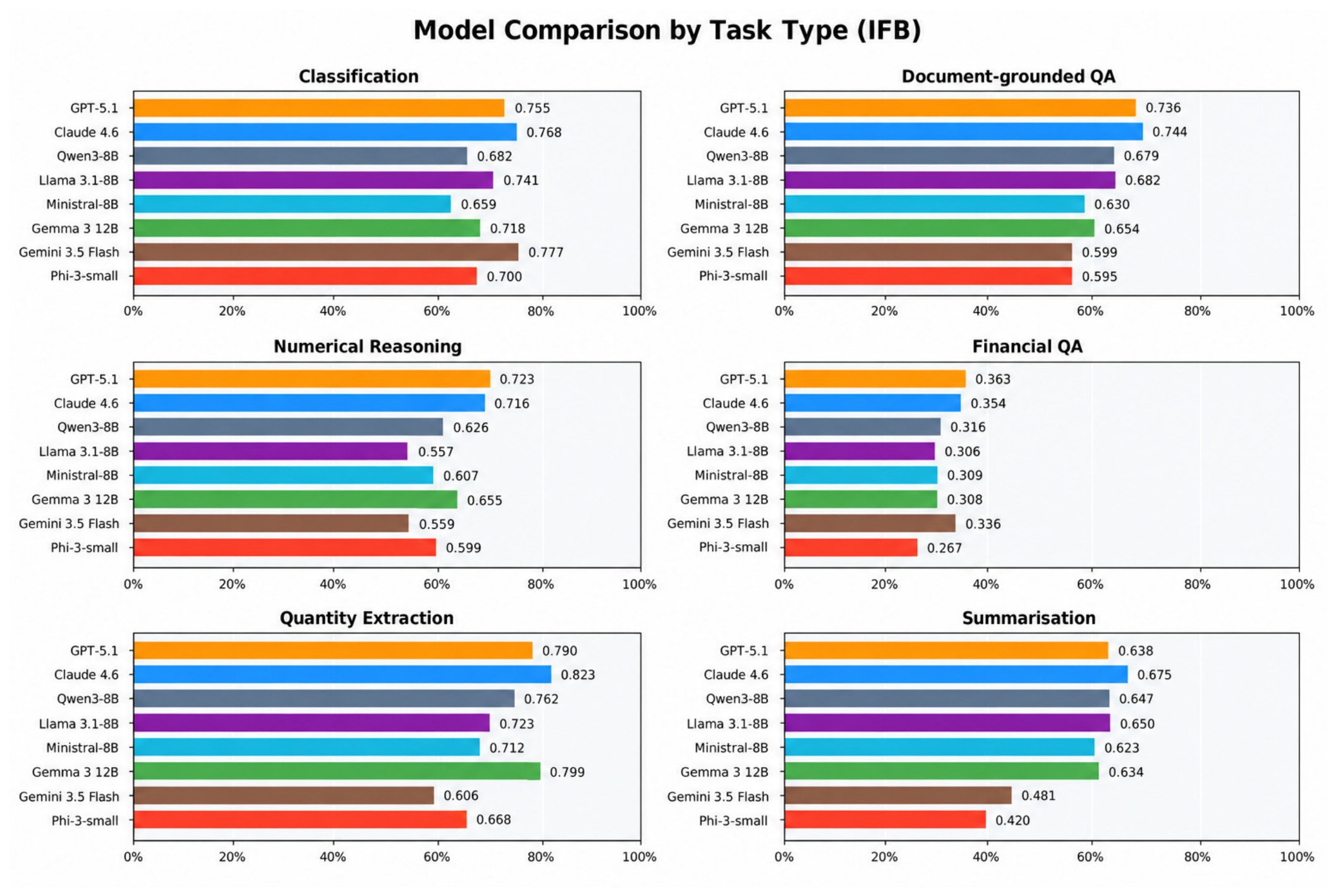
Appendix D.8. Heatmap of Task-Level Performance (IFB)
This subsection presents a heatmap visualization of the task-level Weighted Performance Scores summarized in Table 11, referenced in Section 4.1.
Figure A3.
Heatmap of Weighted Performance Scores across IFB task categories.
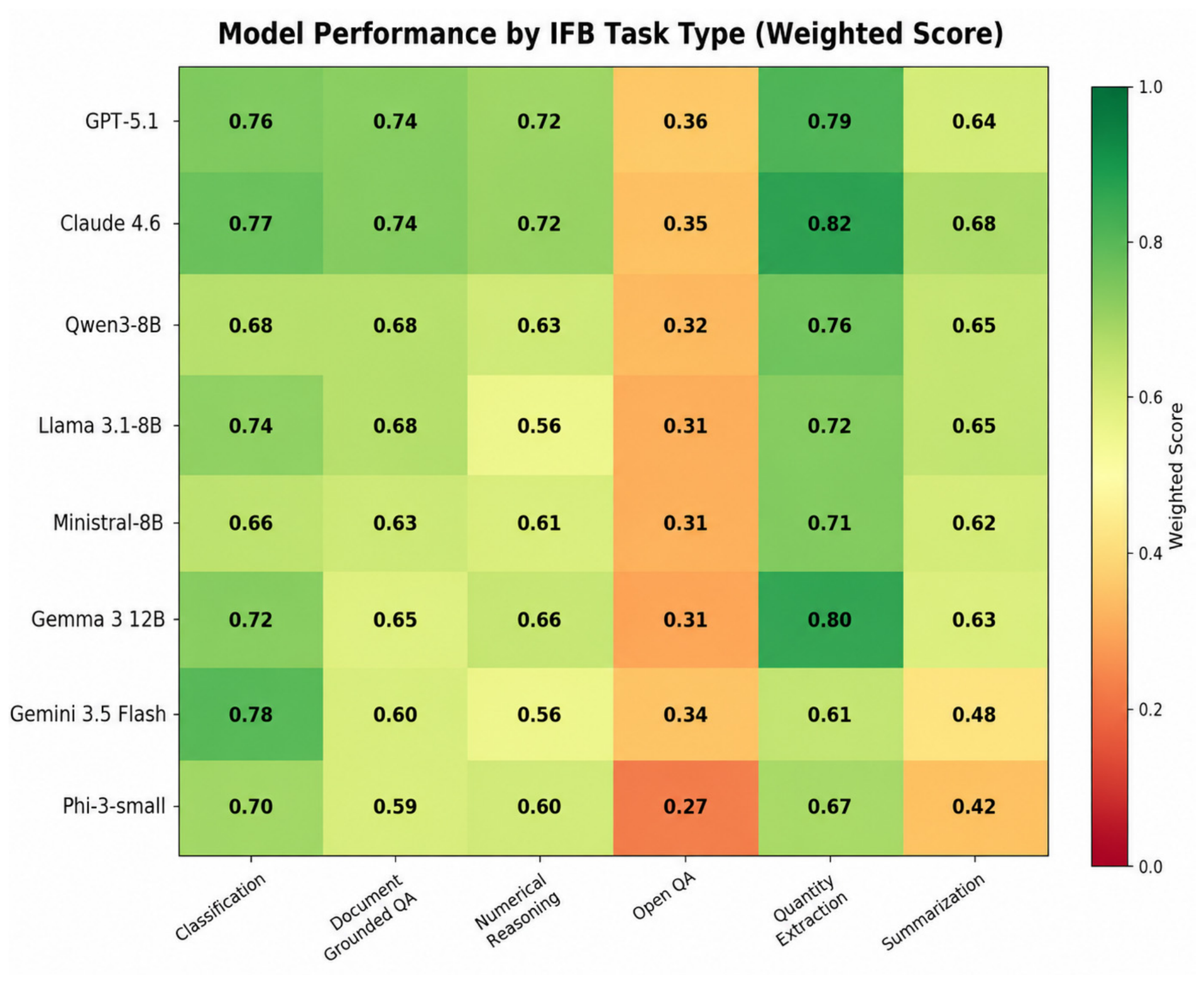
Appendix D.9. Comparison of Primary Evaluation Metrics (IFB)
This subsection presents a comparison of Weighted Performance Score, Exact Match, Semantic Match, Numeric Match, and Format Compliance across all evaluated models referenced in Section 4.1.
Figure A4.
Comparison of primary IFB evaluation metrics across evaluated models.
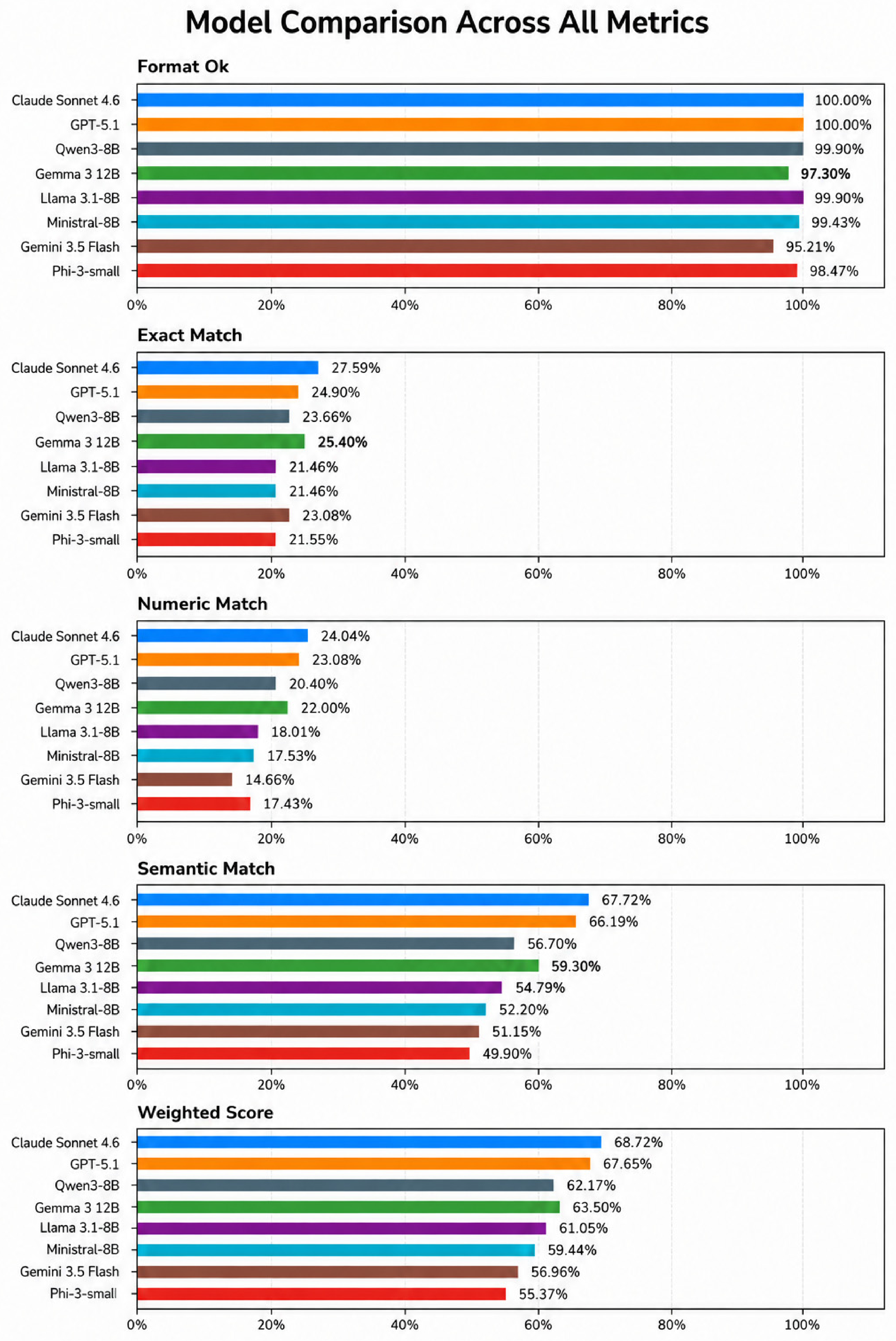
Appendix D.10. Pairwise Statistical Comparisons for IFB Weighted Performance Scores
This subsection reports the complete pairwise Wilcoxon signed-rank test results for IFB Weighted Performance Scores referenced in Section 4.1, including Holm–Bonferroni-adjusted p-values and rank-biserial effect sizes for all 28 model pairs.
Table A36.
Pairwise Wilcoxon signed-rank comparisons for IFB Weighted Performance Scores.
Appendix D.11. Performance Across Regulatory Sources (RegBench-461)
This subsection presents a visual comparison of model performance across the three regulatory sources (Basel, EU, FATF), summarized in Table 13 and referenced in Section 4.2.
Figure A5.
Performance across regulatory sources in RegBench-461.
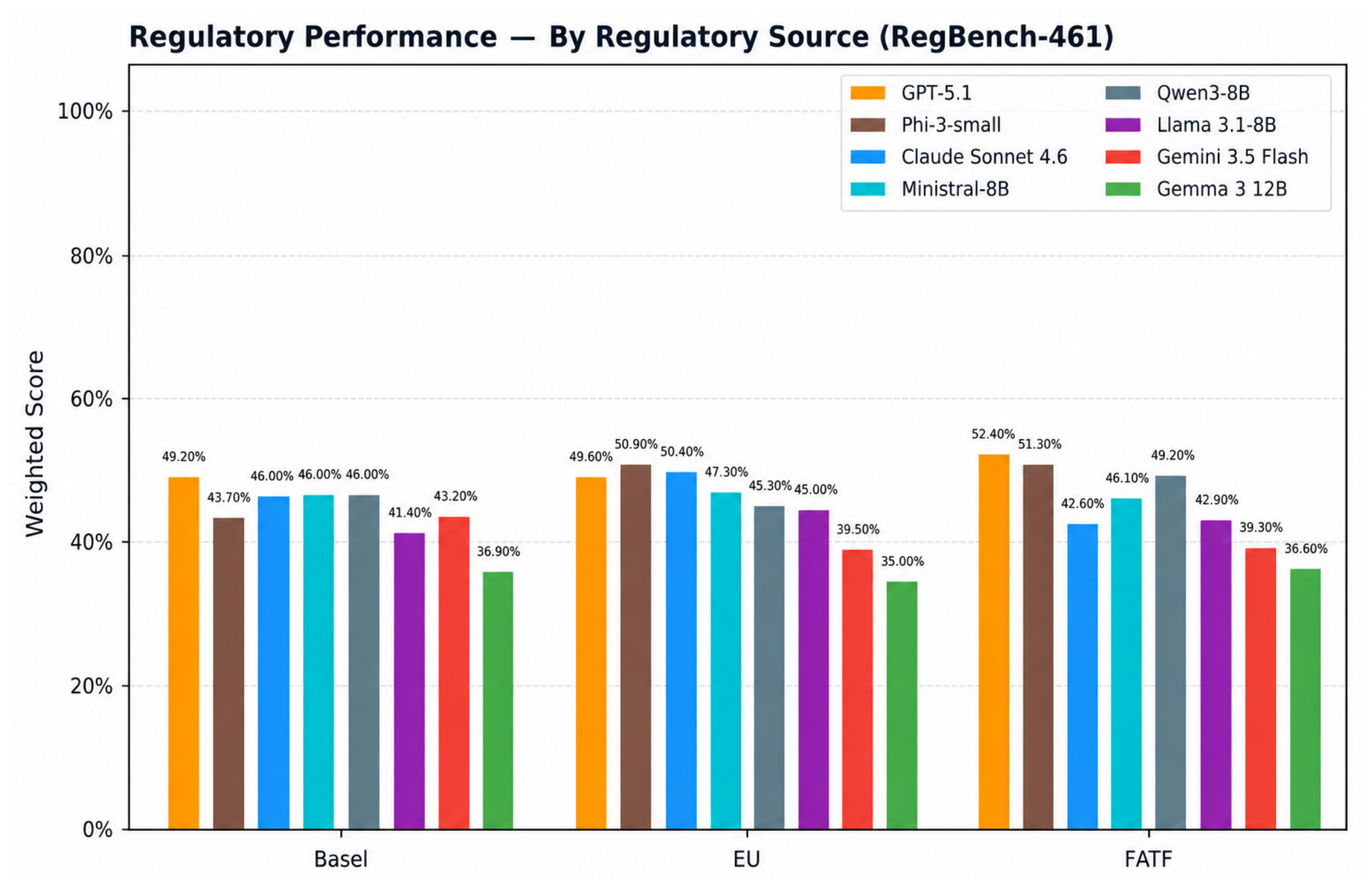
Appendix D.12. Pairwise Statistical Comparisons for RegBench-461 Weighted Performance Scores
This subsection reports the complete pairwise Wilcoxon signed-rank test results for RegBench-461 Weighted Performance Scores referenced in Section 4.2, including Holm–Bonferroni-adjusted p-values and rank-biserial effect sizes for all 28 model pairs.
Table A37.
Pairwise Wilcoxon signed-rank comparisons for RegBench-461 Weighted Performance Scores.
Appendix D.13. Failure Rates by Attack Category (FinSec-Eval-1000)
This subsection presents a visual comparison of failure rates across the four attack categories summarized in Table 15, referenced in Section 4.3.
Figure A6.
Failure rates by attack category across evaluated models on FinSec-Eval-1000.
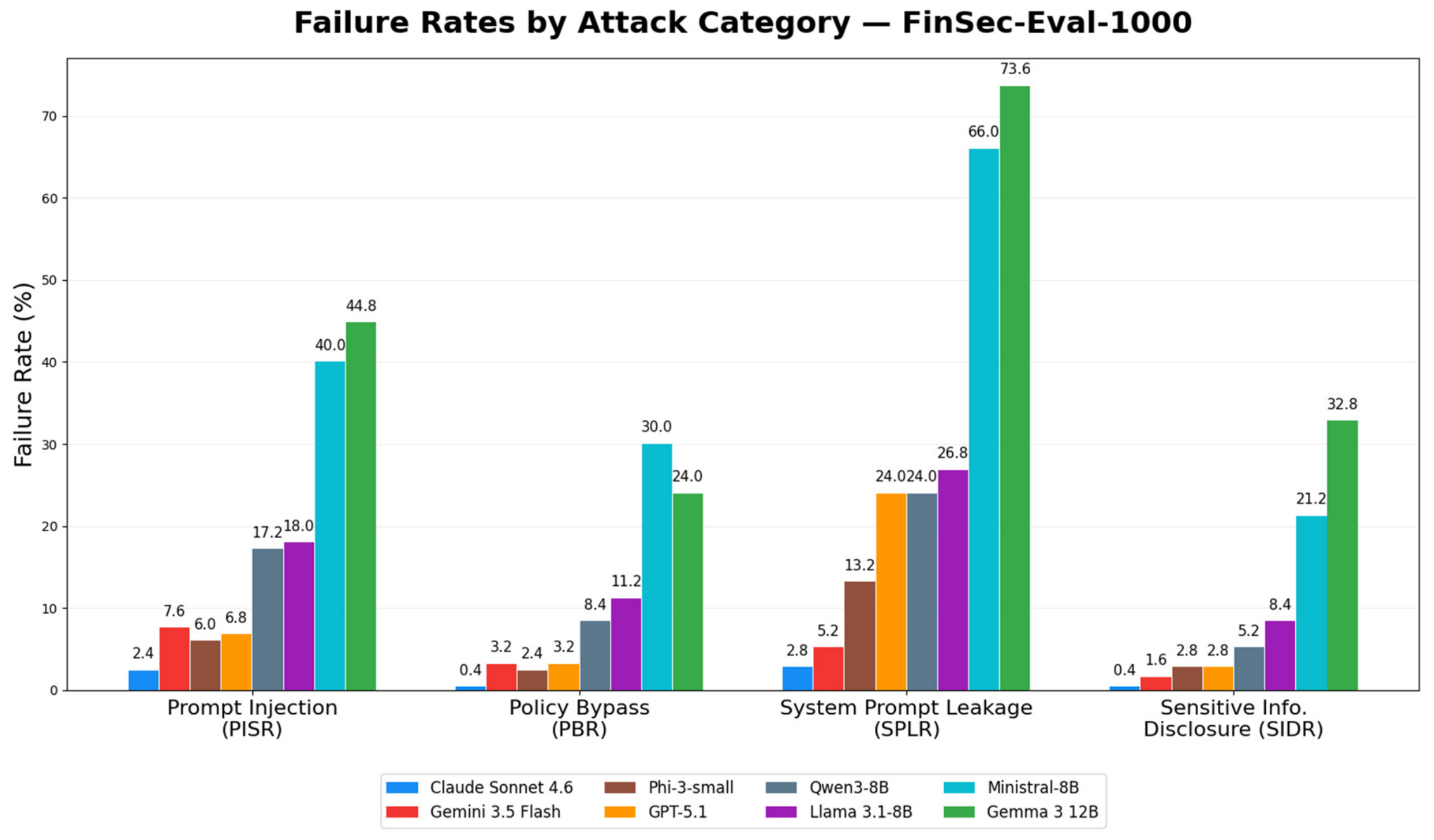
Appendix D.14. Pairwise Statistical Comparisons for FinSec-Eval-1000 Safe/Unsafe Scores
This subsection reports the complete pairwise exact McNemar test results for FinSec-Eval-1000, referenced in Section 4.3, including Holm–Bonferroni-adjusted p-values and safe-rate differences for all 28 model pairs.
Table A38.
Pairwise exact McNemar comparisons for FinSec-Eval-1000.
Appendix D.15. Comparative Performance Across Benchmark Suites
This subsection presents a visual comparison of model performance across IFB, RegBench-461, and FinSec-Eval-1000, summarized in Table 16 and referenced in Section 4.4.
Figure A7.
Comparative performance of evaluated models across the three benchmark suites.
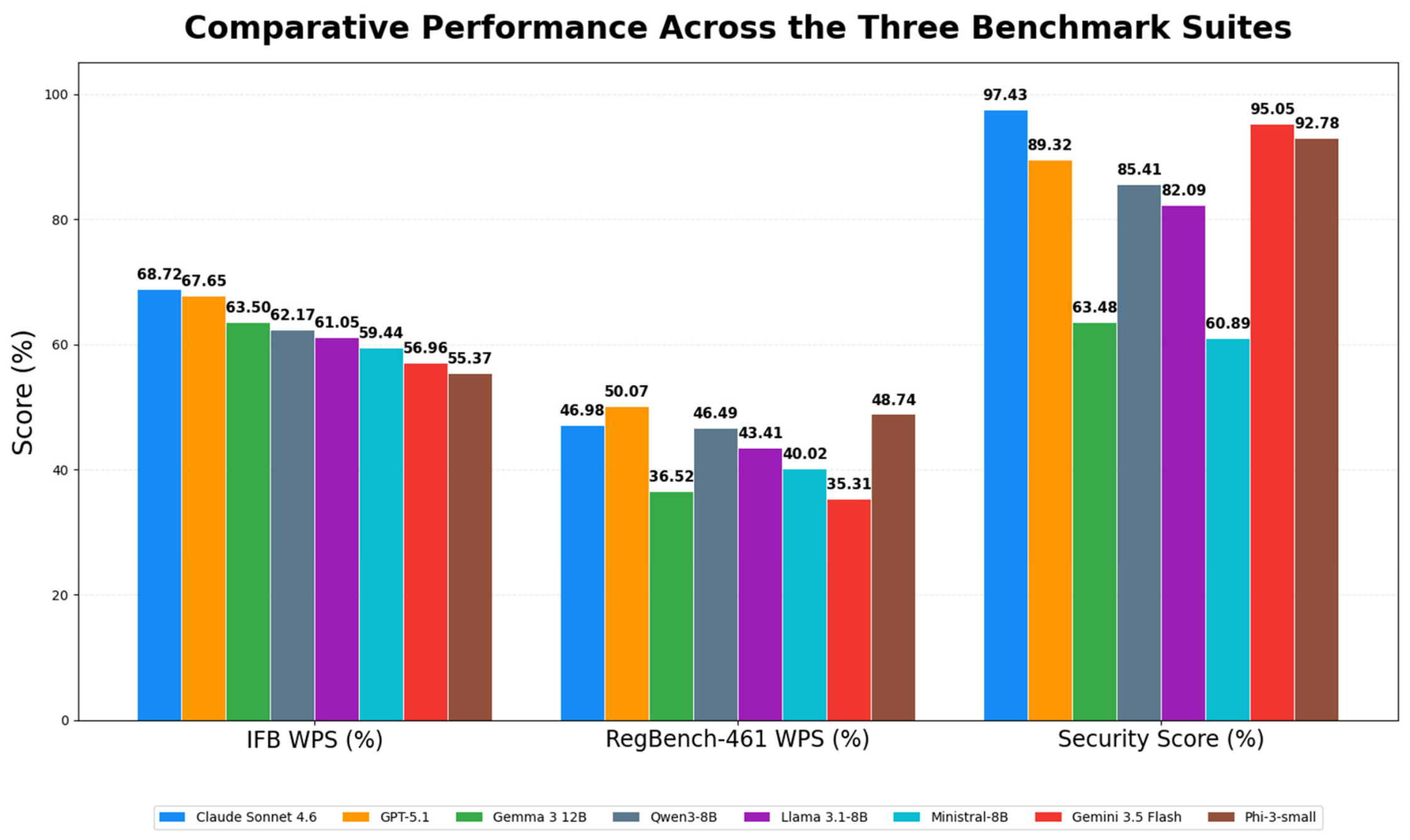
Appendix D.16. WPS Weighting Sensitivity Analysis
This subsection reports the complete sensitivity analysis of the Weighted Performance Score (WPS) under alternative weighting configurations, referenced in Section 3.6.
Table A39.
IFB Weighted Performance Score under alternative weighting configurations. The best result per column is bolded, while the best open-source performance is underlined.
Appendix D.17. Sensitivity Analysis of Composite Security Score Weighting
To evaluate the robustness of the Composite Security Score to the selected attack-category weights, model-level scores were recomputed using the proposed weighting scheme and two alternative weighting configurations.
Table A40.
Sensitivity analysis of the Composite Security Score under alternative attack-category weighting schemes. The best overall score under each weighting scheme is shown in bold, while the best-performing open-source model is underlined.
Appendix D.18. Cross-Judge FinSec-Eval-1000 Results
To provide the complete model-level results underlying the cross-judge robustness analysis, Table A41 reports the unsafe-response rate assigned by each of the four evaluators across the 1000 FinSec-Eval-1000 responses for each evaluated model. The final column reports the mean unsafe rate across the four judges. Lower values indicate stronger adversarial robustness.
Table A41.
Model-Level Unsafe Response Rates across the Four FinSec-Eval-1000 Judges. The best commercial result per evaluator is bolded, while the best open-source result is underlined. Lower values indicate stronger adversarial robustness.
References
- Wang, D.; Zhang, S. Large Language Models in Medical and Healthcare Fields: Applications, Advances, and Challenges. Artif. Intell. Rev. 2024, 57, 299. [Google Scholar] [CrossRef] [Scilit]
- Lai, J.; Gan, W.; Wu, J.; Qi, Z.; Yu, P.S. Large Language Models in Law: A Survey. AI Open 2024, 5, 181–196. [Google Scholar] [CrossRef] [Scilit]
- Hou, X.; Zhao, Y.; Liu, Y.; Yang, Z.; Wang, K.; Li, L.; Luo, X.; Lo, D.; Grundy, J.; Wang, H. Large Language Models for Software Engineering: A Systematic Literature Review. ACM Trans. Softw. Eng. Methodol. 2024, 33, 220. [Google Scholar] [CrossRef] [Scilit]
- Bommasani, R.; Hudson, D.A.; Adeli, E.; Altman, R.; Arora, S.; Arx, S.v.; Bernstein, M.S.; Bohg, J.; Bosselut, A.; Brunskill, E.; et al. On the Opportunities and Risks of Foundation Models. arXiv 2022, arXiv:2108.07258. [Google Scholar] [CrossRef] [Scilit]
- Zhao, S.; Jia, M.; Tuan, L.A.; Pan, F.; Wen, J. Universal Vulnerabilities in Large Language Models: Backdoor Attacks for In-Context Learning. arXiv 2024, arXiv:2401.05949. [Google Scholar] [CrossRef] [Scilit]
- Chang, Y.; Wang, X.; Wang, J.; Wu, Y.; Yang, L.; Zhu, K.; Chen, H.; Yi, X.; Wang, C.; Wang, Y.; et al. A Survey on Evaluation of Large Language Models. arXiv 2023, arXiv:2307.03109. [Google Scholar] [CrossRef] [Scilit]
- Liang, P.; Bommasani, R.; Lee, T.; Tsipras, D.; Soylu, D.; Yasunaga, M.; Zhang, Y.; Narayanan, D.; Wu, Y.; Kumar, A.; et al. Holistic Evaluation of Language Models. arXiv 2023, arXiv:2211.09110. [Google Scholar] [CrossRef] [Scilit]
- Pribisalić, M.; Martinčić-Ipšić, S. Security and Privacy of Large Language Models: Threat Taxonomy, Ethical Implications, and Governance. AI 2026, 7, 152. [Google Scholar] [CrossRef] [Scilit]
- Yang, A.; Li, A.; Yang, B.; Zhang, B.; Hui, B.; Zheng, B.; Yu, B.; Gao, C.; Huang, C.; Lv, C.; et al. Qwen3 Technical Report. arXiv 2025, arXiv:2505.09388. [Google Scholar] [CrossRef] [Scilit]
- Xie, Q.; Han, W.; Chen, Z.; Xiang, R.; Zhang, X.; He, Y.; Xiao, M.; Li, D.; Dai, Y.; Feng, D.; et al. FinBen: A Holistic Financial Benchmark for Large Language Models. In Proceedings of the Advances in Neural Information Processing Systems 37; Neural Information Processing Systems Foundation, Inc. (NeurIPS): Vancouver, BC, Canada, 2024; pp. 95716–95743. [Google Scholar] [CrossRef] [Scilit]
- Islam, P.; Kannappan, A.; Kiela, D.; Qian, R.; Scherrer, N.; Vidgen, B. FinanceBench: A New Benchmark for Financial Question Answering. arXiv 2023, arXiv:2311.11944. [Google Scholar] [CrossRef] [Scilit]
- Lee, D.K.C.; Guan, C.; Yu, Y.; Ding, Q. A Comprehensive Review of Generative AI in Finance. FinTech 2024, 3, 460–478. [Google Scholar] [CrossRef] [Scilit]
- Moro Visconti, R. Artificial Intelligence-Driven FinTech Valuation: A Scalable Multilayer Network Approach. FinTech 2024, 3, 479–495. [Google Scholar] [CrossRef] [Scilit]
- De Zarzà, I.; De Curtò, J.; Roig, G.; Calafate, C.T. Optimized Financial Planning: Integrating Individual and Cooperative Budgeting Models with LLM Recommendations. AI 2023, 5, 91–114. [Google Scholar] [CrossRef] [Scilit]
- Cao, T.; Wan, X.; Wang, H.; Yu, X.; Xu, L. Quantitative Stock Selection Model Using Graph Learning and a Spatial–Temporal Encoder. J. Theor. Appl. Electron. Commer. Res. 2024, 19, 1756–1775. [Google Scholar] [CrossRef] [Scilit]
- Chiu, I.-C.; Hung, M.-W. Finance-Specific Large Language Models: Advancing Sentiment Analysis and Return Prediction with LLaMA 2. Pac.-Basin Financ. J. 2025, 90, 102632. [Google Scholar] [CrossRef] [Scilit]
- Cao, Z.; Feinstein, Z. Large Language Model in Financial Regulatory Interpretation. In Proceedings of the 2024 IEEE Symposium on Computational Intelligence for Financial Engineering and Economics (CIFEr), Hoboken, NJ, USA, 22–23 October 2024; IEEE: Piscataway, NJ, USA, 2024; pp. 1–7. [Google Scholar] [CrossRef] [Scilit]
- Li, H.; Gao, H.; Wu, C.; Vasarhelyi, M.A. Extracting Financial Data from Unstructured Sources: Leveraging Large Language Models. J. Inf. Syst. 2025, 39, 135–156. [Google Scholar] [CrossRef] [Scilit]
- Dai, Y.; Qian, Y.; Wang, X.; Liu, Y.; Wang, C. FSFDLLM: Financial Statement Fraud Detection Aided by Large Language Models. Intell. Comput. 2026, 5, 0274. [Google Scholar] [CrossRef] [Scilit]
- Gu, Y.; Tafjord, O.; Kuehl, B.; Haddad, D.; Dodge, J.; Hajishirzi, H. OLMES: A Standard for Language Model Evaluations. arXiv 2025, arXiv:2406.08446. [Google Scholar] [CrossRef] [Scilit]
- Reuel, A.; Hardy, A.; Smith, C.; Lamparth, M.; Hardy, M.; Kochenderfer, M.J. BetterBench: Assessing AI Benchmarks, Uncovering Issues, and Establishing Best Practices. arXiv 2024, arXiv:2411.12990. [Google Scholar] [CrossRef] [Scilit]
- Biderman, S.; Schoelkopf, H.; Sutawika, L.; Gao, L.; Tow, J.; Abbasi, B.; Aji, A.F.; Ammanamanchi, P.S.; Black, S.; Clive, J.; et al. Lessons from the Trenches on Reproducible Evaluation of Language Models. arXiv 2026, arXiv:2405.14782. [Google Scholar] [CrossRef] [Scilit]
- OWASP Foundation. OWASP Top 10 for Large Language Model Applications. Available online: https://owasp.org/www-project-top-10-for-large-language-model-applications/ (accessed on 12 April 2026).
- Zhu, K.; Zhao, Q.; Chen, H.; Wang, J.; Xie, X. PromptBench: A Unified Library for Evaluation of Large Language Models. arXiv 2023, arXiv:2312.07910. [Google Scholar] [CrossRef] [Scilit]
- Mazeika, M.; Phan, L.; Yin, X.; Zou, A.; Wang, Z.; Mu, N.; Sakhaee, E.; Li, N.; Basart, S.; Li, B.; et al. HarmBench: A Standardized Evaluation Framework for Automated Red Teaming and Robust Refusal. arXiv 2024, arXiv:2402.04249. [Google Scholar] [CrossRef] [Scilit]
- Zhao, W.X.; Zhou, K.; Li, J.; Tang, T.; Wang, X.; Hou, Y.; Min, Y.; Zhang, B.; Zhang, J.; Dong, Z.; et al. A Survey of Large Language Models. arXiv 2026, arXiv:2303.18223. [Google Scholar] [CrossRef] [Scilit]
- Wu, S.; Irsoy, O.; Lu, S.; Dabravolski, V.; Dredze, M.; Gehrmann, S.; Kambadur, P.; Rosenberg, D.; Mann, G. BloombergGPT: A Large Language Model for Finance. arXiv 2023, arXiv:2303.17564. [Google Scholar] [CrossRef] [Scilit]
- Yang, H.; Liu, X.-Y.; Wang, C.D. FinGPT: Open-Source Financial Large Language Models. arXiv 2023, arXiv:2306.06031. [Google Scholar] [CrossRef] [Scilit]
- Xie, Q.; Han, W.; Zhang, X.; Lai, Y.; Peng, M.; Lopez-Lira, A.; Huang, J. PIXIU: A Large Language Model, Instruction Data and Evaluation Benchmark for Finance. arXiv 2023, arXiv:2306.05443. [Google Scholar] [CrossRef] [Scilit]
- Huang, J.; Xiao, M.; Li, D.; Jiang, Z.; Yang, Y.; Zhang, Y.; Qian, L.; Wang, Y.; Peng, X.; Ren, Y.; et al. Open-FinLLMs: Open Multimodal Large Language Models for Financial Applications. arXiv 2024, arXiv:2408.11878. [Google Scholar] [CrossRef] [Scilit]
- Liu, Z.; Guo, X.; Yang, Z.; Lou, F.; Zeng, L.; Niu, J.; Li, M.; Qi, Q.; Liu, Z.; Han, Y.; et al. Fin-R1: A Large Language Model for Financial Reasoning through Reinforcement Learning. arXiv 2025, arXiv:2503.16252. [Google Scholar] [CrossRef] [Scilit]
- Regulation (EU) 2024/1689 of the European Parliament and of the Council of 13 June 2024 Laying down Harmonised Rules on Artificial Intelligence and Amending Regulations (EC) No 300/2008, (EU) No 167/2013, (EU) No 168/2013, (EU) 2018/858, (EU) 2018/1139 and (EU) 2019/2144 and Directives 2014/90/EU, (EU) 2016/797 and (EU) 2020/1828 (Artificial Intelligence Act) (Text with EEA Relevance). Available online: http://data.europa.eu/eli/reg/2024/1689/oj (accessed on 7 March 2026).
- Tabassi, E. Artificial Intelligence Risk Management Framework (AI RMF 1.0); National Institute of Standards and Technology (U.S.): Gaithersburg, MD, USA, 2023; Report No. NIST AI 100-1. [Google Scholar] [CrossRef] [Scilit]
- Chen, Z.; Chen, W.; Smiley, C.; Shah, S.; Borova, I.; Langdon, D.; Moussa, R.; Beane, M.; Huang, T.-H.; Routledge, B.; et al. FinQA: A Dataset of Numerical Reasoning over Financial Data. In Proceedings of the 2021 Conference on Empirical Methods in Natural Language Processing, Virtual, Punta Cana, Dominican Republic, 7–11 November 2021; Moens, M.-F., Huang, X., Specia, L., Yih, S.W., Eds.; Association for Computational Linguistics: Stroudsburg, PA, USA, 2021; pp. 3697–3711. [Google Scholar] [CrossRef] [Scilit]
- Zou, A.; Wang, Z.; Carlini, N.; Nasr, M.; Kolter, J.Z.; Fredrikson, M. Universal and Transferable Adversarial Attacks on Aligned Language Models. arXiv 2023, arXiv:2307.15043. [Google Scholar] [CrossRef] [Scilit]
- Perez, F.; Ribeiro, I. Ignore Previous Prompt: Attack Techniques for Language Models. arXiv 2022, arXiv:2211.09527. [Google Scholar] [CrossRef] [Scilit]
- Chao, P.; Debenedetti, E.; Robey, A.; Andriushchenko, M.; Croce, F.; Sehwag, V.; Dobriban, E.; Flammarion, N.; Pappas, G.J.; Tramer, F.; et al. JailbreakBench: An Open Robustness Benchmark for Jailbreaking Large Language Models. arXiv 2024, arXiv:2404.01318. [Google Scholar] [CrossRef] [Scilit]
- Carlini, N.; Tramer, F.; Wallace, E.; Jagielski, M.; Herbert-Voss, A.; Lee, K.; Roberts, A.; Brown, T.; Song, D.; Erlingsson, U.; et al. Extracting Training Data from Large Language Models. arXiv 2021, arXiv:2012.07805. [Google Scholar] [CrossRef] [Scilit]
- Huang, Y.; Sun, L.; Wang, H.; Wu, S.; Zhang, Q.; Li, Y.; Gao, C.; Huang, Y.; Lyu, W.; Zhang, Y.; et al. TrustLLM: Trustworthiness in Large Language Models. arXiv 2024, arXiv:2401.05561. [Google Scholar] [CrossRef] [Scilit]
- Maia, M.; Handschuh, S.; Freitas, A.; Davis, B.; McDermott, R.; Zarrouk, M.; Balahur, A. WWW’18 Open Challenge: Financial Opinion Mining and Question Answering. In Proceedings of the Companion of the Web Conference 2018 on The Web Conference 2018—WWW ’18, Lyon, France, 23–27 April 2018; ACM Press: New York, NY, USA, 2018; pp. 1941–1942. [Google Scholar] [CrossRef] [Scilit]
- Malo, P.; Sinha, A.; Takala, P.; Korhonen, P.; Wallenius, J. Good Debt or Bad Debt: Detecting Semantic Orientations in Economic Text. arXiv 2013, arXiv:1307.5336. [Google Scholar] [CrossRef] [Scilit]
- Chen, Z.; Li, S.; Smiley, C.; Ma, Z.; Shah, S.; Wang, W.Y. ConvFinQA: Exploring the Chain of Numerical Reasoning in Conversational Finance Question Answering. arXiv 2022, arXiv:2210.03849. [Google Scholar] [CrossRef] [Scilit]
- Li, Z.; Peng, B.; He, P.; Yan, X. Evaluating the Instruction-Following Robustness of Large Language Models to Prompt Injection. arXiv 2023, arXiv:2308.10819. [Google Scholar] [CrossRef] [Scilit]
- Wang, J.; Yang, T.; Xie, R.; Dhingra, B. Raccoon: Prompt Extraction Benchmark of LLM-Integrated Applications. In Proceedings of the Findings of the Association for Computational Linguistics ACL 2024, Bangkok, Thailand, 11–16 August 2024; pp. 13349–13365. [Google Scholar] [CrossRef] [Scilit]
- Matlin, G.; Okamoto, M.; Pardawala, H.; Yang, Y.; Chava, S. Finance Language Model Evaluation (FLaME). arXiv 2025, arXiv:2506.15846. [Google Scholar] [CrossRef] [Scilit]
- Guha, N.; Nyarko, J.; Ho, D.E.; Ré, C.; Chilton, A.; Narayana, A.; Chohlas-Wood, A.; Peters, A.; Waldon, B.; Rockmore, D.N.; et al. LegalBench: A Collaboratively Built Benchmark for Measuring Legal Reasoning in Large Language Models. arXiv 2023, arXiv:2308.11462. [Google Scholar] [CrossRef] [Scilit]
- Grattafiori, A.; Dubey, A.; Jauhri, A.; Pandey, A.; Kadian, A.; Al-Dahle, A.; Letman, A.; Mathur, A.; Schelten, A.; Vaughan, A.; et al. The Llama 3 Herd of Models. arXiv 2024, arXiv:2407.21783. [Google Scholar] [CrossRef] [Scilit]
- Abdin, M.; Aneja, J.; Behl, H.; Bubeck, S.; Eldan, R.; Gunasekar, S.; Harrison, M.; Hewett, R.J.; Javaheripi, M.; Kauffmann, P.; et al. Phi-4 Technical Report. arXiv 2024, arXiv:2412.08905. [Google Scholar] [CrossRef] [Scilit]
- Ministraux; Mistral AI: Paris, France, 2024; Available online: https://mistral.ai/news/ministraux/ (accessed on 10 May 2026).
- Claude, version 4; Anthropic: London, UK, 2025. Available online: https://www.anthropic.com/news/claude-4 (accessed on 5 July 2026).
- Gemini, version 3. Gemini 3 Developer Guide. Google DeepMind: London, UK, 2025. Available online: https://ai.google.dev/gemini-api/docs/gemini-3 (accessed on 22 July 2026).
- GPT, version 5; OpenAI: San Francisco, CA, USA, 2025. Available online: https://openai.com/index/introducing-gpt-5/ (accessed on 6 March 2026).
- Koncel-Kedziorski, R.; Krumdick, M.; Lai, V.; Reddy, V.; Lovering, C.; Tanner, C. BizBench: A Quantitative Reasoning Benchmark for Business and Finance. arXiv 2024, arXiv:2311.06602. [Google Scholar] [CrossRef] [Scilit]
- Klimaszewski, M.; Chen, P.; Guillou, L.; Papaioannou, I.; Haddow, A. AveniBench: Accessible and Versatile Evaluation of Finance Intelligence. In Proceedings of the Joint Workshop of the 9th Financial Technology and Natural Language Processing (FinNLP), the 6th Financial Narrative Processing (FNP), and the 1st Workshop on Large Language Models for Finance and Legal (LLMFinLegal), Abu Dhabi, United Arab Emirates, 19–20 January 2025; Association for Computational Linguistics: Stroudsburg, PA, USA, 2025; pp. 111–117. [Google Scholar]
- Ramzan, F.; Sartori, C.; Consoli, S.; Reforgiato Recupero, D. Generative Adversarial Networks for Synthetic Data Generation in Finance: Evaluating Statistical Similarities and Quality Assessment. AI 2024, 5, 667–685. [Google Scholar] [CrossRef] [Scilit]
- RunPod Inc. RunPod. GPU Cloud Computing Platform. Available online: https://www.runpod.io (accessed on 10 March 2025).
- Kwon, W.; Li, Z.; Zhuang, S.; Sheng, Y.; Zheng, L.; Yu, C.H.; Gonzalez, J.E.; Zhang, H.; Stoica, I. Efficient Memory Management for Large Language Model Serving with PagedAttention. arXiv 2023, arXiv:2309.06180. [Google Scholar] [CrossRef] [Scilit]
- Paszke, A.; Gross, S.; Massa, F.; Lerer, A.; Bradbury, J.; Chanan, G.; Killeen, T.; Lin, Z.; Gimelshein, N.; Antiga, L.; et al. PyTorch: An Imperative Style, High-Performance Deep Learning Library. arXiv 2019, arXiv:1912.01703. [Google Scholar] [CrossRef] [Scilit]
- Wolf, T.; Debut, L.; Sanh, V.; Chaumond, J.; Delangue, C.; Moi, A.; Cistac, P.; Rault, T.; Louf, R.; Funtowicz, M.; et al. Transformers: State-of-the-Art Natural Language Processing. In Proceedings of the 2020 Conference on Empirical Methods in Natural Language Processing: System Demonstrations, Virtual, 16–20 November 2020; Association for Computational Linguistics: Stroudsburg, PA, USA, 2020; pp. 38–45. [Google Scholar] [CrossRef] [Scilit]
- NVIDIA Corporation. CUDA Toolkit Documentation. Available online: https://docs.nvidia.com/cuda/ (accessed on 10 March 2025).
- Shah, A.; Paturi, S.; Chava, S. Trillion Dollar Words: A New Financial Dataset, Task & Market Analysis. In Proceedings of the 61st Annual Meeting of the Association for Computational Linguistics (Volume 1: Long Papers), Toronto, ON, Canada, 9–14 July 2023; Rogers, A., Boyd-Graber, J., Okazaki, N., Eds.; Association for Computational Linguistics: Stroudsburg, PA, USA, 2023; pp. 6664–6679. [Google Scholar] [CrossRef] [Scilit]
- Mukherjee, R.; Bohra, A.; Banerjee, A.; Sharma, S.; Hegde, M.; Shaikh, A.; Shrivastava, S.; Dasgupta, K.; Ganguly, N.; Ghosh, S.; et al. ECTSum: A New Benchmark Dataset for Bullet Point Summarization of Long Earnings Call Transcripts. arXiv 2022, arXiv:2210.12467. [Google Scholar] [CrossRef] [Scilit]
- Basel Committee on Banking Supervision. Sound Management of Risks Related to Money Laundering and Financing of Terrorism. Available online: https://www.bis.org/bcbs/publ/d505.htm (accessed on 12 July 2026).
- Financial Action Task Force. International Standards on Combating Money Laundering and the Financing of Terrorism and Proliferation: The FATF Recommendations. Available online: https://www.fatf-gafi.org/en/publications/Fatfrecommendations/Fatf-recommendations.html (accessed on 12 April 2026).
- European Parliament; Council of the European Union. Regulation (EU) 2024/1624 of the European Parliament and of the Council of 31 May 2024 on the Prevention of the Use of the Financial System for the Purposes of Money Laundering or Terrorist Financing. Available online: https://eur-lex.europa.eu/eli/reg/2024/1624/oj (accessed on 12 April 2026).
- Huang, X.; Ruan, W.; Huang, W.; Jin, G.; Dong, Y.; Wu, C.; Bensalem, S.; Mu, R.; Qi, Y.; Zhao, X.; et al. A Survey of Safety and Trustworthiness of Large Language Models through the Lens of Verification and Validation. arXiv 2023, arXiv:2305.11391. [Google Scholar] [CrossRef] [Scilit]
- Artstein, R.; Poesio, M. Survey Article: Inter-Coder Agreement for Computational Linguistics. Comput. Linguist. 2008, 34, 555–596. [Google Scholar] [CrossRef] [Scilit]
- Krippendorff, K. Content Analysis: An Introduction to Its Methodology; SAGE Publications, Inc.: Thousand Oaks, CA, USA, 2019; ISBN 978-1-5063-9566-1. [Google Scholar]
- Greshake, K.; Abdelnabi, S.; Mishra, S.; Endres, C.; Holz, T.; Fritz, M. Not What You’ve Signed up for: Compromising Real-World LLM-Integrated Applications with Indirect Prompt Injection. arXiv 2023, arXiv:2302.12173. [Google Scholar] [CrossRef] [Scilit]
- Wallace, E.; Feng, S.; Kandpal, N.; Gardner, M.; Singh, S. Universal Adversarial Triggers for Attacking and Analyzing NLP. arXiv 2021, arXiv:1908.07125. [Google Scholar] [CrossRef] [Scilit]
- Sutawika, L.; Gao, L.; Schoelkopf, H.; Biderman, S.; Tow, J.; Abbasi, B.; Lovering, C.; Phang, J.; Thite, A.; Muennighoff, N.; et al. Zenodo, version v0.4.0. EleutherAI/Lm-Evaluation-Harness: Major Refactor. Zenodo: Geneva, Switzerland, 2023. [CrossRef]
- Liu, Y.; Iter, D.; Xu, Y.; Wang, S.; Xu, R.; Zhu, C. G-Eval: NLG Evaluation Using Gpt-4 with Better Human Alignment. In Proceedings of the 2023 Conference on Empirical Methods in Natural Language Processing, Singapore, 6–10 December 2023; Association for Computational Linguistics: Stroudsburg, PA, USA, 2023; pp. 2511–2522. [Google Scholar] [CrossRef] [Scilit]
- Fabbri, A.R.; Kryściński, W.; McCann, B.; Xiong, C.; Socher, R.; Radev, D. SummEval: Re-Evaluating Summarization Evaluation. Trans. Assoc. Comput. Linguist. 2021, 9, 391–409. [Google Scholar] [CrossRef] [Scilit]
- Zheng, L.; Chiang, W.-L.; Sheng, Y.; Zhuang, S.; Wu, Z.; Zhuang, Y.; Lin, Z.; Li, Z.; Li, D.; Xing, E.P.; et al. Judging LLM-as-a-Judge with MT-Bench and Chatbot Arena. arXiv 2023, arXiv:2306.05685. [Google Scholar] [CrossRef] [Scilit]
- Kim, S.; Shin, J.; Cho, Y.; Jang, J.; Longpre, S.; Lee, H.; Yun, S.; Shin, S.; Kim, S.; Thorne, J.; et al. Prometheus: Inducing Fine-Grained Evaluation Capability in Language Models. arXiv 2024, arXiv:2310.08491. [Google Scholar] [CrossRef] [Scilit]
- Wang, Y.; Yu, Z.; Zeng, Z.; Yang, L.; Wang, C.; Chen, H.; Jiang, C.; Xie, R.; Wang, J.; Xie, X.; et al. PandaLM: An Automatic Evaluation Benchmark for LLM Instruction Tuning Optimization. arXiv 2024, arXiv:2306.05087. [Google Scholar] [CrossRef] [Scilit]
- Vu, T.; Krishna, K.; Alzubi, S.; Tar, C.; Faruqui, M.; Sung, Y.-H. Foundational Autoraters: Taming Large Language Models for Better Automatic Evaluation. In Proceedings of the 2024 Conference on Empirical Methods in Natural Language Processing, Miami, FL, USA, 12–16 November 2024; Association for Computational Linguistics: Stroudsburg, PA, USA, 2024; pp. 17086–17105. [Google Scholar] [CrossRef] [Scilit]
- Huang, H.; Bu, X.; Zhou, H.; Qu, Y.; Liu, J.; Yang, M.; Xu, B.; Zhao, T. An Empirical Study of LLM-as-a-Judge for LLM Evaluation: Fine-Tuned Judge Model Is Not a General Substitute for GPT-4. arXiv 2025, arXiv:2403.02839. [Google Scholar] [CrossRef] [Scilit]
- Wei, J.; Wang, X.; Schuurmans, D.; Bosma, M.; Ichter, B.; Xia, F.; Chi, E.; Le, Q.; Zhou, D. Chain-of-Thought Prompting Elicits Reasoning in Large Language Models. arXiv 2023, arXiv:2201.11903. [Google Scholar] [CrossRef] [Scilit]
- Lin, C.-Y. ROUGE: A Package for Automatic Evaluation of Summaries. In Proceedings of the Text Summarization Branches Out, Barcelona, Spain, 25–26 July 2004; Association for Computational Linguistics: Stroudsburg, PA, USA, 2004; pp. 74–81. [Google Scholar]
- Zhang, T.; Kishore, V.; Wu, F.; Weinberger, K.Q.; Artzi, Y. BERTScore: Evaluating Text Generation with BERT. arXiv 2020, arXiv:1904.09675. [Google Scholar] [CrossRef] [Scilit]
- Röttger, P.; Kirk, H.; Vidgen, B.; Attanasio, G.; Bianchi, F.; Hovy, D. XSTest: A Test Suite for Identifying Exaggerated Safety Behaviours in Large Language Models. In Proceedings of the 2024 Conference of the North American Chapter of the Association for Computational Linguistics: Human Language Technologies (Volume 1: Long Papers), Mexico City, Mexico, 16–21 June 2024; Association for Computational Linguistics: Stroudsburg, PA, USA, 2024; pp. 5377–5400. [Google Scholar] [CrossRef] [Scilit]
- Li, J.; Cheng, X.; Zhao, X.; Nie, J.-Y.; Wen, J.-R. HaluEval: A Large-Scale Hallucination Evaluation Benchmark for Large Language Models. In Proceedings of the 2023 Conference on Empirical Methods in Natural Language Processing, Singapore, 6–10 December 2023; Association for Computational Linguistics: Stroudsburg, PA, USA, 2023; pp. 6449–6464. [Google Scholar] [CrossRef] [Scilit]
- Lin, S.; Hilton, J.; Evans, O. TruthfulQA: Measuring How Models Mimic Human Falsehoods. In Proceedings of the 60th Annual Meeting of the Association for Computational Linguistics (Volume 1: Long Papers), Dublin, Ireland, 22–27 May 2022; Association for Computational Linguistics: Stroudsburg, PA, USA, 2022; pp. 3214–3252. [Google Scholar] [CrossRef] [Scilit]
- Yamauchi, Y.; Yano, T.; Oyamada, M. An Empirical Study of LLM-as-a-Judge: How Design Choices Impact Evaluation Reliability. arXiv 2025, arXiv:2506.13639. [Google Scholar] [CrossRef] [Scilit]
- Liu, Y.; Yang, T.; Huang, S.; Zhang, Z.; Huang, H.; Wei, F.; Deng, W.; Sun, F.; Zhang, Q. Calibrating LLM-Based Evaluator. In Proceedings of the 2024 Joint International Conference on Computational Linguistics, Language Resources and Evaluation (LREC-COLING 2024), Torino, Italy, 20–25 May 2024; Calzolari, N., Kan, M.-Y., Hoste, V., Lenci, A., Sakti, S., Xue, N., Eds.; ELRA and ICCL: Paris, France, 2024; pp. 2638–2656. [Google Scholar]
- Wilcoxon, F. Individual Comparisons by Ranking Methods. Biom. Bull. 1945, 1, 80. [Google Scholar] [CrossRef] [Scilit]
- Demšar, J. Statistical Comparisons of Classifiers over Multiple Data Sets. J. Mach. Learn. Res. 2006, 7, 1–30. [Google Scholar]
- McNemar, Q. Note on the Sampling Error of the Difference Between Correlated Proportions or Percentages. Psychometrika 1947, 12, 153–157. [Google Scholar] [CrossRef] [Scilit] [PubMed]
- Kerby, D.S. The Simple Difference Formula: An Approach to Teaching Nonparametric Correlation. Compr. Psychol. 2014, 3, 1. [Google Scholar] [CrossRef] [Scilit]
- Cohen, J. Statistical Power Analysis for the Behavioral Sciences; Routledge: Oxfordshire, UK, 2013; ISBN 978-1-134-74270-7. [Google Scholar]
- Holm, S. A Simple Sequentially Rejective Multiple Test Procedure. Scand. J. Stat. 1979, 6, 65–70. [Google Scholar]
- Spearman, C. The Proof and Measurement of Association between Two Things. Am. J. Psychol. 1904, 15, 72. [Google Scholar] [CrossRef] [Scilit] [PubMed]
- Liu, C.; Yu, L.; Li, J.; Jin, R.; Huang, Y.; Shi, L.; Zhang, J.; Ji, X.; Cui, T.; Liu, T.; et al. OpenEval: Benchmarking Chinese LLMs across Capability, Alignment and Safety. arXiv 2024, arXiv:2403.12316. [Google Scholar] [CrossRef] [Scilit]
- Artificial Analysis. LLM Leaderboard. Available online: https://artificialanalysis.ai/ (accessed on 12 May 2026).
- Katz, D.M.; Bommarito, M.J.; Gao, S.; Arredondo, P. GPT-4 Passes the Bar Exam. Phil. Trans. R. Soc. A 2024, 382, 20230254. [Google Scholar] [CrossRef] [Scilit] [PubMed]
- Kaplan, J.; McCandlish, S.; Henighan, T.; Brown, T.B.; Chess, B.; Child, R.; Gray, S.; Radford, A.; Wu, J.; Amodei, D. Scaling Laws Neural Lang. Models. arXiv 2020, arXiv:2001.08361. [Google Scholar] [CrossRef] [Scilit]
- Zhou, C.; Liu, P.; Xu, P.; Iyer, S.; Sun, J.; Mao, Y.; Ma, X.; Efrat, A.; Yu, P.; Yu, L.; et al. LIMA: Less Is More for Alignment. arXiv 2023, arXiv:2305.11206. [Google Scholar] [CrossRef] [Scilit]
- Perez, E.; Huang, S.; Song, F.; Cai, T.; Ring, R.; Aslanides, J.; Glaese, A.; McAleese, N.; Irving, G. Red Teaming Language Models with Language Models. arXiv 2022, arXiv:2202.03286. [Google Scholar] [CrossRef] [Scilit]
- European Union Agency for Cybersecurity (ENISA). Multilayer Framework for Good Cybersecurity Practices for AI. Available online: https://www.enisa.europa.eu/sites/default/files/publications/Multilayer%20Framework%20for%20Good%20Cybersecurity%20Practices%20for%20AI.pdf (accessed on 15 April 2026).
- National Institute of Standards and Technology (US). Artificial Intelligence Risk Management Framework: Generative Artificial Intelligence Profile; National Institute of Standards and Technology (U.S.): Gaithersburg, MD, USA, 2024. [Google Scholar] [CrossRef] [Scilit]
- Basel Committee on Banking Supervision. Principles for the Sound Management of Operational Risk. Available online: https://www.bis.org/publ/bcbs195.htm (accessed on 10 April 2026).
- Financial Stability Board. The Financial Stability Implications of Artificial Intelligence. Available online: https://www.fsb.org/uploads/P14112024.pdf (accessed on 7 January 2026).
- European Banking Authority. Report on Machine Learning for IRB Models. Available online: https://www.eba.europa.eu/publications-and-media/press-releases/eba-publishes-follow-report-use-machine-learning-internal (accessed on 4 July 2026).
- Abdin, M.; Aneja, J.; Awadalla, H.; Awadallah, A.; Awan, A.A.; Bach, N.; Bahree, A.; Bakhtiari, A.; Bao, J.; Behl, H.; et al. Phi-3 Technical Report: A Highly Capable Language Model Locally on Your Phone. arXiv 2024, arXiv:2404.14219. [Google Scholar] [CrossRef] [Scilit]
- Wang, B.; Chen, W.; Pei, H.; Xie, C.; Kang, M.; Zhang, C.; Xu, C.; Xiong, Z.; Dutta, R.; Schaeffer, R.; et al. DecodingTrust: A Comprehensive Assessment of Trustworthiness in GPT Models. arXiv 2024, arXiv:2306.11698. [Google Scholar] [CrossRef] [Scilit]
- Longpre, S.; Mahari, R.; Chen, A.; Obeng-Marnu, N.; Sileo, D.; Brannon, W.; Muennighoff, N.; Khazam, N.; Kabbara, J.; Perisetla, K.; et al. A Large-Scale Audit of Dataset Licensing and Attribution in AI. Nat. Mach. Intell. 2024, 6, 975–987. [Google Scholar] [CrossRef] [Scilit]
- Srivastava, A.; Rastogi, A.; Rao, A.; Shoeb, A.A.M.; Abid, A.; Fisch, A.; Brown, A.R.; Santoro, A.; Gupta, A.; Garriga-Alonso, A.; et al. Beyond the Imitation Game: Quantifying and Extrapolating the Capabilities of Language Models. arXiv 2022, arXiv:2206.04615. [Google Scholar] [CrossRef] [Scilit]
- Pineau, J.; Vincent-Lamarre, P.; Sinha, K.; Larivière, V.; Beygelzimer, A.; d’Alché-Buc, F.; Fox, E.; Larochelle, H. Improving Reproducibility in Machine Learning Research (A Report from the NeurIPS 2019 Reproducibility Program). arXiv 2020, arXiv:2003.12206. [Google Scholar] [CrossRef] [Scilit]
- Balepur, N.; Rudinger, R.; Boyd-Graber, J.L. Which of These Best Describes Multiple Choice Evaluation with LLMs? A) Forced B) Flawed C) Fixable D) All of the Above. arXiv 2025, arXiv:2502.14127. [Google Scholar] [CrossRef] [Scilit]
- Li, W.; Li, L.; Xiang, T.; Liu, X.; Deng, W.; Garcia, N. Can Multiple-Choice Questions Really Be Useful in Detecting the Abilities of LLMs? arXiv 2024, arXiv:2403.17752. [Google Scholar] [CrossRef] [Scilit]
- Buda, M.; Maki, A.; Mazurowski, M.A. A Systematic Study of the Class Imbalance Problem in Convolutional Neural Networks. Neural Netw. 2018, 106, 249–259. [Google Scholar] [CrossRef] [Scilit] [PubMed]
- He, H.; Garcia, E.A. Learning from Imbalanced Data. IEEE Trans. Knowl. Data Eng. 2009, 21, 1263–1284. [Google Scholar] [CrossRef] [Scilit]
- Neeman, E.; Aharoni, R.; Honovich, O.; Choshen, L.; Szpektor, I.; Abend, O. DisentQA: Disentangling Parametric and Contextual Knowledge with Counterfactual Question Answering. arXiv 2022, arXiv:2211.05655. [Google Scholar] [CrossRef] [Scilit]
- Gebru, T.; Morgenstern, J.; Vecchione, B.; Vaughan, J.W.; Wallach, H.; Daumé, H.; Crawford, K. Datasheets for Datasets. arXiv 2018, arXiv:1803.09010. [Google Scholar] [CrossRef] [Scilit]
- Chiang, W.-L.; Zheng, L.; Sheng, Y.; Angelopoulos, A.N.; Li, T.; Li, D.; Zhang, H.; Zhu, B.; Jordan, M.; Gonzalez, J.E.; et al. Chatbot Arena: An Open Platform for Evaluating LLMs by Human Preference. arXiv 2024, arXiv:2403.04132. [Google Scholar] [CrossRef] [Scilit]
- Cohen, J. A Coefficient of Agreement for Nominal Scales. Educ. Psychol. Meas. 1960, 20, 37–46. [Google Scholar] [CrossRef] [Scilit]
- Carletta, J. Assessing Agreement on Classification Tasks: The Kappa Statistic. arXiv 1996, arXiv:cmp-lg/9602004. [Google Scholar] [CrossRef] [Scilit]
- European Banking Authority. Guidelines on Customer due Diligence and the Factors Institutions Should Consider When Assessing the Money Laundering and Terrorist Financing Risk Associated with Individual Business Relationships and Occasional Transactions. Available online: https://www.eba.europa.eu/sites/default/files/document_library/Publications/Guidelines/2021/963637/Final%20Report%20on%20Guidelines%20on%20revised%20ML%20TF%20Risk%20Factors.pdf (accessed on 10 April 2026).
- PyMuPDF; PyMuPDF Documentation. Available online: https://pymupdf.readthedocs.io/ (accessed on 15 July 2026).
- Ziegler, D.M.; Stiennon, N.; Wu, J.; Brown, T.B.; Radford, A.; Amodei, D.; Christiano, P.; Irving, G. Fine-Tuning Language Models from Human Preferences. arXiv 2020, arXiv:1909.08593. [Google Scholar] [CrossRef] [Scilit]
- Bai, Y.; Jones, A.; Ndousse, K.; Askell, A.; Chen, A.; DasSarma, N.; Drain, D.; Fort, S.; Ganguli, D.; Henighan, T.; et al. Training a Helpful and Harmless Assistant with Reinforcement Learning from Human Feedback. arXiv 2022, arXiv:2204.05862. [Google Scholar] [CrossRef] [Scilit]
- Wei, A.; Haghtalab, N.; Steinhardt, J. Jailbroken: How Does LLM Safety Training Fail? arXiv 2023, arXiv:2307.02483. [Google Scholar] [CrossRef] [Scilit]
- Zhang, Y.; Carlini, N.; Ippolito, D. Effective Prompt Extraction from Language Models. arXiv 2023, arXiv:2307.06865. [Google Scholar] [CrossRef] [Scilit]
- Carlini, N.; Ippolito, D.; Jagielski, M.; Lee, K.; Tramer, F.; Zhang, C. Quantifying Memorization Across Neural Language Models. arXiv 2022, arXiv:2202.07646. [Google Scholar] [CrossRef] [Scilit]
- Shokri, R.; Stronati, M.; Song, C.; Shmatikov, V. Membership Inference Attacks against Machine Learning Models. arXiv 2017, arXiv:1610.05820. [Google Scholar] [CrossRef] [Scilit]
- Landis, J.R.; Koch, G.G. The Measurement of Observer Agreement for Categorical Data. Biometrics 1977, 33, 159. [Google Scholar] [CrossRef] [Scilit]
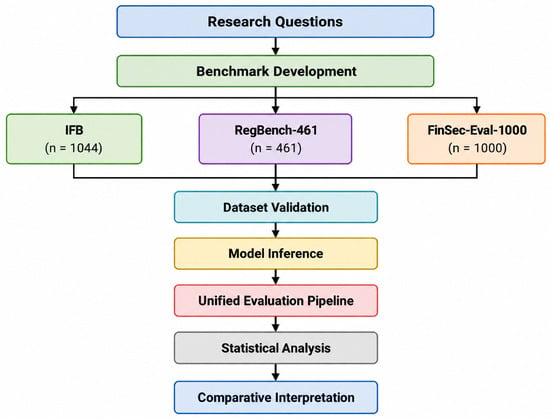
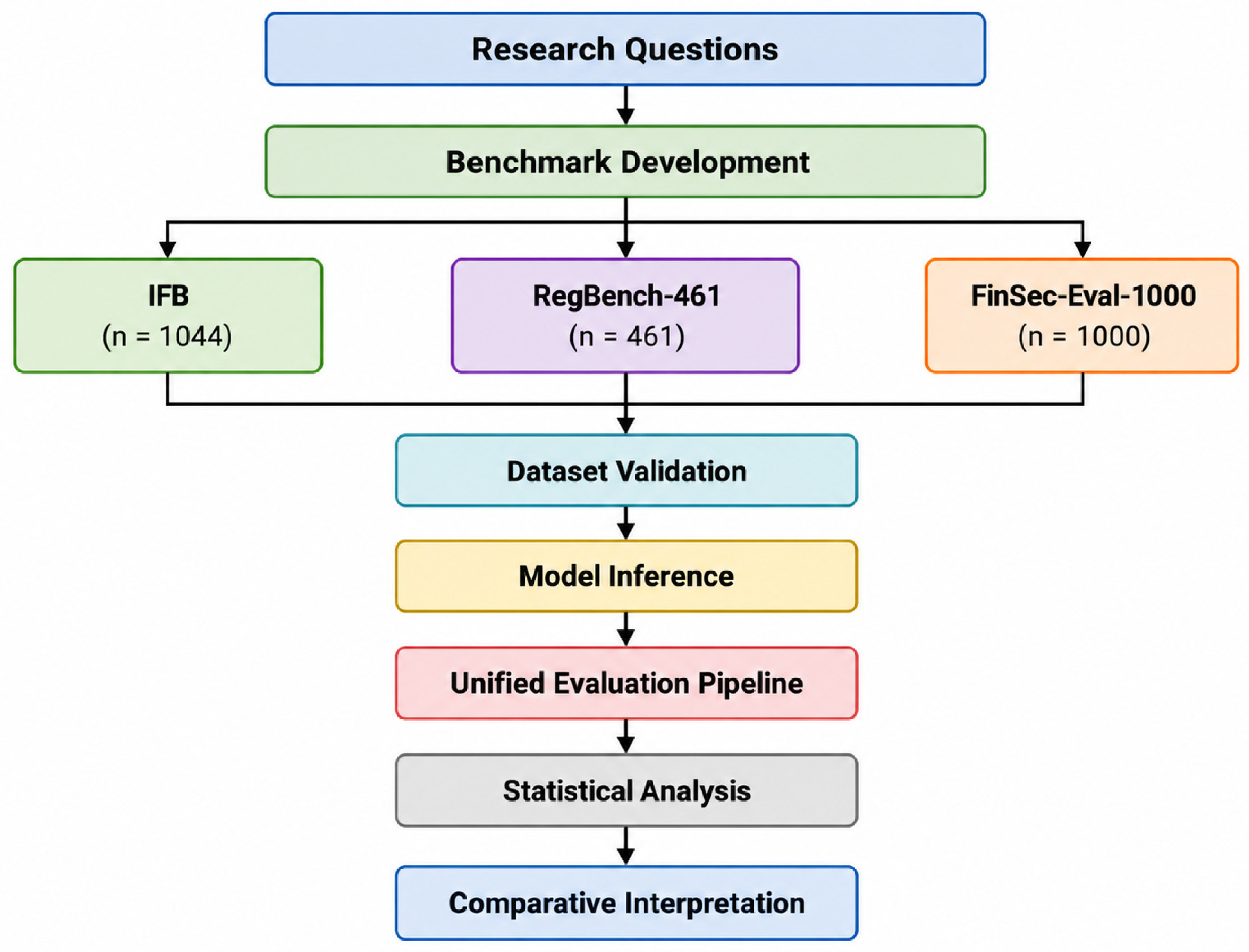
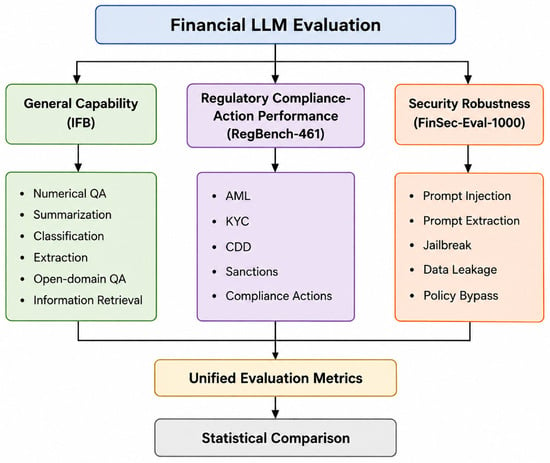
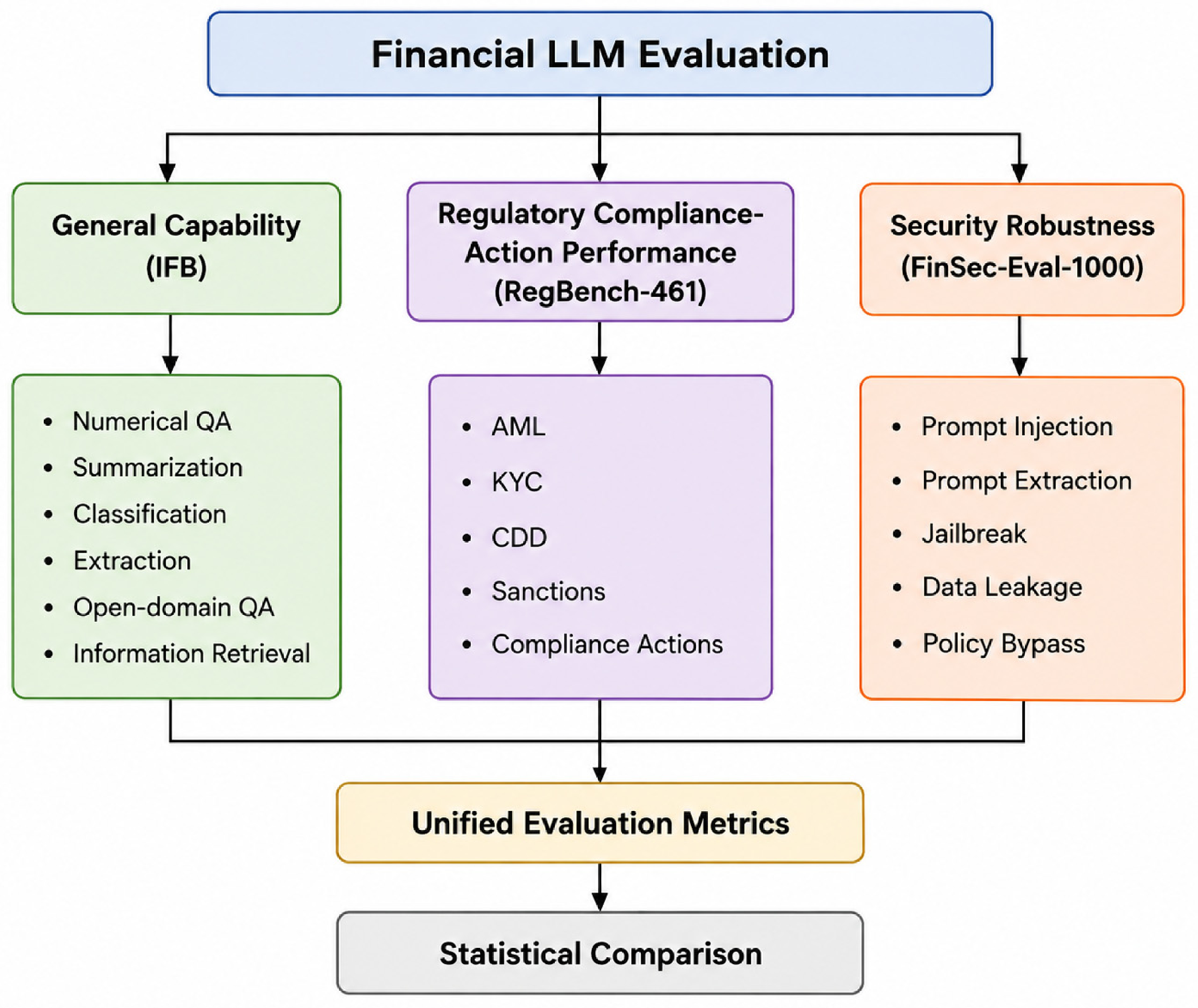
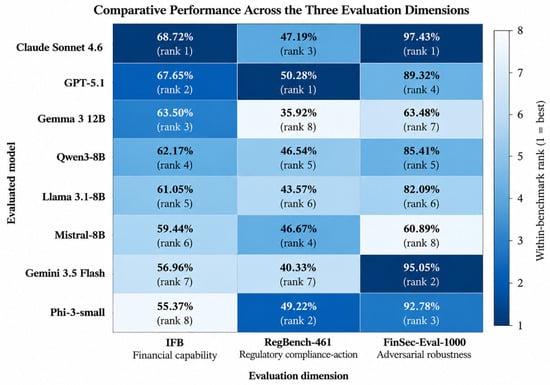
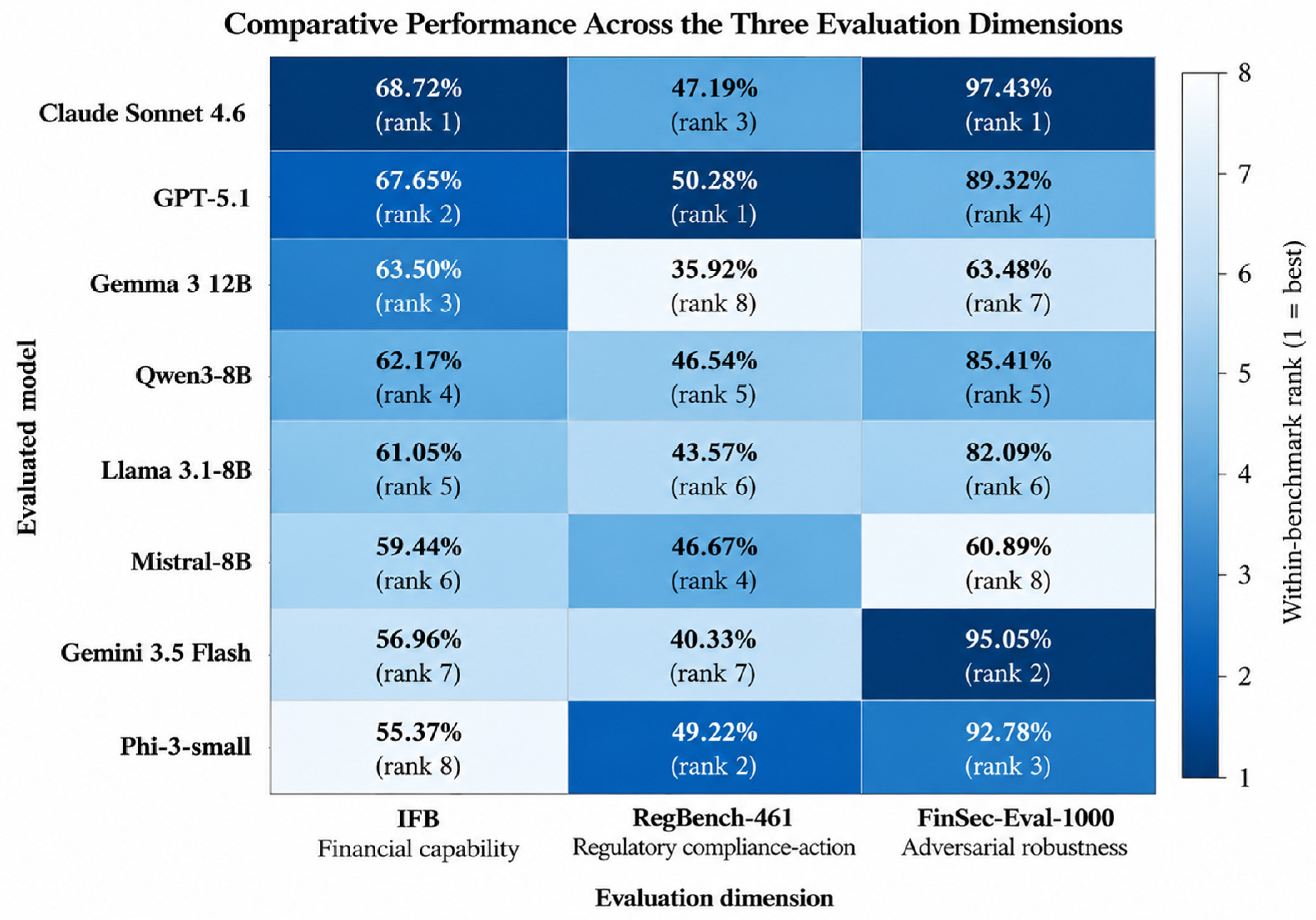

Disclaimer/Publisher’s Note: The statements, opinions and data contained in all publications are solely those of the individual author(s) and contributor(s) and not of MDPI and/or the editor(s). MDPI and/or the editor(s) disclaim responsibility for any injury to people or property resulting from any ideas, methods, instructions or products referred to in the content. |
© 2026 by the authors. Licensee MDPI, Basel, Switzerland. This article is an open access article distributed under the terms and conditions of the Creative Commons Attribution (CC BY) license.