Article

Lidar Measurements and High-Resolution Mesoscale Modeling of Coastally Trapped Disturbances off the Coast of California

by
Timothy W. Juliano
1,†,
Sue Ellen Haupt
1,*,
Eric A. Hendricks
1,
Branko Kosović
2 and
Raghavendra Krishnamurthy
3
1
U.S. NSF National Center for Atmospheric Research, Boulder, CO 80801, USA
2
Ralph O’Connor Sustainable Energy Institute, Johns Hopkins University, Baltimore, MD 21218, USA
3
Pacific Northwest National Laboratory, Redmond, WA 99352, USA
*
Author to whom correspondence should be addressed.
Current address: AiDASH, Palo Alto, CA 94301, USA.
Meteorology 2026, 5(2), 9; https://doi.org/10.3390/meteorology5020009
Submission received: 23 February 2026 / Revised: 11 April 2026 / Accepted: 21 April 2026 / Published: 25 April 2026

Abstract

Coastally Trapped disturbances (CTDs) are shifts in wind direction from the pre-dominant direction to equatorward to poleward for a period of time. These CTDs occur during the warm season off the California coast and impact coastal weather conditions and planned offshore wind plants. This study assesses the characteristics of CTD events as observed by lidar and other offshore buoys, then evaluates the ability of modeling systems to capture the correct characteristics, leveraging model output from the High-Resolution Rapid Refresh (HRRR) operational modeling system and the NOW-23 (National Offshore Wind) model dataset. CTDs were analyzed for October 2020 and May through to October of 2021, identifying 18 unique CTD events, confirmed by a nearby National Data Buoy Center (NDBC) buoy. The HRRR model captured most of these events, but the NOW-23 model output contained only 12 events. Composites of the wind, temperature, and pressure perturbations pre-, during, and post-event demonstrated the diminishment in wind speed, particularly for the alongshore component. Although the NOW-23 model captured the alongshore wind component and pressure perturbations well, the cross-shore wind component and temperature perturbations varied substantially. When the turbulent kinetic energy deviation and wind shear was positive across all levels pre-event, the NOW-23 modeling system was less likely to capture the CTD event. In contrast, the events that were captured by the model tended to have negative wind shear aloft pre-event.

1. Introduction and Motivation

Understanding the meteorological environment in coastal marine regions is important due to the direct influence of the atmospheric processes on economic activities such as shipping, naval operations, and daily coastal life. A potentially new use of the environment off the west coast of the U.S. is for offshore wind energy [1]. The ability to predict atmospheric changes, variability, and turbulence in these areas is crucial for mitigating disruptions caused by sudden shifts in wind patterns, temperature gradients, and ocean–atmosphere interactions, particularly for wind farm operation.
One of the defining atmospheric features along the California coast is the marine boundary layer (MBL), which plays a key role in regulating coastal wind patterns and air–sea exchanges. During the warm months, from about May through to September, the Pacific high-pressure system and the thermal low over the southwestern United States create an MBL that is characterized by a sloping inversion that fosters strong, persistent northerly winds [2,3,4]. At the lower boundary of a pronounced subsidence inversion, a coastal low-level jet (CLLJ) forms, often reaching speeds of 15–25 m/s [5]. The relatively cool sea surface temperatures (SSTs) help to maintain the MBL and synergistically, the strong northerly flow reinforces the cool SSTs through upwelling. Variability in the Northern Pacific High (NPH) location and strength set the background for the CLLJ conditions (e.g., frequency, intensity, and height).
Several times per year, the NPH strengthens and shifts toward the Pacific Northwest, ushering warm and dry continental air over the ocean. As a result, the blocking effect of the coastal mountain ranges forces alongshore winds to remain trapped near the coastline, preventing them from dissipating inland [6]. This trapping mechanism leads to weakening winds and distinct wind reversals [7], which alter coastal weather conditions via cloud formation and modifications in the coastal marine layer, all of which have significant implications for weather forecasting and marine operations ([7,8]), including offshore wind farms.
These coastally trapped disturbances (CTDs) are mesoscale phenomena that form and propagate along many coastlines across the globe while disrupting the local dominant weather regime. CTDs—also called coastally trapped wind reversals or southerly surges—are characterized by tight couplings between the atmosphere, ocean, and coastal topography. Along the United States California coast, CTDs are particularly important because of their role in modulating marine weather, coastal upwelling, and air–sea exchanges [7]. The California coastline is one of the most well-documented regions where CTDs frequently occur. These disturbances are commonly observed during the summer months when the NPH dominates the large-scale circulation, creating a stable and well-defined MBL. Under these conditions, CTDs can disrupt the typical northwest winds along the coast, leading to sudden wind reversals and the development of dense fog and stratus clouds [8].
Understanding CTDs is particularly important because CTDs can cause abrupt weather changes, affecting both coastal communities and offshore operations. Sudden wind reversals can impact aviation, shipping, and recreational boating, necessitating accurate forecasting to mitigate risks [9]. As the U.S. plans for more offshore wind deployment, understanding such phenomena is essential for efficient operation and grid integration. In addition, the interaction between CTDs and the MBL influences the coastal upwelling processes, which are critical for the California current ecosystem. Upwelling brings cold, nutrient-rich water to the surface, supporting one of the most productive marine ecosystems in the world [10]. CTDs can either enhance or suppress upwelling, thereby affecting fisheries and oceanic biogeochemistry. Additionally, studying CTDs contributes to understanding broader climate variability, particularly in the context of changing oceanic and atmospheric conditions [5]. The MBL plays a crucial role in the formation and evolution of CTDs. Several key processes influence CTD dynamics, including stratification and inversion layers, coastal terrain effects, and air–sea interactions. The presence of a strong temperature inversion capping the MBL helps to maintain the structure of CTDs. The strength and altitude of this inversion layer determines the vertical extent and intensity of the disturbance [11]. The interaction between the coastal topography and prevailing wind patterns plays a critical role in trapping and propagating disturbances. The shape and height of coastal mountains create local wind accelerations and variations in the boundary layer depth [7]. Variability in sea surface temperatures (SST) affects the stability of the MBL, influencing CTD formation. Warmer SSTs can destabilize the lower atmosphere, promoting cloud development and altering wind patterns [4]. Additionally, CTDs occur on the background of the weaker diurnal influences of differential heating between the land surface and the ocean, which generates land–sea and sea–land circulations.
Juliano et al. [12] investigated CTDs and highlighted the importance of cloud properties and their role in the radiation budget, and thus, the sensitivity of CTD properties to PBL parameterization choice. Normally, the California coastal region is dominated by a shallow marine cloud deck. For CTD events, as the Pacific High migrates eastward, the offshore wind strengthens and produces an upward motion, resulting in the clearing of the clouds. At the time of wind reversal, air descends from the coastal complex terrain and warms adiabatically, and the warm air advects toward the MBL, setting up conditions for southerly flow and cloud re-formation. Juliano et al. [13] found that these CTD clouds have a higher number of droplets than the typical MBL clouds.
The ability of models to correctly predict CTDs has not been fully assessed. Thus, the current study aims to improve our understanding of CTDs off the California coast by focusing on how well standard models capture these phenomena in comparison with observations. By better understanding predictive capabilities, we can improve weather forecasting models, mitigate coastal hazards, and prepare to use the coastal environment for wind energy deployment. We use observations to identify the CTDs, then assess how well high-resolution model simulations are able to capture their details. Section 2 describes the data used and methods employed. The results are reported in Section 3. Section 4 is devoted to the discussion, summary, conclusions, and suggestions for future research directions.

2. Data and Methods

This study leverages short-term deployment of a specialized lidar buoy as well as a long-term moored buoy to provide observational “truth” data. We seek to assess models’ ability to capture and simulate these CTD features by assessing two modeling systems: (1) an operational high resolution modeling system that provides continuously updated hourly forecasts and (2) a specialized high-resolution modeling system that provides wind resource assessment information for that region. The operational system provides information on the model’s ability to forecast CTDs in real time, while the specialized model includes output that allows us to determine the extent to which models capture the temporal and vertical structure of these events.

2.1. DOE Lidar Buoys

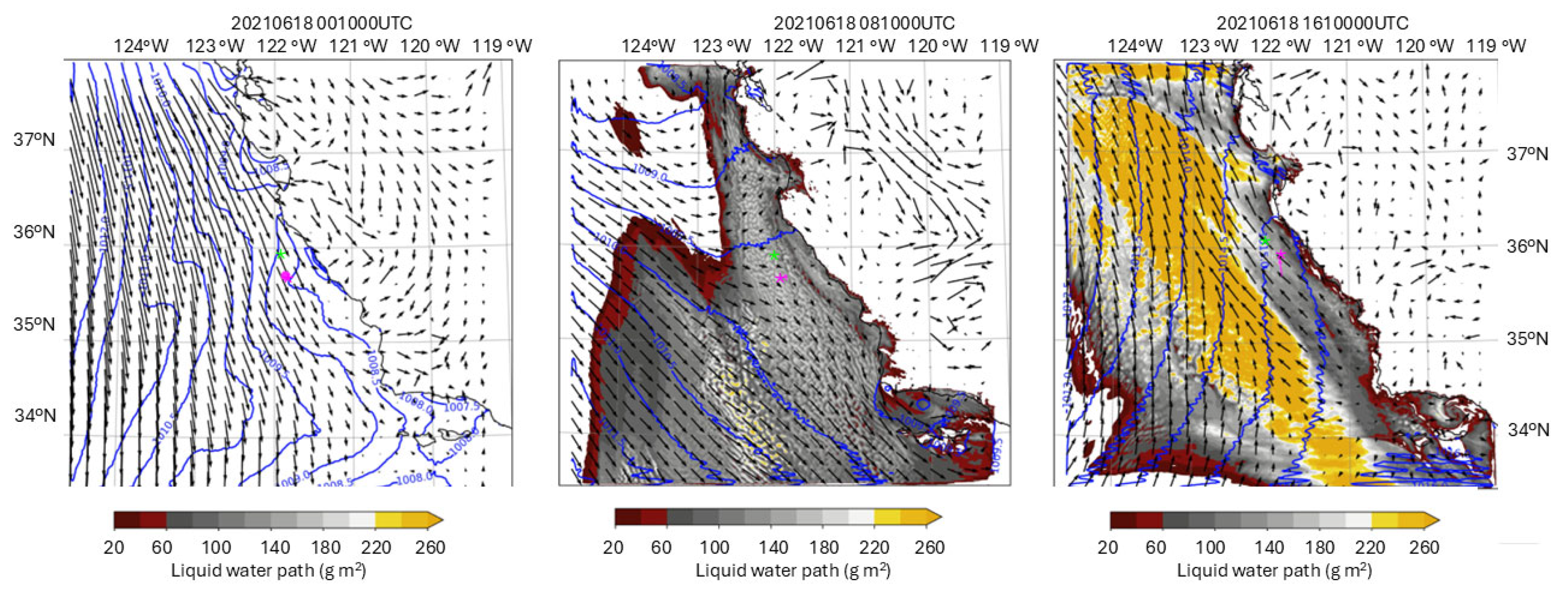
In autumn 2020, the U.S. Department of Energy (DOE), Washington, DC, U.S., through the Pacific Northwest National Laboratory (PNNL), Richland, WA, U.S., deployed two floating lidar buoys in the Morro Bay and Humboldt California wind lease regions [14]. Figure 1 displays a typical CTD in this region and marks the location of the buoys. In this study, we focus on the Morro Bay site because this region historically experiences more CTD events compared to the region north of Cape Mendocino [13]. The Morro Bay lidar buoy was sited ∼50 km offshore of Morro Bay, California, in waters that were 1100 m deep. This deployment was part of a broader initiative to collect year-long, high-resolution atmospheric and oceanographic data. The buoy was equipped with Vaisala’s (Louisville, CO, USA) WindCube v2.1 Doppler lidar system that was capable of measuring wind profiles from 40 to 200 m above sea level. In addition, the 3D wind variance was computed, allowing one to estimate the turbulent kinetic energy (TKE). The buoy also housed instruments to record near-surface meteorological parameters (such as the air temperature, pressure, and humidity), oceanographic conditions (including the wave height and sea surface temperature), and cloud characteristics, providing a comprehensive dataset of the air–sea transition zone.
The collected data underwent rigorous quality control and post-processing to ensure accuracy and reliability. Notably, an issue with the inertial measurement unit (IMU) used for determining wind direction was identified; the IMU data were corrected post-deployment to rectify directional inaccuracies. The buoys underwent rigorous validation in accordance with the recommended practices published by the Carbon Trust for Stage 2 pre-commercial applications [15]. The uncertainties in the lidar observations collected by the buoys were found to be less than 2% [16]. The final processed datasets, including wind profiles, surface meteorology, and oceanographic measurements, are publicly available through the Wind Data Hub [14,17]. These datasets provide valuable insights into offshore wind resource characteristics and are instrumental for validating atmospheric models.

2.2. NDBC

The National Data Buoy Center (NDBC) operates a network of moored buoys and coastal stations that provide continuous in situ observations of marine meteorological and oceanographic conditions. Standard measurements include wind speed and direction, air temperature, sea surface temperature, atmospheric pressure, and wave parameters, typically reported at 10 min intervals. Wind observations are generally recorded at a nominal height of 4 m above the sea surface and are quality-controlled in near real-time. For this study, NDBC buoy data were used to evaluate near-surface wind conditions and to support the validation of model outputs. We focus on the 46028 site, which is located ∼8 km from the Morro Bay lidar buoy site. Data were accessed via the NDBC historical archives [18], with additional post-processing to standardize time formats, remove missing or flagged values, and align observations with the corresponding model output for comparison.

2.3. HRRR

The High-Resolution Rapid Refresh (HRRR) model is an operational, convection-allowing numerical weather prediction system developed by the National Oceanographic and Atmospheric Administration (NOAA), College Park, MD, USA [19]. We include an analysis of HRRR’s performance on the identified CTD events to determine whether it is likely to be able to forecast these events for applications. HRRR is based on the Advanced Research Weather Research and Forecasting (WRF) model (ARW) [20,21] dynamic core and uses horizontal grid cell spacing of 3 km, allowing it to explicitly resolve mesoscale features such as convective storms, sea breezes, and terrain-induced circulations without parameterized convection. HRRR is initialized hourly, using 3D variational data assimilation of radar, aircraft, satellite, and surface observations, and it produces short-term forecasts out to 18 or 48 h, depending on the model initialization time. The model assimilates high-frequency surface observations and uses Rapid Refresh (RAP) background fields to constrain the initial conditions. The SSTs in the HRRR are updated daily (valid for 000 UTC) based on data from the Real-Time Global (RTG) analysis developed by the National Center for Environmental Prediction [19].
The HRRR output is available hourly on a native 3 km Lambert Conformal grid and it includes a comprehensive suite of atmospheric variables at multiple vertical levels and time intervals. For this study, we utilize model-diagnosed winds at 80 m above ground level, mean sea-level pressure, and 2 m temperature. We note that fully three-dimensional fields for the lower boundary layer are not saved, so we are not able to evaluate the evolution of profiles of variables for the HRRR model.

2.4. NOW-23

We leverage the National Offshore Wind dataset (NOW-23), which was developed by the National Renewable Energy Laboratory using the WRF model [22]. NOW-23 includes 23 years of high-resolution simulations of offshore wind conditions across eight U.S. coastal regions. They optimized the setup for a 16-member ensemble for each region, with each simulation being run in month-long segments using a two-day spin-up period. The ensemble framework varied key model components such as the planetary boundary layer (PBL) and surface layer schemes, land surface model, sea surface temperature dataset, and reanalysis forcing product, depending on the offshore region. The setup for the NOW-23 South Pacific region, which includes the offshore California area that included 16 members, varied combinations of physics parameterizations and forcing schemes based on a comparison with available observations (primarily the same lidar observations described in Section 2.1) and was run for 2017. They used statistical metrics—including bias, centered root mean square error, and Pearson correlation—to identify the optimal model configuration for the California region, as described below.
Two simulations of NOW-23 were accomplished for the South Pacific Region for the time period of the lidar buoy deployment [23]: one using the MYNN PBL scheme and the other the YSU scheme. This study chooses the NOW-23 simulation that used the fifth generation European Center for Medium Range Weather Forecasting (ERA5) reanalysis [24], the Mellor–Yamada–Nakanishi–Niino (MYNN) PBL/surface layer schemes [25], the Operational Sea Surface Temperature and Ice Analysis (OSTIA) SST product [26], and the Noah land surface model [27]. For NOW-23, the Yonsei (YSU) PBL scheme [28,29] was used. The MYNN scheme had been previously shown to systematically overpredict wind speeds in that region [22,23,30] and YSU was shown to perform better for CTD events [12]. All simulations were conducted on a 2 km horizontal grid with 5 min output frequency, providing high-resolution temporal and spatial coverage of wind conditions over a multi-decadal period. For this study, we use the 1 h model outputs to match the temporal resolution of HRRR. To obtain a high vertical resolution, NOW-23 includes 61 vertical levels with 12 levels in the lowest 300 m to resolve shear and veer in the wind turbine rotor layer [31]. The high vertical resolution that was saved for NOW-23 allows us to assess WRF’s ability to capture the evolution of the vertical structure during CTD events.

2.5. Identifying Events

To meaningfully identify CTD periods, we developed an automated procedure that detects sustained reversals in the alongshore wind flow from prevailing northerly (negative v-wind component) to southerly (positive v-wind component) conditions. Similarly to previous studies, we first rotate the coordinate systems of the observations and model outputs to approximately align with the coastline orientation near the Morro Bay lidar site (35° rotation). The algorithm operates on the rotated v-wind component from each dataset at a specified vertical level or site and identifies candidate periods of southerly alongshore wind (i.e., a southerly surge) that last at least six hours, while permitting brief negative interruptions up to one hour in duration. One hour was selected to account for HRRR’s and NOW-23’s hourly output frequency. To qualify as a CTD, each positive wind event must be immediately preceded by a period of predominantly negative v-wind (northerly alongshore wind) lasting at least six hours, again allowing for brief positive interruptions. This identification method treats the time series as a binary sequence, groups contiguous segments, and merges small gaps based on the median time resolution.

3. Results

We seek to assess the modeling systems’ ability to model the evolution of CTD events, first in terms of capturing observed events, then through comparing composite time series, and finally by assessing the model’s ability to correctly simulating the temporal changes in the structure of the event as it progresses through its phases.

3.1. Comparison of Number of Events Captured

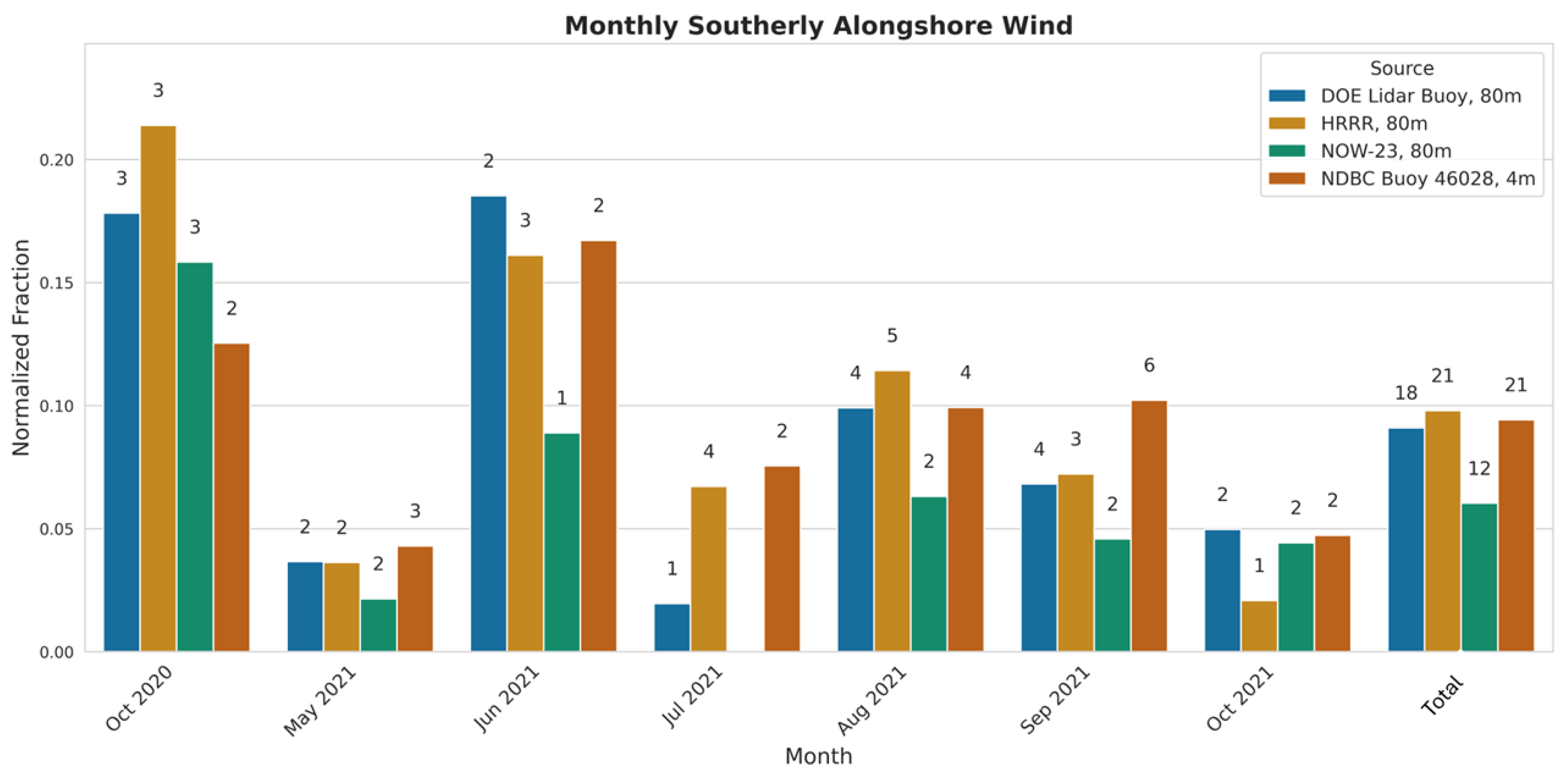
We begin by examining the number of CTD events and total number of southerly flow hours at 80 m above sea level (ASL) at the Morro Bay lidar site (Figure 2). Months considered include October 2020 and May through to October 2021. The lidar recorded one to four events in a given month, with some events lasting only several hours and others over one day. August and September 2021 saw the highest number of events at the lidar buoy site, with the most hours of southerly flow occurring in October 2020 and June 2021. In total, the lidar site observed 18 unique CTD events during the study period. We also display the results from the NDBC 46028 site (wind measurements at ∼4 m ASL), which is located 8 km away from the lidar site, as a sanity check.
By and large, the two sites agree well: in fact, the fraction of times that the two sites agree on the wind direction when both sites have available measurements is greater than 92% in a given month and typically above 95%. In comparison to the observations, the HRRR and NOW-23 models show mixed results: HRRR generally captures the number of events (21) and southerly flow frequency well, but NOW-23 greatly underestimates both of these metrics, capturing only 12 events. This motivates us to study the differences between events captured from those missed.

3.2. Time Series Analysis

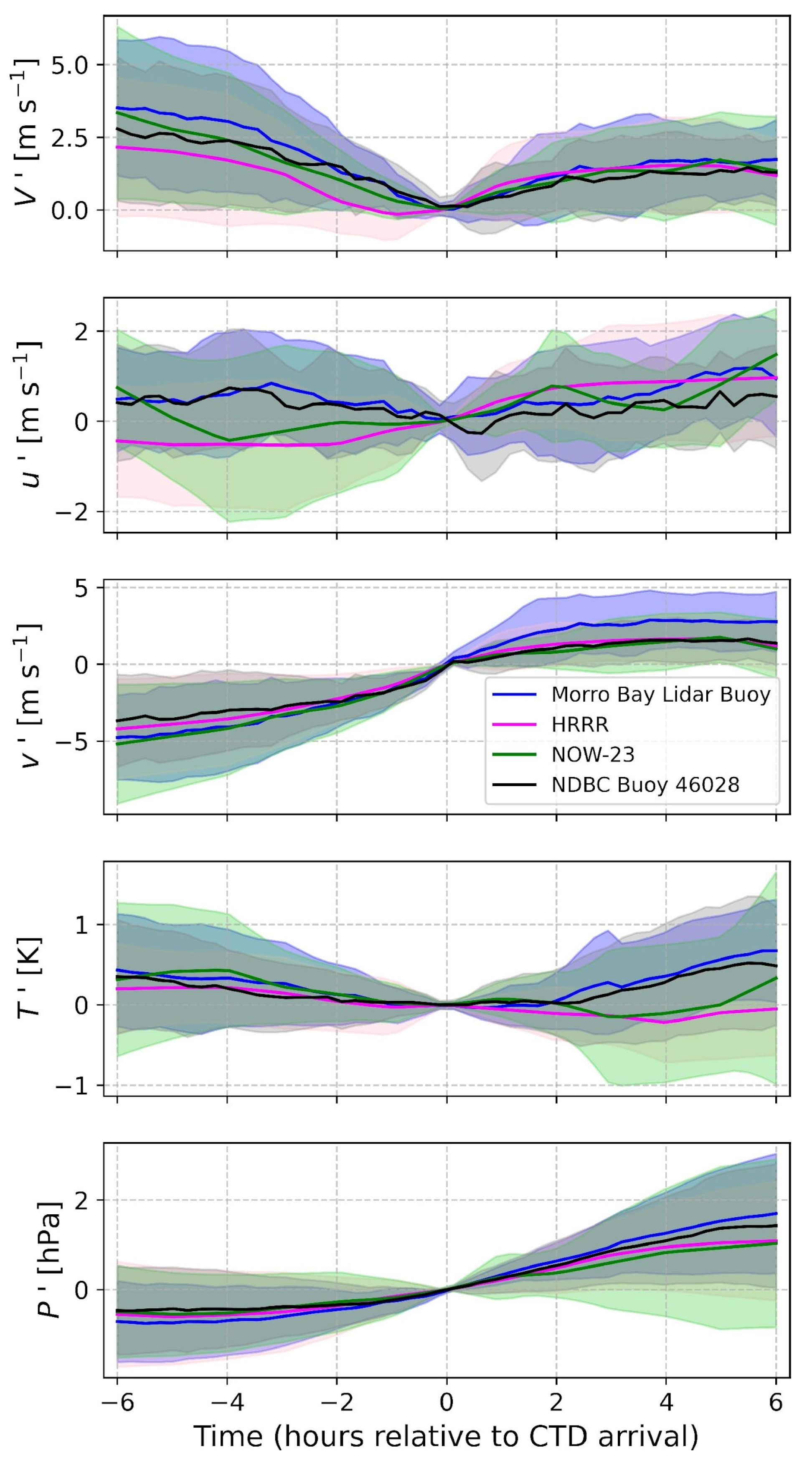
In Figure 3, we show composite time series to understand the change in meteorological state variables within a 12 h period across the CTD passage. Each of the panels is centered at the time (=0 h) of the CTD passage (i.e., when the alongshore wind component switches from northerly to southerly), and the time series lines indicate the perturbation values, relative to t = 0 h. We refer to times prior to t = 0 h as the pre-CTD phase and times after t = 0 h as the post-CTD phase.
Analysis of meteorological variables at the two observation sites and from the two models shows similar trends across the CTD passage. We recall that our criteria maintains only those cases whose alongshore wind component flips from negative (northerly flow) to positive (southerly flow). On average, the wind speed perturbation is approximately 2–4 m s−1 at 6 h prior to the CTD, before steadily decreasing to a minimum when the CTD passes the lidar or NDBC buoy site. The HRRR model shows relatively smaller wind speed perturbations during this period and a more rapid decrease in wind speed of around t = −2 to −3 h. Once the CTD passes, the wind speed perturbations slowly increase within the first few hours, before tapering off to ∼1–2 m s−1. Agreement in the cross-shore wind component (u′) between the observations and models is generally poor during the pre-CTD phase, although the perturbation in this component is very small in magnitude; agreement is somewhat better during the post-CTD phase. The alongshore component time evolution is modeled well, with an underestimation in the perturbation magnitude after the CTD passes. The lidar buoy at 80 m ASL shows ∼2 m s−1 stronger southerly winds compared to the NDBC buoy at 2 m ASL, suggesting substantial vertical wind shear in the boundary layer (to be discussed). The near-surface temperature perturbation lines indicate a decrease of approximately 0.25–0.4 K toward a minimum around t = 0 h in both the observations and model; however, the temperature increases by approximately 0.5–0.6 K after 6 h in the observations, while the models show a relatively constant or even slightly decreasing temperature post-CTD. Lastly, the pressure time series displays relatively low pressure during the pre-CTD stage and relatively high pressure during the post-CTD stage. Pressure increases are less pronounced in the model compared to the observations. Broadly speaking, our composite time series results are in agreement with those reported in Juliano et al. [13]. The differences that we observe between observations and models post-event, including those in the temperature and pressure perturbations, are the reasons that we wish to further analyze the differences between observation and model characteristics.

3.3. Analysis of Vertical Structure Evolution

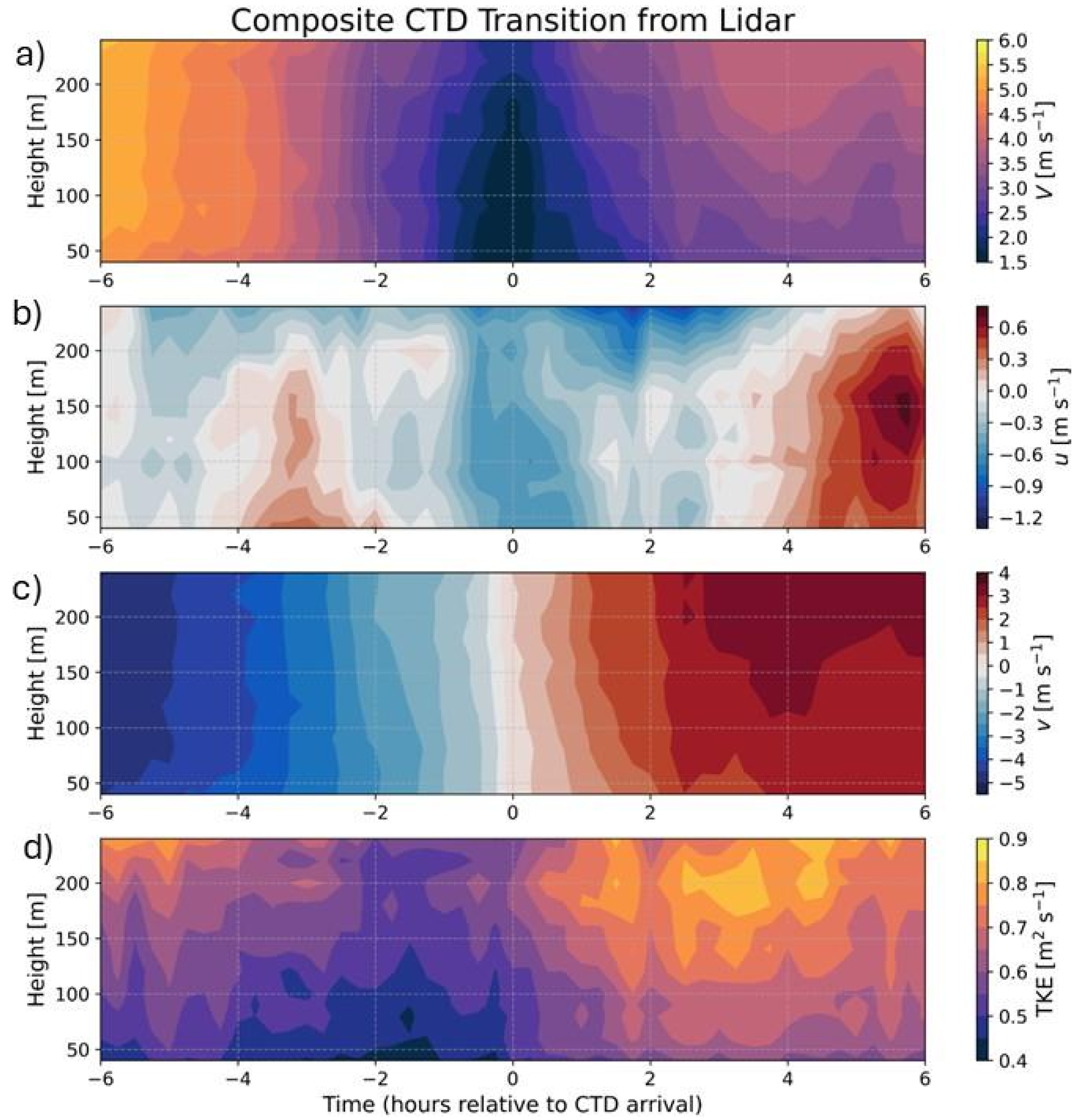
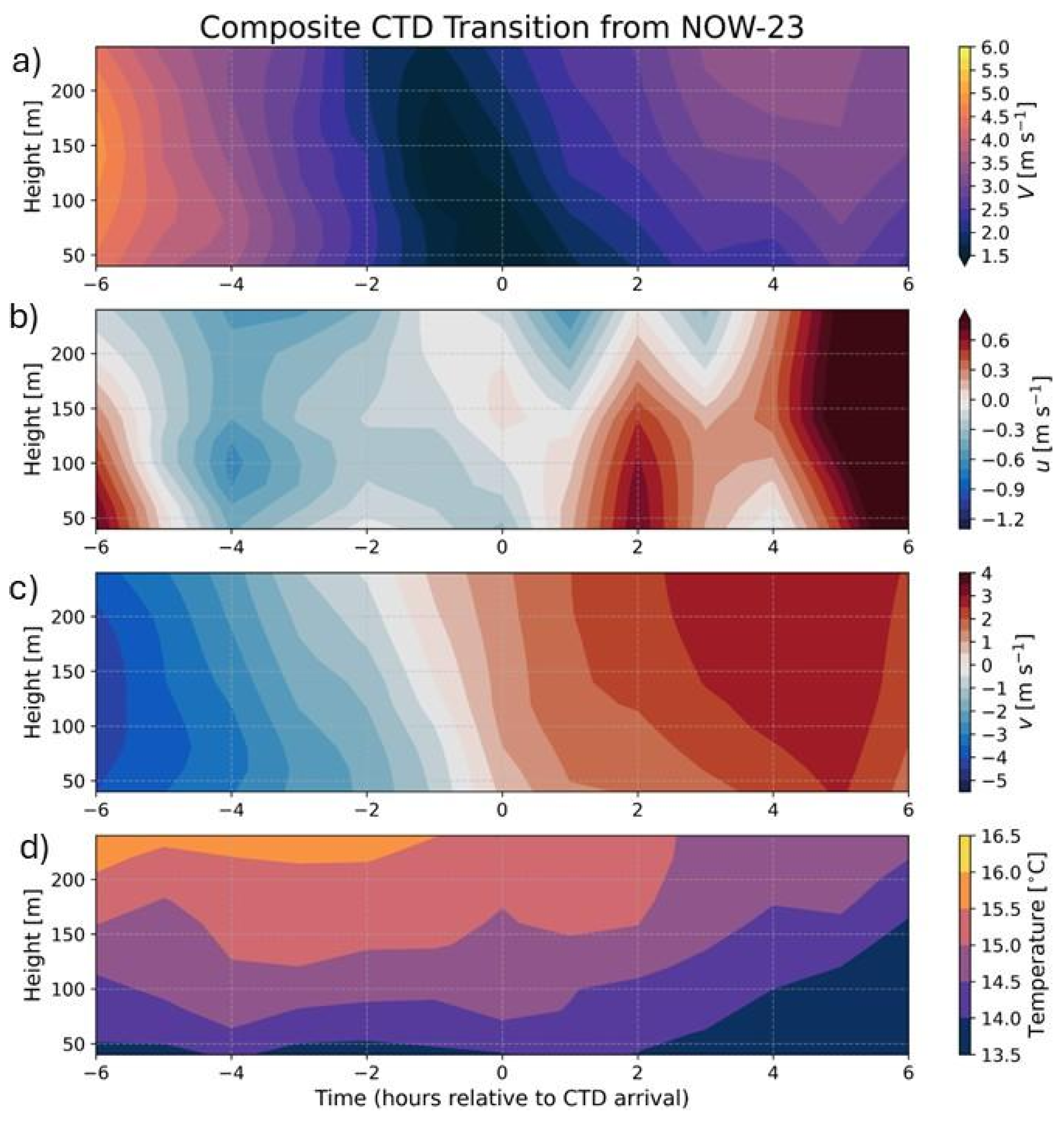
The lidar buoy measurements and NOW-23 model outputs allow us to more completely investigate the vertical structure in the wind field (Figure 4 and Figure 5). Panels (a–c) in both figures show the wind speed, cross-shore wind component, and alongshore wind component, respectively. The colorbar contour ranges in these panels are the same between the two figures to facilitate a direct comparison. Panel (d) in Figure 4 shows the lidar-estimated TKE, while that in Figure 5 shows the temperature. During the pre-CTD stage in the lidar observations (Figure 4), the wind speed magnitude decreases at first slowly with time, and then more rapidly with time as the CTD front approaches. The wind profiles show little vertical shear. Meanwhile, in the NOW-23 model output (Figure 5), the wind speed decreases approximately linearly with time at all heights. Little agreement is seen in the cross-shore wind component, which is small in magnitude. Because the alongshore component dominates, its pattern is similar in panel (c) in both figures. The lidar-observed TKE (bottom panel of Figure 4) is relatively low in the pre-CTD time period and increases markedly, particularly aloft, post-CTD. The modeled temperature (Figure 5d) decreases at all levels at the time of the CTD and post-event, and unlike the observations (Figure 3) it displays substantial cooling near the surface at 6 h post-CTD. Note that temperature profile information was not available from the buoy locations and TKE was not a saved output variable from NOW-23.

3.4. Assessment of Model Ability to Capture Behavior

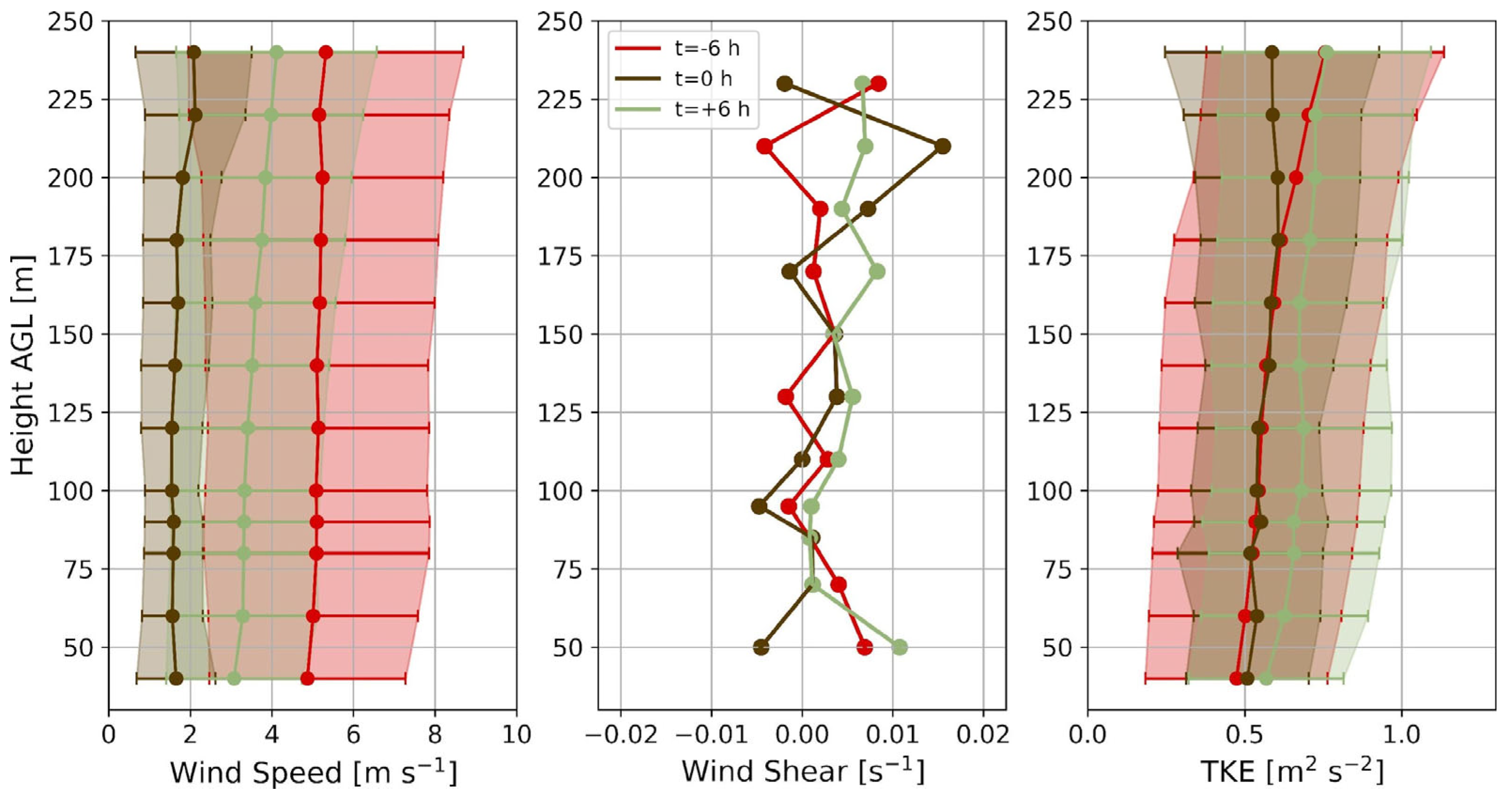
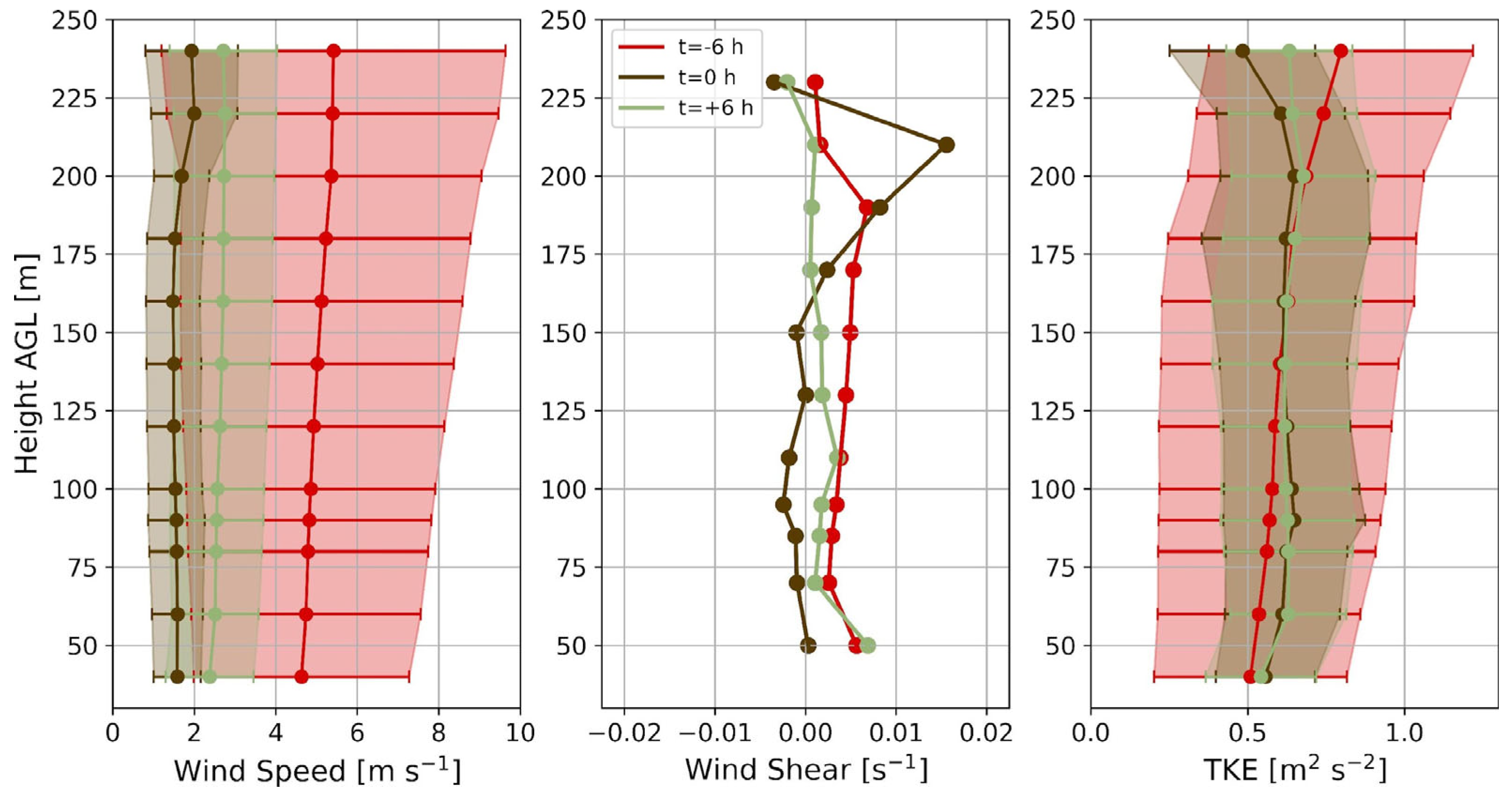
To further understand and assess the model’s ability to capture the vertical structure of a CTD event, we next examine the vertical profiles of the wind speed, wind shear, and TKE. Figure 6 represents the lidar buoy observations for all CTD events in the composite. As demonstrated previously, the wind speed decreases markedly pre-event to a minimum at t = 0 h, then gradually increases in magnitude (but for southerly flow) with time. The middle panel displays wind shear, which is computed between successive levels as the difference in wind speed divided by the layer distance. Prior to the CTD, the shear is positive near the surface and oscillates aloft. At the time of wind reversal, shear becomes negative near the surface, very small in the middle levels and positive at about 210 m, before returning to near-zero at 225 m. Post-event, the shear is more positive at the surface and remains positive throughout the MBL. The observed TKE is small before the event, becomes vertically well-mixed at approximately ∼0.5 m2s−2 at the time of the CTD, and gradually increases after the CTD, in agreement with Figure 4d.
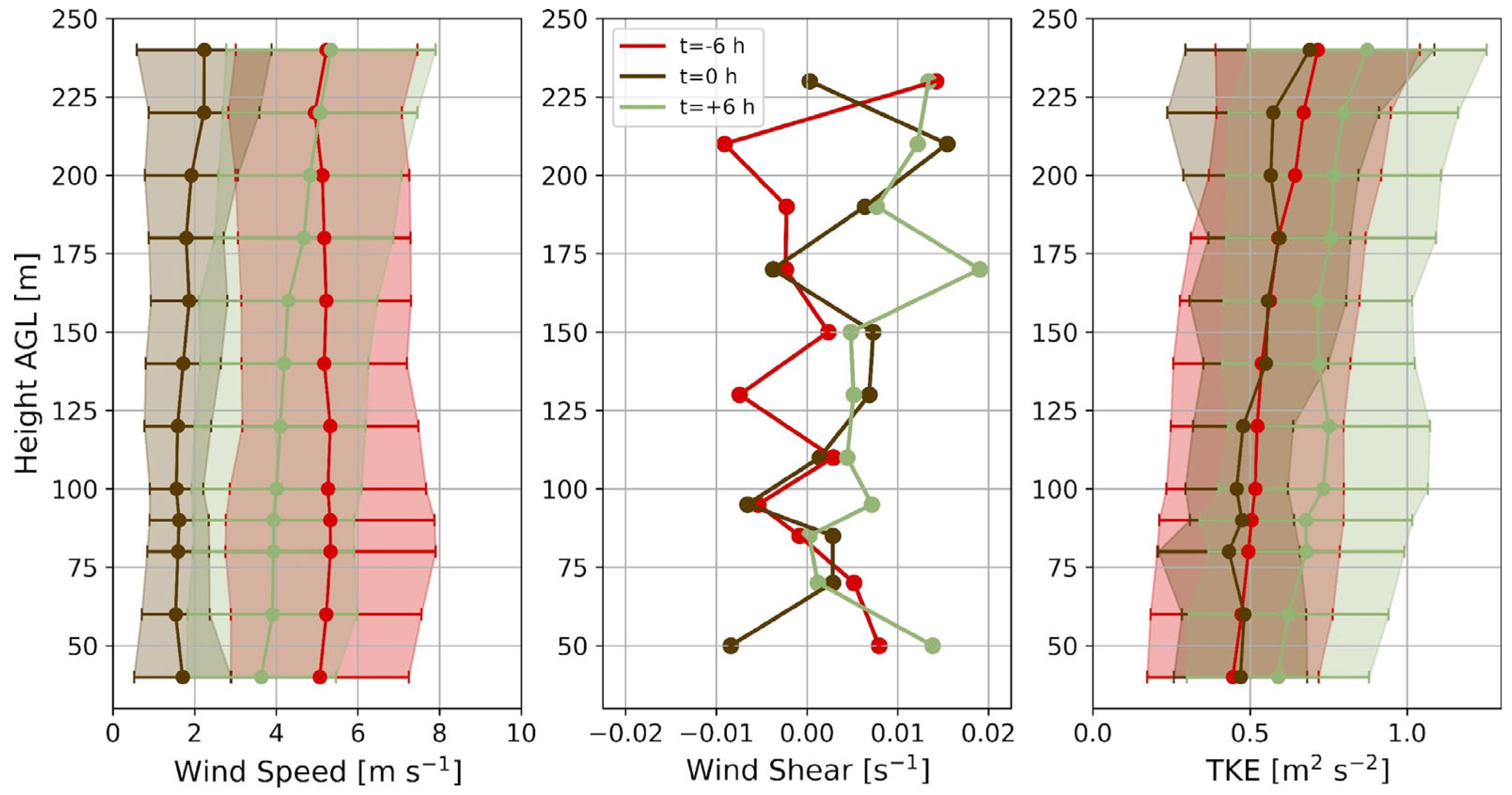
We note, however, that NOW-23 did not capture all of the lidar-observed CTD events. Thus, we now examine the observations for just those 12 events that were captured by both the lidar and NOW-23 (Figure 7), which will provide a better comparison with the modeled events. These events show a similar vertical wind profile during all stages of the CTD, but the wind shear varies more at all stages. The magnitudes of the (negative) pre-event and positive post-event shear is higher than for all events. This implies that a stronger CLLJ was present pre-event for those events modeled correctly by NOW-23. The TKE is also of a larger magnitude post-event.
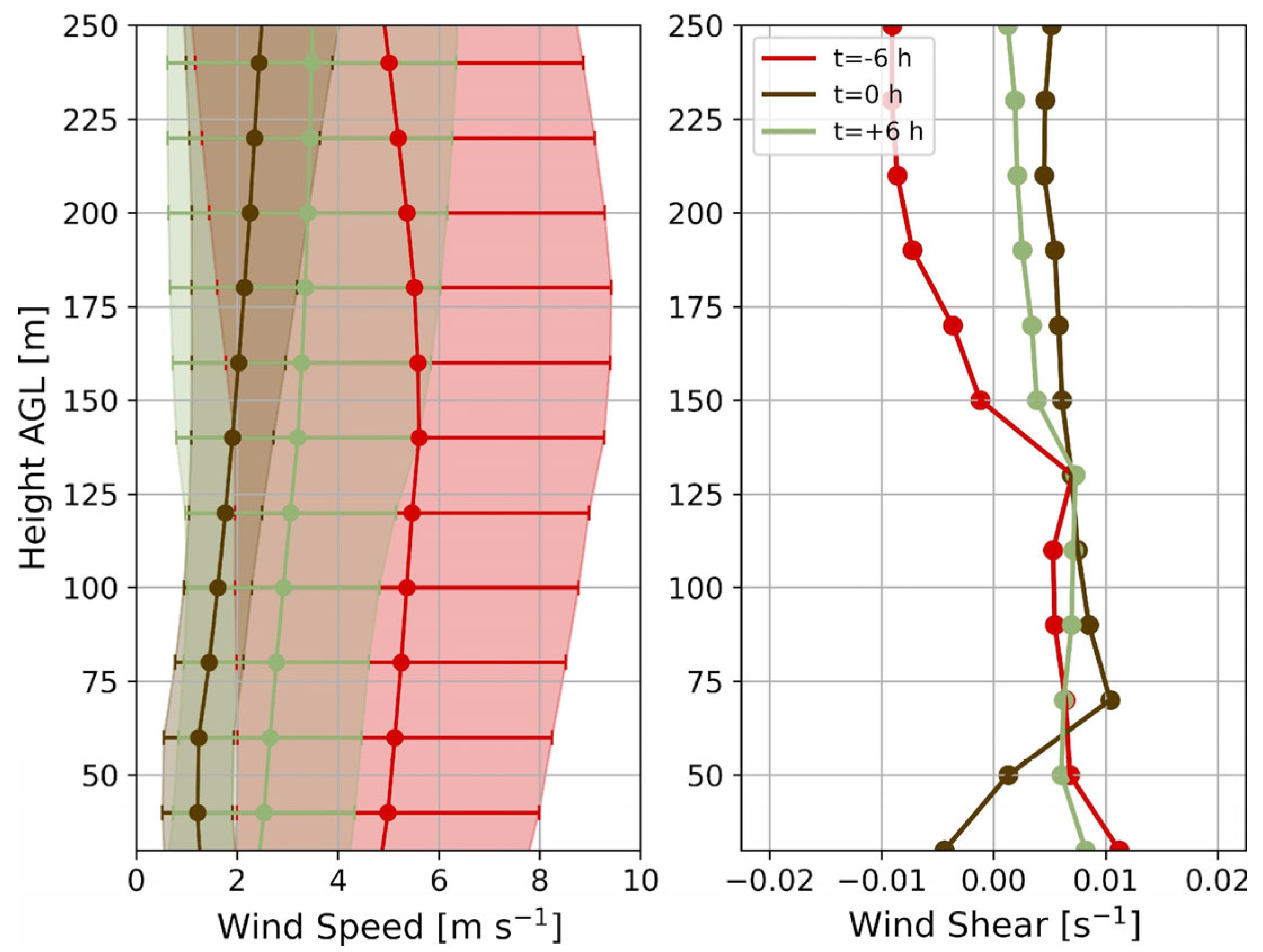
Figure 8 displays the wind speed magnitude and wind shear profiles as modeled by the NOW-23 dataset. Pre-event, the wind speed is stronger than those in the observations (Figure 7). At t = 0 h, the wind’s speed profile matches the composite of the observations well. Post-event, the wind speed is weaker than those in the observed profiles. The modeled wind shear pre-event (red) is positive at the surface, becoming increasingly negative above 150 m, suggesting a CLLJ nose at about that height. At t = 0 h, shear is negative at the surface, but uniformly positive aloft. Post-event (green curve), the modeled wind shear is positive throughout the MBL, similar to the lidar observations, suggesting that the jet structure has broken down.
The final figure (Figure 9) examines the observed CTD events that were not captured by the NOW-23 model to determine what is different about such events from those captured by the model (cross-reference Figure 6). Although the wind speed profiles are fairly similar pre-event, the wind speed variability is lower post-event and lacks any CLLJ signature. The shear and TKE profiles are markedly different. In particular, the pre-event wind shear profile is uniformly positive, unlike that for the events where the model captured the event (Figure 7). Post-event, the wind shear varies from slightly positive at the surface to near-zero aloft. The variability of TKE in the profiles of Figure 9 (red shading) are substantially larger pre-event than those that the model captured (Figure 7), but smaller post-event (green shading). The TKE magnitude (green curve) is smaller post-event than for those that were captured well by the model.

4. Discussion and Conclusions

The goal of this study was to assess the characteristics of CTD events as observed by lidar buoys and other offshore buoys, then to assess the ability of modeling systems to capture the correct characteristics of those events. Since the events are inherently three-dimensional, the DOE lidar buoy and the NOW-23 model output allow for an assessment of the vertical characteristics of these events. Because the HRRR model is operational with 1 h initializations, we also wish to assess its ability to forecast these events in real time. These warm-season CTD events, which are characterized by a reversal of the alongshore wind, have the potential to change weather conditions and disrupt operations in a host of weather-dependent applications ranging from aviation and surface transportation, to harvesting renewable energy.
We studied CTDs during the period of deployment of the DOE lidar buoy near Morro Bay during October 2020 and May through to October of 2021, identifying 18 unique CTD events in the observations. A nearby NDBC buoy confirmed 95% of these events. The operational HRRR model captured most of these events and modeled a few additional events that met the criteria (see Section 2.5). In contrast, the NOW-23 model output contained only 12 events. Composites of the wind, temperature, and pressure perturbations pre-, during, and post-event (Figure 3) demonstrated the expected diminishment in the wind speed, particularly for the alongshore component and increase in the surface pressure, as expected [12]. Although the NOW-23 model captured the alongshore wind component and pressure perturbations well, the cross-shore wind component and temperature deviated substantially. Those small cross-shore components depend on the secondary circulations that develop as the MBL thins, upward motion is generated, and the offshore coastal flow initiated during the reversal. These processes are difficult for mesoscale models to capture correctly. Higher resolution LES models are required to capture those flows [32]. The vertical profiles (Figure 4 and Figure 5) revealed that the NOW-23 model showed linear decreases in the wind speed with time at all levels compared to the observations, which decreased more rapidly as the CTD front approached. We also note a positive wind shear post-event.
Then, we sought to identify what was different about the events that the NOW-23 modeling dataset captured from those that were not correctly modeled. We discovered that when the observed wind shear changes from positive to negative with height, indicating the presence of a CLLJ, NOW-23 is more likely to correctly capture the event. In contrast, when shear is positive across all levels pre-event, the NOW-23 modeling system is less likely to capture the CTD event as defined in Section 2.5. Such events are less likely to display a CLLJ. In contrast, the events that were captured by the model tended to have negative wind shear aloft pre-event—see Figure 8. The NOW-23 system seems to model an observable jet nose somewhat lower (about 150 m) and to have a markedly different cross-shore component prior to the event.
We attempted to study whether employing different model parameterization configurations might help to better capture the non-modeled (by NOW-23) events, but did not find much difference between the model setups). Our study did reveal that some of the cross-shore differences may be significant and are not well-captured by the NOW-23 modeling system.
Because of the constraints of the time frame of the DOE floating lidar deployment, this study was limited to just over a single year for assessment. This is not sufficient to represent the interannual variability or potential differences in the longer term that could be correlated with longer-term features such as El Nino/Southern Oscillation. Additionally, insufficient data were available regarding clouds to assess their impact on CTD development in this study.
Improving the modeling of these events may require more attention to the fine-scale coastal features that impact the details of the cross-shore flow. The surface horizontal inhomogeneity effects due to the coastal-ocean transition may not be captured well in mesoscale models in which parameterizations of physical processes assume horizontal homogeneity. This discrepancy impacts the interaction with the large-scale flow. In related work, we have found that the details of the flow are improved with a higher-resolution simulation [32].
An additional aspect is the influence of the thermodynamics due to cloud formation, and their radiative and latent heat effects that alter the flow conditions, particularly in the across-shore direction. Juliano and Lebo [33] linked large-scale circulation patterns to changes in the properties of MBL clouds during transitions to CTDs. Specifically, CTDs are associated with onshore flow accompanied by a relatively low cloud droplet number concentration: cloud droplets of smaller radii are more reflective than during the more common NPH-dominated flow [12]. The model results are likely sensitive to these changes in microphysical properties, which are difficult to model correctly, particularly during flow regime transitions such as CTDs.
With the growing applications off the coast of California, such as the potential for offshore wind plant deployment, further study is merited. For instance, CTDs could be disruptive to wind plant operation in the coastal and offshore environment. Such abrupt changes in the wind direction and shear are likely to change power production while also producing a large torque on the rotor, which may impact the operations and rotor longevity if not controlled properly. With correct forecasting, those impacts could be mitigated.


Author Contributions

Conceptualization: all authors; Methodology: T.W.J.; Software: T.W.J.; Formal Analysis: T.W.J., S.E.H., E.A.H. and B.K.; Writing—Original Draft: S.E.H. and T.W.J.; Writing—Review and Editing: all authors; Supervision and Funding Acquisition: S.E.H. and R.K.; All authors have read and agreed to the published version of the manuscript.

Funding

This material is based upon work supported by the NSF National Center for Atmospheric Research, which is a major facility sponsored by the U.S. National Science Foundation under Cooperative Agreement No. 1852977. The authors acknowledge support from the Observationally Driven Resource Assessment with Coupled Models (ORACLE) project under grant number 778383, sponsored by the U.S. Dept. of Energy and managed by Pacific Northwest National Laboratory (PNNL). PNNL is operated by the Battelle Memorial Institute for the DOE under Contract DE-AC05-76RL01830.

Data Availability Statement

The observational data are publicly available on the DOE Wind Data Hub portal (https://wdh.energy.gov/project/oracle (accessed on 20 April 2026)).

Conflicts of Interest

The authors declare no conflicts of interest. The funders had no role in the design of the study; in the collection, analyses, or interpretation of data; in the writing of the manuscript; or in the decision to publish the result.

References

  1. Sheridan, L.M.; Krishnamurthy, R.; Garcia Medina, G.; Gaudet, B.J.; Gustafson, W.I.; Mahon, A.M.; Shaw, W.J.; Newsom, R.K.; Pekour, M.; Yang, Z. Offshore Reanalysis Wind Speed Assessment Across the Wind Turbine Rotor Layer off the United States Pacific Coast. Wind. Energy Sci. 2022, 7, 2059–2084. [Google Scholar] [CrossRef]
  2. Beardsley, R.C.; Dorman, C.E.; Friehe, C.A.; Rosenfeld, L.K.; Winant, C.D. Local Atmospheric Forcing during the Coastal Ocean Dynamics Experiment: 1. A Description of the Marine Boundary Layer and Atmospheric Conditions over a Northern California Upwelling Region. J. Geophys. Res. 1987, 92, 1467–1488. [Google Scholar] [CrossRef]
  3. Zemba, J.; Friehe, C.A. The Marine Atmospheric Boundary Layer Jet in the Coastal Ocean Dynamics Experiment. J. Geophys. Res. 1987, 92, 1489–1496. [Google Scholar] [CrossRef]
  4. Parish, T.R. Forcing of the Summertime Low-Level Jet along the California Coast. J. Appl. Meteorol. Clim. 2000, 39, 2421–2433. [Google Scholar] [CrossRef]
  5. Bukovsky, M.S.; Haupt, S.E.; McGinnis, S.; Juliano, T.W.; Mitra, A.; Krishnamurthy, R.; Ghate, V. Exploring the Role of Clouds in Offshore Wind Potential off the US West Coast in a Changing Climate. Environ. Res. Energy 2025, 2, 015007. [Google Scholar] [CrossRef]
  6. Mass, C.F.; Albright, M.D. Coastal Southerlies and Alongshore Surges of the West Coast of North America: Evidence of Mesoscale Topographically Trapped Response to Synoptic Forcing. Mon. Weather Rev. 1987, 115, 1707–1738. [Google Scholar] [CrossRef]
  7. Mass, C.F.; Bond, N.A. Coastally Trapped Wind Reversals along the United States West Coast during the Warm Season. Part II: Synoptic Evolution. Mon. Weather Rev. 1996, 124, 446–461. [Google Scholar] [CrossRef]
  8. Nuss, W.A.; Bane, J.M.; Thompson, W.T.; Holt, T.; Dorman, C.E.; Ralph, F.M.; Rotunno, R.; Klemp, J.B.; Skamarock, W.C.; Samelson, R.M.; et al. Coastally Trapped Wind Reversals: Progress toward Understanding. Bull. Am. Meteorol. Soc. 2000, 81, 719–743. [Google Scholar] [CrossRef][Green Version]
  9. Doyle, J.D. The Influence of Mesoscale Orography on a Coastal Jet and Rainband. Mon. Weather Rev. 1997, 125, 1465–1488. [Google Scholar] [CrossRef]
  10. Rahn, D.A.; Parish, T.R. A Study of the Forcing of the 22–25 June 2006 Coastally Trapped Wind Reversal Based on Numerical Simulations and Aircraft Observations. Mon. Weather Rev. 2008, 136, 4687–4708. [Google Scholar] [CrossRef]
  11. Dorman, C.E.; Holt, T.; Rogers, D.P.; Edwards, K. Large-Scale Structure of the June–July 1996 Marine Boundary Layer along California and Oregon. Mon. Weather Rev. 2000, 128, 1632–1652. [Google Scholar] [CrossRef]
  12. Juliano, T.W.; Coggon, M.M.; Thompson, G.; Rahn, D.A.; Seinfeld, J.H.; Sorooshian, A.; Lebo, Z.J. Marine Boundary Layer Clouds Associated with Coastally Trapped Disturbances: Observations and Model Simulations. J. Atmos. Sci. 2019, 76, 2963–2993. [Google Scholar] [CrossRef]
  13. Juliano, T.W.; Lebo, Z.J.; Thompson, G.; Rahn, D.A. A New Perspective on Coastally Trapped Disturbances Using Data from the Satellite Era. Bull. Am. Meteorol. Soc. 2019, 100, 631–651. [Google Scholar] [CrossRef]
  14. Krishnamurthy, R.; García Medina, G.; Gaudet, B.; Gustafson, W.I., Jr.; Kassianov, E.I.; Liu, J.; Newsom, R.K.; Sheridan, L.M.; Mahon, A.M. Year-Long Buoy-Based Observations of the Air–Sea Transition Zone off the US West Coast. Earth Syst. Sci. Data 2023, 15, 5667–5699. [Google Scholar] [CrossRef]
  15. Carbon Trust. Accelerator Roadmap for the Commercial Acceptance of Floating Lidar Technology. Available online: https://www.carbontrust.com/en-eu/our-work-and-impact/guides-reports-and-tools/accelerator-roadmap-for-the-commercial-acceptance-of-floating-lidar-technology (accessed on 9 April 2026).
  16. Gorton, A.M.; Shaw, W.J. Advancing Offshore Wind Resource Characterization Using Buoy-Based Observations. Available online: http://ouci.dntb.gov.ua/en/works/ldEmBNq9/ (accessed on 9 April 2026).
  17. Department of Energy. WDH: Wind Data Hub. Available online: https://wdh.energy.gov/home (accessed on 6 November 2025).
  18. US Department of Commerce, NOAA. National Data Buoy Center. Available online: https://www.ndbc.noaa.gov/ (accessed on 5 February 2026).
  19. Dowell, D.C.; Alexander, C.R.; James, E.P.; Weygandt, S.S.; Benjamin, S.G.; Manikin, G.S.; Blake, B.T.; Brown, J.M.; Olson, J.B.; Hu, M.; et al. The High-Resolution Rapid Refresh (HRRR): An Hourly Updating Convection-Allowing Forecast Model. Part I: Motivation and System Description. Weather Forecast. 2022, 37, 1371–1395. [Google Scholar] [CrossRef]
  20. Skamarock, W.C.; Klemp, J.B.; Dudhia, J.; Gill, D.O.; Liu, Z.; Berner, J.; Wang, W.; Powers, J.G.; Duda, M.G.; Barker, D.M.; et al. A Description of the Advanced Research WRF Model Version 4.1|OpenSky; NCAR Technical Notes; NCAR/TN-556 + STR.; National Center for Atmospheric Research: Boulder, CO, USA, 2019; p. 145. Available online: https://opensky.ucar.edu/islandora/object/technotes%3A576 (accessed on 9 December 2025).
  21. Powers, J.G.; Werner, K.K.; Gill, D.O.; Lin, Y.-L.; Schumacher, R.S. Cloud Computing Efforts for the Weather Research and Forecasting Model. Bull. Am. Meteorol. Soc. 2021, 102, E1261–E1274. [Google Scholar] [CrossRef]
  22. Bodini, N.; Optis, M.; Redfern, S.; Rosencrans, D.; Rybchuk, A.; Lundquist, J.K.; Pronk, V.; Castagneri, S.; Purkayastha, A.; Draxl, C.; et al. The 2023 National Offshore Wind Data Set (NOW-23). Earth Syst. Sci. Data 2024, 16, 1965–2006. [Google Scholar] [CrossRef]
  23. Bodini, N.; Rybchuk, A.; Optis, M.; Musial, W.; Lundquist, J.; Redfern, S.; Draxl, C.; Krishnamurthy, R.; Gaudet, B. Update on NREL’s 2020 Offshore Wind Resource Assessment for the California Pacific Outer Continental Shelf; NREL/TP-5000-83756, 1899984, MainId: 84529; National Laboratory of the Rockies: Golden, CO, USA, 2022. [Google Scholar] [CrossRef]
  24. Hersbach, H.; Bell, B.; Berrisford, P.; Hirahara, S.; Horányi, A.; Muñoz-Sabater, J.; Nicolas, J.; Peubey, C.; Radu, R.; Schepers, D.; et al. The ERA5 Global Reanalysis. Q. J. R. Meteorol. Soc. 2020, 146, 1999–2049. [Google Scholar] [CrossRef]
  25. Nakanishi, M.; Niino, H. Development of an Improved Turbulence Closure Model for the Atmospheric Boundary Layer. J. Meteorol. Soc. Jpn. 2009, 87, 895–912. [Google Scholar] [CrossRef]
  26. Donlon, C.J.; Martin, M.; Stark, J.; Roberts-Jones, J.; Fiedler, E.; Wimmer, W. The Operational Sea Surface Temperature and Sea Ice Analysis (OSTIA) System. Remote Sens. Environ. 2012, 116, 140–158. [Google Scholar] [CrossRef]
  27. Chen, F.; Janjić, Z.; Mitchell, K. Impact of Atmospheric Surface-Layer Parameterizations in the New Land-Surface Scheme of the NCEP Mesoscale Eta Model. Bound.-Layer Meteorol. 1997, 85, 391–421. [Google Scholar] [CrossRef]
  28. Hong, S.-Y.; Dudhia, J.; Chen, S.-H. A Revised Approach to Ice Microphysical Processes for the Bulk Parameterization of Clouds and Precipitation. Mon. Weather Rev. 2004, 132, 103–120. [Google Scholar] [CrossRef]
  29. Hong, S.-Y.; Noh, Y.; Dudhia, J. A New Vertical Diffusion Package with an Explicit Treatment of Entrainment Processes. Mon. Weather Rev. 2006, 134, 2318–2341. [Google Scholar] [CrossRef]
  30. Liu, J.; Zhu, Y.; Wang, M.; Rosenfeld, D.; Cao, Y. Marine Warm Cloud Fraction Decreases Monotonically with Rain Rate for Fixed Vertical and Horizontal Cloud Sizes. Geophys. Res. Lett. 2023, 50, e2022GL101680. [Google Scholar] [CrossRef]
  31. Bodini, N.; Optis, M.; Rossol, M.; Rybchuk, A.; Redfern, S.; Lundquist, J.K.; Rosencrans, D. 2023 National Offshore Wind Data Set (NOW-23); 22 files; National Laboratory of the Rockies: Golden, CO, USA, 2020. [Google Scholar] [CrossRef]
  32. Hendricks, E.J.T.W.; Haupt, S.E.; Sauer, J.A.; Munoz-Esparza, D.; Dosovic, B. Comparisons of “Gray Zone” Simulations with One- and Three-Dimensional Planetary Boundary Layer Parameterizations and Upscaled Large Eddy Simulations over Coastal Central California. J. Appl. Meteorol. Climatol. 2025; submitted.
  33. Juliano, T.W.; Lebo, Z.J. Linking Large-Scale Circulation Patterns to Low-Cloud Properties. Atmos. Chem. Phys. 2020, 20, 7125–7138. [Google Scholar] [CrossRef]
Figure 1. Simulated evolution of a CTD event that occurred off the coast of California on 25 June 2021. (left panel) displays the atmospheric setup before the event, (middle panel) at the time of initiation, and (right panel) during the southerly flow portion of the event. Displayed are the pressure (blue lines in hPa labeled with blue letters), wind vectors (black barbs), and liquid water path (coloring as in scale below image in g/m2). The pink asterisk represents the DOE lidar buoy and the green asterisk is the NDBC buoy 46028.
Meteorology 05 00009 g001
Figure 2. Fraction of each month that displays southerly alongshore wind at 80 m ASL at Morro Bay as observed by the buoys and models. The values above each bar show the number of unique CTD events occurring in the respective month.
Meteorology 05 00009 g002
Figure 3. Composite time series of meteorological state variables within a 12 h period across the CTD passage. Each panel is centered at the time (=0 h) of the CTD passage (i.e., when the alongshore wind component switches from northerly to southerly). The time series lines indicate the perturbation values relative to t = 0 h. Included are traces observed at the Morro Bay lidar buoy, NDBC Buoy 46028, and model output from HRRR and NOW-23. The shading demonstrates the variation between events. The top panel represents the wind speed perturbation, the second the cross-shore component, the third the alongshore component, the fourth is near-surface temperature perturbation, and the bottom is pressure perturbation.
Meteorology 05 00009 g003
Figure 4. Vertical structure of the wind field from the DOE lidar buoy. The top three panels show (a) the wind speed magnitude, (b) cross-shore wind component, and (c) alongshore wind component. The bottom panel (d) displays the lidar-estimated TKE.
Meteorology 05 00009 g004
Figure 5. Vertical structure in the wind field as modeled by NOW-23. The top three panels show (a) the wind speed magnitude, (b) cross-shore wind component, and (c) alongshore wind component. The bottom panel (d) displays the temperature.
Meteorology 05 00009 g005
Figure 6. Lidar-observed composites of properties surrounding all CTD events observed by the lidar buoy. The red represents the period prior to the event, black at the point of wind reversal, and green after the event. The solid lines represent the mean values across all events and the shading on wind speed and TKE represents the variability across all events.
Meteorology 05 00009 g006
Figure 7. Composites of lidar-observed events where both observations and the NOW-23 model captured the CTD. The red represents the period prior to the event, black at the point of wind reversal, and green after the event. The solid lines represent the mean values across all events and shading on wind speed and TKE represents the variability across all events.
Meteorology 05 00009 g007
Figure 8. Composites of NOW-23 modeled events aligned with observations. The red represents the period prior to the event, black at the point of wind reversal, and green after the event. The solid lines represent the mean values across all events and shading on wind speed and TKE represents the variability across all events.
Meteorology 05 00009 g008
Figure 9. Composites of lidar-observed events where the NOW-23 model did not capture the CTD correctly. The red represents the period prior to the event, black at the point of wind reversal, and green after the event. The solid lines represent the mean values across all events and the shading on wind speed and TKE represents the variability across all events.
Meteorology 05 00009 g009
Disclaimer/Publisher’s Note: The statements, opinions and data contained in all publications are solely those of the individual author(s) and contributor(s) and not of MDPI and/or the editor(s). MDPI and/or the editor(s) disclaim responsibility for any injury to people or property resulting from any ideas, methods, instructions or products referred to in the content.