
Deterministic Step-by-Step Control of Solar Generation Imbalances in Power Systems




Abstract
1. Introduction
- Energy-economic optimisation of IPS operation with a high share of RES [12,13,14], which includes, in particular, an analysis of the impact of large-scale solar power plant deployment on power balance, electricity generation costs, cross-subsidisation, and the financial stability of the energy market and Ukraine’s IPS as a whole.
- Frequency stability and automatic control through the improvement of automatic frequency and power control systems (AFPC) with a high share of solar power plants [20], the participation of inverter-based generation in primary and secondary frequency control [21], and the introduction of synthetic inertia [22].
- Hybridisation and cross-sectoral integration: combining solar power plants with wind farms, energy storage systems, hydrogen production and district heating systems to reduce generation constraints and improve overall energy efficiency [29].
- Reducing forced generation curtailments and market mechanisms, such as research into economic incentives, ancillary services markets, capacity payment mechanisms, and improvements to the RES support system (including reform of the “green” tariff) [30].
- Technologies for the direct use of solar power for heat supply: research into the application of solar power for heat generation [33] (electric boilers, heat pumps) in district heating systems to improve the energy efficiency of Ukraine’s power system.
- Structural transformation of the energy balance through a rapid increase in installed solar power capacity, leading to changes in the operating modes of the IPS, a reduction in the share of traditional flexible generation, and the complication of balancing processes. Therefore, to avoid increased system constraints and reduced stability, scientifically sound solutions to these challenges are required.
- Energy efficiency issues, driven by the high share of solar power plants under the current energy market model, exacerbate imbalances between generation and consumption, increase the volume of forced generation curtailments and the financial burden on the market, highlighting the need for research to develop sustainable models for integrating renewable energy sources.
- A reduction in reliability and frequency stability, as inverter-based PV generation has virtually no natural inertia, which affects the dynamic stability and operation of automatic frequency control systems. The growing share of PV requires the development of new control algorithms and digital solutions to maintain system reliability.
- Increased demands on system flexibility due to the daily and seasonal variability of solar generation, which requires further research into the operation of energy storage systems, hybrid solutions and cross-sector integration technologies (Power-to-Heat, Power-to-Hydrogen).
- The restoration and modernisation of energy infrastructure in the context of damage to energy facilities and grid infrastructure, making the creation of decentralised and hybrid solutions based on solar power plants capable of ensuring autonomous or island operation of individual power system nodes, is particularly relevant.
- The integration and synchronous operation of Ukraine’s power system with the European ENTSO-E grid requires compliance with strict technical standards regarding frequency, power reserves, and controllability of generation. This reinforces the need for scientific research into adapting solar power plants to the requirements of the European integrated power system.
- The need to transition from extensive to optimised development of renewable energy sources, as the key task at the present stage is not simply to increase the capacity of solar power plants, but to integrate them rationally, taking into account energy efficiency indicators, minimising system costs, and improving the overall operational efficiency of Ukraine’s power system.
2. Input Data
3. Task
3.1. Formulation of the Task
- The target hourly sequence of the predicted energy supply , hereinafter PV_FOR(t);
- The hourly sequence of delivered energy , hereinafter referred to as PV_CONS(t);
- The hourly sequence of actual energy generated by the PV system hereinafter PV_FACT(t);
- Hourly sequence of actual energy generated by the storage system hereinafter BATgen(t);
- Hourly sequence of actual energy generated by the flexible system hereinafter P_EXT(t);
- Hourly sequence of energy used to charge the storage system hereinafter BATcharge(t);
- State of the charge level vector of the storage system , hereinafter referred to as BATchargeLEVEL(t);
- Power efficiency coefficient of the storage system K_BAT = 0.9;
- Measure of the of the discrepancy between the actual and predicted energy vectors, hereinafter referred to as IMB(t);
- State of the binary vectors of the impossibility of simultaneous discharge and charge of the storage system, B_YBG(t) and B_YBC(t).
3.2. Main Constraints
- Initial and final charge levels of the storage system:
- Absolute value of the hourly power imbalance is defined as follows:
- Hourly sequence of the actual discharge power of the storage system:
- Hourly sequence of actual power, manoeuvring system:
- State of the charge level vector of the storage system:
- Hourly sequence of power used to charge the storage system:
4. Results
- The main parameters of the aggregated operation of Ukraine’s solar power plants for 2021–2025 (Table 1).
- 2.
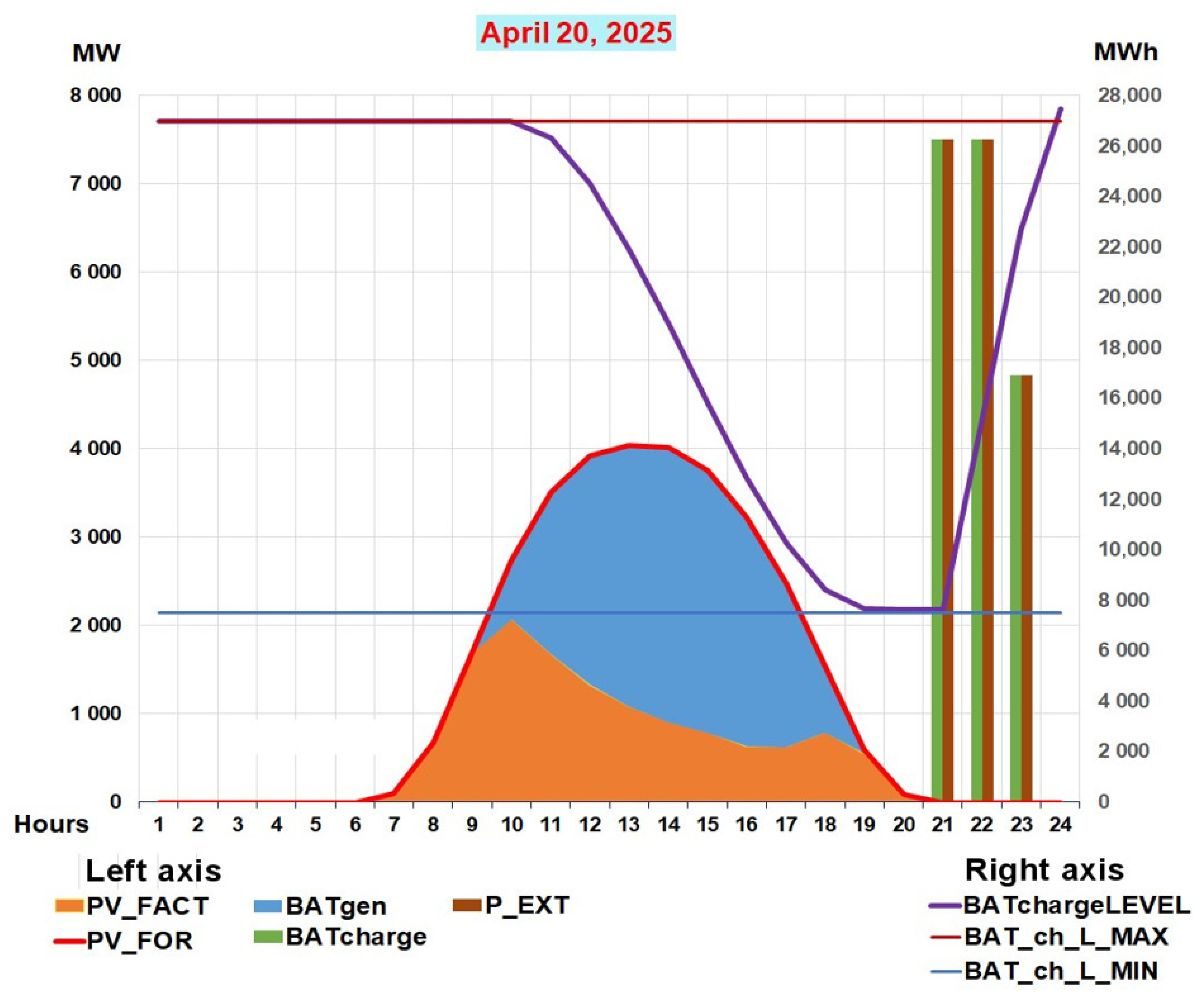
- Estimate the hourly values (for each of the 8760 h in 2025) of the actual PV_FACT and forecast PV_FOR power, the difference between these powers (PV_DELTA), the power generated by the BATgen storage system and used to charge the BATcharge storage system, the state of the storage system charge level vector BATchargeLEVEL, the state of the discrepancy between the supplied and forecast power IMB, the power generated by the flexible system P_EXT, and the state of the binary vectors indicating the impossibility of simultaneous discharge and charge of the storage system B_YBG and B_YBC. An example of the calculation results for the listed parameters on 20 April 2025, showing the greatest PV_DELTA power mismatch, is presented in Table 2 and Figure 1. With a total aggregated installed capacity of the storage system of 30,000 MWh, taking into account the constraints (1), the maximum permissible discharge power of the storage system of 24,300 MW and the charge power of 7500 MW, the hourly balance of forecast and supplied energy IMB(t) = 0 for all t = 1, 2,…, 24, the required daily volume of flexible generation is 19,823 MWh. The maximum capacity of flexible generation is 7500 MW.
- 3.
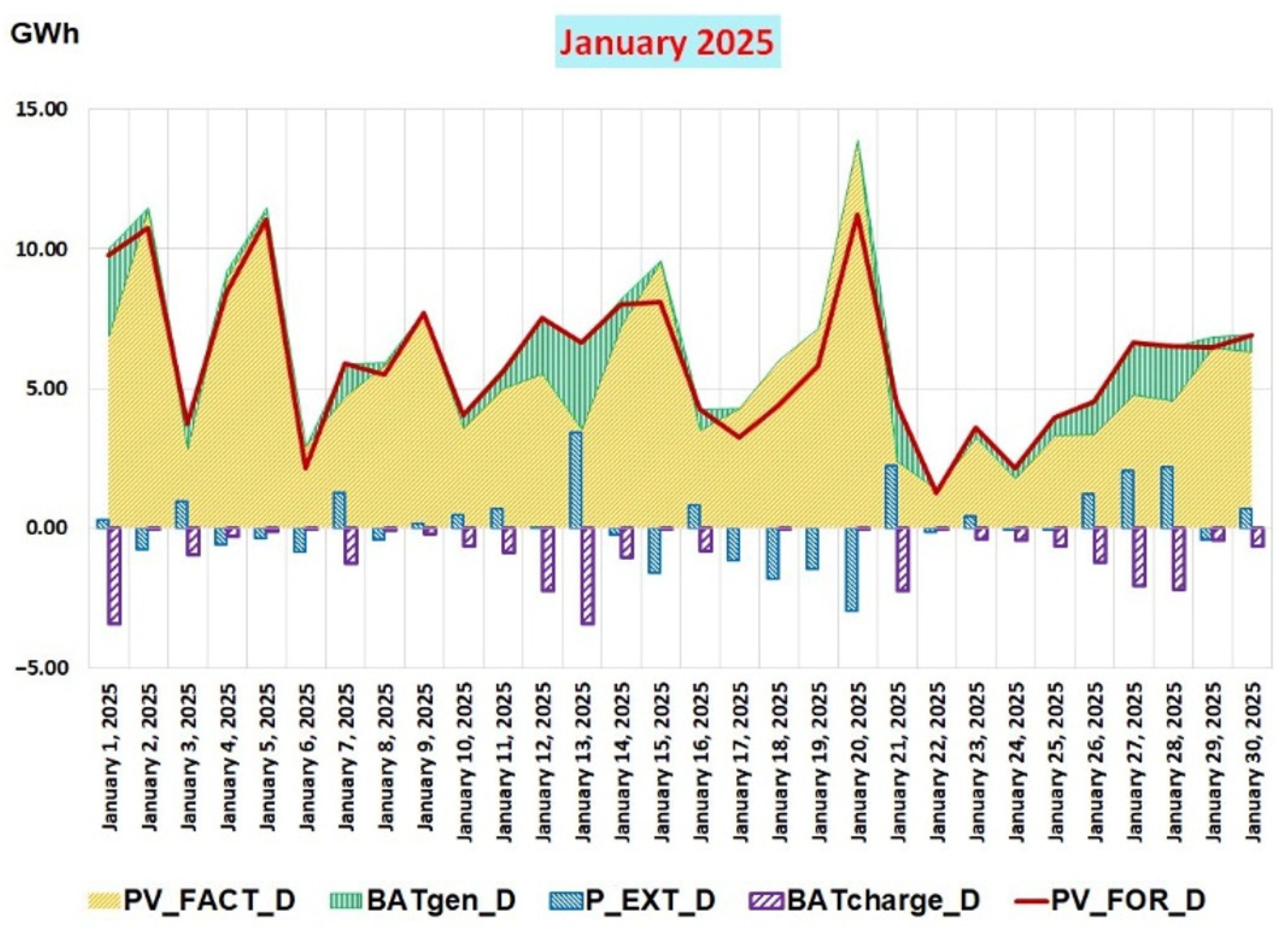
- Estimate the daily (for each of the 355 days of 2025) values of the total actual PV_FACT_D and forecast PV_FOR_D generation, the energy generated by the BATgen_D storage system and used to charge the BATcharge_D storage system, and the volume of energy generated by the P_EXT_D flexible system. An example of actual values and calculation results for daily generation volumes for January 2025 is presented in Table 3 and Figure 2.
- 4.
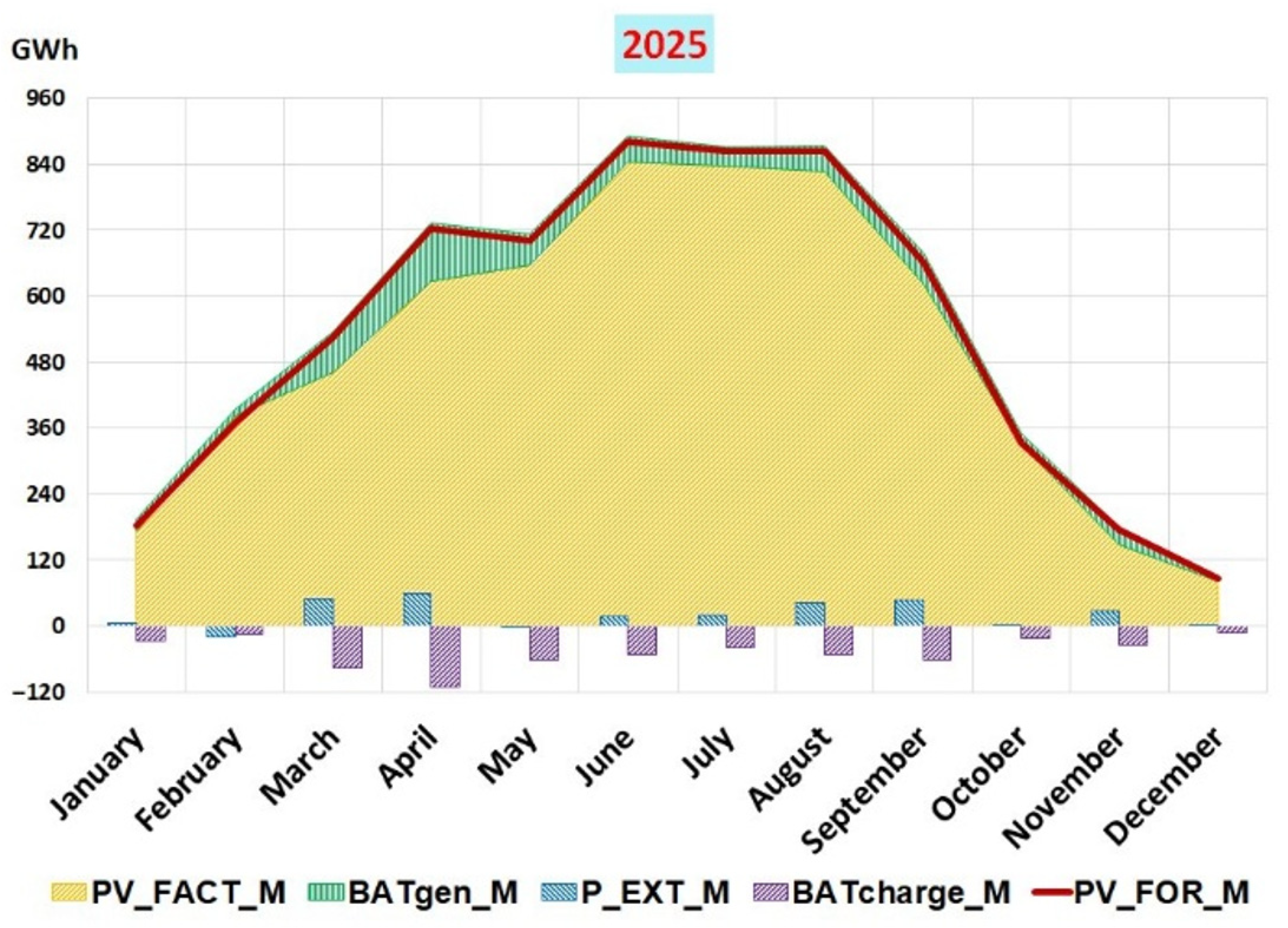
- Estimate the monthly (for each of the 12 months of 2025) values of the total actual PV_FACT_M and forecast PV_FOR_M generation, the energy generated by the BATgen_M storage system and used to charge the BATcharge_M storage system, and the volume of energy generated by the P_EXT_M flexible system. Examples of actual values and calculation results for monthly generation volumes in 2025 are presented in Table 4 and Figure 3.
5. Discussion
- The development of energy storage systems;
- Improvement of ultra-short-term forecasting algorithms;
- Maintaining sufficient reserve capacity;
- The implementation of intelligent decision-support systems.
6. Conclusions
- A mathematical model of step-by-step control of the coverage of the forecast schedule of aggregated PV power generation has been developed as a special case of a hierarchically controlled quasi-dynamic power system.
- A criterion has been proposed for minimising the total measure of inconsistency between forecast and actual generation, taking into account constraints regarding power balance, storage capacity and the system’s manoeuvrability.
- An analysis of hourly data for 2021–2025 revealed a significant level of imbalances in the aggregated generation of Ukraine’s solar power plants, exceeding 3000 MW in capacity and 19 GWh per day in energy during certain periods.
- It has been established that, under the adopted model assumptions and with an energy storage system of 30,000 MWh, coordinated operation with flexible generation can ensure full coverage of the forecast schedule (IMB = 0). This result characterises the technical upper bound of imbalance compensation rather than an economically optimised investment decision.
- The required volumes of aggregated flexible generation and the operating parameters of storage systems that ensure the cost-effective operation of generators under conditions of full responsibility for imbalances have been determined.
- The results obtained confirm that the key direction for the development of the IPS of Ukraine is the optimised integration of solar power plants with energy storage systems and intelligent control algorithms, which contributes to improving the reliability, stability and cost-effectiveness of the Ukrainian energy market.
- The results are obtained under the assumption of an aggregated system without network constraints. Future research should extend the proposed approach to multi-node models that account for transmission limitations and the regional distribution of renewable generation.
- Future work will involve investigating the potential for developing the proposed approach to minimise imbalances between aggregated forecast and actual generation from wind power plants within Ukraine’s IPS, and assessing the necessary limits of the economic and energy parameters of energy storage systems and flexible generation, relative to the installed capacity of individual solar and wind power plants in Ukraine.
Author Contributions
Funding
Data Availability Statement
Acknowledgments
Conflicts of Interest
Abbreviations
| AFPC | Automatic frequency and power control |
| BESS | Battery energy storage systems |
| ENTSO-E | European Network of Transmission System Operators for Electricity |
| IMB | Imbalance (measure of discrepancy between forecast and actual energy) |
| IPS | Integrated power system |
| PV | Photovoltaic |
| PV_FACT | Actual photovoltaic generation |
| PV_FOR | Forecast photovoltaic generation |
| PV_CONS | Supplied (consumed) photovoltaic energy |
| PV_DELTA | Difference between forecast and actual PV generation |
| P_EXT | Power of flexible (external) generation |
| RES | Renewable energy sources |
| SPP | Solar power plant |
| BATgen | Energy generated (discharged) by storage system |
| BATcharge | Energy used to charge storage system |
| BATchargeLEVEL | State of charge of storage system |
| B_YBG | Binary variable prohibiting simultaneous discharge |
| B_YBC | Binary variable prohibiting simultaneous charge |
References
- Denysov, V. Mathematical models for controlling active emergency frequency and power regulators in power systems with potential integration of wind and solar power plants. Priority directions. Syst. Res. Energy 2025, 3, 56–64. [Google Scholar] [CrossRef]
- Zaporozhets, A.; Kulyk, M.; Babak, V.; Denysov, V. Software and Information Complex for Modelling Integrated Multi-node and Autonomous Electric and Heat Supply Systems. In Structure Optimisation of Power Systems with Renewable Energy Sources; Studies in Systems, Decision and Control, Vol. 583; Springer: Cham, Switzerland, 2025. [Google Scholar] [CrossRef]
- Zaporozhets, A.; Kulyk, M.; Babak, V.; Denysov, V. Mathematical Models and Programming Tools for Optimising the Composition and Operating Modes of Energy Systems Under Rapid Growth of Renewable Energy Capacities. In Structure Optimisation of Power Systems with Renewable Energy Sources; Studies in Systems, Decision and Control, Vol. 583; Springer: Cham, Switzerland, 2025. [Google Scholar] [CrossRef]
- Zaporozhets, A.; Kulyk, M.; Babak, V.; Denysov, V. Current Trends in Modelling and Updating the Dissemination Processes of Energy Conversion and Utilisation Technologies in the Energy Sector of Ukraine. In Structure Optimisation of Power Systems with Renewable Energy Sources; Studies in Systems, Decision and Control, Vol. 583; Springer: Cham, Switzerland, 2025. [Google Scholar] [CrossRef]
- Zaporozhets, A.; Kulyk, M.; Babak, V.; Denysov, V. Modelling and Synchronising Energy Systems in Ukraine and Europe: A 2050 Perspective. In Structure Optimisation of Power Systems with Renewable Energy Sources; Studies in Systems, Decision and Control, Vol. 583; Springer: Cham, Switzerland, 2025. [Google Scholar] [CrossRef]
- Zaporozhets, A.; Babak, V.; Kulyk, M.; Denysov, V. Novel Methodology for Determining Necessary and Sufficient Power in Integrated Power Systems Based on the Forecasted Volumes of Electricity Production. Electricity 2025, 6, 41. [Google Scholar] [CrossRef]
- Kulyk, M.; Babak, V.; Denisov, V.; Zaporozhets, A. Use of Battery Storage Systems in Integrated Power Systems with Large Wind Power. In Systems, Decision and Control in Energy VII; Studies in Systems, Decision and Control, Vol. 595; Springer: Cham, Switzerland, 2025. [Google Scholar] [CrossRef]
- Kaya, A.; Conejo, A.J.; Rebennack, S. Fifty years of power systems optimization. Eur. J. Oper. Res. 2026, 329, 1–23. [Google Scholar] [CrossRef]
- Denysov, V.; Kulyk, M.; Babak, V.; Zaporozhets, A.; Kostenko, G. Modelling Nuclear-Centric Scenarios for Ukraine’s Low-Carbon Energy Transition Using Diffusion and Regression Techniques. Energies 2024, 17, 5229. [Google Scholar] [CrossRef]
- Denysov, V.; Babak, V.; Zaporozhets, A.; Nechaieva, T.; Kostenko, G. Energy System Optimisation Potential with Consideration of Technological Limitations. In Nexus of Sustainability; Studies in Systems, Decision and Control, Vol. 559; Springer: Cham, Switzerland, 2024. [Google Scholar] [CrossRef]
- Denysov, V.; Babak, V.; Zaporozhets, A.; Nechaieva, T.; Kostenko, G. Optimal Use of Quasi-dynamic Energy Complexes over the Forecasting Horizon. In Systems, Decision and Control in Energy VI; Studies in Systems, Decision and Control, Vol. 561; Springer: Cham, Switzerland, 2024. [Google Scholar] [CrossRef]
- Liu, S.; Lin, Z.; Dong, Y.; Zhao, J. Editorial: Power system operation and optimisation considering high penetration of renewable energy. Front. Energy Res. 2024, 12, 1483215. [Google Scholar] [CrossRef]
- Li, Z.; Yang, L.; Tian, Y.; Huang, X. Configuration and Operation Optimisation for the Sustainable Retrofit of Industrial Steam Power Systems Considering Renewable Energy Integration. Adv. Sustain. Syst. 2024, 8, 2400064. [Google Scholar] [CrossRef]
- He, Y.; Guo, S.; Zhou, J.; Ye, J.; Huang, J.; Zheng, K.; Du, X. Multi-objective planning-operation co-optimisation of renewable energy systems with hybrid energy storage. Renew. Energy 2022, 184, 776–790. [Google Scholar] [CrossRef]
- Salunkhe, O.; Berglund, Å.F. Industry 4.0 enabling technologies for increasing operational flexibility in final assembly. Int. J. Ind. Eng. Manag. 2022, 13, 38–48. [Google Scholar] [CrossRef]
- Lahrsen, I.-M.; Hofmann, M.; Müller, R. Flexibility of Epichlorohydrin Production—Increasing Profitability through Demand Response for Electricity and the Balancing Market. Processes 2022, 10, 761. [Google Scholar] [CrossRef]
- Das, V.; Singh, A.K.; Karuppanan, P.; Kumar, P.; Singh, S.N.; Agelidis, V.G. Energy management and economic analysis of multiple energy storage systems in solar PV/PEMFC hybrid power systems. Energy Convers. Econ. 2020, 1, 124–140. [Google Scholar] [CrossRef]
- Hossen, K.; Hasan Shihab, M.; Islam, M.R. Energy Systems for Solar-Powered UAVs: Photovoltaics, Hybrid Storage, Thermal Management, and Autonomous Power Control. Next Res. 2026, 6, 101404. [Google Scholar] [CrossRef]
- Yousri, D.; Farag, H.E.Z.; Zeineldin, H.; El-Saadany, E.F. An integrated model for optimal energy management and demand response in microgrids, taking into account hybrid hydrogen-battery storage systems. Energy Convers. Manag. 2023, 280, 116809. [Google Scholar] [CrossRef]
- Zhang, T.; Shi, R.; Jia, L.; Lee, K.Y. An innovative coordinated control strategy for frequency regulation in power systems with high renewable penetration. Appl. Energy 2025, 401, 126700. [Google Scholar] [CrossRef]
- Abayateye, J.; Zimmerle, D.J. Analysis of Primary and Secondary Frequency Control Challenges in African Transmission System. Energy Storage Appl. 2025, 2, 10. [Google Scholar] [CrossRef]
- Ali, H.; Li, B.; Xu, D. A new enhanced synthetic inertia system for improving the stability of hybrid AC/DC grids using MMC integrated with batteries. J. Energy Storage 2025, 127, 117–125. [Google Scholar] [CrossRef]
- Shi, C.; Zhang, X.; Zhang, K.; Xie, X.; Lu, Q.; Zhang, N.; Su, Z. Ultra-short-term photovoltaic power prediction based on ground-based cloud images: A review. Appl. Energy 2025, 402, 126943. [Google Scholar] [CrossRef]
- Kantaros, A.; Ganetsos, T.; Pallis, E.; Papoutsidakis, M. From Mathematical Modelling and Simulation to Digital Twins: Bridging Theory and Digital Realities in Industry and Emerging Technologies. Appl. Sci. 2025, 15, 9213. [Google Scholar] [CrossRef]
- Haj Qasem, M.; Aljaidi, M.; Samara, G.; Alazaidah, R.; Alsarhan, A.; Alshammari, M. An Intelligent Decision Support System Based on Multi-Agent Systems for the Business Classification Problem. Sustainability 2023, 15, 10977. [Google Scholar] [CrossRef]
- Lekshmi, J.D.; Rather, Z.H.; Pal, B.C. A New Tool to Assess Maximum Permissible Solar PV Penetration in a Power System. Energies 2021, 14, 8529. [Google Scholar] [CrossRef]
- Kushwaha, V.; Gupta, R. Congestion control for high-speed wired networks: A systematic literature review. J. Netw. Comput. Appl. 2014, 45, 62–78. [Google Scholar] [CrossRef]
- Kyrylenko, O.; Blinov, I.; Denysiuk, S.; Zaitsev, I.; Vasylchenko, V. Implementation of basic international smart grid standards in Ukraine: Current status. Power Eng. Econ. Technol. Ecol. 2023, 4, 44–53. [Google Scholar] [CrossRef]
- Bravo, R.; Friedrich, D. Integration of energy storage with hybrid solar power plants. Energy Procedia 2018, 151, 182–186. [Google Scholar] [CrossRef]
- Suleymanov, S.G.; Ismailova, G.K.; Sheidai, T.A. Improving mechanisms for the use of renewable energy sources for a greener world. Sci. Bull. IFNTUOG. Ser. Econ. Manag. Oil Gas Ind. 2025, 1, 26–37. [Google Scholar]
- Saleh, A.M.; Vokony, I.; Waseem, M.; Khan, M.A.; Al-Areqi, A. Power system stability with high integration of RESs and EVs: Benefits, challenges, tools, and solutions. Energy Rep. 2025, 13, 2637–2663. [Google Scholar] [CrossRef]
- Post-War Development of the Renewable Energy Sector in Ukraine; GOPA International Energy Consultants GmbH, April 2024. Available online: https://www.energy-community.org/dam/jcr:063d888c-dd3d-469c-a2b3-68d6130b30f5/intec_UA_postwar_RESDeveloment.pdf (accessed on 25 March 2026).
- Schwaegerl, C. Renewable Generation Technologies: Utilising Solar Power. In Distributed Energy Resources in Active Distribution Networks; CIGRE Green Books: Cham, Switzerland; Springer: Cham, Switzerland, 2026. [Google Scholar] [CrossRef]
- Ukoba, K.; Olatunji, K.O.; Adeoye, E.; Jen, T.-C.; Madyira, D.M. Optimizing renewable energy systems through artificial intelligence: Review and future prospects. Energy Environ. 2024, 35, 3833–3879. [Google Scholar] [CrossRef]
- Dong, W.; Sun, H.; Mei, C.; Li, Z.; Zhang, J.; Yang, H. Forecast-Driven Stochastic Optimization Scheduling of an Energy Management System for an Isolated Hydrogen Microgrid. Energy Convers. Manag. 2023, 277, 116640. [Google Scholar] [CrossRef]
- Krishnamurthy, S.; Adewuyi, O.B.; Salimon, S.A. Recent advances in artificial intelligence-based optimization for power system applications: A review of techniques, challenges, and future directions. Renew. Sustain. Energy Rev. 2026, 226, 116340. [Google Scholar] [CrossRef]
- Osifeko, M.; Munda, J. Scenario-Based Stochastic Optimization for Renewable Integration Under Forecast Uncertainty: A South African Power System Case Study. Processes 2025, 13, 2560. [Google Scholar] [CrossRef]
- Ahmad, T.; Madonski, R.; Zhang, D.; Huang, C.; Mujeeb, A. Data-driven probabilistic machine learning in sustainable smart energy/smart energy systems: Key developments, challenges, and future research opportunities in the context of smart grid paradigm. Renew. Sustain. Energy Rev. 2022, 160, 112128. [Google Scholar] [CrossRef]
- Sarin, G.; Srivastava, A.; Srivastava, I.; Bhattacharjee, S.; Gujaran, S.; Reddy, Y.Y.S. Renewable microgrid optimization using AI: A B-SLR approach and future research directions. Energy Rep. 2025, 14, 4963–4975. [Google Scholar] [CrossRef]
- State Enterprise ‘Guaranteed Buyer’. Available online: https://www.gpee.com.ua/ (accessed on 25 March 2026).
- On Amendments to Certain Laws of Ukraine Regarding the Provision of Competitive Conditions for the Production of Electricity from Alternative Energy Sources. Available online: https://zakon.rada.gov.ua/laws/show/2712-19 (accessed on 25 March 2026).
- Denisov, V. Integrated Power System multi-node model, taking into account the nondispatchable nature of renewable energy sources. In Proceedings of the 2022 IEEE 8th International Conference on Energy Smart Systems (ESS), Kyiv, Ukraine, 12–14 October 2022; pp. 175–179. [Google Scholar] [CrossRef]
- Babak, V.P.; Denisov, V.A.; Zaporozhets, A.O.; Nechaeva, T.P. Computer Program ‘SOPS’; Certificate of Copyright Registration for Work No. 137703, 2 July 2025; Ukrainian National Office of Intellectual Property and Innovation: Kyiv, Ukraine, 2025.
- Khalili, S.; Oyewo, A.S.; Lopez, G.; Kaypnazarov, K.; Breyer, C. Technologies, trends, and trajectories across 100% renewable energy system analyses. Renew. Sustain. Energy Rev. 2026, 226, 116308. [Google Scholar] [CrossRef]
- Fuentes, J.; Zapata, S.; Engel, E.; Ochoa, C.; Betancur, V. Modeling Infrastructure Delays and Congestion for Large-Scale Power Systems. Energies 2025, 18, 3047. [Google Scholar] [CrossRef]
- Patil, S.; Kotzur, L.; Stolten, D. Advanced Spatial and Technological Aggregation Scheme for Energy System Models. Energies 2022, 15, 9517. [Google Scholar] [CrossRef]
- Serpe, L.; Cole, W.; Sergi, B.; Brown, M.; Carag, V.; Karmakar, A. The Importance of Spatial Resolution in Large-Scale, Long-Term Planning Models. Appl. Energy 2025, 385, 125534. [Google Scholar] [CrossRef]
- Frysztacki, M.M.; Recht, G.; Brown, T. A Comparison of Clustering Methods for the Spatial Reduction of Renewable Electricity Optimisation Models of Europe. Energy Inform. 2022, 5, 4. [Google Scholar] [CrossRef]



| Year | Installed Capacity, MW | Maximum Power, Pmax, MW | Date/Time of Peak Power | Maximum Imbalance, ΔP, MW | Date/Time of Peak Imbalance | Maximum Daily Generation, MWh |
|---|---|---|---|---|---|---|
| 2021 | 5063 | 3766 | 9 July 2021 13:00 | 1984 | 11 April 2021 12:00 | 32,331 |
| 2022 | 5063 | 3587 | 14 February 2022 11:00 | 3014 | 22 March 2022 12:00 | 23,303 |
| 2023 | 6419 | 3708 | 1 June 2023 12:00 | 2973 | 23 April 2023 12:00 | 31,936 |
| 2024 | 6419 | 4027 | 5 May 2024 12:00 | 2140 | 10 April 2024 13:00 | 34,248 |
| 2025 | 7000–9000 * | 3738 | 10 June 2025 15:00 | 3116 | 10 April 2025 14:00 | 33,638 |
| T, h | PV_FACT, MW | PV_FOR, MW | PV_DELTA, MW | BATgen, MW | BATcharge, MW | BATchargeLEVEL, MWh | IMB | P_EXT, MW | B_YBG | B_YBC |
|---|---|---|---|---|---|---|---|---|---|---|
| 1 | −10 | −9 | 0 | 0 | 0 | 27,000 | 0 | 0 | 0 | 1 |
| 2 | −10 | −9 | 1 | 0 | 0 | 27,000 | 0 | 0 | 0 | 1 |
| 3 | −10 | −9 | 1 | 0 | 0 | 27,000 | 0 | 0 | 0 | 1 |
| 4 | −10 | −9 | 0 | 0 | 0 | 27,000 | 0 | 0 | 0 | 1 |
| 5 | −10 | −9 | 1 | 0 | 0 | 27,000 | 0 | 0 | 0 | 1 |
| 6 | −7 | −6 | 1 | 0 | 0 | 27,000 | 0 | 0 | 0 | 1 |
| 7 | 106 | 104 | −2 | 0 | 0 | 27,000 | 0 | −2 | 1 | 0 |
| 8 | 688 | 670 | −18 | 0 | 0 | 27,000 | 0 | −20 | 1 | 0 |
| 9 | 1694 | 1701 | 7 | 7 | 0 | 27,000 | 0 | 7 | 1 | 0 |
| 10 | 2075 | 2732 | 657 | 657 | 0 | 26,993 | 0 | 0 | 1 | 0 |
| 11 | 1678 | 3506 | 1828 | 1828 | 0 | 26,337 | 0 | 0 | 1 | 0 |
| 12 | 1329 | 3920 | 2591 | 2591 | 0 | 24,509 | 0 | 0 | 1 | 0 |
| 13 | 1085 | 4045 | 2960 | 2960 | 0 | 21,918 | 0 | 0 | 1 | 0 |
| 14 | 906 | 4022 | 3116 | 3116 | 0 | 18,958 | 0 | 0 | 1 | 0 |
| 15 | 788 | 3754 | 2966 | 2966 | 0 | 15,842 | 0 | 0 | 1 | 0 |
| 16 | 631 | 3226 | 2595 | 2595 | 0 | 12,876 | 0 | 0 | 1 | 0 |
| 17 | 625 | 2474 | 1849 | 1849 | 0 | 10,281 | 0 | 0 | 1 | 0 |
| 18 | 790 | 1530 | 739 | 739 | 0 | 8433 | 0 | 0 | 1 | 0 |
| 19 | 549 | 596 | 47 | 47 | 0 | 7693 | 0 | 0 | 1 | 0 |
| 20 | 94 | 91 | −3 | 0 | 0 | 7646 | 0 | 0 | 1 | 0 |
| 21 | −7 | −6 | 0 | 0 | 7500 | 7646 | 0 | 7500 | 0 | 1 |
| 22 | −9 | −9 | 0 | 0 | 7500 | 15,146 | 0 | 7500 | 0 | 1 |
| 23 | −10 | −9 | 1 | 0 | 4838 | 22,646 | 0 | 4838 | 0 | 1 |
| 24 | −9 | −9 | 0 | 0 | 0 | 27,484 | 0 | 0 | 0 | 1 |
| SUM | 12,946 | 32,283 | 19,337 | 19,354 | 19,838 | 27,484 | 0 | 19,823 | ||
| MIN | −10 | −9 | −18 | 0 | 0 | 7646 | 0 | −20 | ||
| MAX | 2075 | 4045 | 3116 | 3116 | 7500 | 27,484 | 0 | 7500 |
| Date | PV_FACT_D, GWh | PV_FOR_D GWh | P_EXT_D GWh | BATgen_D GWh | BATcharge_D GWh |
|---|---|---|---|---|---|
| 1 January 2025 | 6.90 | 9.79 | 0.29 | 3.10 | −3.44 |
| 2 January 2025 | 11.44 | 10.76 | −0.76 | 0.02 | −0.02 |
| 3 January 2025 | 2.84 | 3.74 | 0.97 | 0.88 | −0.97 |
| 4 January 2025 | 8.96 | 8.46 | −0.58 | 0.28 | −0.31 |
| 5 January 2025 | 11.36 | 11.05 | −0.37 | 0.12 | −0.13 |
| 6 January 2025 | 2.91 | 2.15 | −0.87 | 0.00 | 0.00 |
| 7 January 2025 | 4.73 | 5.88 | 1.26 | 1.13 | −1.26 |
| 8 January 2025 | 5.83 | 5.49 | −0.40 | 0.07 | −0.08 |
| 9 January 2025 | 7.57 | 7.69 | 0.18 | 0.19 | −0.21 |
| 10 January 2025 | 3.58 | 4.04 | 0.49 | 0.57 | −0.63 |
| 11 January 2025 | 4.97 | 5.61 | 0.68 | 0.78 | −0.86 |
| 12 January 2025 | 5.53 | 7.54 | 0.00 | 2.02 | −2.25 |
| 13 January 2025 | 3.54 | 6.63 | 3.43 | 3.08 | −3.43 |
| 14 January 2025 | 7.25 | 8.00 | −0.25 | 0.95 | −1.05 |
| 15 January 2025 | 9.54 | 8.12 | −1.60 | 0.01 | −0.02 |
| 16 January 2025 | 3.48 | 4.26 | 0.84 | 0.76 | −0.84 |
| 17 January 2025 | 4.29 | 3.24 | −1.18 | 0.00 | 0.00 |
| 18 January 2025 | 6.00 | 4.39 | −1.81 | 0.00 | 0.00 |
| 19 January 2025 | 7.14 | 5.82 | −1.48 | 0.00 | 0.00 |
| 20 January 2025 | 13.90 | 11.25 | −2.97 | 0.01 | −0.01 |
| 21 January 2025 | 2.40 | 4.46 | 2.25 | 2.03 | −2.25 |
| 22 January 2025 | 1.36 | 1.25 | −0.15 | 0.01 | −0.01 |
| 23 January 2025 | 3.21 | 3.59 | 0.42 | 0.36 | −0.40 |
| 24 January 2025 | 1.79 | 2.17 | −0.02 | 0.38 | −0.43 |
| 25 January 2025 | 3.32 | 3.95 | 0.00 | 0.60 | −0.67 |
| 26 January 2025 | 3.36 | 4.51 | 1.24 | 1.12 | −1.24 |
| 27 January 2025 | 4.76 | 6.64 | 2.06 | 1.85 | −2.06 |
| 28 January 2025 | 4.54 | 6.53 | 2.19 | 1.97 | −2.19 |
| 29 January 2025 | 6.46 | 6.48 | −0.42 | 0.38 | −0.43 |
| 30 January 2025 | 6.33 | 6.92 | 0.68 | 0.60 | −0.67 |
| 31 January 2025 | 2.76 | 3.52 | 0.00 | 0.73 | −0.82 |
| SUM_GWh | 172.08 | 183.92 | 4.13 | 24.01 | −26.68 |
| MIN | 1.36 | 1.25 | −2.97 | 0.00 | −3.44 |
| MAX | 13.90 | 11.25 | 3.43 | 3.10 | 0.00 |
| Month | PV_FACT_M, GWh | PV_FOR_M GWh | P_EXT_M GWh | BATgen_M GWh | BATcharge_M GWh |
|---|---|---|---|---|---|
| January | 172.08 | 183.92 | 4.13 | 24 Jan | −26.68 |
| February | 382.85 | 369.42 | −18.95 | 12.99 | −14.44 |
| March | 461.00 | 527.26 | 49.56 | 74.72 | −76.86 |
| April | 628.19 | 723.11 | 60.55 | 104.21 | −110.79 |
| May | 658.10 | 700.63 | −0.63 | 55.60 | −61.78 |
| June | 844.12 | 882.24 | 16.39 | 46.89 | −51.27 |
| July | 837.62 | 864.81 | 20.40 | 34.54 | −38.38 |
| August | 827.79 | 863.23 | 41.98 | 45.77 | −50.86 |
| September | 621.26 | 662.94 | 48.14 | 56.95 | −61.26 |
| October | 330.58 | 332.36 | 0.01 | 19.68 | −21.87 |
| November | 149.30 | 174.24 | 27.08 | 32.02 | −35.57 |
| December | 81.02 | 85.53 | 3.76 | 11.38 | −12.64 |
| SUM_GWh | 5993.92 | 6369.69 | 252.41 | 518.78 | −562.40 |
| MIN | 81.02 | 85.53 | −18.95 | 11.38 | −110.79 |
| MAX | 844.12 | 882.24 | 60.55 | 104.21 | −12.64 |
Disclaimer/Publisher’s Note: The statements, opinions and data contained in all publications are solely those of the individual author(s) and contributor(s) and not of MDPI and/or the editor(s). MDPI and/or the editor(s) disclaim responsibility for any injury to people or property resulting from any ideas, methods, instructions or products referred to in the content. |
© 2026 by the authors. Licensee MDPI, Basel, Switzerland. This article is an open access article distributed under the terms and conditions of the Creative Commons Attribution (CC BY) license.
Share and Cite
Zaporozhets, A.; Babak, V.; Kulyk, M.; Denysov, V. Deterministic Step-by-Step Control of Solar Generation Imbalances in Power Systems. Solar 2026, 6, 24. https://doi.org/10.3390/solar6030024
Zaporozhets A, Babak V, Kulyk M, Denysov V. Deterministic Step-by-Step Control of Solar Generation Imbalances in Power Systems. Solar. 2026; 6(3):24. https://doi.org/10.3390/solar6030024
Chicago/Turabian StyleZaporozhets, Artur, Vitalii Babak, Mykhailo Kulyk, and Viktor Denysov. 2026. "Deterministic Step-by-Step Control of Solar Generation Imbalances in Power Systems" Solar 6, no. 3: 24. https://doi.org/10.3390/solar6030024
APA StyleZaporozhets, A., Babak, V., Kulyk, M., & Denysov, V. (2026). Deterministic Step-by-Step Control of Solar Generation Imbalances in Power Systems. Solar, 6(3), 24. https://doi.org/10.3390/solar6030024