Brief Report

Whale Sharks Do It Deeper: Extension of Known Depth Range for Rhincodon typus from Satellite Telemetry Data in the Coral Sea, Australia


1
Biopixel Oceans Foundation, Cairns, QLD 4878, Australia
2
AIMS@JCU, College of Science & Engineering, James Cook University, Townsville, QLD 4811, Australia
3
Re:wild, Austin, TX 78746, USA
4
Wildlife Computers, Redmond, WA 98752, USA
5
Marine Megafauna Foundation, West Palm Beach, FL 33411, USA
6
School of Science, Technology and Engineering, University of the Sunshine Coast, Sunshine Coast, QLD 4556, Australia
*
Author to whom correspondence should be addressed.
Hydrobiology 2026, 5(2), 10; https://doi.org/10.3390/hydrobiology5020010
Submission received: 9 February 2026 / Revised: 13 March 2026 / Accepted: 26 March 2026 / Published: 1 April 2026

Abstract

Whale sharks (Rhincodon typus) predominantly inhabit the epipelagic layer, yet dives to at least 1928 m have been reported. Even so, current understanding of the species’ true maximum dive depth is constrained by the technological limitations of depth sensors of commercially available satellite tags, which are generally rated to a maximum depth of 2000 m. Here, we report a new maximum depth range of 1978–2527 m inferred from a Wildlife Computers custom-calibrated SPLASH10-346C finmount tag (2500 m capability), deployed on a 7 m juvenile male whale shark in the Coral Sea, Australia. This extends the currently accepted depth limit by 50–599 m.

1. Introduction

Whale sharks (Rhincodon typus) spend a large proportion of their time in the epipelagic layer of the ocean, yet they also perform intermittent deep dives that indicate mesopelagic and bathypelagic vertical habitat use [1,2]. Despite rapid technological advances in biologging and satellite telemetry [3,4,5,6], the species’ vertical movement ecology remains poorly understood in comparison to their horizontal movements [1,2]. Understanding vertical movement ecology and habitat use patterns in three-dimensional space are critical for effective conservation of this endangered and declining species [7]. The deepest confirmed dive to 1928 m, recorded in the Gulf of Mexico in 2010 [1], has since been widely cited as the maximum recorded depth for whale sharks [7]. However, apparent depth limits are likely constrained by technological limitations rather than the species’ physiological depth limit [2]. Commercially available pop-up satellite archival tags (PSAT), such as those used to record the currently accepted depth limit [1], generally have a depth sensor limit of up to 2000 m, with 1700 m typically used as release depth to avoid crush-depth failure. For example, five of eight PSAT tags that we deployed on whale sharks in the Coral Sea prematurely released due to exceeding the fail-safe depth of 1700 m, which resulted in an inability to record the animals’ true dive depths [8]. Additionally, premature release can also result in significantly shorter-than-intended tracking durations [9]. Unlike PSAT tags, finmount tags (e.g., SPLASH tags) lack (and cannot practically include) an automatic release mechanism when depth limits are reached. These tags are typically pressure-rated to a maximum of approximately 2000 m (with varying sensor limits depending on manufacturer), and exceedance typically results in depth-sensor failure and erroneous readings. As an example, in an unpublished data set derived from 54 fin-mount deployments of SPLASH10-346A 0–1700 m tags on whale sharks in Indonesia, eight of the tags recorded whale shark extreme depth dives to >1800 m, often resulting in depth sensor failure and subsequent nonsensical depth values reported from the still-transmitting tags [10]. In addition, when tags are not physically recovered, which in the case of whale sharks is rare [11], Argos bandwidth constraints result in irregular transmission of low-resolution data summaries [12], reducing the likelihood that extreme events are captured. Here, we report a depth-range extension for Rhincodon typus inferred from transmitted depth data of a still-transmitting 2500 m extended depth range SPLASH tag deployed at a recently documented whale shark constellation site on Australia’s east coast [13].

2. Materials and Methods

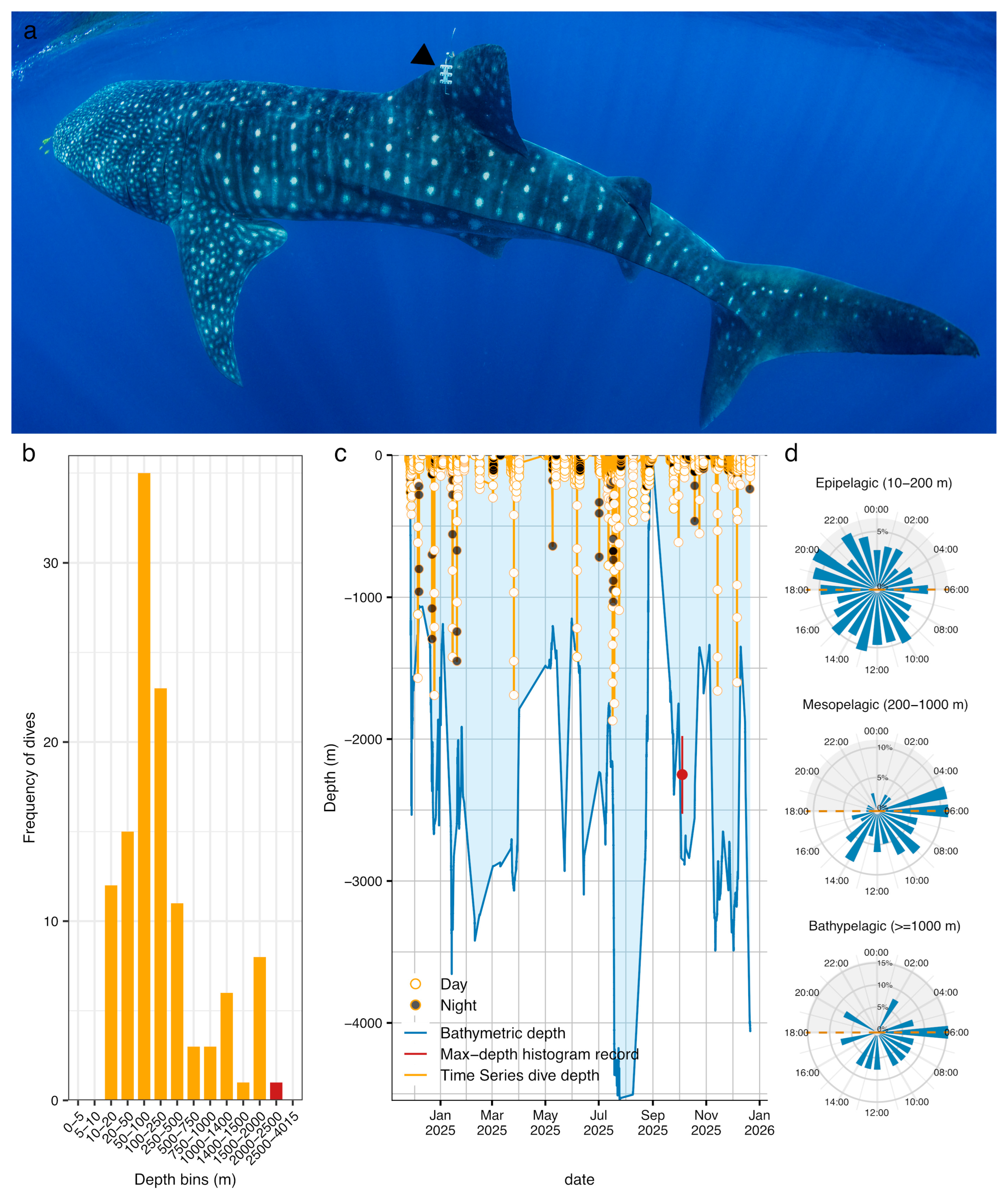
Several whale sharks (n = 13) were equipped with Argos satellite-linked transmitters during a dedicated tagging expedition in November/December 2024 within a recently discovered aggregation site in Wreck Bay located in the far northern Great Barrier Reef on Australia’s east coast [13]. Tagging procedures were previously described [13,14]. Briefly, tags were mounted to a custom-designed fin-clamp and deployed by a free-swimming researcher on the first dorsal fin of encountered whale sharks (Figure 1a). Among others, a 7 m immature male individual (“Francky”) was equipped with a SPLASH tag (PTT ID: 266158; Model: SPLASH10-346C, with custom-extended depth calibration to 2500 m; Wildlife Computers Inc., Redmond, WA, USA) on 26 November 2024. This custom calibration extended the depth sensor limit from the standard 2000 m to 2500 m, meaning that depths recorded up to this extended limit fall within the sensor’s specified operating range. SPLASH tags are archival and satellite transmitting tags that transmit location data alongside archived data (time series depth and temperature; daily binned histogram data) when the tag breaks the surface. Maturity was assessed by clasper calcification (inferred by length and thickness) in males and by total length in females, assuming maturity at around 9–10 m [15,16].
Analyses were performed and illustrations created using RStudio (R version: 4.4.2) [17]. Transmitted data was downloaded through the Wildlife Computer (WC) tag portal and included data from the recently launched Kinéis satellites (https://www.argos-system.org/ (accessed on 9 February 2026)). Time-series data were processed using the ‘diveMove’ R package [18] and histogram data with ‘wcUtils’ [19]. To approximate the location of dives, a correlated random walk (CRW) model was fitted to timestamps of depth time-series records using the ‘aniMotum’ R package [20]. We then estimated the shark’s position at the histogram timestamp of the deepest dive by linear interpolation of locations from the CRW track. To visualise the available depth at each dive in the time series graph, we extracted the available bathymetric depth for each interpolated location using the 2023 General Bathymetric Chart of the Oceans [21]. The track and associated depth data were then visualised in three-dimensional space with ‘rayshader’ [22] and the produced frames were compiled into an animation using ‘av’ [23]. Depth values are presented taking into account the depth sensor’s accuracy (1% of sensor reading ±2 resolutions; in this case, the SPLASH tag depth sensor’s resolution was 1 m).

3. Results

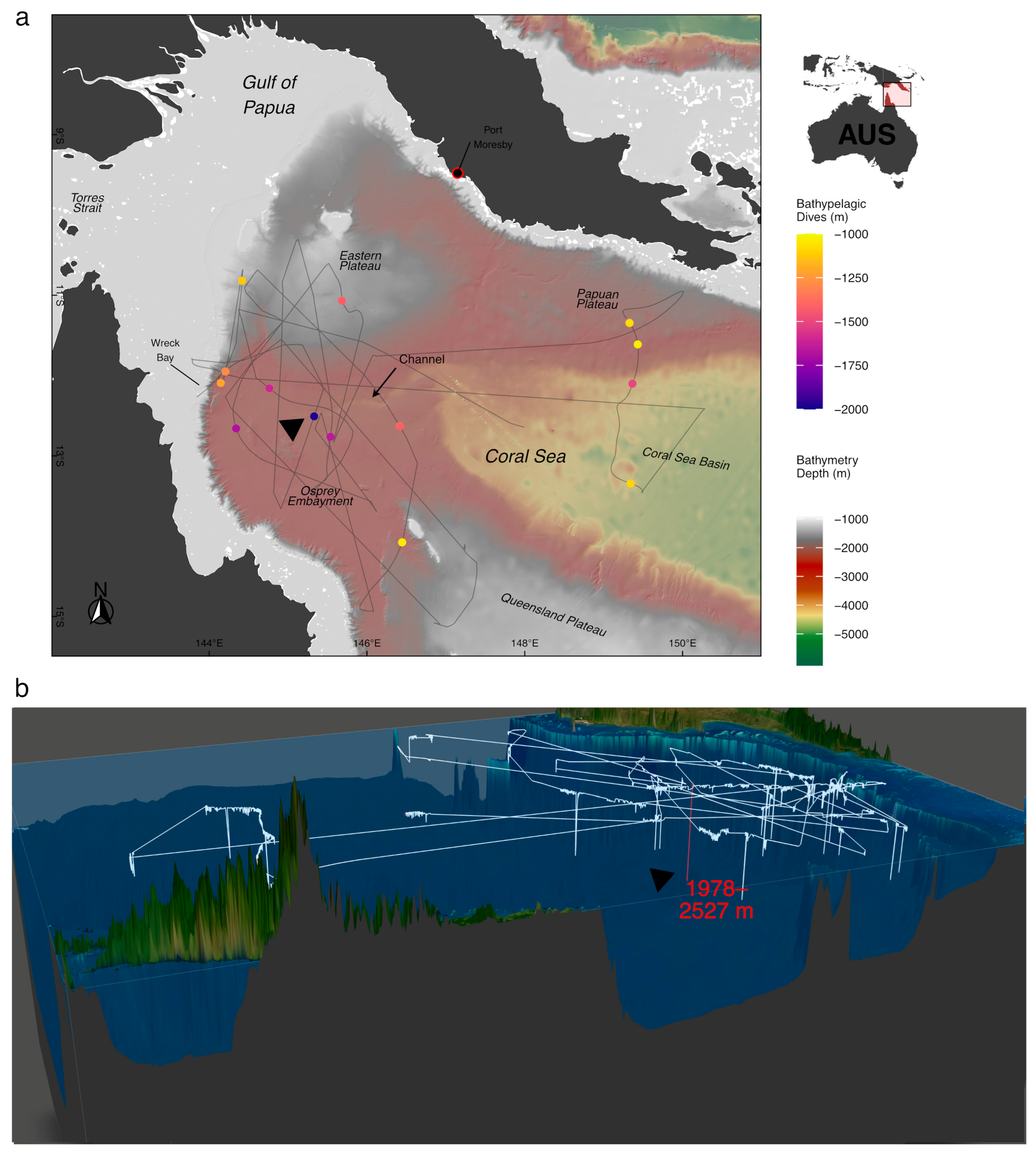
The transmitted SPLASH tag dive data indicated that this individual whale shark frequently conducted dives in the 10 m to 500 m range, with the most frequent dives in the epipelagic zone between 50 m and 100 m (Figure 1b). Although less frequent, deep dive excursions into the bathypelagic zone exceeding 1000 m were evident, with the deepest dive from time-series data recorded at 1869 ± 148 m on 16 July 2025, at 22:00 UTC (Figure 1 and Figure 2). However, depth histogram data provided evidence of one dive in the 2000–2500 m depth bin occurring on 4 October 2025. Taking into account the tags’ depth sensor accuracy (1% of depth reading ±2 m), the minimum depth achieved for this histogram-recorded deep dive is 1978 m, while the maximum depth is 2527 m (Figure 1b and Figure 2). Diel patterns indicate that most deep dives (mesopelagic and bathypelagic) occurred during daytime hours, while epipelagic dives (<200 m) occurred day and night (Figure 1c,d). The approximation of dive locations indicates that most dives, including the extreme deep dives were in pelagic waters (i.e., not to the seafloor); however, most of them appear to have occurred, based on visual inspection, near bathymetric features such as seamounts or channels (Figure 2). In fact, the “extreme” deep dive recorded here took place over a channel with a bathymetric depth of over 3000 m. This channel connects Wreck Bay to the Coral Sea basin (Figure 2).

4. Discussion

Here we report an extension of the known recorded dive depth of whale sharks based on an Argos satellite-transmitted depth record from daily binned data of a SPLASH tag. The recorded depth of the record-breaking dive occurred in the range of 1978–2527 m (taking into account sensor accuracy and the lower and upper bin values of the histogram dive of 2000 m and 2500 m, respectively). MK10 (SPLASH) messages use a CRC-16/MODBUS checksum (Hamming distance 4) with a ~0.0015% chance of an undetected transmission error [24], giving confidence that this depth-bin record is unlikely to be a transmission artefact. This record therefore exceeds the currently accepted depth limit for whale sharks (and any diving epipelagic fish [25]) of 1928 m recorded in 2010 in the Gulf of Mexico [1] by at least 50 m at the most conservative estimate, and by 599 m at the least conservative boundary. Despite ongoing extensive tagging efforts, the 15-year gap between the previously documented depth record [1] and that reported here highlights that observations of extreme dives in epipelagic taxa, including whale sharks, are strongly constrained by current bio-logging technology and the availability of high-resolution time-series data. The recorded maximum depths are likely to be influenced by tag pressure ratings, telemetry limitations and the rarity of physical tag recovery, rather than representing a true physiological boundary [2]. The Wildlife Computer’s SPLASH tag used here was of a newer generation with an extended depth rating of 2500 m. However, the deep dive recorded here, as well as the available depth (as per bathymetric depth at dive location) suggest that even higher depth ratings may be required to extend our understanding of the full vertical habitat use of deep diving species. Recent upgrades to the Argos satellite infrastructure may improve data transmission of time series data alongside location data collection. The Kinéis low-orbit constellation has been operational since mid-2025 and added 20 Argos-linked nanosatellites to the constellation of five original Argos satellites, increasing satellite coverage, message throughput and latency for wildlife telemetry [26]. With the promising improvement in satellite coverage and data throughput, it may be advantageous for researchers to adjust data transmission settings in SPLASH tags to allocate a higher priority to transmitting archived data. When tag-recovery is unlikely, this includes extending the archive transmission window beyond the commonly used 7-day default setting: in our case, the shark’s diving behaviour changed substantially, with transmissions dropping from 133 messages in September to 41 in October (when the deep dive occurred), before increasing to 101 in November. Given the 7-day transmission window, much of the October archive was likely deleted from the holding buffer and never transmitted. We therefore recommend setting longer windows for species where prolonged low-surfacing behaviour is likely (e.g., 60 days) to prevent loss of valuable data, despite the increased latency for recent data.
While the reasons for extreme dives in whale sharks remain elusive [1,2], it has been suggested that they may aid navigation by improving magnetic sensing, as the geomagnetic density gradient increases with depth [1]. Another explanation is linked to foraging as whale sharks are suggested to feed also in deep water, including the bathypelagic layer (≥1000 m) [27]. Diel patterns observed in this study may be attributed to foraging, as deep dives into the mesopelagic and bathypelagic layers were more common during the day when zooplankton is more concentrated at greater depths in deep scattering layers, which is a typical pattern found for whale sharks [1,28]. Interestingly, the deepest dive observed here occurred over a submarine channel linking the Coral Sea basin with the continental shelf adjacent to the aggregation site (Figure 2). Such shelf-edge exchange is consistent with documented Coral Sea subsurface intrusions onto the Great Barrier Reef shelf, which can deliver nutrient-enriched waters and elevate productivity near the outer reef [29,30]. Other deep dives observed from time series data were also near topographic deep-sea features like channels, seamounts or canyons (Figure 2), potentially linked to enhanced deep-water foraging opportunities or rapid search of the vertical column for prey cues suggested for whale sharks [31]. However, more fine-scale time-series data would be required to inspect the dive behaviours during deep dives in this individual. Other explanations for deep dives in whale sharks include thermoregulation [32] and optimising gliding performance to reduce the energetic cost of locomotion [33].
In conclusion, while mammals, particularly Cuvier’s beaked whales (Ziphius cavirostris), have been recorded diving to even more extreme depths closer to 3000 m [34], the recorded extreme dive to a conservative lower bound estimate of 1978 m (and upper bound estimate of 2527 m) reported here extends the currently known depth limit of whale sharks and, to our knowledge, stands as the deepest recorded dive for any epipelagic fish species.

Author Contributions

Conceptualization: I.B.M. and M.V.E.; Methodology: I.B.M.; Formal Analysis: I.B.M.; Software: I.B.M., Validation: M.V.E., A.B. and I.B.M.; Data Curation: I.B.M., M.V.E. and K.L.; Investigation: I.B.M.; Resources: A.B., R.F. and M.V.E.; Project Administration: A.B., R.F. and I.B.M.; Funding Acquisition: A.B. and R.F.; Visualization: I.B.M.; Writing—Original Draft Preparation: I.B.M.; Writing—Review and Editing: I.B.M., M.V.E., A.B., S.J.P., K.L. and R.F. All authors have read and agreed to the published version of the manuscript.

Funding

We acknowledge funding support by the Queensland Government’s Threatened Species Research (round 1) grant (TSR069), the Sapphire Project, Blancpain Ocean Commitment, Georgia Aquarium, Sea World Foundation (SWR/9/2023), Conservation International, MAC3 Impact Philanthropies, the Slattery Family Trust, and 4planet.

Institutional Review Board Statement

Research was conducted under permits G18/39348.1, G21/144109.1 and G22/46908.1 issued by the Great Barrier Reef Marine Park Authority. All work conducted was approved by James Cook University Animals Ethics Committee (A2864).

Data Availability Statement

The original data presented in the study are openly available in Zenodo at https://doi.org/10.5281/zenodo.18529463. Near-live tracks can be viewed on Biopixel Oceans Foundations’ Biotracker: https://biotracker.tv (accessed on 9 February 2026). Bathymetry data is accessible from the General Bathymetric Chart of the Oceans (https://www.gebco.net (accessed on 9 February 2026)).

Acknowledgments

We thank Blue Planet Marine and the crew of the MV Infamis, as well as Craig Howson and Holly Tharp of Northstar Cruises and the crew and helicopter pilot of the MV True North II, for excellent support of our fieldwork. We also thank MAC3 Impact Philanthropies for their ongoing support of our whale shark satellite telemetry research. We extend our gratitude to all research crew involved in this project, including Brad Norman and Samatha Reynolds from Ecocean Inc., Katya Abrantes, Matthew Dunbabin, Gesa Mueller and Christine Dudgeon from Biopixel Oceans Foundation, Lisa Hoopes, Alistair Dove and Cameron Perry from Georgia Aquarium, Chris Rohner from Marine Megafauna Foundation, and Biopixel Oceans Foundation’s spotter plane crew Hannah Robertson and Jasmin Behnke. We also thank Vinay Udyawer for helping with the 3D track animation. IBM acknowledges support through an Australian Government Research Training Program Scholarship (https://doi.org/10.82133/C42F-K220).

Conflicts of Interest

Author Kevin Lay is employed by Wildlife Computers Inc., declares no conflict of interest. Other authors declare no conflict of interest.

References

  1. Tyminski, J.P.; de la Parra-Venegas, R.; Gonzalez Cano, J.; Hueter, R.E. Vertical Movements and Patterns in Diving Behavior of Whale Sharks as Revealed by Pop-Up Satellite Tags in the Eastern Gulf of Mexico. PLoS ONE 2015, 10, e0142156. [Google Scholar] [CrossRef] [PubMed]
  2. Hearn, A.R.; Green, J.R.; Peñaherrera-Palma, C.R.; Reynolds, S.D.; Rohner, C.A.; Roman, M.; Sequeira, A.M.M. Whale Shark Movements and Migrations. In Whale Sharks: Biology, Ecology, and Conservation, 1st ed.; Dove, A.D.M., Pierce, S.J., Eds.; CRC Press: Boca Raton, FL, USA, 2021; pp. 105–127. [Google Scholar]
  3. Watanabe, Y.Y.; Papastamatiou, Y.P. Biologging and Biotelemetry: Tools for Understanding the Lives and Environments of Marine Animals. Annu. Rev. Anim. Biosci. 2023, 11, 247–267. [Google Scholar] [CrossRef] [PubMed]
  4. Hussey, N.E.; Kessel, S.T.; Aarestrup, K.; Cooke, S.J.; Cowley, P.D.; Fisk, A.T.; Harcourt, R.G.; Holland, K.N.; Iverson, S.J.; Kocik, J.F.; et al. ECOLOGY. Aquatic animal telemetry: A panoramic window into the underwater world. Science 2015, 348, 1255642. [Google Scholar] [CrossRef] [PubMed]
  5. Ellis-Soto, D.; Flack, A.; Strandburg-Peshkin, A.; Wild, T.A.; Williams, H.J.; O’Mara, M.T. From biologging to conservation: Tracking individual performance in changing environments. Proc. Natl. Acad. Sci. USA 2025, 122, e2410947122. [Google Scholar] [CrossRef] [PubMed]
  6. Heylen, B.C.; Nachtsheim, D.A. Bio-telemetry as an Essential Tool in Movement Ecology and Marine Conservation. In YOUMARES 8—Oceans Across Boundaries: Learning from Each Other; Springer: Berlin/Heidelberg, Germany, 2018; pp. 83–107. [Google Scholar]
  7. Pierce, S.J.; Rohner, C.A.; Perry, C.T.; Jabado, R.W.; Norman, B.; Reynolds, S.; Womersley, F.; Robinson, D.; Graham, R.; Araujo, G. Rhincodon typus. The IUCN Red List of Threatened Species 2025: E.T19488A126673248. Available online: https://www.iucnredlist.org/species/19488/126673248 (accessed on 17 October 2025).
  8. Miller, I.B.; Erdmann, M.V.; Pierce, S.J.; Norman, B.; Abrantes, K.G.; Fitzpatrick, R.; Hoopes, L.A.; Dudgeon, C.; Barnett, A. Biopixel Oceans Foundation, Cairns, Queensland, Australia. 2026; manuscript in preparation.
  9. Hammerschlag, N.; Gallagher, A.J.; Lazarre, D.M. A review of shark satellite tagging studies. J. Exp. Mar. Biol. Ecol. 2011, 398, 1–8. [Google Scholar] [CrossRef]
  10. Erdmann, M.V. (Re:wild, Austin, Texas, USA); Sianipar, A. (Elasmobranch Institute Indonesia, Denpasar, Bali, Indonesia). Unpublished data, 2015.
  11. Sequeira, A.M.M.; Heupel, M.R.; Lea, M.A.; Eguiluz, V.M.; Duarte, C.M.; Meekan, M.G.; Thums, M.; Calich, H.J.; Carmichael, R.H.; Costa, D.P.; et al. The importance of sample size in marine megafauna tagging studies. Ecol. Appl. 2019, 29, e01947. [Google Scholar] [CrossRef] [PubMed]
  12. Casale, P.; Figgener, C.; Arendt, M.; Broderick, A.C.; Ceriani, S.A.; Kaska, Y.; Plotkin, P.; Sanchez, C.L.; Schwenter, J.; Snape, R.; et al. Performance Comparison of Argos and Iridium Tracking Technologies for Sea Turtle Movement Ecology Studies. Animals 2025, 15, 3605. [Google Scholar] [CrossRef] [PubMed]
  13. Miller, I.B.; Fitzpatrick, R.; Abrantes, K.G.; Norman, B.; Pierce, S.J.; Erdmann, M.V.; Hoopes, L.A.; Dudgeon, C.; Dunbabin, M.D.; Dove, A.D.M.; et al. The Needle in the Haystack: Uncovering the First Whale Shark (Rhincodon typus) Aggregation in the Coral Sea. Ecol. Evol. 2025, 15, e71552. [Google Scholar] [CrossRef] [PubMed]
  14. Miller, I.B.; Niella, Y.; Udyawer, V.; Erdmann, M.V.; Abrantes, K.; Pierce, S.; Fitzpatrick, R.; Hoopes, L.; Dove, A.D.M.; Barnett, A. No Model Fits All: Dynamic Ensemble Species Distribution Model Reveals Seasonal Patterns of Essential Habitat Use of Ocean Giants in the Southwest Pacific. Divers. Distrib. 2026; in press.
  15. Norman, B.M.; Stevens, J.D. Size and maturity status of the whale shark (Rhincodon typus) at Ningaloo Reef in Western Australia. Fish. Res. 2007, 84, 81–86. [Google Scholar] [CrossRef]
  16. Pierce, S.J.; Pardo, S.A.; Rohner, C.A.; Matsumoto, R.; Murakumo, K.; Nozu, R.; Dove, A.D.M.; Perry, C.; Meekan, M. Whale Shark Reproduction, Growth, and Demography. In Whale Sharks: Biology, Ecology, and Conservation, 1st ed.; Dove, A.D.M., Pierce, S.J., Eds.; CRC Press: Boca Raton, FL, USA, 2021; pp. 13–45. [Google Scholar]
  17. Posit Team. RStudio: Integrated Development Environment for R. Posit Software, 2024.4.2.764. Posit Software. PBC: Boston, MA, USA, 2024.
  18. Luque, S.P. diveMove: Dive Analysis and Calibration, R package version 1.6.4; 2025. Available online: https://github.com/spluque/diveMove (accessed on 9 February 2026).
  19. London, J.M. wcUtils: Utilities to Access the Wildlife Computers Data Portal API, R package version 0.1; 2024. Available online: https://github.com/noaa-afsc/wcUtils (accessed on 9 February 2026).
  20. Jonsen, I.D.; Grecian, W.J.; Phillips, L.; Carroll, G.; McMahon, C.R.; Harcourt, R.G.; Hindell, M.A.; Patterson, T.A. aniMotum, an R package for animal movement data: Rapid quality control, behavioural estimation and simulation. Methods Ecol. Evol. 2023, 14, 806–816. [Google Scholar] [CrossRef]
  21. GEBCO Compilation Group. GEBCO 2023 Grid. 2023. Available online: https://www.bodc.ac.uk/data/published_data_library/catalogue/10.5285/f98b053b-0cbc-6c23-e053-6c86abc0af7b (accessed on 4 May 2024).
  22. Morgan-Wall, T. rayshader: Create Maps and Visualize Data in 2D and 3D, R package version 0.38.11; 2025. Available online: https://github.com/tylermorganwall/rayshader (accessed on 9 February 2026).
  23. Ooms, J. av: Working with Audio and Video in R, R package version 0.9.4; 2025. Available online: https://cran.r-project.org/web/packages/av/index.html (accessed on 9 February 2026).
  24. Koopman, P. 32-bit cyclic redundancy codes for Internet applications. In Proceedings of the International Conference on Dependable Systems and Networks, Los Alamitos CA, USA, 23–26 June 2002; pp. 459–468. [Google Scholar]
  25. Evans, K.; Abascal, F.; Kolody, D.; Sippel, T.; Holdsworth, J.; Maru, P. The horizontal and vertical dynamics of swordfish in the South Pacific Ocean. J. Exp. Mar. Biol. Ecol. 2014, 450, 55–67. [Google Scholar] [CrossRef]
  26. Wildlife Computers. Argos Satellite Constellation Update. Available online: https://wildlifecomputers.com/blog/argos-satellite-constellation-update/ (accessed on 23 January 2026).
  27. Rohner, C.A.; Couturier, L.I.E.; Richardson, A.J.; Pierce, S.J.; Prebble, C.E.M.; Gibbons, M.J.; Nichols, P.D. Diet of whale sharks Rhincodon typus inferred from stomach content and signature fatty acid analyses. Mar. Ecol. Prog. Ser. 2013, 493, 219–235. [Google Scholar] [CrossRef]
  28. Brunssschweiler, J.M.; Sims, D.W. Diel Oscillations in Whale Shark Vertical Movements Associated with Meso- and Bathypelagic Diving. Am. Fish. Soc. Symp. 2012, 76, 457–469. [Google Scholar]
  29. Brinkman, R.; Wolanski, E.; Deleersnijder, E.; McAllister, F.; Skirving, W. Oceanic inflow from the Coral Sea into the Great Barrier Reef. Estuar. Coast. Shelf Sci. 2002, 54, 655–668. [Google Scholar] [CrossRef]
  30. Benthuysen, J.A.; Tonin, H.; Brinkman, R.; Herzfeld, M.; Steinberg, C.R. Intrusive upwelling in the Central Great Barrier Reef. J. Geophys. Res. Ocean. 2016, 121, 8395–8416. [Google Scholar] [CrossRef]
  31. Brunnschweiler, J.M.; Baensch, H.; Pierce, S.J.; Sims, D.W. Deep-diving behaviour of a whale shark Rhincodon typus during long-distance movement in the western Indian Ocean. J. Fish. Biol. 2009, 74, 706–714. [Google Scholar] [CrossRef] [PubMed]
  32. Thums, M.; Meekan, M.; Stevens, J.; Wilson, S.; Polovina, J. Evidence for behavioural thermoregulation by the world’s largest fish. J. R. Soc. Interface 2013, 10, 20120477. [Google Scholar] [CrossRef] [PubMed]
  33. Gleiss, A.C.; Norman, B.; Wilson, R.P. Moved by that sinking feeling: Variable diving geometry underlies movement strategies in whale sharks. Funct. Ecol. 2011, 25, 595–607. [Google Scholar] [CrossRef]
  34. Schorr, G.S.; Falcone, E.A.; Moretti, D.J.; Andrews, R.D. First long-term behavioral records from Cuvier’s beaked whales (Ziphius cavirostris) reveal record-breaking dives. PLoS ONE 2014, 9, e92633. [Google Scholar] [CrossRef]
Figure 1. (a) SPLASH satellite transmitter deployed on “Francky”, a 7 m juvenile male whale shark (Rhincodon typus) on 26 November 2024, in the Wreck Bay constellation site. Black arrow indicates the satellite tag mounted to a custom fin-clamp that was attached to the first dorsal fin (photo by Simon Pierce). Dive histogram (b) showing the transmitted daily binned depth data for 12 months of deployment, with the deepest record indicated in red, and (c) transmitted depth time series data for 12 months of deployment, overlayed with bathymetric depth at the interpolated locations of dives (i.e., available depth at approximated dive location), and the deepest recorded dive from the histogram shown in red on 4 October 2025, with error bars indicating the depth range and red point indicating the midpoint. Diel patterns in (c) are indicated in black for dives occurring at night (18:00–06:00 local time; UTC + 10) and in white for daytime dives (06:00–18:00). Proportional diel dive patterns (d) are indicated for dives conducted in different pelagic layers based on the maximum depth of each dive event, with nighttime hours shaded in grey and the daytime period (06:00–18:00) indicated by an orange dashed line.
Hydrobiology 05 00010 g001
Figure 2. Spatial orientation of transmitted dive data from SPLASH tag deployed on a 7 m whale shark (Rhincodon typus). Map (a) illustrates the locations of deep dives conducted in bathypelagic depths (>1000 m). The red box in the Australia inset indicates the location of the study area shown in (a). Panel (b) shows south-westerly looking view of the three-dimensional movement (vertical exaggeration ×10). Locations in (a,b) were interpolated at the dates recorded from depth time-series data using state-space modelling. The recorded deepest dive range from histogram data is indicated by a black arrow at the approximate location in the Coral Sea, near the shelf area. Bathymetry in both maps was derived from the 2023 General Bathymetric Chart of the Oceans [21]. Animated path to (b) can be accessed at Zenodo repository: https://doi.org/10.5281/zenodo.18994885.
Hydrobiology 05 00010 g002
Disclaimer/Publisher’s Note: The statements, opinions and data contained in all publications are solely those of the individual author(s) and contributor(s) and not of MDPI and/or the editor(s). MDPI and/or the editor(s) disclaim responsibility for any injury to people or property resulting from any ideas, methods, instructions or products referred to in the content.