1. Introduction
The analysis of elastic shells has traditionally been formulated within the framework of linear elasticity, which provides the basis of most classical shell models [
1,
2]. When deformations remain small, geometric variations associated with the deformation can be neglected, allowing the equilibrium equations to be expressed with respect to the undeformed configuration and the constitutive behavior to be described through Hooke’s law.
Because a direct treatment based on three-dimensional elasticity is analytically demanding, shell theories have historically relied on kinematic and geometric assumptions that reduce the three-dimensional problem to a two-dimensional model defined on the midsurface of the shell. This reduction forms the basis of thin-shell theories, in which the structural response is expressed in terms of midsurface deformations and stress resultants [
3,
4]. Different models mainly differ in the simplifying assumptions adopted, reflecting the classical compromise between analytical simplicity and descriptive capability [
5,
6].
The foundations of classical shell theory are associated with the Kirchhoff–Love hypotheses [
1], which lead to a first-order formulation neglecting transverse shear deformation. Subsequent developments introduced enriched kinematics capable of accounting for shear effects, including first-order shear-deformation models for plates [
7] and compact formulations for shallow spherical shells [
8,
9]. Further refinements of first-order theories were later proposed [
10], while comprehensive engineering treatments contributed to the systematic dissemination of classical shell formulations [
2]. Higher-order approximations were also developed in order to improve the description of shell behavior [
6,
11,
12,
13]. Additional consistency conditions were introduced to improve the internal coherence of shell equations [
5], and extensions to shells with finite thickness were subsequently proposed [
14,
15].
A rigorous asymptotic justification of shell equations was later established by deriving two-dimensional shell models as limits of three-dimensional elasticity in the vanishing-thickness regime [
16]. This mathematical perspective was further developed in later works addressing issues of well-posedness and theoretical consistency [
17]. Investigations were also conducted on the validity of commonly adopted stress–strain relations [
18], while more general kinematic formulations including shear and dynamic effects were proposed [
19]. In the nonlinear regime, consistent theoretical frameworks capable of describing finite rotations and coupled bending–stretching behavior were developed [
20], together with alternative formulations providing useful insight for limiting cases and numerical approximations [
21].
Several investigations have addressed specific classes of shells of revolution. Asymmetric bending of spherical shells and related problems have been studied through asymptotic and analytical methods [
22,
23]. Conical shells subjected to non-uniform loading have also been analyzed using displacement-based formulations [
24,
25], while toroidal shells were examined in early theoretical studies [
26]. Cylindrical shells, owing to their engineering relevance, have attracted extensive attention. Displacement-based governing equations and related analytical developments were presented in several works [
12,
27]. Additional simplified formulations were introduced in order to facilitate the analytical treatment of cylindrical shell behavior [
14,
28,
29,
30], while compact solutions for non-uniform cylindrical shells were obtained through complex-variable techniques [
6].
An important concept in shell analysis is the edge effect, according to which the structural response can be approximated as the superposition of a membrane solution and a rapidly decaying boundary-layer correction [
1]. Conditions ensuring the existence of such rapidly decaying solutions were later formalized [
5], and simplified treatments for spherical shells under symmetric loading were proposed through reduced systems of governing equations [
31].
More recently, semi-analytical interpretations of shell behavior based on the interaction between two one-dimensional structural families aligned with longitudinal and transverse directions have been proposed [
32]. This framework has been applied to spherical shells [
33] and extended to the static response and buckling of shells with constant curvature [
34], as well as to pavilion vault geometries [
35].
In recent years, significant research efforts have been devoted to the analysis of shell structures, with particular emphasis on anisotropic and laminated doubly curved configurations, including dynamic behavior, vibration response, and the presence of damage or multiphysical effects [
36,
37,
38,
39]. In parallel, advanced numerical and theoretical formulations have been developed for laminated and composite shells, ranging from mesh-free and higher-order models to geometrically nonlinear approaches for variable stiffness structures [
40,
41]. Furthermore, classical shell theories have been revisited and reformulated within modern mathematical frameworks, such as the tangential differential calculus applied to the Reissner–Mindlin theory [
42,
43,
44], while increasing attention has also been paid to coupled thermo-mechanical and multiphysical analyses of laminated shell structures [
45,
46,
47,
48].
In light of the theoretical framework outlined above, the present work develops an approximate formulation for the linear static analysis of axisymmetric shells of revolution with generic meridian geometry. The approach is based on a mechanical reinterpretation of the shell kinematics in which the structural behavior of the surface of revolution is described through the interaction of two families of one-dimensional structural elements associated with two specific orthogonal directions.
Within this framework, the shell geometry is characterized by three curvature radii associated with a specific internal family of curves. A simplified mechanical model is obtained by introducing suitable kinematic assumptions in which the contribution of one of these curvature radii is neglected, an approximation that becomes appropriate when the shell geometry is sufficiently far from the limiting configuration of a flat plate or membrane. Starting from the axisymmetric Reissner–Mindlin shell equations, these assumptions lead to a reduced formulation that preserves the dominant structural mechanisms while significantly simplifying the governing equations.
The resulting model leads to a system of ordinary differential equations along the meridian of the shell. For particular geometries, such as spherical and conical shells, these equations admit closed-form analytical solutions. Two internally constrained variants of the reduced formulation are considered, corresponding to different mechanical assumptions on the behavior of the meridian fibers, and two approximate solution strategies are developed within this framework.
The predictive capability of the proposed reduced models is assessed through comparison with numerical solutions obtained from the classical axisymmetric Reissner–Mindlin shell formulation. The comparison is performed in terms of both displacements and stress resultants for representative shell configurations, allowing the accuracy and range of applicability of the proposed analytical approximations to be evaluated.
2. Axisymmetric Shell Theory
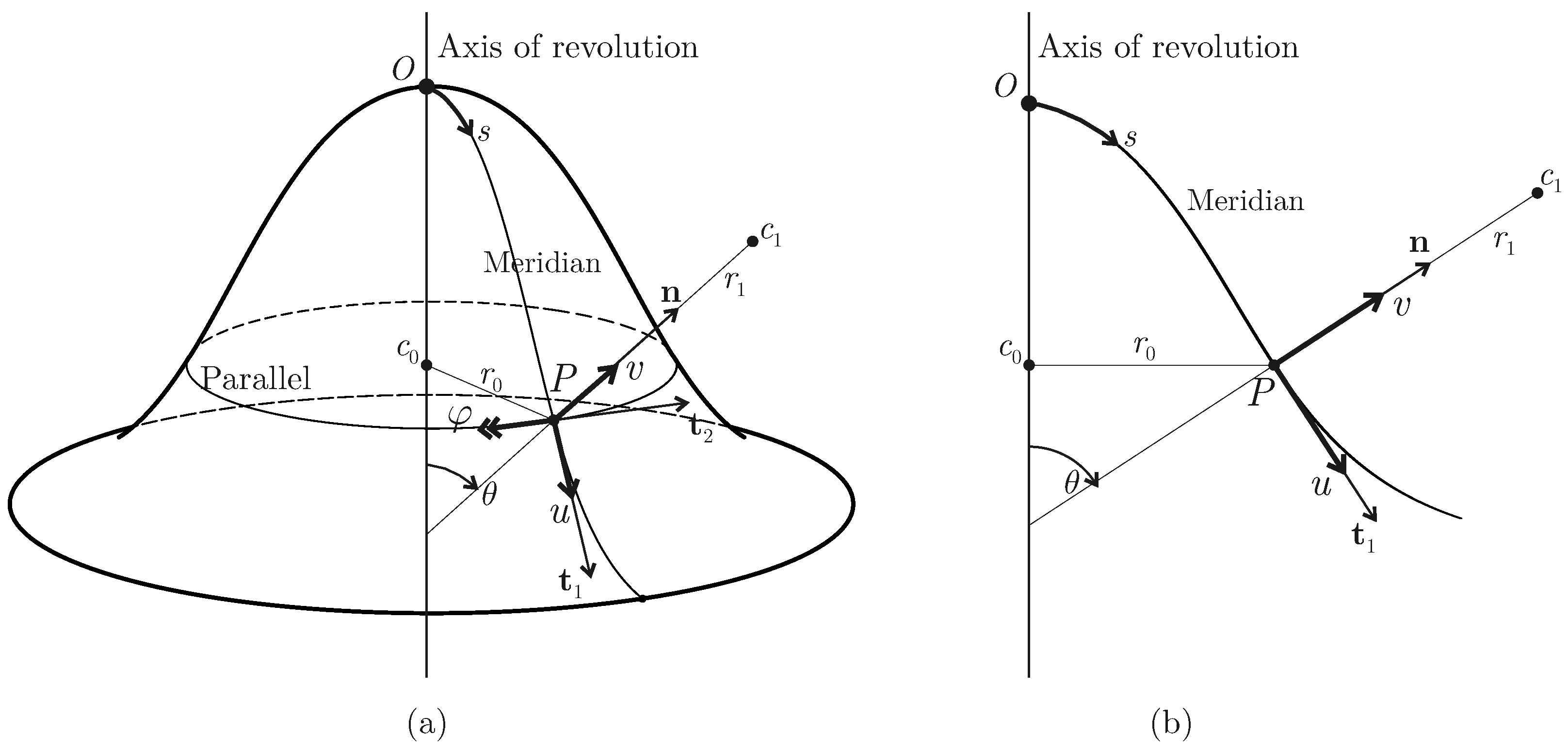
The object investigated in this paper is a shell of revolution, whose geometry is generated by revolving a generic planar curve, hereafter referred to as the generating curve, about a fixed axis, hereafter referred to as the axis of revolution. Axial symmetry is also assumed for the distribution of the loads acting on the shell, thus defining a so-called axisymmetric shell problem. In a surface of revolution, two families of fundamental curves can be identified: the meridians, which geometrically coincide with the generating curve, and the parallels (see
Figure 1).
Although a shell is inherently a two-dimensional structural element, axial symmetry allows the mathematical domain of the problem to be reduced to one dimension while still providing a complete representation of both the kinematic and static fields of the structure. As a consequence, all kinematic and static quantities characterizing the elastic problem depend exclusively on a single variable, s, namely the curvilinear abscissa measured along a generic meridian. The curvilinear abscissa s is assumed to be positive when measured from the top of the shell toward the base.
In the following, the shell models are developed within the framework of linear elasticity under the assumption of small-displacement and small-strain conditions.
2.1. Classical Reissner–Mindlin Model
The axial symmetry of both the geometry and the load distribution allows the axisymmetric shell to be described by means of a reduced set of geometric parameters. The variables
u,
v, and
denote the displacement components that fully characterize the kinematics of the shell (see
Figure 1a).
In the following, the governing equations of the elastic model for shells of revolution are derived according to the axisymmetric Reissner–Mindlin shell theory [
8,
9]. This formulation provides a unified description of membrane, bending, and transverse shear effects within the framework of shell mechanics. In particular, the strain–displacement compatibility equations, hereafter referred to as compatibility equations, are presented. These equations highlight that the mechanical behavior of the structure can be interpreted in terms of the interaction between two characteristic families of fibers: the meridian fibers, associated with the local radius of curvature
(and local center
), and the parallel fibers, characterized by the radius of curvature
(and local center
). By omitting the dependence on the variable
s for brevity, the compatibility equations read as follows:
where
denotes differentiation with respect to the variable
s, and
is the co-latitude angle that the unit normal vector
to the shell at point
P forms with respect to the axis of revolution (see
Figure 1). Once the geometry of the generating (meridian) curve is specified, the co-latitude angle can be regarded as a function of the curvilinear coordinate
s, namely
. Finally, it is worth observing that the first three compatibility equations in (
1), denoted by the subscript
, refer to the meridian fibers and coincide with those describing the kinematics of planar curved beams. The last two compatibility equations in (
1), denoted by the subscript
, instead, refer to the parallel fibers and coincide with those describing the kinematics of ring beams. Therefore, these equations suggest that the overall structural response can be interpreted in terms of the interaction between two families of beam-like components: the meridian fibers and the parallel fibers, thereby highlighting the coupled nature of the deformation mechanisms along two directions (meridian and parallel) of the axisymmetric shell.
The constitutive behavior of the shell is described by a local linear elastic constitutive law. Under the assumption of isotropic material behavior, stresses are related to the corresponding strains in the shell. Let us introduce the vectors of generalized strains
and the corresponding vector of stress resultants
where the components are arranged so that the membrane kinematic and static quantities are listed first, namely
,
, and
,
, respectively. These are followed by the quantities associated with the shear and bending behavior of the shell, namely
,
,
, and
,
, and
. The set of stress resultants employed in the present formulation is more limited than that typically considered, in general, shell theories, as several components are neglected here as a direct consequence of the axisymmetry of the problem. Accordingly, the constitutive relations can be expressed in matrix form as
where
E and
denote the Young’s modulus and the shear modulus, respectively,
is the Poisson’s ratio, and
h is the shell thickness. This formulation clearly highlights the separation between membrane, shear, and bending contributions, as well as the coupling between meridian circumferential fibers induced by Poisson’s ratio
[
2,
3,
4].
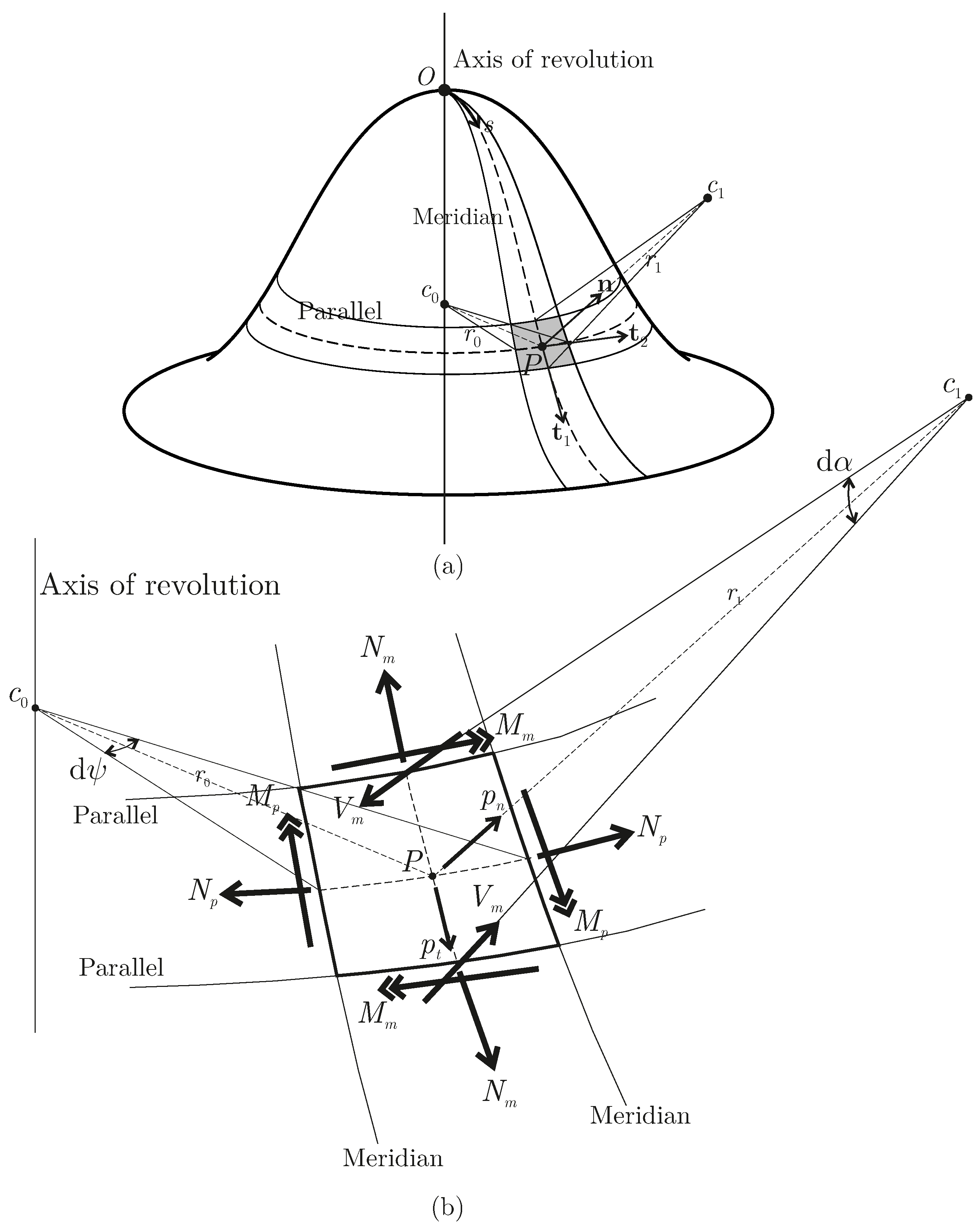
The equilibrium equations are derived directly by enforcing the balance between the internal stress resultants and the external distributed forces acting on an infinitesimal portion of the axisymmetric shell. This infinitesimal element is defined by the intersection of two meridians and two parallels, each pair being infinitesimally close to one another. The small distances between adjacent meridians and parallels are measured by the infinitesimal angles
and
, respectively (see
Figure 2). The equilibrium equations can therefore be written as
The three equilibrium equations in (
5) express, respectively, the balance between internal stress resultants and external forces along the normal direction
and the tangential direction
, as well as the moment equilibrium about the tangential direction
. It is worth noting that the external distributed moment associated with the rotation
is assumed to be zero, owing to the negligible likelihood of such loading conditions in actual structural systems.
Figure 2.
Equilibrium equation: (a) geometry of the infinitesimal portion of shell; (b) stresses acting on the infinitesimal portion of shell.
Figure 2.
Equilibrium equation: (a) geometry of the infinitesimal portion of shell; (b) stresses acting on the infinitesimal portion of shell.
The rigorous formulation of the elastic problem for axisymmetric shells leads to systems of coupled differential equations with variable coefficients which, in general, do not admit closed-form analytical solutions, even when the shell geometry is specialized to a spherical portion.
Finally, another noteworthy aspect is that the axisymmetric Reissner–Mindlin shell model, as well as axisymmetric formulations, in general, contains terms that are formally singular at the pole (
) due to factors of
(see Equation (
1)), leading to an apparent indeterminacy at
. However, this singularity is purely coordinate-induced and disappears once the regularity of the physical solution is enforced. In numerical implementations, this issue is commonly addressed by enforcing regularity conditions at the origin, typically through symmetry constraints, and by replacing the singular operator at
with its finite limiting form as
(see, for further details, [
42,
49,
50]).
2.2. Geometric Interpretation of Shell Behavior from Compatibility Equations
By suitably manipulating the compatibility equations in Equations (
1), an additional interpretation naturally emerges. In particular, these relations can be reformulated to make explicit the introduction of two auxiliary curvature radii, defined as
and
, which contribute to a more comprehensive description of the shell kinematics. The radius
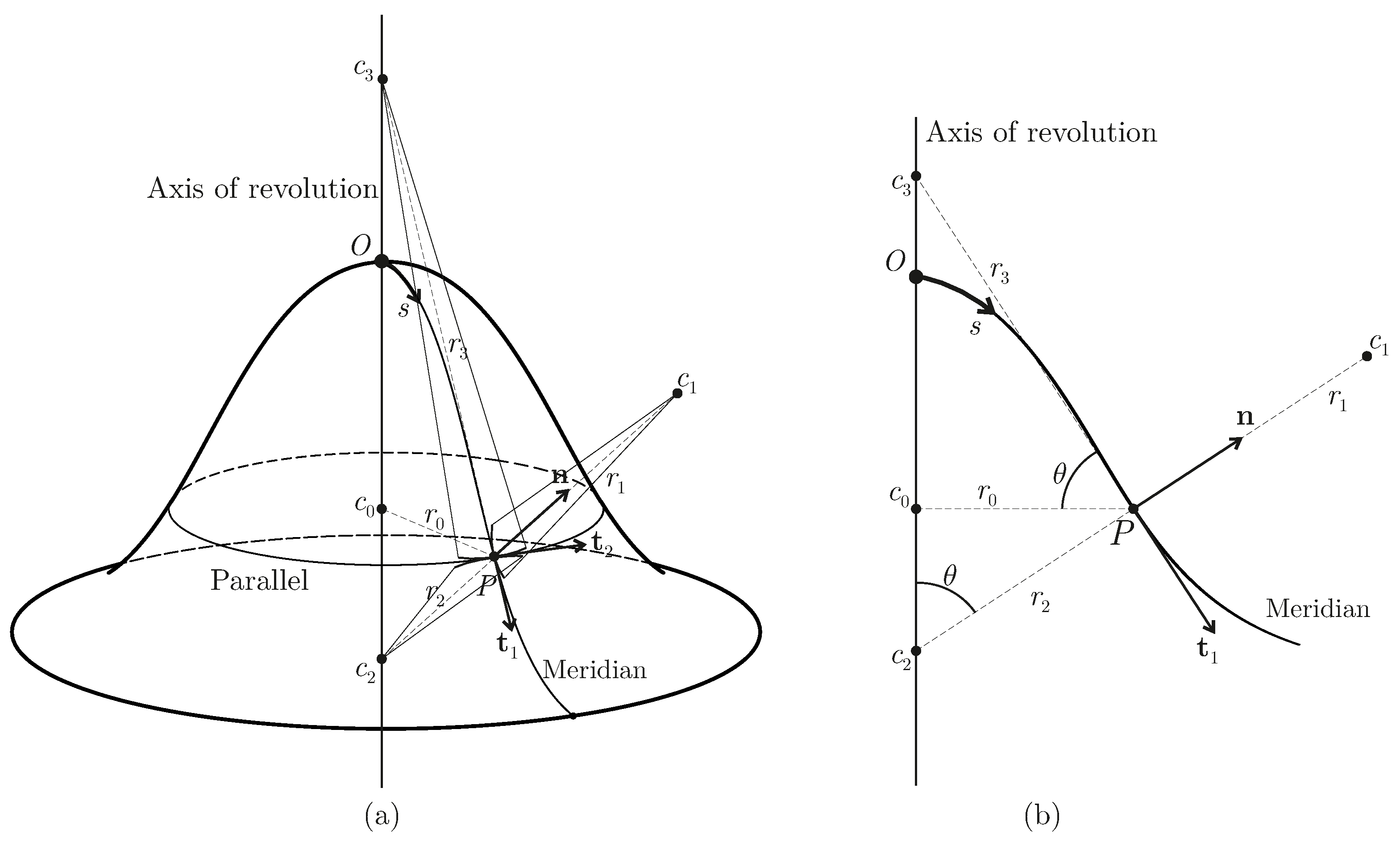
represents the distance between a generic point
P on the surface and the axis of revolution measured along the normal direction
at
P (see segment
in
Figure 3). Conversely, the radius
denotes the distance between the same point
P and the axis of revolution measured along the tangential direction
at
P (see segment
in
Figure 3). Since both radii
and
can be expressed in terms of the parallel radius
, they are also known functions of the curvilinear coordinate
s, namely
and
.
Within this geometric framework, the compatibility equations can be reformulated to explicitly highlight the contribution of the different curvature radii and kinematic variables, leading to the following representation:
The above reformulation of the compatibility equations leads to a meaningful mechanical interpretation. In particular, a comparison between the fourth compatibility equation in Equations (
1) and (
6), which provides the elongation
of the parallel fibers, suggests that the circle with center
and radius
, representing a generic parallel, can be locally approximated in a neighborhood of
P by two auxiliary circles. Specifically, these auxiliary circles are: the circle with center
and radius
, laying in the plane spanned by the unit vectors
and
, and the circle with center
and radius
, lying in the plane spanned by the unit vectors
and
(see
Figure 3a). It follows that the elongation of the parallel fiber,
, can be interpreted as the sum of two contributions, namely the elongation of the circle of radius
,
, and that associated with the circle of radius
,
.
Finally, it is worth noting that the inherent indeterminacy of the axisymmetric Reissner–Mindlin shell model at
, where the radius of the parallel vanishes (
) (see Equation (
1)), can be further interpreted through the reformulation of the compatibility equations in Equation (
6). Since at the pole of the axisymmetric shell only the radius
vanishes, the indeterminacy of the Reissner–Mindlin model can be attributed to the term representing the elongation of the circle of radius
.
3. Reduced Mechanical Model
The kinematic problem of axisymmetric shells allows the introduction of suitable simplifying assumptions based on the kinematic interpretation of the terms associated with the curvature radius .
It is well known that, starting from the axisymmetric shell model, the governing equations of circular membrane or plate problems can be obtained as particular cases by progressively reducing the shell curvature until a flat geometric configuration is reached. In this limit, both radii and tend to infinity. Consequently, the compatibility equations decouple: on the one hand, the equations governing the tangential problem, corresponding to the circular membrane, are recovered; on the other hand, the remaining equations describe the bending behavior of a circular plate.
The variability of the radius spans two limiting cases: (i) cylindrical shells, for which and the kinematic contribution associated with this radius vanishes and (ii) circular membrane/plate configurations, where only the terms associated with the curvature radius are retained. Therefore, the terms associated with can be considered negligible in axisymmetric shells that are sufficiently far from the degenerate membrane/plate planar geometry, while they become increasingly significant as the shell approaches the flat configuration.
3.1. Reduced Kinematics, Statics, and Constitutive Law
At the basis of the proposed reduced axisymmetric shell model lies the assumption that the geometric configuration of the shell is sufficiently far from the flat configuration so that the kinematic terms associated with the curvature radius
can be neglected. It is worth noting, for future reference, that neglecting these kinematic terms, in which
always appears in the denominator, is equivalent to assuming
. The subsequent compatibility equations can therefore be written as
In these equations, the subscript
denotes the strain components associated with the meridian fibers, consistently with the Reissner–Mindlin shell model. With regard to the strains carrying the subscript
, it is worth noting that neglecting the terms associated with the radius
leads to a reduced shell model in which the parallels are approximated solely by the family of curves, denoted as
curves, having radius
at the point
P (see
Figure 3). These curves are obtained by intersecting the shell with a plane containing the unit vectors
and
at
P. Accordingly, in the compatibility equations, the subscript
now refers to the strain components associated with the fibers along the
curves.
The reduced compatibility equations in Equation (
7) are derived from the exact ones in Equation (
6) by not only neglecting the terms involving the radius
, but also omitting the term
in the expression of the shear strain
(see [
28]). This additional simplification has consequences for the equilibrium equations as well and will be discussed in the following when deriving the equilibrium equations of the reduced model.
The constitutive equations for the reduced model are obtained by a suitable reduction of those of the Reissner-Mindlin model (Equations (
4))
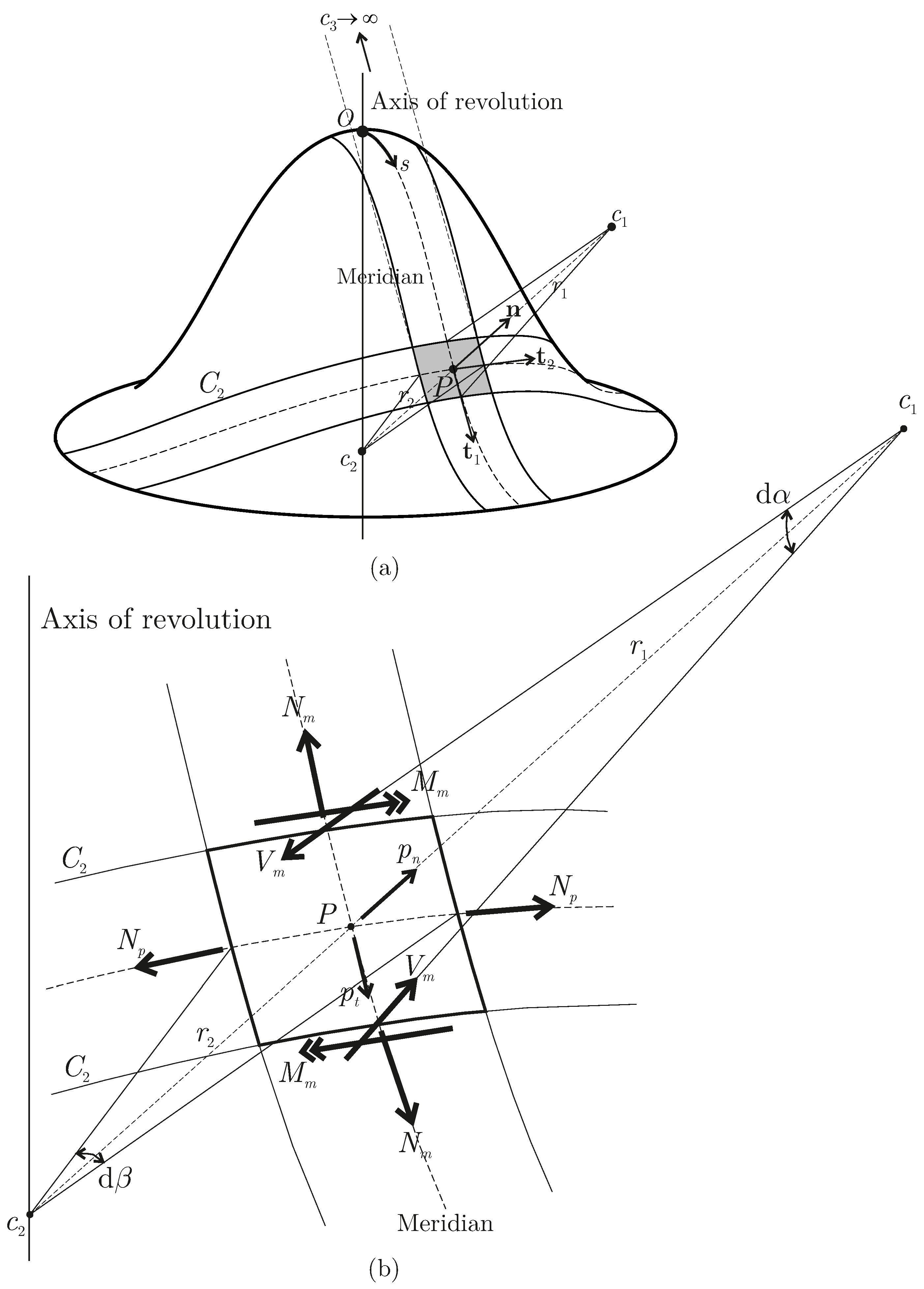
The equilibrium equations are derived directly by enforcing the balance between the internal stress resultants and the external distributed forces acting on an infinitesimal portion of the axisymmetric shell. Neglecting the terms associated with the radius
is equivalent to assuming
, since
always appears in the denominator of the discarded terms. Under this assumption, the two infinitesimally close meridians that bound the shell element remain at a constant distance from each other, as the limit
corresponds to a translational configuration rather than a rotational one. The other two bounding curves of the infinitesimal element are two
curves, whose separation is measured by the infinitesimal angle
(see
Figure 4).
Moreover, consistently with the assumption adopted in deriving the compatibility equations, where the term
is neglected, the corresponding dual assumption must also be enforced in the equilibrium equations. Since the omitted term
represents the contribution of the tangential displacement along the meridian,
u, to the shear strain
, the corresponding term accounting for the effect of the transverse shear force
in the equilibrium equation along the meridian tangential direction, namely
, must likewise be neglected (see [
28]).
The equilibrium equations can therefore be written as
It is worth noting that neglecting the terms
and
in the compatibility and equilibrium equations, respectively, leads to modeling the meridian shear strain as that of a straight beam (see the second equation in Equation (
7)) and to treating the equilibrium along the meridian tangential direction as if the meridian were a straight beam (see the first equation in Equation (
9)).
The reduced elastic problem defined by the compatibility equations in Equation (
7) and the equilibrium equations in Equation (
9) yields a model that is free from the coordinate-induced singularity previously discussed for the Reissner–Mindlin axisymmetric shell formulation. This is because the singular behavior of the full axisymmetric shell model is associated with the terms involving the radius
, and these terms have been neglected in the reduced formulation.
Another noteworthy observation is that, in the reduced model, the duality between the compatibility and equilibrium equations emerges directly through the adjointness of the corresponding differential operators, as in beam models. The vanishing of the terms depending on the radius alters the geometry of the infinitesimal shell portion over which equilibrium is enforced so that it is bounded by two equidistant meridians. As a consequence, the dimensional variation associated with their constant mutual distance along s becomes negligible. The reduced model thus resembles that of axisymmetric cylindrical shells, where the infinitesimal shell portion is longitudinally bounded by two parallel lines, and the duality manifests itself through the adjointness of the compatibility and equilibrium differential operators.
Based on the reduced compatibility equations in Equation (
7), the constitutive relations in Equation (
8), and the equilibrium equations in Equation (
9), and following the displacement-based approach, the governing equilibrium equations in displacement form (i.e., the field equations) can be formulated in terms of the displacement components
u,
v, and
.
3.2. Internal Constrained Model A
In order to reduce the complexity of the model while preserving its ability to accurately represent the physical behavior of the system, a set of internal constraints is introduced for the curved fibers located along the meridian curves.
The first internal constraint concerns the shear indeformability of the meridian fibers, as described by the curved beam model (see the terms with subscript
in Equation (
7)). This constraint is enforced by setting the meridian shear strain
equal to zero. By imposing this internal constraint,
the rotation
becomes a dependent (slave) variable since it can be expressed as a function of the remaining displacement components. Consequently, the equilibrium equations must be condensed, since the shear force
becomes a reactive quantity.
Hence, the compatibility equations, the equilibrium equations, and the constitutive relations of the reduced shear-indeformable axisymmetric shell model are given by
By adopting the displacement-based approach, the equilibrium equations in displacement form can be written as follows:
3.3. Internal Constrained Model B
Building upon the shear-indeformable Model A, an additional inextensibility assumption can be introduced for the curved fibers aligned with the meridian lines. This internal constraint is enforced by setting the meridian strain
equal to zero. The constraint can be written as
where the displacement
v becomes a dependent variable since it can be expressed as a function of the remaining displacement component
u. Consequently, the normal force
becomes a reactive quantity, and the equilibrium equations must therefore be condensed.
Hence, the compatibility equations, the equilibrium equations, and the constitutive relations of the reduced shear-indeformable inextensible axisymmetric shell model are given by
By adopting the displacement-based approach, the equilibrium equations in displacement form can be written as follows
4. Reduced Model for Selected Axisymmetric Shell Geometries
In this section, the reduced Model A and Model B, derived above, are specialized to specific classes of axisymmetric shells. In particular, attention is focused on two geometries of significant practical relevance, namely spherical and conical shells. The choice of these configurations is not arbitrary. From an engineering perspective, spherical and conical shells represent structural forms that are widely employed in a broad range of applications, spanning civil and structural engineering (such as domes, thin roofs, tanks, and silos) as well as mechanical and industrial engineering (including pressurized components, enclosures, and aerospace structures).
To derive the compatibility and equilibrium equations, as well as the constitutive relations, and subsequently obtain the governing equilibrium equations in displacement form according to the displacement-based approach, it is not necessary to reformulate the elastic model. In fact, all equations of the elastic problem can be obtained by specializing the general equations previously established for Model A and Model B.
4.1. Spherical Shell
For spherical shells, the two principal radii of curvature
and
coincide and are constant, namely
. By substituting this geometric condition into the governing equations of Model A in Equation (
11) and adopting the displacement-based approach, the equilibrium equations in displacement form can be obtained. Hence, Model A, when specialized to spherical shear-indeformable axisymmetric shells, is described by the following equilibrium equations in displacement form:
where
b is defined as
and
. Equation (
16) constitutes a coupled system of ordinary differential equations of overall sixth order and therefore requires the imposition of six boundary conditions. The closed-form solutions of this system are not reported here due to their algebraic complexity. Nevertheless, the availability of analytical solutions makes it possible to investigate the shell behavior without resorting to numerical approximations, which would otherwise be necessary in the absence of closed-form expressions.
Also, the Model B can be specialized to spherical shells. Therefore, the governing equations of a shear-indeformable inextensible axisymmetric spherical shell are obtained by introducing the geometric conditions
into Equation (
14). By adopting the displacement-based approach, the equilibrium equation in displacement form is given by
Equation (
19) is a sixth-order ordinary differential equation admitting a closed-form analytical solution
where
are integration constants that are obtained by imposing six boundary conditions.
An interesting interpretation can be drawn from Equation (
17). In particular, by introducing the substitution
, the equation can be rewritten as
which describes the behavior of a shear–indeformable, inextensible spherical shell in a form analogous to that of a straight beam on an elastic foundation, as originally shown by Gekeler [
31].
4.2. Conical Shell
For a conical shell, the two principal radii of curvature are given by and , where s is the coordinate measured from the vertex along the straight meridian line, and is the opening angle defining the slope of the conical shell with respect to the vertical direction.
Owing to these geometric characteristics ( and ), only Model A can be specialized. Indeed, Model A is capable of describing both the tangential and the normal behavior of the meridian fiber, which, in the case of conical shells, leads to two decoupled problems. Moreover, the tangential behavior of the meridian fiber is governed by an equation that coincides with that of a straight beam.
Therefore, by adopting the displacement-based approach, the only equilibrium equation in displacement form of interest, describing the behavior of the meridian fibers in the normal direction, is
Equation (
20) is a fourth-order ordinary differential equation that requires the imposition of four boundary conditions governing only the behavior of the meridian fibers in the normal direction. It admits a closed-form analytical solution, which is not reported here for brevity. In the case of conical shells, the formulation describes an elastic behavior equivalent to that of a cylindrical shell with a variable radius. Alternatively, the governing equation can be interpreted as that of a straight beam resting on an elastic foundation with variable stiffness, since the coefficient multiplying the displacement
v depends explicitly on the curvilinear coordinate
s.
It is finally worth remarking that the shear-indeformable inextensible spherical shells and the shear-indeformable conical shells, described by the governing equilibrium equations in displacement form, Equations (
17) and (
20), respectively, are derived without accounting for the external load distributions
and
. Therefore, they can be employed only to describe boundary effects and their evolution along the shell domain. Moreover, these formulations are obtained under the additional assumption that the Poisson coefficient
.
5. Solution Strategies
As a preliminary observation, Model A is expected to provide higher accuracy than Model B, since the latter involves a greater number of internal constraints, thereby significantly reducing its descriptive capability.
In light of this consideration, two solution strategies are adopted: the first is based on Model A to describe the overall behavior of shells, whereas the second relies on Model B to capture only the boundary effects.
5.1. Method M1
Method M1, adopted exclusively for spherical shells, is based on the closed-form analytical solution admitted by the shear–indeformable axisymmetric spherical shell formulation, based on the Model A and described by the differential system in Equation (
16).
Method M1 operates in a fully autonomous manner, as both the effects of the applied load distribution and the prescribed boundary conditions are directly incorporated into the reduced Model A.
5.2. Method M2
Method M2 is structured in two main stages. The first stage consists of solving the problem associated with the externally distributed loads under the assumption of a purely membrane structural response. As is well known, the membrane problem is internally determinate. Moreover, the set of boundary conditions can be selected to render the problem determinate also with respect to the external constraints. Under these assumptions, the membrane stress resultants can be obtained through equilibrium considerations alone, using a purely algebraic approach. Consequently, the solution of the membrane problem in the first stage is generally not kinematically compatible with the actual boundary conditions, although it provides a sufficiently accurate representation of the dominant structural response away from the boundaries.
The second stage aims at recovering the actual structural behavior by reintroducing the effects associated with the boundary conditions that were neglected in the membrane problem of the first stage but are present in the axisymmetric shell under consideration. As an example, in the case of a clamped boundary, the neglected constraints are reintroduced by imposing displacement or rotation components with opposite signs with respect to those predicted by the membrane model. This correction is carried out by means of the internally constrained shell models, specialized for spherical shells in Equation (
17) and for conical shells in Equation (
20). This procedure is based on the superposition principle, combining the results obtained from the membrane model in the first stage with those provided by Model B in the second stage. In this sense, the homogeneous internal constrained models act as a correction model, compensating for the kinematic incompatibilities of the membrane solution at the shell boundaries.
Moreover, in sufficiently thin shells (i.e., characterized by small values of the ratio ), flexural effects are strongly localized in the vicinity of the supports, while the membrane response dominates the interior region of the structure. Accordingly, Method M2 employs the membrane solution to represent the dominant interior response induced by the external loads, whereas the internal constrained shell models are used as a local corrective tool near the boundaries, where flexural load-carrying mechanisms must be restored.
As a final remark, the procedure proposed in Method M2 is conceptually similar to that presented by Gekeler in [
31]. The fundamental difference lies in the fact that in [
31] a reduced spherical shell model was formulated in terms of parameters that did not facilitate the enforcement of kinematic boundary conditions. The proposed Model B, instead, is directly expressed in terms of the displacement component
u, from which all other displacement components can be rapidly derived, thus allowing the direct imposition of kinematic boundary conditions.
6. Effectiveness Assessment of the Proposed Methodologies
A comparison between the results provided by the two proposed approximate methods, namely Methods M1 and M2, and those obtained using the classical Reissner–Mindlin shell theory is carried out in order to assess the accuracy of the proposed methodologies in describing two classes of axisymmetric shells, namely spherical and conical shells. The comparison is performed in terms of the tangential and normal displacements, u and v, as well as the stress resultants, namely the normal stress and , the meridian shear stress , and the meridian bending moment .
The set of investigated case studies is designed to evaluate the capability of the proposed model to accurately reproduce the structural response under distributed loads acting over the shell domain, considering both complete axisymmetric shells and shells featuring a hole at the apex. Distributed loads of different natures are examined, including hydrostatic loading and self-weight. An additional case study is considered in which, besides the distributed load, a concentrated force is applied at the edge of the hole boundary in order to assess the ability of the proposed model to capture the propagation of boundary effects within the shell domain. Furthermore, additional analyses are performed by varying the opening angle of the spherical and conical shells.
The results obtained using the Reissner–Mindlin model are computed by numerically integrating the governing equilibrium equations in displacement form. To avoid the indeterminacy at the vertex (
), the procedure suggested in [
51] is adopted, whereby the numerical integration is performed by introducing a virtual small hole at the apex. Accordingly, the integration does not start from
, but from a small distance away from the singular point. By contrast, the results obtained using Methods M1 and M2, which involve both Model A and Model B of axisymmetric shells, are derived by exploiting the closed-form analytical solutions admitted by these models.
The mechanical and geometrical characteristics common to axisymmetric spherical and conical shells are summarized in
Table 1.
All the other quantities characterizing the investigated shell are reported in part (a) of the following figures, where the structural scheme is shown together with all the parameter values required to reproduce the numerical integrations.
The shells considered in the numerical simulations do not correspond to any specific real structure. They have been selected from the numerous simulations performed in order to make the comparison between the Reissner–Mindlin shell model and Methods M1 and M2 as meaningful as possible.
6.1. Spherical Shell Subject to Hydrostatic Load
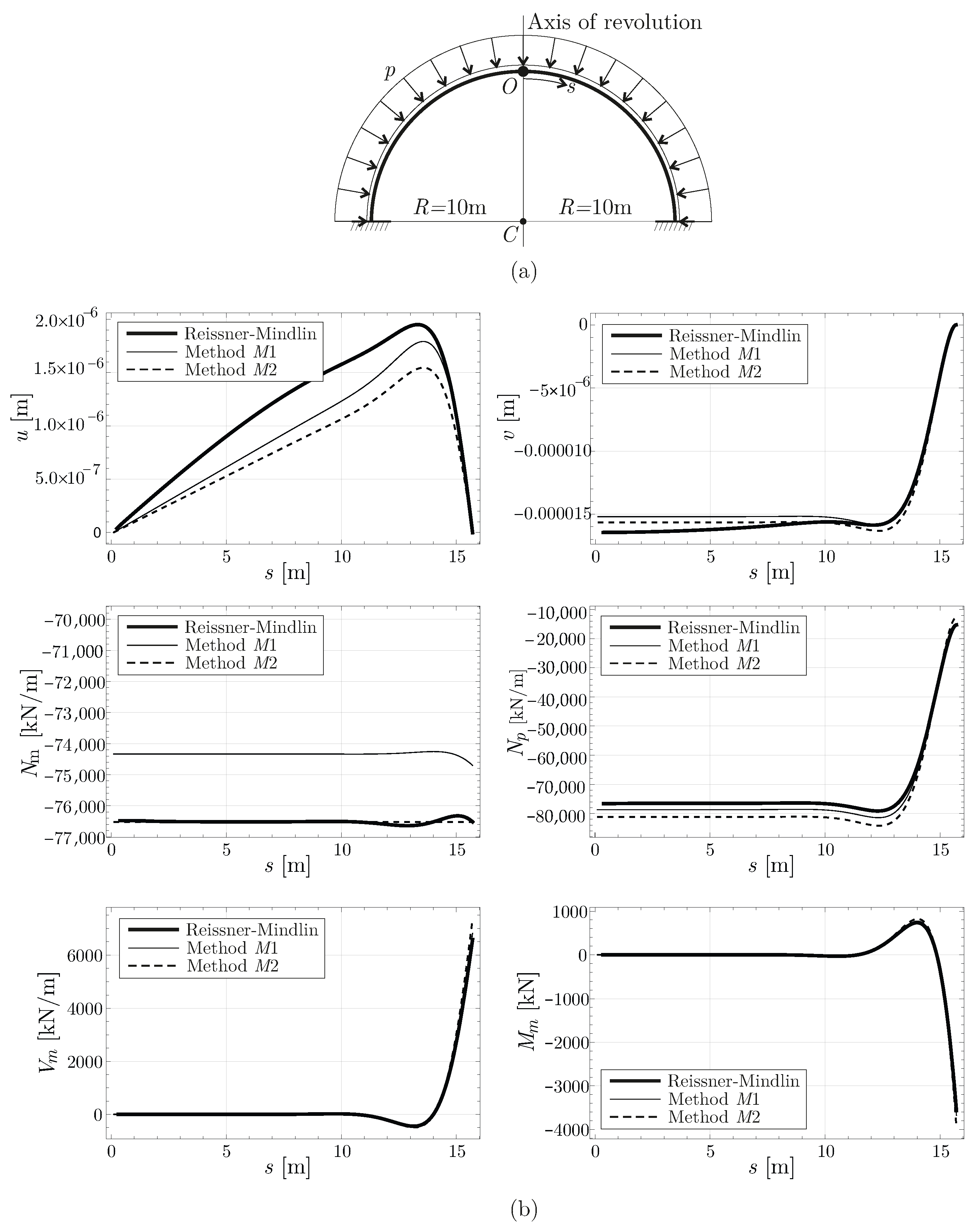
The first benchmark problem concerns a full spherical shell subjected to a hydrostatic load, with an opening angle
and radius
(
Figure 5a). This test is intended to assess whether the proposed methods are capable of properly accounting for the bending contribution inherent to shell behavior while simultaneously ensuring a correct enforcement of the actual boundary conditions.
In general, as can be observed, the results provided by the numerical model and those obtained using the proposed approximate formulations are in very good agreement (
Figure 5b).
Regarding the results obtained with Method M1, which makes use of the shear–indeformable shell Model A (thin lines in the graphs), its good performance can be clearly observed. In particular, Method M1 accurately reproduces the displacements (first row of graphs), the membrane stress resultants and (second row), as well as the shear force and the bending moment (third row). Notably, Method M1 proves especially effective in reproducing the shear force and bending moment distributions, with the curves of and being almost superimposed on those obtained from the Reissner–Mindlin model (thick lines in the graphs). Although the agreement in terms of membrane stress resultants is slightly less accurate, particularly for the meridian normal force , the discrepancy between the Reissner–Mindlin solution and Method M1 remains limited to approximately . Finally, the tangential and normal displacements, u and v, are also well approximated by Method M1, especially in the vicinity of the base boundary.
The results provided by Method M2 (dashed lines in the graphs), which combines the membrane theory with the shear–indeformable and inextensible shell Model B, also show a very satisfactory performance, despite the additional internal inextensional constraint imposed on the shell model. Method M2 continues to approximate the shell stress resultants and very well, with curves almost superimposed on those obtained from the Reissner–Mindlin model. Moreover, Method M2 exhibits an improved capability in describing the membrane stress resultants compared to Method M1, particularly with regard to the meridian normal force .
Finally, it can be observed that, in the evaluation of the stress resultants, the discrepancies among the Reissner–Mindlin model, Method M1, and Method M2 become very small. This high level of agreement is further enhanced when the shell thickness h is reduced while keeping the shell radius fixed.
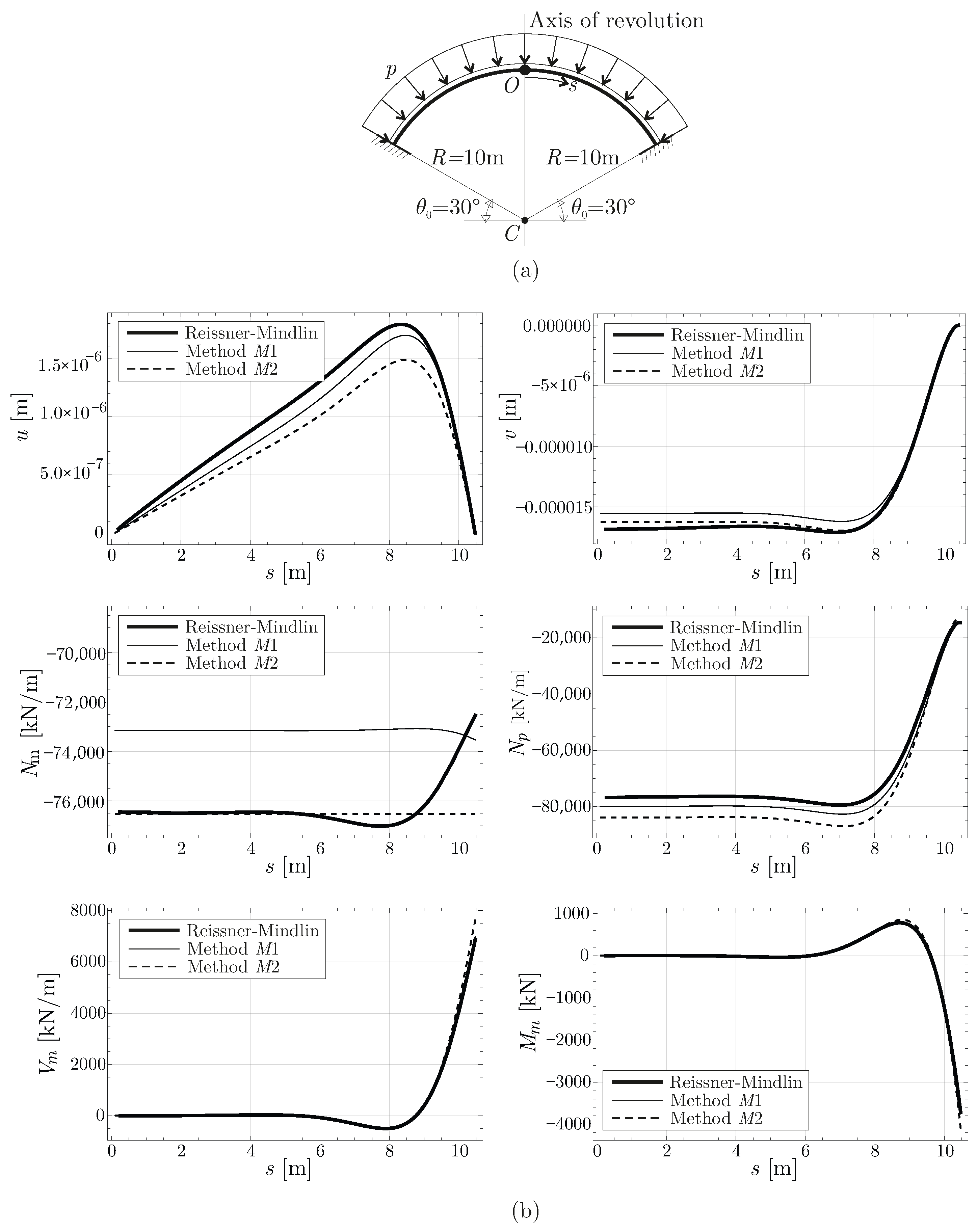
The second case study aims to assess the effectiveness of the approximate Methods M1 and M2 in the analysis of shallow spherical shells. It should be recalled that, in both constrained shell Models A and B, the terms depending on the curvature radius have been neglected. As discussed above, this approximation is expected to be acceptable when such terms are sufficiently small. This condition typically occurs in shells with a low degree of shallowness, especially in the vicinity of the base boundary. In full spherical shells, at the boundary, since the shell tangent is vertical at that location. Consequently, within a sufficiently small neighborhood of the boundary, the terms depending on can be safely neglected. However, these terms tend to become increasingly significant when approaching the vertex of the spherical shell. Nevertheless, if boundary effects decay rapidly, for instance, due to a sufficiently small shell thickness, such terms may reasonably be neglected throughout the entire shell domain.
In contrast, for shallow spherical shells, the terms depending on
may not be small even at the boundary, and, therefore, the validity of the adopted approximation requires careful assessment. Therefore, the second benchmark problem concerns a shallow spherical shell subjected to a hydrostatic load, with opening angle
and radius
(
Figure 6a). The results show that the increase in the opening angle does not lead to any significant loss of accuracy of the proposed models. In particular, the shell stress resultants
and
remain almost superimposed on those obtained from the Reissner–Mindlin model. Moreover, Methods M1 and M2 exhibit a capability to reproduce the displacements
u and
v, as well as the circumferential normal force
, comparable to that observed in the case of the full spherical shell (
Figure 6b). The only noticeable deterioration is observed in the meridian normal force
, where the results provided by Method M1 show a more pronounced deviation compared to the corresponding full spherical shell case. In particular, a quantitative assessment shows that the maximum percentage error in the meridional membrane force
remains on the order of 4% in the most critical regions. This deviation is slightly larger than that observed in the full spherical shell case and can be attributed to the increased relevance of the curvature radius
in this configuration. Nevertheless, the discrepancy remains overall limited.
6.2. Spherical Shell with Hole Under Self-Weight and Concentrated Load
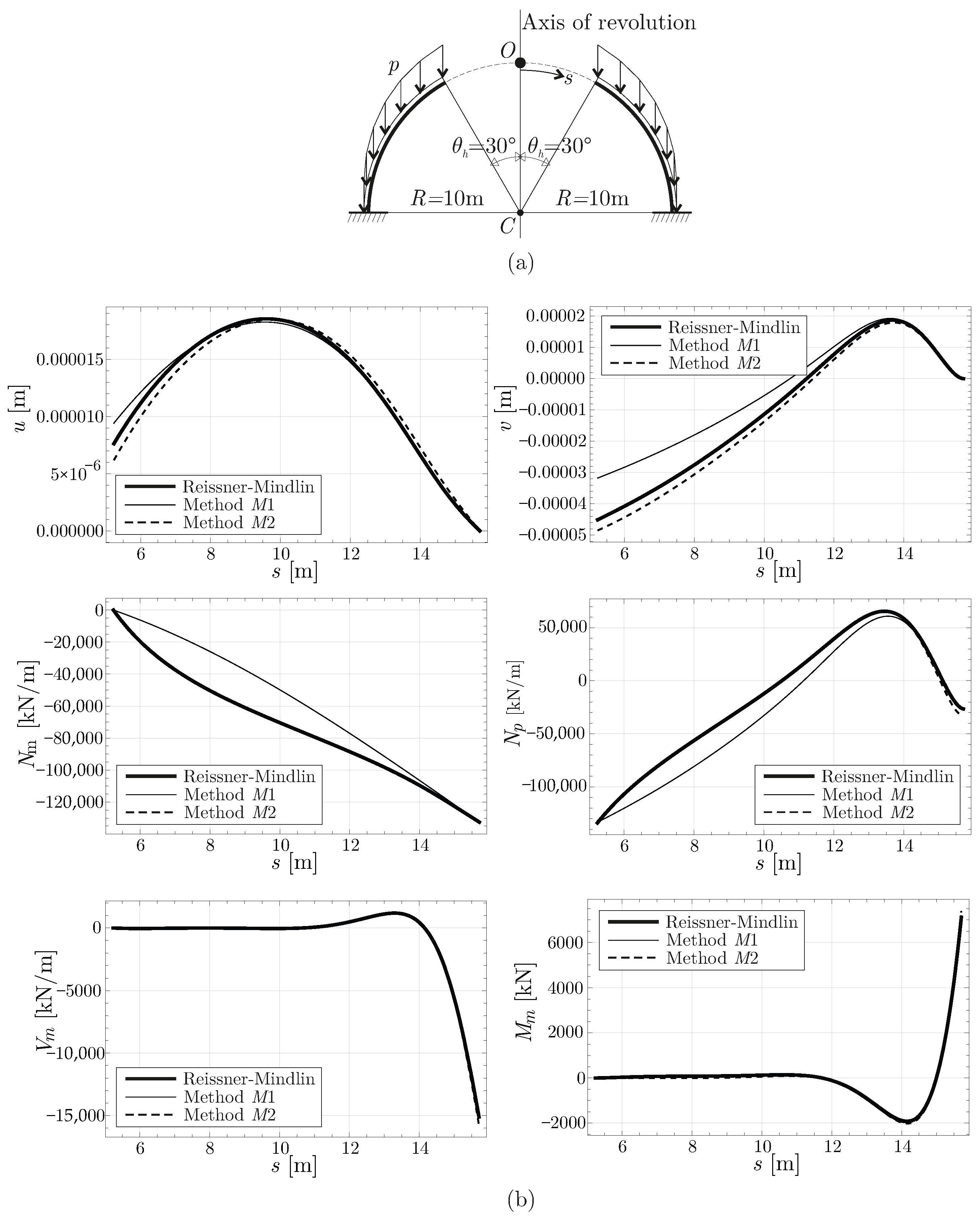
The second benchmark problem considers a full spherical shell with a central hole, subjected to self-weight, with an opening angle
and radius
(
Figure 7a). The results obtained using the Reissner–Mindlin model and those provided by Methods M1 and M2 are shown in
Figure 7b. Also in this case, Methods M1 and M2 perform very well in approximating both the displacement components and the stress resultants in the shell. In particular, in the graphs displaying the membrane and shell stress resultants, the dashed curves representing the results provided by Method M2, are barely visible since they are almost perfectly superimposed on those corresponding to the Reissner–Mindlin model (thick lines in the graphs). Therefore, Method M2 exhibits a higher capability in describing all the investigated quantities compared to Method M1 (thin lines in the graphs). In particular, Method M1 continues to show some difficulty in accurately reproducing the meridian normal force
, especially in regions far from the boundary. In particular, Method M1 continues to show some difficulty in accurately reproducing the meridional normal force
, especially in regions far from the boundary. A quantitative comparison indicates that the discrepancy in
may locally increase, reaching values of up to about 50% in the most critical regions, although it remains confined to limited portions of the domain and does not affect the overall qualitative agreement. In contrast, Model M2 is superimposed on the numerical solution obtained from the canonical Reissner–Mindlin equations.
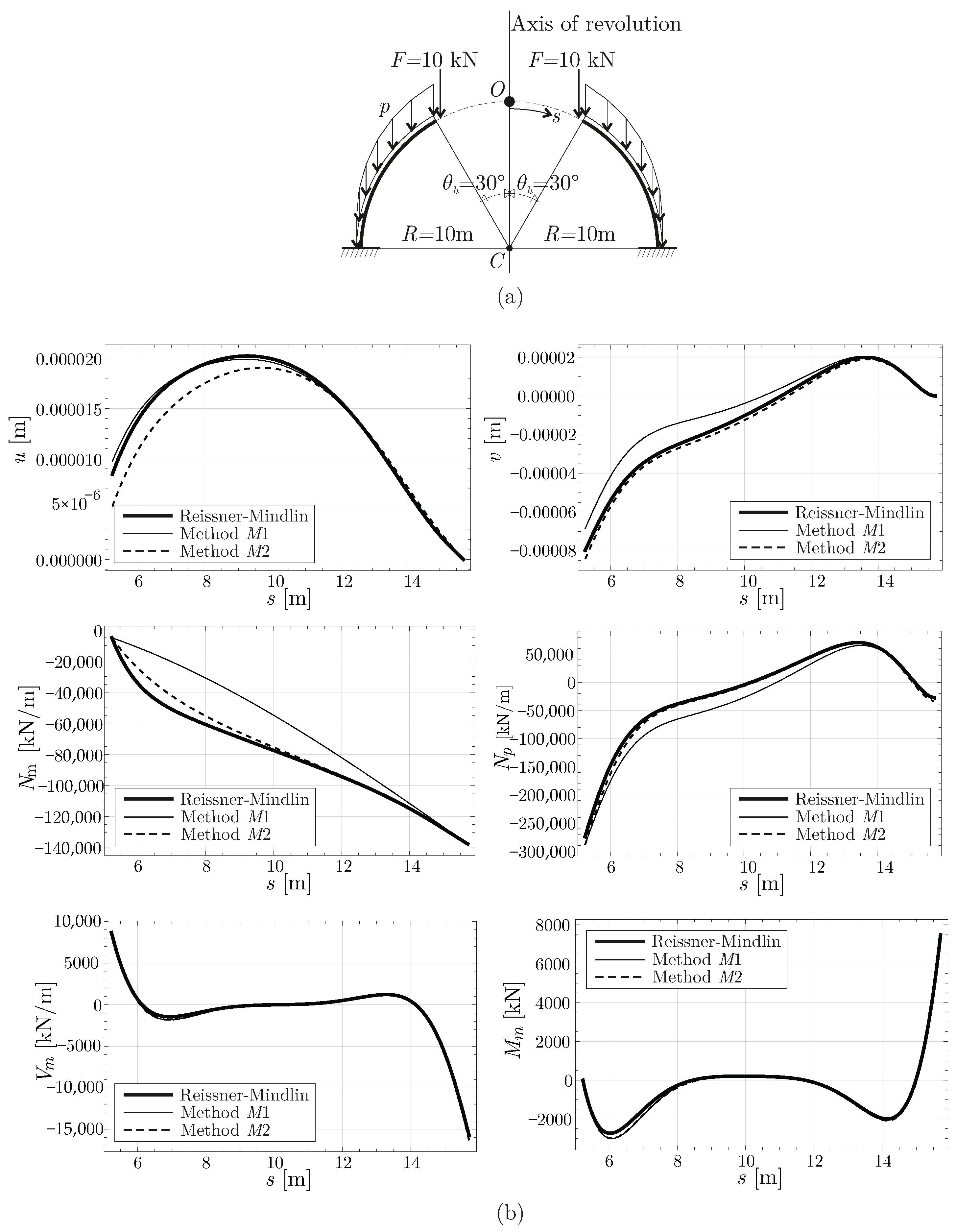
Another benchmark problem, similar to the previous one, is analyzed. The same full spherical shell with a central hole, subjected to self-weight, with opening angle
and radius
, is considered; in addition, a concentrated force distribution is applied along the edge of the hole (
Figure 8a). The aim of this investigation is to assess the capability of the proposed approximate models to describe the propagation of the boundary effects induced by the localized load and their transmission throughout the shell domain. The results obtained using the Reissner–Mindlin model and those provided by Methods M1 and M2 are shown in
Figure 8b. Also in this case, Methods M1 and M2 provide a good approximation of both the displacement components and the stress resultants within the shell. In particular, Method M2 exhibits an overall higher capability in representing the investigated mechanical quantities compared to Method M1. The latter still shows some difficulty in accurately reproducing the meridian normal force
, especially in regions far from the boundary. The maximum percentage error observed with Method M1 is of the same order of magnitude as that found in the case without a concentrated load. In this case, however, the error associated with Method M2 slightly increases, reaching values of about 8% with respect to the solutions of the Reissner–Mindlin equations. As a final remark, the presence of a concentrated load applied at the edge of the hole yields an accuracy of the approximate solutions obtained using Methods M1 and M2 that is comparable to that observed in the absence of the concentrated load (
Figure 7b).
6.3. Conical Shell Under Self-Weight
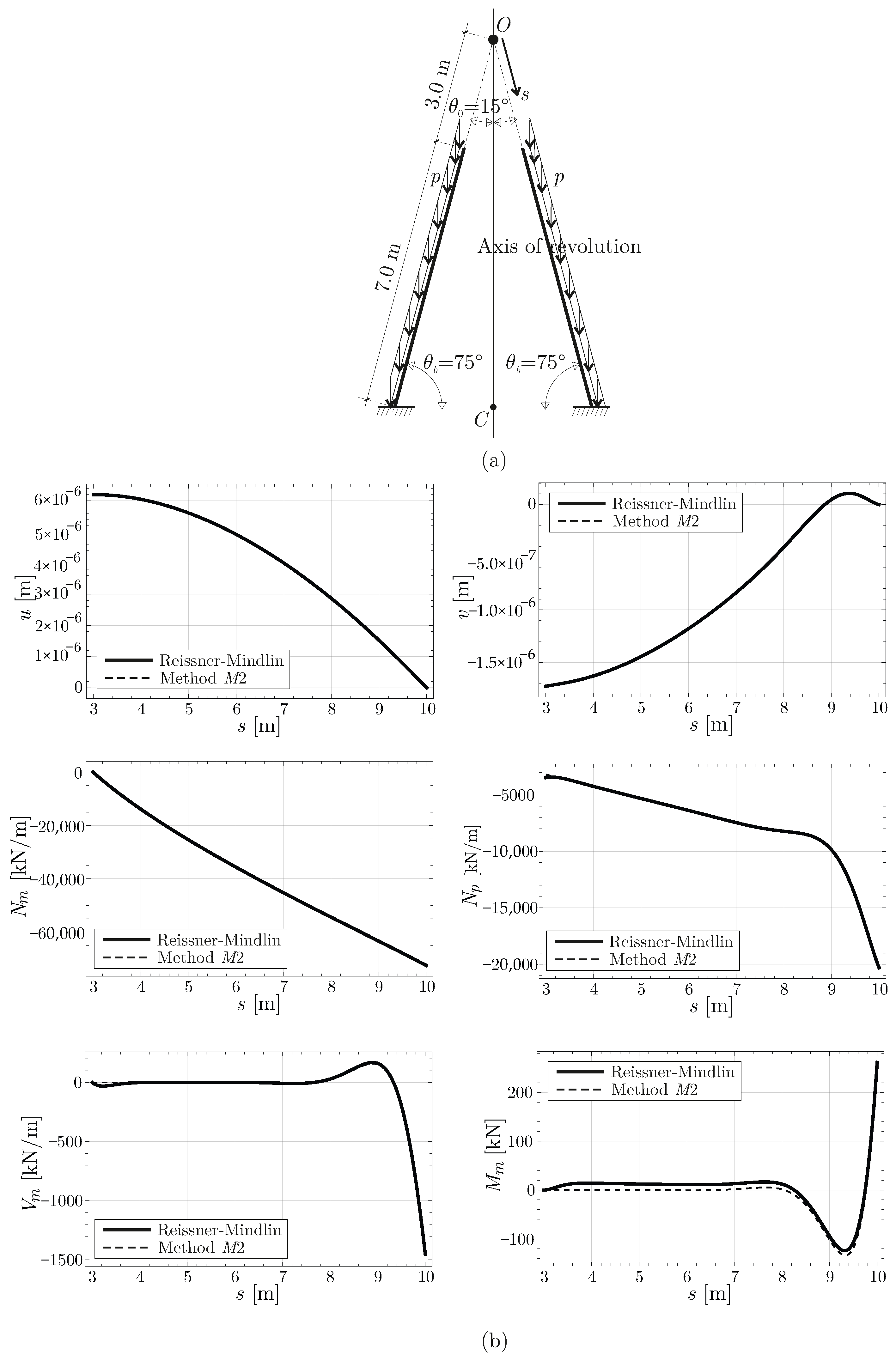
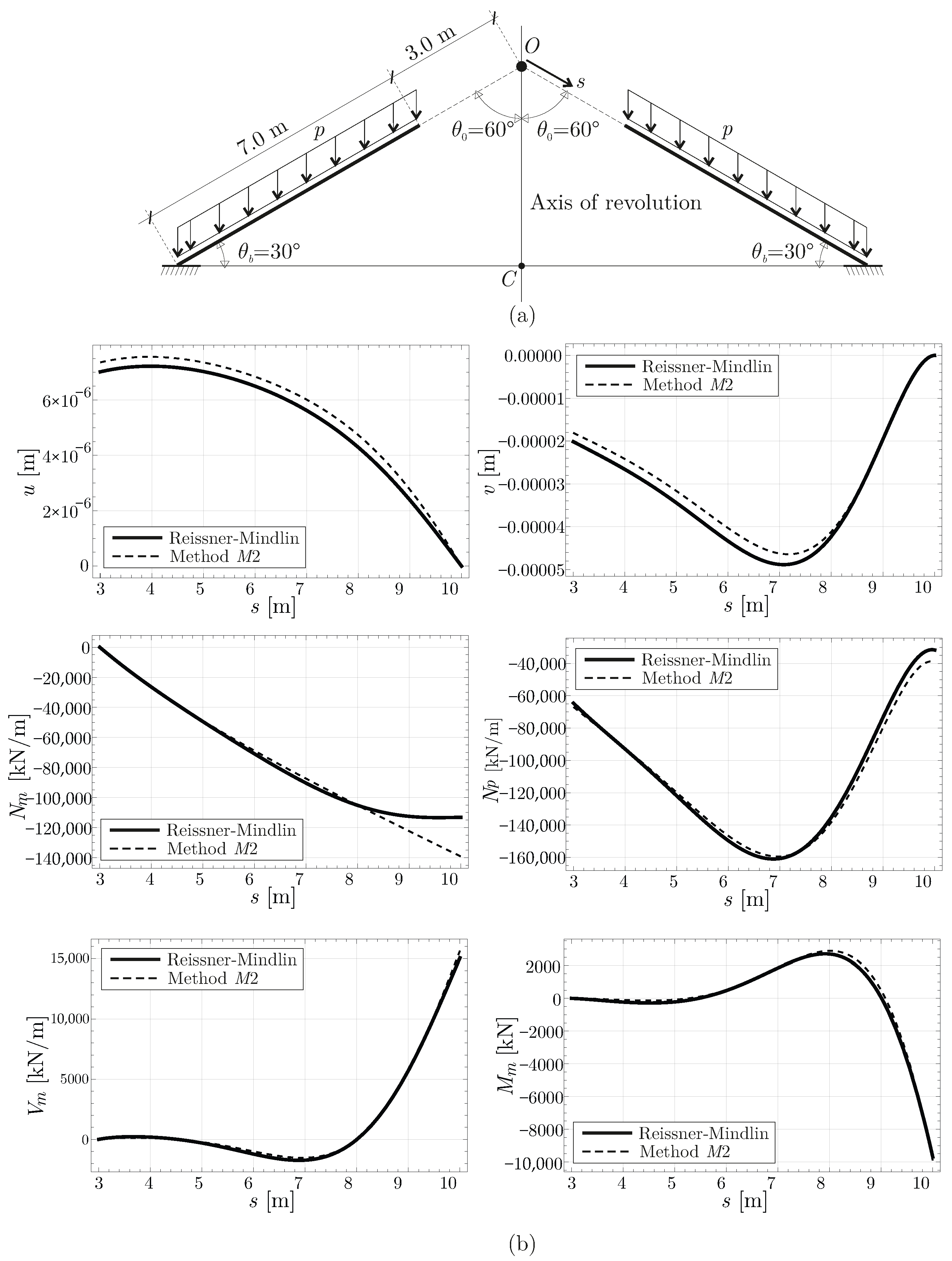
The third benchmark problem concerns a conical shell subjected to self-weight. Since the proposed formulation is designed for axisymmetric shells with general geometrical configurations, this case study is introduced to further assess its effectiveness beyond the spherical shell configuration. Two different geometrical configurations are considered, corresponding, respectively, to small and large opening angles.
The purpose of this comparative analysis is to evaluate the capability of the proposed Method M2, the only method specifically developed for conical shells, to perform effectively under geometrical configurations different from the spherical one. As previously discussed, it is expected that the approximate Method M2 provides better results for tall conical shells characterized by small opening angles, rather than for conical shells with larger opening angles.
The first case concerns a conical shell with a central hole, subjected to self-weight, and characterized by an opening angle
. The length of the straight meridian line is 10.0 m, with the edge of the hole located 3.0 m from the vertex and measured along the meridian line (
Figure 9a). The results obtained using the Reissner–Mindlin model and those provided by Method M2 are shown in
Figure 9b. As can be observed, Model M2 describes very well the behavior of the conical shell, with the results almost perfectly superimposed on those obtained from the Reissner–Mindlin model. In particular, only the bending moment resultant
shows a slight discrepancy between the exact and approximate models.
The second case concerns a conical shell with a central hole, subjected to self-weight, and characterized by an opening angle
. The length of the straight meridian line is 10.0 m, with the edge of the hole located 3.0 m from the vertex and measured along the meridian line (
Figure 10a). It is worth observing that the geometry of the two conical shells (
Figure 9a and
Figure 10a) differs from each other only for the different opening angle
.
The results obtained using the Reissner–Mindlin model and those provided by Method M2 are shown in
Figure 10b. As can be observed, Model M2 continues to provide a good description of the conical shell behavior, with the approximate results remaining very close to those obtained using the Reissner–Mindlin model. Some difficulties are observed in the representation of the meridian normal stress resultant
, where Method M2 shows a reduced ability to closely reproduce the Reissner–Mindlin solution in the vicinity of the boundary. In these regions, the maximum percentage error is approximately 17%.
7. Conclusions
A mono-dimensional formulation for axisymmetric shells has been developed based on the interpretation of the structural response as the interaction between two fundamental families of elements: curved beams aligned with the meridian lines and a secondary system of interacting fibers. This modeling strategy leads to a formulation in which the kinematic problem is the adjoint of the static one, fully consistent with the underlying mechanical principles. Assuming a linear elastic material and small-strain, small-displacement conditions, the proposed mono-dimensional model accurately captures the linear static behavior of axisymmetric shells. To further reduce the mathematical complexity, internal kinematic constraints, namely meridian inextensibility and meridian shear-indeformability, have been introduced, enabling the derivation of simplified yet mechanically sound reduced models that admit closed-form analytical solutions for all case studies examined. The analytical solutions have been systematically compared with numerical results obtained from canonical Reissner–Mindlin shell formulations, confirming both the reliability of the proposed approach and the physical consistency of the simplifying assumptions. Moreover, the availability of closed-form solutions for structurally significant configurations, such as spherical and conical shells, facilitates a direct and transparent investigation of the influence exerted by geometric and constitutive parameters on the global structural response. From a theoretical standpoint, these analytical results also provide valuable benchmarks for emerging computational paradigms such as Physics-Informed Neural Networks (PINNs), thus offering a robust foundation for future developments integrating analytical modeling with data-driven strategies. The main original contributions of the modeling approach can be summarised as follows:
introduction of a mono-dimensional representation of axisymmetric shells based on interacting meridian fibers and orthogonal fiber families, from which a consistent kinematic–static adjoint structure naturally follows;
formulation of reduced elastic models that incorporate meridian inextensibility and shear-indeformability while preserving a sound and physically meaningful mechanical interpretation;
elimination of the coordinate-induced singularity typical of classical axisymmetric formulations by removing terms associated with the vanishing curvature radius ;
availability of closed-form solutions for the families of reduced spherical and conical models, enabling a direct and transparent analytical assessment of the structural response.
The main findings emerging from numerical comparisons are the following:
very good agreement between the proposed models and Reissner–Mindlin numerical solutions in terms of displacements, membrane forces, shear forces, and bending moments;
high accuracy of Model A in predicting meridian shear and bending moment distributions, with excellent global performance;
ability of Model B to capture boundary-layer behaviors, confirming its suitability as a correction model within the M2 strategy;
improvement in accuracy for both approximate methods with decreasing shell thickness, consistent with the membrane-dominated response of thin shells;
robust performance across different geometries (full spherical shells, shallow shells, and conical shells) and loading conditions (hydrostatic load, self-weight, and concentrated loads).