
Article

A Frobenius-Norm Approach to Block Matrices and Singular Value Estimates

by
Ksenija Doroslovački
,
Dragana Cvetković
* and
Irena Prodanović
Faculty of Technical Sciences, University of Novi Sad, Trg Dositeja Obradovića 6, 21000 Novi Sad, Serbia
*
Author to whom correspondence should be addressed.
AppliedMath 2026, 6(10), 162; https://doi.org/10.3390/appliedmath6100162
Submission received: 1 September 2026 / Revised: 16 September 2026 / Accepted: 20 September 2026 / Published: 3 October 2026
(This article belongs to the Section Computational and Numerical Mathematics)

Abstract

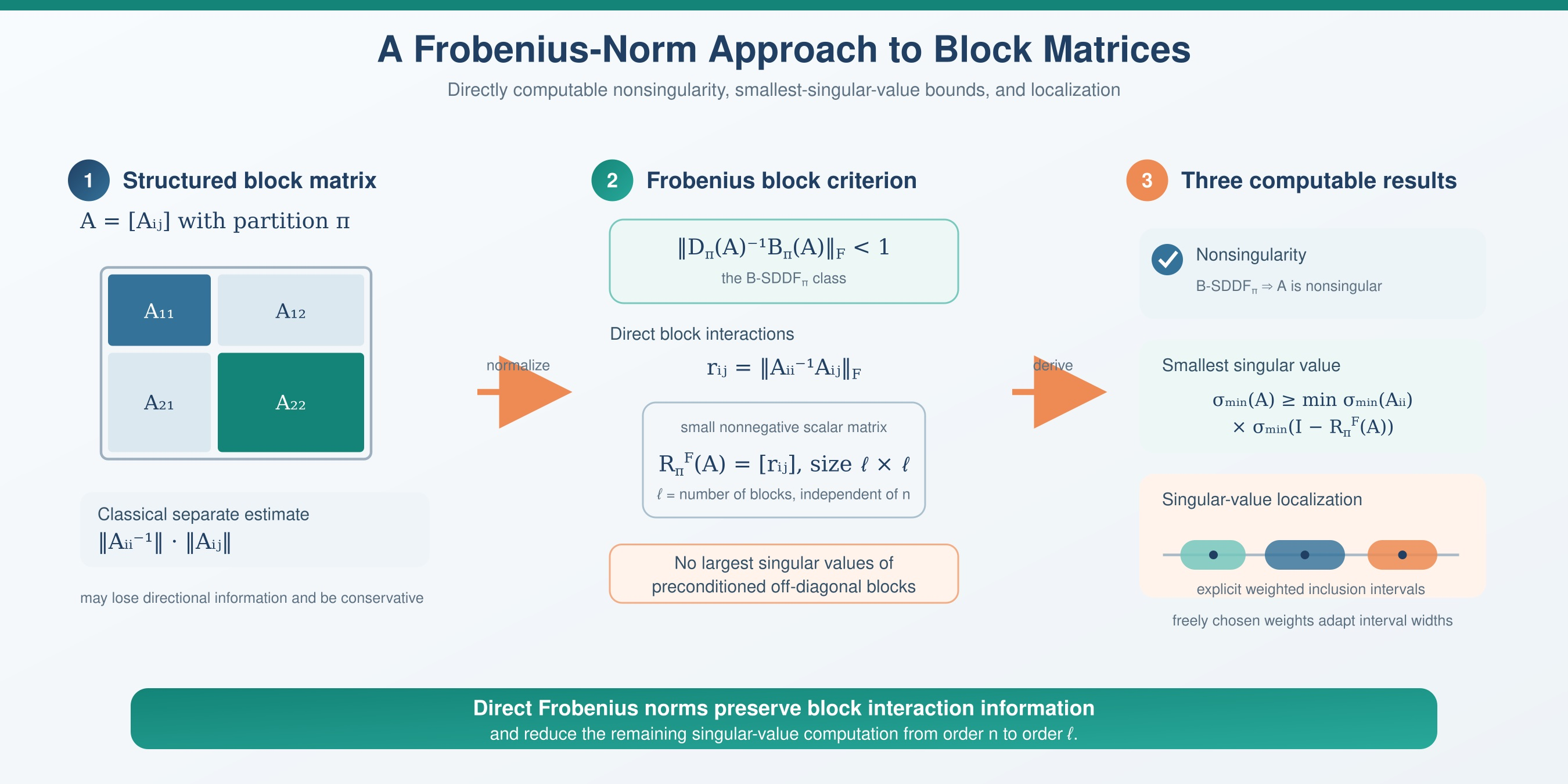
We introduce a Frobenius-norm-based class of block matrices in which the interaction between diagonal and off-diagonal blocks is measured directly through the preconditioned blocks A i i − 1 A i j . The resulting B- S D D F π class provides a directly computable sufficient condition for nonsingularity and is shown to be contained in the Robert-type block H-matrix class associated with the spectral norm. Its main computational advantage is that the Frobenius norms of the preconditioned off-diagonal blocks can be evaluated without computing their largest singular values. Using the associated block normalization, we derive a lower bound for the smallest singular value in terms of a scalar matrix whose order is equal to the number of blocks and is therefore independent of the order of the original matrix. We also apply the proposed nonsingularity criterion to a block representation of the Hermitian dilation and obtain a Frobenius-type singular-value localization condition together with a family of explicit inclusion intervals depending on freely chosen weights. Numerical experiments illustrate the sharpness and scalability of the proposed bounds, quantify the trade-off with the Robert-type criterion, and demonstrate the effect of different choices of weights on the localization intervals.

Graphical Abstract

1. Introduction

Block matrix techniques play an important role in the analysis of large structured linear systems, where exploiting a prescribed partition may provide substantially more information than treating the matrix entrywise. Classical approaches based on block diagonal dominance and block comparison matrices extend several fundamental properties of diagonally dominant and H-matrices to partitioned matrices. Such techniques have been successfully used to establish nonsingularity criteria, estimates for the norm of the inverse, and lower bounds for the smallest singular value [1,2,3]. More recent practical criteria for block H-matrices, together with corresponding eigenvalue estimates, were obtained in [4].
Lower bounds for the smallest singular value have also been extensively studied using diagonal dominance, matrix norms, and Geršgorin-type techniques [5,6,7,8]. More recent lower bounds for the smallest singular value, based on permutation and entrywise matrix information, were derived in [9,10]. However, these approaches are not block-based and do not use the Frobenius norm in the block-normalized manner considered here.
Related Geršgorin-type and other inclusion sets for singular values have been developed in [11,12,13].
A common feature of several classical block comparison techniques is that the interaction between diagonal and off-diagonal blocks is estimated by quantities involving their norms separately. In particular, estimates of the form
∥ A i i − 1 ∥ ∥ A i j ∥
naturally arise [1,3]. Although convenient, this separation may result in a substantial loss of information. Indeed, it does not take into account the directions in which the off-diagonal block A i j acts relative to the singular-vector structure of the diagonal block A i i . Consequently, the quantity ∥ A i i − 1 A i j ∥ may be considerably smaller than ∥ A i i − 1 ∥ ∥ A i j ∥ . This difference can be particularly pronounced when the singular values of A i i are widely separated and the range of A i j is concentrated in directions corresponding to the smaller action of A i i − 1 .
Motivated by this observation, we introduce a Frobenius-norm-based class of block matrices in which the off-diagonal interactions are measured directly after block diagonal normalization. More precisely, for a prescribed block partition and the splitting
A = D − B ,
where D denotes the block diagonal part of A, we consider the condition
∥ D − 1 B ∥ F < 1 .
For a scalar partition, this condition reduces to the Frobenius-type strict diagonal dominance condition introduced in [14]. For a nontrivial block partition, however, it involves the matrices A i i − 1 A i j directly and hence retains information which may be lost when the corresponding factors are estimated separately. At the same time, the use of the Frobenius norm makes these quantities directly computable, without requiring the computation of the largest singular value of each preconditioned off-diagonal block.
We first investigate basic properties of the resulting block matrix class and its relation to existing block diagonal dominance and block H-matrix concepts. We then use the associated block normalization to derive lower bounds for the smallest singular value. In particular, the resulting estimates are designed to remain effective in situations where block comparison estimates based on separate-factor bounds are overly conservative. Finally, we illustrate how the proposed block criterion can be used for singular-value localization by applying it to a suitable block representation of the standard Hermitian dilation. This leads to a Frobenius-type localization condition which can also be obtained from Kolotilina’s auxiliary matrix, and further allows us to derive a family of explicit singular-value inclusion intervals.
The novelty lies not in the elementary nonsingularity argument itself, but in applying the Frobenius norm directly to the complete block-diagonally normalized off-diagonal part. Unlike the induced block norms used in the Robert-type framework, this yields a global, readily computable criterion and leads to the reduced-order smallest-singular-value bound in Theorem 2. The localization condition in Theorem 3 can alternatively be recovered from Kolotilina’s auxiliary matrix, as stated in Remark 2; our further contribution in this part is the derivation of the explicit weighted inclusion intervals. The present construction is also essentially different from that in [15]. There, the matrix is first normalized by its ordinary diagonal part, and a partition is subsequently imposed on the normalized matrix. Here, the partition is introduced directly in the original matrix, and the off-diagonal interactions are normalized with respect to the corresponding diagonal blocks. Thus, except for the scalar partition, the two constructions do not coincide.
The paper is organized as follows. Section 2 introduces the B- S D D F π matrix class, establishes its basic nonsingularity property, and discusses its relation to existing block H-matrix concepts. In Section 3, lower bounds for the smallest singular value are derived using the associated block normalization. Section 4 applies the proposed criterion to singular-value localization and derives explicit inclusion intervals. Numerical examples illustrating the obtained bounds and localization results are presented in Section 5. Finally, Section 6 contains concluding remarks.

2. A Frobenius-Type Block Matrix Class

Let A = [ A i j ] i , j = 1 ℓ ∈ C n × n be partitioned according to π = ( n 1 , … , n ℓ ) , ∑ i = 1 ℓ n i = n , where A i j ∈ C n i × n j . Throughout this section, we assume that all diagonal blocks A i i are nonsingular. Denote by
D π ( A ) = diag ( A 11 , … , A ℓ ℓ )
the block diagonal part of A, and set
B π ( A ) = D π ( A ) − A .
We introduce the following block counterpart of Frobenius-type strict diagonal dominance.
Definition 1. 
A matrix A, partitioned according to π, is said to be block strictly diagonally dominant in the Frobenius sense, abbreviated B- S D D F π , if
∥ D π ( A ) − 1 B π ( A ) ∥ F < 1 .
Since
D π ( A ) − 1 B π ( A ) = 0 − A 11 − 1 A 12 ⋯ − A 11 − 1 A 1 ℓ − A 22 − 1 A 21 0 ⋯ − A 22 − 1 A 2 ℓ ⋮ ⋮ ⋱ ⋮ − A ℓ ℓ − 1 A ℓ 1 − A ℓ ℓ − 1 A ℓ 2 ⋯ 0 ,
the definition admits the following equivalent form.
Proposition 1. 
A matrix A is a B- S D D F π matrix if and only if
∑ i = 1 ℓ ∑ j = 1 j ≠ i ℓ ∥ A i i − 1 A i j ∥ F 2 < 1 .
Proof. 
The assertion follows immediately from the block additivity of the squared Frobenius norm:
∥ D π ( A ) − 1 B π ( A ) ∥ F 2 = ∑ i = 1 ℓ ∑ j = 1 j ≠ i ℓ ∥ A i i − 1 A i j ∥ F 2 .
□
Associated with matrix A and the partition π , define the nonnegative ℓ × ℓ matrix R F π ( A ) = [ r i j ] i , j = 1 ℓ by
r i i = 0 , r i j = ∥ A i i − 1 A i j ∥ F , i ≠ j .
By construction,
∥ R F π ( A ) ∥ F = ∥ D π ( A ) − 1 B π ( A ) ∥ F ,
and consequently,
A is a B - SD D F π matrix ⟺ ∥ R F π ( A ) ∥ F < 1 .
Thus,
A is a B - SD D F π matrix ⟺ I − R F π ( A ) is an S D D F matrix .
For the scalar partition, the proposed class reduces to the S D D F class introduced in [14]: a matrix M is called strictly diagonally dominant in the Frobenius sense ( S D D F ) if
∥ D − 1 B ∥ F < 1 ,
where M = D − B is the standard splitting of M into its diagonal and off-diagonal parts.
It is important to emphasize that this definition is not a special case of the Robert-type block construction. The latter is based on block matrix norms induced by the corresponding vector norms. In contrast, the Frobenius norm is not an induced matrix norm when the block order is greater than one. Consequently, the nonsingularity of the B- S D D F π class must be established independently. Its subsequent inclusion in the Robert-type class associated with the Euclidean vector norm follows from ∥ M ∥ 2 ≤ ∥ M ∥ F , but this inclusion does not reduce the proposed definition to an existing induced-norm construction.
The first basic property of the new class is its nonsingularity.
Theorem 1. 
If A is a B- SD D F π matrix, then A is nonsingular.
Proof. 
Since
A = D π ( A ) I − D π ( A ) − 1 B π ( A ) ,
it is sufficient to prove that
I − D π ( A ) − 1 B π ( A )
is nonsingular. By Definition 1, ∥ D π ( A ) − 1 B π ( A ) ∥ F < 1 , therefore,
ρ D π ( A ) − 1 B π ( A ) ≤ ∥ D π ( A ) − 1 B π ( A ) ∥ 2 ≤ ∥ D π ( A ) − 1 B π ( A ) ∥ F < 1 ,
and I − D π ( A ) − 1 B π ( A ) is nonsingular. Since all diagonal blocks A i i are nonsingular, D π ( A ) is nonsingular as well, and the result follows. □
The definition of B- S D D F π matrices is based on the norms of the preconditioned off-diagonal blocks A i i − 1 A i j . A first indication of the potential advantage of this approach follows from the standard inequality
∥ A i i − 1 A i j ∥ F ≤ ∥ A i i − 1 ∥ 2 ∥ A i j ∥ F , i ≠ j .
Consequently,
∑ i = 1 ℓ ∑ j = 1 j ≠ i ℓ ∥ A i i − 1 A i j ∥ F 2 ≤ ∑ i = 1 ℓ ∑ j = 1 j ≠ i ℓ ∥ A i i − 1 ∥ 2 2 ∥ A i j ∥ F 2 .
Thus, estimating the two factors separately provides a sufficient condition for membership in B- S D D F π , but the converse need not hold.
The difference between the two sides of (1) can be substantial. This occurs, in particular, when the off-diagonal block A i j acts mainly in directions in which A i i − 1 has a relatively small action. The following example illustrates this phenomenon.
Example 1. 
Consider the matrix
A = A 11 A 12 A 21 A 22 ,
partitioned according to π = ( 2 , 2 ) , where
A 11 = 0.1 0 0 10 , A 22 = 10 0 0 0.1 , A 12 = 0 0 1 0 , A 21 = 0 1 0 0 .
Since
A 11 − 1 = 10 0 0 0.1 , A 22 − 1 = 0.1 0 0 10 ,
we obtain
A 11 − 1 A 12 = 0 0 0.1 0 , A 22 − 1 A 21 = 0 0.1 0 0 .
Hence
∥ A 11 − 1 A 12 ∥ F = ∥ A 22 − 1 A 21 ∥ F = 0.1 ,
and therefore
∑ i = 1 2 ∑ j = 1 j ≠ i 2 ∥ A i i − 1 A i j ∥ F 2 = 2 ( 0.1 ) 2 = 0.02 < 1 .
Thus, A is a B- S D D F π matrix.
On the other hand,
∥ A 11 − 1 ∥ 2 = ∥ A 22 − 1 ∥ 2 = 10 , ∥ A 12 ∥ F = ∥ A 21 ∥ F = 1 ,
so that
∥ A 11 − 1 ∥ 2 ∥ A 12 ∥ F = ∥ A 22 − 1 ∥ 2 ∥ A 21 ∥ F = 10 .
Consequently,
∑ i = 1 2 ∑ j = 1 j ≠ i 2 ∥ A i i − 1 ∥ 2 2 ∥ A i j ∥ F 2 = 200 .
This example shows that estimating the interaction between the diagonal and off-diagonal blocks by the product of their separate norms may be extremely conservative. In the present case, each directly normalized interaction has Frobenius norm 0.1, whereas the corresponding separate-factor estimate is equal to 10.
Remark 1. 
The class B- S D D F π can be related to the Robert-type block H-matrix class [1]. Indeed, let
R 2 π ( A ) = [ s i j ] i , j = 1 ℓ , s i i = 0 , s i j = ∥ A i i − 1 A i j ∥ 2 , i ≠ j .
Since
∥ A i i − 1 A i j ∥ 2 ≤ ∥ A i i − 1 A i j ∥ F ,
we have
0 ≤ R 2 π ( A ) ≤ R F π ( A )
entrywise. Hence, if A is a B- S D D F π matrix, then
ρ ( R 2 π ( A ) ) ≤ ρ ( R F π ( A ) ) ≤ ∥ R F π ( A ) ∥ 2 ≤ ∥ R F π ( A ) ∥ F < 1 .
Consequently, I − R 2 π ( A ) is a nonsingular M-matrix, and therefore A belongs to the Robert-type block H-matrix class associated with the spectral norm. Thus, B- S D D F π provides a directly computable sufficient condition for membership in this block H-matrix class. Although the Frobenius-norm condition is more restrictive, its advantage is that the quantities ∥ A i i − 1 A i j ∥ F can be evaluated without computing the largest singular value of each preconditioned off-diagonal block.
The B- S D D F π condition depends on the chosen partition, and there is no general monotonicity with respect to partition refinement. A coarser partition incorporates more interactions into the diagonal blocks and may therefore reduce the normalized off-diagonal coupling, but it requires solves with larger diagonal blocks. Conversely, a finer partition reduces the cost of the block solves, although it need not produce a sharper criterion. In applications, the partition should therefore reflect the natural structure of the matrix, while several admissible partitions may be compared when such a structure is not prescribed.

3. Lower Bounds for the Smallest Singular Value

The Frobenius-type block normalization introduced in the previous section can also be used to derive a lower bound for the smallest singular value. We first consider the block diagonally normalized matrix
C = D π ( A ) − 1 A .
Its diagonal blocks are identity matrices, while
C i j = A i i − 1 A i j , i ≠ j .
Theorem 2. 
Let A be a B- S D D F π matrix. Then
σ min D π ( A ) − 1 A ≥ σ min I − R F π ( A ) .
Consequently,
σ min ( A ) ≥ min 1 ≤ i ≤ ℓ σ min ( A i i ) σ min I − R F π ( A ) .
Proof. 
Partition vectors x and y = C x conformally with π :
x = [ x 1 T , … , x ℓ T ] T , y = [ y 1 T , … , y ℓ T ] T .
Since
y i = x i + ∑ j = 1 j ≠ i ℓ A i i − 1 A i j x j ,
the triangle inequality gives
∥ y i ∥ 2 ≥ ∥ x i ∥ 2 − ∑ j = 1 j ≠ i ℓ ∥ A i i − 1 A i j x j ∥ 2 .
Using
∥ A i i − 1 A i j x j ∥ 2 ≤ ∥ A i i − 1 A i j ∥ 2 ∥ x j ∥ 2 ≤ ∥ A i i − 1 A i j ∥ F ∥ x j ∥ 2 ,
we obtain
∥ y i ∥ 2 ≥ ∥ x i ∥ 2 − ∑ j = 1 j ≠ i ℓ r i j ∥ x j ∥ 2 .
With u : = [ ∥ x 1 ∥ 2 , … , ∥ x ℓ ∥ 2 ] T and v : = [ ∥ y 1 ∥ 2 , … , ∥ y ℓ ∥ 2 ] T , (4) can be rewritten as
v ≥ I − R F π ( A ) u .
Since A is a B- S D D F π matrix,
ρ ( R F π ( A ) ) ≤ ∥ R F π ( A ) ∥ 2 ≤ ∥ R F π ( A ) ∥ F < 1 .
Hence I − R F π ( A ) is a nonsingular M-matrix and I − R F π ( A ) − 1 ≥ 0 . It follows from (5) that
u ≤ I − R F π ( A ) − 1 v .
Therefore,
∥ u ∥ 2 ≤ ∥ I − R F π ( A ) − 1 ∥ 2 ∥ v ∥ 2 .
By the definition of u and v,
∥ u ∥ 2 = ∥ x ∥ 2 , ∥ v ∥ 2 = ∥ y ∥ 2 ,
and hence
∥ x ∥ 2 ≤ ∥ I − R F π ( A ) − 1 ∥ 2 ∥ C x ∥ 2 .
Thus,
σ min ( C ) = min x ≠ 0 ∥ C x ∥ 2 ∥ x ∥ 2 ≥ 1 ∥ I − R F π ( A ) − 1 ∥ 2 = σ min I − R F π ( A ) ,
which proves (2). Finally, since A = D π ( A ) C , we have
σ min ( A ) ≥ σ min ( D π ( A ) ) σ min ( C ) = min 1 ≤ i ≤ ℓ σ min ( A i i ) σ min ( C ) ,
which proves inequality (3). □
It is worth emphasizing that the matrix I − R F π ( A ) appearing in the bound is of order ℓ, independently of the order n of the original matrix A. Thus, once the Frobenius norms ∥ A i i − 1 A i j ∥ F have been evaluated, the computation of σ min ( I − R F π ( A ) ) requires a singular value computation only for an ℓ × ℓ matrix. In particular, no singular value computations are required for the preconditioned off-diagonal blocks A i i − 1 A i j . For the normalized matrix D π ( A ) − 1 A , therefore, the bound avoids singular value computations involving the individual blocks.

4. Application to Singular Value Localization

We now apply the B- S D D F π nonsingularity criterion to the standard Hermitian matrix associated with the singular values of A. Recall that, for σ ≥ 0 ,
H σ ( A ) = σ I A A * σ I
is singular if and only if σ is a singular value of A [12].
Instead of considering the natural n + n block partition of H σ ( A ) , we permute its rows and columns simultaneously so that the coordinates corresponding to the ith components of the two n-dimensional blocks are paired. The resulting matrix is partitioned into n × n blocks of order 2, with diagonal blocks
H i i ( σ ) = σ a i i a i i ¯ σ
and off-diagonal blocks
H i j = 0 a i j a j i ¯ 0 , i ≠ j .
This simultaneous permutation groups the ith coordinate of the first copy of C n with the ith coordinate of the second copy. It therefore induces the block partition
π ^ = ( 2 , … , 2 )
of the 2 n × 2 n matrix H σ ( A ) into n × n blocks of order 2. The hat distinguishes this partition from the general partition π = ( n 1 , … , n ℓ ) used in the preceding sections.
Theorem 3. 
Let A = [ a i j ] ∈ C n × n and define
r i , 2 2 = ∑ j = 1 j ≠ i n | a i j | 2 , c i , 2 2 = ∑ j = 1 j ≠ i n | a j i | 2 , i = 1 , 2 , … , n .
Thus, r i , 2 and c i , 2 are the Euclidean norms of the off-diagonal parts of the ith row and the ith column of A, respectively. Then every singular value σ of A either satisfies σ = | a i i | for some i, or
∑ i = 1 n σ 2 + | a i i | 2 r i , 2 2 + c i , 2 2 | σ 2 − | a i i | 2 | 2 ≥ 1 .
Proof. 
Let σ be a singular value of A. Then H σ ( A ) , as well as its permuted version, is singular. Obviously, it is sufficient to consider the case
σ ≠ | a i i | , i = 1 , … , n .
Then every diagonal block H i i ( σ ) is nonsingular and
H i i ( σ ) − 1 = 1 σ 2 − | a i i | 2 σ − a i i − a i i ¯ σ .
Hence, for i ≠ j ,
H i i ( σ ) − 1 H i j = 1 σ 2 − | a i i | 2 − a i i a j i ¯ σ a i j σ a j i ¯ − a i i ¯ a i j .
Therefore,
∥ H i i ( σ ) − 1 H i j ∥ F 2 = ( σ 2 + | a i i | 2 ) | a i j | 2 + | a j i | 2 | σ 2 − | a i i | 2 | 2 .
If
∑ i = 1 n ∑ j = 1 j ≠ i n ∥ H i i ( σ ) − 1 H i j ∥ F 2 < 1 ,
then the permuted matrix H σ ( A ) would be a B- S D D F π ^ matrix and hence, by Theorem 1, nonsingular. This contradicts the fact that σ is a singular value of A. Consequently,
∑ i = 1 n ∑ j = 1 j ≠ i n ( σ 2 + | a i i | 2 ) | a i j | 2 + | a j i | 2 | σ 2 − | a i i | 2 | 2 = ∑ i = 1 n ( σ 2 + | a i i | 2 ) r i , 2 2 + c i , 2 2 | σ 2 − | a i i | 2 | 2 ≥ 1 .
□
Remark 2. 
The localization condition in Theorem 3 can also be obtained by applying the scalar S D D F nonsingularity criterion to Kolotilina’s auxiliary matrix [12]
C ( σ , A ) = σ 2 I n − | D | 2 0 0 σ 2 I n − | D | 2 + D B H σ B σ B H D H B , A = D − B , D = diag ( A ) .
Thus, the same singular-value inclusion condition arises from two different nonsingularity frameworks: from the scalar Frobenius criterion applied to C ( σ , A ) , and from the block Frobenius criterion applied to the permuted Hermitian matrix H σ ( A ) .
Corollary 1. 
Let p i > 0 , i = 1 , … , n , be such that ∑ i = 1 n p i = 1 . Then all singular values of A are contained in
⋃ i = 1 n max { 0 , t i − } , t i + ,
where
t i ± = | a i i | 2 + r i , 2 2 + c i , 2 2 2 p i ± 1 2 ( r i , 2 2 + c i , 2 2 ) 2 p i 2 + 8 | a i i | 2 ( r i , 2 2 + c i , 2 2 ) p i .
Proof. 
Let σ be a singular value of A such that σ ≠ | a i i | , i = 1 , … , n . By Theorem 3,
∑ i = 1 n ( σ 2 + | a i i | 2 ) ( r i , 2 2 + c i , 2 2 ) | σ 2 − | a i i | 2 | 2 ≥ 1 .
Since ∑ i = 1 n p i = 1 , there exists at least one index i such that
( σ 2 + | a i i | 2 ) ( r i , 2 2 + c i , 2 2 ) | σ 2 − | a i i | 2 | 2 ≥ p i .
Hence
σ 2 − | a i i | 2 2 ≤ r i , 2 2 + c i , 2 2 p i σ 2 + | a i i | 2 .
Solving this quadratic inequality with respect to σ 2 gives
t i − ≤ σ 2 ≤ t i +
for at least one i, where t i ± are defined above. Therefore
σ ∈ ⋃ i = 1 n max { 0 , t i − } , t i + .
If σ = | a i i | for some i, then it belongs to the corresponding interval as well, because
t i − ≤ | a i i | 2 + r i , 2 2 + c i , 2 2 2 p i − 1 2 r i , 2 2 + c i , 2 2 p i = | a i i | 2 ≤ t i + .
□
Remark 3. 
The choice of the weights p i may be adapted to the matrix A. For example, provided that
r i , 2 2 + c i , 2 2 > 0 , i = 1 , … , n ,
taking
p i = r i , 2 2 + c i , 2 2 ∑ k = 1 n ( r k , 2 2 + c k , 2 2 )
leads to
r i , 2 2 + c i , 2 2 p i = ∑ k = 1 n ( r k , 2 2 + c k , 2 2 ) ,
whereas the choice p i = 1 / n yields
r i , 2 2 + c i , 2 2 p i = n ( r i , 2 2 + c i , 2 2 ) .
Neither choice is uniformly better in general.

5. Numerical Examples

We illustrate the two main types of estimates developed above. The first example concerns the lower bound for the smallest singular value, while the second one illustrates the singular-value localization result and the influence of the choice of the weights in Corollary 1.
Example 2. 
Consider the same matrix as in Example 1.
A = 0.1 0 0 0 0 10 1 0 0 1 10 0 0 0 0 0.1 ,
with the partition π = ( 2 , 2 ) . The corresponding blocks are
A 11 = 0.1 0 0 10 , A 22 = 10 0 0 0.1 , A 12 = 0 0 1 0 , A 21 = 0 1 0 0 .
Since
A 11 − 1 A 12 = 0 0 0.1 0 , A 22 − 1 A 21 = 0 0.1 0 0 ,
we have
R F π ( A ) = 0 0.1 0.1 0 .
Therefore, ∥ R F π ( A ) ∥ F = 0.02 < 1 , and hence A is a B- S D D F π matrix. Moreover,
I − R F π ( A ) = 1 − 0.1 − 0.1 1 ,
so that σ min I − R F π ( A ) = 0.9 . The first estimate in Theorem 2 therefore gives
σ min D π ( A ) − 1 A ≥ 0.9 .
In fact, direct computation gives σ min D π ( A ) − 1 A = 0.9 , and hence the estimate is attained. Since min { σ min ( A 11 ) , σ min ( A 22 ) } = 0.1 , the second estimate in Theorem 2 yields
σ min ( A ) ≥ 0.1 · 0.9 = 0.09 .
On the other hand, the singular values of A are 11 , 9 , 0.1 , 0.1 , and consequently
σ min ( A ) = 0.1 .
Thus, the lower bound gives 0.09 compared with the exact value 0.1 . This example also shows that the estimate for the block-diagonally preconditioned matrix may be sharp.
Example 3. 
Consider
A = 2 0.1 0 0 0.05 1.5 0.08 0 0 0.06 1.2 0.09 0 0 0.05 0.8 .
Its singular values, arranged in decreasing order, are approximately 2.0113 , 1.5053 , 1.1961 , 0.7881 . For this matrix,
r 1 , 2 2 + c 1 , 2 2 = 0.0125 , r 2 , 2 2 + c 2 , 2 2 = 0.0225 , r 3 , 2 2 + c 3 , 2 2 = 0.0206 , r 4 , 2 2 + c 4 , 2 2 = 0.0106 ,
and therefore
∑ k = 1 4 r k , 2 2 + c k , 2 2 = 0.0662 .
We first choose
p i = r i , 2 2 + c i , 2 2 ∑ k = 1 4 r k , 2 2 + c k , 2 2 , i = 1 , … , 4 .
Then
r i , 2 2 + c i , 2 2 p i = 0.0662 , i = 1 , … , 4 ,
and Corollary 1 gives the intervals
[ 1.8179 , 2.1821 ] , [ 1.3177 , 1.6822 ] , [ 1.0175 , 1.3824 ] , [ 0.6165 , 0.9829 ] .
Each singular value of A belongs to the corresponding interval.
For comparison, consider the uniform choice
p i = 1 4 , i = 1 , … , 4 .
In this case,
r i , 2 2 + c i , 2 2 p i = 4 ( r i , 2 2 + c i , 2 2 ) ,
and the resulting intervals are
[ 1.8418 , 2.1582 ] , [ 1.2873 , 1.7126 ] , [ 0.9961 , 1.4036 ] , [ 0.6537 , 0.9461 ] .
The results are summarized in Table 1.
The example illustrates that the freedom in choosing the weights p i is not merely formal. The uniform choice produces narrower intervals for the first and fourth singular values, whereas the choice proportional to r i , 2 2 + c i , 2 2 gives narrower intervals for the second and third ones. Thus, neither of these two choices is uniformly superior.

5.1. A Large Structured Block Example

We next consider a family of large block matrices for which the bound in Theorem 2 is attained. Let ℓ = 4 , let m be a positive integer, and define
u = 1 m [ 1 , … , 1 ] T ∈ R m , P = u u T .
For 0 < t < 1 / 6 , consider the block tridiagonal matrix
A m ( t ) = I m − t P 0 0 − t P I m − t P 0 0 − t P I m − t P 0 0 − t P I m
with the natural partition π = ( m , m , m , m ) . Since P is a rank-one orthogonal projector, ∥ P ∥ F = ∥ P ∥ 2 = 1 . Consequently,
R F π ( A m ( t ) ) = t 0 1 0 0 1 0 1 0 0 1 0 1 0 0 1 0 , ∥ R F π ( A m ( t ) ) ∥ F = t 6 < 1 .
Thus, A m ( t ) is a B- S D D F π matrix. To determine its smallest singular value, observe that P = u u T acts as the identity on the one-dimensional space spanned by u and vanishes on its orthogonal complement. Consequently, on the components parallel to u in the four diagonal blocks, the action of A m ( t ) is described by the 4 × 4 matrix I − R F π ( A m ( t ) ) , whereas all components orthogonal to u remain unchanged. Therefore, the singular values of A m ( t ) consist of the singular values of I − R F π ( A m ( t ) ) , together with additional singular values equal to 1. Since
σ min I − R F π ( A m ( t ) ) = 1 − 2 t cos π 5 < 1 ,
we obtain
σ min A m ( t ) = σ min I − R F π ( A m ( t ) ) = 1 − 2 t cos π 5 .
Hence, the bound in Theorem 2 is attained for every block size m, while the order of the reduced matrix remains equal to four. For t = 0.4 , the exact smallest singular value and the bound from Theorem 2 are both
1 − 2 t cos π 5 = 0.3527864045 .
For every scalar row of A m ( t ) , the off-diagonal row and column sums coincide. Their largest value, attained in the two interior block rows, is 2 t . Consequently, the scalar lower bounds of Varah [5], Qi [6], and Johnson [7] all reduce in this example to
σ min ( A m ( t ) ) ≥ 1 − 2 t = 0.2 .
Thus, the proposed block bound is exact and is strictly sharper than all three scalar estimates for every m. Table 2 reports single-threaded computation times for several values of m. The timings are machine dependent and are included only to illustrate the growth of the full singular-value computation relative to the fixed-order reduced problem.

5.2. Frequency of Successful Frobenius and Robert Tests

To quantify the increased restrictiveness of the Frobenius condition, we generated 1000 structured random block matrices. All computations were performed in Python 3.13.15 using NumPy 2.5.3 and SciPy 1.18.1, Apple M1. Random numbers were generated by the NumPy PCG64 generator with the fixed seed 20260914. Each matrix consisted of six diagonal identity blocks of order 30. For every ordered pair i ≠ j , the normalized off-diagonal interaction was generated in the form C i j = X i j Y i j T , where X i j , Y i j ∈ R 30 × 2 had independent standard normal entries. For each realization, the matrix R F π = [ ∥ C i j ∥ F ] was normalized to have Frobenius norm one. All off-diagonal interactions were then multiplied by the same random parameter γ , generated independently from the uniform distribution on [ 0 , 1.5 ) . The Frobenius condition
γ ∥ R F π ∥ F = γ < 1
was compared with the Robert-type condition
γ ρ ( R 2 π ) < 1 , R 2 π = [ ∥ C i j ∥ 2 ] .
The Frobenius condition was satisfied in 664 of the 1000 realizations, whereas the Robert-type condition was satisfied in 908 realizations. All 664 matrices recognized by the Frobenius condition were also recognized by the Robert-type condition, while the latter additionally recognized 244 matrices. The remaining 92 matrices satisfied neither condition. These results agree with the theoretical inclusion of the B- S D D F π class in the Robert-type block H-matrix class and quantify the corresponding trade-off: the Frobenius criterion is more restrictive, but it avoids the singular-value computations required for the spectral block comparison matrix.

5.3. Computational-Time Comparison

To complement the operation-count comparison, we also measured the computational time required by the Frobenius-norm and Robert-type criteria. Both criteria require the same preliminary computations, namely, solving the block systems
A i i C i j = A i j , i ≠ j ,
and differ only in the subsequent evaluation of the norms of the matrices C i j . We therefore report separately the time required for the common block solves and the times required to compute all Frobenius and spectral norms. The experiment was performed for matrices partitioned into six blocks of equal order m. Each diagonal block was generated as
A i i = Q i diag linspace ( 1 , 2 , m ) Q i T ,
where Q i was obtained from the QR factorization of a matrix with independent standard Gaussian entries. The off-diagonal blocks had independent standard Gaussian entries scaled by 1 / m . All random matrices were generated using NumPy’s PCG64 generator with the fixed seed 20260915. The computations were performed in Python 3.13.15 using NumPy 2.5.3 and SciPy 1.18.1 on an Apple M1 processor, with a single BLAS thread. The reported values are medians over five runs for m = 25 , 50 , three runs for m = 100 , and two runs for m = 200 .
The results presented in Table 3 confirm the difference predicted by the operation counts. The cost of evaluating the Frobenius norms remains negligible compared with the common block solves, whereas the computation of the spectral norms becomes increasingly expensive as the block order grows. For m = 200 , the spectral-norm evaluations are approximately 178 times slower than the corresponding Frobenius-norm evaluations. Even when the common block solves are included, the complete Robert-type test is more than twice as expensive as the proposed Frobenius-norm test.
More generally, the matrix operations involved in block-matrix computations may also benefit from fast matrix multiplication algorithms; for a recent practically oriented contribution and correction of the underlying formulas, see [16].

6. Conclusions

In this paper, we introduced the B- S D D F π class of block matrices, defined by applying the Frobenius norm directly to the block-diagonally preconditioned off-diagonal part of a matrix. The resulting condition provides a simple sufficient criterion for nonsingularity and retains information contained in the products A i i − 1 A i j that may be lost when the diagonal and off-diagonal blocks are estimated separately. Although the proposed class is more restrictive than the Robert-type block H-matrix class associated with the spectral norm, it has the computational advantage of avoiding the computation of the largest singular value of every preconditioned off-diagonal block.
The same block normalization leads to a lower bound for the smallest singular value of the original matrix. In particular, the estimate for the normalized matrix involves the smallest singular value of the scalar matrix I − R F π ( A ) , whose order is determined only by the number of blocks. Thus, after the required Frobenius norms have been evaluated, the remaining singular value computation is performed on a matrix of order ℓ rather than on the individual matrix blocks.
The numerical results further support the practical relevance of the proposed approach. For a scalable structured block family, the reduced-order bound is attained independently of the block size and is strictly sharper than the corresponding scalar bounds of Varah, Qi, and Johnson. A reproducible experiment on random block matrices quantifies the expected trade-off with the Robert-type criterion: the Frobenius condition is more restrictive, but requires only Frobenius norms of the preconditioned blocks. The computational-time comparison confirms that this distinction becomes increasingly relevant as the block size grows, since the spectral-norm evaluations required by the Robert-type criterion become substantially more expensive.
Finally, the block Frobenius criterion was applied to a permuted Hermitian dilation, yielding a localization condition for the complete singular-value spectrum. The resulting condition also admits an alternative derivation through the scalar S D D F criterion applied to Kolotilina’s auxiliary matrix. Its weighted formulation leads to a family of explicit inclusion intervals, with the freedom in the choice of the weights allowing the localization to be adapted to the distribution of the off-diagonal entries. The numerical results confirm that different choices of weights may improve different parts of the singular-value localization, so that no single choice is uniformly preferable.
Overall, the results show that Frobenius-norm-based block criteria provide a useful compromise between the strength of block comparison conditions and their direct computational accessibility. In particular, they can be attractive for large structured problems with a moderate number of blocks, where the reduced-order estimates remain inexpensive while singular-value computations on the individual blocks become increasingly costly.

Author Contributions

Conceptualization, D.C.; methodology, K.D. and I.P.; formal analysis, D.C., K.D. and I.P.; resources, D.C.; writing-original draft preparation, D.C.; writing-review and editing, D.C., K.D. and I.P. All authors have read and agreed to the published version of the manuscript.

Funding

This research was funded by the Provincial Secretariat for Higher Education and Scientific Research of Vojvodina (Research Grants 003870631 2025 09418 003 000 000 001 04 004 and 003870560 2025 09418 003 000 000 001 04 004).

Data Availability Statement

The original contributions presented in the study are included in the article. Further inquiries can be directed to the corresponding author.

Conflicts of Interest

The authors declare no conflicts of interest.

References

  1. Kolotilina, L.Y. On block generalizations of H -matrices. J. Math. Sci. 2017, 224, 926–936. [Google Scholar] [CrossRef] [Scilit]
  2. Zhang, W.; Han, Z.-Z. Bounds for the spectral radius of block H-matrices. Electron. J. Linear Algebra 2006, 15, 269–273. [Google Scholar] [CrossRef] [Scilit][Green Version]
  3. Cvetković, Lj.; Kostić, V.R.; Doroslovački, K.; Cvetković, D.Lj. Euclidean norm estimates of the inverse of some special block matrices. Appl. Math. Comput. 2016, 284, 12–23. [Google Scholar] [CrossRef] [Scilit]
  4. Gao, H.; Han, G.; Sun, Y.; Sun, F.; Ren, Y. Block H-matrices and spectrum of block matrices. J. Phys. Conf. Ser. 2020, 1575, 012114. [Google Scholar] [CrossRef] [Scilit]
  5. Varah, J.M. A lower bound for the smallest singular value of a matrix. Linear Algebra Appl. 1975, 11, 3–5. [Google Scholar] [CrossRef] [Scilit]
  6. Qi, L. Some simple estimates for singular values of a matrix. Linear Algebra Appl. 1984, 56, 105–119. [Google Scholar] [CrossRef] [Scilit]
  7. Johnson, C.R. A Gersgorin-type lower bound for the smallest singular value. Linear Algebra Appl. 1989, 112, 1–7. [Google Scholar] [CrossRef] [Scilit]
  8. Doroslovački, K.; Cvetković, Lj.; Šanca, E. A new lower bound for the smallest singular value. Filomat 2019, 33, 2711–2723. [Google Scholar] [CrossRef] [Scilit]
  9. Lin, M.; Xie, M. On some lower bounds for smallest singular value of matrices. Appl. Math. Lett. 2021, 121, 107411. [Google Scholar] [CrossRef] [Scilit]
  10. Shun, X. Two new lower bounds for the smallest singular value. J. Math. Inequal. 2022, 16, 63–68. [Google Scholar] [CrossRef] [Scilit]
  11. Li, H.-B.; Huang, T.-Z.; Li, H. Inclusion sets for singular values. Linear Algebra Appl. 2008, 428, 2220–2235. [Google Scholar] [CrossRef] [Scilit]
  12. Kolotilina, L.Y. Inclusion sets for the singular values of a square matrix. J. Math. Sci. 2009, 157, 701–714. [Google Scholar] [CrossRef] [Scilit]
  13. He, J.; Liu, Y.-M.; Tian, J.-K.; Ren, Z.-R. New inclusion sets for singular values. J. Inequal. Appl. 2017, 2017, 64. [Google Scholar] [CrossRef] [Scilit] [PubMed]
  14. Cvetković, D.; Vukelić, Đ.; Doroslovački, K. A new subclass of H-matrices with applications. Mathematics 2024, 12, 2322. [Google Scholar] [CrossRef] [Scilit]
  15. Cvetković, D.Lj.; Šanca, E. Dynamical system stability criteria based on the Frobenius norm. AppliedMath 2026, 6, 9. [Google Scholar] [CrossRef] [Scilit]
  16. Respondek, J.S. Correction of ‘J. Laderman, V. Pan, X.-H. Sha, On practical algorithms for accelerated matrix multiplication, Linear Algebra and its Applications, Vol. 162–164 (1992), pp. 557–588’. Linear Multilinear Algebra 2025, 73, 838–848. [Google Scholar] [CrossRef] [Scilit]

Table 1. Singular-value localization for two choices of the weights p i .
i σ i ( A ) p i = r i , 2 2 + c i , 2 2 ∑ k = 1 4 ( r k , 2 2 + c k , 2 2 ) p i = 1 / 4
12.0113 [ 1.8179 , 2.1821 ] [ 1.8418 , 2.1582 ]
21.5053 [ 1.3177 , 1.6822 ] [ 1.2873 , 1.7126 ]
31.1961 [ 1.0175 , 1.3824 ] [ 0.9961 , 1.4036 ]
40.7881 [ 0.6165 , 0.9829 ] [ 0.6537 , 0.9461 ]
Table 2. Full and reduced computations for the structured block family.
mn σ min ( A m ( 0.4 ) ) Full SVD (s)Reduced SVD (s)
502000.3527860.0022180.000013
1004000.3527860.0120910.000014
2008000.3527860.1054430.000054
40016000.3527861.0062650.000058
Table 3. Computational times, in seconds, for the common block solves and the norm evaluations. The last two columns compare the spectral- and Frobenius-norm computations and the corresponding total costs.
mBlock SolvesFrobenius NormsSpectral NormsNorm-Time RatioTotal-Time Ratio
25 5.7412 ×   10 − 4 4.2209 × 10 − 5 1.2647 × 10 − 3 30.02.98
50 1.3493 × 10 − 3 5.5417 × 10 − 5 3.9884 × 10 − 3 72.03.80
100 4.3970 × 10 − 3 1.2008 × 10 − 4 1.6343 × 10 − 2 136.14.59
200 1.5190 × 10 − 2 5.1504 × 10 − 4 9.1881 × 10 − 2 178.46.82
Disclaimer/Publisher’s Note: The statements, opinions and data contained in all publications are solely those of the individual author(s) and contributor(s) and not of MDPI and/or the editor(s). MDPI and/or the editor(s) disclaim responsibility for any injury to people or property resulting from any ideas, methods, instructions or products referred to in the content.